주요어: 스트레스 관련 장애, 심리적 스트레스, 간호사, 문헌분석
Address reprint requests to: Kim, Jong Kyung, Department of Nursing, Dankook University, San 29 Anseo-dong, Dongnam-gu, Cheonan 330-714, Korea. Tel: 82-41-550-3893, Fax: 82-41-559-7902, E-mail: [email protected]
투고일 2011년 12월 31일 / 수정일 2012년 2월 7일 / 게재확정일 2012년 2월 16일
A Literature Review of Compassion Fatigue in Nursing
Yang, Young Hee
1· Kim, Jong Kyung
21
Professor,
2Assistant Professor, Department of Nursing, Dankook University
Purpose: In this study the literature of compassion fatigue in nurses was reviewed in order to analyze the trends of overall research for level of fatigue, symptoms, and factors. Methods: For this study, five databases were searched using the key words ‘compassion fatigue’, ‘secondary traumatization’, ‘secondary traumatic stress’, and
‘vicarious traumatization’. Thirty-six papers were analyzed. Results: Most of the compassion fatigue research (86%) was conducted between 2006 and 2011 and the most frequent research approach was quantitative re- search with the ProQOL which was the most frequently used instrument in the studies. He research was conducted in pediatric, emergency & trauma, oncology, psychiatric, and hospice units with no consistent patterns of t compas- sion fatigue levels. Factors affecting compassion fatigue were personal factors such as age, education back- ground, work-related factors such as caring for trauma patients, work hours, psychological factors such as work stress, burnout, and support/coping factors such as organizational support, and coping resources. Conclusion:
Nurses’ compassion fatigue varied from low to high by nursing specialties. Many factors affected the compassion fatigue of nurses. In the future there is a need for study on Korean nurses, and identification of groups at risk for compassion fatigue. Furthermore there is a need to develop management programs on compassion fatigue in nurses, stress reduction and wellbeing.
Key Words: Stress disorders, post-traumatic, Stress, psychological, Nurses, Review literature as topic
INTRODUCTION
Stress can be defined as a dynamic interaction be- tween a person and the environment where certain en- vironmental tasks or situations are perceived as taxing, exceeding the person’s skills and abilities, or jeopardiz- ing his or her well-being (Lazarus & Folkman, 1984).
Occupational stress is common in nursing (McVicar, 2003). Nurses are continually exposed to stressful events in their day-to-day work and are at risk for the negative effects of stress. A potential consequence of such caring work has a negative and profound effect on nurses, and it is sometimes referred to as compassion fatigue or sec- ondary traumatic stress (Sabo, 2006).
Compassion fatigue is a phenomenon experienced by caregivers who work with traumatized clients (Figley, 2002). While Figley initially referred to the phenomena of compassion fatigue as ‘secondary traumatic stress dis- order,’ he later changed the name to compassion fati- gue (Figley, 1995). Joinson (1992) first used the term
compassion fatigue to describe a prevalent experience among professional caregivers such as nurses, physi- cians, ministers, and mental health counselors. If chron- ic stress continues, individuals may use ineffective cop- ing strategies to self-treat their emotional and physical pain with defensive or avoidant actions, and finally be- come apathetic, cynical, angry, or depressed (Joinson, 1992; Lazarus & Folkman, 1984).
The concept of vicarious traumatization was first in- troduced by McCann & Pearlman (1990), who provided a theoretical framework for understanding the complex and distressing effects of trauma work on therapists.
Compassion fatigue or vicarious traumatization has been
identified among individuals who, in the course of work-
ing with victims of traumatic events, themselves fall vic-
tim to secondary traumatic stress reactions brought on
by helping or wanting to help a traumatized person
(Figley, 1995). Figley (1995) stressed that compassion fa-
tigue, vicarious trauma, and secondary traumatic stress
are natural, predictable, treatable, and unpreventable
when working with suffering and traumatized patients.
Therefore, compassion fatigue has almost the same meaning as secondary trauma from clients at various setting.
The psychosocial and physiological symptoms of compassion fatigue are avoiding reminders of the trau- ma, heightened irritability, sleep disturbances, quick tem- per, sadness, withdrawal, and task avoidance (Figley, 2002).
Compassion fatigue has primarily been studied within the fields of psychotherapy and emergency medicine.
However, as the concept has recently been better de- fined and studied, the impact of compassion fatigue is now believed reach far into other populations who of- ten do counseling interventions with traumatized indi- viduals. The studies about compassion fatigue, have been done for health professionals in many countries includ- ing hospice personnel (Keidel, 2002), social workers (Simon, Pryce, Roff, & Klemmack, 2005), psychiatric (Sprang & Clark, 2007), and emergency professionals (Conrad, & Kellar-Guenther, 2006). However, there has been little research in the nursing field. Beck (2011), in a study using a literature review of secondary traumatic stress in nursing, found only seven studies in his review research. Two other limited literature review studies were one by Sinclair & Hamill (2007) who studied vicar- ious traumatization of oncology nurses, and one by Najjar, Davis, Beck-Coon, & Doebbeling (2009) who stu- died the prevalence of compassion fatigue among can- cer-care providers. Only a few literature reviews on com- passion fatigue in nursing have been done so far. In Korea, there is no research on compassion fatigue in nurses. But Korean nurses have much burnout and turn- over intention, because they have stress from patients and other organizational affects (June & Byun, 2009;
Kim et al., 2009). Therefore, we need research on com- passion fatigue in Korean nurses, for the following rea- sons: It is now widely recognized that indirect exposure to trauma involves a risk of significant emotional, cogni- tive, and behavioral changes in nurses, and is viewed as an occupational hazard. Compassion fatigue puts nurses at high risk for poor professional judgement, wrong as- sessments, unsympathetic nursing care, fear and avoid- ing nursing care, decreasing the quality of nursing care, and it also results in a decrease in self-esteem, increas- ing turnover rate, and possible complications (Bride, Radey, & Figley, 2007).
The goal of this study was to review the literature on compassion fatigue in nurses in order to analyze the trends of overall research on compassion fatigue, and to
identify the level, symptoms, and related factors of com- passion fatigue. Additionally, in this study suggestions are made for future research and effective intervention studies for reducing compassion fatigue in nurses.
This study is a type of systematic review. A systematic review is a literature review focused on a research ques- tion that tries to identify, appraise, select and synthesize all high quality research evidence relevant to that ques- tion. Framework for a systematic review includes, first, a theme, method for data collection, and review of the re- sults of related research, second, analysis and synthesis of results, and derivation of conclusions related to the research question and finally provision of valid in- formation (Greenhalgh, 1997). This systematic review was done using Greenhalgh's method of systematic review.
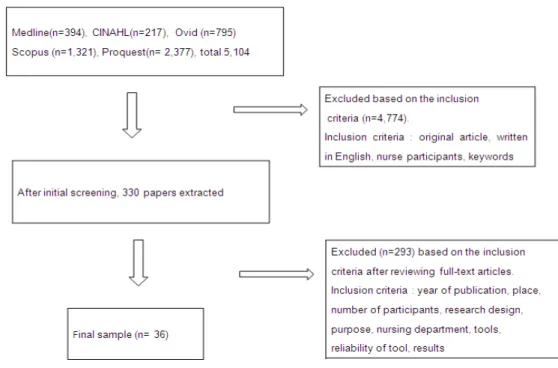
1. Data extraction methods for the literature review For the literature review, Medline, CINAHL (the Cumul- ative Index to Nursing and Allied Health Literature), Ovid, Proquest and Scopus databases were searched us- ing 4 key words: ‘compassion fatigue,’ ‘secondary trau- matization,’ ‘secondary traumatic stress’ and ‘vicarious traumatization.’ There was no date limitation because these concepts were considered new. Searching for this study was of English research, because there is no re- search on compassion fatigue with Korean nurses as participants. First, a list of 5104 articles were retrieved using the 4 key words, then titles and abstracts of these articles were assessed with inclusion criteria. Of the 5,104 articles, 4,774 articles were excluded based on the inclusion criteria which were defined as follows. The papers were an original article, written in English, nur- ses as participants were included, and the concept of at least one of the 4 key words was measured. After exclu- sion, 330 articles remained. Researchers reviewed the 330 articles with full text and from that review 293 articles were excluded based on inclusion criteria which were described year, place, number of participants, research design, purpose, nursing department, tools, reliability of tool, results. Finally, 36 papers were extracted for this review on compassion fatigue of nurses (Figure 1).
2. Data analysis
In the selected studies, the following information was
METHODS
Figure 1. Process of proper research extraction.
gathered: publication year, country where research was conducted, research design, detailed research purposes, sample, sampling method, research tools, and study re- sults. Furthermore, researchers examined if the reliabil- ity and validity of instruments were described for evalu- ating the quality of studies. The study results were ana- lyzed by the level of compassion fatigue according to nursing specialties, factors associated with compassion fatigue, and management for compassion fatigue.
1. Analysis of overall literature features and research methods
1) Year of publication and studied country
The literature on compassion fatigue appeared in the early ‘90s, but the first study in which nurses only or par- tially were investigated as participants was published in 2000. Until 2005, there were only one or two research papers a year. From 2006 to 2011, 31 papers were pub- lished. Seven papers (19.4%) were published in 2006 and 2008 each. Eight papers (22.2%) on the subject were published in 2009 and 2010 each. Most studies (n=29, 80.6%) were performed in the U.S.A. Other countries where research was conducted were South Africa (n=3), Israel (n=2), Norway (n=1), and Greece (n=1) (Table 1).
2) Research design and purposes & sample
Out of the 36 studies, there were 30 (83.3%) descrip- tive research studies, and 4 (1.1%) experimental re- search studies. There was 1 (2.8%) each for qualitative research and triangulation research. The four experi- mental studies evaluated the effects of treatments for compassion fatigue. The detailed research purposes were categorized into 4 kinds. Major purposes were to identify level of compassion fatigue (n=28, 77.8%) and/
or to determine related factors (n=29, 80.6%).
The different work areas for the nurses participating in the research studies were pediatrics (n=7, 19.4%), emergency room or trauma units (n=6, 16.7%), oncol- ogy (n=4, 11.1%), psychiatry or general wards (n=5 each, 13.5%), hospice centers (n=3, 8.3%), sexual as- sault victim examination units (n=2, 5.6%), operating room or intensive care units (each n=1, 2.7%), and long term facilities or public health clinics (n=1 each, 2.8%).
In 23 studies, the participants were all nurses, and the other 13 studies included other professionals such as physicians, social workers, chaplains, and paramedics.
The portion of nurses in the samples varied from 13.8%
to 86.3% and all studies at least 40% of total participants were nurses (Table 1).
3) Sampling method and sample size
In 18 (50%) of the 36 studies detailed explanations of
RESULTS
Table 1. Analysis of Selected Studies (N=36)
Variables Categories n (%) Remarks
Year of publication 2000~2005 2006~2011
5 (13.9) 31 (86.1)
2000 (1), 2002 (2), 2004 (1), 2005 (1)
2006 (7), 2008 (7), 2009 (8), 2010 (8), 2011 (1)
Country USA
South Africa Others
29 (80.6) 3 (8.3)
4 (11.1) Israel (2), Norway (1), Greece (1) Research Design Descriptive
Experimental Qualitative Triangulational
30 (83.3) 4 (11.1) 1 (2.8) 1 (2.8) Detailed purpose
†CF level
Relating factors CF symptoms Management of CF
28 (77.8) 29 (80.6) 3 (8.3) 9 (25.0) Nursing specialties Pediatric
ER/trauma Oncology Psychiatric General wards Hospice Others
7 (19.4) 6 (16.7) 4 (11.1) 5 (13.9) 5 (13.9) 3 (8.3)
6 (16.7) SAVEU (2), OR (1), ICU (1), PHC (1), Nursing home (1)
Sample All nurses
Partially nurses
23 (63.9)
13 (36.1) Range: 13.8~86.3%, Mean: 55.7%
Sampling method Mentioned
Non-probability Probability
18 (50.0) 11 (30.6) 7 (19.4)
Convenience (7), Purposive (2), Non random (2) Random (5), Proportional (1), Systematic (1) Rational for sample size Mentioned 4 (11.1) All correlational studies
Validation for tool Reliability Validity
Mentioned Mentioned
29 (80.5) 15 (41.7)
Calculated by authors (13) Calculated by author (0)
CF=compassion fatigue; SAVEU=sexual assault victim examiner unit; OP=operating room; ICU=intensive care unit; PHC=public health clinic.
†Multiple answers.
sampling methods were included. A non-probability method such as convenience sampling or purposive sampling was used in 11 studies (30.6%), and in 7 stud- ies (19.4%), the probability method was used. In 4 stud- ies (11.1%), all correlational studies, rational for the sam- ple size for the study was described. None of 4 experi- mental studies had an estimated sample size (Table 1).
4) Research tools
For 29 of the 36 studies (80.6%) the reliability of the tool was reported and for 15 studies (41.7%) the validity was reported. Reliability was calculated by the authors for only 13 studies, and no study included calculation of
validity by authors. Questionnaires developed by au- thors were used in 3 studies, and existing analysis tools in 32 studies.
There were 7 kinds of tools used in 32 the studies.
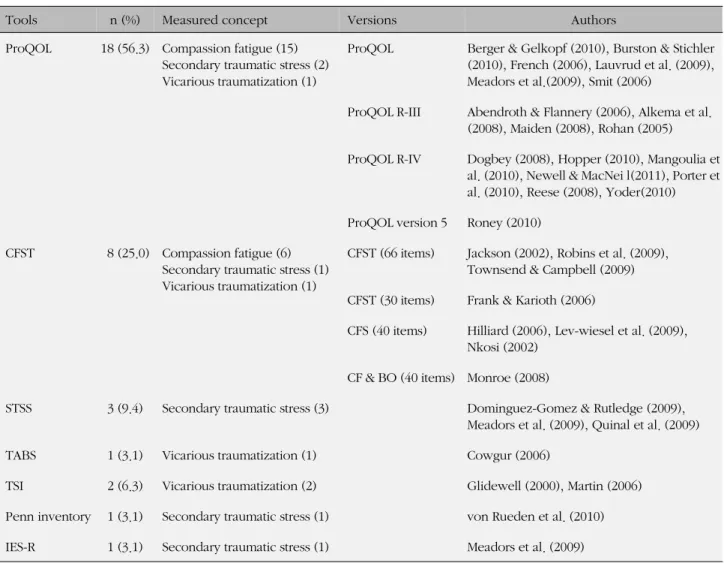
The Professional Quality of Life (ProQOL) scale was most commonly used (n=18, 56.3%), and measured the concepts of ‘compassion fatigue,’ ‘secondary traumatic stress,’ and ‘vicarious traumatization.’ The Compassion Fatigue Self Test (CFST) was used in 8 studies (25.5%) and measured the concepts of ‘compassion fatigue,’
‘secondary traumatization,’ and ‘vicarious traumatiza-
tion.’ The Secondary Traumatic Stress Scale (STSS) was
used in 3 studies (9.4%), and measured the concept of
Table 2. Tools according to 4 Key Words (N=32)
Tools n (%) Measured concept Versions Authors
ProQOL 18 (56.3) Compassion fatigue (15) Secondary traumatic stress (2) Vicarious traumatization (1)
ProQOL Berger & Gelkopf (2010), Burston & Stichler (2010), French (2006), Lauvrud et al. (2009), Meadors et al.(2009), Smit (2006)
ProQOL R-III Abendroth & Flannery (2006), Alkema et al.
(2008), Maiden (2008), Rohan (2005)
ProQOL R-IV Dogbey (2008), Hopper (2010), Mangoulia et al. (2010), Newell & MacNei l(2011), Porter et al. (2010), Reese (2008), Yoder(2010) ProQOL version 5 Roney (2010)
CFST 8 (25.0) Compassion fatigue (6) Secondary traumatic stress (1) Vicarious traumatization (1)
CFST (66 items) Jackson (2002), Robins et al. (2009), Townsend & Campbell (2009) CFST (30 items) Frank & Karioth (2006)
CFS (40 items) Hilliard (2006), Lev-wiesel et al. (2009), Nkosi (2002)
CF & BO (40 items) Monroe (2008)
STSS 3 (9.4) Secondary traumatic stress (3) Dominguez-Gomez & Rutledge (2009), Meadors et al. (2009), Quinal et al. (2009)
TABS 1 (3.1) Vicarious traumatization (1) Cowgur (2006)
TSI 2 (6.3) Vicarious traumatization (2) Glidewell (2000), Martin (2006)
Penn inventory 1 (3.1) Secondary traumatic stress (1) von Rueden et al. (2010) IES-R 1 (3.1) Secondary traumatic stress (1) Meadors et al. (2009)
ProQOL=professional quality of life; CFST=compassion fatigue self test; STSS=secondary traumatic stress scale; TABS=the trauma and attach- ment belief scale; TSI=traumatic stress institue belief scale; IES-R=impact of events scale-revised; CF & BO=compassion and burnout test.
‘secondary traumatization.’ The Traumatic Stress Insti- tute Belief Scale (TSI) was used in 2 studies (6.3%). The Trauma and Attachment Belief Scale (TABS), Penn In- ventory, and Impact Events Scale-Revised (IES-R) were used in 1 study each (3.1%).
CFST is a tool for measurement of compassion fatigue and job burnout, and compassion satisfaction, job burn- out, and compassion fatigue with 66 items in the origi- nal tool but with a reduced number of items in different versions (Beck, 2011). ProQOL is a revision of CFST and is composed of three discrete subscales: Compassion satisfaction, burnout, and compassion fatigue (Bride et al, 2007). STSS is a tool for assessment of the symptoms of secondary traumatic stress associated with indirect exposure to traumatic events through clinical work with traumatized populations (Beck, 2011). TABS is a new version of TSI (Beck, 2011). TSI is a tool for measure- ment of disruption in cognitive schemata that are related
to 5 basic psychological needs (safety, trust, esteem, in- timacy, control) (Beck, 2011). Penn Inventory is a tool for measuring the presence or absence of traumatic stress symptoms. IES-R is a tool for measuring traumatic stress symptoms (Beck, 2011) (Table 2).
2. Analysis of research results 1) Level of compassion fatigue
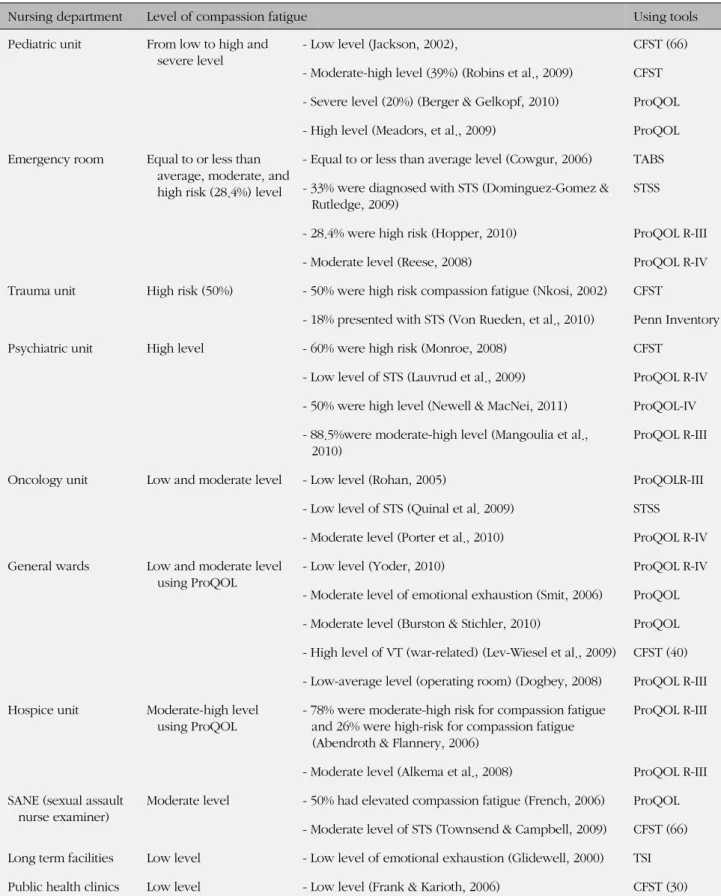
The level of compassion fatigue was found to vary ac- cording to nursing specialties in these studies (Table 3).
It was difficult to compare compassion fatigue by nurs- ing speciality units, because of the different tools used for measuring compassion fatigue in the research studies.
Nurses on pediatric units reported from low to high and
severe levels of compassion fatigue, and emergency
room nurses reported equal to or less than average,
moderate, and high risk (28.4%) levels. Trauma unit nur-
Table 3. Level of Compassion Fatigue according to Various Nursing Specialties
Nursing department Level of compassion fatigue Using tools
Pediatric unit From low to high and severe level
- Low level (Jackson, 2002), CFST (66)
- Moderate-high level (39%) (Robins et al., 2009) CFST - Severe level (20%) (Berger & Gelkopf, 2010) ProQOL - High level (Meadors, et al., 2009) ProQOL Emergency room Equal to or less than
average, moderate, and high risk (28.4%) level
- Equal to or less than average level (Cowgur, 2006) TABS - 33% were diagnosed with STS (Dominguez-Gomez &
Rutledge, 2009)
STSS
- 28.4% were high risk (Hopper, 2010) ProQOL R-III
- Moderate level (Reese, 2008) ProQOL R-IV
Trauma unit High risk (50%) - 50% were high risk compassion fatigue (Nkosi, 2002) CFST
- 18% presented with STS (Von Rueden, et al., 2010) Penn Inventory
Psychiatric unit High level - 60% were high risk (Monroe, 2008) CFST
- Low level of STS (Lauvrud et al., 2009) ProQOL R-IV - 50% were high level (Newell & MacNei, 2011) ProQOL-IV - 88.5%were moderate-high level (Mangoulia et al.,
2010)
ProQOL R-III
Oncology unit Low and moderate level - Low level (Rohan, 2005) ProQOLR-III
- Low level of STS (Quinal et al. 2009) STSS - Moderate level (Porter et al., 2010) ProQOL R-IV General wards Low and moderate level
using ProQOL
- Low level (Yoder, 2010) ProQOL R-IV
- Moderate level of emotional exhaustion (Smit, 2006) ProQOL - Moderate level (Burston & Stichler, 2010) ProQOL - High level of VT (war-related) (Lev-Wiesel et al., 2009) CFST (40) - Low-average level (operating room) (Dogbey, 2008) ProQOL R-III Hospice unit Moderate-high level
using ProQOL
- 78% were moderate-high risk for compassion fatigue and 26% were high-risk for compassion fatigue (Abendroth & Flannery, 2006)
ProQOL R-III
- Moderate level (Alkema et al., 2008) ProQOL R-III SANE (sexual assault
nurse examiner)
Moderate level - 50% had elevated compassion fatigue (French, 2006) ProQOL - Moderate level of STS (Townsend & Campbell, 2009) CFST (66) Long term facilities Low level - Low level of emotional exhaustion (Glidewell, 2000) TSI Public health clinics Low level - Low level (Frank & Karioth, 2006) CFST (30)
ProQOL=professional quality of life; CFST=compassion fatigue self test; STSS=secondary traumatic stress scale; TABS=the trauma and attachment belief scale; TSI=traumatic stress institue belief scale; STS=secondary traumatic stress; VT=vicarious traumatization;CF=compassion fatigue.
ses reported high risk (50%) of compassion fatigue. and psychiatric unit nurses reported high levels. Oncology unit nurses reported low and moderate levels of com- passion fatigue and general unit nurses reported low and moderate levels using ProQOL. Hospice unit nurses reported moderate - high level using ProQOL, and SANE (Sexual assault nurse examiner) nurses reported moder- ate levels of compassion fatigue. Long term facility nurses reported low level of compassion fatigue, and public health clinic nurses also reported low levels. Meadors, Lamson, Swanson, White, & Sira (2009) reported physi- cians showed higher levels of compassion fatigue than nurses and child-life specialists. Robins, Meltzer, & Zeli- kovsky (2009) reported pediatric trauma workers had the same level of compassion fatigue as healthcare pro- fessionals. In Newell & MacNeil’s (2011) study, mental health providers at psychiatric clinics had the same level of compassion fatigue as administrators, and Rohan (2005) reported social workers had the same level of compassion fatigue as oncology physicians and nurses.
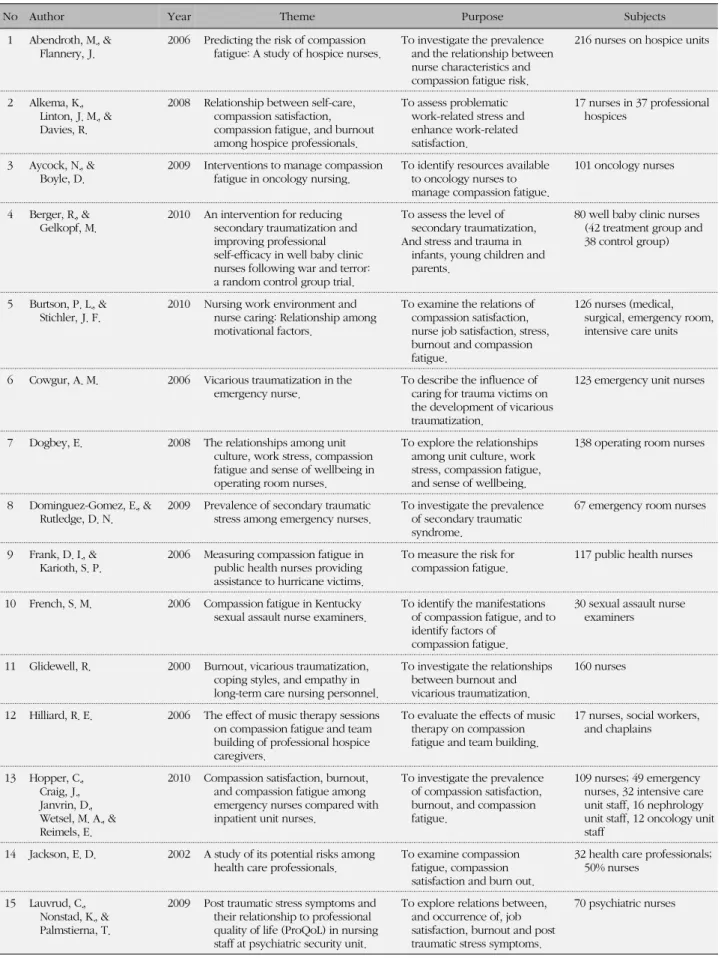
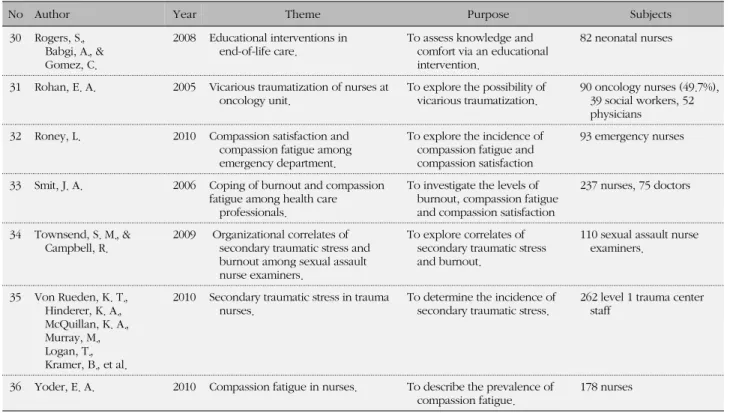
Smit (2006) reported that physicians at general hospitals showed a higher level of compassion fatigue than nur- ses, and in the study by Lev-Wiesel, Goldblatt, Eisiko- vits, & Admi (2009), social workers who worked in war- related areas reported higher levels of compassion fa- tigue than nurses (Reference by Table 5).
2) Factors associated with compassion fatigue
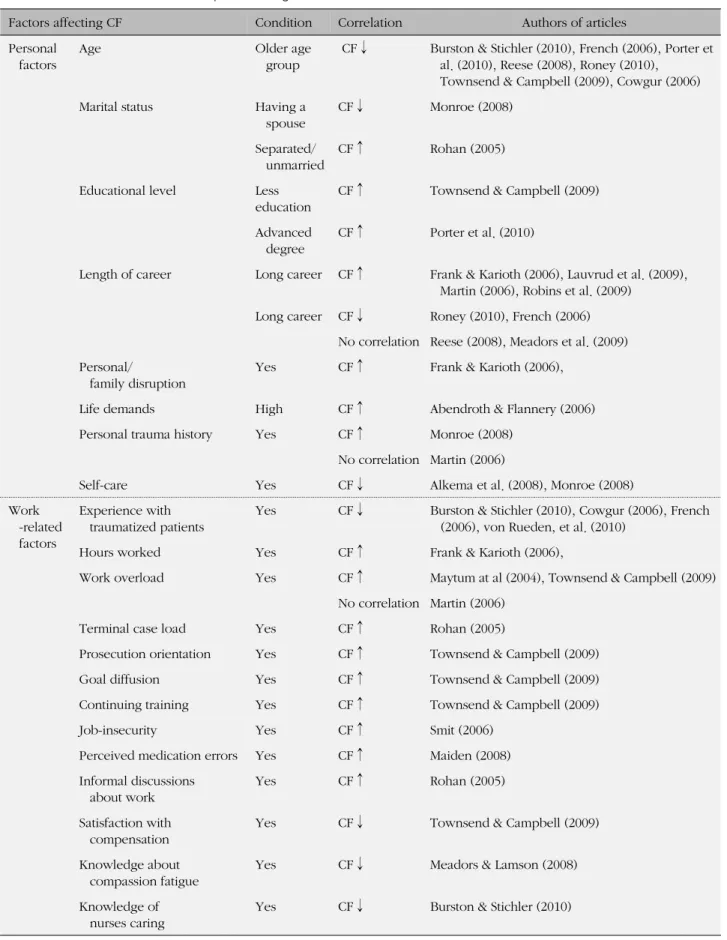
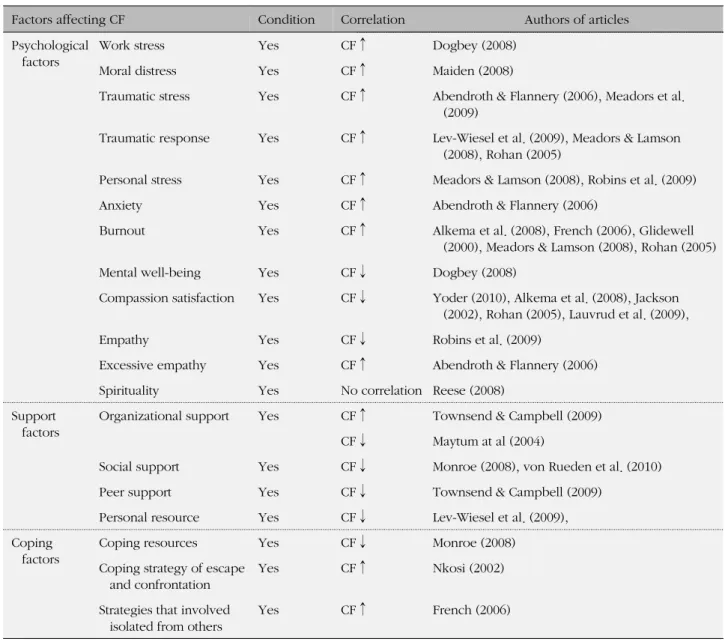
The factors associated with compassion fatigue were organized into five categories: personal factors, profes- sional factors, psychological factors, support factors, and coping factors (Table 4). Factors associated with high compassion fatigue were younger age, separated or unmarried (marital status), personal/family disrup- tion, life demands, and high self-care. Factors such as educational level, career year and personal trauma his- tory had inconsistent results. Among the work- related factors, factors associated with high compassion fatigue were less experience with traumatized patients, long work hours or overload, terminal case load, greater pro- secution orientation, more goal diffusion, more continu- ing training, more job insecurity, perception of more medication errors, and informal discussions about work.
Knowledge about compassion fatigue or nursing care was related to low compassion fatigue. Among the psy- chological factors, factors associated with high compas- sion fatigue were high work stress, traumatic stress, mo- ral distress, personal stress, anxiety, traumatic response, burnout, and excessive empathy. Factors associated with low compassion fatigue were mental well-being and
compassion satisfaction and appropriate empathy. The support factors except for organizational support were related to low compassion fatigue. Among the coping factors, coping resources were related to low compas- sion fatigue, coping strategies such as escape, con- frontation, or isolation from others were related to high compassion fatigue. Although the same factors affecting compassion fatigue were present, researchers reported different correlation tendencies. Factors such as length of career, personal training history, work load, and spiri- tuality had different results for correlation with compas- sion fatigue in these studies.
3) Symptoms of compassion fatigue
The symptoms of compassion fatigue from these re- sults were difficulty sleeping (Dominguez-Gomez & Ru- tledge, 2009; Jackson, 2002; Quinal, Harford, & Rutledge, 2009), irritability, intrusive thoughts, diminished activity levels (Dominguez-Gomez & Rutledge, 2009; Quinal et al., 2009), avoidance of clients, emotional numbing (Dominguez-Gomez & Rutledge, 2009), a foreshortened future outlook (Quinal et al., 2009), and mental health dysfunction (Jackson, 2002) (References by Table 5).
4) Results of intervention studies for compassion fatigue There were 9 research studies related to management of compassion fatigue. In 5 studies, descriptive designs were used. In 1 study resources available to oncology nurses from all over the country were investigated. The results showed that ‘online professional resources’ and
‘educational programs’ were more frequently provided compared to ‘specialized retreats’ (Aycock & Boyle, 2009). The other four studies reported effective coping strategies utilized by participants as, engaging in self- care activities, developing a personal philosophy of nursing care, change/management of current situation, debrief informally, developing supportive professional relationships, using support systems; family, friends, coworkers, spiritual or religious, attitude modification, taking time away from work for hobbies, meditation or exercise (French, 2006; Maytum et al., 2004; Von Rueden et al,. 2010; Yoder, 2010).
There were four experimental research studies on management of compassion fatigue: 1) increasing aware- ness of compassion fatigue, 2) increasing knowledge of warning signs of compassion fatigue (Meadors & Lamson, 2008), 3) improving professional self-efficacy, and 4) re- ducing levels of secondary traumatization (Berger &
Gelkopf, 2010). Having levels of comfort and knowl-
edge in care for dying infants was shown to be impor-
Table 4. Factors associated with Compassion Fatigue
Factors affecting CF Condition Correlation Authors of articles
Personal factors
Age Older age
group
CF↓ Burston & Stichler (2010), French (2006), Porter et al. (2010), Reese (2008), Roney (2010),
Townsend & Campbell (2009), Cowgur (2006)
Marital status Having a
spouse
CF↓ Monroe (2008)
Separated/
unmarried
CF↑ Rohan (2005)
Educational level Less education
CF↑ Townsend & Campbell (2009)
Advanced degree
CF↑ Porter et al. (2010)
Length of career Long career CF↑ Frank & Karioth (2006), Lauvrud et al. (2009), Martin (2006), Robins et al. (2009)
Long career CF↓ Roney (2010), French (2006) No correlation Reese (2008), Meadors et al. (2009) Personal/
family disruption
Yes CF↑ Frank & Karioth (2006),
Life demands High CF↑ Abendroth & Flannery (2006)
Personal trauma history Yes CF↑ Monroe (2008)
No correlation Martin (2006)
Self-care Yes CF↓ Alkema et al. (2008), Monroe (2008)
Work -related factors
Experience with traumatized patients
Yes CF↓ Burston & Stichler (2010), Cowgur (2006), French (2006), von Rueden, et al. (2010)
Hours worked Yes CF↑ Frank & Karioth (2006),
Work overload Yes CF↑ Maytum at al (2004), Townsend & Campbell (2009) No correlation Martin (2006)
Terminal case load Yes CF↑ Rohan (2005)
Prosecution orientation Yes CF↑ Townsend & Campbell (2009)
Goal diffusion Yes CF↑ Townsend & Campbell (2009)
Continuing training Yes CF↑ Townsend & Campbell (2009)
Job-insecurity Yes CF↑ Smit (2006)
Perceived medication errors Yes CF↑ Maiden (2008) Informal discussions
about work
Yes CF↑ Rohan (2005)
Satisfaction with compensation
Yes CF↓ Townsend & Campbell (2009)
Knowledge about compassion fatigue
Yes CF↓ Meadors & Lamson (2008)
Knowledge of nurses caring
Yes CF↓ Burston & Stichler (2010)
CF=compassion fatigue.
Table 4. Factors associated with Compassion Fatigue (Continued)
Factors affecting CF Condition Correlation Authors of articles
Psychological factors
Work stress Yes CF↑ Dogbey (2008)
Moral distress Yes CF↑ Maiden (2008)
Traumatic stress Yes CF↑ Abendroth & Flannery (2006), Meadors et al.
(2009)
Traumatic response Yes CF↑ Lev-Wiesel et al. (2009), Meadors & Lamson (2008), Rohan (2005)
Personal stress Yes CF↑ Meadors & Lamson (2008), Robins et al. (2009)
Anxiety Yes CF↑ Abendroth & Flannery (2006)
Burnout Yes CF↑ Alkema et al. (2008), French (2006), Glidewell
(2000), Meadors & Lamson (2008), Rohan (2005)
Mental well-being Yes CF↓ Dogbey (2008)
Compassion satisfaction Yes CF↓ Yoder (2010), Alkema et al. (2008), Jackson (2002), Rohan (2005), Lauvrud et al. (2009),
Empathy Yes CF↓ Robins et al. (2009)
Excessive empathy Yes CF↑ Abendroth & Flannery (2006)
Spirituality Yes No correlation Reese (2008)
Support factors
Organizational support Yes CF↑ Townsend & Campbell (2009) CF↓ Maytum at al (2004)
Social support Yes CF↓ Monroe (2008), von Rueden et al. (2010)
Peer support Yes CF↓ Townsend & Campbell (2009)
Personal resource Yes CF↓ Lev-Wiesel et al. (2009),
Coping factors
Coping resources Yes CF↓ Monroe (2008)
Coping strategy of escape and confrontation
Yes CF↑ Nkosi (2002)
Strategies that involved isolated from others
Yes CF↑ French (2006)
CF=compassion fatigue.
tant in the management of compassion fatigue (Rogers et al,. 2008). One experimental research was on the ef- fects of musical interventions on compassion fatigue, but there was no significant differences were reported (Hilliard, 2006) (References by Table 5).
This study was a systematic review study on compas- sion fatigue in nurses. It was done in order to analyze the overall trends of research related to compassion fa- tigue, and to identify the level, symptoms, and factors related to compassion fatigue. Compassion fatigue is an important concept but concept of compassion fatigue is
not precisely defined, and this lack presents obstacles to many researchers. There are four similar concepts in compassion fatigue, but concept definitions which take into account these differences are needed. In much of the research on compassion fatigue, different tools were used making it difficult to compare results. Therefore, there is a need for a clear definition of compassion fa- tigue, and uniformed tools to measure it.
Through this study, the level of compassion fatigue in nurses was found to differ by nurses' working units.
Especially nurses who worked in war-related units had a high level of compassion fatigue, because war is a high crisis for everyone. Many research studies showed dif- ferent levels of compassion fatigue in hospice, psychi-
DISCUSSION
Table 5. Reviewed Research for This Study
No Author Year Theme Purpose Subjects
1 Abendroth, M., &
Flannery, J. 2006 Predicting the risk of compassion
fatigue: A study of hospice nurses. To investigate the prevalence and the relationship between nurse characteristics and compassion fatigue risk.
216 nurses on hospice units
2 Alkema, K., Linton, J. M., &
Davies, R.
2008 Relationship between self-care, compassion satisfaction, compassion fatigue, and burnout among hospice professionals.
To assess problematic work-related stress and enhance work-related satisfaction.
17 nurses in 37 professional hospices
3 Aycock, N., &
Boyle, D.
2009 Interventions to manage compassion fatigue in oncology nursing.
To identify resources available to oncology nurses to manage compassion fatigue.
101 oncology nurses
4 Berger, R., &
Gelkopf, M.
2010 An intervention for reducing secondary traumatization and improving professional self-efficacy in well baby clinic nurses following war and terror:
a random control group trial.
To assess the level of secondary traumatization, And stress and trauma in
infants, young children and parents.
80 well baby clinic nurses (42 treatment group and 38 control group)
5 Burtson, P. L., &
Stichler, J. F.
2010 Nursing work environment and nurse caring: Relationship among motivational factors.
To examine the relations of compassion satisfaction, nurse job satisfaction, stress, burnout and compassion fatigue.
126 nurses (medical, surgical, emergency room, intensive care units
6 Cowgur, A. M. 2006 Vicarious traumatization in the emergency nurse.
To describe the influence of caring for trauma victims on the development of vicarious traumatization.
123 emergency unit nurses
7 Dogbey, E. 2008 The relationships among unit culture, work stress, compassion fatigue and sense of wellbeing in operating room nurses.
To explore the relationships among unit culture, work stress, compassion fatigue, and sense of wellbeing.
138 operating room nurses
8 Dominguez-Gomez, E., &
Rutledge, D. N. 2009 Prevalence of secondary traumatic
stress among emergency nurses. To investigate the prevalence of secondary traumatic syndrome.
67 emergency room nurses
9 Frank, D. I., &
Karioth, S. P. 2006 Measuring compassion fatigue in public health nurses providing assistance to hurricane victims.
To measure the risk for
compassion fatigue. 117 public health nurses
10 French, S. M. 2006 Compassion fatigue in Kentucky sexual assault nurse examiners.
To identify the manifestations of compassion fatigue, and to identify factors of
compassion fatigue.
30 sexual assault nurse examiners
11 Glidewell, R. 2000 Burnout, vicarious traumatization, coping styles, and empathy in long-term care nursing personnel.
To investigate the relationships between burnout and vicarious traumatization.
160 nurses
12 Hilliard, R. E. 2006 The effect of music therapy sessions on compassion fatigue and team building of professional hospice caregivers.
To evaluate the effects of music therapy on compassion fatigue and team building.
17 nurses, social workers, and chaplains
13 Hopper, C., Craig, J., Janvrin, D.,
Wetsel, M. A., &
Reimels, E.
2010 Compassion satisfaction, burnout, and compassion fatigue among emergency nurses compared with inpatient unit nurses.
To investigate the prevalence of compassion satisfaction, burnout, and compassion fatigue.
109 nurses; 49 emergency nurses, 32 intensive care unit staff, 16 nephrology unit staff, 12 oncology unit staff
14 Jackson, E. D. 2002 A study of its potential risks among health care professionals.
To examine compassion fatigue, compassion satisfaction and burn out.
32 health care professionals;
50% nurses
15 Lauvrud, C., Nonstad, K., &
Palmstierna, T.
2009 Post traumatic stress symptoms and their relationship to professional quality of life (ProQoL) in nursing staff at psychiatric security unit.
To explore relations between, and occurrence of, job satisfaction, burnout and post traumatic stress symptoms.
70 psychiatric nurses
Table 5. Reviewed Research for This Study (Continued)
No Author Year Theme Purpose Subjects
16 Lev-wiesel, R., Goldblatt, H., Eisikovits, Z., &
Admi, H.
2009 The case of social workers and nurses working in a shared war reality.
To assess post-traumatic stress symptoms and vicarious traumatization versus post-traumatic growth.
76 nurses, 128 social workers
17 Maiden, J. 2008 A quantitative and qualitative inquiry into moral distress, compassion fatigue, medication error, and critical care nursing.
To determine the accuracy of the IVs; moral distress and compassion fatigue in predicting medication scores.
205 critical care nurses
18 Mangoulia, P., Koukia, E., Alevizopoulos, G., Fildissis, G., &
Katostaras, T.
2010 Compassion fatigue, burnout and compassion satisfaction among nurses in Greece.
To investigate the risk of secondary traumatic stress/compassion fatigue and burnout.
174 psychiatric nurses
19 Martin, P. 2008 An investigation into the effects of vicarious trauma experienced by healthcare workers.
An examination of the effects of working with traumatized individuals.
37 psychiatric nurses
20 Maytum, J. C., Heiman, M. B., &
Garwick, A. W.
2004 Compassion fatigue and burnout in
children's unit nurses. To identify the triggers and coping strategies for compassion fatigue and prevent burnout.
7 care coordinators, 4 case managers, 7 nurses, 1 manager, 1 practitioner 21 Meadors, P., &
Lamson, A.
2008 Compassion fatigue and secondary traumatization: at intensive care units for children.
To describe the scope of compassion fatigue.
185 health care providers in critical care units with children, 62.2% nurses
22 Meadors, P., Lamson, A.,
Swanson, M., White, M., &
Sira, N.
2009 Secondary traumatization in pediatric healthcare providers:
compassion fatigue, burnout, and secondary traumatic stress.
To examine the impact of
secondary traumatization. 167 pediatric health care professional (13.8%
nurses)
23 Monroe, A. 2008 Psychiatric nurses' management of compassion fatigue through self-care.
To explore the levels of
compassion and burn out. 51 psychiatric nurses
24 Newell, J. M., &
MacNeil, G. A.
2011 Burnout and professional quality of life in clinical mental health providers.
To determine the degree of burnout, compassion fatigue, and compassion satisfaction.
87 mental health professional staff and 78 administrative staff
25 Nkosi 2002 Compassion fatigue and coping
styles in nurses working in a hospital trauma unit.
To determine whether a relationship exists between compassion fatigue and coping style.
2 trauma unit nurses
26 Potter, P., Deshields, T., Divanbeigi, J.,
Berger, J., Cipriano, D.,
Norris, L., et al.
2010 Compassion fatigue and burnout oncology nurses.
To explore the prevalence of burnout and compassion fatigue.
132 nurses and 21 patient care technicians, medical assistants, technologist
27 Quinal, L. O. C. N., Harford, S. O. C. N., &
Rutledge, D. N.
2009 Secondary traumatic stress in
oncology staff. To explore the prevalence of
secondary traumatic stress. 33 nurses (76.7%) in 42 oncology staff
28 Reese, M. 2008 Compassion fatigue and spirituality with emergency health care providers.
To investigate the relationship between spirituality and compassion fatigue, compassion satisfaction, and burn out.
89 emergency health care providers (nurses, flight paramedics, chaplains, and physicians)
29 Robins, P. M., Meltzer, L., &
Zelikovsky, N.
2009 Secondary traumatic stress upon
children care providers. To assess the impact of providing care to patients, compared two comparison groups of professionals.
136 nurses in 314 health care professional settings
Table 5. Reviewed Research for This Study (Continued)
No Author Year Theme Purpose Subjects
30 Rogers, S., Babgi, A., &
Gomez, C.
2008 Educational interventions in
end-of-life care. To assess knowledge and comfort via an educational intervention.
82 neonatal nurses
31 Rohan, E. A. 2005 Vicarious traumatization of nurses at oncology unit.
To explore the possibility of vicarious traumatization.
90 oncology nurses (49.7%), 39 social workers, 52 physicians
32 Roney, L. 2010 Compassion satisfaction and compassion fatigue among emergency department.
To explore the incidence of compassion fatigue and compassion satisfaction
93 emergency nurses
33 Smit, J. A. 2006 Coping of burnout and compassion fatigue among health care
professionals.
To investigate the levels of burnout, compassion fatigue and compassion satisfaction
237 nurses, 75 doctors
34 Townsend, S. M., &
Campbell, R. 2009 Organizational correlates of secondary traumatic stress and burnout among sexual assault nurse examiners.
To explore correlates of secondary traumatic stress and burnout.
110 sexual assault nurse examiners.
35 Von Rueden, K. T., Hinderer, K. A., McQuillan, K. A., Murray, M., Logan, T., Kramer, B., et al.
2010 Secondary traumatic stress in trauma nurses.
To determine the incidence of secondary traumatic stress.
262 level 1 trauma center staff
36 Yoder, E. A. 2010 Compassion fatigue in nurses. To describe the prevalence of compassion fatigue.
178 nurses