• 검색 결과가 없습니다.

The Effect of Visual Deprivation on Trunk and Lower Extremity Muscle Activity on an Unstable Surface

N/A
N/A
Protected

Academic year: 2021

Share "The Effect of Visual Deprivation on Trunk and Lower Extremity Muscle Activity on an Unstable Surface"

Copied!
7
0
0

로드 중.... (전체 텍스트 보기)

전체 글

(1)

Original Article Open Access

불안정면에서 시각차단이 체간과 하지의 근활성도에 미치는 영향

한진태

1)

경성대학교 물리치료학과

The Effect of Visual Deprivation on Trunk and Lower Extremity Muscle Activity on an Unstable Surface

Jin-Tae Han

Department of Physical Therapy, Kyungsung University Received: October 29, 2018 / Revised: November 14, 2018 / Accepted: November 15, 2018

ⓒ 2018 Journal of Korea Proprioceptive Neuromuscular Facilitation Association

This is an Open Access article distributed under the terms of the Creative Commons Attribution Non-Commercial License (http://creativecommons.org/licenses/by-nc/3.0) which permits unrestricted non-commercial use, distribution, and reproduction in any medium, provided the original work is properly cited.

| Abstract |

Purpose: Visual information is one of the most important factors for postural balance. The purpose of this study was to investigate the effect of visual deprivation on the lower extremities and trunk muscle activity on an unstable surface during quiet standing.

Methods: Fifteen healthy males from a university population participated in this study. Surface electromyography of the rectus abdominis, the erector spinalis, the vastus femoris oblique, the semitendinosis, the tibialis anterior, and the medial gastrocnemius was measured using EMG equipment (Telemyo 2400, Noraxon, USA). The participants were asked to maintain postural balance on an unstable surface (Balance pad, Airex, USA) for 30 seconds with eyes open and with eyes closed during quiet standing. The Wilcoxon test was used to compare the muscle activity of the lower extremities and the trunk between open and closed eyes on an unstable surface.

Results: The muscle activity of the trunk and the lower extremities was increased more with eyes closed than with eyes open on the unstable surface during quiet standing.

Conclusion: The findings from this study suggest that visual information could alter lower extremity and trunk muscle activity.

Therefore, visual deprivation can be used as a method to improve postural balance.

Key Words: Visual deprivation, Postural balance, Unstable surface

†Corresponding Author : Jin-Tae Han ([email protected])

(2)

Ⅰ. 서 론

시각정보는 사람이 움직이는 동안 동적 안정성을 유지하기 위해 중요한 감각정보를 제공한다(Marigold, 2008; Rietdyk & Rhea, 2006). 보행의 안정성에 대한 시간 차단의 효과를 알아보는 선행연구들은 낮은 시각정보 는 동적 안정성을 감소시키고 보행 안정성을 제공하기 위해 체성감각과 전정계의 의존도를 증가시킨다고 제 시하고 있다(Iosa et al., 2012; Reynard & Terrier, 2015).

즉, 시각정보를 제공할 때 보다 시각정보를 차단하였을 때 보행이 점점 느려지며 보행속도는 안정성에 영향을 미친다고 보고하였다(Hallemans et al., 2009).

불안정면 위에서의 기능 훈련은 신경근육 재활과 상태, 그리고 협응력과 신경근육 동원 형태를 지속적 으로 개선할 수 있다(Stronjnik et al., 2002). 또한 불안정 면은 중심 안정 운동을 위해 최근 많이 사용하고 있으 며(Escamilla et al., 2010; Lehman et al., 2008) 자세 안정 성을 유지하기 위해 필요한 근육을 강화하는 목적으 로 유용하다고 하였다(Imai et al., 2010). 즉, 지지면이 불안하면 신체분절을 지나는 근육들이 균형을 유지하기 위해 공동수축을 더 많이 하게 되고, 감마 운동신경의 활성을 통해 관절의 안정성을 강화한다고 하였다 (Granacher et al., 2006). 불안정면에서의 근육 반응은 다 양하며 운동의 형태나 평가 근육에 따라 다르다. 즉 몇몇 연구는 불안정면이 체간의 근활성도를 강화시킨다고 하 였고(Imai et al., 2010; Vera-Garcia et al., 2000), 반면 어떤 연구는 체간안정화 근육의 활성과는 관련이 없다고 보고 하였다(Lehman et al., 2005; Lehman et al., 2010).

불안정 요소에 대한 반작용으로 효과적인 자세조 절을 위해, 건강한 중추신경계는 고유수용감각, 전정 기관, 시각시스템에서 오는 감각정보를 근거로 반응 한다고 하였다(Alexandrov et al., 2005). 정적 서기 동안 자세조절시스템은 감각정보, 발의 위치 변화에 민감 하다고 하였고 감각차단은 크고 빠른 자세동요를 유 발하고 이는 자세 불안정성이 증가된 신호로 해석된 다(Raymakers et al., 2005; Era et al., 2006). 시각시스템 은 직립자세의 유지와 방향성을 보조하고 있으며 의 식적 혹은 무의식적 자세교정은 시각정보의 입력으로 가능하다. 비록 시각시스템이 수직성과 안정성 한계

내의 신체 동요를 유지하는 데 중요한 참고 요소이긴 하지만 자세조절에 필수적이지는 않다, 즉 눈을 감은 상태에서 균형 유지가 가능하다(Horak & Shupert, 1994). 고유수용기는 균형에서 자세, 운동 그리고 변화 의 인지를 설명하며 관절 위치의 감각과 접촉의 감각 을 포함한다(Willems et al., 2002).

이와 같이 지금까지의 선행연구들은 주로 시각차 단이 보행과 균형능력에 미치는 영향을 알아보는 연 구가 대부분이었으며 불안정면이 체간근육의 활성도 에 영향이 있는지도 논란 중이다. 또한 불안정한 면에 서 시각차단이 체간과 하지의 근활성도에 어떠한 영 향이 있는 지 알아보는 연구는 부족한 상황이다. 따라 서 본 연구는 불안정지지면에서 시각차단이 정적 서 기 자세를 유지하기 위한 하지와 체간의 근활성도에 어떠한 영향을 미치는 지 알아보고 시각정보가 정적 자세 유지를 위한 중요한 요소임을 증명하고자 한다.

Ⅱ. 연구 방법

1. 연구 대상

20대 건강한 남자 15명이 본 실험에 참여했으며 정상적인 관절운동범위와 근력, 보행을 할 수 있는 대상자를 포함하였고, 하지의 통증, 기형이 있는 자, 최근 3개월 이내 자세균형에 문제를 발생시키는 질환 이 있었던 자는 대상자에서 제외하였다(Ledoux &

Hillstrom, 2002). 또한 근력차이로 인한 오류를 배제하 기 위해 여자는 제외하였다. 대상자들은 실험 전 실험 에 대한 내용에 대해 설명을 들었으며 자발적으로 연 구에 참여하는 것에 동의하였다.

2. 측정 방법

1) 측정 도구

하지와 체간의 근활성도를 측정하기 위해 표면근

전도 무선시스템(Telemyo 2400T G2, Noraxon Inc., AZ,

USA)을 사용하였고 표면전극은 은염화 이중전극(272,

(3)

Noraxon Inc., AZ, USA)을 사용하였고 피부 저항을 최소화하기 위해 측정부위를 면도한 후 부착하였다.

신호 추출율은 1500㎐로 하였으며, 근전도 원신호를 20-450 ㎐ 대역필터와 60㎐ 노치(noch)필터를 통해 노 이즈(noise)를 제거하였다. 각 근육의 근전도 신호는 보다 정확한 정보를 얻기 위하여 파형을 제곱한 뒤 적분하여 제곱근을 씌우는 방법(root mean square, RMS) 으로 정량화하였고 MyoResearch Master XP 1.07 프로그램(Noraxon Inc., AZ, USA)을 사용하여 저장하 고 처리하였다.

2) 하지와 체간의 근활성도 측정

대상자는 불안정면 위에 서서, 눈을 뜬 상태와 눈은 감은 상태에서 등세움근(erector spinalis), 배곧은근 (rectus abdominis), 안쪽넓은근(vastus medialis oblique), 반힘줄근(semitendinosus), 앞정강근(tibialis anterior), 안쪽장딴지근(medial gastrocnemius)의 근활성도를 측 정하였다. 근전도의 표준화를 위해 안정면에서 서 있 는 동안 체간과 하지 근육의 근수축을 기준수축 (reference voluntary contraction, RVC) 으로 하는 %RVC 방법을 사용하였다(Criswell, 2011). 안정면과 불안정 면에서 바로 선 자세를 30초 동안 유지하도록 하고 각 근육의 근활성도를 측정하였으며 처음과 마지막 5초를 뺀 20초의 RMS값을 사용하였다. 그리고 모든 자료는 3번 측정하여 평균값을 사용하였다.

3. 실험 절차

대상자들은 편안한 복장과 신발을 신고 실험에 참 여하였으며 일상생활에서 흔히 경험하는 신발을 신은 상황에서의 균형능력을 확인하고자 본인의 신발을 착 용한 상태로 실험을 실시하였다. 먼저 안정면에서 각 근육의 근활성도를 측정하였고, 불안정면에서는 무작 위로 눈을 뜬 상태와 눈을 감을 상태의 근활성도를 측정 하였다. 측정 자세는 불안정면(50×41×6㎝ Balance pad, Airex, USA) 위에 발을 나란하게 하고 팔은 허리 옆에

편안하게 위치한 자세를 취하게 하였다. 근활성도는 30 초 동안 눈을 뜬 상태와 눈을 감은 상태에서 똑바로 선 자세를 그대로 유지한 상태에서 측정하였으며 자 세를 유지하는 동안 몸을 움직이거나 발이 바닥면에 서 떨어지면 다시 측정하였다. 낙상을 예방하기 위하 여 실험보조자가 대상자 옆에 서서 낙상의 위험이 있 는 경우를 대비하였다. 각 과제를 수행하는 사이에는 10 분의 휴식시간을 제공하였다.

4. 자료 분석

불안정면에서 눈을 뜬 상태와 눈을 감은 상태의 체간과 하지근육활성도를 비교하기 위하여 윌콕슨 검 정(Wilcoxon test)을 사용하였고 자료는 평균과 표준편 차로 제시하였다. 통계자료분석은 SPSS Version 25.0 (SPSS Inc. Chicago, IL, USA)을 사용하였으며, 유의수 준은 α는 0.05로 하였다.

Ⅲ. 연구 결과

1. 연구 대상자의 일반적인 특성

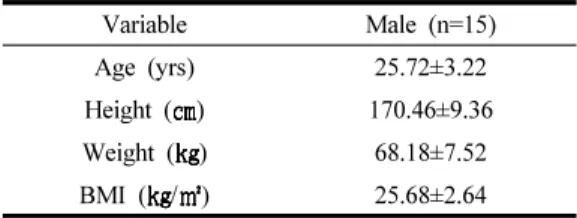
본 연구에 참여한 대상자는 남자 15명으로 대상자 들의 신체적 특성은 Table 1과 같다.

Variable Male (n=15)

Age (yrs) 25.72±3.22

Height ( ) 170.46±9.36

Weight ( ) 68.18±7.52

BMI ( / ) 25.68±2.64

Table 1. General characteristics of subjects(mean±SD)

2. 시각차단에 따른 체간 근활성도 비교

시각차단에 따른 등세움근과 배곧은근 모두 불안

정면 위에서 눈을 뜨고 있을 때 보다 눈을 감고 있을

(4)

Variables Eyes open Eyes closed z p

Erector spinalis 105.76±79.81 153.56±97.14 -2.32b 0.02*

Rectus abdominis 168.43±144.72 403.72±94.71 -2.89b 0.00*

*p<0.05

b : based on negative ranks

Table 2. Comparison of muscle activity of trunk with eyes open and close (mean ±SD) (unit: %RVC)

Variables Eyes open Eyes closed z p

Vastus medialis oblique 135.44±84.72 203.91±166.67 -1.02b 0.30

Semitendinosus 108.47±53.42 202.22±157.50 -2.04b 0.04*

Tibialis anterior 125.06±43.21 247.45±156.43 -2.89b 0.00*

Medial gastrocnemius 160.68±89.83 257.09±181.20 -1.64b 0.10

*p<0.05

b : based on negative ranks

Table 3. Comparison of muscle activity of lower extremity with eyes open and close(mean ±SD)(unit: %RVC)

때 근활성도가 증가하였으며 통계적으로 유의한 차이 가 있었다(p<0.05)(Table 2).

3. 시각차단에 따른 하지 근활성도 비교

시각차단에 따른 반힘줄근과 앞정강근은 불안정면 위에서 눈을 뜨고 있을 때 보다 눈을 감고 있을 때 근활성도가 증가하였고 통계적으로 유의한 차이가 있 었다(p<0.05)(Table 3). 시각차단에 따른 안쪽넓은근과 안쪽장딴지근은 불안정면 위에서 눈을 뜨고 있을 때 보다 눈을 감고 있을 때 근활성도가 대체적으로 증가 하였으나 통계적으로 유의한 차이가 없었다(p>0.05) (Table 3).

Ⅳ. 고 찰

본 연구는 불안정면에서 정적자세를 유지하는 동 안 시각차단이 체간과 하지의 근활성도에 어떠한 영 향을 미치는지 알아보는 것이었으며 불안정면에서 눈 을 뜰 때와 눈을 감을 때 체간과 하지의 근활성도가 다르다는 것을 연구가설로 정하였다. 즉 불안정면에

서 눈을 감을 경우 체간과 하지의 근활성도가 눈을 뜬 경우 보다 증가할 것이며 정적 균형을 유지하기 위해 보다 효과적인 방법으로 제공될 수 있을지 알아 보고자 하였다.

정적 서기 자세를 유지하기 위해서 인지와 감각정 보를 포함하는 복잡한 과정이 필요하며 주어진 환경 에서 체중지지 기저면 위로 무게중심을 조절하여 유 지해야한다(Umphred, 2001). 또한 정적 자세 유지 시 근육의 근활성도는 하지와 같은 먼 쪽에서 먼저 증가 하며 체간과 같은 몸 쪽 방향으로 진행된다고 보고되 었다(Woo et al., 2004). 최근 불안정면에서의 운동은 감각운동 방법 중 한가지로 근골격계 환자에게 자세조 절과 체성감각을 향상시키며 하지와 체간의 근력을 강 화시키는 중재방법으로 많이 사용되고 있다(Akuthota

& Nadler, 2004).

본 연구의 결과는 불안정면에서 시각을 차단한 경 우 체간 근육인 등세움근과 배곧은근 모두 유의하게 근활성도가 증가하였고 하지 근육인 반힘줄근과 앞정 강근의 근활성도는 유의하게 증가하였고 안쪽넓은근 과 안쪽장딴지근의 근활성도는 증가하였으나 유의한 차이는 없었다.

Lee 등(2010)은 불안정면에서 교각운동 시 등세움

(5)

근과 배곧은근의 근활성도는 변화가 없었다고 보고하 였으나 본 연구에서는 등세움근과 배곧은근의 근활성 도가 유의하게 증가하는 것을 볼 수 있었다. 이는 각각 의 실험에서 근활성도를 측정한 자세가 다르기 때문 으로 생각되어진다. 즉, 누운 자세에서 보다 바로 선 자세에서 등세움근과 배곧은근의 근활성도를 측정할 경우 중력의 영향이 큼으로, 불안정한 지면에서도 균 형을 더 잘 유지하기 위해 등세움근과 배곧은근이 크 게 작용한 것으로 판단되며 임상에서 체간근의 활성 화을 목적으로 하는 운동에서는 불안정한 면에서 선 자세로 수행하는 것이 더 효과적일 것으로 생간된다.

Kim 등(2016)은 불안정면에서 여성노인의 하지 근활 성도 분석연구에서 가쪽넓은근과 안쪽넓은근의 근활 성도가 증가한다고 보고하였으며 불안정면을 이용한 균형훈련만으로도 여성 노인의 균형능력과 하지근력 강화에 효과적이라고 설명하였다. 불안정면에서의 운 동은 고유수용성 감각기능을 향상시키어 균형 조절을 위한 빠른 반응을 가능하게 하여 노인의 낙상예방에 효과적인 운동이라고 하였다(Lee et al., 2014). 불안정 면에서 안쪽장딴지근의 근활성도가 증가한다는 연구 (Oliveira et al., 2006) 와 반면 앞정강근의 근활성도가 크게 증가하는 연구가 있었다(Braun Ferreira et al., 2011). Isakov와 Mizrahi (1997)는 불안정면에서 앞정강 근과 장딴지근은 급격한 자세변화와 균형조절을 위해 역동적 방어역할을 한다고 보고하였다. 본 연구에서 는 후자와 같이 안쪽장딴지근과 앞정강근이 모두 근 활성도가 증가하였으나 앞정강근의 근활성도가 더 크 게 증가하였으며 이는 눈을 감은 상태에서 정적 자세를 유지하기 위해 앞정강근이 안쪽장딴지근 보다 더 강한 작용을 하는 것으로 추측이 된다. 임상에서 정적 자세유 지를 위한 운동을 하는 경우 앞정강근을 강화하는 운동 은 먼저 제안하는 것이 좋을 것으로 생각된다.

Braun Ferreira 등(2011)은 불안정한 면에서 시각차 단이 하지 근육들의 근활성도를 대체적으로 증가시키 고 특히 안쪽장딴지근의 근활성도는 통계적으로 유의 하게 증가시킨다고 하였다. 본 연구에서는 앞정강근 과 안쪽장딴근 모두 근활성도가 증가하였고 앞정근에

서 통계적으로 유의하게 증가하는 결과를 보였다. 이 는 시각 차단이 지면의 불안정성 보다 신체의 동요를 더 많이 유발을 시키고 이에 대항하여 신체 균형을 유지하기 위해 하지의 근활성도가 높아진 것으로 생 각된다. Mann 등(2010)은 요통환자가 정상인보다 불 안정면에서 신체의 위치변화에 빠르게 반응하기 위해 시각정보의 의존도가 높으며 이는 건강한 성인이나 노인들로 유사할 것이라고 예측하였다. 균형능력을 강화하는 방법으로 시각을 차단하는 방법만으로도 균 형능력이 상실된 환자들에게 좋은 효과가 있을 것으 로 판단된다.

본 연구의 한계점은 대상자 수가 부족하여 연구결 과를 일반화하기에 어려움이 있고 실험환경에 대한 적응이 대상자 간 차이가 있는 점은 연구결과에 다소 영향을 미쳤을 것으로 생각하다. 향후 이러한 문제점 을 보완하고 측정 근육들을 좀 추가한다면 불안정면 에서 시각차단이 신체 근육활동에 미치는 결과에 대 한 신뢰성을 높일 수 있을 것으로 생각한다.

Ⅴ. 결론

본 연구는 불안정면에서 눈을 뜬 경우와 눈을 감은 경우 체간과 하지의 근활성도가 차이가 있는 지를 알 아보았다. 불안정면에서 눈을 뜬 때 보다 눈을 감은 때 체간의 근활성도는 증가하였고 하지의 근활성도 역시 대체적으로 증가하였다. 이는 불안정면에서 시 각차단이 체간의 안정성을 높이기 위해 근육의 활동 이 증가하다는 것을 보여주며 향후 정적 균형 능력을 향상시키기 위한 운동의 과학적 근거로 사용될 수 있 을 것이다.

Acknowledgments

This research was supported by Kyungsung University

Research Grants in 2018.

(6)

References

Alexandrov AV, Frolov AA, Horak FB, et al. Feedback equilibrium control during human standing. Biological Cybernetics. 2005;93(5):309-322.

Akuthota V, Nadler SF. Core strengthening. Archives of Physical Medicine and Rehabilitation. 2004;85(3):86-92.

Braun Ferreira LA, Pereira WM, Rossi LP, et al. Analysis of electromyographic activity of ankle muscles on stable and unstable surfaces with eye open and closed.

Journal of Bodywork and Movement Therapies.

2011;15(4):496-501.

Criswell E2. Cram’s introduction to surface electromyography, 2nd ed. Sudbury. Jones and Bartlett Publishers. 2011.

Era P, Sainio P, Koskinen S, et al. Postural balancein a random sample 7979 subjects aged 30 years and over.

Gerontology. 2006;52(4):204-213.

Escamilla RF, Lewis C, Bell D, et al. Core muscle activation during Swiss ball and traditional abdominal exercises.

The Journal of Orthopeadic and Sports Physical Therapy. 2010;40(5):265-276.

Granacher U, Gollhofer A, Strass D. Training induced adaptations in characteristics of postural reflexes in elderly men. Gait & Posture. 2006;24(4):459-466.

Hallemans A, Beccu S, Van Loock K, et al. Visual deprivation leads to gait adaptations that are age-and context- specific: Ⅰ. Step-time parameters. Gait & Posture.

2009;30(1):55-59.

Horak FB, Shupert C. The role of the vestibular system in postural control. In: vestibular rehabilitation. New York. FA Davis. 1994.

Imai A, Kaneoka K, Okubo Y, et al. Trunk muscle activity during lumbar stabilization exercises on both a stable and unstable surface. The Journal of Orthopeadic and Sports Physical Therapy. 2010;40(6):369-375.

Iosa M, Fusco A, Morone G, et al. Effects of visual deprivation on gint dynamic stability. The Scientific World Journal.

2012;2012:974560. doi: 10.1100/2012/974560.

Isakov E, Mizrahi J. Is balance impaired by recurrent sprained ankle?. British Journal of Sports Medicine. 1997;

31(1)65-67.

Kim EJ, Choi YD, Kim MJ. The effects of unstable surface training on balance and lower extremity muscle activity of elderly women. Neurotherapy. 2016;20(2):

17-23.

Ledoux WR, Hillstrom HJ. The distributed plantar vertical forced of neutrally aligned and pes planus feet. Gait

& Posture. 2002;15(1):1-9.

Lee HK, Lee JC, Song GH. The effects of rhythmic sensorimotor training in unstable surface on balance ability of elderly women. Journal of Korean Society of Physical Medicine. 2014;9(2):181-191.

Lee SH, Kim TH, Cynn HS. The influence of unstability of supporting surface on trunk and lower extremity muscle activities during bridging exercise combined with core-stabilitation exercise. Korean Research Society of Physical Therapy. 2010;17(1):17-25.

Lehman GJ, Gilas D, Patel U. An unstable support surface does not increase scapulothoaracic stabilizing muscle activity during push up and push up plus exercises.

Manual Therapy. 2008;13(6):500-506.

Lehman GJ, Gordon T, Langley J, et al. Replacing a Swiss ball for an exercise bench causes variable changes in trunk muscle activity during upper limb strength exercises. Dynamic Medicine. 2005;4:6. doi: 10.1186/

1476-5918-4-6.

Mann L, Kleinpaul JF, Pereira Moro, et al. Effect of low back pain on postural stability in younger women:

influence of visual deprivation. Journal of Bodywork and Movement Therapies. 2010;14(4):361-366.

Marigold DS. Role of peripheral visual cues in online visual guidance of locomotion. Exercise and Sport Sciences Reviews. 2008;36(3):145-151.

Raymakers JA, Samson MM, Verhaar HJJ. The assessment

(7)

of body sway and the choice of ths stability parameter (s). Gait & Posture. 2005;21(1):274-281.

Reynard F. Terrier P. Role of visual input in the control of dynamic balance: variability and instability of gait in treadmill walking while blindfolded. Experimental Brain Research. 2015;233(4):1031-1040.

Rietdyk S, Rhea CK. Control of adaptive locomotion: effect of visual obstruction and visual cues in the environment.

Experimental Brain Research. 2006;169(2): 272-278.

Stronjnik V, Vengust R, Pavlovic V. The effect of proprioceptive training on neuromuscular function inn patient’s with patellar pain. Cellular and Molecular Biology Letters.

2002;7(1):170-171.

Umphred DA. Neurological rehabilitation, 4th ed. St. Louis.

Mosby. 2001.

Vera-Garcia FJ, Grenier SG, McGill SM. Abdominal muscle response during curl-ups on both stable and libile surfaces. Physical Therapy. 2000;80(6):564-569.

Willems T, Witvrouw E, Verstuyft J, et al. Proprioception and muscle strength in subjects with a history of ankle sprain and chronic instability. Journal of Athletic Training. 2002;37(4):487-493.

Woo YK, Park JW, Choi JD, et al. Electromyographic activities

of lower leg muslces during static balance control

in normal adults. Korean Research Society of Physical

Therapy. 2004;11(2):35-45.

수치

Table 1. General characteristics of subjects(mean±SD)
Table 3. Comparison of muscle activity of lower extremity with eyes open and close(mean ±SD)(unit: %RVC)

참조

관련 문서

Conclusion In conclusion, unstable surface exercise program helps to improve the balancing ability and musle activity in a anterior cruciate ligament

The tibialis anterior muscle activity was significant change from the unstable surface with difference levels of air pressures between group 1.0 psi and 1.8 psi and between

After wearing the thick insole standing position(0') had increased EMG activity of vastus lateralis muscle, the knee angle is rectus femoris, vatus

Conclusion In conclusion, unstable surface exercise program helps to improve the balancing ability and musle activity in a anterior cruciate ligament recunstruction

Purpose: The purpose of this study was to investigate the effect of the simultaneous abdominal drawing-in maneuver (ADIM) on the muscle activity of the ipsilateral trunk and

Purpose: The aim of this study was to examine the activation of the contralateral upper and lower extremities and trunk muscle during ipsilateral upper extremity

Purpose: This study investigated the effect of core and abdominal muscle-strengthening exercises on muscle activity in the lower extremity on unexpected perturbation..

The Effect of Lower Extremity Muscle Activity on Bridging Exercise According to the Knee Joint Angle.. Kyung-hwan Kim, P.T., MSc., Kyong-il Ki, P.T.,