Hemoptysis is a major reason for emergency department (ED) visits. Catamenial hemoptysis (CH), a rare condition of thoracic endometriosis, can cause recurrent hemoptysis but is difficult to di- agnose in the ED due to the scarcity of cases and nonspecific clinical findings. We report a case of a 26-year-old woman who presented to the ED with recurrent hemoptysis since 2 years with- out a definite cause. Her vital signs and blood test findings were unremarkable. Chest computed tomography (CT) did not show any specific lesions other than a non-specific ground-glass opaci- ty pattern in her right lung. She was on day 4 of her menstrual cycle and her hemoptysis fre- quently occurred during menstruation. Although there was no histological confirmation, based on her history of hemoptysis during menstruation and no other cause of the hemoptysis, the pa- tient was tentatively diagnosed with CH and was administered gonadotropin-releasing hormone.
She had no recurrence of hemoptysis for 3 months. While CH is difficult to diagnose in the ED, the patient’s recurrent hemoptysis related to menstruation was a clue to the presence of CH.
Therefore, physicians should determine the relationship between hemoptysis and menstruation for women of childbearing age presenting with repeated hemoptysis without a definite cause.
Keywords: Emergency; Endometriosis; Hemoptysis; Menstrual cycle; Menstruation
Recurrent hemoptysis in a 26-year-old woman with a ground-glass opacity lesion of the lung
Jong Ha Kim
1, Sin-Youl Park
21Department of Emergency Medicine, Kyungpook National University Chilgok-Hospital, Daegu, Korea
2Department of Emergency Medicine, Yeungnam University College of Medicine, Daegu, Korea
Introduction
Hemoptysis is a common respiratory symptom occurring in 7%–
15% of patients with respiratory disease [1]. Pulmonary tubercu- losis, bronchiectasis, lung cancer, and bronchitis are the most common causes of hemoptysis. In addition, while approximately 40 other conditions can cause hemoptysis, the cause cannot be identified in about 30% of cases [2]. Massive hemoptysis, defined as bleeding of more than 100 mL at one time or more than 400–
600 mL in 24 hours, is associated with high mortality but occurs in only 1.5% of cases. Most hemoptysis cases do not present a life-threatening situation and usually resolve within 24 hours.
However, hemoptysis is a major cause of emergency department
Case report
eISSN 2384-0293 Yeungnam Univ J Med 2020;37(1):59-62 https://doi.org/10.12701/yujm.2019.00304
Received: April 5, 2019 Revised: August 14, 2019 Accepted: August 23, 2019 Corresponding author:
Sin-Youl Park
Department of Emergency Medicine, Yeungnam University College of Medicine, 170 Hyeonchung-ro, Nam-gu, Daegu 42415, Korea
Tel: +82-53-620-3626 Fax: +82-53-623-8030 E-mail: [email protected]
(ED) visits because its occurrence is anxiety-inducing for both patients and caregivers [3]. Because recurrent hemoptysis lowers patient quality of life and causes anxiety, ED visits increase in pa- tients searching for the cause of their hemoptysis. Here, we pres- ent a case of a young woman who presented with recurrent he- moptysis for 2 years without a definite cause.
Case
A 26-year-old woman visited our ED for 2 days with recurrent he- moptysis. The woman produced blood-tinged sputum and the frequency of hemoptysis had increased gradually over 2 days. Her first hemoptysis event had occurred 2 years prior. The hemoptysis
59 https://doi.org/10.12701/yujm.2019.00304
Copyright© 2020 Yeungnam University College of Medicine
This is an Open Access article distributed under the terms of the Creative Commons Attribution Non-Commercial License (http://creativecommons.org/licenses/by-nc/4.0/) which permits unrestricted non-commercial use, distribution, and reproduction in any medium, provided the original work is properly cited.
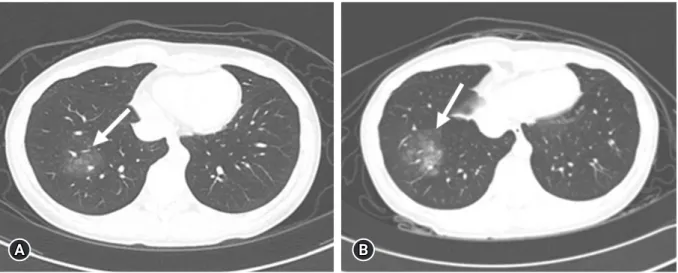
stopped without any special treatment but had recurred every 2–4 months. When hemoptysis had recurred 5 months prior, the pa- tient had again visited the hospital. While her chest radiograph was unremarkable, chest computed tomography (CT) showed a lesion with a focal ground-glass opacity (GGO) pattern in her right lung (Fig. 1A). No abnormal findings were found in other examinations, including bronchoscopy. Her tuberculin test was negative. The hemoptysis improved after 2 days and the GGO-pattern lesion disappeared on follow-up CT. She had a 2 pack-year smoking history. The patient had no other known dis- ease or family history. She was married but had never given birth.
There was no history of pelvic surgery. Her menarche began at 14 years and her menstrual period was regular but with mild dys- menorrhea.
On presentation, the patient’s blood pressure was 124/83 mmHg, pulse rate was 76 beats/min, oxygen saturation was 98%, and she was afebrile. Her lung auscultation was clear. The labora- tory results included a hemoglobin concentration of 10.9 g/dL and platelet count of 373 K/μL. Her prothrombin/activated par- tial thromboplastin times were normal, at 13.4/30.8 seconds. Se- rum profiles including blood chemistry, electrolyte, and liver and renal function tests were normal. The serum levels of tumor markers such as cancer antigen 125 (CA 125) were not evaluated.
Her urine was red in color. Chest radiographs were unremarkable.
CT chest scans showed a focal GGO pattern in the right lower lung field in the same location as the lesion observed 5 months prior (Fig. 1B). While investigating the cause of her red-colored urine, we learned that the patient was on day 4 of her menstrual cycle and that her hemoptysis frequently occurred during men-
struation. Based on her history of frequent hemoptysis during menstruation with no other cause of hemoptysis, she was tenta- tively diagnosed with catamenial hemoptysis (CH). The patient was referred to a gynecologist for pelvic examinations, with no re- markable findings from ultrasonography or pelvic examination.
Video-assisted thoracoscopic surgery (VATS) was planned for histological confirmation. However, she was reluctant to agree to surgical resection for diagnosis. The gynecologist administered gonadotropin-releasing hormone (GnRH, 3.75 mg Leuplin DPS®) subcutaneously for control of her recurrent hemoptysis.
She visited the gynecological clinic and additionally received GnRH injection once monthly for 3 months, during which time there was no recurrence of hemoptysis.
Discussion
Endometriosis is defined as the presence of endometrial glands and stroma outside the uterine cavity. Endometriosis is estimated to affect 3%–10% of fertile and 2%–5% of post-menopausal wom- en. It is usually confined to the pelvis and rarely occurs in ex- tra-pelvic areas. Thoracic endometriosis syndrome (TES) refers to the various clinical and radiological manifestations associated with the deposition of endometrial tissue in the lung parenchyma, pleura, diaphragm, and/or tracheobronchial tree. The incidence of TES is very rare. Nearly all cases have been reported through case reports and small retrospective series [4,5]. The four main types of TES are catamenial pneumothorax, catamenial hemotho- rax, CH, and lung nodules. Of these, CH is an extremely rare manifestation, occurring in 7% of all TES cases [6].
Fig. 1. Chest CT scan performed during menstruation. (A) A GGO lesion (arrow) is visible in the right lower lung field on chest CT performed 5 months prior. (B) A similar GGO lesion (arrow) is also visible in the same position in chest CT performed in the emergency department for hemoptysis. CT, computed tomography; GGO, ground-glass opacity.
A B
https://doi.org/10.12701/yujm.2019.00304 60
Kim JH and Park SY. Recurrent hemoptysis in a young woman with a GGO lesion
CH was first reported by Lattes et al. in 1956 and approximately 74 cases have been reported in the English literature since that time [7]. Unlike other forms of TES, pleuritic chest pain is not a com- mon clinical presentation and symptoms may not occur with every menstrual cycle [8]. Fatal hemoptysis from CH has not yet been reported but it may cause life-threatening asphyxiation. Recent studies have reported massive hemoptysis requiring bronchial em- bolization in CH [9,10]. In addition, recurrent hemoptysis by CH can reduce the quality of life of patients due to the associated respi- ratory symptoms and anxiety. Therefore, early recognition of CH has significance for patients. However, CH is not easy to diagnose because of the limited number of cases and its nonspecific physical examination, laboratory, and imaging findings. Auscultation is gen- erally unremarkable and chest radiography and CT findings are nonspecific. Increased serum CA 125 levels have been reported, but only in patients with concurrent pelvic endometriosis [11].
Histologically, pulmonary endometriosis can be diagnosed when endometrial tissue is found in the lung parenchyma. Because most pathological lesions are located around the lung parenchyma, the role of bronchoscopy in diagnosis is limited [12]. Currently, VATS, which can directly observe the lung parenchyma, is the preferred method for histologic diagnosis; however, this method is invasive and can lead to complications [8]. CH is diagnosed by identifica- tion of the characteristic cyclic hemoptysis associated with men- struation after excluding other pulmonary causes of hemoptysis, for which treatment can be started on that basis [3]. Chest CT scans in CH often show nonspecific findings such as ill- or well-de- fined opacities, nodules, thin-walled cavities, bullous formations, and GGO patterns [13,14] . Although the results are nonspecific, a comparison of serial CT scans not only helps in the detection of CH but also in determining the underlying causes of the hemopty- sis [9,15]. Pelvic endometriosis may help clinicians to suspect CH;
however, TES is not always accompanied by pelvic endometriosis.
While 50%–85% of women diagnosed with TES have concomi- tant pelvic endometriosis, the incidence of TES in women with pelvic endometriosis is unknown [16].
CH can be treated medically or surgically; however, there are no clear treatment guidelines. Hormone therapy, including GnRH, oral contraceptives, progesterone drugs, and danazol, is commonly used for the treatment of CH. Our patient had no he- moptysis recurrence for 3 months with GnRH; however, long- term follow-up was not performed. With medical treatment alone, hemoptysis in CH recurs in up to 50% of patients [16]. Consider- ing the pathogenesis of TES, inhibiting estrogen stimulation by removing endometrial tissue is reasonable and recent studies sup- port the efficacy of combined surgical and medical therapy [8,17]
In conclusion, despite recent advances in diagnostic techniques,
CH is not easy to diagnose in the ED due to the scarcity of cases and its nonspecific examination results. However, recurrent he- moptysis due to CH causes not only patient anxiety and discom- fort but may also cause asphyxia or massive hemoptysis. When ruling out the common causes of hemoptysis, identification of the relationship between hemoptysis and menstruation is helpful for the diagnosis of CH. Therefore, physicians should assess this rela- tionship in women of childbearing age presenting with repeated hemoptysis without a definite cause.
Acknowledgments
Conflicts of interest
No potential conflict of interest relevant to this article was report- ed.
ORCID
Jong Ha Kim, https://orcid.org/0000-0003-4131-5992 Sin-Youl Park, https://orcid.org/0000-0003-4005-1956
References
1. Garzon AA, Cerruti MM, Golding ME. Exsanguinating he- moptysis. J Thorac Cardiovasc Surg 1982;84:829–33.
2. Han CD, Kim YJ, Lee YS, Park JY, Jung TH. Evaluation of pa- tients with hemoptysis and a normal chest roentgenogram. Tu- berc Respir Dis 1995;42:42–9.
3. Jean-Baptiste E. Clinical assessment and management of mas- sive hemoptysis. Crit Care Med 2000;28:1642–7.
4. Vinatier D, Orazi G, Cosson M, Dufour P. Theories of endome- triosis. Eur J Obstet Gynecol Reprod Biol 2001;96:21–34.
5. Alifano M, Trisolini R, Cancellieri A, Regnard JF. Thoracic en- dometriosis: current knowledge. Ann Thorac Surg 2006;81:761–9.
6. Joseph J, Sahn SA. Thoracic endometriosis syndrome: new ob- servations from an analysis of 110 cases. Am J Med 1996;100:
164–70.
7. Lattes R, Shepard F, Tovell H, Wylie R. A clinical and patholog- ic study of endometriosis of the lung. Surg Gynecol Obstet 1956;103:552–8.
8. Azizad-Pinto P, Clarke D. Thoracic endometriosis syndrome:
case report and review of the literature. Perm J 2014;18:61–5.
9. Kim CJ, Nam HS, Lee CY, Yum HK, Yang SH, Seo KH, et al.
Catamenial hemoptysis: a nationwide analysis in Korea. Respi- ration 2010;79:296–301.
10. Shin SP, Park CY, Song JH, Kim HM, Min D, Lee SH, et al. A case of catamenial hemoptysis treated by bronchial artery em-
61 https://doi.org/10.12701/yujm.2019.00304
Yeungnam Univ J Med 2020;37(1):59-62
bolization. Tuberc Respir Dis 2014;76:233–6.
11. Hwang SM, Lee CW, Lee BS, Park JH. Clinical features of tho- racic endometriosis: a single center analysis. Obstet Gynecol Sci 2015;58:223–31.
12. Hope-Gill B, Prathibha BV. Catamenial haemoptysis and clomi- phene citrate therapy. Thorax 2003;58:89–90.
13. Rousset P, Rousset-Jablonski C, Alifano M, Mansuet-Lupo A, Buy JN, Revel MP. Thoracic endometriosis syndrome: CT and MRI features. Clin Radiol 2014;69:323–30.
14. Elliot DL, Barker AF, Dixon LM. Catamenial hemoptysis. New
methods of diagnosis and therapy. Chest 1985;87:687–8.
15. Jang HI, Kim SE, Kim TJ, Lee YY, Choi CH, Lee JW, et al. Cata- menial hemoptysis accompanied by subcutaneous endometrio- sis treated with combination therapy. Obstet Gynecol Sci 2017;60:236–9.
16. Channabasavaiah AD, Joseph JV. Thoracic endometriosis: revis- iting the association between clinical presentation and thoracic pathology based on thoracoscopic findings in 110 patients.
Medicine (Baltimore) 2010;89:183–8.
17. Alifano M, Roth T, Broët SC, Schussler O, Magdeleinat P, Reg- nard JF. Catamenial pneumothorax: a prospective study. Chest 2003;124:1004–8.
https://doi.org/10.12701/yujm.2019.00304 62
Kim JH and Park SY. Recurrent hemoptysis in a young woman with a GGO lesion