A Nexus Study on the SEA and the Meta-urban Planning (MUP)
Jong-Gwan Jung
Research Fellow of Chungnam Development Institute (CDI) 101 Geumheung-dong, Gongju, Chungnam, 314-140, Republic of Korea
(Manuscript received 25 October 2009; accepted 10 April 2010)
광역도시계획과 전략환경평가 연계방안
정 종 관
충남발전연구원 환경생태연구부 (2009년 10월 25일 접수, 2010년 4월 10일 승인)
Abstract
광역도시계획은 전략계획, 정책계획, 지침계획의 성격을 지니는 공간계획으로 청사진 계획으로 운용되어 온 기존의 광역개발계획 및 도시기본계획과 구분된다. 광역도시계획이 정하는 사항은 도 시기본계획 및 관련 하위계획에서 기본적 취지를 검토하여 집행됨으로써 이들 계획에 대하여 지침 (guideline)적 성격을 가지나, 직접적으로 개별 개발행위나 토지이용행위를 구속하지는 않는다.
행정중심복합도시 광역도시계획에 대한 전략환경평가는 국토해양부 시행지침에서 제시한 절차를 준용하되, 계획수립 여건을 고려하여 평가계획 수립, 항목과 범위 설정(scoping), 환경성평가, 보고 서 작성, 보고서 검토, 모니터링 및 사후평가의 6단계로 진행하였다.
전략환경평가 시 구체적인 항목과 범위, 평가방법 등은 계획의 범위와 성격, 내용 등에 대해 대안 의 비교·검토가 가능하도록 4가지 사항을 중점적으로 고려하였다. 즉, 정책목표 달성방법의 환경 적 적정성, 대안의 설정, 자원과 에너지 이용의 효율성, 계획이 지구환경에 미치는 영향 등이다. 계 획의 환경성 제고를 위해 설정한 항목은 인구, 토지이용계획, 교통계획, 녹지관리 등 4가지이며, 평 가과정에서 반복 및 환류를 통하여 계획과 평가간의 연계성을 도모하였다. 이 과정에서 공간구조 변 화는 행정중심복합도시를 정점으로 하고 주변 연결거점을 3개로 늘려 조정하였다.
주요어 : Strategic Environmental Assessment (SEA), Meta-urban Planning (MUP), Regional Urban Planning (RUP), Multi-functional Administrative (MFA) City
Corresponding Author: Jong-Gwan Jung, Research Fellow of Chungnam Development Institute (CDI) 101 Geumheung-dong, Gongju, Chungnam, 314-140, Republic of Korea Tel: 82-41-840-1200 Fax: 82-41-840-1219 E-mail: [email protected] 연구논문
I. Introduction
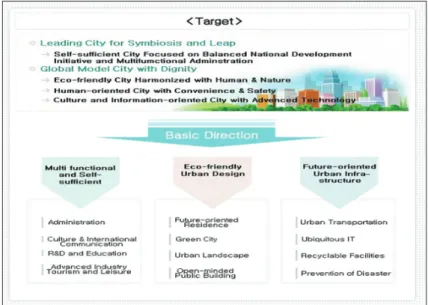
According to the planned economic structure, scarce resources invested into particular regions and industries such as heavy and petrochemical industries. Under this situation, unbalanced development generated many adverse social ones, such as social disintegrated and disparity, and weak local autonomy. Growing regional divide becomes a factor to prevent the futuristic balanced development from sustainable growth of Korea. In the context of the leading policy for balanced regional development plan, the former government promoted construction of the Multi- functional Administrative (MFA) City (Figure 1) with a population of 500,000 until 2030 as a core administrative and self-sufficient function as well (MOCT, 2006).
By the legislation of the Special Act for the Construction of Multi-functional Administrative City, the Minister of Land Transport & Maritime Affairs designated the planned area and its vicin- ity as a planning boundary and then made a
MUP framework by taking into deliberation. In this stage, the process for green city including land purchase in the selected areas, design and implementation planning is a main task to be addressed (Lee, Yong-Woo and Lim Sang-Yeon, 2006).
The MUP of the MFA city is superior to the Regional Urban Planning (RUP) of Daejeon and Cheongju and other urban basic ones. In accor- dance with this higher meta-urban plan, these basic and regional plans are changed for the maintenance of consistency. The MUP of the MFA city has the characteristics of strategic, poli- cy oriented and guidance, so it is different from the former conventional regional and basic urban plan in the review of blueprint methodology.
It is mainly focused on the implementation plan for the enforcement of objectives as set by strategic goal for the solution of main policy sub- ject themes rather than the proposition of long- term futuristic images in the perspective of strate- gic plan side. And it carries out the role of sys- tematic presentation of execution and measure
Figure 1. Basic policy plan for the development of the MFA City
programs to be promoted by the policy subjects for the achievement of strategic goal as a policy side.
It has a function of presentation in the process of basic urban planning in detail as a guideline, and conditions for considering the approval along the individual development projects as a guidance side (MOE, 2008). Regulation items of the MUP are served as guidelines for the imple- mentation of the basic plans by reviewing the purport of lower level, but they are not directly subject to restriction of individual development and land use planning (Han, Sang-Wook et al.,
2006).II. Implementing Method of SEA
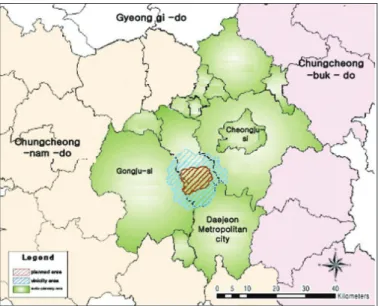
Boundary of the MUP of the MFA city (Figure 2) has designated and noticed by the Minister of MLTM through the deliberation of committee for the promotion with the whole 3,598km2 in the planned area and its outskirts(Chungnam Provincial Government, 2008).
Range of time is set by 2005 as a standard, and 2030 as a target for the completion of con- struction of the MFA city. Range of contents is composed of objective, strategy and spatial struc- ture as a basic initiative (Lee, Byung-Joon, 2007), and includes the meta-level land use planning, green tract and environmental conservation, transport and physical distribution, facilities, landscape, culture, leisure and prevention of dis- aster, and management programs for the enhancement of effectiveness of the plan as well.
SEA on the MUP was processed on the basis of the “Directive on the SEA Working Stipulation (2006. 12 revised)” of the Ministry of Land, Transport & Maritime Affairs (MLTM) due to it is pertinent to the long-term basic plan to be applied for, and by applying the directive criteria have been provided, we analyzed and evaluated the environmental impact of these planning con- tents (Figure 3). To draw out a rational quantita- tive evaluation results, matrix and checklist tech- niques can be used, but the latter would be rather reasonable to apply for the comparison
Figure 2. Boundary of the MUP in the MFA city
scale (Therivel, R. and Wood, G., 2004).
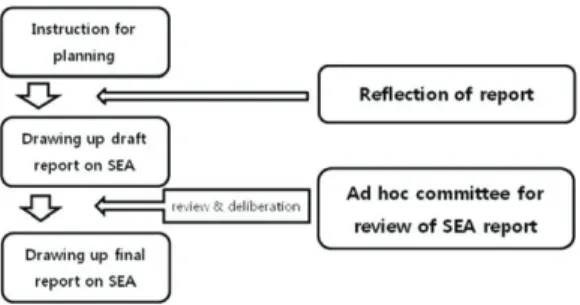
In compliance with the procedure of SEA and taking into account the implementation of plan, it was processed by 6 stages as introductory plan- ning of evaluation, scoping as set-up of evalua- tion items, evaluation of programs in detail (feed- back of adjustment of program after evaluation as a follow-up process), report on evaluation results, review of report and consultation, ex post
management of evaluation (Figure 4).
SEA integrated in planning has affirmative points not only as in viewed to be most efficient in affecting plan and cost-effective planning and assessment process, but also it will affect negative impact on the transparency of the plan-making process and possibilities for public involvement and the visibility of its effects which can be com- promised (Figure 5, Saddler, Barry, 2005).
III. Application of SEA to the MUP
SEA is a supporting tool for systematic deci- sion making processes aimed at sustainable development, integrating consideration of the economic and social impacts, together with the environmental aspects in the process of upper- level administrative planning, carried out prior to Figure 3. Outline of drawing up SEA report
Figure 4. Flowchart of the SEA process
beginning a development project (Saddler, Barry, 2005). The application method of analysis for the MUP is implemented by the macro scale and qualitative to policy goal, promotion strategy and direction and even to contents for further quanti- tative, if necessary. The MUP should be allowed to collect the contents on the consideration of environmental aspects in accordance with the implementation of SEA. Particularly in the course of SEA the definite items, range and evaluation methods are set up by the MUP of the MFA con- sidering the contents and characteristics of plan, and it should be possible to compare and review the alternatives as follows: Firstly, policy goal, strategy direction, and environmental suitability for the promotion of scheme are the critical path.
Secondly, set-up alternatives, and then consider resources and energy efficiency in parallel with
global impacts of the plan.
Selection of an optimum alternative to con- serve the environment by evaluation of multiple options proposed in compliance with the items in SEA according to the sectored contents and plan- ning indicators. On the particular procedure and enforcement of SEA, we can review the contents of planning which are identical to the environ- mental policy and criteria according to the addi- tional guideline promulgated by the Minister of MLTM separately.
For the purpose of drawing out core findings which are main issues to consider in environ- mental aspects for difference in each planning step, we should present eco-friendly contents and process of planning through the review of advanced cases and comparison of alternatives.
For self evaluation items in the context of sus-
Figure 5. Concurrent Feedback of the MUP and the SEA Process
tainability in the MUP, the applied framework is the matrix methodology, because it is more rele- vant than checklist one, a list of recommended methods for solving specific environmental prob- lems. However, a compendium of methods, with numerous footnotes and explanations of caution, is likely to be in the process of an iterative man- ner for the integration of the SEA process into the various stages of the plan-making process.
The contents of planning process of the MUP are conceptual in the focus of a strategy and policy as well as guideline, so it does not include the development plan in detail. Conventionally, we can apply the environmental indicators to over- come the objectiveness as a limiting factor of qualitative assessment; however it is not easy to adapt for its inherent attribute of abstraction.
IV. Evaluation Result and Improvement
To draw-out core factors in the SEA process, in the initial self assessment as a result of screen-
ing process which has done by the ad hoc com- mittee, four major factors are main concerns:
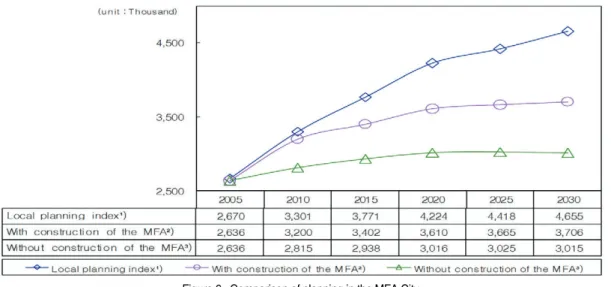
population (Figure 6), land use planning, land- scape management and meta-transport planning.
Within this context, scoping requires more public consultation to know their concerns and opin- ions. Moreover, it provides the stakeholders an opportunity to voice their concerns at the early stage of assessment. In this case, usage of expert opinion is possibly the best choice to draw out four major factors, and can include the environ- mental factors as well.
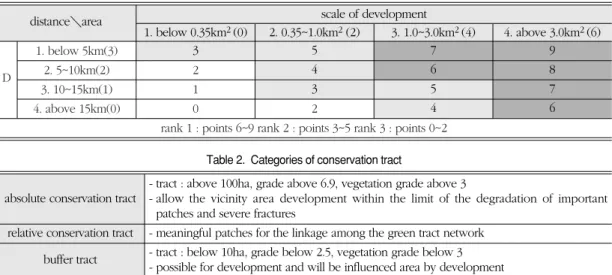
In the aspect of eco-friendly land use planning, we can consider the weight of index to the dis- tance as 2:1 in the aspect of scale of project applied (Table 1). According to the principle of smart growth with minimizing the urban sprawl- ing and linking the existed central area effective- ly, making gradation considering the scale of pro- ject and distance from the CBD is necessary req- uisite condition. In the context of landscape ecol- ogy, green tract system has composed of matrix,
Figure 6. Comparison of planning in the MFA City
Note: 1) Local planning index includes the existed planning with the MFA population prediction2) With construction of the MFA includes the population prediction in accordance with the consideration of the impact along the construction
3) Without construction of the MFA includes the population prediction in the Meta-urban area without construction
corridor and patch, so it can be analyzed by huge passage or patch (Table 2). And patch has the meaning of functional linkage among the eco- logical factors; it accordingly can be set up as three categories. Spatial structure of the MUP has changed from two adjacent subordinate urban clusters to three ones for the prevention of sprawling and for the enhancement of develop- ment effect in the MFA City and its outskirts
(Figure 7, Figure 8).
V. Conclusion
On the planning process in parallel with meta- urban planning council, public hearing and advi- sory committee, four major review items have been brought up including population index, land use planning, transportation and tract man- Table 1. Priority simulation for the local development project
distance\areascale of development
1. below 0.35km2 (0) 2. 0.35~1.0km2(2) 3. 1.0~3.0km2 (4) 4. above 3.0km2 (6)
1. below 5km(3) 3 5 7 9
D 2. 5~10km(2) 2 4 6 8
3. 10~15km(1) 1 3 5 7
4. above 15km(0) 0 2 4 6
rank 1 : points 6~9 rank 2 : points 3~5 rank 3 : points 0~2