- 557 -
Double Vent 창호 시스템의 단열성능평가
유 승 호†, 박 진 우*, 문 현 준
단국대학교 건축공학과, *단국대학교 대학원 건축공학과
The Evaluation of Thermal Performance of Double Vent Window System
Seung Ho Ryu
*†, Jin Woo Park
*, Hyeun Jun Moon
***
Department of Architecture Engineering, Dankook University, Yongin, Korea
**
Professor, Department of Architecture Engineering, Dankook University, Yongin, Korea
ABSTRACT: Window system is an essential component for ventilation, lighting, and thermal environment in buildings. However, window system has the lowest insulation performance and may cause high energy consumptions, if it is not properly designed. Thus, performance of window systems play an important role in built environment. This study proposes a new window systems for balcony, which has double vents and analyses the thermal performance using an intergrated simulation method with Therm 6.1 and Widow 6.1.
The result shows higher U-factor than conventional window systems. It is expected that the double vent window system can increase thermal performance and save energy in apartment houses.
Key words: U-Factor(열관류율), Therm 6.1(Therm 6.1 프로그램), Window 6.1(Window 6.1 프로그램), Double Vent Window System(Double Vent 창호 시스템)
†Corresponding author
Tel.: +82-31-8005-3750; fax: +82-31-8005-3704 E-mail address: [email protected]
1. 서 론
하루가 다르게 급등하는 고유가 시대인 요즘 에너지 소비 절약에 대한 중요성은 점점 더 커져 가고 있다. 에너지 소비에 있어서 건축 부분이 차지하는 비율은 국내 전체 에너지 소비량의 약 25%에 달하며. 산업 등 다른 분야에 비해 연간 에너지 소비 증가율이 큰 추세이다. 이렇게 건물 의 에너지 소비량이 높은 주원인은 건물 외피의 단열성능과 직접적인 관련이 있으며 건물의 외피 중에서도 일반 벽체의 열손실에 비해 약 6배 이 상의 열손실이 일어나는 창호 시스템의 열 성능
향상이 꾸준히 요구되어 왔다. 창호는 건물에 있 어서 조망성, 채광 및 환기 등을 위하여 필수적 인 부분이지만 열적인 측면에서 건축물의 외피 중 가장 취약한 부위이며 창호에 의한 에너지소 비량은 건물전체의 20∼40%를 차지하고 있다. 때 문에 창호는 에너지 절약 측면에서 가장 우선적 으로 고려되어야 하는 중요요소이다. 특히 최근 의 건축물의 추세는 조망 및 의장적 요인과 경량 고층화 경향으로 인해 외피의 창면적비가 지속적 으로 증가함에 따라 창을 통한 열손실 절감 기술 이 매우 중요한 역할을 담당하고 있다.
이에 따라 본 연구에서는 단열성능을 향상시킬 수 있는 각 요소별 핵심기술들을 조합하여 벽체 의 열관류율에 근접할 수 있는 창호시스템의 설 계를 제시하고 이를 Therm 6.1과 Window 6.1을 통한 시뮬레이션을 통해 평가하여 상용화, 보급 화 하기위한 기초 자료로 활용하고자 한다.
08-W-095
대한설비공학회 2008 동계학술발표대회 논문집 pp. 557 ~ 560
- 558 - Material Conductivity (W/m-k)
Aluminum 160
Gasket 0.34
Polyamide 0.25
Silicone 0.34
Table 1 Material properties
Name Type Conductivity (W/m-k)
Viscosity (kg/m-s)
Cp (J/kg-k)
Density
(kg/m
3) Prandtl
Air pure 0.0241 0.000017 1006.10 1.2922 0.7197
Table 3 Gas properties
Temperature film (W/m
2-k)
Interior 20℃ 9.43
Exterior 0℃ 13.15
Table 4 Environmental condition
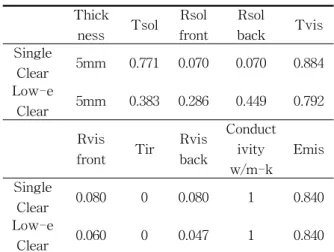
Thickness Tsol Rsol front
Rsol
back Tvis Single
Clear 5mm 0.771 0.070 0.070 0.884 Low-e
Clear 5mm 0.383 0.286 0.449 0.792 Rvis
front Tir Rvis back
Conduct ivity w/m-k
Emis
Single
Clear 0.080 0 0.080 1 0.840
Low-e
Clear 0.060 0 0.047 1 0.840
Table 2 Glass Properties
2. 시뮬레이션 개요2.1 시뮬레이션 프로그램
본 연구에서는 미국 LBNL(Lawrence Berkeley national Laboratory)에서 개발하여 세계적으로 창호의 열 성능을 시뮬레이션 하기 위해 폭넓게 사용되는 Therm 6.1과 Window 6.1을 사용하였 다. Therm 6.1과 Window 6.1은 미국의 국립 창 호 인증 위원회(NFRC : National Fenestration Ration Council) 및 미국 환경성(EPA : U.S.
Environmental Protection Agency)에서 창호에 대한 인증 평가 시 이용되고 있으며, 주택의 창 호 선정 시 유지비용 및 에너지 절감률을 예측하 기 위한 정량적 도구로 활용되고 있다.
Therm 6.1과 Window 6.1은 상호 호환관계를 갖으며, Therm 6.1에서는 Window 6.1에서 설정 한 Glazing System의 라이브러리를 이용하여 각 부분의 창틀을 포함한 창의 열적특성을 구하고, 이를 다시 Window 6.1에서 전체 창호시스템의 열관류율을 구하는데 사용할 수 있다.
2.2 요소별 물성치 및 경계조건
본 연구에서는 Therm 6.1과 Window 6.1을 이 용하여 Double Vent Window 시스템에 대한 시 뮬레이션을 실시하였다. 시뮬레이션에 사용된 Frame의 각 요소별 물성치는 다음의 Table 1에 나타내었다. Glazing System의 Glass에 대한 물 성치와 충진 Gas의 물성치는 각각 Table 2와 Table 3에서 나타내었다.
Window 6.1에서 창호의 전체 U-Factor값을
산출하기 위해서는 시뮬레이션상의 내부와 외부 의 경계조건이 지정되어야 하는데, 본 연구에서 는 KS F 2278의 ‘창호의 단열성 시험 방법’에서 규정 되어있는 내부와 외부의 온도조건 및 표면 열전달 계수를 경계조건으로 적용하였으며 그 내 용은 Table 4에서 나타내고 있다.
3. 열 성능 평가
본 연구에서는 선행 연구를 통해 개선된 double vent window system을 제안하여 이에 대한 열 성능을 평가한다. Frame의 형식은 Tilt
& Turn Type과 Fixed Type의 Case로 나누어 실시하였다. 각 Case에 적용된 Frame의 단면도 는 Fig. 1에서 나타내고 있다. Thermal break는 Polyamide 재질이며, 단열 스페이서는 Stainless steel 재질을 사용하였다.
시뮬레이션에 적용된 창의 면적은 두 경우 모
두 2m
2(W : 1m x H : 2m)이며 Frame의 폭은
Case 1이 104.21mm이며 Case 2가 94.21mm이다.
- 559 - Fig. 1 Frame profile in case
Fig. 2 U-Factor in case 1 sections
Fig. 3 Temperature distribution in Case 1
Fig. 4 U-Factor in case 2 sections 3.1 Case 1의 단열성능 평가
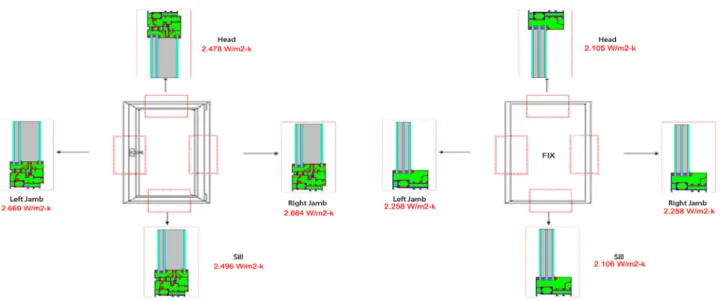
Case 1의 Frame 형식은 Tilt & Turn Type으 로 Tilt & Turn Type은 Glazing을 둘러싸고 있 는 각 부위별 Frame의 내·외부 경계조건의 투영 면적이 같기 때문에 Section별 U-Factor값이 거 의 일정하며, 시뮬레이션을 통한 Frame Section 별 U-Factor값을 Fig. 2에서 나타내고 있다. 평 균 U-Factor값은 2.57 W/m
2-k였으며. 온도분포 는 Fig. 3과 같다.
Case 1에서 사용된 Glazing의 구성은 6Low-e + 12Air + 6CL + 56.2Air + 6CL이고 Low-e의 코팅은 Low-e 유리의 2번째 면에 실시하였다.
이때의 Glazing의 U-Factor값은 1.20 W/m
2-k로 나타났으며, Window 6.1을 통한 Case 1의 창호 의 전체적인 U-Factor값은 1.73 W/m
2-k로 나타 났다.
3.2 Case 2의 단열성능 평가
Case 2의 Frame 형식은 Fixed Type으로 창의 개폐가 불가능한 Type이다. 이러한 Fixed Type 창호는 Case 1의 Tilt & Turn Type과 함께 병 용되어 System 창호로 구성될 수 있으며, 발코니 확장에 따라 사용이 증가되고 있다. Tilt & Turn Type과 마찬가지로 Glazing을 둘러싸고 있는 각 부위별 Frame의 내·외부 경계조건의 투영 면적 이 같기 때문에 Section별 U-Factor값이 거의 일 정하며 Case 2의 U-Factor값은 평균 2.27 W/m
2-k로 나타났다. Case 2의 Frame Section별 U-Factor값과 각 Section별 온도분포를 Fig. 4와 Fig. 5에서 나타내고 있다.
Case 2에서 사용된 Glazing의 구성은 5Low-e
- 560 - Fig. 5 Temperature distribution in Case 2,
+ 12Air + 5CL + 12Air + 5Low-e이고 Low-e 의 코팅은 첫 번째 Low-e 유리의 2번째 면과 두 번째 Low-e 유리의 1번째 면에 실시하였다. 이 때의 Glazing의 U-Factor값은 0.93 W/m
2-k로 나 타났으며, Window 6.1을 통한 Case 2의 창호의 전체적인 U-Factor값은 1.41 W/m
2-k로 나타났 다.
4. 결 론
본 연구에서는 건물의 단열성능에 가장 취약부 분인 창호 시스템의 열 손실을 줄이고자 Double vent window system을 제안하고 시뮬레이션을 통하여 단열성능을 평가하였다. 본 논문의 결과 를 바탕으로 도출한 결론은 다음과 같다.
(1) Case 1과 Case 2에 Glazing의 U-Factor값 은 각각 1.20 W/m
2-k와 0.93 W/m
2-k를 나타내 었으며, 기존의 double glazing 보다 단열 성능이 개선되었음을 확인할 수 있었다.
(2) Case 1과 Case 2의 전체 창호의 U-Factor 값은 각각 1.73 W/m
2-k와 1.41 W/m
2-k를 나타 내었다. 이는 현재 보편적으로 사용되고 있는 창 호보다 단열성능이 우수한 것으로 나타났다.
따라서 본 연구에서 제안한 double vent window system을 외부에 노출되는 발코니 창호 등에 사용하여 에너지 절감 효과를 기대할 수 있 을 것으로 사료된다.
후 기
본 연구는 현대알루미늄과 롯데건설의 지원으 로 수행되었으며, 이에 감사드립니다.
참 고 문 헌