pISSN 2466-1384 eISSN 2466-1392 Korean J Vet Res (2020) 60(3):105~108 https://doi.org/10.14405/kjvr.2020.60.3.105
105 ORIGINAL ARTICLE
A study on the needs to improve Korea abattoir's critical control point of HACCP system
Seongjoon Kim, Kwanghoon Choi, Donghoon Myung, Hangsung Chung, Sukwon Kim, Nonghoon Choe*
College of Veterinary Medicine, Konkuk University, Seoul 05029, Korea
Abstract: These days abattoirs' hygiene of Korea is regulated by Hazzard Analysis Critical Control Point (HACCP). Although 20 years have been left since first HACCP was adjusted in Korea, 12% of abattoirs got inconsistence on evaluations. Food poisoning caused by bacteria feces like pathogenic Escherichia coli and Salmonella has not decreased. These bacteria on meat cross- contaminate at the abattoir. Therefore, field verification of abattoir's critical control point (CCP) and experiments to find alternative ways of the CCP were conducted. The aerobic bacteria were measured before and after high-pressure water based washing process set as CCP in most abattoirs. Four parts of cattle carcasses were selected to apply sponge-swab method. The effects were < 1 log reduction which is not significant. Lactic acid (LC), chlorine dioxide (ClO
2) and slightly acidic electrolyzed water (SAEW) were used to measure the effect of reducing bacteria on beef by the different time. LC has 1.24–2.02 log reduction for aerobic bacteria. ClO
2has 1.44–1.96 log reduction for aerobic bacteria. SAEW has 1.1–1.91 log reduction for aerobic bacteria. There was significant difference according to concentrations (p < 0.05). This study presents legitimacy for hygiene improvement of CCP by field verification. In addition, chemical disinfectants that can be mechanically applied have better reduction effects of high-pressure washing.
Keywords: abattoirs, South Korea, Hazard Analysis and Critical Control Points, disinfectants
Introduction
Meat is highly prone to contamination by various bacteria, such as Salmo- nella, Listeria, Campylobacter, Clostridium perfringens, Escherichia coli O157:H7, and Yersinia. Of these, the greatest threat to public health is E. coli O157:H7, which is derived from feces and is typically found in the intestine of cows [1]. So high-pressure water based washing method that is used at the majority of abattoirs in Korea is set as a critical control point (CCP). This method controls contamination in meat through water pressure and time.
However, using only water pressure and time involves many disadvantages.
Organic matters on the meat are often scattered due to the high-pressure, and these scattered organic matters can give way to secondary contamination.
Moreover, if time, volume of water, pressure, temperature, and various other conditions are not met, the microorganism reduction effect drastically decreases, which means that contamination in one area of meat may quickly spread throughout other areas of meat [2-4]. Other various methods have been proposed to control meat contamination through results from previous stud- ies. However, these methods cannot be used if they are not economically fea- sible. 82% of abattoirs in Korea replied that their business conditions are difficult or average, indicating that most abattoirs in Korea face financial issues [5].
Therefore, this study will evaluate the effectiveness of high-pressure water based washing that is used in most abattoirs. Also, the study of reduction effect of approved chemical disinfectants was conducted to replace CCP.
Materials and Methods
Verification of high-pressure water based washing method Location
This study was performed a t Livestock Process Complex in Gyeonggi-do.
The abattoir processed up to 10 cattles and 1,700 pigs on average per day.
*Corresponding author Nonghoon Choe
College of Veterinary Medicine, Konkuk University, 120 Neungdong-ro, Gwangjin-gu, Seoul 05029, Korea
Tel: +82-2-450-3709 Fax: +82-2-454-3709 E-mail: [email protected] ORCID
Seongjoon Kim
https://orcid.org/0000-0001-5505-2957 Kwanghoon Choi
https://orcid.org/0000-0002-0580-250X Donghoon Myung
https://orcid.org/0000-0003-3251-6813 Hansung Chung
https://orcid.org/0000-0003-4405-7511 Sukwon Kim
https://orcid.org/0000-0003-1606-719X Nonghoon Choe
https://orcid.org/0000-0002-8809-6064 Conflict of Interest
The authors declare no conflict of interest.
Received: December 27, 2019
Revised: May 6, 2020
Accepted: June 4, 2020
106 Seongjoon Kim, Kwanghoon Choi, Donghoon Myung, Hangsung Chung, Sukwon Kim, Nonghoon Choe
Swab Total 25 carcasses were collected in 5 days. Collecting site was high-pressure washing process defined as CCP on abat- toir. Whirl-pak (Nasco, USA) was used to collect samples.
Sterilized sponges soaked with 20 mL 0.1% (W/V) peptone water (PW; peptone, Difco, USA) were used to swab. Bris- ket, front-leg, flank and neck were collected (100 cm
2). To avoid overlapped sampling and accuracy, sampling was per- formed at the left side of carcasses. After collecting samples, samples were kept in the refrigerator until performing micro- biological examination. Microbiological examinations were performed within 20 h after sampling.
Microbial testing
The 20 mL of 0.1% PW was inserted to Whirl paks sam- pling cattle carcass to make total volume as 40 mL. Whirl paks were homogenized for 30 sec using shaker. After homogenization, 1 mL was transported from whirl-pak to AC petri film (3M
TM, USA). All films were incubated at 36
oC for 48 h.
Decontamination effects of chlorine dioxide (ClO
2), lactic acid (LC) and slightly acidic electrolyzed water (SAEW) for different concentration on bacteria inocu- lated beef
Bacteria culture
Aerobic bacteria were used. Aerobic bacteria were col- lected from carcass not taking high-pressure washing. Sam- pling points were brisket, flank and rump (100 cm
2). Samples were transported laboratory being chilled. The 1 mL was transported from whirl-pak to nutrient broth (NB; Oxoid, USA) to proliferate. After incubating at 37
oC for 24 h, 1 mL of incubated NB was transferred to another NB. These cycles were repeated until performing experiment because of the cell activations.
Disinfectants
LC (Tokyo Chemical Industry Co., Ltd., Japan) was car- ried in powder form. LC powder was dissolved in water at 55
oC before conduct experiment. Concentration of LC was 1%, 2%, 3% (W/V). Slightly acidic electrolyzed water (SAEW; Cosmic-Round Korea Co., Ltd., Korea) was carried in the aqueous form. SAEW w as diluted in w ater at 55
oC before conduct experiment. Concentration of SAEW was 10, 20 and 30 ppm. ClO
2(Furgo-farm Co., Ltd., Korea) was car- ried in aqueous form. ClO
2was diluted in water at 55
oC before conducting experiment. Concentration of ClO
2w as 10, 20 and 40 ppm. Solutions were prepared using deionized water.
Application methods
To mimic abattoir’s environment, the applied system was made. Beef was broken into pieces aseptically by 5 g in clean bench with sterilized scissor and forceps. Beef was trans- ferred to small petri-dishes (35.00 × 10.00 mm) with a hole
of the side. The hole at petri-dish was made for letting disin- fectants get out. If disinfectant couldn’t get out, it would affect the results of experiment. The 0.5 mL of NB which contains aerobic bacteria from the abattoir was inoculated.
The inoculum density was adjusted to 0.010 absorbance units at 600 nm using a micro ELISA plate reader (SoftMax Pro, USA). The mean concentration of inoculated NB was 5.77 log colony forming unit (CFU)/mL. There was 10 min attach- ing bacteria to beef. Five petri-dishes put into the chamber obliquely. Spray (Marolex Sp. Z o.o., Poland) containing dis- infectants was put in front of chamber. Length of spray to petri-dishes was 20 cm. Antimicrobial applications were sprayed for 5 or 10 sec. After being sprayed, wait 10 min. To stop activating disinfectants, beef on the dishes was trans- ferred to neutralization broth which contains 20% yeast extract (BD DIFCO, USA). Then the beef was shaken for 30 min on shaker.
Microbial testing
1 mL was transported from neutralization broth to AC petri film (3M
TM). All films were incubated at 36
oC for 48 h.
Statistical analysis
The data is expressed as mean and standard deviation of the log
10value. Statistical analysis was performed by Graph- Pad Prism 5.01(GraphPad Software Inc., USA). Two-way analysis of variance and Bonferroni post tests are used to analyze. Significant differences were defined as p < 0.05.
Results
Verification of high-pressure water based washing method Before high-pressure washing, the contamination levels of flank, brisket, front leg and neck are 2.05, 3.63, 3.23 and 2.85 log CFU/cm
2, respectively. After high-pressure wash- ing, the contamination levels of flank, brisket, front leg and neck are 2.18, 2.63, 2.38 and 2.16 log CFU/cm
2, respectively (Fig. 1). Average contamination level of carcasses at before high-pressure washing is 2.94 log CFU/cm
2. Average con- tamination level of carcasses at after high-pressure washing is 2.34 log CFU/cm
2. There is significant log reduction at brisket, front leg and neck. Contamination levels of brisket, front leg and neck after high-pressure washing were signifi- cantly reduced by 1, 0.86 and 0.68 log CFU/cm
2, respec- tively, compared with those before high-pressure washing (p < 0.05). However, in case of flank, there is no significant reduction between before and after high-pressure washing (p > 0.05). On the contrary, contamination level of after high- pressure washing is slightly increased than that of before high-pressure washing.
Decontamination effects of ClO
2, LC and SAEW for different concentration on bacteria inoculated beef
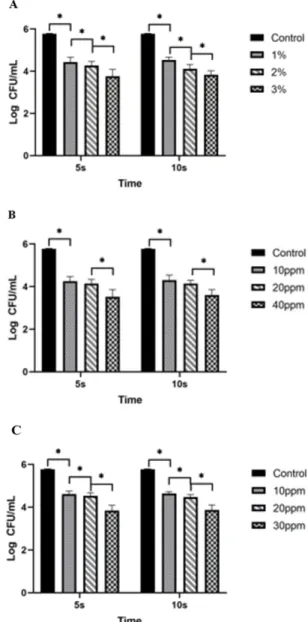
Application of LC for 5 sec significantly reduce aerobic
bacteria by 4.47, 4.22 and 3.75 log CFU/mL for treatment
Decontamination effects of disinfectants and abattoir's CCP method 107
concentration of 1%, 2% and 3%, respectively. Application of LC for 10 sec significantly reduce aerobic bacteria by 4.53, 4.12 and 3.84 log CFU/mL for treatment concentration of 1%, 2% and 3%, respectively. ClO
2at the concentration of 10, 20 and 40 ppm is significantly reduced aerobic bacteria by 4.24, 4.21 and 3.53 log CFU/mL after treatment for 5 sec, respectively, and by 4.25, 4.15 and 3.54 log CFU/mL after treatment for 10 sec, correspondingly. In addition, SAEW at the concentration of 10, 20 and 40 ppm was significantly reduced aerobic bacteria by 4.66, 4.52 and 3.88 log CFU/mL after treatment for 5 sec, respectively, and by 4.64, 4.49 and 3.86 log CFU/mL after treatment for 10 sec, correspond- ingly. There are no significant difference between treatment time (p > 0.05). However, when it comes to concentration there are significant reduction. (p < 0.05).
Discussion
The reduction of aerobic bacteria on chest, front leg and neck after high-pressure washing was 1.0, 0.86 and 0.68 log CFU/mL, respectively, compared with those before high- pressure washing (Fig. 1). According to the previous study, it is not very effective on a small number of common bacteria, coliform, and E. coli cells [6]. Also coincide with other stud- ies reporting that high-pressure washing with only water offers an extremely low bacteria reduction rate and even causes contamination on the surface of other pieces of meat [2-4,7]. Moreover, the log reduction value was negative for flanks, which demonstrates that microorganism contamina- tion increased after high-pressure washing than before. In the study that was conducted on a large-scale abattoir, the level of microorganismal contamination increased from 0.78 log CFU/cm
2to 1.01 log CFU/cm
2, revealing that the method acts to redistribute the bacteria than to remove them [8].
These results show the methods used in abattoir are not quite effective for meat hygiene. Therefore, the alternative meth- ods using disinfectants should be considered. LC has 1.24–
2.02 log reduction for aerobic bacteria (Fig. 2). This coin- cides with the results of previous studies reporting that 2%
LC sprayed onto beef head for 26 sec led to 1.52 log reduc- tion in microorganismal count, with 2% LC sprayed on beef resulting in 1.6 log reduction in microorganismal count [9,10]. Moreover, 2% LC applied for 15 sec on meat inocu- lated with E. coli was found to result in 1.5–2.2 log reduc- tion in E. coli count [11]. Similarly, when LC was sprayed in the abattoir, there was a 0.9–2.3 log reduction in aerobic bac- teria [12]. Another study also reported an improvement in the storage quality of meat to which LC was applied [13]. ClO
2has 1.44–1.96 log reduction for aerobic bacteria. This is sim- ilar to a previous study reporting that when 10 ppm of ClO
2Fig. 1. The contamination level of aerobic bacteria before/after high-pressure water based washing. Four spots (flank, brisket, front leg, neck) of cattle carcasses are collected (n = 25). All data are expressed as mean ± SD.
*
p < 0 .0 5.
Fig. 2. The decontamination effects of lactic acid (A), chlorine dioxide (B), slightly acidic electrolyzed water (C) regarding aer- obic bacteria on beef samples (n = 15). All data are expressed as mean ± SD.
*