DOI:https://doi.org/10.21218/CPR.2016.4.4.131 eISSN 2508-125X
D-UPFC Application as the Series Power Device in the Massive Roof-top PVs and Domestic Loads
Kyungsoo Lee*
Department of Energy and Electrical Engineering, Korea Polytechnic University, Siheung 15073, Republic of Korea
ABSTRACT: This paper shows the series power device in the massive roof-top PVs and domestic loads. D-UPFC as the series power device controls the distribution voltage during voltage rise (or fall) condition. D-UPFC consists of the bi-directional ac-ac converter and the transformer. In order to verify the D-UPFC voltage control, the distribution model is used in the case study. D-UPFC enables the voltage control in the distribution voltage range. Dynamic voltage control from voltage rise and voltage fall conditions is performed.
Scaled-down experimental test of the D-UPFC is verified the voltage control and it is well performed without high voltage spikes in the inductive load.
Key words: series power device, distribution-unified power flow controller, bi-directional ac-ac converter, roof-top PV
*Corresponding author: [email protected]
Received September 8, 2016; Revised September 13, 2016;
Accepted September 25, 2016
ⓒ 2016 by Korea Photovoltaic Society
This is an Open Access article distributed under the terms of the Creative Commons Attribution Non-Commercial License (http://creativecommons.org/licenses/by-nc/3.0)
which permits unrestricted non-commercial use, distribution, and reproduction in any medium, provided the original work is properly cited.
Nomenclature
V : voltage D : duty cycle
P : pole transformer capacity N : turns ratio
subscript
AE-PVC : autonomy-enhanced pv cluster
D-UPFC : distribution-unified power flow controller
1. Introduction
Japan set up the long-term R&D roadmap titled “PV2030” in June 2004. According to this scenario, it is known that mass deployment is expected up to 100 GW totally, more than 40% of which will be brought from residential roof-top PV applications.
To make this story realistic, the author proposed “Autonomy- Enhanced PV Cluster” concept
1,2). Fig. 1 illustrates a basic image of “Autonomy-Enhanced PV Cluster (AE-PVC)” by utilizing power electronic devices and battery storage stations.
The former will bring network control functions to improve grid
parameters along the community internal grids by utilizing shunt/series active components, meshed network, loop power controller (LPC). The existence of storage devices mainly gives higher degree autonomy control.
To realize 100% PV deployment of PV houses, it is necessary to solve voltage distribution and islanding detection restric- tions
1). This paper focuses on solving the voltage distribution restriction. To compensate voltage rise (or drop), a kind of automatic voltage regulator is introduced as the series power devices, which is called Distribution-Unified Power Flow Controller (D-UPFC)
3). Fig. 2 gives present and proposed approach of voltage control in the distribution grid
2).
When the voltage rise happens due to reverse power flow, present step voltage regulator (SVR) has narrow allowable voltage window. However, power electronic devices based D-UPFC can have wide allowable voltage window.
D-UPFC voltage control is performed from one of distribution grid side methods. Compared with present distribution grid voltage control methods, it has some advantages. It can control the active power, fast control the distribution voltage using pwm function, linearly controls the distribution voltage during voltage rise (or drop), and it can performs in the bi-directional power flow condition
3).
In this study, the D-UPFC voltage control in the case study is shown. The simulation condition is considered the actual distribution grid as the inductive load. The scaled-down experiment of D-UPFC voltage control is performed.
131
AC Storage Device AC Storage
Device
Community Grids
PVPV PV
PVPV PV PVPV
PV PVPV
PV
PVPV PV PVPV
PV
AC Storage Device AC Storage
Device
PVPV PV
PVPV PV PVPV PV PVPV
PV
PVPV PV PVPV
PV PVPV
PV PVPV
PV PVPV PV PVPV
PV PVPV
PV PVPV
PV
Shunt Power DeviceShunt Power Device
Inter-Feeder Router (LPC) Inter-Feeder Router (LPC) Power Device
External UtExternal Ut
100% PV Clusters Autonomy
Enhanced
PVPV PV PVPV
PV
PVPV PV PVPV
PV PVPV
PV PVPV
PV
AE-PVC Concept Fig. 1. Autonomy-Enhanced, Community-based PV Cluster
Concept by employing active control
Allowable Volt. Window Narrow
Allowance
Substation
External GridsExternal Grids
Passive Inter- connection Fluctuating Flow
SVR Set to upper limit
(a) Present approach according to existing regulations
Allowable Volt. WindowAllowable Volt. Window PE
PE
Wide AllowanceWide Allowance
External UtilityExternal Utility
Controlled Inter- connection Orderly
Flow
Battery Station Battery Station
AVR
AVR AVRAVR Anchor to centre
(b) Proposed approach which accepts 100% reversal power flow from clustered PV systems
Fig. 2. 2 types concept of the voltage distribution along the grid
Fig. 3. D-UPFC topology
Fig. 4. Bi-directional ac-ac converter circuit
2. D-UPFC concept
As mentioned in Fig. 2(b), the D-UPFC controls the distribu- tion grid voltage with the wide voltage window during voltage rise (or fall). The D-UPFC consists of the bi-directional ac-ac converter and the transformer. The transformer supplies a part of pole transformer secondary voltage and the bi-directional ac-ac converter regulates the voltage rise (or fall) in order to match the nominal pole transformer secondary voltage.
2.1 D-UPFC topology
The D-UPFC topology which consists of the bi-directional ac-ac converter and the transformer is shown in Fig. 3
3).
The operation of the D-UPFC topology is the output voltage V
outis controlled by the bi-directional ac-ac converter and the transformer. Thus, the equation of this topology can be written as,
1 2 _ 0
= +
out tr tr
V V V (1)
The bi-directional ac-ac converter consists of four power MOSFETs, input, and output filters. It provides direct ac to ac conversion and thus, there is no energy storage device. Also, it converts the output voltage always less than input voltage. The bi-directional ac-ac converter circuit is shown in Fig. 4.
This circuit is the same as dc-dc buck converter and thus, its equation can be written as,
2 _
=
2×
tr o tr
V V D (2)
where, D is duty cycle of the converter.
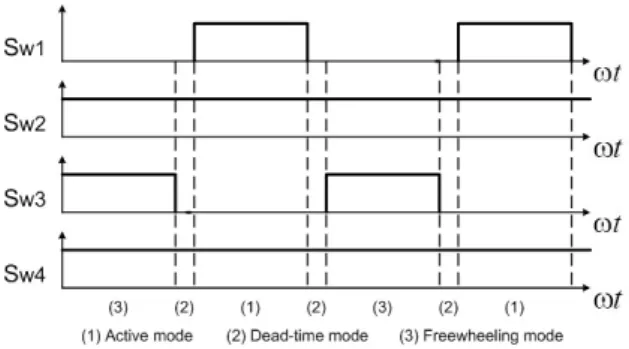
2.2 Bi-directional ac-ac converter switching patterns D-UPFC should be operated both forward power flow and reverse power flow condition in order to control voltage rise (or) fall. The transformer of D-UPFC can automatically transfer the ac power during bi-directional power flow condition. Thus, the ac-ac converter of the D-UPFC is required the operation during bi-directional power flow condition. The ac-ac converter with the bi-directional power flow is realized by the switching patterns. The switching patterns of the converter offer safe commutation without high-voltage spikes using intelligent PWM switching patterns. Switching patterns are decided by the polarity of input voltage V
tr2. When V
tr2is positive, S
w1and S
w3operate pwm switching, reversely. At the same time, S
w2and S
w4turn on state. Also, the switching patterns consists of active
mode, dead-time mode, and freewheeling mode. If the sign of
Fig. 5. Bi-directional ac-ac converter switching patterns when Vtr2 is positive polarity
Fig. 6. Phase diagram of D-UPFC input voltage Vs and output current Iout
Fig. 7. D-UPFC voltage control block
the V
tr2is changed, the switching patterns of four switches are reversed. Also, these switching techniques enables the power conversion without high-voltage spikes in the inductive or capacitive load
4). Fig. 5 shows the ac-ac converter switching patterns.
The bi-directional ac-ac converter switching patterns enable the proper operation in the four-quadrant states. Thus, the phase relation between D-UPFC input voltage V
sand output current I
outcan be drawn as Fig. 6.
In the forward power flow condition, V
sand I
outphase is decided by load power factor condition. If the load consists of resistive, the power factor is 1.0 and thus, the switching patterns of the bi-directional ac-ac converter are divided by V
spolarity.
However, the load power factor is not the same as 1.0, which means inductive or capacitive load, the switching patterns of the converter are divided by four-quadrant states depending on V
sand I
outpolarity.
2.3 Voltage control method and transformer tap relation
In the D-UPFC voltage control method, D-UPFC output voltage V
outis always controlled by reference voltage V
ref_dc. The D-UPFC control block is shown in Fig. 7.
The V
ref_dcis the same as low-voltage distribution grid voltage 202 V. The V
erroris calculated by V
ref_dcand RMS value of
V
out. The V
error_piis calculated through PI compensator. The maximum duty cycle of bi-directional ac-ac converter is 1.0 and the reference duty cycle V
ref_dutyis 0.5 during normal condition. If the voltage rise condition occurs, the value of V
pwmis decreased. Reversely, the value of V
pwmis increased during voltage fall condition. In the PWM control, the switching frequency of triangle signal is 20 kHz. D-UPFC input voltage V
sphase is detected and then used in the switching patterns.
As shown in Fig. 3, the transformer tap of D-UPFC is decided by bi-directional ac-ac converter in this paper.
According to the Japan’s voltage range regulations, the secondary voltage range of the pole transformer is 202±20 V (101±6 V). Considering the pole transformer voltage range, the ac-ac converter controls the distribution voltage ±20 V in this paper. The transformer tap of D-UPFC can be calculated by power relation of D-UPFC input and output
5).
1 2
s tr tr
P P = + P (3)
where, P
sis total input power, P
tr1is output power in winding N
1’, P
tr2is output power in winding N
21 1 2 2
( ) ( )
s s tr tr tr tr
V I × = V × I + V × I (4)
since, the transformer tap N
1is 1.0, N
1’ is 0.9, N
2is 0.2 and the normal duty cycle D of bi-directional ac-ac converter is 0.5.
1
9
tr
10
sV = V
22
tr
10
sV = V , and I
tr2= × D I (
out= I
tr1)
Equ. (4) can be rewritten as,
1 1 2
9 ( ) 2 ( 0.5 )
10 10
s s tr tr tr out
V I × = V × I + V × × I (5)
1 2
9 ( ) 1 ( )
10 10
s s tr out tr out
V I × = V × I + V × I (6)
s out
I = I (7)
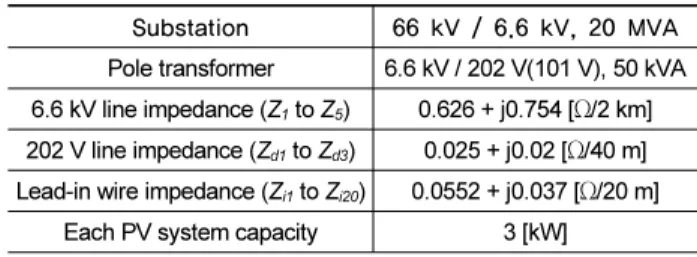
202 V line impedance (Zd1 to Zd3) 0.025 + j0.02 [Ω/40 m]
Lead-in wire impedance (Zi1 to Zi20) 0.0552 + j0.037 [Ω/20 m]
Each PV system capacity 3 [kW]
Table 2. D-UPFC parameters
Vref_dc 202 V Cin & Cout 50 [μF]
N1 : N1’ : N2 1 : 0.9 : 0.2
PI gain Kp=0.025
Vref_duty 0.5 Ki=0.001
Lin & Lout 50 [μH] Switching fre. 20 [kHz]
Fig. 8. Distribution model with D-UPFC installation
3. Case study
3.1 Distribution model
In order to verify the D-UPFC voltage control during voltage rise (or fall) in the distribution grid, the distribution model is proposed
4). The distribution model is assumed to be residential area in Japan. Total feeders of the distribution model are 8.
However, the distribution model for simulation is considered only 1 feeder. The distribution model using ATP-EMTP simulation tool is shown in Fig. 8.
The length of one feeder is 10 km and the pole transformer is located in every 2 km. The T
r1pole transformer of is connected with 20 roof-top PVs and they are divided 4 nodes. 5 roof-top PVs are connected to each node. The distance of each node is 40 m. The distance between each node and each roof-top PV house is 15 m. The maximum output power of each roof-top PV is 3 kW. The distribution model parameters are shown in Table 1.
D-UPFC parameters in the distribution model are shown in Table 2.
D-UPFC is installed after the secondary side of the T
r1pole transformer and the D-UPFC reference voltage V
ref_dcis 202 V.
The input filter reduces the input voltage and curent harmonics.
At the same way, the output filter reduces the output voltage and current harmonics from 20 kHz of switching frequency
4). In the reverse power flow, the present input filter and output filter is reversed.
In the case study, voltage fall and voltage rise conditions are simulated. In order to simulate voltage fall, the load
consumption power is changed. The pole transformer secondary capacity is calculated according to the load current,
capacity secondary secondary
P = V × I (8)
where, P
capacityis the pole transformer secondary capacity, V
secondaryis the pole transformer secondary voltage, I
secondaryis total load current.
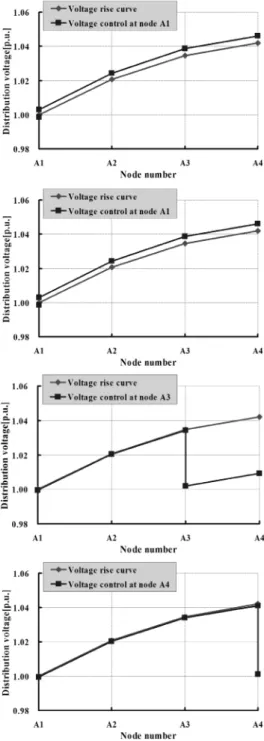
The voltage fall curve from node A
1to A
4which is caused by
load power change is shown in Fig. 9. The value of voltage
difference through the node A
1to A
4is due to the distribution
line impedance. The voltage of node A
4decreases more than
other nodes. D-UPFC voltage control during voltage fall
condition from node A
1to A
4is shown in Fig. 10(a) to (d),
respectively. Here, the pole transformer secondary capacity is
70%, which is already shown in Fig. 9. Through the voltage fall
simulation, the D-UPFC controlled the distribution voltage to
the reference voltage at the installation node.
Fig. 9. Voltage fall curve due to load power change
Fig. 10. D-UPFC voltage control during voltage fall at the installation site from A1 to A4
Fig. 11. Voltage rise curve due to reverse power flow from clustered PV system
Fig. 12. D-UPFC voltage control during voltage rise at the installation site from A1 to A4
(file clustered_heavy_test2_4.pl4; x-var t) c:XX0378-XX0080 0.15 0.19 0.23 0.27 0.31 [s] 0.35 -300
-200 -100
(a) Pole transformer secondary current
(file clustered heavy test2 4.pl4; x-var t)0.15 0.19 v:XX01120.23c:XX0498-XX0112 0.27 0.31 [s]0.35 -300
-200 -100 0 100 200 300
(b) D-UPFC output voltage (red) and current (green)
(file clustered heavy test2 4 pl4; x-var t)0.15 0.19 t: XX02830.23 0.27 0.31 [s]0.35
0.0 0.2 0.4 0.6 0.8 1.0
(c) D-UPFC duty cycle
Fig. 13. Dynamic test of D-UPFC during voltage fall condition
(fil 0.15li ht t t24 4 l40.19t) XX0372 XX00630.23 0.27 0.31 [s]0.35
-350.0 -262.5 -175.0 -87.5
(a) Pole transformer secondary current
(fil 0.15li h 24 4 l40.19) XX0102 XX0598 XX01020.23 0.27 0.31 [s]0.35
-350.0 -262.5 -175.0 -87.5 0.0 87.5 175.0 262.5 350.0
(b) D-UPFC output voltage (red) and current (green)
(fil0.15 li h 24 4 l40.19 ) XX02740.23 0.27 0.31 [s]0.35
0.0 0.2 0.4 0.6 0.8 1.0
(c) D-UPFC duty cycle
Fig. 14. Dynamic test of D-UPFC during voltage rise condition
In the voltage rise condition, reverse power flow from PV systems is occurred. Here, the pole transformer secondary capacity is calculated as,
(
_)
capacity secondary total pv secondary
P = V × I − I (9)
where, P
capacityis the pole transformer secondary capacity, V
secondaryis the pole transformer secondary reference voltage, I
total_pvis total PV output current, I
secondaryis total load current.
Distribution voltage rise due to increasing PV output current is shown in Fig. 11. As shown in equ. (9), total load current is fixed to 10% of pole transformer secondary capacity. The maximum P
capacityis 50 kVA, which is shown in Table 2. In the Fig. 11, the voltage of node 4 increases more than other node voltages.
Fig. 12 shows the D-UPFC voltage control at the installation node These results are performed when the pole transformer secondary capacity is 90%. D-UPFC controls the distribution voltage to reference voltage in Fig. 12(b) to (d). However, the
D-UPFC do not control exactly the distribution voltage at node A
1in Fig. 12(a).
3.2 Dynamic voltage control
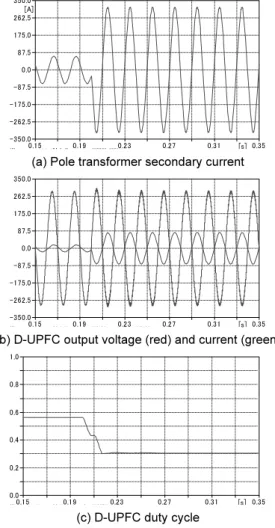
In the D-UPFC dynamic voltage control, voltage fall and rise conditions are simulated. The voltage fall condition is simulated under the 70% of pole transformer secondary capacity. The D-UPFC controls the distribution voltage at node A
4which is already shown in Fig. 10(d). In the Fig. 13(a), the load consumption power increases to 70% at 0.2 s. Thus, the pole transformer current also increases.
At this time, the D-UPFC controls the voltage fall during 1
cycle from the voltage fall phenomenon. Fig. 13(b) shows the
D-UPFC output voltage V
outand output current I
outat node A
4.
Before the D-UPFC control, V
outwas under 0.96 p.u. However,
V
outwas about 1.0 p.u. after D-UPFC control from 0.22 s. The
D-UPFC duty cycle during voltage fall condition is shown in
Fig. 13(c). Before the voltage control, the normal duty cycle of
the D-UPFC is 0.5. However, the duty cycle of the D-UPFC
Table 3. The parameters of the experimental set
Vs 10 V, 50 Hz PI gain Kp=1, Ki=0.25 N1 : N1’ : N2 1 : 0.7 : 0.6 Switching fre. 20 [kHz]
Vref_duty 0.5 Vpv 11 V, 50 Hz
Lin & Lout 2.6 [mH] Rline 20 [Ω]
Cin & Cout 3 [μF] Lload 0.26 [H]
(a) Voltage fall condition
(b) Voltage rise condition
Fig. 16. Experimental results of before and after D-UPFC control
Fig. 15. Experimental set of D-UPFC control
increases during voltage fall condition.
The dynamic test of D-UPFC during voltage rise condition is shown in Fig. 14. As shown in Fig. 14(a), the PV output power is 70% of the maximum pole transformer capacity from 0.2 s. D-UPFC output voltage V
outand current I
outare shown in Fig. 14(b). D-UPFC controls the rising voltage, which was 1.04 p.u. after 0.22 s. Fig. 14(c) shows the D-UPFC duty cycle and the D-UPFC decreases the duty cycle during voltage rise condition.
Through the dynamic test simulation of D-UPFC, D-UPFC using PWM control enables the fast voltage control which is less than 2 cycles.
4. Experiment
In the experimental study, D-UPFC voltage control during voltage rise and voltage fall conditions is performed. The experimental set is shown in Fig. 15. Here, two bipolar sources are used. One of them is voltage source and the other is current source considering reverse power flow. The parameters of the experimental set are given in Table 3.
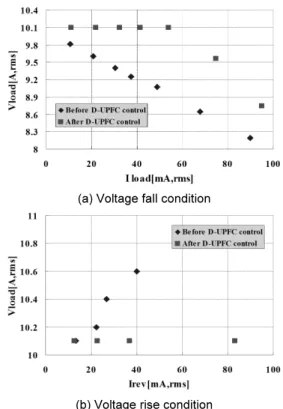
Fig. 16(a), (b) show the before and after D-UPFC control during voltage fall and voltage rise condition, respectively. In the voltage fall test, the load is considered only resistive load.
The value R
loadis changed 470 Ω to 90 Ω and thus, the load current I
loadincreases. Consequently, the load voltage V
loaddecreases due to R
load. In the experimental result of Fig. 16(a),
V
loaddecreases 9.8 V to 8.2 V. The D-UPFC controls the V
loadto 10.1 V until I
load54 mA. However, if the value of I
loadis larger than 54 mA, V
loadwhich is controlled by D-UPFC decreases because the value of transformer inner dc resistance of D-UPFC increases.
In the voltage rise test from Fig. 16(b), the R
loadis fixed to 1 kΩ and the current source inner resistance R
inneris changed 47 Ω to 4.7 Ω. The current source voltage V
pvis 11V. Thus, the reverse power flows to the voltage source V
s. the reverse power flow from the current source increases. I
revincreases from 13 mA to 50 mA with the voltage rise. D-UPFC controls the V
loadto 10.1 V during reverse power flow condition. Here, I
revdramatically increases at V
load10.6 V.
In the Fig. 17, the bi-directional ac-ac converter output
(a) Vtr2_o and Vload waveforms during voltage fall condition (Scale: 2 V/div., 20 V/div., 50 ms/div.)
(b) Vtr2_o and Vload waveforms during voltage rise condition (Scale: 2 V/div., 20 V/div., 50 ms/div.)
Fig. 17. D-UPFC voltage control waveforms during voltage fall and voltage rise condition
(a) Vs, Vtr2_o, Iload, and Vload waveforms
(Scale: 20 V/div., 5 V/div., 500 mA/div., 10 V/div., 5 ms/div.)
(b) Voltage waveforms from Sw1 to Sw4
(Scale: 5 V/div., 10 V/div., 5 V/div., 10 V/div., 25 μs/div.) Fig. 18. D-UPFC voltage control waveforms in the inductive
load condition
voltage V
tr2_oand load voltage V
loadwaveforms are shown when the voltage fall and rise conditions occur, respectively.
In the Fig. 17(a), V
outis 9.1 V before the D-UPFC control which is mentioned in Fig. 22(a). However, D-UPFC controls the V
outto 10.1 V after 20 cycles from the trigger start. In the Fig. 17(b), the V
outwas 10.8 before the D-UPFC control and it is controlled to 10.1 V after 20 cycles from the trigger start.
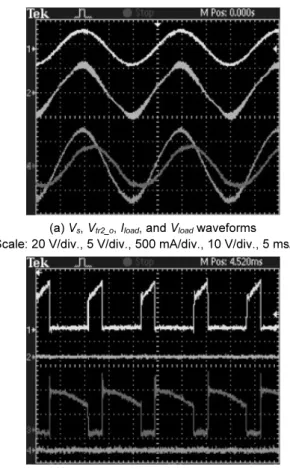
Fig. 18 shows the D-UPFC voltage, current, and each switch voltage waveforms during inductive load condition. In this test, the R
loadis 47 Ω and L
loadis 0.26 H from the load parameters.
The power factor is 0.86.
Fig. 18(a) shows the D-UPFC input voltage V
s, the ac-ac converter output voltage V
tr2_o, the load current I
load, and the load voltage V
load. During this waveform, I
loadphase lags the V
loadphase is confirmed due to the inductive load condition.
Fig. 18(b) shows each switch voltage of the bi-directional ac-ac converter when the converter input voltage V
tr2is positive polarity. The voltages from S
w1to S
w4are performed with the PWM control.
5. Conclusions
This paper shows the series power device in the massive roof-top PVs and domestic loads. D-UPFC as the series power device controls the distribution voltage during voltage rise (or fall) condition.
D-UPFC consists of the bi-directional ac-ac converter and the transformer. D-UPFC is performed in the reverse power flow condition as well as forward power flow condition using the converter switching patterns.
In order to verify the D-UPFC voltage control, distribution model is used in the case study. Through the D-UPFC voltage control simulation, D-UPFC enables the voltage control in the distribution voltage range. Dynamic voltage control from voltage rise and voltage fall conditions is performed. D-UPFC rapidly controls the voltage using the PWM control.
The scaled-down experiment of D-UPFC voltage control is
performed. D-UPFC controls the load voltage during voltage
fall and voltage rise test. D-UPFC is well performed without
high-voltage spikes in the inductive load condition.
In the future study, D-UPFC protection methods from the short-circuit and ground fault from the distribution grid are necessary.
Acknowledgments
This works was supported by the financial support of the Korea Energy Agency (No. G10201605010004).
References
1. Kurokawa, K., “Further considerations on solar PV community concept considering of massive roof-top PVs and domestic loads”, 22nd European Photovoltaic Solar Energy Conference
and Exhibition, 5BP2.5, 2007.
2. Kurokawa, K., “A conceptual study on solar PV cities for 21st century”, IEEE 4th World Conference on Photovoltaic Energy Conversion, pp. 2283-2287, 2006.
3. Lee, K., Yamaguchi, K., and Kurokawa, K., “Proposed dis- tribution voltage control method for connected cluster PV sys- tems”, Journal of Power Electronics, Vol. 7, No. 4, pp. 286-293, 2007.
4. Kwon, B., Min, B., and Kim, J., “Novel commutation techni- que of AC-AC converters”, IEE Proc.-Electr. Power Appl., Vol. 145, No. 4, pp. 295-300, 1998.
5. Aeloiza, E. C., Enjeti, P. N., Morán, L. A., Montero-Hernandez, O. C., and Kim, S., “Analysis and design of a new voltage sag compensator for critical loads in electrical power distribution systems”, IEEE Transaction on Industry Applications, Vol. 39, No. 4, pp. 1143-1150, 2003.