Redundant Parallel Hopfield Network Configurations:
A New Approach to the Two-Dimensional Face Recognitions
Kim Yong Taek
†⋅Deo Kiatama
††ABSTRACT
Interests in face recognition area have been increasing due to diverse emerging applications. Face recognition algorithm from a two-dimensional source could be challenging in dealing with some circumstances such as face orientation, illuminance degree, face details such as with/without glasses and various expressions, like, smiling or crying. Hopfield Network capabilities have been used specially within the areas of recalling patterns, generalizations, familiarity recognitions and error corrections. Based on those abilities, a specific experimentation is conducted in this paper to apply the Redundant Parallel Hopfield Network on a face recognition problem. This new design has been experimentally confirmed and tested to be robust in any kind of practical situations.
Keywords : Redundant Parallel Hopfield Network, Two-Dimensional Face Recognition, Face Expressions, Pattern Recall, GPU
병렬 다중 홉 필드 네트워크 구성으로 인한 2-차원적 얼굴인식 기법에 대한 새로운 제안
김 영 택
†⋅Deo Kiatama
††요 약
얼굴인식 분야의 관심은 다양한 신흥분야의 응용에 의해 증강되고 있다. 2-차원적인 인식 알고리즘의 필요성이 어떤 변화무쌍한 환경들, 예 를 들어서, 얼굴의 방향이나 조명도, 안경의 유무, 혹은 웃음과 울음 같은 다양한 표정변화의 처리에 적합할 수 있게 고찰 되어 지고 있다. 형상 기억이나 일반화 과정, 유사성 인식, 오류수정 등에 장점을 가지고 있는 홉 필드 네트워크의 기능을 바탕으로 하여 본 연구에서는 새로운 방법 의 병렬적인 다중 홉 필드 네트워크를 구성하여 변화에 강한 얼굴표정 인식의 실험을 2-차원 알고리즘으로 실시하였고 결과가 실제적인 얼굴 형상 환경 변화에서 강한 적응성을 가지고 있음을 확인하였다.
키워드 : 병렬 다중 홉 필드 네트워크, 2-차원 얼굴인식, 얼굴표정, 형상인식, 그래픽스처리장치
1. Introduction
1)Facial recognitions have many applications in many areas such as social networks and security systems. Those applications demand the IT industry to develop some more practically efficient and accurate systems. Even though, recently, many researchers have worked on those practical problems of face recognition, but, still several challenges
†종신회원 : 경성대학교 컴퓨터공학과 교수
††비 회 원 : 경성대학교 컴퓨터공학과 석사과정 Manuscript Received : August 11, 2017 First Revision : October 13, 2017 Accepted : November 7, 2017
* Corresponding Author : Kim Yong Taek([email protected])
need to be solved, such as, problems with different orientation
of the subject, direction of lighting, face details with the
matter of wearing glasses, and with some delicate face
expressions, like, smile or mad, crying or happy. And, those
are only a few examples to be dealt with. Some researchers
tried to make a three-dimensional face recognition system to
discriminate the face orientations and lighting problems,
for example, with the established anthropometric facial
proportions of the human face for detecting them and they
tried to isolate and employ unique textural and/or structural
characteristics of those fiducial points along with the
established anthropometric facial proportions of the human
face [1-5]. But they present all with some more complicated
results in comparison to this paper’s two-dimensional recognition in software and hardware design point of view.
This research proposes a different two-dimensional face recognition algorithm instead of three-dimensional ways to acquire some easier implementation methodology with more efficient outcomes by using Redundant Parallel Hopfield Network concept.
2. Hopfield Network
Hopfield Network is a neural network proposed by John Hopfield in 1982. Hopfield Network serves as content -addressable memory systems.
Fig. 1. Sample Diagram of Hopfield Neural Network
Neural connections in the Hopfield Network are not just connected in a single direction but both directions. Patterns can be taught into Hopfield Network to be stored in the format of energetic values instead of binary. It is done by updating weight (W) between nodes in the network. For a set of M pattern the formula is as follow.
To calculate the output of the neuron, the equation can be written as below.
where, f(x) is activation function,
To recall the pattern that has been stored, usually multiple steps are needed. First, the test pattern is set and the output is calculated by implementing a matrix operation.
If the result is different from any input pattern, than, the current output repeats the process again. Recall process ends when the current output does not differ from the previous values.
There is a limit to the number of pattern that can be stored in the network. John Hopfield reported that as a result of computer simulations 0.15N states can be recalled simultaneously before errors become severe [6]. But, this does not mean the pattern is always stored perfectly without error. There are conditions called Spurious States where the stable states of the Hopfield Network are different from the fundamental memories of the network [7, 8]. The Spurious States occurrence could be affected by the ratio of M/N of the neural network. And, the Spurious States may be one of the groups, as follows [9]:
1. Reversed fundamental memories. Where the pattern is reversed from the fundamental memories.
2. Mixtures states. Where the pattern is combination from an odd number patterns.
3. Spin glass states. Where the pattern is not correlated with any of the fundamental memories of the network.
3. Problem with Face Recognition Implementation using Hopfield Network
To explore a two-dimensional approach with proposed redundant parallel network configuration, firstly, for the face recognition implementation with Hopfield Network, a specific experiment was done to test the pattern recall capability stored in the network. This simulation has been designed and tested by using some standard facial database from the AT&T Laboratories Cambridge [10]. The database contains 40 distinct subjects and there are 10 images for each subject. For all subjects, each images were taken at each different situations, like, times of the day, light conditions, expressions (open/closed eyes, smile/not smile) and some other facial details (with/without glasses on, etc.).
All these images were taken up against some dark homogeneous background with the subjects in an upright, frontal position (with tolerances for some side movement).
The files are in PGM format and the size of each image is 92x112 pixels, with 256 grey levels per pixel.
Experiment conducted using a Hopfield Network with
10304 nodes. Those images from the AT&T Lab. Database [10] have been preprocessed using Adaptive Histogram Equalization (CLAHE) [11] technique with the threshold at 127 grey levels to 1 for value > 127 and -1 for value <= 127.
Threshold data from the images are taught to the Hopfield Network. This preprocessing has been done in C language using Open CV library.
The images of randomly chosen different subjects are taught to the network and tested for pattern recall capability of all the images taught. From 3000 tests conducted, the result was averaged and shown in Fig. 2 below.
Fig. 2. Pattern Recall Capability Result
Fig. 2 is showing the recalling ability of the Hopfield Network as numbers of patterns is stored in the network.
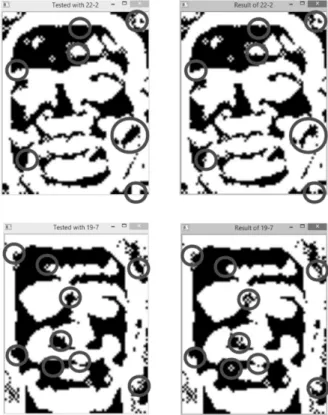
As shown in Fig. 2, Hopfield Network with 10304 nodes is incapable of recalling all of the patterns stored in the network. This phenomenon occurred when more than 5 patterns of images taught to the network. With 6 images taught to the network, the recall capability slightly getting started down to 99%. It is far less than 0.15N store capacity limitation announced. Output of the network is not anything that have been taught to the network, that indicates with the face information stored the network is suffering from Spurious States. It is shown in comparison between the taught facial pattern and output from Hopfield Network in Fig. 3 below. Examples taken from experiment with 15 subjects taught to the Hopfield Network and tried to be recalled using the same pattern that is taught to the network as the input.
From the examples shown in Fig. 3, there are some parts where changes happened in the pattern taught. Based on the evidences found, it is confirmed that the spurious states really happened in any realistic face recognition implementation using Hopfield Network.
Fig. 3. The Comparison Between Taught Patterns, on the Left Side, and Outputs, on the Right Side
4. Strategy to Overcome Two-dimensional Face Recognition Problem
Spurious state in Hopfield Network is not the only problem, but the different situations such as luminance conditions, different emotional expressions, and face details.
The idea to take care of this problem was using many different samples for a given specific target subject with different emotional expression and lighting condition, through the redundant parallel network design method as discussed in the next section.
5. Redundant Parallel Hopfield Network Design by Using Fabricated Face Info.
It is true that the face Recognition Implementation using
Hopfield Network could not avoid the spurious state
problem as mentioned in the previous section, and the
two-dimensional face recognition problems, as well. So, in
this paper’s experiment, the problems are addressed by
using parallel multiple Hopfield Network which taught with
multiple facial expression and situationally different images
of the same subject under different circumstances such as
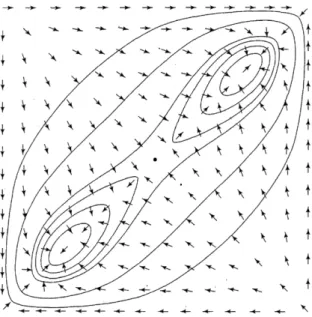
Fig. 5. An Energy Contour Map for a Two-neuron, Two-stable State System [7]
light conditions, and/or some other facial expressions, facial details, all into each different parallel network nodes as described in the Fig. 4 below.
Here, we also could use any kind of prototype image processing tools for the fabrication to create some necessary amended pictures of facial information from the original picture to be dealt with.
Fig. 4. Redundant Parallel Hopfield Network with Many Different Fabricated Images to Feed into the Network
The main point of this structure is having some redundant information of the same target subject while avoiding the Spurious State of the Hopfield Network by reducing the number of original pattern subjects for each stored inside networks to increase the ratio of M/N. With this parallel structure, each of the networks inside the whole structure can be processed independently in each different GPU processor elements, easily, and from this sort of independency, the system can reduce the M/N ratio definitely and any target face recognition systems
could be efficiently implemented in those parallel com- putation environments to recognize the main target, in actively variable situations.
Here, the stored patterns are recalled in the minimum repetition manner between the parallel networks. It is based on the assumption that the pattern in Hopfield Network is recalled by doing multiple repetition of “recalling” process.
Each repetition bringing the input pattern to the nearest/
most similar pattern in the network, therefore the network which have the most similar pattern with input pattern will need least number of repetition [7, 12].
So, from that assumption the most similar patterns across all parallel networks are to be recalled.
6. Face Recognition Implementation with Redundant Parallel Hopfield Network
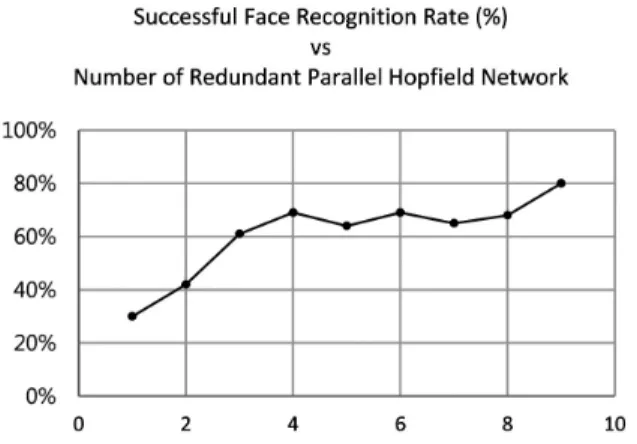
Facial recognition capability of Redundant Parallel Hopfield Network has been tested by using various numbers of images per each target subject and tested to recognize an image which has not been taught to the network. Samples used for this experiment is 5 unique random subject face patterns in each network and multiple number of networks in parallel configuration; for example: if there are 9 networks in parallel then there are 45 different patterns in total. The small number of pattern stored in each network is done to minimize of the Spurious State problem occurred in the general face recognition implementation with Hopfield Network and to clearly capture the capability of the Redundant Parallel Hopfield Network. After all the networks were taught by either number of patterns, one random sample from one of the subject but with different face alignment or lighting condition which never been taught to the network is given as input. Here, those general experimental drawbacks with some Spurious Problems included, as shown in the Fig. 2 has not been seriously occurred on this research implementation as shown in the result of the experiment in Fig. 6 below.
As described in the figure above, the result based on 1800
different experiments by using samples from AT&T
Laboratories Cambridge’s face database [10], it is shown
that the recognition rate of one single network taught is
only around 30%, in average. However, this paper’s
successful implementation result shows that the number of
parallel redundant networks did increase the rate of the
correct face recognition drastically. In this specific case of
Fig. 6. Successful Result in Face Recognition Implementation with Redundant Parallel Hopfield Network
nine parallel redundant network results, 80% successful recognition rate has been achieved.
However, in this facial recognition experiment, two unsuccessful conditions were found: one is wrong guess problem and the other, unable to find match pattern problem within the parallel networks. For example, in 20% of the unsuccessful recognition results in the experiment with nine parallel redundant network, 12% of them were wrong guess and 8% of them were failure because of the unable to find match pattern problem. The examples of some wrongly guessed recognition is presented in Fig. 7 below.
Fig. 7. Wrongly Guessed Face Recognition Examples
As shown in example of Fig. 6, the wrong guessed results done by the Redundant Parallel Hopfield Network in general have similar face orientation and can be happened between two subjects that have different gender.
7. Conclusions
Experiments have been done to implement the facial recognition with a new approach by using redundant parallel
network which is appeared to be easier and efficient methodology in terms of recognition rate with some help of current IT technologies such as Internet, Internet of Things, Big data and the GPU parallel processing techniques.
Based on the studies made by Kasar, M. M., Bhattacharyya, D., & Kim, T. H. (2016) [13] which compared many approaches to solve 2-dimension face recognition problems using various neural network other than Hopfield Network, the recognition rate on this experiment might be less than the other studies compared that has been made in the past years.
Fig. 8. Comparison of Neural Network Methods by Kasar, M.
M., Bhattacharyya, D., & Kim, T. H. (2016) [13]
But, considering the challenges of implementing the two- dimensional facial recognition using Hopfield network, the newly designed Redundant Parallel Hopfield Network has successfully improved the rate of successful face recognition especially in implementation using Hopfield Network as described in section 3 and 6. The experiment result turned out to be promising, yet still has some rooms for deeper observation of its nature and capability to reduce the wrongly guessed recognition possibilities.
References
[1] T. Heseltine, N. Pears, and J. Austin, “Three-Dimensional Face Recognition Using Surface Space Combinations,”
BMVC, Vol.4. 2004.
[2] A. M. Bronstein, M. M. Bronstein, and R. Kimmel,
“Three-dimensional face recognition,” International Journal of Computer Vision, Vol.64, No.1, pp.5-30, 2005.
[3] S. Gupta, M. K. Markey, and A. C. Bovik, “Anthropometric
3D face recognition,” International Journal of Computer
Vision, Vol.90, No.3, pp.331-349, 2010.
[4] C. C. Queirolo, L. Silva, O. R. Bellon, and M. P. Segundo, “3D face recognition using simulated annealing and the surface interpenetration measure,” IEEE Transactions on Pattern Analysis and Machine Intelligence, Vol.32, No.2, pp.206-219, 2010.
[5] L. Spreeuwers, “Fast and accurate 3d face recognition,”
International Journal of Computer Vision, Vol.93, No.3, pp.
389-414, 2011.
[6] J. Hopfield, “Neural Networks and Physical Systems with Emergent Collective Computational Abilities,” Proceedings of the National Academy of Sciences, Vol.79, pp.2554-2558, 1982.
[7] S. Haykin, “Neural Networks: A Comprehensive Foundation,”
2nd ed. Prentice Hall, 1999.
[8] D. J. C. Mackay, “Information Theory, Inference and Learning Algorithms,” Cambridge University Press, 2003.
[9] J. Amit and A. Treves, “Associative Memory Neural Network with Low Temporal Spiking Rates,” Proceedings of the National Academy of Sciences, Vol.86, pp.7871-7875, 1989.
[10] AT&T Laboratories Cambridge, The Database of Faces [internet], http://www.cl.cam.ac.uk/research/dtg/attarctive/
facedatabase.html.
[11] K. Zuiderveld, “Contrast limited adaptive histogram equalization,” Academic Press Professional, Inc. Graphics gems IV, pp.474-485, 1994.
[12] K. Gurney, “An Introduction to Neural Networks,” Taylor
& Francis, 1997.
[13] M. M. Kasar, D. Bhattacharyya, and T. H. Kim, “Face recognition using neural network: a review,” International Journal of Security and Its Applications, Vol.10, No.3, pp.81-100, 2016.
Kim Yong Taek
http://orcid.org/0000-0003-1776-4448
e-mail : [email protected]
He got his BS degree in CS from Fairleigh Dickinson Univ. in 1983, and MS degree in CS from Polytech Univ.
in 1985. And he also finished Ph. D program in CS at Polytech Univ. in 1987. His interest is mostly in Fuzzy Logical Inference and currently working as the professor of Kyung-Sung Univ. Computer Eng. Dept.
Deo Kiatama
http://orcid.org/0000-0002-5807-6599