Hypoglycemic effects of Welsh onion in an animal model of diabetes mellitus
Min-Jung Kang1, Ji-Hye Kim1, Ha-Neul Choi1, Myoung-Jin Kim1, Jung-Hee Han2, Jai-Heon Lee3 and Jung-In Kim1§
1Department of Smart Foods and Drugs, School of Food and Life Science, Institute for Food Sciences, Inje University, 607 Obang-dong, Gimhae 621-749, Korea
2Department of Nutrition, Pusan Paik Hospital, Busan 633-165, Korea
3Department of Genetic Engineering, Bk 21 Center for Silver-Bio Industrialization Dong-A University, Busan 604-714, Korea
Abstract
Tight control of blood glucose is the most important strategy for the treatment of diabetes mellitus. Here, we investigated the beneficial effects of Welsh onion on fasting and postprandial hyperglycemia. Inhibitory activities of hot water extracts from the green stalk and white bulb, which are the edible portions of the Welsh onion, and the fibrous root extract against yeast α-glucosidase were measured in vitro. To study the effects of Welsh onion on postprandial hyperglycemia, a starch solution (1 g/kg) with and without Welsh onion fibrous root extract (500 mg/kg) or acarbose (50 mg/kg) was administered to streptozotocin-induced diabetic rats after an overnight fast. Postprandial plasma glucose levels were measured and incremental areas under the response curve were calculated. To study the hypoglycemic effects of chronic feeding of Welsh onion, five-week-old db/db mice were fed an AIN-93G diet or a diet containing either Welsh onion fibrous root extract at 0.5% or acarbose at 0.05% for 7 weeks after 1 week of adaptation. Fasting plasma glucose and blood glycated hemoglobin were measured. Compared to the extract from the edible portions of Welsh onion, the fibrous root extract showed stronger inhibition against yeast α-glucosidase, with an IC50 of 239 μg/mL. Oral administration of Welsh onion fibrous root extract (500 mg/kg) and acarbose (50 mg/kg) significantly decreased incremental plasma glucose levels 30-120 min after oral ingestion of starch as well as the area under the postprandial glucose response curve, compared to the control group (P < 0.01). The plasma glucose and blood glycated hemoglobin levels of the Welsh onion group were significantly lower than those of the control group (P <
0.01), and were not significantly different from those fed acarbose. Thus, we conclude that the fibrous root of Welsh onion is effective in controlling hyperglycemia in animal models of diabetes mellitus.
Key Words: Welsh onion, α-glucosidase inhibition, diabetes, glucose, glycated hemoglobin
Introduction6)
Type 2 diabetes is characterized as an imbalance in carbohy- drate, fat, and protein metabolism, primarily due to increased insulin resistance and relatively impaired insulin secretion [1].
Tight control of blood glucose levels and the prevention of diabetic complications are the major goals in diabetes treatment [2,3]. Controlling hyperglycemia is also the most important factor for reducing risks of diabetic complications [3]. Both fasting and postprandial glucose are critical in achieving long-term proper control of hyperglycemia in diabetic patients [4].
Agents with α-glucosidase inhibitory activity, such as acarbose and miglitol, are hypoglycemic agents that are effective in alleviating both fasting and postprandial hyperglycemia [5,6]. α -Glucosidase inhibitors partially inhibit digestion of dietary carbohydrates in the small intestine, resulting in a delayed increase in blood glucose and insulin after a meal. From this
point of view, numerous studies have been performed to identify more effective and safer inhibitors of α-glucosidase from natural materials, including plants [7-11]. Natural materials such as Touchi, fermented soybean [7], Rhus Chinensis galls [8], Rosa damascena Mill. Flowers [9], Saururus chinensis Baill leaves [10], and guava leaves [11] have shown potent inhibitory activity against α-glucosidase activity.
The Welsh onion (Allium fistulosum L.) belongs to the genus Allium, which is composed of edible perennial plants, including shallots, garlic, chives, and leeks. The edible portions of the Welsh onion are the green stalk and the white bulb, which are used as ingredients in Asian cuisine, especially in East and Southeast Asia. In contrast, the white fibrous root is usually discarded. The edible portion of Welsh onion has been reported to show hypolipidemic [12] and antioxidant effects in rats fed a high-fat, high sucrose diet [13]. Dyslipidemia is one characteristic of diabetes [14], and hyperglycemia in diabetes
This work was supported by the 2010 Inje University research grant.
§Corresponding Author: Jung-In Kim, Tel. 82-55-320-3236, Fax. 82-55-321-0691, Email. [email protected] Received: August 13, 2010, Revised: November 14, 2010, Accepted: November 19, 2010
ⓒ2010 The Korean Nutrition Society and the Korean Society of Community Nutrition
This is an Open Access article distributed under the terms of the Creative Commons Attribution Non-Commercial License (http://creativecommons.org/licenses/by-nc/3.0/) which permits unrestricted non-commercial use, distribution, and reproduction in any medium, provided the original work is properly cited.
leads to increase oxidative stress, which plays an important role in the progression of diabetes [15,16]. Thus, the Welsh onion could be beneficial for diabetes because of its hypolipidemic and antioxidant effects.
However, few studies on the hypoglycemic effects of Welsh onion have been reported. Additionally, the physiological effects of the edible portion and fibrous root of the Welsh onion have not been compared in a scientific study. Thus, we investigated the α-glucosidase inhibitory activities of the edible portion and fibrous root of the Welsh onion in vitro. The fibrous root, which exerted strong α-glucosidase inhibition in vitro, was further studied to examine potential beneficial effects on fasting and postprandial hyperglycemia in an animal model of diabetes.
These effects were compared with those of acarbose to evaluate its possible use as a hypoglycemic agent.
Materials and Methods
Preparation of Welsh onion extract
Welsh onions were obtained from a local market in Busan, Korea. The green stalk and white bulb (edible portion) along with the fibrous root were separated using a knife. The edible portion and fibrous root were freeze-dried, powdered, and extracted with 20 volumes of water at 100℃ for 2 h [17]. The solvent was removed by rotary evaporation at 80℃. The extract yields of the edible portion and fibrous root were 7.7% and 11.0%, respectively. The dry extract was used for an in vivo study, and was redissolved in dimethylsulfoxide (DMSO) at a concentration of 5 mg/mL. DMSO and all other chemical reagents used in this study were purchased from Sigma Chemical Co. (St. Louis, MO, USA).
Enzyme inhibition assay
Yeast α-glucosidase inhibitory activity was determined using the chromogenic method developed by Watanabe et al. [18] with a microplate reader (model 550, Bio-Rad, Hercules, CA, USA).
Yeast α-glucosidase (0.7 U, Sigma Chemical Co.) dissolved in 100 mM phosphate buffer (pH 7.0) containing 2 mg/mL of bovine serum albumin and 0.2 mg/mL of NaN3, was used as the enzyme, and 5 mM p-nitrophenyl-α-D-glucopyranoside in the same buffer (pH 7.0) was used as a substrate solution. The final extract concentrations of the edible portion and fibrous root of the Welsh onion along with acarbose, a positive control, were 25, 50, 100, 250, and 500 μg/mL. Measurements were performed in triplicate, and the IC50 value, the concentration of the root extract that resulted in 50% inhibition of maximal activity, was determined.
Measurement of postprandial blood glucose response in streptozotocin-induced diabetic rats
Male Sprague-Dawley rats weighing 220-250 g were purchased from Bio Genomics, Inc. (Seoul, South Korea). All rats were fed a commercial chow (Samyang Co., Seoul, Korea) ad libitum for 2 weeks after arrival. The animals received an intraperitoneal injection of streptozotocin (STZ; 60 mg/kg) in citrate buffer at pH 4.5 [19]. Blood samples were taken from the tail tip after 1 week, and blood glucose concentrations were measured using a glucometer (Glucotrend, Roche Diagnostics, UK). Animals were considered diabetic and included in the study if fasting blood glucose levels exceeded 200 mg/dL. The animals were maintained under standard laboratory conditions of 24 ± 5℃ and 55 ± 5% relative humidity with a regular 12/12-h light/dark cycle.
The rats (n = 18) were randomly divided into three groups. After an overnight fast, the rats were given soluble starch (1 g/kg) alone or starch with an extract of the Welsh onion fibrous root (500 mg/kg) or acarbose (50 mg/kg, Glucobay; Bayer, Korea) by gastric intubation [20]. Blood samples were collected from the tail tip after 30, 60, 120, 180, and 240 min and centrifuged (1,000 g, 15 min). Plasma glucose was measured by enzymatic methods [21] using a commercial kit (Yeongdong Co. Seoul, Korea). Glucose levels were expressed as increments from baseline, and areas under the response curves (AUC) were calculated using the trapezoidal rule.
Measurement of control of fasting hyperglycemia in db/db mice Five-week-old male C57BL/KsJ-db/db mice (n = 21) were purchased from SLC Japan (Shizuoka, Japan). After 1 week of adaptation, during which time the animals had free access to commercial chow, they were randomly divided into control, Welsh onion, and acarbose treatment groups. The mice in the control group were fed an AIN-93G diet composed of 39.8%
cornstarch, 20% casein, 13.2% dextrinized cornstarch, 10%
sucrose, 7% soybean oil, 5% Alphacel, 3.5% mineral mixture, 1% vitamin mixture, 0.3% l-cystine, 0.25% choline bitartrate, and 0.0014% tert-butyl hydroquinone [22], ad libitum for 7 weeks.
The Welsh onion and acarbose groups were fed the same diet supplemented with 0.5% (wt/wt, final concentration) hot water extract of the Welsh onion fibrous root and 0.05% acarbose, respectively. At the end of the experimental period, the mice were sacrificed by heart puncture after an overnight fast. Blood glycated hemoglobin (HbA1C) was measured using a chromato- graphic assay kit (BioSystems, Barcelona, Spain) [23]. Plasma glucose was measured by enzymatic methods [21] using an assay kit (Yeongdong Co., Seoul, Korea).
The experiments were performed according to the guidelines of animal experimentation, as approved by the Animal Resource Center at Inje University, Korea.
0 20 40 60 80
0 100 200 300 400 500
% inhibition
Concentration (μg/mL)
Fig. 1. Inhibitory activities of Welsh onion against yeast α-glucosidase. The inhibitory activities of the hot water extracts of the edible portions (green stalk and white bulb) and fibrous root of Welsh onion as well as acarbose were measured at concentrations of 25, 50, 100, 250, and 500 μg/mL. ●, edible part (green stalk and white bulb) of Welsh onion; ○, fibrous root of Welsh onion; ■, acarbose. Values represent means ± SD of triplicate measurements.
a a
a
a b** ns
b**
b**
b**
ab
b** b** b**
-20 0 20 40 60 80 100 120 140
0 60 120 180 240
Incremental plasma glucose (mg/dL)
Time (min)
Fig. 2. Increase in blood glucose after administration of Welsh onion extract in STZ-induced diabetic rats. Control group (●): Starch (1 g/kg) was administered orally to streptozotocin-induced diabetic rats after an overnight fast. Welsh onion group (○): Starch (1 g/kg) plus water extract of fibrous root of Welsh onion (500 mg/kg) was administered orally to rats after an overnight fast. Acarbosegroup (■):
Starch (1 g/kg) plus acarbose (50 mg/kg) was administered orally to rats after an overnight fast. Values represent means ± SD (n = 6). Means that do not share a common letter are significantly different at P< 0.01 (**).
Group Control Welsh onion Acarbose
Initial body weight (g) 22.3 ± 1.4ns2) 22.2 ± 1.7 21.9 ± 1.6 Final body weight (g) 44.1 ± 1.5ns 43.2 ± 2.0 41.7 ± 1.8 Weight gain (g) 0.44 ± 0.02ns 0.43 ± 0.06 0.41 ± 0.05
Food intake (g) 4.4 ± 0.4ns 4.4 ± 0.3 4.2 ± 0.5
Feed efficiency ratio (%)1) 10.1 ± 1.2ns 9.7 ± 1.3 9.7 ± 1.6 The control group was fed a standard AIN-93G diet, whereas the Welsh onion and acarbose groups were fed either a diet containing 0.5% hot water extract of Welsh onion fiberous root (wt/wt, final concentrations) or 0.05% acarbose ad libitum for 7 weeks. Values represent means ± SD (n = 7).
1)Feed efficiency ratio (%) = (Body weight gain [g/day]/food intake [g/day]) × 100
2)Not significant
Table 2. Body weight, food intake, and feed efficiency ratio of db/db mice
Group AUC (mg․min/dL)
Control 11,147 ± 1,651a
Welsh onion 5,165 ± 894b
Acarbose 3,752 ± 681b
Control group: Starch (1 g/kg) was administered orally to streptozotocin-induced diabetic rats after an overnight fast. Welsh oniongroup: Starch (1 g/kg) plus water extract of the fibrous root of Welsh onion (500 mg/kg) was administered orally to rats after an overnight fast. Acarbosegroup: Starch (1 g/kg) plus acarbose (50 mg/kg) was administered orally to rats after an overnight fast. Values represent means ± SD (n = 6). Means that do not share a common superscript are significantly different at P< 0.01.
Table 1. Area under the glucose response curve (AUC) of STZ-induced diabetic rats
Statistical analysis
All data are expressed as the mean ± standard deviation (SD).
All statistical analyses were performed using SAS software (ver.
9.2). Differences among groups were assessed by one-way analysis of variance (ANOVA) and a post hoc Tukey test (P
< 0.05).
Results
Inhibition of α-glucosidase activity in vitro
The inhibitory activities of water extracts of Welsh onion against yeast α-glucosidase in vitro are shown in Fig. 1. The
water extracts of the edible portion and fibrous root of the Welsh onion inhibited yeast α-glucosidase activity by 15.5% and 62.1%
at the concentration of 500 μg/mL, respectively, and both extracts inhibited enzyme activity in a dose-dependent manner. Acarbose, an α-glucosidase inhibitor that is used as an oral hypoglycemic agent, inhibited enzyme activity by 31.2% at the same concentration. The IC50 value of the fibrous root extract was estimated as 239 μg/mL.
Amelioration of postprandial blood glucose in STZ-induced diabetic rats
The fibrous root extract of the Welsh onion, which showed strong α-glucosidase inhibition in vitro, was further studied for α-glucosidase inhibitory activity in vivo. Fig. 2 shows plasma glucose responses to a single oral dose of starch (1 g/kg) alone, the Welsh onion root extract (500 mg/kg), and acarbose (50 mg/kg) in STZ-induced diabetic rats. The consumption of the fibrous root extract or acarbose significantly decreased incremental plasma glucose levels at 30, 60, and 120 min (P < 0.01).
Incremental plasma glucose levels in the acarbose group were significantly lower than those of the control group at 180 min (P < 0.05). Incremental plasma glucose levels in the Welsh onion group were not significantly different from the acarbose group.
The AUCs for glucose responses in the Welsh onion (5,165
± 894 mg·min/dL) and acarbose groups (3,752 ± 681 mg·min/dL) were significantly decreased, compared to the control group (11,147 ± 1,651 mg·min/dL, P < 0.01; Table 1). There were no significant differences between the AUCs of the Welsh onion
(A)
(B)
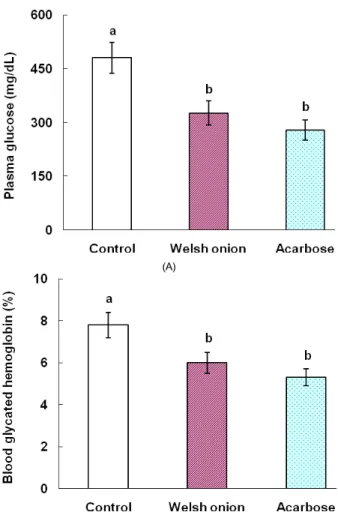
Fig. 3. Hypoglycemic effects of Welsh onion extract in db/db mice. A. Fasting plasma glucose; B. Blood glycated hemoglobin (HbA1C). Values represent means ± SD (n = 7). Means that do not share a common letter are significantly different at P< 0.01.
group and those of the acarbose group.
Alleviation of fasting hyperglycemia in db/db mice
The consumption of fibrous root extracts from Welsh onion (0.5% of diet, wt/wt) or acarbose (0.05% of diet, wt/wt) did not significantly influence body weight, food intake, or feed efficiency ratio in db/db mice (Table 2). Consumption of the fibrous root extract significantly reduced plasma glucose (326
± 34 mg/dL) compared to the control group (480 ± 44 mg/dL, P < 0.01; Fig. 3). Plasma glucose was significantly reduced in the acarbose group (279 ± 29 mg/dL) as compared to the control group (P < 0.01). There were no significant differences between the plasma glucose levels of the Welsh onion and acarbose groups.
Consumption of the fibrous root extract of the Welsh onion or acarbose significantly decreased blood HbA1C (6.0 ± 0.5% and 5.3 ± 0.4%, respectively) compared to the control group (7.8 ±
0.6%, P < 0.01). There was no significant difference between blood HbA1C levels in the Welsh onion and acarbose groups.
Discussion
The edible portions of the Welsh onion (the green stalk and white bulb) are widely used in Asian cuisine for flavoring in countries such as Korea, Japan, and China. However, the fibrous root of the Welsh onion is typically discarded as a waste product.
We found that the yeast α-glucosidase inhibitory activity of the fibrous root extract of Welsh onion was twice as strong as that of acarbose, and four times stronger than the edible portion of the Welsh onion at a concentration of 500 μg/mL in vitro.
Although α-glucosidase inhibitors are common oral hypoglycemic agents, the chronic use of these agents can lead to gastrointestinal side effects such as flatulence, vomiting, and diarrhea [24].Thus, many investigators have performed studies to discover α -glucosidase inhibitors from natural products with reduced side effects [7-11]. Among known materials with α-glucosidase inhibitor activity, guava leaf extract and Touchi extract have been approved as individual authorized health functional foods to improve postprandial hyperglycemia [25] in Korea, and as Foods for Specified Health Use (FOSHU) in Japan [26]. In this study the fibrous root extract of the Welsh onion inhibited α-glucosidase in a dose-dependent manner with an IC50 of 239 μg/mL.
The inhibitory activity of the fibrous root extract against α -glucosidase was further determined in STZ-induced diabetic rats using a carbohydrate load test. The fibrous root extract administered at a dose of 500 mg/kg showed significant suppressive effects on postprandial glucose levels at 30-120 min, and a reduction in the AUC of the glucose response curve by 54%
(P < 0.01). These effects were comparable with those of acarbose, a competitive inhibitor of α-glucosidase given at 50 mg/kg.
Controlling not only fasting, but also postprandial hyperglycemia, is important in achieving tight control of blood glucose levels, which is the major target of diabetic therapy [4]. It was reported that postprandial hyperglycemia might be more strongly correlated with cardiovascular morbidity and mortality than fasting hyperglycemia [27]. Postprandial hyperglycemia has been shown to increase the production of free radicals, which induce vasoconstriction and stimulate prothrombotic pathways leading to an increased risk of cardiovascular disease, the major cause of premature death among type 2 diabetic patients [28]. Thus, the fibrous root extract of the Welsh onion may be beneficial in the management of diabetes.
The hypoglycemic effects of chronic consumption of Welsh onion fibrous root were compared with acarbose in db/db mice, which exhibit obesity, insulin resistance, and hyperglycemia. The fibrous root extract, consumed at 0.5% of the diet for 7 weeks, decreased fasting plasma glucose and HbA1c by 32.0% and 23.2%, respectively. Acarbose, which was given as a positive control at 0.05% of the diet, also reduced plasma glucose and HbA1c (by 41.9% and 32.5%, respectively). These results, however, were not significantly different from those of the Welsh onion group. The average intakes of fibrous root extract and acarbose were calculated as 512 and 51 mg/kg/day, based on
food intake and final body weight, respectively.
Clinical trials have shown that chronic consumption of acarbose effectively controls fasting hyperglycemia in type 2 diabetic patients, which results from decreases in postprandial hyperglycemia [29-32]. It was suggested that reducing postprandial glucose elevations using an α-glucosidase inhibitor contribute to reductions in glucose toxicity, which leads to overall glycemic control [33]. It was also suggested that acarbose could increase insulin sensitivity in obese diabetic rats [34] and patients with type 2 diabetes [32]. It is possible that Welsh onion fibrous root extract could alleviate fasting hyperglycemia by reducing glucose toxicity and increasing insulin sensitivity.
HbA1c is considered to be a marker of long-term blood glucose control [35] and reflects both fasting plasma glucose and postprandial glucose [36]. Because HbA1c has strong predictive value for diabetic complications [37,38], reduced HbA1c in response to Welsh onion fibrous root treatment could contribute to a lower risk of diabetic complications.
The data from this study suggest that the fibrous root of the Welsh onion has potential use as an effective hypoglycemic agent, rather than being discarded. Further studies aimed at isolating the active components in the extract are necessary to develop Welsh onion as a hypoglycemic agent.
In conclusion, the fibrous root of the Welsh onion alleviated fasting and postprandial hyperglycemia by inhibiting α-glucosidase in an animal model of diabetes. Thus, the fibrous root of the Welsh onion may be helpful in controlling blood glucose.
References
1. King H, Aubert RE, Herman WH. Global burden of diabetes, 1995-2025: prevalence, numerical estimates, and projections.
Diabetes Care 1998;21:1414-31.
2. American Diabetes Association (ADA). Summary of revisions for the 2008 clinical practice recommendations. Diabetes Care 2008;31:S3-4.
3. UK Prospective Diabetes Study (UKPDS) Group. Intensive blood glucose control with sulphonylureas or insulin compared with conventional treatment and risk of complications in patients with type 2 diabetes (UKPDS 33). Lancet 1998;352:837-53.
4. Abrahamson MJ. Optimal glycemic control in type 2 diabetes mellitus: fasting and postprandial glucose in context. Arch Intern Med 2004;164:486-91.
5. Standl E, Baumgartl HJ, Füchtenbusch M, Stemplinger J. Effect of acarbose on additional insulin therapy in type 2 diabetic patients with late failure of sulphonylurea therapy. Diabetes Obes Metab 1999;1:215-20.
6. Sels JP, Huijberts MS, Wolffenbuttel BH. Miglitol, a new alpha-glucosidase inhibitor. Expert Opin Pharmacother 1999;1:
149-56.
7. Fujita H, Yamagami T, Ohshima K. Fermented soybean-derived water-soluble Touchi extract inhibits alpha-glucosidase and is antiglycemic in rats and humans after single oral treatments. J Nutr 2001;131:1211-3.
8. Shim YJ, Doo HK, Ahn SY, Kim YS, Seong JK, Park IS, Min
BH. Inhibitory effect of aqueous extract from the gall of Rhus Chinensis on alpha-glucosidase activity and postprandial blood glucose. J Ethnopharmacol 2003;85:283-7.
9. Gholamhoseinian A, Fallah H, Sharifi far F. Inhibitory effect of methanol extract of Rosa damascena Mill. flowers on alpha- glucosidase activity and postprandial hyperglycemia in normal and diabetic rats. Phytomedicine 2009;16:935-41.
10. Joo HJ, Kang MJ, Seo TJ, Kim HA, Yoo SJ, Lee SK, Lim HJ, Byun BH, Kim JI. The hypoglycemic effect of Saururus chinensis Baill in animal models of diabetes mellitus. Food Sci Biotechnol 2006;15:413-7.
11. Wang H, Du YJ, Song HC. α-Glucosidase and α-amylase inhibitory activities of guava leaves. Food Chem 2010;123:6-13.
12. Yamamoto Y, Aoyama S, Hamaguchi N, Rhi GS. Antioxidative and antihypertensive effects of Welsh onion on rats fed with a high-fat high-sucrose diet. Biosci Biotechnol Biochem 2005;69:
1311-7.
13. Yamamoto Y, Yasuoka A. Welsh onion attenuates hyperlipidemia in rats fed on high-fat high-sucrose diet. Biosci Biotechnol Biochem 2010;74:402-4.
14. Yoshino G, Hirano T, Kazumi T. Dyslipidemia in diabetes mellitus. Diabetes Res Clin Pract 1996;33:1-14.
15. Maritim AC, Sanders RA, Watkins JB 3rd. Diabetes, oxidative stress, and antioxidants: a review. J Biochem Mol Toxicol 2003;17:24-38.
16. Kaneto H, Nakatani Y, Kawamori D, Miyatsuka T, Matsuoka TA, Matsuhisa M, Yamasaki Y. Role of oxidative stress, endoplasmic reticulum stress, and c-Jun N-terminal kinase in pancreatic β-cell dysfunction and insulin resistance. Int J Biochem Cell Biol 2005;37:1595-608.
17. Youn JY, Park HY, Cho KH. Anti-hypergltcemic activity of Commelina communis L.: inhibition of α-glucosidase. Diabetes Res Clin Pract 2004;66:S149-55.
18. Watanabe J, Kawabata J, Kurihara H, Niki R. Isolation and identification of α-glucosidase inhibitors from Tochu-cha. Biosci Biotechnol Biochem 1997;61:177-8.
19. Akbarzadeh A, Norouzian D, Mehrabi MR, Jamshidi Sh, Farhangi A, Allah Verdi A, Mofidian SMA, Lame Rad B.
Induction of diabetes by streptozotocin in rats. Indian J Clin Biochem 2007;22:60-4.
20. Lee SK, Hwang JY, Song JH, Jo JR, Kim MJ, Kim ME, Kim JI. Inhibitory activity of Euonymus alatus against alpha-glucosidase in vitro and in vivo. Nutr Res Pract 2007;1:184-8.
21. Raabo E, Terkildsen TC. On the enzymatic determination of blood glucose. Scand J Clin Lab Invest 1960;12:402-7.
22. Reeves PG, Nielsen FH, Fahey GC Jr. AIN-93 purified diets for laboratory rodents: final report of the American Institute of Nutrition ad hoc writing committee on the reformulation of the AIN-76A rodent diet. J Nutr 1993;123:1939-51.
23. Schifreen RS, Hickingbotham MJ, Bowers GN Jr. Accuracy, precision, and stability in measurement of hemoglobin A1c by
“high performance” cation-exchange chromatography. Clin Chem 1980;26:466-72.
24. Hanefeld M. The role of acarbose in the treatment of non-insulin- dependent diabetes mellitus. J Diabetes Complications 1998;12:228-37.
25. Korea Food and Drug Administration. Functional Food [Internet].
[cited 2010 Aug 30]. Available from: http://hfoodi.kfda.go.kr.
26. Saito M. Role of FOSHU (food for specified health uses) for healthier life. Yakugaku Zasshi 2007;127:407-16.
27. Haller H. The clinical importance of postprandial glucose. Diabetes
Res Clin Pract 1998;40:S43-9.
28. Ceriello A, Davidson J, Hanefeld M, Leiter L, Monnier L, Owens D, Tajima N, Tuomilehto J; International Prandial Glucose Regulation Study Group. Postprandial hyperglycaemia and cardiovascular complications of diabetes: an update. Nutr Metab Cardiovasc Dis 2006;16:453-6.
29. Holman RR, Cull CA, Turner RC. A randomized double-blind trial of acarbose in type 2 diabetes shows improved glycemic control over 3 years (U.K. Prospective Diabetes Study 44). Diabetes Care 1999;22:960-4.
30. Balfour JA, McTavish D. Acarbose. An update of its pharmacology and therapeutic use in diabetes mellitus. Drugs 1993;46:1025-54.
31. Coniff RF, Shapiro JA, Robbins D, Kleinfield R, Seaton TB, Beisswenger P, McGill JB. Reduction of glycosylated hemoglobin and postprandial hyperglycemia by acarbose in patients with NIDDM. A placebo-controlled dose-comparison study. Diabetes Care 1995;18:817-24.
32. Meneilly GS, Ryan EA, Radziuk J, Lau DC, Yale JF, Morais J, Chiasson JL, Rabasa-Lhoret R, Maheux P, Tessier D, Wolever T, Josse RG, Elahi D. Effect of acarbose on insulin sensitivity in elderly patients with diabetes. Diabetes Care 2000;23:1162-7.
33. Lebovitz HE. α-Glucosidase inhibitors as agents in the treatment
of diabetes. Diabetes Rev 1998;6:132-45.
34. Dolan PL, Tapscott EB, Peterson RG, Dohm GL. Effects of feeding acarbose on muscle glucose transport and GLUT4 protein in lean and obese diabetic (ZDFIGmi-fa) rats. J Nutr Biochem 1997;8:322-7.
35. Sacks DB, Bruns DE, Goldstein DE, Maclaren NK, McDonald JM, Parrott M. Guidelines and recommendations for laboratory analysis in the diagnosis and management of diabetes mellitus.
Clin Chem 2002;48:436-72.
36. LeRoith D, Smith DO. Monitoring glycemic control: the cornerstone of diabetes care. Clin Ther 2005;27:1489-99.
37. Knowler WC, Barrett-Connor E, Fowler SE, Hamman RF, Lachin JM, Walker EA, Nathan DM; Diabetes Prevention Program Research Group. Reduction in the incidence of type 2 diabetes with lifestyle intervention or metformin. N Engl J Med 2002;
346:393-403.
38. Stratton IM, Adler AI, Neil HA, Matthews DR, Manley SE, Cull CA, Hadden D, Turner RC, Holman RR. Association of glycaemia with macrovascular and microvascular complications of type 2 diabetes (UKPDS 35): prospective observational study. BMJ 2000;321:405-12.