• 검색 결과가 없습니다.

Primary Adenocarcinoma of the Minor Duodenal Papilla Takeru Wakatsuki,

N/A
N/A
Protected

Academic year: 2022

Share "Primary Adenocarcinoma of the Minor Duodenal Papilla Takeru Wakatsuki,"

Copied!
4
0
0

로드 중.... (전체 텍스트 보기)

전체 글

(1)

Yonsei Med J 49(2):333 - 336, 2008 DOI 10.3349/ymj.2008.49.2.333

Yonsei Med J Vol. 49, No. 2, 2008 A 70-year-old man was admitted to our institution due to

aggravation of blood-sugar level control and because an abdominal CT showed dilatation of the main pancreatic duct.

Upper gastrointestinal endoscopy revealed a flat elevated tumor with central ulceration in the second portion of the duodenum. Subsequent duodenoscopy for a more detailed examination showed that the tumor had originated in the minor duodenal papilla. A biopsy specimen showed moderately differentiated adenocarcinoma. Endoscopic retrograde pancreato- graphy via the major duodenal papilla revealed a slightly dilated main pancreatic duct and obstruction of the accessory pancreatic duct. Endoscopic ultrasonography showed a hypoechoic mass in the minor duodenal papilla with retention of the muscularis propria of the duodenum. These findings suggest that the tumor existed only to a limited extent in the minor duodenal papilla, and that the tumor did not infiltrate into the pancreas. For treatment, pylorus-preserving pancreato- duodenectomy was performed, and histological findings revealed a well- differentiated adenocarcinoma that originated in the minor duodenal papilla. Primary adenocarcinoma of the minor duodenal papilla is extremely rare. Our case is the first report of primary adenocarcinoma of the minor duodenal papilla at an early stage with no infiltration into muscularis propria of the duodenum and pancreas.

Key Words: Adenocarcinoma, minor duodenal papilla, endo- scopic ultrasonography

INTRODUCTION

The minor duodenal papilla is an opening for the accessory pancreatic duct. Some cases of

tumors in the minor duodenal papilla have been reported, such as adenoma, carcinoid, gangliocytic paraganglioma, and adenomyoma.

1-6

To our know- ledge, however, primary adenocarcinoma of the minor duodenal papilla is extremely rare; only one case report has been published.

7

That scarcity of reports might be explained by the difficulty in diagnosing whether a tumor is derived from the minor duodenal papilla or pancreatic parenchyma by endoscopic and histologic findings. We report an apparent primary adenocarcinoma of the minor duodenal papilla.

CASE REPORT

A 70-year-old man was admitted to our institu- tion in September 2003 because of aggravation of blood sugar control. Subsequent abdominal com- puted tomography (CT) showed dilation of the main pancreatic duct. He had no other symptoms.

No other abnormality was apparent by CT, except dilation of the main pancreatic duct. Although the fasting blood sugar level and HbA1c were ab- normal (230 mg/dL, normal range: 60 - 110 mg/

dL, and 6.3%, normal range: 4.3 - 5.8%), other la- boratory findings, including tumor markers (CEA and CA 19 - 9), were normal. Screening upper gastrointestinal endoscopy showed a flat elevated tumor with central ulceration in the 2nd portion of the duodenum (Fig. 1). Subsequently, duode- noscopy using a side-view endoscope showed that the tumor was located in the descending duo- denum where the minor duodenal papilla should have been situated (the major duodenal papilla was normally visible); furthermore, absence of the

Primary Adenocarcinoma of the Minor Duodenal Papilla

Takeru Wakatsuki,

1

Atsushi Irisawa,

1

Tadayuki Takagi,

1

Yoshihisa Koyama,

2

Sayuri Hoshi,

3

Seiichi Takenoshita,

2

Masafumi Abe,

3

and Hiromasa Ohira

1

Departments of

1

Internal Medicine 2,

2

Surgery 2 and

3

Pathology 1, Fukushima Medical University School of Medicine, Fukushima, Japan.

Received September 1, 2006 Accepted November 9, 2006

Reprint address: requests to Dr. Atsushi Irisawa, Department of Internal Medicine 2, Fukushima Medical University School of Medicine, 1 Hikarigaoka, Fukushima City, Fukushima 960-1295, Japan. Tel: 81-24-547-1202, Fax: 81-24-547-2055, E-mail: irisawa@

fmu.ac.jp

(2)

Takeru Wakatsuki, et al.

Yonsei Med J Vol. 49, No. 2, 2008

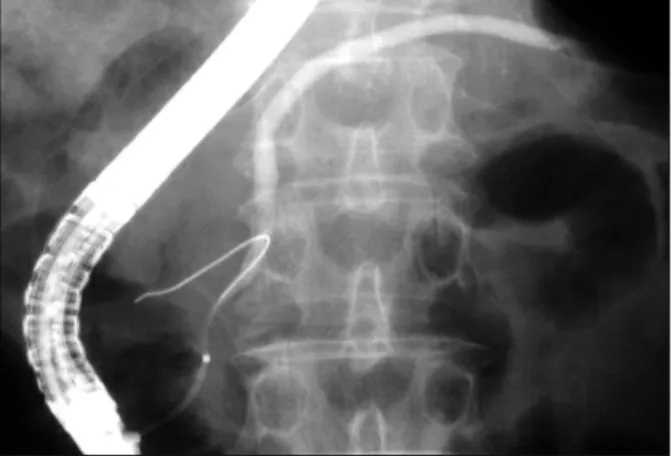
minor duodenal papilla elsewhere was confirmed (Fig. 2). Biopsy results indicated moderately differentiated adenocarcinoma. Endoscopic retro- grade pancreatography (ERP) via the major duo- denal papilla revealed no apparent abnormality except a slightly dilated main pancreatic duct and obstruction of the accessory pancreatic duct (Fig.

3). To assess the tumor’s origin and staging, endo- scopic ultrasonography (EUS, 7.5 MHz, UM230;

Olympus Medical Systems Corp., Tokyo, Japan) was performed using a deaerated water-filled method in the duodenum. Those results revealed an elevated hypoechoic mass in the minor duodenal papilla with retention of the muscularis propria of the duodenum (Fig. 4), suggesting that

the tumor existed only to a limited extent in the minor papilla and did not infiltrate into the pancreas. According to TNM classification of the tumor in the duodenal major papilla, this case was inferred to be T1.

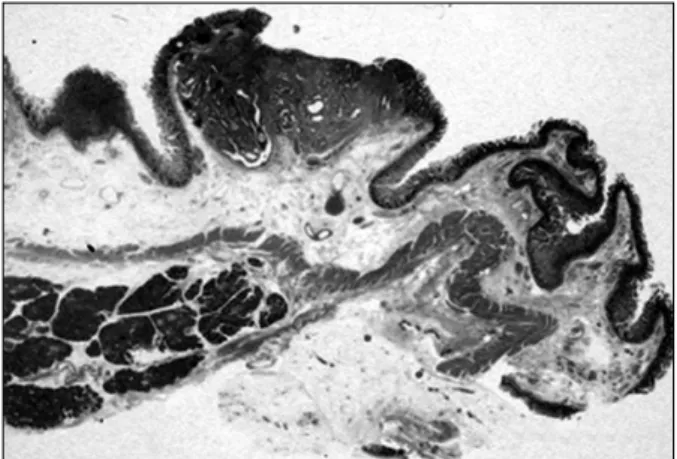
For treatment, pylorus-preserving pancreatico- duodenectomy was done. The tumor was found in the minor duodenal papilla and macroscopic examination of the resected specimen showed that the tumor was 11 mm × 8 mm. Microsopic exami- nation showed a well-differentiated adeno- carcinoma, and the tumor cells surrounded the orifice of the minor papilla with a slight invasion into the submucosa (Fig. 5). There was no finding of lymph node metastasis or infiltration into the

Fig. 1. Upper gastrointestinal endoscopy revealed a flat elevated tumor with central ulceration in the 2nd portion of the duodenum.

Fig. 2. Duodenoscopy with a side-view endoscope showed the tumor that originated in the minor duodenal papilla.

The major papilla existed in the anal side of the minor papilla.

Fig. 4. EUS revealed an elevated hypoechoic mass in the minor duodenal papilla. Also, EUS showed an elevated hypoechoic mass (long arrow) in the minor papilla with retention of muscularis propria (short arrow) of the duodenum.

Fig. 3. Endoscopic retrograde pancreatography via the

major duodenal papilla revealed no apparent abnormality

except a slightly dilated main pancreatic duct and

obstruction of the accessory pancreatic duct.

(3)

Adenocarcinoma of Minor Duodenal Papilla

Yonsei Med J Vol. 49, No. 2, 2008

pancreas parenchyma (Fig. 6). These findings were thought to support the EUS findings. Because of the above-mentioned findings, we diagnosed a primary adenocarcinoma of the minor duodenal papilla. No relapse of the tumor after surgery was identified for 32 months.

DISCUSSION

Primary adenocarcinoma of the minor papilla is extremely rare.

7

Actually, the incidence of adeno- carcinoma of the minor duodenal papilla, especi- ally at an early stage, might be low, but it seems that the main reason for the rarity of reports in

the literature is that most tumors in this area are identified in an advanced stage; they seldom present symptoms in the early stage. It is therefore difficult to diagnose whether a tumor has originated from the minor duodenal papilla or pancreatic parenchyma.

The minor duodenal papilla is the opening for the accessory pancreatic duct. It consists of: the accessory pancreatic duct; pancreatic tissue of the dorsal pancreas, which penetrate the muscularis propria of the duodenum; and the surrounding fibrous connective tissue.

8

Therefore, primary adenocarcinoma of the minor duodenal papilla is defined as a tumor derived from the epithelium covering the minor papilla or the accessory pancreatic duct within the duodenal wall. In the present case, the tumor cells surrounded the orifice of the minor duodenal papilla with a slight invasion into the submucosa and no infiltration into the pancreas parenchyma. Although it remains unclear whether the tumor had origi- nated in the epithelium covering the minor duodenum papilla, the accessory pancreatic duct, or the ectopic pancreatic tissue penetrating the muscularis propria, the tumor was classified as a primary adenocarcinoma of the minor duodenal papilla.

Our patients had no symptoms or abnormalities aside from aggravation of blood sugar control and dilatation of the main pancreatic duct by CT.

These findings are not associated with tumors of the minor duodenal papilla. Among previous reports regarding tumors of minor duodenal papilla, 2 patients had no symptom,

4,6

2 patients had transient epigastralgia,

5,7

and 1 patient had acute relapsing pancreatitis.

3

No specific symp- tom of the tumor of the minor duodenal papilla existed; in all patients, including the patient described herein, tumors were discovered inci- dentally by upper gastrointestinal examination.

When routine endoscopic examination of the upper gastrointestinal tract is performed, careful observation of ampulla, including the minor duodenal papilla, is necessary.

Although CT is useful for evaluation of tumor staging, Yamao et al.

7

described the usefulness of EUS for tumors of the minor duodenal papilla. In addition, in the presented case, EUS with 7.5 MHz revealed the tumor as a hypoechoic mass and

Fig. 5. Microsopic examination showed a well differen- tiated adenocarcinoma; tumor cells surround the orifice of the minor papilla with slight invasion into submucosa (arrow) (Elastica Masson staining, original magnification ×

20).

Fig. 6. Microscopic findings showed no infiltration into

the pancreas parenchyma. (Hematoxylin Eosin staining,

original magnification × 3).

(4)

Takeru Wakatsuki, et al.

Yonsei Med J Vol. 49, No. 2, 2008

duodenal muscularis propria as a hypoechoic layer. Consequently, we were able to verify that no infiltration into the pancreatic parenchyma had occurred. Diagnosis of whether the carcinoma infiltrated into the pancreatic parenchyma was an important matter because infiltration into the pancreatic parenchyma is an important predictive factor of prognosis.

9

Recently, endoscopic resection (papillectomy) has been reported in patients with a tumor of the major duodenal papilla and a few malignant cases have been treated by papillectomy.

10-12

Some in- vestigators have asserted that the indication of papillectomy should be limited to benign cases.

13,14

Regarding endoscopic treatment for tumors of the minor duodenal papilla, a few cases of papillec- tomy have been reported;

4,5

these also were all benign. Our case showed malignancy in spite of the T1 stage. Therefore, we did not choose endoscopic treatment. Expansion of indications of papillectomy for malignancy in duodenal papilla will require further accumulation of case infor- mation.

REFERENCES

1. Malone MJ, Silverman ML, Braasch JW, Jin GL, Dayal Y. Early somatostatinoma of the papilla of the duct of Santorini. Arch Surg 1985;120:1381-3.

2. Stömmer PE, Stolte M, Seifert E. Somatostatinoma of Vater’s papilla and of the minor papilla. Cancer 1987;

60:232-5.

3. Singh VV, Bhutani MS, Draganov P. Carcinoid of the minor papilla in incomplete pancreas divisum pre- senting as acute relapsing pancreatitis. Pancreas 2003;

27:96-7.

4. Sugiyama M, Kimura W, Muto T, Yahagi N, Ichinose M, Miki K. Endoscopic resection of adenoma of the minor papilla. Hepatogastroenterology 1999;46:189-92.

5. Nakamura T, Ozawa T, Kitagawa M, Takehira Y, Yamada M, Yasumi K, et al. Endoscopic resection of gangliocytic paraganglioma of the minor duodenal papilla: case report and review. Gastrointest Endosc 2002;55:270-3.

6. Fukuda A, Yazumi S, Sawada M, Seno H, Nabeshima M, Fujii H, et al. Adenomyoma of the minor duodenal papilla. Gastrointest Endosc 2005;61:475-9.

7. Yamao K, Ohhashi K, Furukawa T, Mizutani S, Matsumoto S, Banno T, et al. Primary carcinoma of the duodenal minor papilla. Gastrointest Endosc 1998;48:

634-6.

8. Ohta T, Nagakawa T, Kobayashi H, Kayahara M, Ueno K, Konishi I, et al. Histomorphological study on the minor duodenal papilla. Gastroenterol Jpn 1991;26:

356-62.

9. Nakao A, Harada A, Nonami T, Kishimoto W, Takeda S, Ito K, et al. Prognosis of cancer of the duodenal papilla of Vater in relation to clinicopathological tumor extension. Hepatogastroenterology 1994;41:73-8.

10. Goldberg M, Zamir O, Hadary A, Nissan S. Wide local excision as an alternative treatment for periampullary carcinoma. Am J Gastroenterol 1987;82:1169-71.

11. Ponchon T, Berger F, Chavaillon A, Bory R, Lambert R. Contribution of endoscopy to diagnosis and treat- ment of tumors of the ampulla of Vater. Cancer 1989;

64:161-7.

12. Jung S, Kim MH, Seo DW, Lee SK. Endoscopic snare papillectomy of adenocarcinoma of the major duodenal papilla. Gastrointest Endosc 2001;54:622.

13. Binmoeller KF, Boaventura S, Ramsperger K, Soehendra N. Endoscopic snare excision of benign adenomas of the papilla of Vater. Gastrointest Endosc 1993;39:127-31.

14. Catalano MF, Linder JD, Chak A, Sivak MV Jr, Raijman

I, Geenen JE, et al. Endoscopic management of ade-

noma of the major duodenal papilla. Gastrointest

Endosc 2004;59:225-32.

수치

Fig. 1. Upper gastrointestinal endoscopy revealed a flat elevated tumor with central ulceration in the 2nd portion of the duodenum.
Fig. 6. Microscopic findings showed no infiltration into the pancreas parenchyma. (Hematoxylin Eosin staining, original magnification × 3).

참조

관련 문서