SCIENCE & TECHNOLOGY. Vol. 12, No. 1, 55~61 (2006) 55
Understanding the Effects of Different Edible Coating Materials on the Storability of ‘Bing’ Sweet Cherries
Su-il Park and Yanyun Zhao*
Pulmuone Co., Ltd., Seoul, 120-600, Korea
*Oregon State University, Corvallis, Oregon 97331, United State of America
Abstract ‘Bing’ sweet cherries (P. avium L.) were coated with four different coating materials at 1% concentration (Semperfresh®, calcium caseinate, chitosan, or TIC Pretested® colloid 911) and stored at 2.0oC and 88% RH up to 35 days. The influence of different coating materials on the storability of fresh cherries was investigated. Semperfresh® coat- ings significantly improved overall quality of fresh cherries by decreasing weight loss and improving color stability, and chitosan-based coatings were effective in controlling mold incidence. However, colloid 911 and calcium caseinate coat- ings did not show significant benefit in preventing quality deterioration of fresh cherry during storage, probably due to their hydrophilic nature leads to exacerbated weight loss and shriveling with the possible interactions between coating materials and cherries epidermal layers.
Key words Cherries, Edible coating, Semperfresh®, Chitosan
Introduction
Sweet cherries are highly perishable and have a very short shelf-life in fresh fruit market. Sweet cherries are also very vulnerable to physical damage resulted in pitting and bruising.
Edible coatings have been used to create a micro-modified atmosphere around products to extend shelf-life of fresh fruits and vegetables during cold storage by acting as semiper- meable barriers to water loss and gas exchange (Baldwin, 1994). A few coating attempts have been made for fresh cher- ries, which include CaCl2 with xanthan gum (Lidster et al., 1979), antitranspirant or surface-active agents (Wade and Bain 1980), waxes (Lidster, 1981; Drake et al., 1988), Semper- fresh® (Drake et al., 1988; Yaman and Bayondrl, 2001a, 2001b), and Aloe vera gel ( Martinez-Romero, 2006).
Xanthan gum has been applied to cherry surface as a thick- ener to enhance calcium uptake through cherry skin and pos- tulated to prevent water loss from damaged cherry (Lidster et al., 1979). Wax-type coatings are the most often used edible coatings for fresh fruits. Drake et al. (1988) reported that the wax layer applied on the cherry surface decreased weight loss by enhancing cuticular diffusive resistance and retarded
microbial decay rate. However, the waxy taste on the fruit sur- face may be rejected by the consumers (Park, 1999), and the effectiveness of wax coating in reducing surface pitting and stem discoloration was not conclusive. Inconsistent results on antitranspirant coatings for cherries were reported. Lidster (1981) showed that commercial antitranspirant coating was effective in decreasing weight loss, stem discoloration, and surface pitting rate of cherries during storage, but Wade and Bain (1980) found that antitranspirant coating increased skin pitting rate of the cherries. Semperfresh® has been applied to cherry surfaces and reported as successful shelf-life extender of stored cherries (Drake et al., 1988; Yaman and Bayondrl 2001a). According to Martnez-Romero et al. (2006), storabil- ity of cherry was also significantly extended without any det- rimental effect on taste, aroma or flavors by aloe vera gel coating treatments.
In this study, the efficacies of different coating materials on the storability of fresh sweet cherry were tested for under- standing how the nature of different coating materials may affect the function of coating on fresh cherries. Two com- mercial coating materials, Semperfresh® and TIC Pretested® Colloid 911, and two edible polymers, calcium caseinate and chitosan were evaluated. Semperfresh®, a mixture of sucrose esters of fatty acids, sodium carboxymethlcellulose, and mono-diglycerides of fatty acids is a well-known commercial coating material for most fresh fruits. Colloid 911 is a mixture of water-soluble hydrocolloid developed for use in bakery, fresh fruit glaze, and fruit coatings (Percival et al., 2002). Pro- tein based materials have never been used for coating cherries.
†Corresponding Author : Yanyun Zhao
Associate Professor, Department of Food Science and Technology, Oregon State University, 100 Wiegand Hall, Corvallis, OR 97331- 6602, USA
E-mail : <[email protected]>
Calcium caseinate was selected as a protein-based coating material because of its good film forming property (Mei and Zhao, 2003) and potential for increasing the firmness of cher- ries during storage due to the calcium component in the for- mulation. Chitosan has been known for itsbroad antimicrobial activity with excellent film forming properties, and been used as a semi-permeable coating material on fruits and vegetables for shelf-life extension (Du et al., 1997; Zhang and Quantick, 1998). The combined antifungal activities of chitosan coating and hypobaric treatment against postharvest decay have been reported, but no data were presented regarding the effects of chitosan coating on physiological changes or antifungal activ- ity of chitosan alone (Romanazzi et al., 2003).
Our objective was to study the effects of different edible coating materials on the storability of fresh 'Bing' sweet cher- ries by monitoring weight loss, surface and stem color, surface pitting and mold incidence, titratable acidity and soluble solid content, and firmness of the cherries during storage.
Materials & Methods
1. Materials
Four coating materials evaluated in this study were Sem- perfresh®(SF: AgriCoat Industries Ltd., England; distributed by Pace International, Seattle, WA, USA), calcium caseinate (CC: Alanate 385, NZMP, Santa Rosa, CA, USA) with 92.9%
protein and 1.4% calcium, chitosan (CH: Vanson Inc., Red- mond, WA, USA) with11 cps viscosity of a 1% w/w aqueous acetic acid solution at 25oC and 89.9% deacetylation, and TIC Pretested® Colloid 911 powder (C911: TIC Gums Inc., Bel- camp, MD, USA). Other materials include polysorbate 80 (Tween 80: Integra, Renton, WA, USA) and analytical grade glacial acetic acid (Baker Adamson, Morristown, NJ, USA).
All materials were food-grade.
2. Methoods
1) Preparation of coating solutions
The concentration of all coating solutions was 1% (w/v).
Semperfresh® (SF) coating solution was prepared by diluting 50% SF concentrate with distilled water. Chitosan (CH) solu- tion was prepared by dissolving chitosan in 0.5% aqueous ace- tic acid with 0.1% Tween 80 (w/w chitosan) for better wettability. Colloid 911 powder (C911) was dissolved in dis- tilled water with 0.1% Tween 80 (w/w C911). All film-form- ing solutions were homogenized using a homogenizer (Polytron PT 10-35, Kinematica AG, Littau, Switzerland) for 1 min at 3,000 rpm to ensure complete dissolution. Calcium caseinate (CC) solution in distilled water was prepared by homogenizing for 1 min at 3000 rpm and then heated in shak- ing water bath at 60oC for 30 min, followed by cooling to room temperature.
2) Sample preparation
‘Bing’ sweet cherries (P. avium L.) harvested at Dalles, OR,
USA were immediately transported to our lab after hydro- cooling in chlorinated water (50 ppm) at 2oC for about 30 min.
Cherries were selected for uniform size and color, absence of visible defects, and then stored overnight at 2oC before coat- ing treatment. Cherries were randomly assigned to one of four coating treatments, or a control (uncoated) treatment. Cherries were dipped in coating solution for about 1 min and dried on a stainless steel screen under fans to ensure surface dryness.
Dried cherries were then packed in clam shell container (0.45 kg) and stored in a cooler at 2oC and 88% RH without light. Few containers of cherries were stored in an envi- ronmental chamber (T10RS, Tenney Environmental, Will- iamsport, PA, USA) set at 25oC and 50% RH to compare the decay rate of cherries with those in cooler. Qualities of the cherries were evaluated at 0, 3, 7, 14, 21, 28, and 35 days of storage at 2oC.
3) Weight loss
Cumulative weight losses (%) of the cherries during storage were measured by monitoring the weight changes of cherries, and calculated as percentage loss of the initial weight. Two sets of 10 cherries were used for each replication.
4) Skin and stem color measurements
Surface color of the cherries was measured using a Hunter Labscan colorimeter (Model No. MS/S-4500L, Hunter Asso- ciates Laboratory, Inc., Reston, VA, USA) with an aperture diameter of 10 mm. L*, a*, and b* values were recorded, and hue angle (tan−1 b*/a*) was calculated to determine the color changes during storage. Ten samples were used for each mea- surement where three different sites of each cherry were mea- sured and averaged. Stem color was estimated as percent of the stem showing green color. Two sets of 30 cherries each were evaluated for each replication.
5) Skin pitting rate
Visible pitting rate was evaluated based on three categories:
none, moderate (1 to 3) and severe (> 3). Only pits equal to or greater than 2.4 mm in diameter were recorded. Sunken areas with smooth transitional edges were not scored as pits. Two sets of 30 cherries were used for each replication.
6) Titratable acidity and soluble solid content
Titratable acidity and percent soluble solid content were determined on juice and puree mixture extracted using a juicer (Hamilton Beach, Southern Pines, NC, USA). About 5 g ali- quots of 10 cherries were diluted with 50 ml of distilled water, titrated with 0.1 N NaOH to pH 8.1, and expressed as mg of malic acid/100 ml (% malic acid). Percent soluble solid con- tent was determined with a refractometer (RA-250HE, KEM, Japan). Ten cherries were used for each measurement.
7) Firmness
Firmness of the cherries was determined by measuring the
compressive force using a Texture Analyzer (TA-XT2, Stable Micro Systems, Surre, England) with a 5 mm diameter punch probe. Each cherry was subjected to a compression force at a 0.5 mm/sec after contact and penetrated 3 mm (Drake et al., 1988). The firmness was reported as peak force and expressed in Newton. Ten cherries were measured for each replication.
8) Decay rate assessment
Cherries were examined for visible surface mold infection.
A cherry was considered infected when a visible incidence by alienorganisms and subsequent destruction of the cherry tissue were observed. The infected cherries were removed from the container immediately to prevent spreading to adjacent cher- ries. The decay rate was expressed as number of the cherries infected in two sets of 30 cherries.
9) Statistical analysis
All experiments were repeated three times. Data was ana- lyzed by analysis of variance (ANOVA) with SAS statistical software (Release 8.02, SAS Institute, Cary, NC, USA). Gen- eral linear model (GLM) procedures were performed (p <
0.05) for all the treatments at different storage times. Tukey's multiple comparison was used for mean separation among treatments.
Results & Discussion
1. Weight loss and appearance
All coatings formed on cherry surface were invisible and odorless. Only SF coating reduced weight loss, whereas other coating treatments increased the weight loss compared to uncoated cherries (Fig. 1). Weight loss by moisture evapo-
ration through fruit surface is determined by the resistance of the cherry skin to vapor diffusion and the strength of pressure differences between cherry tissues and surroundings (Patter- son, 1987). Polysaccharide-based coatings have been mainly applied for intermediate or dry food products due to the hydrophilic nature compared to themore hydrophobic wax coatings. Tested SF, CH, and C991 are all polysaccharide- based materials with (1-4) linked polymeric backbone struc- tures. It was expected that these polymers have some degree of barrier properties by forming water-holding layer on applied surface, providing decrease in respiration rate and increase in the resistance of the cherry skin to gas and water vapor diffusion. However, this was not found in CH and C911 coated cherries. The SF coatings decreased weight loss of fresh cherries compared to control, probably due to the car- boxymethyl cellulose structure of SF with highly incorporated short-chain unsaturated fatty acid esters that acts as a nonionic surfactant and increases hydrophobicity of the coatings.
Chitosan coatings on other fruits, such as raspberries and strawberries showed successful control in weight loss (Zhang and Quantick, 1998). The effectiveness of coatings depends on the properties of natural protective layers of each variety.
Fruit outer protective layer, which plays important role in cherry weight loss, is composed of cuticle, epidermal cells, stomata, and lenticles (Kader, 1985). Cherry has a very thin, about 1µm, cuticle layer which is susceptible to external dam- age and environment conditions (Glenn and Poovaiah, 1987).
It may be speculated that the structural integrity of thin cuticle layer is weakened by coating materials which furthermore penetrate through cherry skin causing ionic interactions with charged membrane components. Another possible explanation is that the stomatal pore area on cherry surface may be vul- nerable to attached alien molecules resulting increased water molecule transportation through stomatous cherry surface.
During storage, the dimensional deformations of coating layers were observed as a result of wilting and shriveling caused by weight loss and different surface tensions between coating layers and cherries surface. Different surface tensions between coating material and cherry surface may cause sep- aration of thin cuticular layer from underneath epidermal cell walls of the cherries. The high contact angles, about 94.2o for water droplets, on the sweet cherry surface were reported (Peschel et al., 2003). The high surface tension of the cherries hindered uniform formations of CH and C911 coatings. Add- ing Tween 80 in coating solutions helped to avoid the for- mation of window area on cherry surface. In general, wetting agents increase permeability of the coatings. Severe shriveling was observed in CH and C911 coated cherries when wetting agents were incorporated. Wade and Bain (1980) reported that increased physical disorder on cherry surface was occurred by coating treatments with antitranspirant or wetting agents, such as Vapor Gard®), Agral 60®, and dimethyl sulphoxide.
Successful coating applications on fresh cherries require maintain the natural intact protective layer of the cherries and Fig. 1. Effects of coatings and storage time on the weight loss
of sweet cherries stored at 2oC and 88% RH (C = control;
SF = Semperfresh®; CC = calcium caseinate; CH = chitosan;
C911 = TIC Pretested® Colloid 911).
add additional coating layer to enhance the barrier properties against gases and moisture vapor diffusions. Interactions between the surface of cherries and applied coating material need to be further studied to fully understand the effectiveness of different coating materials on cherries. Increasing coating solution concentration without wetting agent addition may also be beneficial for future coating applications on fresh cherries.
2. Skin and stem colors
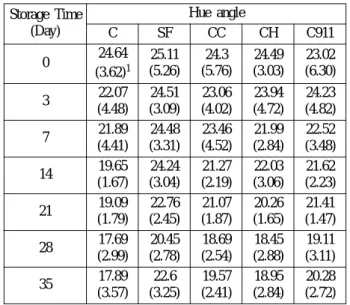
Table 1 shows the surface color changes of cherries during storage. Hue angle significantly (P < 0.05) decreased with increased storage time in all samples. Edible coatings showed significant delay in color changes of fresh cherries stored at ambient condition except CC coating. This was also generally true for cherries stored at 2oC , where significantly higher hue angle values were calculated in coated samples than those of control. The red pigment in cherries is anthocyanin, which is the most important attributor in color change of sweet cher- ries. The decrease in hue angle values during storage may be due to the synthesis of the anthocyanins, which made the fruits redder and darker. Our results were consistent with those by Ochoa et al. (2001) and Yaman and Bayoιnιdrlι (2001b) that total pigment content in cherries decreased with storage time and the values decrease more rapidly with increasing storage temperature. It was clear that cold storage is a key in pre- venting color loss of fresh cherries when applying edible coat- ings.
Slight retention of stem green color was observed on both SF and CC coated cherries. However, no significant statistical
difference was found in comparison with uncoated cherries (Table 2). It was also noticed that cherry stems dry out much faster than that of fruits due to its physical structure, where the long and thin shape resulted in a large surface area to volume ratio, made it very susceptible to physical damage and water evaporation (Schick and Toivonen, 2000). Stem quality pres- ervation is one of the big challenges in fresh cherry industry since consumers reject shriveled and brown stems as a quality defection. Dry out of the stems is a large portion of total weight loss of cherries. Our results suggested that edible coat- ings in 1% solid concentration tested in this study were not very effective to control stem discoloration except SF coating.
Increase in coating thickness with higher solution concen- tration might be worth to evaluate on their capability to improve cherry stem discoloration during storage in the future studies.
3. Soluble solid content and titratable acidity
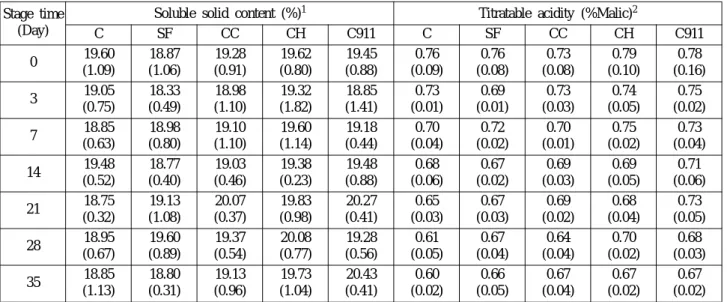
Soluble solid content of cherries were not significantly dif- ferent (P > 0.05) among all treatments throughout storage time (Table 3). Soluble solid content values are expected to decrease along with increased storage time because sugars in the cherries are used to generate energy, and cherries have lit- tle starch reserves which are converted to sugar during stor- age. However, our results did not follow this assumption. One of the explanations is that weight loss of cherries during stor- age result in condensation of sugars in cherry matrix and com- pensates sugar losses.
Coating treatment delayed titratable acidity losses compared to uncoated cherries (Table 4). Titratable acidity values of cherries gradually decreased with storage time, which is expected in general fruit senescence progress by use of acid as nutritional source. At the end of 35 days of storage, uncoated Table 1. Effect of edible coatings and storage time on the skin
color changes (Hue angle) of 'Bing' sweet cherries during stor- age at 2oC
Storage Time (Day)
Hue angle
C SF CC CH C911
0 24.64
(3.62)1 25.11 (5.26)
24.3 (5.76)
24.49 (3.03)
23.02 (6.30)
3 22.07
(4.48)
24.51 (3.09)
23.06 (4.02)
23.94 (4.72)
24.23 (4.82)
7 21.89
(4.41)
24.48 (3.31)
23.46 (4.52)
21.99 (2.84)
22.52 (3.48)
14 19.65
(1.67)
24.24 (3.04)
21.27 (2.19)
22.03 (3.06)
21.62 (2.23)
21 19.09
(1.79)
22.76 (2.45)
21.07 (1.87)
20.26 (1.65)
21.41 (1.47)
28 17.69
(2.99)
20.45 (2.78)
18.69 (2.54)
18.45 (2.88)
19.11 (3.11)
35 17.89
(3.57) 22.6 (3.25)
19.57 (2.41)
18.95 (2.84)
20.28 (2.72) C = control; SF = Semperfresh®; CC = calcium caseinate;
CH = chitosan; C911 = TIC Pretested® Colloid 911.
1Data reported are means of 30 measurements and values in parenthesis are standard deviations.
Table 2. Effects of edible coatings and storage time on the stems color (percentage of showing green) of ‘Bing’ sweet cher- ries during storage at 2oC
Storage Time (Day)
Stem green color(%)
C SF CC CH C911
7 92.8
(2.5)1 89.2 (3.9)
86.7 ( 6.3)
89.2 (3.9)
89.4 (5.3)
14 61.9
(25.5) 62.3 (29.3)
66.7 (20.2)
61.7 (21.3)
62.5 (18.3)
21 37.2
(10.3) 40.2 (13.0)
34.1 (13.3)
41.3 (23.3)
40.7 (14.9)
28 21.6
(2.7) 25.9 (5.2)
23.2 (5.2)
23.7 (5.3)
21 (5.5)
35 20.9
(2.3) 21.7 (2.5)
22.4 (6.5)
18.7 (2.8)
19.3 (3.3) C = control; SF = Semperfresh®; CC = calcium caseinate;
CH = chitosan; C911 = TIC Pretested® Colloid 911.
1Data reported are means of 180 measurements and values in parenthesis are standard deviations.
cherries had the largest decrease (about 21%) in titratable acidity, while coated samples had about 8 to 14% reduction.
4. Firmness
Firmness is an important quality attribute of sweet cherries.
No significant differences were observed between coated and uncoated samples, as well as among different coating treat-
ments (Table 4). Weight loss usually results in decreased cell turgor (Glenn and Poovaiah, 1987), hence fruit softening occurs. Our results on cherries showed increased trends in firmness during storage. This may be explained by the changes in the internal temperature of cherries, where cherries were first exposed to ambient temperature for coating appli- cations (dipping and drying at ambient conditions), and then subjected to a sharp temperature reduction for cold storage at 2oC. Along with temperature reduction, cell membrane is rigidified by restricted rotational motion in membrane struc- ture with increased binding of negatively-charged phospho- lipids molecules in membrane components with divalent calcium and magnesium (Shewfelt, 1992), thus hardening the structure of the cherries. The firmness increases during storage may also be explained by increased solid to liquid ratio, because cherry skin integrity is maintained while moisture continuously evaporated during storage. In this study, calcium in CC coatings did not show improved cherry firmness as compared with other coating treatments.
5. Skin pitting rate
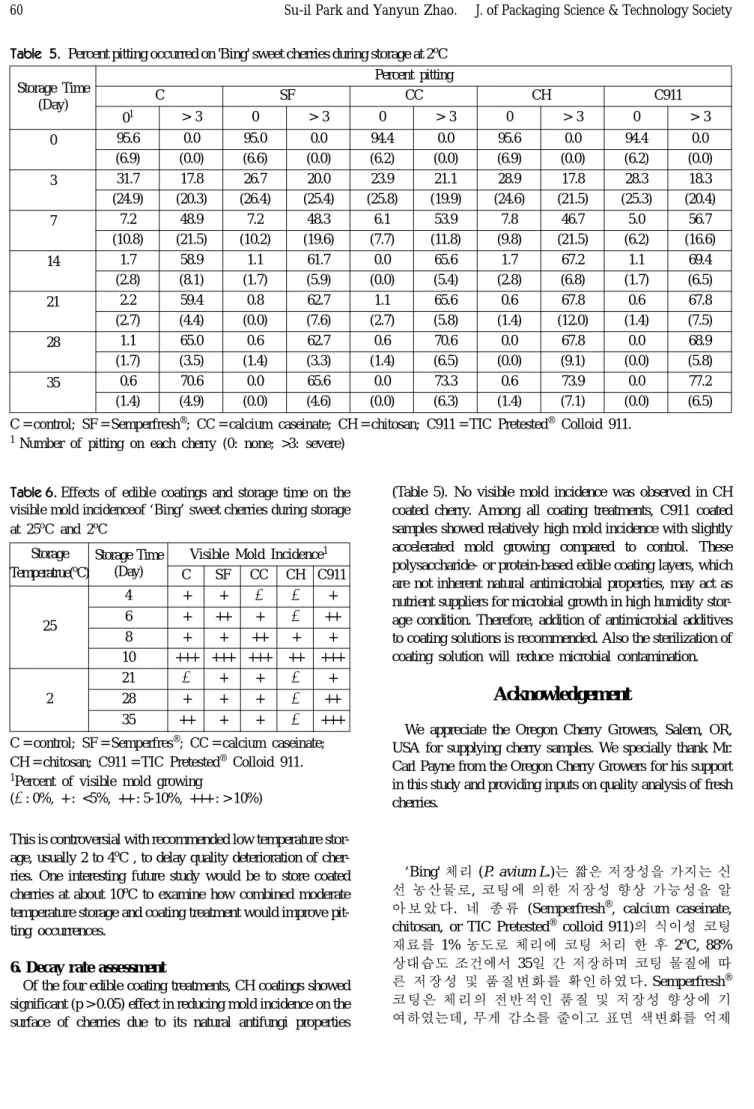
Edible coatings did not significantly (p > 0.05) reduce pit- ting rate of the cherries, but low temperature storage sig- nificantly (p < 0.05) slowed down pitting development on the surface of the cherries (Table 4). Surface pitting of the cherries may be the results of physical damages during picking, han- dling, and may also be due to the stress from adjacent stems during storage and transportation. Crissosto et al. (1993) rec- ommended that cherries should be cooled to 0oC and handled at 10 to 20oC to reduce pitting formation because cherries become more vulnerable to surface pitting in low temperature.
Table 3. Effect of edible coatings and storage time on the soluble solid content and titratable acidity of ‘Bing’ sweet cherries during storage at 2oC
Stage time (Day)
Soluble solid content (%)1 Titratable acidity (%Malic)2
C SF CC CH C911 C SF CC CH C911
0 19.60
(1.09)
18.87 (1.06)
19.28 (0.91)
19.62 (0.80)
19.45 (0.88)
0.76 (0.09)
0.76 (0.08)
0.73 (0.08)
0.79 (0.10)
0.78 (0.16)
3 19.05
(0.75)
18.33 (0.49)
18.98 (1.10)
19.32 (1.82)
18.85 (1.41)
0.73 (0.01)
0.69 (0.01)
0.73 (0.03)
0.74 (0.05)
0.75 (0.02)
7 18.85
(0.63)
18.98 (0.80)
19.10 (1.10)
19.60 (1.14)
19.18 (0.44)
0.70 (0.04)
0.72 (0.02)
0.70 (0.01)
0.75 (0.02)
0.73 (0.04)
14 19.48
(0.52)
18.77 (0.40)
19.03 (0.46)
19.38 (0.23)
19.48 (0.88)
0.68 (0.06)
0.67 (0.02)
0.69 (0.03)
0.69 (0.05)
0.71 (0.06)
21 18.75
(0.32)
19.13 (1.08)
20.07 (0.37)
19.83 (0.98)
20.27 (0.41)
0.65 (0.03)
0.67 (0.03)
0.69 (0.02)
0.68 (0.04)
0.73 (0.05)
28 18.95
(0.67)
19.60 (0.89)
19.37 (0.54)
20.08 (0.77)
19.28 (0.56)
0.61 (0.05)
0.67 (0.04)
0.64 (0.04)
0.70 (0.02)
0.68 (0.03)
35 18.85
(1.13)
18.80 (0.31)
19.13 (0.96)
19.73 (1.04)
20.43 (0.41)
0.60 (0.02)
0.66 (0.05)
0.67 (0.04)
0.67 (0.02)
0.67 (0.02) C = control; SF = Semperfresh®; CC = calcium caseinate; CH = chitosan; C911 = TIC Pretested® Colloid 911.
1Data reported are means of 6 measurements and values in parenthesis are standard deviations.
2Data reported are means of 30 measurements and values in parenthesis are standard deviations.
Table 4.Effect of edible coatings and storage time on the firm- ness of ‘Bing’ sweet cherries during storage at 2oC.
Storage Time (Day)
Firmness (N)
C SF CC CH C911
0 4.98
(1.76)1 4.90 (1.43)
4.81 (1.53)
5.06 (1.16)
5.20 (1.20)
3 5.83
(1.67) 5.70 (1.66)
5.71 (1.51)
5.51 (1.59)
5.66 (1.41)
7 5.34
(1.33) 5.61 (1.76)
5.44 (1.17)
6.28 (1.13)
6.08 (1.38)
14 6.58
(1.55) 6.45 (1.63)
6.74 (1.28)
6.08 (1.14)
6.24 (1.55)
21 6.7
(1.56)
76.76 (1.43)
6.76 (1.83)
6.94 (1.48)
6.71 (1.67)
28 6.93
(1.51) 6.80 (1.47)
6.66 (2.03)
6.83 (1.68)
6.29 (1.36)
35 7.01
(1.63) 6.94 (1.48)
6.85 (1.74)
6.37 (1.37)
6.44 (1.79) C = control; SF = Semperfresh®; CC = calcium caseinate;
CH = chitosan; C911 = TIC Pretested® Colloid 911.
1Data reported are means of 30 measurements and values in parenthesis are standard deviations.
This is controversial with recommended low temperature stor- age, usually 2 to 4oC , to delay quality deterioration of cher- ries. One interesting future study would be to store coated cherries at about 10oC to examine how combined moderate temperature storage and coating treatment would improve pit- ting occurrences.
6. Decay rate assessment
Of the four edible coating treatments, CH coatings showed significant (p > 0.05) effect in reducing mold incidence on the surface of cherries due to its natural antifungi properties
(Table 5). No visible mold incidence was observed in CH coated cherry. Among all coating treatments, C911 coated samples showed relatively high mold incidence with slightly accelerated mold growing compared to control. These polysaccharide- or protein-based edible coating layers, which are not inherent natural antimicrobial properties, may act as nutrient suppliers for microbial growth in high humidity stor- age condition. Therefore, addition of antimicrobial additives to coating solutions is recommended. Also the sterilization of coating solution will reduce microbial contamination.
Acknowledgement
We appreciate the Oregon Cherry Growers, Salem, OR, USA for supplying cherry samples. We specially thank Mr.
Carl Payne from the Oregon Cherry Growers for his support in this study and providing inputs on quality analysis of fresh cherries.
요 약
‘Bing' 체리 (P. avium L.)는 짧은 저장성을 가지는 신 선 농산물로, 코팅에 의한 저장성 향상 가능성을 알 아보았다. 네 종류 (Semperfresh®, calcium caseinate, chitosan, or TIC Pretested® colloid 911)의 식이성 코팅 재료를 1% 농도로 체리에 코팅 처리 한 후 2oC, 88%
상대습도 조건에서 35일 간 저장하며 코팅 물질에 따 른 저장성 및 품질변화를 확인하였다. Semperfresh® 코팅은 체리의 전반적인 품질 및 저장성 향상에 기 여하였는데, 무게 감소를 줄이고 표면 색변화를 억제 Table 5. Percent pitting occurred on 'Bing' sweet cherries during storage at 2oC
Storage Time (Day)
Percent pitting
C SF CC CH C911
01 > 3 0 > 3 0 > 3 0 > 3 0 > 3
0 95.6 0.0 95.0 0.0 94.4 0.0 95.6 0.0 94.4 0.0
(6.9) (0.0) (6.6) (0.0) (6.2) (0.0) (6.9) (0.0) (6.2) (0.0)
3 31.7 17.8 26.7 20.0 23.9 21.1 28.9 17.8 28.3 18.3
(24.9) (20.3) (26.4) (25.4) (25.8) (19.9) (24.6) (21.5) (25.3) (20.4)
7 7.2 48.9 7.2 48.3 6.1 53.9 7.8 46.7 5.0 56.7
(10.8) (21.5) (10.2) (19.6) (7.7) (11.8) (9.8) (21.5) (6.2) (16.6)
14 1.7 58.9 1.1 61.7 0.0 65.6 1.7 67.2 1.1 69.4
(2.8) (8.1) (1.7) (5.9) (0.0) (5.4) (2.8) (6.8) (1.7) (6.5)
21 2.2 59.4 0.8 62.7 1.1 65.6 0.6 67.8 0.6 67.8
(2.7) (4.4) (0.0) (7.6) (2.7) (5.8) (1.4) (12.0) (1.4) (7.5)
28 1.1 65.0 0.6 62.7 0.6 70.6 0.0 67.8 0.0 68.9
(1.7) (3.5) (1.4) (3.3) (1.4) (6.5) (0.0) (9.1) (0.0) (5.8)
35 0.6 70.6 0.0 65.6 0.0 73.3 0.6 73.9 0.0 77.2
(1.4) (4.9) (0.0) (4.6) (0.0) (6.3) (1.4) (7.1) (0.0) (6.5)
C = control; SF = Semperfresh®; CC = calcium caseinate; CH = chitosan; C911 = TIC Pretested® Colloid 911.
1 Number of pitting on each cherry (0: none; >3: severe)
Table 6.Effects of edible coatings and storage time on the visible mold incidenceof ‘Bing’ sweet cherries during storage at 25oC and 2oC
Storage Temperatrue(oC)
Storage Time (Day)
Visible Mold Incidence1
C SF CC CH C911
25
4 + + − − +
6 + ++ + − ++
8 + + ++ + +
10 +++ +++ +++ ++ +++
2
21 − + + − +
28 + + + − ++
35 ++ + + − +++
C = control; SF = Semperfres®; CC = calcium caseinate;
CH = chitosan; C911 = TIC Pretested® Colloid 911.
1Percent of visible mold growing
(−: 0%, + : <5%, ++ : 5-10%, +++ : > 10%)
하는 것으로 관측되었다. 키토산을 기본으로 하는 코 팅은 저장 중 곰팡이 발생을 억제하는데 효과적이었 다. 하지만 colloid 911 과 calcium caseinate를 이용한 코 팅은 신선 체리의 저장성 향상에 기여하지 못했는데, 이들 친수성 코팅 물질의 경우, 체리의 표피층과 코 팅 물질 사이의 상호작용에 의해서 체리의 자연적인 보호층인 큐티클 층이 영향을 받음으로 체리의 무게 감소가 저장 기간 중에 촉진되었던 것으로 사료된다.
References
1. Baldwin, E.A. 1994. Edible coatings for fresh fruits and vegetables: past, present and future. In: Edible Coatings and Films to Improve Food Quality. J. Krochta, E. Baldwin, M.
Nisperos-Carriedo (eds.). Technomic Publ Co., Basel, Switzerland. pp. 25-65.
2. Crisosto, C.H., Garner, D., Doyle, J., Day, K.R. 1993.
Relationship between fruit respiration, bruising susceptibility, and temperature in sweet cherries. HortScience, 28, 132-135.
3. Drake, S.R., Kupferman, E.M., Fellman, J.K. 1988. 'Bing' sweet cherry (Prunus avium L.) quality as influenced by wax coatings and storage temperature. J. Food Sci. 53, 124-126.
4. Du, J.M., Gemma, H., Iwahori,S. 1997. Effects of chitosan coating on the storage of peach, Japanese pear, and kiwifruit.
J. Jap. Soc. Hort. Sci. 66, 15-22.
5. Glenn, G.M., Poovaiah, B.W. 1987. Role of calcium in delaying softening of apples and cherries. Postharvest Pomology Newsletter, 5, 10-19.
6. Kader, A.A. 1985. Postharvest biology and technology: An overview. In: Postharvest Technology of Horticultural Crops.
A.A Kader, R.F. Kasmire, F.G. Mitchell, M.S. Reid, N.F.
Sommer, J.F. Thompson (eds.). Division of Agriculture and Natural Resources, Cooperative Extension, University of California, CA. USA. pp. 3-7.
7. Lidster, P.D. 1981. Some effects of emulsifiable coatings on weight loss, stem discoloration, and surface damage disorders in 'Van' sweet cherries. J. Am. Soc. Hortic. Sci. 106, 478- 480.
8. Lidster, P.D., Tung, M.A., Yada, R.G. 1979. Effects of Preharvest and postharvest calcium treatments on fruit calcium content and the susceptibility of ‘Van’ cherry to impact damage. J. Am. Soc. Hortic. Sci. 104, 790-793.
9. Martnez-Romero, D., Alburquerque, N., Valverde, J.M., Guilln, F., Castillo, S., Valero, D., Serrano, M. 2006.
Postharvest seewt cherry quality and safety maintenance by Aloe vera treatment: a new edible coating. Postharvest Biol.
Technol. 39, 93-100.
10. Mei, Y., Zhao, Y. 2003. Barrier and mechanical properties of milk protein-based edible films containing nutraceuticals. J.
Agric. Food. Chem. 51, 1914-1918.
11. Ochoa, M.R., Kesseler, A.G., Michelis, A.D., Mugridge, A., Chaves, A.R. 2001. Kinetics of color change of raspberry, sweet (Prunus avium) and sour (Prunus cerasus) cherries preserves packed in glass containers: light and room temperature effects. J. Food Eng. 49, 55-62.
12. Park, H.J. 1999. Development of advanced edible coatings for fruits. Trends Food Sci. Technol. 10, 254-260.
13. Patterson, M.E. 1987. Factors of loss and the role of heat removal for maximum preservation of sweet cherries.
Postharvest Pomology Newsletter, 5, 3-9.
14. Percival, D., Crowe, N., Stevens, D., O'Laughlin, P. 2002.
Reduction in anthocyanin Extrudation from individual quick frozen lowbush blueberries (Vaccinium angustifolium AIT.) through use of edible films. Acta. Hort. 574, 139-145.
15. Peschel, S., Beyer, M., Knoche, M. 2003. Surface characteristics of sweet cherry fruit: stomata-number, distribution, functionality and surface wetting. Scientia Horticulturae, 97, 265-278.
16. Romanazzi, G., Nigro, F., Ippolito, A. 2003. Short hypobaric treatments potentiate the effect of chitosan in reducing storage decay of sweet cherries. Postharvest biol. Technol.
29, 73-80.
17. Schick, J.L., P.M.A Toivonen. 2000. Optimizing cherry stem quality. In: 16th Annual Postharvest Conference. March 14- 15, Washington State University, Yakima, WA, USA.
18. Shewfelt, R.L. 1992. Response of plant membranes to chilling and freezing. In: Plant membranes: a biophysical approach to structure, development, and senescence. Y.Y Leshem, .RL. Shewfelt, C.M. Willmer, O. Pantoja (eds.).
Kluwer Academic, Boston, USA. pp. 192-219.
19. Wade, N.L., Bain, J.M. 1980. Physiological and anatomical studies of surface pitting of sweet cherry fruit in relation to bruising, chemical treatments and storage conditions. J.
Hort.Sci. 55, 375-384.
20. Yaman, Ö., Bayondrl, L. 2001a. Effects of an edible coating and cold storage on shelf-life and quality of cherries.
Lebensm. -Wiss. N. -Technol. 35, 146-150.
21. Yaman, Ö., Bayondrl, L. 2001b. Effects of an edible coating, fungicide and cold storage on microbial spoilage of cherries.
Eur. Food Res. Technol. 213, 53-55.
22. Zhang, D., Quantick, P.C. 1998. Antifungal effects of chitosan coating on fresh strawberries and raspberries during storage. J. Hortic. Sci. Biotechnol. 73, 763-767.