• 검색 결과가 없습니다.

Postpartum Transmission as a Major Route of Mother-to-Child Helicobacter felis Infection

N/A
N/A
Protected

Academic year: 2022

Share "Postpartum Transmission as a Major Route of Mother-to-Child Helicobacter felis Infection"

Copied!
3
0
0

로드 중.... (전체 텍스트 보기)

전체 글

(1)

319

Postpartum Transmission as a Major Route of Mother-to-Child Helicobacter felis Infection

Sunhwa Hong

1

, Hyun-A Lee

1

, Youngho Kim

2

* and Okjin Kim

1,3

*

1

Center for Animal Resources Development, Wonkwang University, Iksan, Korea

2

Department of Biochemistry, School of Medicine, Wonkwang University, Iksan, Korea

3
Institute of Animal Experiment & Efficacy Evaluation, Wonkwang University, Iksan, Korea

In this study we investigated maternal Helicobacter felis (H. felis) infection status to determine the potential of maternal transmission. Pregnant Beagle dogs were infected experimentally with H. felis.

Following the experimental design, the stools of the mother and litters were isolated and assessed for transmission of H. felis at parturition day, 1-week old age and 6-week old age respectively. Polymerase chain reaction (PCR) was used to examine the presence of transmitted H. felis. All litters showed no transmission of H. felis at parturition day. However, they revealed 14.3 % and 100 % at 1-week old age and 6-week old age respectively by PCR. These results suggested that vertical infection during prenatal period or delivery procedure is unlikely as a route of mother-to-child H. felis infection. It might be acquired H. felis through breast-feeding, contaminating saliva and fecal-oral during co-habitat.

Key words: Helicobacter, H. felis, dog, transmission, route, postpartum

Received 27 August 2010; Revised version received 11 September 2010; Accepted 14 September 2010

In-depth knowledge of the transmission patterns of Helicobacter species may constitute important information for future intervention strategies. In the absence of consistent and verified environmental reservoirs, a predominantly person- to-person transmission has been postulated. Helicobacter pylori (H. pylori) infection is associated with poor living conditions, and possible transmission routes are fecal-oral, oral-oral, or gastro-oral, but firm evidence is lacking (Torres et al., 2000; Kim et al., 2006). Young children are particularly vulnerable to infection by transmission of H. pylori from their infected parents, especially infected mothers (Rothenbacher et al., 1999), and it is generally believed that such transmission is influenced by socio-economic status. However, little is known about how and when maternal transmission occurs

during perinatal period, especially whether this occurs before or after parturition. Also, H. felis infection is suspected to acquire mainly in early aged animal but the exact modes of transmission remain elusive (Lee et al., 2007; Oh et al., 2009). In this study, we investigated maternal H. felis infection status to determine the potential of maternal transmission.

H. felis (ATCC 49179; American Type Culture Collection, USA) was incubated in a brain-heart infusion broth containing 10% fetal bovine serum at 37

o

C overnight under a microaerophilic atmosphere and allowed to grow to a density of ~2.0×10

9

colony-forming units (CFU) per 1 mL of culture broth. Two pregnant Beagle dog were inoculated twice at 3-day intervals by oral administration of 1.0×10

10

CFU of H. felis suspended in 10 mL of broth. All studies were performed in accordance with the Guide for Animal Experimentation by Wonkwang University and approved by the Institutional Animal Care and Use Committee of Wonkwang University (Iksan, Korea). All efforts were made to minimize pain or discomfort of animals used. The challenged animals were confirmed to be H. felis-positive by polymerase chain reaction (PCR) of their fecal samples as described previously (Baele et al., 2004). The pregnant dogs were cared until delivery and the mother and her litters were housed in one cage per family. The stools of the mother and litters

*Corresponding authors: Youngho Kim, Department of Biochemistry, School of Medicine, Wonkwang University, 344-2 Shinyoung-dong, Iksan, Jeonbuk 570-749, Korea

TEL: +82-63-850-6795 FAX: +82-63-850-6795 E-mail: [email protected]

Okjin Kim, Center for Animal Resources Development, Wonkwang University, 344-2 Shinyoung-dong, Iksan, Jeonbuk 570-749, Korea

TEL: +82-63-850-6668 FAX: +82-63-850-7308 E-mail: [email protected]

Lab. Anim. Res. 2010: 26(3), 319-321

Letter

(2)

320 Sunhwa Hong et al.

Lab. Anim. Res. | September, 2010 | Vol. 26, No. 3

were sampled and assessed for transmission of H. felis at parturition day, 1week and 6 weeks after delivery respectively.

Bacterial DNAs were extracted from the stools by bead beater- phenol extraction method (Kim and Kim, 2004; Oh et al., 2009). PCR was performed as previously described method (Baele et al., 2004), which predicted PCR products of 434 base pairs for the final round of amplification. The PCR products were electrophoresed on a 1.2% (weight/volume) agarose gel.

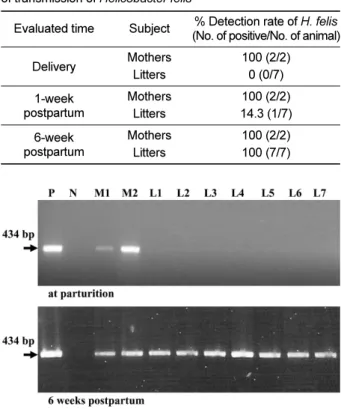
Vertical transmission was examined at parturition day. The mothers were identified H. felis infection by PCR (Table 1).

However, their fetuses were not infected with H. felis (Figure 1). Maternal transmission was examined at 1 week and 6 weeks postpartum (corresponding to transitional milk and weaning stage, respectively). Each stage group was composed of 7 litters. At 1 week postpartum, the mothers were revealed H. felis infected status by PCR and one of their litters was infected with H. felis (Table 1). At 6 weeks postpartum, the mothers and all their litters were infected with H. felis (Table 1 and Figure 1). The frequency of maternal transmission was increased during the nursing period. The transmission rate at 6 weeks postpartum (weaning stage) was significantly higher than at 1 week postpartum (lactating stage) (Table 1).

The results indicated that vertical transmission of H. felis was not occurred at pregnant and delivery period. However, they reveled 14.3 % and 100 % at lactating and weaning stage respectively. Recent epidemiological studies in humans suggest that the acquisition of H. pylori occur during childhood. For example, Rothenbacher et al. (2000) reported that H. pylori acquisition seems to occur mainly between the first and second year of life: that is, after the age of weaning. Our results are in agreement with those reports.

Also, Rothenbacher et al. (2002) reported that infected parents, especially infected mothers, play a key role in the transmission of H. pylori within families. Maternal contact behavior during the breastfeeding period may be responsible for the high frequency of maternal transmission. Our results also showed that the maternal-transmission of H. felis was not observed during pregnancy and delivery stage, but detected at lactating and weaning stage. The virulence mechanisms of non-H.

pylori gastric Helicobacters like as H. felis are hitherto largely unknown nor is it clears whether the same differences in terms of virulence are present among these organisms (De Bock et al., 2006). On the basis of these findings, vertical infection during pregnancy or at delivery is unlikely as a route of mother-to-child H. felis infection. We suggested that H.

felis infection of transplacental route during pregnancy might not be occurred and that H. felis transmission by discharges of uterine or vagina, obstetric delivery tract, during parturition might not be occurred. It might be acquired H. felis through breast-feeding, contaminating saliva and fecal-oral during co- habitat.

In conclusion, the present study provides new and important information on maternal transmission of H. felis. This study implied that maternal transmission of H. felis might be developed during latency or later postpartum stage.

Acknowledgements

This study was supported by the research fund of Wonkwang University in 2009, Iksan, Korea. The authors thank Prof.

Kook Y. for invaluable discussions during the preparation of the manuscript.

References

Baele, M., Van den Bulck, K., Decostere, A., Vandamme, P., Hänninen, M.L., Ducatelle, R. and Haesebrouck, F. (2004) Multiplex PCR assay for differentiation of Helicobacter felis, H. bizzozeronii, and H. salomonis. J. Clin. Microbiol. 42(3), 1115-1122.

De Bock, M., Decostere, A., Hellemans, A., Haesebrouck, F. and Ducatelle, R. (2006) Helicobacter felis and Helicobacter bizzozeronii induce gastric parietal cell loss in Mongolian Table 1. Results of polymerase chain reaction for assessment

of transmission of Helicobacter felis

Evaluated time Subject % Detection rate of H. felis (No. of positive/No. of animal)

Delivery Mothers 100 (2/2)

Litters 0 (0/7)

1-week postpartum

Mothers 100 (2/2)

Litters 14.3 (1/7)

6-week postpartum

Mothers 100 (2/2)

Litters 100 (7/7)

Figure 1. Result of Helicobacter felis specific polymerase chain

reaction with the fecal samples. P, positive control; N, negative

control; M1, mother 1; M2, mother 2; L1~L7, litter 1~litter 7. On

parturition day, there was no positive reaction in litters, while 6

weeks postpartum, all litters showed positive reaction.

(3)

Transmission of Helicobacter felis 321

Lab. Anim. Res. | September, 2010 | Vol. 26, No. 3 gerbils. Microbes Infect. 8(2), 503-510.

Kim, S.H. and Kim, O. (2004) Application of Consensus Polymerase Chain Reaction for Monitoring of Helicobacter Species. Lab. Anim. Res. 20(4), 316-320.

Kim, S.K., Cho, S.J. and Kim, O. (2006) Detection and identification of secreting Helicobacter species from cats. Lab.

Anim. Res. 22(3), 243-247.

Lee, H.A., Park, Y.S. and Kim, O. (2007) Prevalence of Helicobacter Species in Feces of Dogs. Lab. Anim. Res. 23(3), 339-344.

Oh, H.G., Kim, Y., Lee, H.A. and Kim, O. (2009) Detection of Helicobacter heilmannii infection in a cat. Lab. Anim. Res.

25(4), 385-391.

Rothenbacher, D., Inceoglu, J. and Bode, G.. (1999) Helicobacter pylori among preschool children and their parents: evidence of parent-child transmission. J. Infect. Dis. 179(2), 398-402.

Rothenbacher, D., Inceoglu, J. and Bode, G. (2000) Acquisition of Helicobacter pylori infection in a high-risk population occurs within the first 2 years of life. J. Pediat. 136(6), 744- 748.

Rothenbacher, D., Winkler, M. and Gonser, T. (2002) Role of infected parents in transmission of Helicobacter pylori to their children. Pediatr. Infect. Dis. J. 21(7), 674-679.

Torres, J., Perez-Perez, G. and Goodman, K.J. (2000) A

comprehensive review of the natural history of Helicobacter

pylori infection in children. Arch. Med. Res. 31(5), 431-469.

수치

Figure 1. Result of Helicobacter felis specific polymerase chain reaction with the fecal samples

참조

관련 문서