http://dx.doi.org/10.5468/ogs.2016.59.4.269 pISSN 2287-8572 · eISSN 2287-8580
Introduction
Cervical cancer is a malignant disease that develops in the cervix; with increasing use of the Pap smear for screening, the incidence and mortality rate have decreased significantly.
Moreover, with the development of vaccines after discovering the causative agent to be a high-risk human papillomavirus, cervical cancer is now the first preventable cancer. However, after breast cancer, cervical cancer remains the second most common cancer among women worldwide. Surgical treat- ment is used when the cancer is detected at an early stage, and concurrent chemoradiotherapy (chemoradiation) is used
Clinical value of routine serum squamous cell carcinoma antigen in follow-up of patients with
locally advanced cervical cancer treated with radiation or chemoradiation
Jinju Oh, Hyun Joo Lee, Tae Sung Lee, Ju Hyun Kim, Suk Bong Koh, Youn Seok Choi
Department of Obstetrics and Gynecology, Catholic University of Daegu School of Medicine, Daegu, Korea
Objective
The objective of this study was to evaluate the clinical benefits of routine squamous cell carcinoma antigen (SCC-Ag) monitoring of patients with locally advanced cervical squamous cell carcinoma treated with radiation or chemoradiation.
Methods
A total of 53 patients with recurrent cervical squamous cell carcinoma treated with radiotherapy or chemoradiation were enrolled in this study. A retrospective review of medical records was conducted. The role of routine monitoring of serum SCC-Ag was evaluated in terms of cost effectiveness and effect on survival after diagnosis of recurrence.
Results
Serum SCC-Ag abnormality (≥2.5 ng/mL) was observed in 62.3% of patients when recurrent disease was diagnosed.
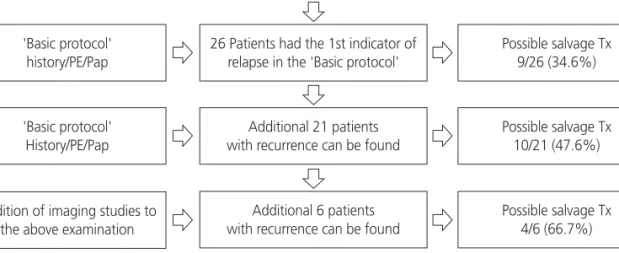
The first indicator of relapse was abnormal serum SCC-Ag level in 21 patients (39.6%), 10 of whom had asymptomatic recurrent disease amenable to salvage therapy. Adding SCC-Ag measurement to the basic follow up protocol improved the sensitivity for detecting recurrence (The sensitivity of the basic protocol vs. addition of SCC-Ag: 49.1%
vs. 88.7%, P<0.001). Twenty-three patients who were candidates for salvage therapy with curative intent showed better survival compared with those who were not candidates for therapy (5-year survival: 36.6% vs. 0%, P=0.012).
Conclusion
Surveillance with routine serum SCC-Ag monitoring can better detect asymptomatic recurrent disease that is potentially amenable to salvage therapy with curative intent. Early diagnosis of recurrent disease that can be treated with salvage therapy may lead to better survival.
Keywords: Chemoradiotherapy; Squamous cell carcinoma-related antigen; Surveillance; Uterine cervical neoplasms
Articles published in Obstet Gynecol Sci are open-access, distributed under the terms of the Creative Commons Attribution Non-Commercial License (http://creativecommons.
org/licenses/by-nc/3.0/) which permits unrestricted non-commercial use, distribution, and reproduction in any medium, provided the original work is properly cited.
Copyright © 2016 Korean Society of Obstetrics and Gynecology Received: 2015.12.7. Revised: 2016.2.6. Accepted: 2016.2.17.
Corresponding author: Youn Seok Choi
Department of Obstetrics and Gynecology, Catholic University of Daegu School of Medicine, 33 Duryugongwon-ro 17-gil, Nam-gu, Daegu 42472, Korea
Tel: +82-53-650-4087 Fax: +82-53-650-4078 E-mail: [email protected]
http://orcid.org/0000-0001-8901-9434
as the standard therapy for locally advanced cancer [1,2].
After completion of primary treatment, patients are followed for the possibility of recurrence using methods recommended by the Society of Gynecologic Oncology (SGO) and National Comprehensive Cancer Network (NCCN) [3]. To detect recur- rence, histories are reviewed and physical examinations are conducted at every visit, and an annual Pap smear is recom- mended. A radiologic test or a blood test is recommended when there are symptoms of recurrence, abnormal physical findings, or abnormal Pap smear results.
Although a serum tumor marker test is not included in the routine post-treatment surveillance recommended by the SGO, squamous cell carcinoma antigen (SCC-Ag) is com- monly used as a tumor marker for squamous cell cervical car- cinoma, and carcinoembryonic antigen for adenocarcinoma [2]. SCC-Ag is a 45-kDa glycoprotein, with two types: SCC- 1 and SCC-2 [4]. Increased serum SCC-Ag levels are com- monly observed in squamous cell carcinoma of the esopha- gus, lungs, head and neck, anus, and cervix, but levels may also increase in benign diseases such as skin disorders, pelvic inflammatory disease, cystitis, and renal failure [4,5]. The serum SCC-Ag level at the time of diagnosis is correlated with the tumor stage, size, depth of invasion, parametrial invasion, and lymph node metastasis [4,6,7]. Moreover, the serum SCC-Ag level is associated with the patient’s response to treatment [8-10].
Increase in serum SCC-Ag levels at recurrence above identi- fied thresholds was observed in 46% to 92% of patients; this increase occurred at an average of 2 to 8 months prior to clini- cal diagnosis of the recurrence. The increase in SCC-Ag levels is the first evidence of recurrence in 15% of patients [11,12].
However, using the SCC-Ag test during regular checkups is not recommended for asymptomatic patients [2,3,13], be- cause, thus far, the survival benefit of post-recurrence salvage therapy, except surgery for central pelvic recurrence, is still uncertain [14]. For the same reasons, radiologic tests are not recommended at every visit for asymptomatic patients not suspected to have a recurrence [2,3,13].
The treatment method for recurrent cervical cancer depends on the type of primary treatment and the location of recur- rence. When recurrence occurs in the pelvis after surgery as the primary treatment, radiation or concurrent chemoradio- therapy can be used as salvage therapy [15]. When radiation or concurrent chemoradiotherapy was used as the primary treatment, few patients are candidates for salvage therapy
with curative intent. Patients with central pelvic recurrence or isolated para-aortic lymph node recurrence without previous radiation treatment can be treated with surgery (radical hys- terectomy or pelvic exenteration) and with chemoradiation, respectively [16-22]. Furthermore, because several studies showed a survival benefit of surgical resection for pulmonary metastasis [23,24], patients with distant metastasis that can be completely resected also might be candidates for salvage therapy. These data suggest that current post-treatment sur- veillance focused on detecting central pelvic recurrence needs to be re-evaluated.
The objective of this study was to evaluate the clinical ben- efits of routine SCC-Ag monitoring of patients with locally advanced cervical squamous cell carcinoma treated with radia- tion or chemoradiation. The clinical benefits were evaluated based on two goals: first, the improvement of sensitivity for recurrent disease detection by the addition of serum SCC-Ag testing to the basic surveillance protocol recommended by SGO, and second, the influence of salvage therapy on post- recurrence survival to assess value of the effort to detect as- ymptomatic recurrence.
Materials and methods
1. Patients
We studied patients with relapse among those diagnosed with locally advanced cervical squamous cell carcinoma who un- derwent radiation or concurrent chemoradiotherapy between January 1, 2000 and December 31, 2014 at the Department of Gynecology and Radiation Oncology at the Daegu Catholic University Medical Center. Adenocarcinoma patients and pa- tients who had never had their serum SCC-Ag tested during follow-up were excluded. Furthermore, patients were also ex- cluded if they had received radiation and concurrent chemo- radiotherapy as adjuvant therapy after radical hysterectomy as the primary treatment.
2. Methods
The patients’ medical records and test results for the diagnosis
of recurrence were retrospectively examined. Patients under-
went regular checkups after primary treatment. The patient’s
history and physical examination, Pap smear, chest radiog-
raphy, and serum SCC-Ag test were evaluated every 2 to 3
months for the first 2 years, once every 4 to 6 months for the
next 3 years, and annually after 5 years. A radiologic test was conducted every 6 to 12 months even when there were no symptoms present, and all necessary examinations, including biopsy, and radiologic tests, such as computed tomography (CT), magnetic resonance imaging (MRI), and positron emis- sion tomography (PET)-CT were conducted when there were symptoms of recurrence or abnormal results from other tests.
A diagnosis of recurrence was defined as a recurrence con- firmed by biopsy or a radiological test showing progression of a lesion. In addition, when lesions persisted for 3 months after primary treatment with radiation or concurrent chemoradio- therapy, it was considered persistent cervical cancer and diag- nosed as a recurrence. Disease-free interval was defined as the period between the completion of primary treatment and the diagnosis of the recurrence.
Considering the location and number of recurrent lesions as well as the previous treatment, we categorized recurrent lesions amenable to salvage therapy with curative intent as follows: 1) central pelvic recurrence, 2) para-aortic lymph node recurrence that was not previously treated with radia- tion, and 3) distant metastatic lesions that could be com- pletely resected.
Among patients who could receive salvage therapy for re- current lesions, some did not receive aggressive therapy such as surgery, radiation, and concurrent chemoradiotherapy for various reasons, including refusal of treatment. In contrast, there were patients with distant metastasis, such as pulmo- nary metastasis and lymph node metastasis, who received ag- gressive therapy, including surgery or radiation. Therefore, we categorized the patients into those who received aggressive therapy, such as surgery, radiation, or concurrent chemoradio- therapy, and those who only received chemotherapy or did not receive any treatment, and we compared the difference in survival.
In addition, post-treatment surveillance protocols were di- vided as follows to evaluate the improvement of sensitivity for detecting recurrent lesions by adding serum SCC-Ag testing: 1) basic protocol: a basic screening method that included taking the history, performing a physical examination, and obtaining a Pap smear; and 2) addition of serum SCC-Ag: a method that includes testing the serum SCC-Ag in addition to the basic screening method.
In searching for evidence of recurrence by evaluating symp- toms, physical examination findings, Pap smear results, serum SCC-Ag values, chest radiography findings, and CT/MRI/PET-
CT findings, the earliest diagnostic evidence that suggested recurrence or abnormal results was defined as the ‘first indica- tor of relapse’. Symptoms suggesting recurrence were vaginal bleeding, vaginal bloody discharge, lower abdominal pain, pelvic pain, sciatic pain, weight loss, and general weakness.
Examples of signs suggesting recurrence were abnormal pelvic findings (a mass or ulceration), and palpable enlarged lymph nodes (inguinal, supraclavicular, or axillary lymph nodes).
3. Serum squamous cell carcinoma antigen measurement and cutoff value
Serum SCC-Ag was measured using an immunoradiometric assay (Abbott Diagnostics, Chicago, IL, USA). Many previous studies have used a serum SCC-Ag range of 1.5 to 3 ng/mL as the upper normal limit [4,9,14,25]. Therefore, values ≥2.5 ng/
mL were considered abnormal in this study [9].
4. Statistical analysis methods
The McNemar test was used to analyze the difference be- tween the sensitivity of the basic protocol and that of the Addition of serum SCC-Ag protocol. The difference in fre- quency between the two comparison groups was analyzed with a chi-square test. Differences in the survival rate based on each clinical variable were analyzed using the Kaplan- Meier method and the log rank test. Differences with a P- value <0.05 were considered statistically significant. Statisti- cal analysis was performed using IBM SPSS ver. 19 (IBM Co., Armonk, NY, USA).
Results
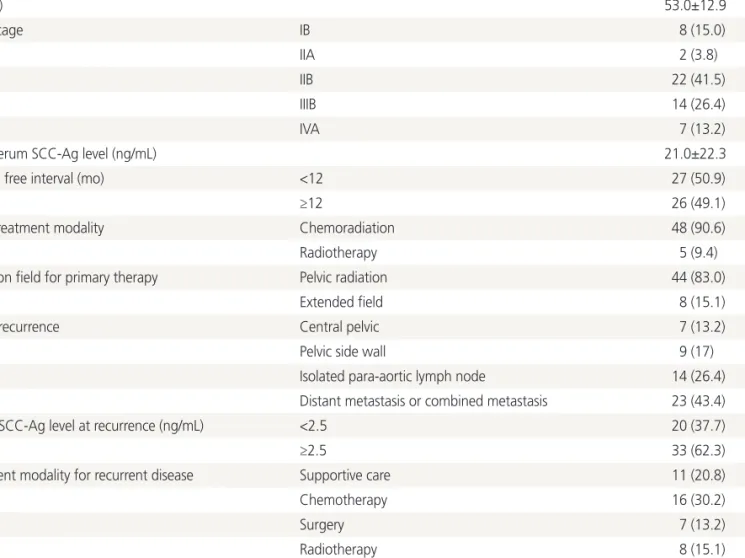
Of the 355 patients who were treated with radiation or con- current radiotherapy for locally advanced cervical squamous cell carcinoma, 53 were diagnosed with recurrence. The char- acteristics of the patients at the time of first diagnosis and at the time of recurrence are summarized in Table 1. A total of 23 patients showed recurrence in regions amenable to salvage therapy, such as central pelvic recurrence or para-aortic lymph node recurrence not treated previously with radiotherapy.
Twenty-six patients received aggressive therapy, such as sur-
gery, radiation, and concurrent chemoradiotherapy, after the
recurrence, and the remaining patients received chemotherapy
or only conservative management. The serum SCC-Ag level
at the time of diagnosis of recurrence was ≥2.5 ng/mL in 33
patients (62.3%) (Table 1).
The symptoms, signs, blood test results, and radiologic test results at the time of diagnosis of recurrence are summarized in Table 2. There were 39.6% of the patients who showed symptoms indicating recurrence, 9.4% who showed abnormal findings during physical examination, and 5.7% who showed abnormal Pap smear results (Table 2). Increased serum SCC- Ag levels at the time of diagnosis of recurrence was more common in patients with high serum SCC-Ag levels at initial diagnosis; 27.3% of the patients who had normal SCC-Ag at initial diagnosis showed an elevated serum SCC-Ag level, while 73% of patients who had high serum SCC-Ag levels at initial diagnosis showed an elevated serum SCC-Ag level (P=0.011).
The basic protocol (as recommended by the SGO) included Table 1. Characteristics of enrolled patients
Characteristics Value
Age (yr) 53.0±12.9
Initial stage IB 8 (15.0)
IIA 2 (3.8)
IIB 22 (41.5)
IIIB 14 (26.4)
IVA 7 (13.2)
Initial serum SCC-Ag level (ng/mL) 21.0±22.3
Disease free interval (mo) <12 27 (50.9)
≥12 26 (49.1)
Initial treatment modality Chemoradiation 48 (90.6)
Radiotherapy 5 (9.4)
Radiation field for primary therapy Pelvic radiation 44 (83.0)
Extended field 8 (15.1)
Site of recurrence Central pelvic 7 (13.2)
Pelvic side wall 9 (17)
Isolated para-aortic lymph node 14 (26.4)
Distant metastasis or combined metastasis 23 (43.4)
Serum SCC-Ag level at recurrence (ng/mL) <2.5 20 (37.7)
≥2.5 33 (62.3)
Treatment modality for recurrent disease Supportive care 11 (20.8)
Chemotherapy 16 (30.2)
Surgery 7 (13.2)
Radiotherapy 8 (15.1)
Chemoradiation 11 (20.8)
Values are presented as mean±standard deviation or number (%).
SCC-Ag, squamous cell carcinoma antigen.
Table 2. Diagnostic modalities showing abnormal findings at the diagnosis of recurrence
Diagnostic modalities No. (%)
a)Symptoms 21 (36.9)
Physical examination 5 (9.4)
Pap smear 3 (5.7)
SCC-Ag 33 (62.3)
Chest X-ray 1 (1.9)
Computed tomography 41 (77.4)
Magnetic resonance imaging 7 (13.2)
Positron emission tomography 20 (37.7) SCC-Ag, squamous cell carcinoma antigen.
a)