논문 투고 양식
(2018년 9월 개정)
1. 모든 논문은 학회 jams 페이지를 통해서 온라인으로 투고하셔야 합니다.
(https://phonology.jams.or.kr) 투고관련 의문사항은 편집위원장에게 이메일로 문의하시 면 됩니다 (윤관희, [email protected]).
2. 논문은 홈페이지에 명시된 양식을 준수해서 작성해야 합니다.
3. 논문을 최초 투고하실 때는 저자 관련 정보를 기입하지 마시고 WORD 파일과 PDF 파일을 함께 제출해 주시기 바랍니다.
4. 논문을 투고하시려면 회비를 학회 계좌로 납부하셔야 하며 최초 투고시 심사비 6 만원을 편집위원장 계좌로 송금해 주십시오.
학회 회비 납부 계좌: 안영란(재무이사), 우리은행 1002-961-527963 심사비 납부 계좌: 윤관희(편집위원장), 대구은행 508-14-012824-7(윤관희)
5. 투고자는 본 학회지에 논문 게재시 게재료를 학회 회비 납부 계좌로 납부하셔야 합니다. 논문 게재료는 연구비 수혜 논문 25만원, 대학 및 기관에 소속된 전임교수 님들의 논문 15만원, 비전임 선생님 및 대학원생들의 논문은 10만원입니다.
게재비 납부 계좌: 안영란(재무이사), 우리은행 1002-961-527963
6. 25쪽을 초과한 논문에 대해서는 초과 게재료가 있으며 1쪽당 1만원입니다. 게재 결 정 통보 후 최종 수정 파일을 학회 jams 페이지에 올려 주십시오. 심사결과 “수정 후 게재” 판정을 받은 경우에는 논문 수정 파일과 함께 수정내용을 기록한 파일도 jams 페이지에 올려주십시오.
편집 도구
문서편집기 MS-Word 97 이상 편집용지 A4 (21×29.7 cm)
<용지설정> [레이아웃] → [페이지 설정] → [용지크기]
여백 위쪽 6.35 cm, 아래쪽 5.35 cm 왼쪽 4.45cm, 오른쪽 4.45 cm 머리글 5.35 cm, 바닥글 0 cm
<여백설정> [레이아웃] → [페이지 설정] → [여백]
글꼴 영문
Times New Roman; 한글
바탕체머리말, 쪽수 편집 위원회에서 삽입
기본 형식
논문제목 14 pt,
굵게첫 글자만 대문자로 (
Korean palatalization) 가운데 맞춤; 줄간격 고정, 15 pt
아래로 두 줄 뗌 (빈 줄 간격 고정, 15 pt) 저자명 저자명 12 pt, 소속 10pt, 보통체
(소속) 가운데 맞춤; 줄간격 고정, 13 pt
소속은 저자명 바로 아래 줄 괄호 속에
소속과 Abstract 사이를 한 줄 뗌
(공동 저자일 경우 동일한 요령으로 좌우로 배치 → 예시 참조) Abstract 9 pt
저자, 연도, 제목 →
굵게학회지명 → 이탤릭; 소속(괄호 포함) →
굵게양쪽 맞춤; 들여쓰기 왼쪽, 오른쪽 0.63 cm;
줄간격 고정, 12 pt
Abstract와 Keywords 사이를 한 줄 뗌 (Abstract 끝에서 enter 두 번) Keywords 글꼴, 단락은 Abstract와 동일
Keywords 다음에 colon을 입력하고 한 칸 뗌 가능한 한 줄을 넘지 않게 배려
Keywords 다음에 두 줄 뗌 (두 줄의 줄 간격은 고정, 12 pt로 설정 → Keywords 바로 아래 빈 두 줄을 선택하고 위의 값을 설정)
절 제목 12 pt,
굵게(한 자리) 가운데 맞춤; 줄간격 고정, 14.5 pt 앞, 뒤로 한 줄 뗌
번호 뒤에 점을 찍고 한 칸 뗌
첫 글자만 대문자로 (
1. Introduction to alphabets) 인용할 때는 마지막 점 생략 (In section 1, I argued that…) 소절(1) 10 pt, 보통체
(세 자리까지) 가운데 맞춤; 줄간격 고정, 14.5 pt 앞, 뒤로 한 줄 뗌
번호 뒤에 점을 찍지 않고 한 칸 뗌
첫 글자만 대문자로 (1.2 Introduction to the Korean alphabet, 1.2.1 Origin of the Korean alphabet)
인용 방법 (In section 1.2, I argued that…; It has been shown in section 1.2.1 that…) 소절(2) 10 pt, 보통체
(네 자리 이상) 양쪽 맞춤; 줄간격 고정, 14.5 pt
앞 쪽에 한 줄 여백을 두지만, 아래쪽에는 빈 줄 없이 바로 본문입력 번호는 본문 왼쪽과 맞춤; 번호 뒤에 점을 찍지 않고 한 칸 뗌 첫 글자만 대문자로 (1.2.1.2 The date of invention)
인용 방법 (It has been argued in section 1.2.1.2 that…) 본문 10 pt, 보통체
양쪽 맞춤; 첫 줄 들여쓰기, 0.125 inch; 줄간격 고정, 14.5 pt 절, 소절 다음의 첫 단락은 첫 줄 들여쓰기 하지 않음 단락과 단락 사이는 빈 줄 없이 연속으로 작성 부록제목 10 pt,
굵게가운데 맞춤
Appendix A, Appendix B
와 같이 입력 위로
두줄, 아래로
한줄 뗌
부록내용 본문과 동일 (10 pt, 보통체, 첫 줄 들여쓰기, 0.125 inch; 줄간격 고정, 14.5 pt)
참고문헌제목 10 pt,
굵게,첫 자는 큰 대문자 나머지는 작은 대문자
('글꼴 설정'에서 작은 대문자 체크 R EFERENCES ) 가운데 맞춤
위로
두줄, 아래로
한줄 뗌
참고문헌내용 10 pt, 보통체
양쪽 맞춤; 첫 줄 내어쓰기 3글자; 줄간격 고정, 14.5 pt
저자명 →
첫 자는 큰 대문자 나머지는 작은 대문자,
FULL
NAME (middle name은 initial도 가능) 명시
두 명 이상일 때 and는 소문자
저널명, 서적명, 학위논문제목 → 이탤릭체, 전치사를 제외한 단어 첫 글자는 모두 대문자
논문제목 → 보통체, 첫 글자만 대문자로 쓰고 나머지는 소문자 주소 참고문헌 아래로 두 줄 떼고 작성
(빈 줄은 줄간격 고정, 14.5 pt) (e-mail 명기) 8 pt, 보통체
왼쪽맞춤; 줄간격 고정, 12 pt
기타 세부 사항
각주 9 pt, 보통체
양쪽 맞춤; 첫 줄 내어쓰기, 1.81 글자; 줄간격 고정, 12 pt 각주 번호는 위 첨자
각주번호 다음에 스페이스 한 번 입력 각주와 각주 사이는 빈 줄 없이 연속
예문 글꼴, 단락 본문과 동일 (10 pt, 보통체; 양쪽맞춤; 줄간격 고정, 14.5 pt) 예문 번호는 ( ) 속에 쓰며, 들여쓰기를 하지 않고 본문 왼쪽에 맞춤 예문을 나열할 때는 a, b, c…를 사용하고 점을 입력 (a. chelswu-nun namswu-wa…)
본문과 위아래로 한 줄 뗌 (빈 줄은 간격 고정, 14.5 pt) 인용할 때는 (1), (1a) 등과 같이 사용
Tableaux 번호와 tableau 모두 들여쓰기를 하지 않고 본문 왼쪽에 맞춤
표가 왼쪽으로 벗어나면 커서를 표의 왼쪽 줄 위에 놓고 오른쪽으로 끌어서 맞추어 주어야 함
번호 및 제목과 tableau 사이에 빈 줄을 두지 않음 선두께: ¾ pt
음영: 회색 20 %
constraint가 길어서 두 줄 이상이 될 때 constraint가 제시된 행은 [위쪽 가운데]로 맞춤
input 부분과 벌점 표시(*) 부분은 [정가운데] 맞춤 인용할 때는 예문과 동일하게 (1), (1a) 등으로 사용
<셀 내용 맞추는 방법>
필요한 셀을 선택 → 오른쪽 마우스 버튼 클릭 → [셀맞춤] → [위쪽 가 운데] 또는 [정가운데]로 표시된 아이콘 선택
<셀 음영 및 선 종류 변경하는 방법>
필요한 셀을 선택 → 오른쪽 마우스 버튼 클릭 → [테두리 및 음영]
<[보기] → [도구모음] → [표 및 테두리]를 선택하면 표를 처리할 때 필 요한 여러 가지 기능이 아이콘으로 나타남>
인용문 글꼴은 본문과 동일 (10 pt, 보통체)
양쪽 맞춤; 들여쓰기 왼쪽, 오른쪽 0.25 inch; 줄간격 고정, 14.5 pt 단일문단; 본문과 앞뒤로 한 줄 뗌 (빈 줄은 줄간격 고정, 12 pt) 그림 본문과 한 줄 (줄간격 고정, 14.5 pt) 떼고 그림 삽입
그림 아래로 한 줄 떼고 (줄간격 고정, 12 pt) 제목 입력
<그림 위치 설정 방법>
그림 위에 커서를 놓고 오른쪽 마우스 버튼 클릭 → [그림서식] → [레이 아웃] 수평맞춤: 가운데 → [고급] → [그림위치] {가로} 맞춤: 가운데, 기 준: 열; {세로} 절대위치: 0, 다음의 아래: 줄; {옵션} 텍스트와 함께 개체 이동 → [텍스트 배치] 배치스타일: 위/아래 → [확인] → [확인]
그림제목
10 pt, 굵게가운데맞춤; 줄간격 고정,
12 ptFigure 1. A spectrogram
과 같이 쓰고, 인용할 때는 In Figure 1 we see…
와 같이 사용
제목 다음에 아래로 한 줄 뗌 (줄간격 고정, 12 pt) 표제목 본문 아래로 한 줄 떼고 (줄간격 고정,
12 pt) 표제목 입력
10 pt,
굵게가운데 맞춤; 줄간격 고정,
12 ptTable 2. Range of consonants…
와 같이 쓰고 인용할 때는 In Table 2 we see…와 같이 사용
제목 아래로 한 줄 뗌 (줄간격 고정,
12 pt)
표 가운데 맞춤
표 아래로 한 줄 뗌 (줄간격 고정, 값 14.5 pt)
<표 위치 설정 방법>
표 위에 커서를 놓고 오른쪽 마우스 버튼 클릭 → [표등록정보] → [표]
→ 맞춤: 가운데 → [확인]
→
표는 Tableau의 양식에 따라 작성해도 무방특수문자 1. 발음기호 등 특수문자를 입력할 경우에도 가능하면 [삽입] → [기호]
로 들어가 그곳에 있는 기호를 사용하는 것을 권장
2. 발음기호 입력을 위하여 다른 글꼴(font) 사용이 불가피하면 SILDoulosIPA93을 사용하여야 함. (이 글꼴을 얻기 위해서는 학회 홈 페이지 참조)
3. Windows 운영체제에 기본적으로 들어 있지 않은 그 밖의 글꼴(font) 을 사용하였을 경우 글꼴을 포함시켜 문서를 저장하고 이 사실을 편 집위원회에 반드시 통보해야 하며 필요할 경우 해당 font를 함께 보 내야 함.
4. 특수 문자를 사용하였을 경우 최종 출판본에 문제가 없는지 반드시 확인하여야 함.
<저장 시 글꼴을 포함시키는 방법>
[도구] → [옵션] → [저장] {저장옵션} 트루 타입 글꼴 포함에 체크 참고문헌인용법 Hoijer (1960), Hale and Eagle (1980)
세 명 이상일 때: Jakobson et al. (1952)
페이지를 명기할 경우 Hoijer (1960: 961), Hoijer (1960: 961, 963)
괄호 속에 삽입할 경우 (Hoijer 1960), (Hoijer 1960: 961), (Hoijer 1960, Hale
and Eagle 1980, Jun 1995), (Hoijer 1960: 961, Jun 1995: 30)
논문작성 예시
다음 예시문은 단지 논문의 형식을 보여 주기 위해서 본 학회지에 실린 실제 논문과 기 타 자료에서 필요에 따라 부분적으로 발췌하여 나열한 것이므로 내용 상으로는 전혀 일 관성이 없으며 예시문에 나타난 어떤 변형이나 오류도 실제 저자에게 책임이 없음을 밝 혀둔다.
예시문에 <빈줄>로 표기된 것은 줄간격 고정, 14.5 pt를 의미하며 <빈줄 간격 고정, 10 pt>
등 으로 표기된 경우를 제외하고, 대부분 앞쪽에서 enter를 치면 자동으로 줄간격 14.5 pt 의 빈 줄이 삽입된다.
다음의 예시문에 사용된 여러 종류의 양식을 스타일로 설정해 놓았으므로 학회 홈페이지 에서 내려 받아 논문작성시 사용할 것을 권장한다. ‘음운제목, 음운본문, 음운각주’ 등과 같이 모두 ‘음운-’으로 시작된다.
Studies in phonetics, phonology and morphology style sheet
<빈줄 줄간격 고정, 15pt>
<빈줄 줄간격 고정 15pt>
Choon-Hyang Sung
(Chonnam National University)
<빈줄 간격 고정, 값 13pt>
Sung, Choon-Hyang. 2015. Studies in phonetics, phonology and morphology stylesheet. Studies in Phonetics, Phonology and Morphology 0.0. 00-000. This stylesheet aims to help authors in preparing their papers for publication. … (Chonnam National University, Assistant Professor)
<빈줄 간격 고정, 값 12pt>
Keywords: style sheet, margin, font, references, tableau
<빈줄>
<빈줄>
1. Introduction
<빈줄>
There are a significant number of tone languages where the determination of tone placement heavily draws on the special relationship between a marked tone and the metrically prominent position in the prosodic domain (Goldsmith 1987, Sietsema 1989, Bickmore 1995, Idsardi and Kim 1997 and many others).
In this paper, I attempt to analyze and compare the tone patterns of both types of languages in Optimality Theory (Prince and Smolensky 1993, McCarthy and Prince
1993): Creek for the former type of languages and Shingazidja for the latter type of languages.
<빈줄>
1.1 ME main stress assignment
<빈줄>
1.1.1 NF loan words
<빈줄>
1.1.1.1 NF non-prefixed words
In the NF non-prefixed words in (1), main stress is generally placed on the first syllable of these words (e.g., glórie, stórie), with some exceptions in which the second or final syllable carries main stress (e.g., arbýtour or honóur).
As native words carry initial main stress, thus rarely showing stress doublets, the application of the NFMSR in (2) is limited to NF loan words. I claim that NF loan words in ME are subject to two main stress rules: GMSR and NFMSR. The GMSR assigns main stress on the first syllable of the words and then the NFMSR applies to assign main stress again on the final syllable.1
Examples are separated from the main text by a blank line on both sides. Examples are typed in 10pt Times and labeled by a number (progressively throughout the text) between brackets.
(3) Main Stress Rule (Halle 1998: 549)
a. Construct a binary foot at the end of string on line 0.
Condition K: the last grid projects a light syllable.
b. Construct a unary foot where this is not the case –that is, where the syllable is heavy or there are not enough syllables in the word.
(4) Questa è una frase in Italiano.
this is a sentence in Italian
‘This is a sentence in Italian.’
(5) Ihoo im-ofi’-at John kisi-tok.
1
An anonymous reader suggests that main and secondary stresses in ME can be derived
together on the foot level by the main stress rule and the destressing rule without having the
NFMSR.
woman dat-dog-nom John bite-past
‘The woman’s dog bit John.’
Reported speech and quotations in the main text are typed between double quotes.
Long quotations are better formatted as follows:
This is a quotation from some author. It is typed as a single paragraph in 10pt Times, which is indented by 0.25 inch (i.e. 1/4 inch) on both sides, … Tableaux are treated as examples (not as figures). This means that if you have both examples and tableaux in your text they both are part of the same progressive numbering system.
(6) Samchek dialect: mwucíkay ‘rainbow’
Mwu]cikay PhraseH NoSpread NonFin AlignL AlignR
a. mwú]cíkáy *!* *! **
b. mwú]cíkay *! *! * *
c. mwu]cíkáy *! **
d. mwú]cikay *! **
f. mwu]cikáy **!
e. mwu]cíkay * *
Candidates (6a-c) fail on the constraint NoSpread. Candidate (6d) satisfies AlignL, but it is ruled out because the conflicting constraint NonFin is ranked higher than AlignL. Of the candidates (6f) and (6e), …
(7) bángili mbilí ‘two bracelets’
Input: bangili mbili P
ARSE
-FT
ALL
-MPh-R
IGHT
ALL
-MPh- LEFT
a. {[bán](gili mbi)}{[lí]} * **
b. {[bán]}{[gili mbí](li)} **! *
c. (ban){[gili mbí] (li)} *! *
Figures are centered and separated from the main text by a blank line on both sides.
<빈줄>
<빈줄 간격 고정, 12 pt>
Figure 1. A spectrogram
<빈줄>
The caption for figures is below each figure. It is typed in 10 pt Times and in boldface and it is separated by a blank line from the figure itself. Figures are progressively numbered starting with 1.
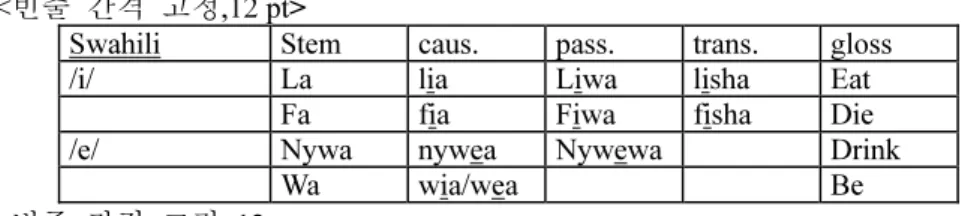
Tables are also centered and separated from the main text by a blank line on both sides.
<빈줄>
Table 2. Monosyllabic verbs and extension
<빈줄 간격 고정,12 pt>
Swahili Stem caus. pass. trans. gloss
/i/ La lia Liwa lisha Eat
Fa fia Fiwa fisha Die
/e/ Nywa nywea Nywewa Drink
Wa wia/wea Be
<빈줄 간격 고정, 12pt>
The caption for figures is above each figure. It is typed in 10 pt Times and in boldface and it is separated by a blank line from the table itself. Tables are progressively numbered starting with 1.
<빈줄>
<빈줄>
Appendix A. Swear words
<빈줄>
Here you can write all the swear words that you will think about while setting your papers according to this style sheet.
<빈줄>
<빈줄>
R
EFERENCES
<빈줄>
H
ALLE
,MORRIS
. 1998. The stress of English words 1968-1998. Linguistic Inquiry 29, 539-568.H
ULST
,HARRY VAN DER
. 1984. Syllable Structure and Stress in Dutch. Dordrecht:Foris Publication.
R
ICE
,KEREN
. 1989. A Grammar of Slave. Berlin: Mouton de Gruyter.<빈줄>
<빈줄>
Choon-Hyang Sung (Assistant Professor) Department of English
Chonnam National University
300 Yongbong-dong, Buk-gu, Gwangju
Incheon 22212 Republic of Koreae-mail: [email protected]
<빈줄간격 고정, 12 pt>
<빈줄간격 고정, 12 pt>
Received: September 12, 2002
Revised: November 11, 2002
Accepted: November 20, 2002
공동저자 표기 방법
Studies in phonetics, phonology and morphology stylesheet
<빈줄>
<빈줄>
Choon-Hyang Sung*
(Daehan Nationa University) Mong-Ryong Lee
(Mingook National University)
Sung, Choon-Hyang and Mong-Ryong Lee. 2002. Studies in phonetics, phonology and morphology stylesheet. Studies in Phonetics, Phonology and Morphology 0.0. 00-000. This stylesheet aims to help authors in preparing their papers for publication. … (Daehan National University and Mingook National University, Assistant Professor)
책임저자 또는 교신저자는 저자이름 위에 *를 표기하고 이를 각주에서 밝힌다.
구체적인 References 작성법
<저서>
저자명 full name; last name, 쉼표, first, (middle) name 순 제목은 이탤릭체, 단어 첫 글자는 대문자 (전치사, 관사 제외)
H
ULST
, HARRY VAN DER
. 1984. Syllable Structure and Stress in Dutch. Dordrecht:Foris Publication.
R
ICE
,KEREN
. 1989. A Grammar of Slave. Berlin: Mouton de Gruyter.<학위논문>
제목은 이탤릭체, 단어 첫 글자는 대문자 (전치사, 관사 제외)
J
UN
,JONGHO
. 1995. Perceptual and Articulatory Factors in Place Assimilation: An Optimality-theoretic Approach. PhD Dissertation. UCLA.K
IM
, BONG
-GUK
. 1998. Samchuk Ciyekeuy Sengco Yenkwu (The Investigation of Tone in Samcheok Dialect). MA Thesis. Seoul National University.<공동저자>
첫 번째 저자 이름 다음에 쉼표, 마지막 저자 앞에만 and 삽입, and는 소문자, 두 번째 저자부터는 first name, (middle name), last name 순으로; middle name은 생략 또는 initial 가능
H
ALE
, KENNETH
and JOSIE
W. EAGLE
. 1980. A preliminary metrical account of Winnebago accent. International Journal of American Linguistics 46, 117-132.J
AKOBSON
, ROMAN
, GUNNAR
FANT
and MORRIS
HALLE
. 1952. Preliminaries to Speech Analysis. Cambridge, MA: MIT Press.<편저>
D
IAMOND
,STANLEY
(ed.). 1960. Culture in History: Essays in Honor of Paul Radin.New York: Columbia University Press.
H
OMBERT
, JEAN
-MARIE
and LARRY
HYMAN
(eds.). 1999. Bantu Historical Linguistics: Theoretical and Empirical Perspectives. Stanford, CA: CSLI Publications.K
AGER
,RENÉ
,HARRY VAN DER
HULST
and WIM
ZONNEVELD
(eds.). The Prosody- Morphology Interface. Cambridge: Cambridge University Press.<정기간행물에 실린 논문>
논문제목은 첫 글자만 대문자,
간행물 이름은 저서명과 같이 단어 첫 글자를 모두 대문자로 (전치사, 관사 제외) 페이지는 쉼표 다음에 입력
H
ALLE
,MORRIS
. 1998. The stress of English words 1968-1998. Linguistic Inquiry 29, 539-568.P
ULLUM
,GEOFFREY
K. 1976. The Duke of York gambit. Journal of Linguistics 12, 83-102.<국내 정기간행물에 실린 논문>
맨 뒤에 학회명 기재
K
IM
, YOOKANG
. 2001. Old English stress: A synchronic analysis with some notes on its diachronic development. Studies in Phonetics, Phonology and Morphology 7.1, 21-62. The Phonology-Morphology Circle of Korea.H
WANGBO
,YOUNG
-SHIK
. 2001. On the role of nonfinality in pitch accent systems.Eoneohag 29, 31-55. The Linguistic Society of Korea.
<비정기 간행물에 실린 논문>
간행물 편집자의 이름은 보통체, full name원칙, first name은 initial도 허용, first name부터
H
OIJER
, HARRY
. 1960. Athabaskan languages of the Pacific coast. In Stanley Diamond (ed.). Culture in History: Essays in Honor of Paul Radin, 960-976.New York: Columbia University Press.
I
TÔ
,JUNKO
andARMIN
MESTER
. 1999. Realignment. In René Kager, Harry van der Hulst and Wim Zonneveld (eds.). The Prosody-Morphology Interface, 188-217.Cambridge: Cambridge University Press.
S
TERIADE
, DONCA
. 1993. Closure, release and nasal contours. In Phonetics and Phonology, Volume 5: Nasals, Nasalization and the Velum, 125-153. San Diego:Academic Press.
<Proceedings 게재 논문>
다음 방법을 참고하되 일관성 있게
P
ERLMUTTER
,DAVID
M.1978. Impersonal passives and the unaccusative hypothesis.Berkeley Linguistic Society 4, 157-189.
___________________.1978. Impersonal passives and the unaccusative hypothesis.
BLS 4, 157-189.
Y
IP
,MOIRA
. 1992. Reduplication with fixed melodic material. Proceedings of the Northeast Linguistic Society 22, 459-474.___________________. 1992. Reduplication with fixed melodic material. NELS 22, 459-474.
<미출판 논문>
I
TÔ
,JUNKO
andARMIN
MESTER
. 1994. Reflections on CodaCond and alignment. Ms.University of California, Santa Cruz. ROA-141.
K
ENSTOWICZ
,MICHAEL
. 1998. Uniform exponence: Exemplification and extension.Ms. MIT. ROA-218.
M
INER
,KENNETH
. 1990. Winnebago accent: the rest of the data. Ms. University of Kansas.<학회발표 논문>
S
TERIADE
, DONCA
. 1996. Paradigm uniformity and the phonetics-phonology boundary. Paper presented at the fifth conference on Laboratory Phonology.Evanston, Illinois.
<한국어로 된 논문>
논문제목을 발음대로 적고 ()에 영문 번역 첨가; 발음대로 적을 때는 국어의 로마자 표기법 권장, 한국어 서적 및 논문에 영문제목이 있으면 그것을 따르고, 그렇지 않으면 저자가 번역
G
IM
,CHA
-GYUN
. 1997. Ryongjeong bangeongwa Uljin bangeon seongjoui bigyo (A study on the contrastive analysis of the tone systems between Ryongjeong dialect and Uljin dialect). Eoneohag 20, 113-178. The Linguistic Society of Korea.K
WAK
, CHUNG
-GU
. 1991. Hamgyeongbukdo Yukjin Bangeonui Eumullon
(Phonology of Yukcin dialect in Hamgyong North province). PhD Dissertation.Seoul National University.
<동일저자의 논문이 여러 편일 때>
S
TERIADE
, DONCA
. 1993. Closure, release and nasal contours. In Phonetics and Phonology, Volume 5: Nasals, Nasalization and the Velum, 125-153. San Diego:Academic Press.
_______________. 1996. Paradigm uniformity and the phonetics-phonology boundary. Paper presented at the fifth conference on Laboratory Phonology.
Evanston, Illinois.
<기타 인터넷 및 컴퓨터 프로그램 자료>