INTRODUCTION
Endoosseous oral implantation has proven to be a successful approach for dental rehabilitation. This procedure often requires alveolar bone reconstruction in the maxillary and mandibular regions. Of the vari- ous procedures used for alveolar bone augmentation, guided bone regeneration (GBR) using autogenous bone, is well documented1-4).
Various graft materials has been used during the
GBR procedure. Recently, various growth factors and cytokines have been studied to use for accelerating regeneration5-7). However, Autogenous bone is still considered as the gold standard during the GBR pro- cedure due to its high biocompatibility and healing potential8,9). Autogenous bone in particulate form could be collected using hand chisels, burs, or bone collectors. Several studies showed bone debris ob- tained from implant drilling sites could be effective for covering exposed implant threads10-13).
The quality of bone debris could be influenced by the drilling conditions, such as, the drilling speed, the drilling time, the drill configuration (pressure, diame- ter, blade positioning, and angulation) and the coolant delivery system. Particle size of autogenous bone could influence on the induction of vital osteoblasts12).
The effect of implant drilling speed on the composition of particle collected during site preparation
Chang-hee Jeong
1, Do-Young Kim
2, Seung-Yun Shin
1, Jongrak Hong
3, Seung-Beom Kye
1, Seung-Min Yang
1*1. Department of Periodontics, The Institute of Oral Health Science, Samsung Medical Center, Sungkyunkwan University School of Medicine
2. Kim & Jeon dental clinic
3. Department of Oral & Maxillofacial Surgery, The Institute of Oral Health Science, Samsung Medical Center, Sungkyunkwan University School of Medicine
ABSTRACT
Purpose: This study was aimed to evaluate the effect of implant drilling speed on the composition of particle size of collected bone debris.
Methods: Brånemark System® drills were used to collect bone debris from 10 drilling holes (1 unit) at 1,500 rpm (Group A) and 800 rpm (Group B) in bovine mandible. After separating particles by size into > 500 ㎛, between 250 ㎛ and 500
㎛, and < 250 ㎛ fractions, particle wet volume, dry volume, and weight were measured and the proportion of 3 fractions of bone debris to total wet volume, dry volume and weight was calculated as wet volume % , dry volume % and weight %.
Results: No significant differences were found between Group A and B in wet volume, dry volume, and weight. However, of >500 ㎛ fractions, Group B had significantly higher wet volume % (P = 0.0059) and dry volume % (P = 0.0272) than in Group A.
Conclusions: The drilling speed influenced the composition of particle size in collected drilling bone debris. The drilling in 800 rpm produced the more percentage of large particles than in 1,500 rpm. However, the drilling speed didn’t effect on total volume of and weight of bone debris. (J Korean Acad Periodontol 2009;39:253-259)
KEY WORDS: dental high-speed technique; dental implantation; particle size.
Correspondence: Seung-Min Yang
Department of Periodontics Samsung Medical Center, Sungkyunkwan University School of Medicine, 50 Irwon-dong, Gangnam-gu, Seoul 135-710, South Korea.
E-mail: [email protected], Tel: 82-2-3410-6425, Fax: 82-2-3410-0038 Received: Jul 6, 2009; Accepted: Jul 29, 2009
Acknowledgement: We have no conflict of interests.
Zaner and Yukna14) concluded that a particle size be- tween 300 μm and 500 μm is appropriate for perio- dontal surgery. Although bone debris obtained from implant drilling was used in many studies, little is known about the relationship between drilling speed and bone debris particle size during implant surgery.
The aim of the study is to evaluate the effect of im- plant drilling speed on the composition of particle size of collected bone debris in an in vitro bovine model.
MATERIALS AND METHODS
1. Bone debris collecting
The implant drilling for collection of bone debris was performed on two lateral portions of dead bovine mandibles (Fig. 1a). Periosteum was elevated with periosteal elevators in order to expose mandibular body. This method is a modification of a previously described experimental model15).
The experiment groups were divided into Group A and B according to drilling speed. In Group A, bone debris was collected from 10 drilling holes (1 unit) at 1,500 rpm. In Group B, bone debris was collected in the same manner except drilling speed at 800 rpm.
Br 。anemark System◯R (Nobel B iocare AB . Gӧteborg.
Sweden) drills were used to make drilling holes and collect bone debris. The drill system was connected to a KaVo INTRAsurg 300 plus◯R system (KaVo, Lake Zurich, IL) and set at 800 rpm or 1500 rpm. Drilling was performed according to the manufacturerʼs recommendations. Each drilling site was prepared up to a depth of 10 mm using a Guide drill, a Twist drill Ø2.0 mm, a Pilot drill, and a Twist drill Ø3.0 mm under copious irrigation, which is the standard drill- ing procedure when preparing a Regular Platform (RP) implant in type II bone.
B one debris was collected to small bowl after the drilling procedures using saline irrigation. On one bo- ny surface, total 50 osteotomies (holes) were randomly drilled. All bone debris obtained from the 10 holes was defined as 1 unit. To achieve statistical power, debris was collected from 10 units per group. The particles were divided into 3 fractions using sieves (Chunggye Co. Seoul, South Korea) (Fig. 1b); particles > 500 ㎛ sizes (LP), particles between 250 ㎛ and 500 ㎛ (MP), and particles < 250 ㎛ (SP). Fraction volume and weight were measured. For wet volume measurements, bone debris was packed into each 2 cc syringes. Dry volume was measured after drying bone debris for 72 hours at room temperature. Weight was measured us- ing a MX microbalance electronic-scale◯R (Mettler- Toledo Co. Sweden-America). Also the proportion of 3 fractions of bone debris to total wet volume, dry vol- A
B
Figure 1. (A) Drilling sites in the bovine mandible. To reduce errors, drill holes were blocked with wax before the next drilling. (B) Two sieves (250 ㎛ and 500 ㎛) were used tofractionate particles by size.
ume and weight was expressed as wet volume %, dry volume % and weight %.
2. Microscopic analysis
The shapes and sizes of dried particles were de- termined using an Olympus◯R optical microscope (Olympus Co. Tokyo. Japan) fitted with a photo- automatic camera (Wild Leitz Mp551, Germany).
3. Statistical analysis
Mann-Whitney test were used to compare Group A and B of wet volumes, dry volumes and dry weight in total, LP, MP and SP fractions. Wilcoxonʼs signed rank test was used to compare wet volumes and dry volumes in each groups of Group A and B. Statistical significance was accepted for P values of < 0.05.
RESULTS
1. Microscopic analysis
There was no difference between two groups in the shape of bone debris. In LP fractions, clustered par- ticles were observed, and wood shaving-like particles were observed. In MP and SP fractions, wood shav- ing-like particle was not found and the difference was not observed each other except particle size (Fig. 2).
2. Quantitative analysis
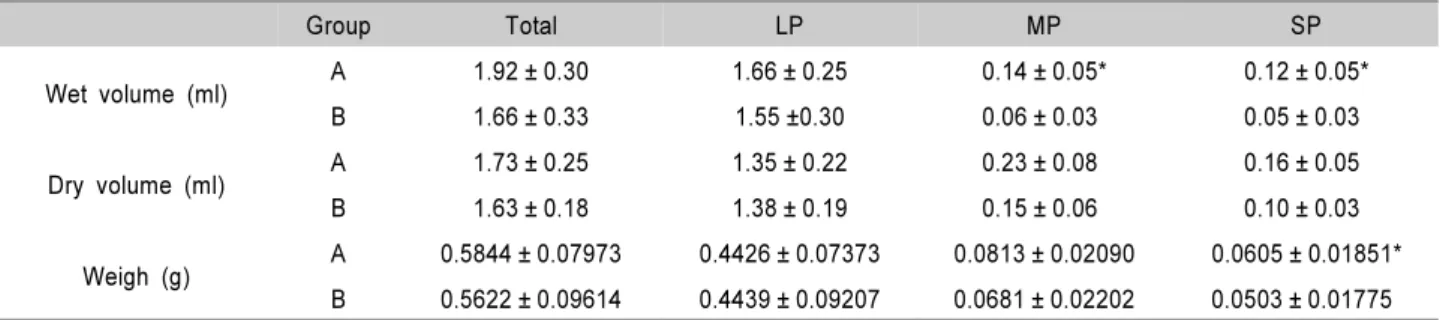
Wet volume, dry volume, and weight of drilling de- bris obtained from Group A (1,500 rpm) and Group B (800 rpm) are shown in Table 1. Total wet volumes (P
= 0.1505), total dry volumes (P = 0.2324), and total weights (P = 0.6226) showed no statistically sig- A
B
Figure 2. Microscopic view of bone debris. (A) Wood shaving-like particles shown in LP fraction. (B) Particles shown in MP and SP fraction. (Original magnification x 40).
Table 1. Mean wet volume, dry volume and weight of bone particles from 10 units. (1 unit = 10 drilling sites); LP = particles
> 500 µm, MP = particles between 250 and 500 µm, SP=particles < 250 µm; Group A= drilling speed 1500 rpm, Group B=
drilling speed 800 rpm; (values: means ± SD)
Group Total LP MP SP
Wet volume (ml) A 1.92 ± 0.30 1.66 ± 0.25 0.14 ± 0.05* 0.12 ± 0.05*
B 1.66 ± 0.33 1.55 ±0.30 0.06 ± 0.03 0.05 ± 0.03
Dry volume (ml) A 1.73 ± 0.25 1.35 ± 0.22 0.23 ± 0.08 0.16 ± 0.05
B 1.63 ± 0.18 1.38 ± 0.19 0.15 ± 0.06 0.10 ± 0.03
Weigh (g) A 0.5844 ± 0.07973 0.4426 ± 0.07373 0.0813 ± 0.02090 0.0605 ± 0.01851*
B 0.5622 ± 0.09614 0.4439 ± 0.09207 0.0681 ± 0.02202 0.0503 ± 0.01775
*: statistically significant between Group A and B (P < 0.05)
nificant differences between Group A and Group B . Wet volume (P = 0.0312) of MP fractions and wet vol- ume (P = 0.0213) and weight (P = 0.0015) of SP frac- tions were significantly greater in Group A. However, no significant differences were observed between wet volumes, dry volumes, or particle weights of the LP fractions of the two groups.
Ratios of summed measurements are shown in Fig.
3. Wet volume, dry volume and weight between 2 groups were compared in Total, LP, MP and SP fractions. In LP fractions, wet volume section of Group A and Group B showed 86.46%, 93.28%
respectively. The difference was statistically sig- nificant (P = 0.0059) between two groups. Group B (84.79%) in the dry volume also showed significantly higher percentages than Group A (77.91%) (P = 0.0272). Group B in weight also showed higher per- centage than Group A. However, the difference was not statistically significant. In MP fractions, Group A
and Group B each showed 7.25%, 3.82% in the wet volume section and 14.00%, 12.19% in the dry volume section. Group A was significantly greater than Group B in wet and dry volume sections (P = 0.0029, P = 0.0312). However,there was no significant difference in the weight %. In SP fractions, Group A was ac- quired the significantly higher value only in wet vol- ume % (P = 0.0023).
Wet volume was significantly greater than dry vol- ume in the LP fractions of Group A (P = 0.0006) and Group B (P = 0.0040). However, in the MP (Group A:
P = 0.0012, Group B : P = 0.0020) and SP fractions (Group A: P = 0.0061, Group B: P = 0.0115), dry vol- umes were greater than wet volumes.
In summed wet volumes % of the MP and LP frac- tions (the particle sizes ≥ 250 μm) of Group B, a statistically significant increase (P = 0.0023) was found compared with Group A. On the other hand, wet volumes, dry volumes, weights, wet volumes %, and
particle size > 500um (LP)
particle size between 250 and 500um (MP) particle size < 250um (SP)
110 100 90 80 70 60 50 40 30 20 10 0
particle size > 500um (LP)
particle size between 250 and 500um (MP) particle size < 250um (SP)
90 80 70 60 50 40 30 20 10
Group A Group B Group A Group B0
Group Group
particle size > 500um (LP)
particle size between 250 and 500um (MP) particle size < 250um (SP)
90 80 70 60 50 40 30 20 10 0
Figure 3. Mean fractional percentages for (A) wet vol- ume, (B) dry volume and (C) particle weights from 10 units. LP=particles > 500 µm, MP=particles between 250 and 500 µm, SP=particles < 250 µm.
*: statistically significant between Group A and B (P < 0.05).
Group A Group B
Group
A B
C
dry volume % in the summed SP and MP fractions (the particle sizes ≤ 500 μm) were greater in Group A than in Group B (P = 0.0045; P = 0.0324; P = 0.0432;
P = 0.0059; and P = 0.0272, respectively).
DISCUSSION
Sufficient width and depth of alveolar ridge are im- portant in implant placement. Sometimes, implant fix- tures were not completely covered by bony architecture.
In cases only small size of dehiscence is found, a lo- calized autogenous bone graft using implant drilling debris is recommended rather than performing major surgery using autogenous bone from the mandibular ramus or chin11-13).
When bone debris is collected for this purpose, ev- ery possible factor should be considered to achieve appropriate graft material. Several recent studies have focused on the risk of osseous damage at elevated drilling speeds during implant surgery16-18). Also, the possibilities of bone necrosis of drilling debris by me- chanical manipulation, pressure, and temperature have been investigated19). A drilling speed of less than 2000 rpm with an irrigation system was not found to gen- erate excessive heat during drilling20,21). Furthermore, Reingewirtz et al.22) recommended the use of less than 800 rpm in dense bone to prevent overheating. Anitua et al.23) suggested that drilling at a speed of only 50 rpm could reduce damage to the host tissue and ob- tain a mass of living bone.
Based on above evidence, drill speeds of 1,500 rpm (Group A) and 800 rpm (Group B) were selected in this experiment. No significant difference was found be- tween the two groups in the total weight and volume of collected debris. In this study, mean dry volume per site in Groups A and B was 0.173 ± 0.025 mL (1.73 ± 0.25/10 drillings) and 0.163 ± 0.018 mL (1.63
± 0.18/10 drillings) respectively. In Savantʼs study24),
0.195 ± 0.099 mL of implant debris dry volume was obtained per site. These differences came from the use of different drilling depth and collecting devices. In Savantʼs study, drilling depth was longer than this study and they used bone collector which could not collect small size of bone debris.
Many studies suggested that the particle size of the grafting material could effect on the osteogenic ability. Lee et al.25) suggested that the autogenous drilling dusts showed better results in regeneration for dehiscence-type defects. Zaner and Yukna14) ar- gued that the appropriate particle size of graft mate- rial for periodontal surgery was 300 to 500 μm.
Moreover, Mellonig26), in an in vitro study, concluded that particle sizes between 250 and 1,000 μm are sig- nificantly better than particle sizes of ≤ 250 μm in terms of bone growth rate. Shapoff et al.27) studied the relation between particle size and enhanced osteo- genesis and concluded that; (1) particle sizes between 125 μm and 1,000 μm had increased surface area, which promotes bone formation, (2) an increase in surface area, with an increase in osteoclastic activity, could result in enhanced osteogenic induction, and (3) graft particles in the range of 125 to 1,000 μm could stimulate osteogenesis by increasing the number of pores. It was also suggested that an increase in par- ticle surface-to-volume ratio increases bone morpho- genic protein levels. Sampath and Reddi28) reported that the subcutaneous implantation of coarse powders (74 to 420 ㎛) of demineralized bone matrix results in the local differentiation of bone, whereas the im- plantation of a 44 to 77 ㎛ sized particles does not. In the present study, total wet volume was not different in two groups. However, the percentage of >250 ㎛ particle was higher in 800rpm than in 1500 rpm significantly.
The results of the present study showed that wet volume was greater than dry volume only in the LP fractions ( > 500 ㎛) of both groups. In a previous clinical study, wet-conditioned bone particles were
found to have a larger volume than dry bone par- ticles24). These volumetric changes must be considered during the use of commercial xenograft or allograft products because graft material was soaked in saline for easy handling during the GBR procedure.
Despite of the small number of bone samples and small amount of acquired bone debris, this study showed that the drilling speed influenced the compo- sition of particle size in collected drilling bone debris.
The drilling in 800 rpm produced the more percentage of large particles than the drilling in 1,500 rpm.
However, the drilling speed didnʼt effect on total vol- ume of and weight of bone debris. Further, other fac- tors, i.e. drillʼs shape, dilltʼs sequential procedure, should be investigated under in vitro and in vivo.
REFERENCES
1. Lee Y, Han S, Um H, Kim D. Histologic observation of regenerated bone in human intraosseous Lesion following guided tissue regeneration with calcium carbonate implant and autogenous bone graft J Korean Acad Periodontol 1998;28:263-273.
2. Becker W, Schenk R, Higuchi K, Lekholm U, Becker BE.
Variations in bone regeneration adjacent to implants aug- mented with barrier membranes alone or with demineral- ized freeze-dried bone or autologous grafts: a study in dogs. Int J Oral Maxillofac Implants 1995;10:143-154.
3. Block MS, Kent JN, Kallukaran FU, Thunthy K, Weinberg R. Bone maintenance 5 to 10 years after sinus grafting. J Oral Maxillofac Surg 1998;56:706-714.
4. Marx RE. Clinical application of bone biology to man- dibular and maxillary reconstruction. Clin Plast Surg 1994;
21:377-392.
5. Seol Y, Lee J, Kye S et al. The effect of PDGF-BB loaded TCP/chitosan microgranules on new bone formation J Korean Acad Periodontol 2002;32:489-500.
6. The effect of PDFG-BB loaded biodeqradable membrane on early healinq stage in quided tissue reqeneration. J Korean Acad Periodontol 1999;29:507-519.
7. Cheong H, Kim K, Park Y et al. Osteogenic effects of pol- yethyleneimine-condensed BMP-2 genes in vitro and in vivo. J Korean Acad Periodontol 2007;37:859-869.
8. Nkenke E, Radespiel-Troger M, Wiltfang J et al. Morbidity of harvesting of retromolar bone grafts: a prospective study.
Clin Oral Implants Res 2002;13:514-521.
9. Schlegel KA, Fichtner G, Schultze-Mosgau S, Wiltfang J.
Histologic findings in sinus augmentation with autogenous bone chips versus a bovine bone substitute. Int J Oral Maxillofac Implants 2003;18:53-58.
10. Karacaoglan N, Uysal OA. Use of iliac bone graft for sad- dle nose deformity. Auris Nasus Larynx 1998;25:49-57.
11. Lauer G, Schilli W. Collected implant cavity borings used as peri-implant osseous augmentation material. International Journal of Oral and Maxillofacial Implants 1994;9:437-443.
12. Widmark G, Ivanoff CJ. Augmentation of exposed implant threads with autogenous bone chips: prospective clinical study. Clin Implant Dent Relat Res 2000;2:178-183.
13. Young MP, Worthington HV, Lloyd RE et al. Bone col- lected during dental implant surgery: a clinical and histo- logical study. Clin Oral Implants Res 2002;13:298-303.
14. Zaner DJ, Yukna RA. Particle size of periodontal bone grafting materials. J Periodontol 1984;55:406-409.
15. Kainulainen VT, Kainulainen TJ, Oikarinen KS, Carmichael RP, Sandor GK. Performance of six bone collectors de- signed for dental implant surgery. Clin Oral Implants Res 2006;17:282-287.
16. Iyer S, Weiss C, Mehta A. Effects of drill speed on heat production and the rate and quality of bone formation in dental implant osteotomies. Part II: Relationship between drill speed and healing. Int J Prosthodont 1997;10:536-540.
17. Iyer S, Weiss C, Mehta A. Effects of drill speed on heat production and the rate and quality of bone formation in dental implant osteotomies. Part I: Relationship between drill speed and heat production. Int J Prosthodont 1997;
10:411-414.
18. Sharawy M, Misch CE, Weller N, Tehemar S. Heat gen- eration during implant drilling: the significance of motor speed. J Oral Maxillofac Surg 2002;60:1160-1169.
19. Hoegel F, Mueller CA, Peter R, Pfister U, Suedkamp NP.
Bone debris: dead matter or vital osteoblasts. J Trauma 2004;56:363-367.
20. Eriksson RA, Adell R. Temperatures during drilling for the placement of implants using the osseointegration technique.
J Oral Maxillofac Surg 1986;44:4-7.
21. Marx RE, Miller RI, Ehler WJ, Hubbard G, Malinin TI. A comparison of particulate allogeneic and particulate autoge- nous bone grafts into maxillary alveolar clefts in dogs. J Oral Maxillofac Surg 1984;42:3-9.
22. Reingewirtz Y, Szmukler-Moncler S, Senger B. Influence of different parameters on bone heating and drilling time in implantology. Clin Oral Implants Res 1997;8:189-197.
23. Anitua E, Carda C, Andia I. A novel drilling procedure and subsequent bone autograft preparation: a technical note. Int J Oral Maxillofac Implants 2007;22:138-145.
24. Savant TD, Smith KS, Sullivan SM, Owen WL. Bone vol- ume collected from dental implant sites during osteotomy. J Oral Maxillofac Surg 2001;59:905-907.
25. Lee SH, Yoon HJ, Park MK, Kim YS. Guided bone re-
generation with the combined use of resorbable membranes and autogenous drilling dust or xenografts for the treatment of dehiscence-type defects around implants: an experimental study in dogs. Int J Oral Maxillofac Implants 2008;23:
1089-1094.
26. Mellonig JT. Decalcified freeze-dried bone allograft as an implant material in human periodontal defects. Int J Periodontics Restorative Dent 1984;4:40-55.
27. Shapoff CA, Bowers GM, Levy B, Mellonig JT, Yukna RA. The effect of particle size on the osteogenic activity of composite grafts of allogeneic freeze-dried bone and autog- enous marrow. J Periodontol 1980;51:625-630.
28. Sampath TK, Reddi AH. Homology of bone-inductive pro- teins from human, monkey, bovine, and rat extracellular matrix. Proc Natl Acad Sci U S A 1983;80:6591-6595.