Received: February 14, 2019, Revised: February 23, 2019, Accepted: February 27, 2019 eISSN 2233-7679
†Correspondence to: Ji-Min Hwang, https://orcid.org/0000-0003-2199-8319
Department of Dental Hygiene, Baekseok Culture University, 58 Munam-ro, Dongnam-gu, Cheonan 31065, Korea Tel: +82-41-550-2731, Fax: +82-41-550-2153, E-mail: [email protected]
Copyright © The Korean Society of Dental Hygiene Science.
Effects of Critical Thinking and Communication Skills on the Problem-Solving Ability of Dental Hygiene Students
Ji-Hyoung Han
1, Eunsuk Ahn
2, and Ji-Min Hwang
3,†1
Department of Dental Hygiene, Suwon Science College, Hwaseong 18516,
2
Department of Dental Hygiene, Kyungbok University, Pocheon 11138,
3
Department of Dental Hygiene, Baekseok Culture University, Cheonan 31065, Korea
Background: This study aimed to investigate the effects of critical thinking and good communication skills on the problem-solving abilities of dental
hygiene students.
Methods: A total of 508 dental hygiene students were convenience-sampled from 3 universities.
Results:
The results revealed that critical thinking had the highest intellectual fairness score of 3.60, and systematicity was the lowest at 3.19. The values for communication skills were high in reaction, social adequacy, and concentration, with an average of 3.65. Problem-solving abilities were in the following order: clarification of the problem, seeking solutions, and decision making. According to general characteristics, more extroverted personalities possessed higher levels of critical thinking, communication skills, and problem-solving abilities (p<0.01). Critical thinking scores were high (p=0.016) in students who responded that peer relationship was difficult; however, their communication skills were the lowest (p<0.001).
Additionally, problem-solving abilities were highest among students who reported a difficult peer relationship (p=0.001). The higher the satisfaction with dental hygiene academics, the higher the critical thinking, communication skill, and problem-solving ability (p<0.001). Critical thinking showed a high positive correlation with variables in the following order: clarification of the problem, performing the solutions, seeking solutions, decision making, and evaluation and reflection. The communication skills were also related to these variables listed above (p<0.01). With critical thinking, confidence, watchfulness, intellectual passion/curiosity, sound skepticism, objectivity, and systematicity all influenced the problem-solving ability.
Conclusion: Communication skills were influenced by noise control, putting on the other’s shoe, social tensions, and efficiency, which affected the
problem-solving ability. Dental clinics require dental hygienists to have critical thinking to make analytical judgments and effective communication skills to solve human relation problems with patients and care-givers. Therefore, these skills should be developed in dental hygiene students to improve their problem-solving abilities.
Key Words: Communication, Critical thinking, Dental hygiene, Problem-solving
Introduction
The World Economic Forum has adopted 16 technologies from the 21st century, which are necessary for students living in this era. The core competencies among basic questions, core competencies, and personality qualities are the necessary factors for students to overcome complex challenges through the application of critical thinking, problem-solving, creativity, and communication
1).
In addition, the New Dental Hygienist Competency
Statement, published by the American Council on Dental
Education, reports that its required competencies needed
for evidence-based dental hygiene practice involves the
application of critical thinking and problem-solving
abilities
2). Hence, according to these changes and demands
of the times, critical thinking, communication skills, and
problem-solving abilities for dental hygienists and
students are essential for the theoretical application of
knowledge and technology to clinical practice.
Critical thinking is the ability to determine the logical structure and meaning of linguistic expressions and behaviors in order to determine what views to accept, what to do, and how to make the best judgments based on the concepts, evidences, criteria, methods, and contexts
3). Critical thinking is essential for analyzing the information of subjects and the application of the appropriate procedures to solve problems during the dental hygiene process. It is also important to improve the decision- making capabilities, and to improve the quality of performance and patient care
4). Wilkins
5)recommends the application of critical thinking skills in data processing, including classification, interpretation, and validation during the diagnosis phase of dental hygiene. Kim et al.
6)proposed the necessity of reviewing the dental hygiene education as a methodological approach to critical thinking. In addition, a newer curriculum is needed to help students organize their knowledge and express their opinions in order to develop critical thinking.
Communication is a dynamic and simultaneous interchange between participants. It is also a complex action that receives and accepts its message in verbal and non-verbal ways
7). Communication skills are required to communicate effectively, and it is the ability to accurately convey one’s thoughts and feelings to others
8). If there is a lack of communication skills, one’s intention may be misinterpreted, causing conflicts with the other party or lowering their problem-solving abiliy
9). Effective communication skills at medical service sites, which are diversified and systematically established day by day, are emphasized as the basic qualities of dental hygienists
10). In addition, effective communication skills can be an important means of solving problems through patient interaction;
thus improving the quality of oral health services and patient satisfaction.
Problem-solving ability is the intellectual and creative ability to recognize and resolve differences between the current status the projected goals
11). The ability to solve problems is the ability to solve them by using communication skills, not only in clinical practice but also in potential problems. Problem-solving skills also play a critical role in the way the individual interacts with the
environment and process information about problem situations
12,13). The National Institute of Education’s report on the improvement of university education in the United States also emphasizes the importance of problem- solving abilities, such as the ability to think critically, communicate effectively, and solve problems
14). Therefore, the development and research of the best educational system to improve critical thinking, communication skill, and problem-solving ability are steadily being carried out.
The purpose of this study was to investigate the effects of critical thinking and communication skills on the problem-solving ability of dental hygiene students.
Additionally, this study will be used as basic data to search for ways to develop the curriculum and improve the problem-solving ability in the dental hygiene field.
Materials and Methods
1. Subjects and methods
Using a convenience sampling method, this study enrolled dental hygiene students in two universities in Gyeonggi-do and one university in Chungnam. The survey period was from August 27 to September 15, 2018. For ethical reasons, the study was conducted with the consent of the subjects. The sample size was based on the G*Power 3.1 program with a significance level of 0.05, a statistical power of 0.95, and a regression analysis effect size of 0.3. The number of people calculated was 515, and the total value was 508.
2. Variables
The general characteristics included were age, grade, personality, peer relationship, academic satisfaction with dental hygiene, and average grade in the previous semesters. The variables for the determination of critical thinking were the tools developed by Yoon
15). A total of 27 items which consisted of systematicity (3 items), intellectual fairness (4 items), sound skepticism (4 items), objectivity (3 items), intellectual passion/curiosity (5 items), watchfulness (4 items), and confidence (4 items) was measured. The grading system attributed 5 points for a ‘very well’ response, and 1 point for a ‘not at all’
response. The Cronbach’s value of the research tool was
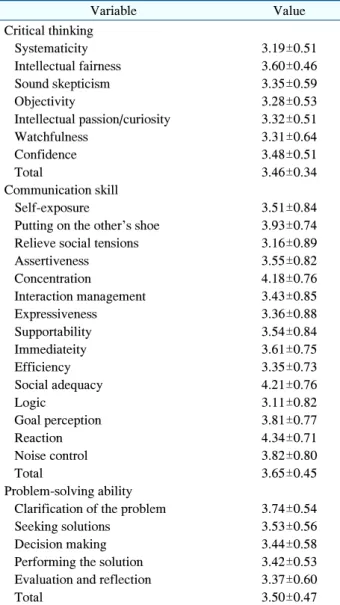
Table 1. Critical Thinking, Communication Skill, and Problem- Solving Ability of Dental Hygiene Students
Variable Value
Critical thinking
Systematicity 3.19±0.51
Intellectual fairness 3.60±0.46
Sound skepticism 3.35±0.59
Objectivity 3.28±0.53
Intellectual passion/curiosity 3.32±0.51
Watchfulness 3.31±0.64
Confidence 3.48±0.51
Total 3.46±0.34
Communication skill
Self-exposure 3.51±0.84
Putting on the other’s shoe 3.93±0.74 Relieve social tensions 3.16±0.89
Assertiveness 3.55±0.82
Concentration 4.18±0.76
Interaction management 3.43±0.85
Expressiveness 3.36±0.88
Supportability 3.54±0.84
Immediateity 3.61±0.75
Efficiency 3.35±0.73
Social adequacy 4.21±0.76
Logic 3.11±0.82
Goal perception 3.81±0.77
Reaction 4.34±0.71
Noise control 3.82±0.80
Total 3.65±0.45
Problem-solving ability
Clarification of the problem 3.74±0.54
Seeking solutions 3.53±0.56
Decision making 3.44±0.58
Performing the solution 3.42±0.53 Evaluation and reflection 3.37±0.60
Total 3.50±0.47
Values are presented as mean±standard deviation.
0.812. The communication skill was determined using Lee’s tool
16), which modified and supplemented the GICC (Global Interpersonal Communication Competence) developed by Hur
17). A total of 15 questions were asked about self-exposure, putting on the other’s shoe, relieve of social tensions, assertiveness, concentration, interaction management, expressiveness, supportability, immediateity, efficiency, social adequacy, logic, goal perception, reaction, and noise control. The 5-point Likert-type scale was used, and the Cronbach’s value was 0.852.
The problem-solving ability was measured using a scale developed by Lee et al.
18)with 30 items, including:
clarification of the problem (6 items), seeking solutions (6 items), decision making (6 items), performing the solution (6 items), and evaluation and reflection (6 items). The 5-point Likert-type scale was used, and the Cronbach’s value was 0.936.
3. Analysis method
Statistical analysis was conducted to examine the critical thinking, communication skills, and problem-solving ability of the subjects. T-test and ANOVA were performed to compare the critical thinking, communication skills, and problem-solving ability according to the general characteristics. Post-hoc analysis was performed to determine the significant difference between the groups.
Levene statistics were used to determine the homogeneity of the variance test, and Scheffe analysis was also performed. The correlation between critical thinking, communication skill, and problem-solving ability was examined by Pearson’s correlation analysis. Additionally, stepwise multiple regression analysis was performed to examine the factor effecting on the problem-solving ability. The data were analyzed using PASW statistics 18.0 (IBM Co., Armonk, NY, USA) and the significance level was 0.05.
Results
1. Critical thinking, communication skill, problem-solving ability
Table 1 shows the critical thinking, communication skill, and problem-solving ability of dental hygiene students. In critical thinking, the intellectual fairness score was the highest (3.60), and it was followed by the variables of confidence, sound skepticism, and intellectual passion/
curiosity. However, systematicity was the lowest at 3.19.
For communication skills, there was a higher reaction
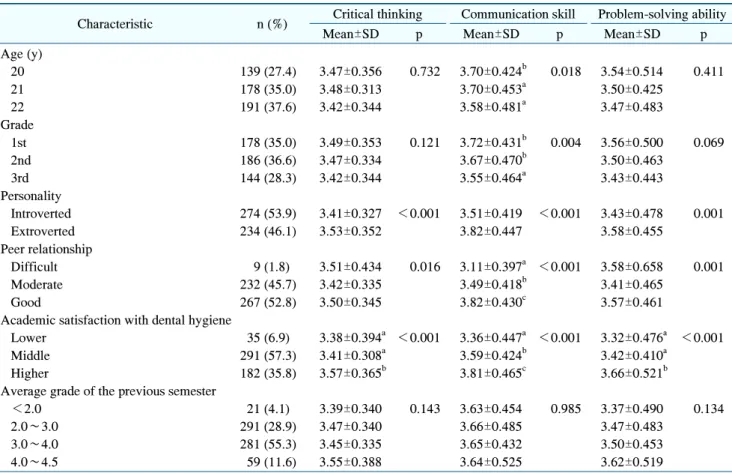
Table 2. Differences in Critical Thinking, Communication Skill, and Problem-Solving Ability according to General Characteristics
Characteristic n (%) Critical thinking Communication skill Problem-solving ability
Mean±SD p Mean±SD p Mean±SD p
Age (y)
20 139 (27.4) 3.47±0.356 0.732 3.70±0.424
b0.018 3.54±0.514 0.411
21 178 (35.0) 3.48±0.313 3.70±0.453
a3.50±0.425
22 191 (37.6) 3.42±0.344 3.58±0.481
a3.47±0.483
Grade
1st 178 (35.0) 3.49±0.353 0.121 3.72±0.431
b0.004 3.56±0.500 0.069
2nd 186 (36.6) 3.47±0.334 3.67±0.470
b3.50±0.463
3rd 144 (28.3) 3.42±0.344 3.55±0.464
a3.43±0.443
Personality
Introverted 274 (53.9) 3.41±0.327 <0.001 3.51±0.419 <0.001 3.43±0.478 0.001
Extroverted 234 (46.1) 3.53±0.352 3.82±0.447 3.58±0.455
Peer relationship
Difficult 9 (1.8) 3.51±0.434 0.016 3.11±0.397
a<0.001 3.58±0.658 0.001
Moderate 232 (45.7) 3.42±0.335 3.49±0.418
b3.41±0.465
Good 267 (52.8) 3.50±0.345 3.82±0.430
c3.57±0.461
Academic satisfaction with dental hygiene
Lower 35 (6.9) 3.38±0.394
a<0.001 3.36±0.447
a<0.001 3.32±0.476
a<0.001
Middle 291 (57.3) 3.41±0.308
a3.59±0.424
b3.42±0.410
aHigher 182 (35.8) 3.57±0.365
b3.81±0.465
c3.66±0.521
bAverage grade of the previous semester
<2.0 21 (4.1) 3.39±0.340 0.143 3.63±0.454 0.985 3.37±0.490 0.134
2.0∼3.0 291 (28.9) 3.47±0.340 3.66±0.485 3.47±0.483
3.0∼4.0 281 (55.3) 3.45±0.335 3.65±0.432 3.50±0.453
4.0∼4.5 59 (11.6) 3.55±0.388 3.64±0.525 3.62±0.519
Values are analysed by t-test and one-way ANOVA statistics.
SD: standard deviation.
a,b,c
The same letter indicates no significant difference by Scheffe.
(4.34), social adequacy (4.21), and concentration (4.18) with an average value of 3.65. The problem-solving ability was followed by clarification of the problem (3.74), seeking solutions (3.53), decision making (3.44), performing the solution (3.42), and evaluation and reflection (3.37).
2. Differences in critical thinking, communication skill, and problem-solving ability according to general characteristics
Critical thinking, communication skill, and problem- solving ability showed differences in personality, peer relationship, and academic satisfaction with dental hygiene according to the general characteristics. Furthermore, the more extroverted personalities displayed a higher critical thinking (3.53), communication skill (3.82), and problem- solving ability (3.58). Students who replied that their friendships were difficult obtained the highest scores for
critical thinking (p=0.016), but the lowest scores (3.11) for communication skills (p<0.001). Additionally, the problem-solving ability was highest among the students who reported a difficult peer relationship (p=0.001). The higher the academic satisfaction with dental hygiene, the higher the critical thinking (3.57), communication skill (3.81), and problem-solving ability (3.66) (p<0.001;
Table 2).
3. Relationship between critical thinking and communication skill with sub-domains of problem- solving ability
Critical thinking showed a high correlation in the following order: clarification of the problem (0.664), seeking solutions (0.606), performing the solution (0.610), decision (0.601), and evaluation and reflection (0.570).
The values for the communication skills were lower than
Table 3. Relationship between Critical Thinking and Communication Skill on Sub-Domains of Problem-Solving Ability
Clarification of
the problem Seeking solutions Decision making Performing the solution
Evaluation and reflection
Critical thinking 0.664** 0.606** 0.601** 0.610** 0.570**
Communication skill 0.496** 0.472** 0.452** 0.490** 0.467**
Values are analysed by Pearson correlation statistics.
**p<0.01.
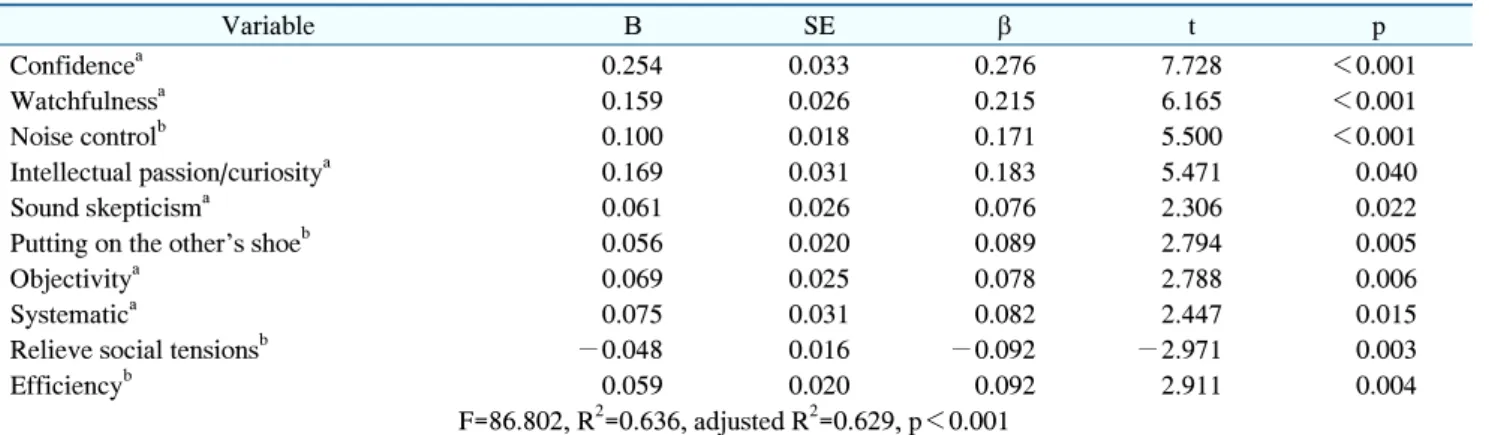
Table 4. Factors Affecting the Problem-Solving Ability
Variable B SE t p
Confidence
a0.254 0.033 0.276 7.728 <0.001
Watchfulness
a0.159 0.026 0.215 6.165 <0.001
Noise control
b0.100 0.018 0.171 5.500 <0.001
Intellectual passion/curiosity
a0.169 0.031 0.183 5.471 0.040
Sound skepticism
a0.061 0.026 0.076 2.306 0.022
Putting on the other’s shoe
b0.056 0.020 0.089 2.794 0.005
Objectivity
a0.069 0.025 0.078 2.788 0.006
Systematic
a0.075 0.031 0.082 2.447 0.015
Relieve social tensions
b−0.048 0.016 −0.092 −2.971 0.003
Efficiency
b0.059 0.020 0.092 2.911 0.004
F=86.802, R
2=0.636, adjusted R
2=0.629, p<0.001 Values are analysed by multiple regression statistics.
SE: standard error.
a