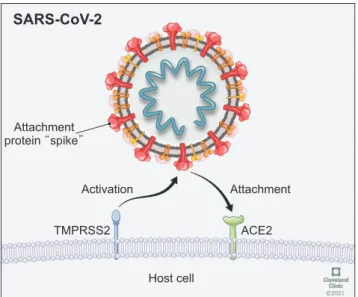
COVID-19 caused by the severe acute respiratory syndrome coronavirus 2 (SARS-CoV-2) has had an immense impact on human life, economic state, and healthcare, including reproductive health. Although much research is still needed to clarify the global im- pact of the COVID-19 pandemic on human health, the molecular mechanisms of infection have been widely investigated (Fig. 1), leading to the synthesis of vac- cines. Even with the introduction of the vaccine, the need for robust safety measures is crucial in reducing the transmission of the novel coronavirus as outlined by the American Society for Reproductive Medicine (ASRM) Taskforce guidelines [1,2].
As countries around the world have adopted mea- sures to contain the pandemic, continuity of care for patients with diseases other than COVID-19 is becom- ing a big challenge. Reproductive health services are one of the services which were postponed during the COVID-19 pandemic [3]. The decision to disrupt ferti lity services was supported by the lack of sufficient data about the effect of COVID-19 on reproductive health
and was intended to be a precautionary measure. Al- though there is a pressing need to preserve health from contagion, this has particularly impacted a vulnerable groups of patients, who urgently need andrological services, such as patients who have been diagnosed with cancer and need to begin their treatment without further delay. It is well known that many of the che- motherapeutic drugs may result in a significant reduc- tion in sperm production and in some cases complete azoospermia [4]. Hence, these men have a very tiny window of opportunity to cryopreserve their sperm and therefore, semen testing and sperm cryopreserva- tion were categorized as essential services [5]. Although Gacci et al (2021) reported a significantly higher per- centage of cryptozoospermia in men who had recovered from COVID-19 as compared to the general population, this effect on male reproductive health cannot be con- firmed due to the small sample size and limited statis- tical power of this study [6]. It remains unclear if cross- contamination is possible between stored tissues from COVID-19 infected and non-infected samples. Based on
Received: Feb 8, 2021 Accepted: Feb 15, 2021 Published online Mar 5, 2021 Correspondence to: Ashok Agarwal https://orcid.org/0000-0003-0585-1026
Andrology Center and American Center for Reproductive Medicine, Cleveland Clinic, Mail Code X-11, 10681 Carnegie Avenue, Cleveland, OH 44195, USA.
Tel: +1-216-444-9485, Fax: +1-216-445-6049, E-mail: [email protected], Website: www.Clevelandclinic.org/ReproductiveResearchCenter Copyright © 2021 Korean Society for Sexual Medicine and Andrology
Best Practice Guidelines for Andrology Laboratory Services during COVID-19 Crisis: Cleveland
Clinic’s Experience
Ashok Agarwal1 , Rakesh Sharma1 , Sajal Gupta1 , Meaghanne Caraballo1 , Renata Finelli1 , Sarah Madani2 , Manesh Kumar Panner Selvam1
1American Center for Reproductive Medicine, Cleveland Clinic, Cleveland, OH, USA, 2Department of Biology and Physiology of Organisms, Faculty of Biological Sciences, University of Science and Technology, Houari Boumedien, Algiers, Algeria
This is an Open Access article distributed under the terms of the Creative Commons Attribution Non-Commercial License (http://creativecommons.org/licenses/by-nc/4.0) which permits unrestricted non-commercial use, distribution, and reproduction in any medium, provided the original work is properly cited.
Editorial
pISSN: 2287-4208 / eISSN: 2287-4690 World J Mens Health 2021 Apr 39(2): 169-171 https://doi.org/10.5534/wjmh.210018
Male reproductive health and infertility
https://doi.org/10.5534/wjmh.210018
170
www.wjmh.orgthese considerations, semen samples collected from CO- VID-19 positive patients must be handled with great caution and processed in a manner similar to that of samples obtained from seropositive patients.
The Andrology Laboratory at Cleveland Clinic implemented safety measures based on the recom- mendations of professional reproductive societies such as ASRM Taskforce Updates [1-3,7], Society for Male Reproduction and Urology (SMRU) in collaboration with the Society for the Study of Male Reproduction (SSMR) under the guidance of the SMRU and SSMR joint committee [8], Center for Disease Control (CDC) [9]
and the recommendations by the Cleveland Clinic In- stitutional COVID-19 Task Force [10]. These guidelines were prepared in response to the pandemic with the intent of offering sperm banking services and semen analysis. The safety measures were strictly followed by staff members and patients, and these included: wear- ing of a facemask covering both the mouth and nose, eye protection (Face Shields or Goggles) and physical or spatial distancing of at least 6 feet apart. Social and physical distancing signages were posted in the Clinic as a reminder for all employees and patients. Further- more, patients are screened for COVID-19 symptoms by using a questionnaire. In fact, at the time of sched- uling the appointment over the phone, each patient was asked to answer questions to identify any possible risk of COVID-19 infection, and the presence of symp-
toms. The patient answers these questions again at the time of their visit, along with temperature checks to mitigate the risk to other patients as well as to the healthcare providers, including the laboratory and clinical staff. To prevent the chances of accidental con- tact between patients, the Cleveland Clinic policy is to schedule each appointment on a one-hour time slot and not to allow accompanying persons in the laboratory premises, except in such cases where the patient is a minor or needs special assistance. The screening of the Cleveland Clinic employees includes daily temperature scan as well as the completion of a health symptom screening questionnaire using a mobile responsive app called “COVID Pass”. Based on the individual’s input and response, an immediate notification is received that informs if an employee is cleared or not cleared to enter the onsite work location. In case the care- giver reports having symptoms, such as fever, severe cough or shortness of breath, they will not be cleared to work. Further, laboratory personnel are also specifi- cally instructed to practice rigorous personal hygiene, including washing their hands frequently with soap and water for at least 20 seconds, especially after being in a public place, or after coughing, or sneezing. Other precautions adopted by the Andrology laboratory in- clude decontamination of the laboratory, work stations and patient areas at the start of each procedure and again after any procedure by using decontaminants that meet the Environmental Protection Agency (EPA) criteria for use against COVID-19 virus. Testing or pro- cessing of all semen samples for sperm banking has to be conducted under a biosafety level (BSL)-2 hood, as a universal precautionary approach for infection control.
Strategies for the safety of patients and caregivers instituted during this pandemic are critical for miti- gating the viral spread. Appropriate hand-washing, screening procedures, patient masking and physi- cal distancing, staggered appointments, appropriate personal protective equipment, disinfecting protocol, and stringent enforcement of these policies can keep patients and staff safe in the andrology laboratory set- ting.
ACKNOWLEDGEMENTS
Authors are thankful to the artists from the Cleve- land Clinic’s Center for Medical Art & Photography for their help with the illustration.
ACE2 Attachment Activation
TMPRSS2 Attachment protein spike
Host cell
SARS-CoV-2
Fig. 1. Graphical representation of SARS-CoV-2 infection. Infection is mediated by the binding between viral spike proteins and angioten- sin I converting enzyme 2 (ACE2) cellular receptor, and the further proteolytic cleavage and activation of spike proteins by the trans- membrane protease serine 2 (TMPRSS2).
Ashok Agarwal, et al: COVID-19 and Andrology Laboratory Services
171
www.wjmh.org
Conflict of Interest
The authors have nothing to disclose.
Author Contribution
Conceptualization: AA, Supervision: AA. Writing – original draft: All authors. Writing – review & editing: All authors.
REFERENCES
1. American Society for Reproductive Medicine (ASRM).
American Society for Reproductive Medicine (ASRM) patient management and clinical recommendations during the coro- navirus (COVID-19) pandemic, update no. 11 – COVID-19 vaccination December 16, 2020 [Internet]. Washington, D.C.:
ASRM; c2020 [cited 2021 Feb 10]. Available from: https://
www.asrm.org/globalassets/asrm/asrm-content/news-and- publications/covid-19/covidtaskforceupdate11.pdf.
2. American Society for Reproductive Medicine (ASRM).
American Society for Reproductive Medicine (ASRM) patient management and clinical recommendations during the coro- navirus (COVID-19) pandemic, update no. 12 - January 18, 2021 testing and vaccine truths [Internet]. Washington, D.C.:
ASRM; c2021 [cited 2021 Feb 10]. Available from: https://
www.asrm.org/globalassets/asrm/asrm-content/news-and- publications/covid-19/covidtaskforceupdate12.pdf.
3. American Society for Reproductive Medicine (ASRM).
American Society for Reproductive Medicine (ASRM) patient management and clinical recommendations during the coro- navirus (COVID-19) pandemic, update #3 (April 24, 2020 through May 11, 2020) [Internet]. Washington, D.C.: ASRM;
c2020 [cited 2021 Feb 10]. Available from: https://www.asrm.
org/globalassets/asrm/asrm-content/news-and-publications/
covid-19/covidtaskforceupdate3.pdf.
4. Hibi H, Sugie M, Ohori T, Fukunaga N, Sonohara M, Asada Y.
Male infertility treatment for cancer survivors: does antican- cer treatment affect infertility treatment? Nagoya J Med Sci 2020;82:677-84.
5. Adiga SK, Tholeti P, Uppangala S, Kalthur G, Gualtieri R, Tal- evi R. Fertility preservation during the COVID-19 pandemic:
mitigating the viral contamination risk to reproductive cells in cryostorage. Reprod Biomed Online 2020;41:991-7.
6. Gacci M, Coppi M, Baldi E, Sebastianelli A, Zaccaro C, Mor- selli S, et al. Semen impairment and occurrence of SARS- CoV-2 virus in semen after recovery from COVID-19. Hum Reprod 2021. doi: 10.1093/humrep/deab026 [Epub].
7. American Society for Reproductive Medicine (ASRM).
American Society for Reproductive Medicine (ASRM) patient management and clinical recommendations during the coro- navirus (COVID-19) pandemic, update no. 10 (November 17, 2020*) [Internet]. Washington, D.C.: ASRM; c2020 [cited 2021 Feb 10]. Available from: https://www.asrm.org/globalas- sets/asrm/asrm-content/news-and-publications/covid-19/
covidtaskforceupdate10.pdf.
8. American Society for Reproductive Medicine (ASRM).
SMRU statement regarding male reproductive health and COVID-19: prepared in conjunction with the Society for the Study of Male Reproduction (SSMR) [Internet]. Washington, D.C.: ASRM [cited 2021 Feb 10]. Available from: https://
www.asrm.org/news-and-publications/covid-19/statements/
smru-statement-regarding-male-reproductive-health-and- covid-19/.
9. Centers for Disease Control and Prevention (CDC). CO- VID-19 [Internet]. Atlanta (GA): CDC [cited Year Mon date].
Available from: https://www.cdc.gov/coronavirus/2019-ncov/
index.html.
10. Cleveland Clinic. Cleveland Clinic COVID-19 toolkit-home.
[Internet]. Cleveland (OH): Cleveland Clinic [cited 2021 Feb 10]. Available from: http://portals.ccf.org/occ/Infection- Prevention/COVID-19-Toolkit.