PGHN
Review Article
Nutritional Counseling for Obese Children with Obesity-Related Metabolic Abnormalities in Korea
Ki Soo Kang
Division of Pediatric Gastroenterology, Hepatology and Nutrition, Department of Pediatrics, Jeju National University Hospital, Jeju, Korea
Child obesity has become a significant health issue in Korea. Prevalence of obesity in school-age children in Korea has been alarmingly rising since 2008. Prevalence of obesity among infants and preschool-age children in Korea has doubled since 2008. Obese children may develop serious health complications. Before nutritional counseling is pursued, several points should be initially considered. The points are modifiable risk factors, assessment for child obesity, and principles of treatment. Motivational interviewing and a multidisciplinary team approach are key princi- ples to consider in managing child obesity effectively in the short-term as well as long-term. Nutritional counseling begins with maintaining a daily log of food and drink intake, which could possibly be causing obesity in a child. Several effective tools for nutritional counseling in practice are the Traffic Light Diet plan, MyPlate, Food Balance Wheel, and 'Food Exchange Table'. Detailed nutritional counseling supported by a qualified dietitian is an art of medicine enabling insulin therapy and hypoglycemic agents to effectively manage diabetes mellitus in obese children.
Key Words: Obesity, Child, Prevalence, Nutrition, Counseling
Received:June 6, 2017, Revised:June 12, 2017, Accepted:June 16, 2017
Corresponding author: Ki Soo Kang, Division of Pediatric Gastroenterology, Hepatology and Nutrition, Department of Pediatrics, Jeju National University Hospital, 15 Aran 13-gil, Jeju 63241, Korea. Tel: +82-64-754-8146, Fax: +82-64-717-1131, E-mail: [email protected]
Copyright ⓒ 2017 by The Korean Society of Pediatric Gastroenterology, Hepatology and Nutrition
This is an openaccess article distributed under the terms of the Creative Commons Attribution NonCommercial License (http://creativecommons.org/licenses/by-nc/4.0/) which permits
INTRODUCTION
Obesity is a state of excessive fat accumulation in a body. Obesity is diagnosed when body mass index (kg/m2) is more than 95 percentile per sex and age or the percentage of actual weight compared to stand- ard weight for height more than 120% [1]. Body mass index is also referred to as BMI. The prevalence of childhood obesity in United States (US) from 2 to 19 years old was 16.9% in 2011-2012 [2]. According to
estimates from the World Health Organization’s Childhood Obesity Surveillance Initiative, approx- imately 1 in 3 children in the European Union age 6-9 were overweight and obese in 2010 [3]. The preva- lence of obesity in school-age children age 7 to 18 in Korea has been steadily rising from 8.36% in 2008 to 14.3% in 2016 (Fig. 1) [4]. Prevalence of obesity in in- fants and preschool-age children in Korea was 2.8% in 2015, double the rate compared to 1.4% in 2008 (Fig.
2) [5]. Obese children may develop serious health
Fig. 1. Obesity prevalence of school-age children in Korea.
Obesity prevalence of school-age children in Korea is steadily rising from 8.4% in 2008 to 14.3% in 2016 [4].
Fig. 2. Obesity prevalence of preschool-age children in Korea.
Obesity prevalence of infants and preschool-age children in Korea was 2.8% in 2015, double the rate compared to 1.4% in 2008 [5].
complications including hypertension, insulin resist- ance, non-alcoholic fatty liver disease, and metabolic syndrome [6]. Obesity also progresses to non-insulin dependent diabetes mellitus (type 2 DM) and liver disease such as liver cirrhosis in the long-term prog- nosis [6]. In this article, the author reviews the bene- fits of nutritional counseling for obese children with obesity-related metabolic abnormalities.
BEFORE NUTRITIONAL COUNSELING
Modifiable risk factors
Before initiating nutritional counseling for obe- sity, the physician should collect and analyze in- formation pertinent to risk factors that caused obe- sity in a patient. When health care providers effec- tively motivate obese children and their parents to modify risk factors, children may gradually recover from obesity. Modifiable risk factors for obesity are diet, exercise, lifestyle, psychological issues and fam- ily and school environment surrounding obese chil- dren [7]. Health care providers must induce obese children and their parents to modify unhealthy hab- its linked with diet, exercise and lifestyle. If a child has serious psychologic issues causing obesity, the child and his or her parents must be counseled by a pediatric psychiatrist. Parental obesity must also be
managed, because it is a major risk factor of child obesity [8]. Schools must provide healthy lunches, beverages and exercise periods to promote a healthy environment for children [9,10].
Assessment of child obesity
In addition to maintaining a daily log of food and drink intake for modifiable risk factors of an obese child, health care providers must assess a child’s med- ication history including use of corticosteroid and symptoms suggesting an organic disease. Health care providers need to collect anthropometric data and conduct a physical examination of a child [7]. Obese children tend to be in a higher percentile of height. If an obese child has a lower height percentile, some en- docrine or genetic disorders may be suspected. The physical examination of a child should assess sexual maturation rate, neck pigmentation (acanthosis nig- ricans) suggesting insulin resistance, and orthopedic issues in the lower extremities. Laboratory parameters for an obese child are necessary for evaluation of in- sulin resistance, hepatitis associated with fatty liver and dyslipidemia [7,11]. Parameters are fasting glu- cose, fasting insulin, hemoglobin A1C, aspartate ami- notransferase, alanine aminotransferase, fasting lipid battery including total cholesterol, low-density lip- oprotein, high-density lipoprotein, and triglyceride in
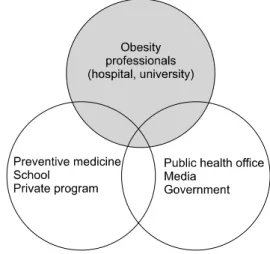
Fig. 3. Multidisciplinary team for the treatment of obese children.
The team includes obesity professionals, school and local education board, preventive medicine, public health office, media, and authorities for an obesity plan. Obesity professionals are physician, psychiatrist, dietitian, physical activity trainer, coordinator, and clinical psychologist.
the serum [11]. X-ray for bone age and liver ultra- sonography for fatty liver evaluation.
In obese children, the presence of metabolic syn- drome can be identified from clinical and laboratory findings. When an obese child has multiple risk fac- tors for cardiovascular disease, metabolic syndrome may be suspected. Although there is no global stand- ard for the diagnosis of metabolic syndrome, diag- nostic criteria include obesity, blood pressure, trigly- ceride, high density lipoprotein, fasting glucose, and fasting insulin [12-15].
Principles of treatment for child obesity The principle treatment for child obesity is chang- ing unhealthy behavior associated with diet, ex- ercise, and life style, through motivational inter- viewing [16]. Treatment should be based on a fam- ily-based approach that consists of “parent-child”
and “parent-only” treatment [16,17]. Behavior mo- dification can be successfully achieved by specifying target behavior, self-monitoring, goal setting, stim- ulus control, and promotion of self-efficacy and self-management skills. However, treatment of child obesity is difficult because a child must change fixed, long-term unhealthy behavior that is the cause of
obesity. School-based, community-participating, and hospital-participating strategies are also necessary for effective treatment of child obesity. Therefore, a multi-disciplinary team approach is critical [6]. The team should include obesity professionals, school and local education boards, preventive medicine, public health offices, media, and authorities for an obesity plan (Fig. 3). Obesity professionals are physi- cians, psychiatrists, dietitians, physical activity (PA) trainers, coordinators and clinical psychologists.
When community-based lifestyle programs are planned, barriers and facilitators of programs should be considered [18]. Especially, barriers such as stig- ma associated with obesity and accessibility to the site, where the program will be conducted, are crit- ical to success of the program.
NUTRITIONAL COUNSELING FOR CHILD OBESITY
Maintaining a log of daily food and drink intake The information about unhealthy diet habits should be collected from obese children and their parents [19-21]. Unhealthy diet habits consist of irregular meals or skipping meals, eating too much, refusing to eat vegetables, drinking too many beverages contain- ing sugar, eating too much high trans-fat foods, candy and chocolate, eating before sleeping at night, and so forth. The frequency of the above mentioned un- healthy diet habits is another critical point in main- taining a daily log of food and drink intake. Dietitians can estimate daily calorie intake of obese children us- ing a diet diary or 24 hours recall method [22,23].
Dietary reference intake of energy has been well established by the Institute of Medicine of National Academics in the US (Table 1) [24]. Age groups in- clude 0-36 months, 3-8 years and 9-18 years. The 0-36-month group is classified into four subgroups for calculation of estimated energy requirement (EER). The 3-8 years group has different equations for EER according to sex. The 9-18 years group also has a different equation for EER according to sex.
The types of PA included in the equation are seden- tary, low active, active, and very active. Dietary refer-
Table 1.Dietary Reference Intake of Energy in Childhood
Age Subgroup Estimated energy requirements (EER, kcal)
0-36 mo 0-3 mo (89×weight [kg]–100)+175 kcal
4-6 mo (89×weight [kg]–100)+56 kcal 7-12 mo (89×weight [kg]–100)+22 kcal 13-36 mo (89×weight [kg]–100)+20 kcal
3-8 y Boys 88.5–(61.9×age [y])+PA×(26.7×weight [kg]+903×height [m])+20 kcal Girls 135.3–(30.8×age [y])+PA×(10.0×weight [kg]+934×height [m])+20 kcal 9-18 y Boys 88.5–(61.9×age [y])+PA×(26.7×weight [kg]+903×height [m])+25 kcal
Girls 135.3–(30.8×age [y])+PA×(10.0×weight [kg]+934×height [m])+25 kcal Physical activity [PA] (boys)=1 (sedentary), 1.13 (low active), 1.26 (active), 1.42 (very active); PA (girls)=1 (sedentary), 1.16 (low active), 1.31 (active), 1.56 (very active).
Modified from Institute of Medicine. Dietary reference intakes for energy, carbohydrate, fiber, fat, fatty acids, cholesterol, protein, and amino acids [24].
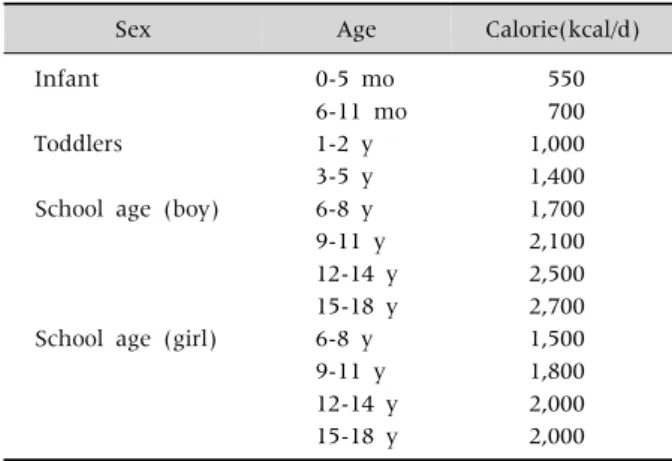
Table 2.Dietary Reference Intake of Calorie in Korean Children
Sex Age Calorie(kcal/d)
Infant 0-5 mo 550
6-11 mo 700
Toddlers 1-2 y 1,000
3-5 y 1,400
School age (boy) 6-8 y 1,700
9-11 y 2,100
12-14 y 2,500
15-18 y 2,700
School age (girl) 6-8 y 1,500
9-11 y 1,800
12-14 y 2,000
15-18 y 2,000
Adapted from Ministry of Health and Welfare, The Korean Nutrition Society. Dietary reference intakes for Koreans 2015 [25].
ence intake of calories in Korean children is sim- plified in Table 2 [25]. The guideline was established by the Ministry of Health and Welfare and The Korean Nutrition Society. Dietitians can recommend calorie intake appropriate for each obese child, ac- cording to the dietary reference intake established by their home country.
Traffic Light Diet
The Traffic Light Diet is a useful method of nutri- tional counseling for obese children [11]. It is a sim- ple and easy method to understand. The Traffic Light Diet consists of green, yellow and red light food (Table 3). Each color food should be considered in three aspects such as quality, types of food and quantity. Green light food is low-calorie, high-fiber, low-fat, and nutrient-dense. Fruits and vegetables represent green light food. The intake of green light food is unlimited. Yellow light food is nutrient-dense, but higher in calories and fat. There are meats with low fat, dairy, starch, and grain in food. The intake of yellow light food must be an appropriate amount for a child. Red light food is high in calories, sugar, and fat. Such food includes fatty meats, sugar, sugar ad- ditive beverages, and fried meals. The intake of red light food should be infrequent or avoided.
MyPlate, food pyramid or Food Balance Wheels For ideal calorie intake and a healthy diet, appro- priate food composition is imperative. The US De-
partment of Agriculture (USDA) published the nu- trition guide, MyPlate. It depicts a place setting with a plate and glass divided into five food groups.
MyPlate replaced the USDA’s MyPyramid guide June 2, 2011 [26]. The Irish food pyramid is also a well-established food-based dietary guideline [27].
In Korea, food can be classified into six groups includ- ing grains, meat-fish-egg-bean, vegetables, fruits, milk-dairy and oil-sugar group (Fig. 4) [25]. The area of each group in the figure shows the relative size of each food group that should be ingested. Every meal should contain essential components from the grain group, meat-fish-egg-bean group and vegetable group. Children should eat food from the fruit group and milk-dairy group one or two times daily.
Table 3.Traffic Light Diet Plan [11]
Feature Green light foods Yellow light foods Red light foods
Quality Low-calorie, high-fiber, low-fat, nutrient-dense
Nutrient-dense, but higher in calories and fat
High in calories, sugar, and fat
Types of food Fruits, vegetables Lean meats, dairy, starches, grains Fatty meats, sugar, sugar-sweetened beverages, fried foods
Quantity Unlimited Limited Infrequent or avoided
Fig. 4. Food Balance Wheels. Foods can be classified into 6 groups including grains, meat-fish-egg-bean, vegetables, fruits, milk-dairy, and oil-sugar group. Adapted from Ministry of Health and Welfare, The Korean Nutrition Society. Dietary reference intakes for Koreans 2015 [25].
Appropriate and adequate water consumption is im- perative to “ride” the Food Balance Wheels well and maintain a healthy diet.
‘Food Exchange Table’ or The Diabetic Exchange List
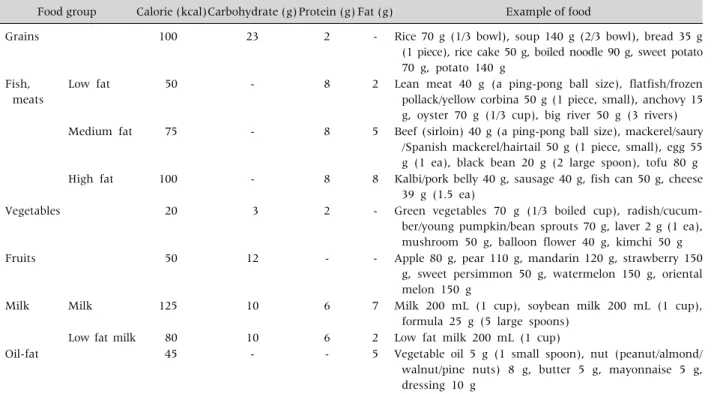
To practice ideal calorie intake for every meal, the specific amount of food for the standard calorie unit is
nominated to ‘1 exchange unit’ (Table 4) [28,29]. Each group of the six food groups has the standard calorie unit and specific amount of food in each group. ‘1 ex- change unit’ can be only substituted in the same group. For example, a one-third full bowl of rice can be substituted with a piece of bread, but not with a 40-gram meat ball. Using the Food Exchange Table, dietitians can easily suggest an example of a menu
Table 4.Example of ‘Food Exchange Table’
Food group Calorie (kcal)Carbohydrate (g)Protein (g) Fat (g) Example of food
Grains 100 23 2 - Rice 70 g (1/3 bowl), soup 140 g (2/3 bowl), bread 35 g
(1 piece), rice cake 50 g, boiled noodle 90 g, sweet potato 70 g, potato 140 g
Fish, meats
Low fat 50 - 8 2 Lean meat 40 g (a ping-pong ball size), flatfish/frozen
pollack/yellow corbina 50 g (1 piece, small), anchovy 15 g, oyster 70 g (1/3 cup), big river 50 g (3 rivers) Medium fat 75 - 8 5 Beef (sirloin) 40 g (a ping-pong ball size), mackerel/saury
/Spanish mackerel/hairtail 50 g (1 piece, small), egg 55 g (1 ea), black bean 20 g (2 large spoon), tofu 80 g High fat 100 - 8 8 Kalbi/pork belly 40 g, sausage 40 g, fish can 50 g, cheese
39 g (1.5 ea)
Vegetables 20 3 2 - Green vegetables 70 g (1/3 boiled cup), radish/cucum-
ber/young pumpkin/bean sprouts 70 g, laver 2 g (1 ea), mushroom 50 g, balloon flower 40 g, kimchi 50 g
Fruits 50 12 - - Apple 80 g, pear 110 g, mandarin 120 g, strawberry 150
g, sweet persimmon 50 g, watermelon 150 g, oriental melon 150 g
Milk Milk 125 10 6 7 Milk 200 mL (1 cup), soybean milk 200 mL (1 cup),
formula 25 g (5 large spoons)
Low fat milk 80 10 6 2 Low fat milk 200 mL (1 cup)
Oil-fat 45 - - 5 Vegetable oil 5 g (1 small spoon), nut (peanut/almond/
walnut/pine nuts) 8 g, butter 5 g, mayonnaise 5 g, dressing 10 g
Modified from Korean Diabetes Association. User guidelines of food exchange table for diabetes [28].
plate consisting of ideal calories for each meal for obese children. ‘Food Exchange Table’ is useful for nu- tritional counseling relative to DM in obese children.
In the US, the diabetic exchange list issued by the American Diabetes Association is being used [30].
Nutritional counseling in obese children with diabetes mellitus
There are two types of DM including type 1 and type 2. The 24% of type 1 DM and 96% of type 2 DM patients are known to be obese children [31].
Because of beta-cell destruction by autoantibody, type 1 DM patients cannot expect auto-regulation of insulin concentration in their blood. In obese chil- dren with DM, principles of nutritional counseling are to promote best compliance, to approach step by step, to continue normal growth and development, to maintain ideal blood glucose level and appropriate nutritional state [32]. For children with type 2 DM, households with a lack of understanding about healthy eating habits are a primary cause of the dis-
ease [33]. Unhealthy diet behavior includes over-snacking and skipping meals. Adolescents often engage in non-appetite-based eating (i.e., emotional eating, television-cued eating, boredom) and cyclic dieting [33]. Type 2 DM children have poor com- pliance histories, because they are already obese and have been engaging in long-term unhealthy diet habits [34].
Every meal and snack significantly impacts blood glucose management in patients [32]. Obese children must be educated about healthy diet habits [35].
Regularity and consistency of calorie intake for every meal and snack are critical for patients with DM. With these factors and appropriate exercise, insulin therapy or a hypoglycemic agent can enable patients to effec- tively manage their blood glucose. Therefore, main- taining a daily DM management diary is critical for controlling blood glucose effectively (Supplementary Table 1). A daily DM management diary can be more effective, if the diary includes glucose intake before meals, the menu and frequency of meal and snacks,
exercise according to the time food is processed daily.
For consistency of calorie intake, dietitians may sug- gest ideal menus and calculate calorie intake in a daily diary using the ‘Food Exchange Table’.
Hypoglycemia can significantly impact compliance of DM treatment in obese children. Therefore, prevent- ing hypoglycemia is a critical component of DM control. The patient with hypoglycemia should be able to eat food easily such as candy or drink orange juice which would increase blood glucose rapidly.
CONCLUSION
The obesity prevalence of children has alarmingly increased in Korea in the last 10 years. Before begin- ning nutritional counseling for obese children, analy- sis of modifiable risk factors, assessment of obese children and principles of obesity treatment should be considered. Specifically, a multi-disciplinary team approach to obesity treatment is critical. Nutritional counseling can be successfully conducted by requir- ing parents of obese children to maintain a daily log of food and drink intake and ensure that their chil- dren engage in a sensible dieting lifestyle using effec- tive counseling tools such as the Traffic Light Diet,
‘Food Exchange Table’, and Food Balance Wheels.
Nutritional counseling relative to obese children with DM can be more effective if parents of obese children with DM judiciously maintain a ‘DM management diary’.
SUPPLEMENTARY DATA
Supplementary data can be found with this article online at http://www.pghn.org and at https://doi.
org/10.5223/pghn.2017.20.2.71.
REFERENCES
1. Keane VA. Assessment of growth. In: Kliegman RM, Stanton BF, St. Geme III JW, Schor NF, Behrman RE, eds. Nelson textbook of pediatrics. 20th ed. Philadel- phia: Elsevier, 2016.
2. Ogden CL, Carroll MD, Kit BK, Flegal KM. Prevalence of childhood and adult obesity in the United States,
2011-2012. JAMA 2014;311:806-14.
3. European Commission. EU action plan on childhood obesity 2014-2020 [Internet]. European Commission;
2014 Feb 24 [cited 2017 Jun 2]. Available from:
https://ec.europa.eu/health/nutrition_physical_activity/
key_documents_en#anchor1.
4. Ministry of Education, Republic of Korea. Report of stu- dent health test results 2016 [Internet]. Seoul: Ministry of Education; 2017 [cited 2017 Jun 2]. Available from:
https://goo.gl/kiyZuM.
5. National Health Insurance Service, Republic of Korea.
The white paper for obesity 2016 [Internet]. Seoul:
National Health Insurance Service; 2017 [cited 2017 Jun 2]. Available from: http://www.nhis.or.kr/bbs7/
boards/B0039/22703.
6. Grant-Guimaraes J, Feinstein R, Laber E, Kosoy J.
Childhood overweight and obesity. Gastroenterol Clin North Am 2016;45:715-28.
7. Skelton J, Cohen G. Obesity. In: Wyllie R, Hyams J, Kay M, eds. Pediatric gastrointestinal and liver disease. 5th ed. Philadelphia: Elsevier, 2016.
8. Oh MS, Kim S, Jang JH, Park JY, Kang HS, Lee MS, et al. Associations among the degree of nonalcoholic fat- ty liver disease, metabolic syndrome, degree of obesity in children, and parental obesity. Pediatr Gastroenterol Hepatol Nutr 2016;19:199-206.
9. Welker E, Lott M, Story M. The school food environment and obesity prevention: progress over the last decade.
Curr Obes Rep 2016;5:145-55.
10. Aceves-Martins M, Llauradó E, Tarro L, Moriña D, Papell-Garcia I, Prades-Tena J. A school-based, peer-led, social marketing intervention to engage Spanish ado- lescents in a healthy lifestyle ("We are cool"-Som la Pera study): a parallel-cluster randomized controlled study.
Child Obes 2017. doi: 10.1089/chi. 2016.0216. [Epub ahead of print]
11. Gahagan S. Overweight and obesity. In: Kliegman RM, Stanton BF, St. Geme III JW, Schor NF, Behrman RE, eds. Nelson textbook of pediatrics. 20th ed. Philadel- phia: Elsevier, 2016.
12. Kiess W, Blüher S, Kapellen T, Körner A. Metabolic syn- drome in children and adolescents: prevalence, public health issue, and time for initiative. J Pediatr Gastroen- terol Nutr 2009;49:268-71.
13. Weiss R, Dziura J, Burgert TS, Tamborlane WV, Taksali SE, Yeckel CW, et al. Obesity and the metabolic syndrome in children and adolescents. N Engl J Med 2004;350:2362-74.
14. Lambert M, Paradis G, O'Loughlin J, Delvin EE, Hanley JA, Levy E. Insulin resistance syndrome in a representative sample of children and adolescents from
Quebec, Canada. Int J Obes Relat Metab Disord 2004;28:833-41.
15. Butte NF, Comuzzie AG, Cole SA, Mehta NR, Cai G, Tejero M, et al. Quantitative genetic analysis of the met- abolic syndrome in Hispanic children. Pediatr Res 2005;58:1243-8.
16. Resnicow K, Harris D, Wasserman R, Schwartz RP, Perez-Rosas V, Mihalcea R, et al. Advances in motiva- tional interviewing for pediatric obesity: results of the brief motivational interviewing to reduce body mass in- dex trial and future directions. Pediatr Clin North Am 2016;63:539-62.
17. Arai L, Panca M, Morris S, Curtis-Tyler K, Lucas PJ, Roberts HM. Time, monetary and other costs of partic- ipation in family-based child weight management in- terventions: qualitative and systematic review evidence. PLoS One 2015;10:e0123782.
18. Kelleher E, Davoren MP, Harrington JM, Shiely F, Perry IJ, McHugh SM. Barriers and facilitators to ini- tial and continued attendance at community-based life- style programmes among families of overweight and obese children: a systematic review. Obes Rev 2017;18:
183-94.
19. Reid AE, Chauhan BF, Rabbani R, Lys J, Copstein L, Mann A, et al. Early exposure to nonnutritive sweet- eners and long-term metabolic health: a systematic review. Pediatrics 2016;137:e20153603.
20. Lu L, Xun P, Wan Y, He K, Cai W. Long-term association between dairy consumption and risk of childhood obe- sity: a systematic review and meta-analysis of pro- spective cohort studies. Eur J Clin Nutr 2016;70:414- 23.
21. Cecchini M, Sassi F, Lauer JA, Lee YY, Guajardo- Barron V, Chisholm D. Tackling of unhealthy diets, physical inactivity, and obesity: health effects and cost-effectiveness. Lancet 2010;376:1775-84.
22. Yon BA, Johnson RK, Harvey-Berino J, Gold BC. The use of a personal digital assistant for dietary self-mon- itoring does not improve the validity of self-reports of energy intake. J Am Diet Assoc 2006;106:1256-9.
23. Dubin SM, Vadivelu J, Copur-Dahi N, Miranda L, Palermo D, Pandey B, et al. A simple dietary ques- tionnaire correlates with formal dietitian evaluation and frequently identifies specific clinical interventions in an outpatient gastroenterology clinic. J Clin Gastro- enterol 2016;50:e71-6.
24. Institute of Medicine. 2005. Dietary reference intakes for energy, carbohydrate, fiber, fat, fatty acids, choles-
terol, protein, and amino acids. Washington, DC: The National Academies Press. Available from: https://do- i.org/10.17226/10490.
25. Ministry of Health and Welfare, The Korean Nutrition Society. Dietary reference intakes for Koreans 2015.
3rd ed. Seoul: Ministry of Health and Welfare, The Korean Nutrition Society, 2015.
26. United States Department of Agriculture. Choose MyPlate.gov [Internet]. Washington, DC: USDA; 2011 [cited 2017 Jun 1]. Available from: https://www.
choosemyplate. gov.
27. Food and Agriculture Organization of the United Nations. Food-based dietary guidelines [Internet].
Rome: FAO; 2017 [cited 2017 Jun 2]. Available from:
http://www.fao.org/nutrition/education/food-dietary- guidelines/home/en/.
28. Korean Diabetes Association. User guidelines of food exchange table for diabetes. 3rd ed. Seoul: Korean Diabetes Association, 2010.
29. Ju DL, Jang HC, Cho YY, Cho JW, Yoo HS, Choi KS, et al. Korean food exchange lists for diabetes: revised 2010. J Nutr Health 2011;44:577-91.
30. American Diabetes Association. The diabetic exchange list [Internet]. Arlington: American Diabetes Association; [cited 2017 Jun 2]. Available from:
http://glycemic.com/DiabeticExchange/The%20Diabe tic%20Exchange%20List.pdf.
31. Scott CR, Smith JM, Cradock MM, Pihoker C.
Characteristics of youth-onset noninsulin-dependent diabetes mellitus and insulin-dependent diabetes mel- litus at diagnosis. Pediatrics 1997;100:84-91.
32. Connell JE, Thomas-Dobersen D. Nutritional manage- ment of children and adolescents with insulin-depend- ent diabetes mellitus: a review by the diabetes care and education dietetic practice group. J Am Diet Assoc 1991;91:1556-64.
33. Svoren BM, Jospe N. Type 2 diabetes mellitus. In:
Kliegman RM, Stanton BF, St. Geme III JW, Schor NF, Behrman RE, eds. Nelson textbook of pediatrics. 20th ed. Philadelphia: Elsevier, 2016.
34. Pulgaron ER, Delamater AM. Obesity and type 2 dia- betes in children: epidemiology and treatment. Curr Diab Rep 2014;14:508.
35. Gidding SS, Dennison BA, Birch LL, Daniels SR, Gillman MW, Lichtenstein AH, et al. Dietary recom- mendations for children and adolescents: a guide for practitioners. Pediatrics 2006;117:544-59.

![Table 3. Traffic Light Diet Plan [11]](https://thumb-ap.123doks.com/thumbv2/123dokinfo/5411356.222282/5.892.95.799.219.827/table-traffic-light-diet-plan.webp)