http://dx.doi.org/10.3938/NPSM.67.555
Trend Analysis by Using Text Mining of Journal Articles Regarding Consumer Policy
Min-Jeong Kim · Kyungyoung Ohk
∗· Chung-Sook Moon
Department of Consumer Economics, Sookmyung Women’s University, Seoul 04310, Korea (Received 10 January 2017 : revised 3 April 2017 : accepted 4 April 2017)
This paper identifies the direction of change in consumer policy research, where consumer policies are shifting from consumer protection perspectives to consumer responsibility perspectives. In this research, text mining and association-rule techniques were used on the titles and keywords of articles published in “Consumer Policy and Education Review”, a major journal for consumer policy studies, from 2005 to 2015 to find major research trends, longitudinal trends, and a research field association rule; these results were visualized so that they could be easily understood. First, 1026 keywords were extracted from 238 papers that had titles and keywords. From these, 73 keywords that appeared 10 times or more were selected as research targets and were analyzed. From the analysis, the longitudinal patterns of the keywords’ appearance frequency by year showed steady increasing, increasing, one-time peak, and rapidly increasing then decreasing trends. Finally, the association rule was used to find frequent patterns in the keyword database; this revealed a structure in which groups were formed based on the keyword “consumer”. Through this research, the trends and the keywords of papers on consumer policy studies could be understood; thus, this research can be used as fundamental data for predicting trends in articles on consumer policy studies.
PACS numbers: 89.70.+c, 89.90.+n1
Keywords: Consumer policy’s trend, Text mining, K-means clustering, Association rule
I. INTRODUCTION
Text mining refers to a process of extracting mean- ingful, non-trivial patterns or knowledge from a set of unstructured texts [1]. Identification of meaningful pat- terns and trends and the extraction of potential knowl- edge in large volumes of text data is an important task in various fields [2]. In particular, the advent of high- speed internet generates large amounts of textual data in a variety of forms [3]. As an aspect of this trend, in various fields such as academic article information and news article information, research utilizing text mining technique is actively being carried out to find trends and extract implicit information from large volume of data [1,4,5].
∗E-mail:[email protected]
This paper identifies the direction of change in con- sumer policy research, where consumer policies are shift- ing from consumer protection perspectives to consumer responsibility perspectives. In this research, we analyze
“Consumer Policy and Education Review” journal dur- ing 11 years from its first issue (2005) to determine its main concerns and research concentrations, the trends that have appeared in its research over the past 11 years, how they have changed, and which research subjects are connected. This research uses text mining and associa- tion rule techniques to analyze trends in articles pub- lished in “Consumer Policy and Education Review”.
Through this, the major research trends and longi- tudinal trends, and keyword co-occurrence information were determined and visualized to promote ease of under- standing. As such, this research has been able to observe the status and progress of research in consumer policy
This is an Open Access article distributed under the terms of the Creative Commons Attribution Non-Commercial License (http://creativecommons.org/licenses/by-nc/3.0) which permits unrestricted non-commercial use, distribution, and reproduction in any medium, provided the original work is properly cited.
Table 1. Analysis target.
Year Published Articles Number of Issues
2005 8 1
2006 15 2
2007 13 2
2008 24 4
2009 21 4
2010 21 4
2011 28 4
2012 20 4
2013 27 4
2014 35 4
2015 26 3*
Total 238
*Analysis target of year 2015 include 3 issues
across time, and it has been able to examine the interre- lations among the keywords included in “Consumer Pol- icy and Education Review”.
II. DATA GATHERING
“Consumer Policy and Education Review” was first published in 2005. In 2005, it was released in a volume, number format one time. Since 2007, it has been released in the volume, number format quarterly. The analysis target articles are outlined in Table 1. We used the ti- tles and keywords of the 238 articles as targets for text mining analysis. In this research, the publication year, article title, and article keywords are used as the main data for performing an analysis of keywords by article and an analysis of keywords by year.
III. ANALYSIS METHODS
The program used for text mining and association rule was an open source program called R, version 3.2.3. The tm (text mining) package [6] was used to perform text mining on the titles and keywords of the previously col- lected articles. Based on this, a term-document matrix and a term-year matrix were created. Then, k-means clustering [7], a nonhierarchical clustering method, was used to understand how keywords have changed, and
which research subjects are connected. The arules (as- sociation rules) package [8] was used to find relations among keywords, and the arulesViz package [9] was used to visualize the correlations.
The R program’s tm package can analyze a data struc- ture called a corpus, so the txt data files were read and converted into a corpus, and then basic text process- ing and subsequent analysis were performed. The basic text processing converts all text into lowercase, removes symbols such as numbers and punctuation, removes stop words, and removes blank space. After this, it is possi- ble to construct a term-document matrix that describes the frequency of keywords that occur in a collection of documents. Then, we selected important keywords that appeared frequently, excluding words with multiple meanings, common verbs, and general words. Based on these important keywords selected, the high dimensional datasets were created from the term-document matrix made with the text mining results. The other dataset is the portion of data representing the frequency of the keywords over time period from 2005 to 2015 and called term-year matrix.
Generally, the term-document matrix simply uses the frequency by keyword, but in this research, rather than using a simple document appearance frequency by key- word, a weight was calculated for each word with regard to Term Frequency-Inverse Document Frequency (TF- IDF), which is widely used in information search and text mining research [10]. This is a value that can judge how important a particular term is in a particular document from a collection of several documents. Term Frequency (TF) is a value representing how frequently a particular word appears in a document; the larger this value, the more important a word can be considered to be in a doc- ument. Frequent use in a document collection means that a word appears commonly. Therefore, not only the word frequency but also the document frequency is considered.
This is called Document Frequency (DF), and the recip- rocal number of this value is called Inverse Document Frequency (IDF), which has a weight for each word. IDF is a value that shows how commonly a certain word ap- pears in a document collection. It is the logarithmically scaled inverse fraction of the documents that contain the word, obtained by dividing the total number of docu- ments by the number of documents containing the term,
and then taking the logarithm of that quotient. There- fore, TF-IDF is a value that multiplies TF and IDF and is calculated as follows.
TF-IDF = TF × log(N/DF) (1) - TF : Frequency of a particular word in the docu-
ments
- N : Number of all documents
- DF : Number of documents containing a particular word
- IDF : Inverse of DF
The IDF value increases if few documents contain the specified word among all documents, and it decreases if many documents contain the specified word among all documents. This is because as the number of documents that contain the word increases, the value of N/DF ap- proaches 1, and the IDF value approaches 0.
Next, for the term-document matrix, k-means cluster- ing was used to determine how clustering occurred in relation to specific keywords. Then, k-means clustering was also used to understand the yearly changes in specific keywords for the term-year matrix.
Finally, using association rule technique, we found the relations between keywords, where each document is con- sidered as a transaction, and each keyword in the docu- ment is an item. There are three main measures called support, confidence, and lift [11] to assess the strength of the rule among specific keywords.
IV. ANALYSIS RESULTS
1. Main Keywords
A total of 1736 words were used in the titles and key- words of the 238 articles, but after the words not needed for analysis were removed, 1026 words remained. Look- ing at this process step-by-step, a corpus was first cre- ated using the data for analysis, then text processing was performed (removing blank space, punctuation, symbols, numbers and stop words; performing lowercase conver- sion; etc.) so that only the analysis target keywords were
Table 2. Summary of articles and keywords from the
“Consumer Policy and Education Review”.
Category Collection Research
Targets Targets
Articles 238 238
Keywords 1736 1026
extracted. In the next step, the analysis target keywords were analyzed, and because they could be singular or plural, all plural words in the corpus were converted into singular words. Third-person verbs and past-tense verbs were converted into present-tense verbs, and other addi- tional modifications were made to the corpus.
Through this process, the 1736 words from the 238 articles were condensed into 1026 words; the collected items are listed in Table 2. In this research, the frequency analysis was based on the final 1026 keywords.
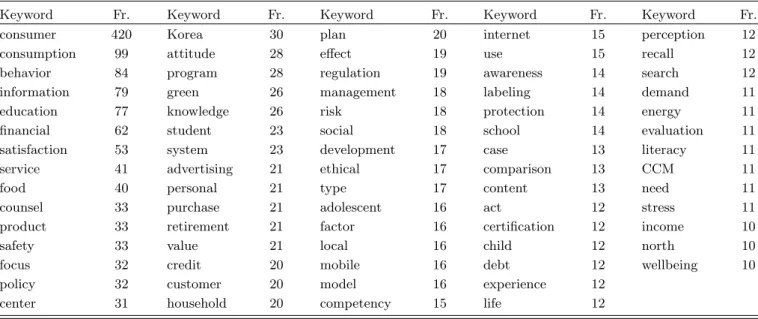
In this paper, we selected 73 important keywords that appeared more than 10 times, excluding words with mul- tiple meanings, common verbs, and general words from the 1026 words that were gathered. For example, words such as “study”, “analysis”, and “research” were in- cluded in the most frequent keywords, but they had no value for analysis and thus were not chosen. The 73 selected keywords are listed in Table 3 in order of fre- quency. Using only TF value, we can understand which keywords are frequently used in the “Consumer Policy and Education Review” journal. The word “consumer”
was overwhelmingly frequent in Table 3, because the
“Consumer Policy and Education Review” journal is about consumer study. Looking at the keywords, there were many words related to consumer. Unlike other jour- nals, the most frequent keywords in “Consumer Policy and Education Review” included very little on research methodology, and most words were on research subjects related to consumer’s studies.
2. Main Keywords by Year
In this section, using tm package, we selected impor- tant keywords that appeared frequently by year. The selected keywords by year are listed in Table 4. Look- ing at the keywords, there were many words related to
Table 3. Most frequent keywords in the “Consumer Policy and Education Review” and their frequency.
Keyword Fr. Keyword Fr. Keyword Fr. Keyword Fr. Keyword Fr.
consumer 420 Korea 30 plan 20 internet 15 perception 12
consumption 99 attitude 28 effect 19 use 15 recall 12
behavior 84 program 28 regulation 19 awareness 14 search 12
information 79 green 26 management 18 labeling 14 demand 11
education 77 knowledge 26 risk 18 protection 14 energy 11
financial 62 student 23 social 18 school 14 evaluation 11
satisfaction 53 system 23 development 17 case 13 literacy 11
service 41 advertising 21 ethical 17 comparison 13 CCM 11
food 40 personal 21 type 17 content 13 need 11
counsel 33 purchase 21 adolescent 16 act 12 stress 11
product 33 retirement 21 factor 16 certification 12 income 10
safety 33 value 21 local 16 child 12 north 10
focus 32 credit 20 mobile 16 debt 12 wellbeing 10
policy 32 customer 20 model 16 experience 12
center 31 household 20 competency 15 life 12
Table 4. Keywords by year.
Year Keywords
‘05 policy, information, act, protection
‘06 education, personal, curriculum, debt, financial
‘07 education, school, north
‘08 education, behavior, satisfaction, financial, administration, retirement
‘09 energy, advertising, information, internet, labeling, wellbeing
‘10 green, food, counselling, network, safety, act, financial, knowledge
‘11 safety, green, recall, education, attitude
‘12 financial, retirement, food, information, policy, safety, green, knowledge
‘13 credit card, eco-friendly, literacy, social, usage, commerce, risk, competency
‘14 mobile, service, ethical, customer, management, CCM, certification, counselor
‘15 regulation, annuity, boycott
consumer’s right such as consumer protection and con- sumer education in early days, gradually the articles addressed consumer responsibility-related research, and the frequent keywords included “energy”, “green”, “eco- friendly”, and “ethical”. These results show that con- sumer policy research with regard to the trend of research has been changed from consumer protection perspectives to consumer responsibility perspectives.
3. Keyword Clustering
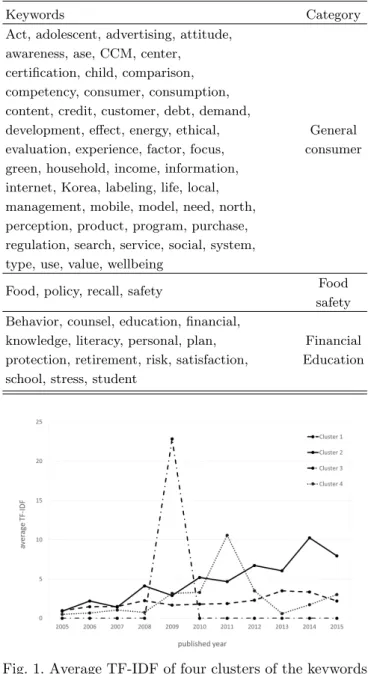
To examine the group patterns of the term-document matrix and the term-year matrix calculated in TF-IDF value, they were divided into clusters using k-means clus- tering. Table 5 shows how the clusters for certain key- words were divided using the term-document matrix.
The numbers of groups (k) to be divided into were set at 3, 4, and 5. Division into 3 groups made it possible to obtain the most meaningful results.
In the clustering results of the term-document ma- trix, the categories appeared to be formed according to the keywords of the cluster. The keywords of Cluster 1 included a variety of keywords mostly about research related to general consumer. Cluster 2 was made of only four keywords, and all keywords (“food”, “policy”,
“recall”, and “safety”) were related to the food safety.
Cluster 3 also includes a variety of keywords about re- search related to financial education for a variety of tar- get. Through this, it was discovered that the most fre- quent keywords in the “Consumer Policy and Education Review” journal could be broadly categorized as policies about general consumption and food safety, and financial education for a variety of target.
The “Consumer Policy and Education Review” journal published 36 issues from Volume 1, Number 1 in Novem- ber 2005 to Volume 11, Number 3 in September 2015.
Therefore, in this research, a term-year matrix was used
Table 5. K-means clustering results for term-document matrix.
Keywords Category
Act, adolescent, advertising, attitude, awareness, ase, CCM, center,
certification, child, comparison, competency, consumer, consumption, content, credit, customer, debt, demand,
development, effect, energy, ethical, General evaluation, experience, factor, focus, consumer green, household, income, information,
internet, Korea, labeling, life, local, management, mobile, model, need, north, perception, product, program, purchase, regulation, search, service, social, system, type, use, value, wellbeing
Food, policy, recall, safety Food
safety Behavior, counsel, education, financial,
knowledge, literacy, personal, plan, Financial protection, retirement, risk, satisfaction, Education school, stress, student
Fig. 1. Average TF-IDF of four clusters of the keywords observed over the past 11 years (2005-2015).
to find the occurrence patterns for each keyword from 2005 until 2015. k-means clustering was performed to in- vestigate the changes in keywords by year. Fig. 1 shows the average TF-IDF factor of four clusters from k-means clustering.
Cluster 1 shows a trend of steady increase. Cluster 2 shows a trend of continual increase since 2005. Cluster 3 has one-time peak with the highest average TF-IDF factor in 2009, and it does not exist before and after 2009.
This is believed to be because there was a special edition
in 2009 on the topic of energy. Cluster 4 shows a trend of increasing rapidly in 2011, followed by a decrease.
A list of the keywords that belongs to each cluster is shown in Table 6. This result can provide an understand- ing of research trends in the “Consumer Policy and Ed- ucation Review” journal over the past 11 years. Names were assigned to each of the cluster categories in Table 6 according to the yearly trends of average TF-IDF results for each of the clusters. Cluster 1 is the steady increasing keywords, Cluster 2 is the increasing keywords, Cluster 3 is the one-time peak keywords, and Cluster 4 is the rapidly increasing then decreasing keywords.
Looking at the keywords in Cluster 1, it can be seen that the keywords are distributed throughout a variety of research topics that are addressed in research related to consumer. The keywords that have been steadily receiv- ing attention from researchers since 2005 are in Cluster 1. Looking at the keywords in Cluster 2 (“behavior”,
“consumer”, “consumption”, “education”, “ethical”,
“financial”, “food”, “information”, “mobile”, etc.), it can be seen that the keywords receive a fairly large amount of attention. Cluster 3 showed the one-time peak in 2009 but has no more attention, which is believed to be be- cause energy was the subject of a special edition in 2009.
Cluster 4 showed a rapid increase in 2011 but has gradu- ally lost attention, which has a distribution of keywords about “green”, “safety”, and “wellbeing”.
4. Keyword Association Rules
This section analyzes the association rules for the 73 words that appeared in article titles and keywords. Table 7 shows the keyword support, confidence, and lift of the association rules between keywords. For this, rules were derived only with a support value of at least 0.01 and a confidence value of at least 0.5, but this produced a total of 963 association rules. Of these, 107 association rules with 1 element each were found. Of these, the 10 rules with the highest lift value are shown in Table 7.
We can know that most of these are made of words that are used associatively. For example, the support value for “debt” and “household” (i.e., the probability that they will appear together) is small at 0.0168, but in articles that include the antecedent subject “debt,” the
Table 6. K-means clustering results for term-year matrix.
Keywords Category
act, case, CCM, certification, child, comparison, competency, content, credit, customer, debt, development, effect, evaluation, experience, factor,
focus, household, income, internet, Steady knowledge, Korea, labeling, life, increasing literacy, local, management, need, north,
perception, personal, plan, policy, program, protection, regulation, retirement, risk, school, search, social, stress, student, system, type, use behavior, center, consumer,
consumption, education, ethical, Increasing financial, food, information, mobile,
satisfaction, service
Energy One-time
peak adolescent, advertising, attitude, Rapidly awareness, counsel, demand, green, increasing model, product, purchase, recall, safety, then
value, wellbeing decreasing
Table 7. Keyword Support, Confidence and Lift.
Antecedent Consequent Supp. Conf. Lift
debt household 0.0168 0.8000 19.0400
CCM case 0.0252 0.6667 15.8667
Food safety 0.0336 0.6667 14.4242
income household 0.0168 0.5714 13.6000
north Korea 0.0168 1.0000 12.5263
CCM center 0.0336 0.8889 11.7531
case customer 0.0210 0.5000 10.8182
certification plan 0.0126 0.5000 9.9167
retirement plan 0.0168 0.5000 9.9167
labeling system 0.0168 0.5714 9.0667
confidence value of the consequent subject, “household,”
(i.e., the probability that it will appear) is very high at 0.8. Furthermore, in the case of the lift—i.e., the associa- tion—”debt” and “household” have a lift value of 19.04, so it can be known that if “debt” appears, the possibility that “household” appears is fairly great.
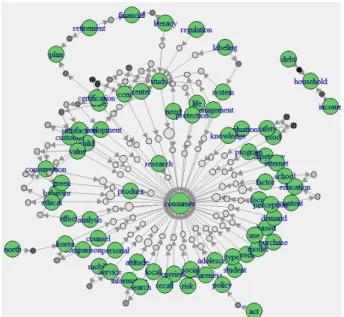
Fig. 2 shows the results of using a network graph to visualize the association rules between keywords. A va- riety of keywords are evenly associated with “consumer”
at the center. Most of keywords are directly connected to
“consumer” except for isolated keywords such as “debt”,
Fig. 2. (Color online) Keyword correlation analysis re- sults.
“household”, and “income”. However, aside from these, there are other keywords (“north”, “act”, “labeling”, and “regulation”) that are indirectly connected to
“consumer” through other keywords. Through this, it can be known that the “Consumer Policy and Education Review” journal deals with a variety of research topics centered on “consumer” with only a few isolated key- words. Moreover, the sizes of the circles in Fig. 2 are proportional to the support values between the two key- words, and the darker the circle’s color, the larger the lift value. Therefore, it is easy to see whether there is a stronger association rule between keywords. It can be seen that the rule debthousehold has a highest lift value.
V. CONCLUSION
In this research, we analyzed the titles and keywords of 238 articles from the “Consumer Policy and Edu- cation Review” journal in order to determine its main concerns and research concentrations, the trends that have appeared in its research over the past 11 years, how they have changed, and which research subjects are connected. We utilized text mining and association rule techniques to analyze trends in articles published in
“Consumer Policy and Education Review”.
First, we found the 73 keywords that appear most fre- quently in the titles and keywords of the 238 articles,
and also selected main keywords by year. Then, k-means clustering was used on the term-document matrix to see how the clusters would form. Next, the results of clus- tering analysis based on a term-year matrix showed that there were keywords decreasing except for a particular year and keywords with one-time peak, but for all other keywords, the number of articles increased along a time series. Finally, the association rules between keywords were analyzed to quantify and visualize the relations of each keyword. The association rules results showed that a large group formed based on the keyword “consumer”.
This research is significant in that it is the first to ap- ply text mining and association rule mining techniques to consumer policy-related research articles. We could iden- tify the direction of change in consumer policy research similar to consumer policy paradigm which is shifting from consumer protection perspectives to consumer re- sponsibility perspectives. Moreover, the results of this research can be used before starting new research to find articles with keywords similar to those in existing re- search and seen which research topics the “Consumer Policy and Education Review” journal has been cover- ing recently.
However, in this paper, text mining was performed on only titles and keywords. For a more comprehensive anal- ysis, the abstracts of articles need to be included. Unfor- tunately, the data of this journal were collected manually because data from “Consumer Policy and Education Re- view” journal website could not be downloaded as html files. For future follow-up research, it is necessary to per- form analysis with more data including abstracts and comparative analysis on other data such as news articles related to consumer policy to determine their similarities and differences.
REFERENCES
[1] J. L. Hung and K. Zhang, J. Comput. High. Educ.
24, 1 (2012).
[2] A. Kao and S. R. Poteet, Natural Language Pro- cessing and Text Mining (Springer-Verlag London, London, 2007).
[3] S. G. Cho and S. B. Kim, Int. J. Inf. Educ. Technol.
2, 233 (2012).
[4] S. J. Lee, S. H, Lee, H. J. Seol and Y. T. Park, R&D Management 38, 169 (2008).
[5] A. Balahur and R. Steinberger, in Proceedings of the 1st Workshop on Opinion Mining and Sentiment Analysis (Seville, 2009).
[6] Package ‘tm’, https://cran.r-project.org/web/ pack- ages/tm/tm.pdf (accessed Jan. 10, 2016).
[7] Package ‘cluster’, https://cran.r-project.org/web/
packages/cluster/cluster.pdf (accessed Jan. 10, 20 16).
[8] Package ‘arules’, https://cran.r-project.org/web/
packages/arules/arules.pdf (accessed Jan. 13, 20 16).
[9] Package ‘arulesViz’, https://cran.r-project.org/we b/packages/arulesViz/arulesViz.pdf (accessed Jan.
13, 2016).
[10] G. Salton and C. Buckley, Information Processing and Management 24, 513 (1988).
[11] R. Agrawal, T. Imieli´nski and A. Swami, in Pro- ceedings of the 1993 ACM SIGMOD International Conference on Management of Data (Washington, D.C., 1993).