K.-S. Cho
국립식량과학원 고령지농업연구센터
(Highland of Agriculture Research Center, National Institute of Crop Science, RDA, Pyongchang, 232-955, Republic of Korea) T.-H. Park ( )
대구대학교 원예학과, 대구대학교 생명환경연구소
(Department of Horticulture and Institute of Life and Environment, Daegu University, Gyeongsan 712-714, Republic of Korea) e-mail: [email protected]
원형질체 융합을 이용한 감자 육종
조광수 ・ 박태호
Potato breeding via protoplast fusion
Kwang-Soo Cho ・ Tae-Ho Park
Received: 16 June 2014 / Revised: 20 June 2014 / Accepted: 26 June 2014
ⓒKorean Society for Plant Biotechnology
Abstract Plant cells from which the cell walls have been enzymatically or mechanically removed are called protoplasts.
The protoplasts are theoretically totipotent and can be used as sources of somatic cell fusion in practical breeding programs. Wild Solanum species have often been used as sources of important agricultural traits including diverse disease resistance. However, they cannot often be directly applied to breeding programs due to their sexual incom- patibility with S. tuberosum. Somatic hybridization via protoplast fusion is one of the ideal methods to overcome this limitation and to introgress certain traits into S. tuberosum.
This technique has still widely been used in potato since the first fusion was reported in 1970s. Therefore, this review highlights general perspectives of protoplast fusion and discusses the application of protoplast fusion in potato breeding.
서 론
원형질체(protoplast)는 세포벽을 기계적으로 또는 효소에 의해 제거한 식물세포를 말한다. 이론적으로 원형질체는 탈분화할 수 있는 능력을 가지며, 세포주기로 진입하여 반복적인 유사분열을 진행함으로써 증식 또는 다양한 기 관으로 재분화 하는 등의 전형성능을 갖는다. 이러한 성
질은 다양한 식물종을 대상으로 원형질체 융합을 이용한 실용적인 육종방법을 제공하며, 생식세포의 수정을 통해 이루어지는 접합자의 형성 전 또는 형성 후, 정상적인 접 합자를 형성하는데 문제를 발생시키는 근연이종 식물체 간 의 교잡능력 장벽을 피해 서로 다른 동형핵체(homokaryon) 또는 이핵접합체(heterokaryon)와 이형세포질 잡종(alloplasmic hybrids, cybrids)을 창출할 수 있는 기회를 제공한다.
4배체(2n=4x=48)인 재배종 감자(Solanum tuberosum L.) 는 전세계적으로 생산량이 네 번째에 이르는 가장 중요 한 작물 중 하나이다. 재배종 감자는 역병, 풋마름병, 더 뎅이병 등 다양한 병에 대해 감수성을 보이며, 이러한 병 들은 결과적으로 감자의 생산성에 영향을 줄 뿐 만 아니 라 품질에도 큰 영향을 미친다. 따라서 다양한 감자 유전 자원을 이용한 병저항성 감자품종의 육성은 다양한 병에 대해 저항성을 달성할 수 있는 가장 현실적이며 이상적 인 방법으로 고려되고 있다(Jansky 2000). Solanum 속의 야 생종은 이러한 생물학적인 요인 뿐 만 아니라 비생물학 적 요인과 다양한 농업형질에 대한 가치를 지닌 중요한 유전자원으로 가치를 인정받고 있으며(Cardi et al. 1993;
Helgeson and Haberlach, 1999), 다양한 야생종들이 실제 감 자의 병저항성을 증대시키기 위한 육종 프로그램에 이용 되고 있다. 하지만 많은 수의 야생종들이 재배종 감자와 생리적으로 불화합성이란 제한된 조건에서 육종에 활용 되고 있다. 이는 교배양친의 배유의 게놈 구성비(endosperm balance number, EBN)에 의해 결정되며, 이에 따른 정상적 인 배와 배유형성의 여부가 이종 및 이배수체 간 교잡의 성공을 결정하는 요인이 되고 있다(Ortiz and Ehlenfeldt 1992;
Cho et al. 1997).
감자의 육종에 다양한 야생종을 활용하는데 발생되는 이러한 불화합성을 극복하기 위한 방법으로는 도입 유전 자원의 EBN을 고려하여 교배가 가능한 유전자원들을 선 재적으로 교배하여 재배종 감자와 교배가 가능한 새로운 DOI:http://dx.doi.org/10.5010/JPB.2014.41.2.65
Review
ISSN 1598-6365
계통을 육성하는 방법(bridge crosses), 재배종 감자가 보 유하고 있지 못한 유용 형질과 관련된 유전자를 근연야 생종에서 찾아 클로닝하여 형질전환 방법을 이용하여 재 배종 감자로 도입하는 방법(genetic modification, GM), 그 리고 앞서 언급한 원형질체 융합을 이용한 체세포잡종을 유도하는 방법(somatic hybridization)이 있다(Ahn and Park 2013). 이중 bridge cross와 GM방법의 경우, 전자는 재배종 감자와 교배가 가능한 계통을 육성하기 위하여 교배조합 을 구성하여 후대 식물체를 전개하고 도입하고자 하는 형질에 대한 선발 과정이 수 차례 반복되어야 하며, 후자 는 우선적으로 도입하고자 하는 유용 형질과 관련된 유 전자를 클로닝하는 작업이 필수적인 과정인 이유로 시간 과 노력이 많이 들 뿐 만 아니라, 특히 GM방법의 경우 여전히 사회적으로 거부감을 나타내고 있어, 실질적인 감자 육종에 활용하는 데 많은 어려움이 있다. 반면에 체 세포잡종을 이용한 감자 육종은 1970년대 후반 감자의 원형질체로부터 식물체의 재분화가 성공적으로 이루어지 고 체세포잡종 육성 프로그램에 적용된 이래로 현재까지 도 여전히 불화합성 감자 근연야생종으로부터 농업적으 로 중요한 형질을 재배종 감자로 도입하는 시도가 이루 어지고 있다(Shepard and Totten 1977; Binding et al. 1978;
Melchers et al. 1978).
이에 본 논문에서는 식물 원형질체 융합에 대한 전반 적인 연구현황과 감자의 근연야생종이 가지고 있는 유용 형질을 원형질체 융합을 통하여 재배종 감자에 도입하고 자 이루어진 감자육종 연구의 실례를 대상으로 실제 육 종에 이용된 근연야생종, 목표형질, 선발방법 등을 조사 하여 검토한 후 국내에서 이러한 육종 방법의 적용 가능 성을 논의하고자 한다.
식물 원형질체 융합 및 선발 방법
원형질체 융합에 대한 이론은 이미 약 100년 여 전에 보 고가 되었으며, 작물을 이용한 체세포잡종의 경우에는 담배를 이용한 종간 체세포잡종이 첫 번째 성공사례로 보고되었다(Carlson et al. 1972). 이후 다른 많은 식물종에 서 원형질체를 이용하여 체세포잡종 창출이 시도되었고 이를 통해 성공적인 체세포잡종 식물체 재분화가 이루어 졌으며, 최근까지도 다양한 식물종을 대상으로 지속적으 로 연구가 진행되고 있다(Gamborg 2002; Eeckhaut et al. 2013;
Shankar et al. 2013).
원형질체 융합의 방법으로는 식물의 종류에 따라 화학 적 융합법과 전기적 융합법이 이용되고 있으며 거의 유사 한 비율로 적용되고 있다. 두 가지 방법의 장점을 결합한 새로운 방법이 개발되기도 했으나, 이는 운향과(Rutaceae) 식물에서만 성공적으로 적용된 사례로 거의 이용되고 있
지는 않다(Olivares-Fuster et al. 2005). 또한 융합 대상 식물들 의 유전적 기여 방식에 따라 대칭적 원형질체 융합(symmetric fusion)과 비대칭적 원형질체 융합(asymmetric fusion)으로 구분할 수 있다. 대칭적 원형질체 융합은 융합 대상 양친 간의 완전한 게놈이 융합된 형태를 말하며, 이 경우 특정 염색체 간에 서로 거부 반응을 나타냄에 따라 유전자 충 돌(gene conflict) 현상이 증가하게 된다. 뿐 만 아니라, 원 하지 않는 유전적 특성이 도입되어 융합 식물체가 비정 상적으로 또는 매우 느린 속도로 생장하거나 거의 불임 인 식물체로의 재분화, 그리고 비정상적으로 다루기 힘 든 캘러스로의 분화 등 부정적 효과가 나타나기도 한다 (Eeckhaut et al. 2006). 이에 반해 비대칭적 원형질체 융합 은 게놈 분절(genome fragmentation) 이후 하나의 제한된 게 놈이 융합체로 전달되게 된다(Xia 2009). 이러한 비대칭 융 합은 세포질 DNA와 핵 DNA의 융합에 적용될 수 있으며, 특히 세포질 웅성불임(cytoplasmic male sterility, CMS)와 같은 형질의 도입에 많이 이용되고 있다(Liu et al. 2005).
원형질체 융합을 육종에 이용하기 위한 초기 융합계통 육성 과정은 일반적으로 원형질체의 분리, 분절(비대칭 융합의 경우 적용), 융합, 재분화 그리고 선발의 과정을 거친다(Razdan 2003; Liu et al. 2005). 이중 융합 이후, 융합 하고자 하는 서로 다른 식물체 간의 게놈이 실제 융합이 되었는지를 확인하고 융합체를 선발하는 과정은 육종을 위해서 가장 중요하다고 할 수 있다. 이를 위해 DNA 분 자표지의 이용, 세포유전학적 기법 등 다양한 생명공학적 기술이 이용되고 있다. 많이 이용되는 분자표지로는 RAPD (Randomly Amplified Polymorphic DNA), SSR (Simple Sequence Repeats), AFLP (Amplified Fragment Length Polymorphism), RFLP (Restriction Fragment Length Polymorphism), CAPS (Cleaved Amplified Polymorphic Sequence), SCAR (Sequence Characterized Amplified Region) 등이 있으며, 이러한 분자표지를 적용하 는데 사용되는 DNA 정보는 핵 내 DNA의 서열뿐 만 아니 라 세포질의 미토콘드리아나 엽록체 DNA의 서열이 활용 되고 있다(Thieme et al. 2010; Patel et al. 2011; Saker et al.
2011; Wang et al. 2011a; Yu et al. 2012a). 이에 더해 최근에는 real time PCR, microarray, transcriptome, reverse transcription PCR, real-time reverse transcription PCR 분석 등과 같은 전 사체 기반의 분석 기술과(Liu et al. 2012; Yu et al. 2012b;
Wang et al. 2011b, 2013) proteome 분석과 같은 단백질체 기반의 분석 기술(Gancle et al. 2006; Wang et al. 2010) 또한 이용되고 있다. 세포유전학적 기법으로는 염색체수 검 사, 유동 세포분석법(flow cytometry), GISH (Genomic in situ hybridization) 등이 이용되고 있으며(Xu et al. 2007; Lian et al. 2011; Wang et al. 2011a; Jiang et al. 2012), 기타 방법으 로 동위효소 분석법(isozyme analysis), 식물조직학적 분석 법(histological analysis) 등이 이용되고 있다(Wang et al. 2012;
Yu et al. 2012a)
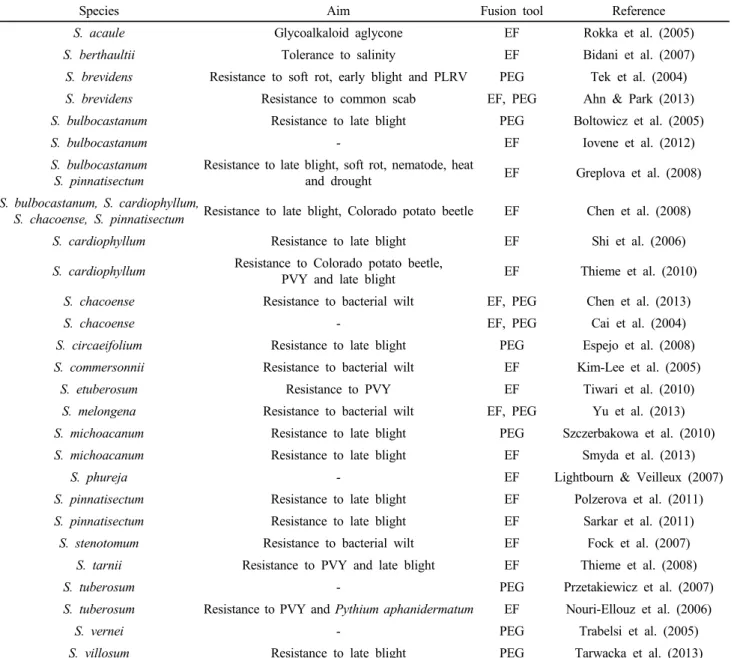
Table 1 Progress in protoplast fusion in potato during the last decade (2004-2013)
Species Aim Fusion tool Reference
S. acaule Glycoalkaloid aglycone EF Rokka et al. (2005)
S. berthaultii Tolerance to salinity EF Bidani et al. (2007)
S. brevidens Resistance to soft rot, early blight and PLRV PEG Tek et al. (2004)
S. brevidens Resistance to common scab EF, PEG Ahn & Park (2013)
S. bulbocastanum Resistance to late blight PEG Boltowicz et al. (2005)
S. bulbocastanum - EF Iovene et al. (2012)
S. bulbocastanum S. pinnatisectum
Resistance to late blight, soft rot, nematode, heat
and drought EF Greplova et al. (2008)
S. bulbocastanum, S. cardiophyllum,
S. chacoense, S. pinnatisectum Resistance to late blight, Colorado potato beetle EF Chen et al. (2008)
S. cardiophyllum Resistance to late blight EF Shi et al. (2006)
S. cardiophyllum Resistance to Colorado potato beetle,
PVY and late blight EF Thieme et al. (2010)
S. chacoense Resistance to bacterial wilt EF, PEG Chen et al. (2013)
S. chacoense - EF, PEG Cai et al. (2004)
S. circaeifolium Resistance to late blight PEG Espejo et al. (2008)
S. commersonnii Resistance to bacterial wilt EF Kim-Lee et al. (2005)
S. etuberosum Resistance to PVY EF Tiwari et al. (2010)
S. melongena Resistance to bacterial wilt EF, PEG Yu et al. (2013)
S. michoacanum Resistance to late blight PEG Szczerbakowa et al. (2010)
S. michoacanum Resistance to late blight EF Smyda et al. (2013)
S. phureja - EF Lightbourn & Veilleux (2007)
S. pinnatisectum Resistance to late blight EF Polzerova et al. (2011)
S. pinnatisectum Resistance to late blight EF Sarkar et al. (2011)
S. stenotomum Resistance to bacterial wilt EF Fock et al. (2007)
S. tarnii Resistance to PVY and late blight EF Thieme et al. (2008)
S. tuberosum - PEG Przetakiewicz et al. (2007)
S. tuberosum Resistance to PVY and Pythium aphanidermatum EF Nouri-Ellouz et al. (2006)
S. vernei - PEG Trabelsi et al. (2005)
S. villosum Resistance to late blight PEG Tarwacka et al. (2013)
* All species were fused with S. tuberosum.
* Aim indicated with ‘-‘ was not precisely reported in the reference.
* For fusion methods, EF and PEG indicate using electrofusion and polyethylene glycol as fusion agent, respectively.
원형질체 융합을 이용한 감자의 육종
생식세포의 융합(유성생식 잡종, sexual hybridization)에 반대적 개념이라고 할 수 있는 체세포 융합은 종내 또는 종간 두 개의 서로 다른 전체 게놈을 합치기 위한 시도로 체세포로부터 분리된 두 가지의 원형질체를 무성적으로 융합(무성생식 잡종, asexual hybridization)하는 방법이다.
이러한 방법은 감자의 육종에서 유성적 융합(교잡에 의 한 고전적 육종) 과정에서 나타나는 불화합성과 주요한 형질의 도입을 위해 이용되는 이배체 야생종과 재배종 감자의 EBN 차이에 의한 유성적 융합의 제한을 극복하
기 위한 방법으로 이용되고 있다. 즉, 원형질체 융합은 이배체와 재배종 감자의 이배성 반수체(dihaploid)로부터 새로운 사배체(tetraploid) 유전자원을 새롭게 창출하는 과 정에서 많이 이용된다.
감자에서의 원형질체 융합
감자의 원형질체 융합에는 약 3-4주 간 기내에서 배양된 식물체가 이용되고 있으며, 원형질체 분리를 위해서는 효소 처리에 의한 세포벽 제거 방법이 주고 이용되고 있 다. 융합의 방법에는 앞서 언급한 바와 같이 전기적 방법
과 PEG를 이용한 화학적 방법이 이용되고 있으나, Table 1에서 제시된 바와 같이 전기적 방법이 더욱 보편적으로 이용되고 있다. 전기적 방법에 의한 실험법(Thieme et al.
2008; Symda et al. 2013)과 PEG를 이용한 화학적 방법에 의한 실험법(Trabelsi et al. 2005; Espejo et al. 2008)은 각각 의 문헌에 제시된 바와 같이 비교적 자세히 기술되어 있 으며, 그 방법에 있어서 연구자에 따라 약간의 차이를 보 이나 대다수의 연구에서 보편적으로 이용되고 있다.
감자 체세포융합의 가장 중요한 목표는 재배종 감자가 가지고 있지 않은 병저항성, 환경스트레스 내성과 같은 주요 형질을 야생종으로부터 도입하는 것이다. 이를 달 성하기 위한 가장 효과적인 방법으로는 이배체의 야생종 과 이배성 반수체 감자의 대칭적 융합이 가장 많이 이용 되다. 이러한 방법은 추가적인 염색체의 배가 과정을 거 치지 않고 바로 사배체를 육성할 수 있게 한다. 이후 야 생종으로부터 유래된 원하지 않는 유전적 특성을 배제시 키기 위해서는 추가적인 여교배(backcross)가 요구된다.
하지만 여기서 요구되는 여교배 세대는 2-3세대로 제한 된 반면 고전육종에 의해 융합이 이루어질 경우에는 6-7 세대까지 이루어져야 하는 것을 감안하면 매우 효율적이 라 할 수 있다.
1960년대 초 Chase (1963)는 감자의 육종에서 사배체를 대신하여 이배성 반수체를 이용하는 것을 제안하였다.
이후 이는 감자육종 프로그램에서 체세포융합 기술이 새 로운 품종을 육성하기 위한 효율적 수단이 될 수 있게 하 였다(Frei et al. 1998). 앞서 서론에서 언급했던 바와 같이, 감자에서 원형질체를 이용한 체세포 잡종 생산이 1970년 대에 성공적으로 이루어진 이후 다양한 야생종을 대상으 로 여러 유용형질들을 감자에 도입하고자 하는 시도가 이루어지고 있다. 하지만 최근 약 10년여 간 이루어진 감 자 원형질체 융합 사례를 보면(Table 1), 유용형질 도입을 위해 이용된 야생종의 수가 제한적이며, 대다수의 도입 형질이 역병저항성을 대표적으로 한 병저항성에 국한되 어 있음을 확인할 수 있다. 또한 이러한 방법을 적용하여 새로운 감자품종을 육성하는 것이 감자 육종가들과 상업 적인 감자 육종기업에 의해 받아들여지기 까지는 많은 시간이 걸렸으며, 유럽과 미국의 감자 육종회사에서 원 형질체 융합을 통하여 성공적인 감자품종 육성이 이루어 지고 있음에도 불구하고, 최근 한국에서 체세포 잡종법 을 이용하여 감자 품종을 육성한 예가 있으나(Kim et al.
2013), 한국을 포함한 중국, 인도 등과 같은 대다수의 개 발도상국 국가에서는 그다지 많이 이용되고 있지 않다.
따라서 원형질체를 이용한 체세포잡종의 육성과 고전육 종 방법의 조합은 여전히 성공적인 감자품종 육성의 기 회가 되고 있으며, 이를 통한 지속적인 감자의 생산성 증 가와 재배종 감자의 유전적 다양성을 확보하는 기회를 제공할 것이다.
감자 체세포 융합의 문제점 및 전망
체세포 융합은 다양하고 폭넓은 유전자원을 대상으로 유 전적 기능을 결합하고자 하는 매우 정교한 방법이라 할 수 있다. 여기에는 원형질체의 분리, 융합, 배양, 재분화, 선발, 체세포잡종의 형질 평가 등을 필요로 하며 이를 이 용한 감자육종에는 육성된 체세포잡종 재료를 육종프로 그램으로 도입하는 것이 필요하다. 이를 위해 무엇보다 도 효율적이고 효과적인 체세포 융합을 위해서는 많은 비용과 시간이 필요할 뿐 만 아니라 장비와 기술을 필요 로 한다. 가장 중요한 제한적인 요인으로는 원형질체의 분 리와 배양 및 재분화 과정에서의 유전자형 효과(genotype effects)이다(Rokka 2009). 감자의 원형질체 융합에 대한 다 양한 정보가 생산되고 있으나, 여전히 그 방법적인 측면 에서는 경험에 의존하는 경우가 많다. 지금까지 많은 수 의 계통들에 반복적으로 적용할 수 있는 유전자형에 독 립적으로 실험이 가능한 융합법이나 재분화 방법이 확립 되어 있지 않다. 융합법의 경우 최근까지도 여전히 PEG 를 이용한 화학적 융합법과 전기적 융합법이 거의 이용 되고 있으나(Table 1), 이 중 전기적 융합법의 사용 빈도 가 더 많으며, 이는 두 가지의 방법을 비교해 볼 때 융합 효율적인 측면에는 큰 차이를 보이지 않으나, 융합 이후 의 세포성장과 캘러스의 분화 등에서 전기적 융합법이 더 나은 결과를 보이기 때문인 것으로 사료된다(Cai et al.
2004). 결론적으로 원형질체의 분리, 융합, 배양, 재분화 실험 방법에 대해서는 유전자형에 따라 여전히 최적화 과정이 필요하며, 많은 노동력과 자원을 필요로 한다.
추가적인 문제점으로는 원형질체 융합체에 대한 빠르고 효율적인 선발에 관한 것으로 대다수의 융합 실험에서 표면적으로 쉽게 구별이 가능한 형태적 표지인자가 없어, 실질적인 육종 프로그램에서 각각의 목적에 따른 제한적 인 방법이 적용되고 있다. Table 2에 나타난 바와 같이, DNA 분자표지를 이용한 방법과 세포유전학적 방법이 많 이 이용되고 있으며, 대부분의 연구에서는 복수의 방법 을 선택하여 활용하고 있다. 다만 최근 10여년 전체적인 흐름을 고려해 볼 때, 감자의 전체 유전체 해독이 완료되 고(The Potato Genome Sequencing Consortium 2011) 체세포 잡종 선발과 특성 구명에 많은 이점이 있는 DNA 기반의 분자표지 기술의 활용 빈도가 더 많은 것을 확인할 수 있 다. 그러나 이 또한 분석을 위해서는 체세포 잡종 개체들 을 대상으로 재분화하는데 소요되는 시간이 길다는 점과 분자표지 분석에 필요한 충분한 재료의 양적 확보를 위 하여 잡종 개체들을 무균상태에서 어느 정도 일정기간 지속적인 유지 및 증식이 필요하다는 것이다.
마지막으로 원형질체를 이용한 체세포 융합, 잡종은 고전육종이나 유전자 변형을 통한 GM 품종 육성에 대해
Table 2 Approaches for somatic hybrid selection or characterization used during the last decade (2004-2013)
Tools References
Isozyme analysis Trabelsi et al. (2005), Nouri-Ellouz et al. (2006)
Flow cytometry analysis Cai et al. (2004), Tek et al. (2004), Trabelsi et al. (2005), Bidani et al. (2007), Greplova et al. (2008), Thieme et al. (2010), Tiwari et al. (2010), Polzerova et al. (2011), Sarkar et al.
(2011), Ahn & Park (2013), Yu et al. (2013)
Chromosome counting Tek et al. (2004), Boltowicz et al. (2005), Nouri-Ellouz et al. (2006), Shi et al. (2006), Przetakiewicz et al. (2007), Chen et al. (2008), Espejo et al. (2008), Szczerbakowa et al. (2010), Ahn & Park (2013), Tarwacka et al. (2013), Yu et al. (2013)
SSR marker Cai et al. (2004), Tek et al. (2004), Trabelsi et al. (2005), Nouri-Ellouz et al. (2006), Bidani et al. (2007), Lightbourn & Veilleux (2007), Thieme et al. (2010), Tiwari et al. (2010), Polzerova et al. (2011), Sarkar et al. (2011), Iovene et al. (2012), Ahn & Park (2013), Chen et al. (2013), Smyda et al. (2013), Yu et al. (2013)
AFLP marker Tek et al. (2004), Thieme et al. (2010), Ahn & Park (2013)
RAPD marker Cai et al. (2004), Boltowicz et al. (2005), Rokka et al. (2005), Trabelsi et al. (2005), Shi et al. (2006), Przetakiewicz et al. (2007), Chen et al. (2008), Espejo et al. (2008), Greplova et al. (2008), Szczerbakowa et al. (2010), Tiwari et al. (2010), Polzerova et al. (2011), Sarkar et al. (2011), Ahn & Park (2013), Smyda et al. (2013), Tarwacka et al. (2013)
RFLP marker Tek et al. (2004), Przetakiewicz et al. (2007)
CAPS/SCAR marker Nouri-Ellouz et al. (2006), Sarkar et al. (2011), Smyda et al. (2013), Yu et al. (2013) DNA sequence analysis Bidani et al. (2007)
Fluorescence in situ hybridization
(FISH) Tek et al. (2004)
Genomic in situ hybridization (GISH) Tek et al. (2004), Iovene et al. (2012), Tarwacka et al. (2013), Yu et al. (2013)
대체가 되는 방법을 의미하는 것은 아니다. 앞서 언급한 바와 같이, 원형질체 융합을 통하여 얻어진 체세포 잡종 개체는 지속적인 선발과 여교잡과 같은 고전적 육종 방 법이 적용되어야 한다. 이 뿐 만 아니라, 앞으로는 형질전 환 방법까지도 여기에 함께 적용하여 유전자 집적(gene pyramiding, gene stacking)의 목표를 달성하는데 도움이 되 어 다양한 형질에 대해 우수한 형질을 보유한 우량한 감 자 품종을 육성할 수 있을 것이다.
결 론
원형질체를 이용한 체세포잡종 육성은 다양한 유전체적 조합을 통해 새로운 계통을 육성할 수 있는 육종의 한 방 법이라 할 수 있다. 이는 다른 다양한 육종 방법과 비교 해 보았을 때 매우 다른 특성을 지니고 있다. 기본적으로 는 불화합성 유전자원의 좋은 형질을 한 개체로 모을 수 있다는 장점을 가지고 있으며, 특히 형질전환 방법을 이 용한 육종과 비교했을 때 클로닝되지 않은 다양한 유전 자를 도입할 수 있는다는 측면과 형질전환에 의해 생산 된 GM작물에 대한 사회적, 정치적 반감을 회피할 수 있 다는 등의 다양한 장점을 가지고 있다. 하지만 체세포잡 종에 의해 일반적으로 나타나는 현상이라고 할 수 있는 불화합성 유전자원 간의 융합에 따른 염색체 재배열, 염
색체 배수성화에 따른 불안정한 임성, 융합 이후의 낮은 식물체 재분화 효율 등과 같은 문제점을 여전히 가지고 있다. 따라서 앞으로의 연구는 원형질체 융합을 통하여 발생하는 이러한 문제점들을 개선할 뿐 만 아니라, 불화 합성을 이유로 형질도입이 어려웠던 유전자원을 활용하 여 농업적으로 중요한 더욱 더 다양한 형질들을 도입하 고 선발할 수 있는 육종이 이루어져야 할 것이다.
사 사
본 연구는 농림축산식품부, 해양수산부, 농촌진흥청, 산 림청 Golden Seed 프로젝트(세부과제명: 수출용 감자 품 종 육성 효율 증진을 위한 분자표지 및 유용 유전자 개 발, 세부과제번호: 213001-04-2-SB540) 및 농촌진흥청 연 구사업(세부과제명: 감자 육종능력 증진을 위한 감자 유 전자원 관리, 세부과제번호: PJ008573042014)에 의해 이 루어진 것임
References
Ahn YK, Kim HY, Choi, HS, Kim K-T, Park HG (2001a) Production of interspecific somatic hybrids between the cultivated potato (Solanum tuberosum) and the wild species
(S. brevidens). J Korean Soc Hort Sci 24:420-424
Ahn YK, Kang JC, Kim HY, Lee SD, Park HG (2001b) Resistance to blackleg and tuber soft rot in interspecific somatic hybrids between S. brevidens and S. tuberosum (‘Superior’, ‘Dejima, and dihaploid of ‘Superior’). J Korean Soc Hort Sci 24:
430-434
Ahn Y-K, Ghislain M, Choi H-S, Park H-G (2002) Selection of somatic hybrids of potato using molecular marker and chloroplast number. Korean J Breed 34:188-194
Ahn YK, Park T-H (2013) Resistance to common scab developed by somatic hybrids between Solanum brevidens and Solanum tuberosum. Acta Agric Scand Sect B-Soil & Plant Sci 63:
595-603
Bidani A, Nouri-Ellouz O, Lakhoua L, Sihachakr D, Cheniclet C, Mahjoub A, Drira N, Gargouri-Bouzid R (2007) Interspecific potato somatic hybrids between Solanum berthaultii and Solanum tuberosum L. showed recombinant plstome and improved tolerance to salinity. Plant Cell Tiss Organ Cult 91:
179-189
Binding H, Nehls R, Schieder O, Sopory SK, Wenzel G (1978) Regeneration of mesophyll protoplasts isolated from dihaploid clones of Solanum tuberosum L. Physiol Plant 43:52-54 Boltowicz D, Szczerbakowa A, Wielgat B (2005) RAPD analysis
of the interspecific somatic hybrids Solanum bulbocastanum (+) S. tuberosum. Cell Mol Biol Lett 10:151-162
Cai X, Liu J, Xie C (2004) Mesophyll protoplast fusion of Solanum tuberosum and Solanum chacoense and their somatic hybrid analysis. Acta Hort Sinica 31:623-626
Carlson PS, Smith HH, Dearing RD (1972) Parasexual interspecific plant hybridization. Proc Natl Acad Sci USA 69:2292-2294 Cardi T, Amborsio FD, Consoli D, Puite KJ, Ramulu KS (1993)
Production of somatic hybrids between frost-tolerant Solanum commersonii and S. tuberosum: characterization of hybrid plants. Theor Appl Genet 87:193-200
Chase SS (1963) Analytical breeding scheme in Solanum tuberosum L.- A scheme utilizing parthenotes and other diploid stocks.
Can J Genet Cytol 5:359-363
Chen Q, Li HY, Shi YZ, Beasley D, Bizimungu B, Goettel MS (2008) Development of an effective protoplast fusion system for production of new potatoes with disease and insect resistance using Mexican wild potato species as gene pools.
Can J Plant Sci 88:611-619
Chen L, Guo X, Xie C, He L, Cai X, Tian L, Song B, Liu J (2013) Nuclear and cytoplasmic genome components of Solanum tuberosum + S. chacoense somatic hybrids and three SSR alleles related to bacterial wilt resistance. Theor Appl Genet 126:1861-1872
Cho HM, Kim-Lee HY, Om YH, Kim JK (1997) Influence of endosperm balance number (EBN) in interploidal and inters- pecific crosses between Solanum tuberosum dihaploids and wild species. Korean J Breed 29:154-161
Eeckhaut T, van Laere K, de Riek J, van Huylenbroeck J (2006) Overcoming interspecific barriers in ornamental plant breeding.
In: Teixeira da Silva J (ed), Floriculture, Ornamental and Plant Biotechnology: Advances and Topical Issues, Global Science
Books, London, pp 540-551
Eeckhaut T, Lakshmanan PS, Deryckere D, van Bockstaele E, van Huylenbroeck J (2013) Progress in plant protoplast research.
Planta 238:991-1003
Espejo R, Cipriani G, Rosel G, Golmirzaie A, Roca W (2008) Somatic hybrids obtained by protoplast fusion between Solanum tuberosum L. subsp. tuberosum and the wild species Solanum circaeifolium Bitter. Rev Peru Biol 15:73-78 Fock I, Collonnier C, Lavergne D, Vaniet S, Ambroise A, Luisetti
J, Kodja H, Sihachakr D (2007) Evaluation of somatic hybrids of potato with Solanum stenotomum after a long-term in vitro conservation. Plant Physiol Biochem 45:209-215
Frei U, Stattmann M, Lőssel and Wenzel G (1998) Aspects of fusion combining ability of dihaploid Solanum tuberosum L.:
Influence of the cytoplasm. Potato Res 41:155-162
Gamborg OL (2002) Plant tissue culture. Biotechnology. Milestones.
In Vitro Cell Dev Biol Plant 38:84-92
Gancle A, Grimplet J, Sauvage F, Ollitrault P, Brillouet J (2006) Pre-dominant expression of diploid mandarin leaf proteome in two citrus mandarin-derived somatic allotetraploid hybrids.
J Agr Food Chem 54:6212-6218
Greplová M, Polzerová, Vlastníková H (2008) Electrofusion of protoplasts from Solanum tuberosum, S. bulbocastanum and S. pinnatisectum. Acta Physiol Plant 30:787-796
Helgeson JP, Kaberlach GT (1999) Somatic hybrids of Solanum tuberosum and related species. In: Altman A, Ziv M, Izhar S (eds), Plant biotechnology and in vitro biology in the 21st century, Kluwer, Dordrecht, pp 151-154
Iovene M, Aversano R, Savarese S, Caruso I, Di Matteo A, Cardi T, Frusciante L, Carputo D (2012) Interspecific somatic hybrids between Solanum bulbocastanum and S. tuberosum and their haploidization for potato breeding. Bio Plant 56: 1-8 Jansky S (2000) Breeding for disease resistance in potato. In:
Janick J (ed), Plant breeding reviews, Wiley, New York, pp 69-155
Jiang L, Cai Y, Xia G, Xiang F (2012) Introgression of the heterologous nuclear DNAs and efficacious compositions from Swertia tetraptera Maxim. into Bupleurum scorzonerifolium Willd. via somatic hybridization. Protoplasma 249:737-745 Kim SR, Ahn YK, Kim TG, Kang HS, Song SW, Kim BC, Kang
SG (2013) Breeding of a new cultivar ‘Jeseo’ with resistance to common scab. Kor J Breed Sci 45:468-473
Kim-Lee H, Moon JS, Hong YJ, Kim MS, Cho HM (2005) Bacterial wilt resistance in the progenies of the fusion hybrids between haploid of potato and Solanum commersonii. Amer J of Potato Res 82:129-137
Lakshmanan PS, Eeckhaut T, Deryckere D, van Bockstaele E, van Huylenbroeck J (2013) Asymmetric somatic plant hybridization:
Status and applications. Amer J Plant Sci 4:1-10
Lian Y, Lin G, Zhao X, Lim H (2011) Production and genetic characterization of somatic hybrids between leaf mustard (Brassica juncea) and broccoli (Brassica oleracea). In Vitro Cell Dev Plant 47:289-296
Lightbourn GJ, Veilleux RE (2007) Production and evaluation of somatic hybrids derived from monoploid potato. Amer J of
Potato Res 84:425-435
Liu J, Xu X, Deng X (2005) Intergeneric somatic hybridization and its application to crop genetic improvement. Plant Cell Tiss Org Cult 82:19-44
Liu C, Li S, Wang M, Xia G (2012) A transcriptomic analysis reveals the nature of salinity tolerance of a wheat introgression line. Plant Mol Biol 78:159-169
Melchers G, Sacristan MD, Holder AA (1978) Somatic hybrid plants of potato and tomato regenerated from fused protoplasts.
Carlsberg Res Comm 43:203-218
Nouri-Ellouz O, Gargouri-Bouzid R, Sihachakr D, Triki MA, Ducreux G, Drira N, Lakhoua L (2006) Production of potato intraspecific somatic hybrids with improved tolerance to PVY and Pythium aphanidermatum. J Plant Physiol 163:1321-1332 Olivares-Fuster O, Duran-Vila N, Navarro L (2005) Electrochemical
protoplast fusion in Citrus. Plant Cell Rep 24:112-119 Ortiz R, Ehlenfeldt MK (1992) The importance of endosperm
balance number in potato breeding and the evolution of tuber-bearing Solanum species. Euphytica 1992:105-113 Patel D, Power J, Anthony P, Badakshi F, Heslop-Harrison J,
Davey M (2011) Somatic hybrid plants of Nicotiana x sanderae + N. debneyi with fungal resistance to Peronospora tabacina. Ann Bot 108:809-819
Polzerová H, Patzak J, Greplová M (2011) Early characterization of somatic hybrids from symmetric protoplast electrofusion of Solanum pinnatisectum Dun. and Solanum tuberosum L. Plant Cell Tiss Organ Cult 104:163-170
Przetakiewicz J, Nadolska-Orczyk A, Kuć D, Orczyk W (2007) Tetraploid somatic hybrids of potato (Solanum tuberosum L.) obtained from diploid breeding lines. Cell Mol Biol Lett 12:
253-267
Razdan M (2003) Somatic hybridization. In: Razdan M (ed), Introduction to plant tissue culture, Science Publishers, Enfield, pp 147-175
Rokka V-M (2009) Potato haploids and breeding. In: Touraev A, Forster BP, Jain SM (eds), Advances in haploid production in higher plants, Springer Science + Business Media B.V., Dordrecht, pp 199-208
Rokka V-M, Laurila J, Tauriainen A, Laakso I, Larkka J, Metzler M, Pietilä (2005) Glycoalkaloid aglycone accumulations associated with infection by Clavibacter michiganensis ssp.
sepedonicus in potato species Solanum acaule and Solanum tuberosum and their interspecific somatic hybrids. Plant Cell Rep 23:683-691
Sarkar D, Tiwari J, Sharma S, Sharma Poonam S, Gopal J, Singh B, Luthra S, Pandey S, Pattanayak D (2011) Production and characterization of somatic hybrids between Solanum tuberosum L. and S. pinnatisectum Dun. Plant Cell Tiss Org Cult 107:427-440
Shepard JP, Totten RE (1977) Mesophyll cell protoplasts of potato.
Isolation, proliferation, and plant regeneration. Plant Physiol 60:313-316
Shi YZ, Chen Q, Li HY, Beasley D, Lynch DR (2006) Somatic hybridization between Solanum tuberosum and S. cardiophyllum.
Can J Plant Sci 86:539-545
Smyda P, Jakuczun H, Dębski K, Śliwka J, Thieme R, Nachtigall M, Wasilewicz-Flis I, Zimnoch-Guzowska E (2013) Development of somatic hybrids Solanum x michoacanum Bitter. (Rydb.) (+) S. tuberosum L. and autofused 4x S. x michoacanum plants as potential sources of late blight resistance for potato breeding. Plant Cell Rep 32:1231-1241
Szczerbakowa A, Tarwacka J, Oskiera M, Jakuczun H, Wielgat B (2010) Somatic hybridization between the diploids of S. x michoacanum and S. tuberosum. Acta Physiol Plant 32:
867-873
Tarwacka J, Polkowska-Kowalczyk L, Kolano B, Śliwka J, Wielgat B (2013) Interspecific somatic hybrids Solanum villosum (+) S. tuberosum, resistance to Phytophthora infestans. J Plant Physiol 170:1541-1548
Tek AL, Stevenson WR, Helgeson JP, Jiang J (2004) Transfer of tuber soft rot and early blight resistances from Solanum brevidens into cultivated potato. Theor Appl Genet 109:
249-254
The Potato Genome Sequencing Consortium (2011) Genome sequence and analysis of the tuber crop potato. Nature 475:
189-197
Thieme R, Rakosy-Tican E, Gavrilenko T, Antonova O, Schubert J, Nachtigall M, Heimbach U, Thieme T (2008) Novel somatic hybrids (Solanum tuberosum L. + Solanum tarnii) and their fertile BC1 progenies express extreme resistance to potato virus Y and late blight. Theor Appl Genet 116:691-700 Thieme R, Rakosy-Tican E, Nachtigall M, Schubert J, Hammann
T, Antonova O, Gavrilenko T, Heimbach U, Thieme T (2010) Characterization of the multiple resistance traits of somatic hybrids between Solanum cardiophyllum Lindl. and two commercial potato cultivars. Plant Cell Rep 29:1187-1201 Tiwari JK, Poonam, Sarkar D, Pandey SK, Gopal J, Kumar SR
(2010) Molecular and morphological characterization of somatic hybrids between Solanum tuberosum L. and S. etuberosum Lindl. Plant Cell Tiss Organ Cult 103:175-187
Trabelsi S, Gargouri-Bouzid R, Vedel F, Nato A, Lakhoua L, Drira N (2005) Somatic hybrids between potato Solanum tuberosum and wild species Solanum vernei exhibit a recombination in the plastome. Plant Cell Tiss Org Cult 83:1-11
Wang L, Pan Z, Guo W (2010) Proteomic anlaysis of leaves from a diploid cybrid produced by protoplast fusion between Satsuma mandarin and pummelo. Plant Cell Tiss Org Cult 103:165-174
Wang GX, Tang Y, Yan H, Sheng XG, Hao WW, Zhang L, Lu K, Liu F (2011a) Production and characterization of interspecific somatic hybrids between Brassica oleracea var. botrytis and B. nigra and their progenies for the selection of advanced pre-breeding materials. Plant Cell Reports 30:1811-1821 Wang J, Zhao C, Liu C, Xia G, Xiang F (2011b) Introgression of
Swertia mussotii gene into Bupleurum scorzonerifolium via somatic hybridization BioMedCentral Plant Biol 11:71 Wang M, Peng Z, Hong S, Zhi D, Xia G (2012) Hybrid
inflorescences derived from gamma-fusion of Arabidopsis thaliana with Bupleurum scorzonerifolium. Protoplasma 249:
197-205
Wang X, Zhou J, Yang Y, Yu F, Chen J, Yu C, Wang F, Cheng Y, Yan C, Chen J (2013) Transcriptome analysis of a progeny of somatic hybrids of cultivated rice (Oryza sativa L.) and wild rice (Oryza meyeriana L.) with high resistance to bacterial blight. J Phyto Pathol 161:324-334
Xia G (2009) Progress of chromosome engineering mediated by asymmetric somatic hybridization. J Genet Genomics 36:
547-556
Xu XY, Hu ZY, Li JF, Liu JH, Deng XX (2007) Asymmetric somatic hybridization between UV-irradiated Citrus unshiu and C. sinensis: Regeneration and characterization of hybrid shoots. Plant Cell Rep 26:1263-1273
Yu Y, Li Z, Wang P, Xiang F (2012a) Genetic and biochemical characterization of somatic hybrids between Bupleurum scorzonerifolium and Gentianopsis paludosa. Protoplasma 249:1029-1035
Yu X, Chu B, Liu R, Sun J, Brian J, Wang H, Shuijin Z, Sun Y (2012b) Characteristics of fertile somatic hybrids of G.
hirsutim L. and G. trilobum generated via protoplast fusion.
Theor Appl Genet 125:1503-1516
Yu Y, Ye W, He L, Cai X, Liu T, Liu J (2013) Introgression of bacterial wilt resistance from eggplant to potato via protoplast fusion and genome components of the hybrids. Plant Cell Rep 32:1687-1701