• 검색 결과가 없습니다.

Clinical Features of Deep Neck Infections and Predisposing Factors for Mediastinal Extension

N/A
N/A
Protected

Academic year: 2021

Share "Clinical Features of Deep Neck Infections and Predisposing Factors for Mediastinal Extension"

Copied!
6
0
0

로드 중.... (전체 텍스트 보기)

전체 글

(1)

http://dx.doi.org/10.5090/kjtcs.2012.45.3.171 ISSN: 2233-601X (Print) ISSN: 2093-6516 (Online)

1

Department of Thoracic and Cardiovascular Surgery, Chungnam National University Hospital, Chungnam National University School of Medicine,

2

Department of Otorhinolaryngology, Chungnam National University Hospital, Chungnam National University School of Medicine

†This study was financially supported by research fund of Chungnam National University in 2010.

Received: October 14, 2011, Revised: October 20, 2011, Accepted: October 22, 2011

Corresponding author: Seung Pyung Lim, Department of Thoracic and Cardiovascular Surgery, Chungnam National University Hospital, Chungnam National University School of Medicine, 282 Munhwa-ro, Jung-gu, Daejeon 301-721, Korea

(Tel) 82-42-280-7376 (Fax) 82-42-280-7373 (E-mail) [email protected]

C

The Korean Society for Thoracic and Cardiovascular Surgery. 2012. All right reserved.

CC

This is an open access article distributed under the terms of the Creative Commons Attribution Non-Commercial License (http://creative- commons.org/licenses/by-nc/3.0) which permits unrestricted non-commercial use, distribution, and reproduction in any medium, provided the original work is properly cited.

Clinical Features of Deep Neck Infections and Predisposing Factors for Mediastinal Extension

Shin Kwang Kang, M.D.

1

, Seokkee Lee, M.D.

1

, Hyun Kong Oh, M.D.

1

,

Min-Woong Kang, M.D., Ph.D.

1

, Myung Hoon Na, M.D., Ph.D.

1

, Jae Hyeon Yu, M.D., Ph.D.

1

, Bon Seok Koo, M.D., Ph.D.

2

, Seung Pyung Lim, M.D., Ph.D.

1

Background: Deep neck infections (DNI) can originate from infection in the potential spaces and fascial planes of the neck. DNI can be managed without surgery, but there are cases that need surgical treatment, especially in the case of mediastinal involvement. The aim of this study is to identify clinical features of DNI and analyze the pre- disposing factors for mediastinal extension. Materials and Methods: We reviewed medical records of 56 patients suffering from DNI who underwent cervical drainage only (CD group) and those who underwent cervical drainage combined with mediastinal drainage for descending necrotizing mediastinitis (MD group) from August 2003 to May 2009 and compared the clinical features of each group and the predisposing factors for mediastinal extension.

Results: Forty-four out of the 56 patients underwent cervical drainage only (79%) and 12 patients needed both cervical and mediastinal drainage (21%). There were no differences between the two groups in gender (p=0.28), but the MD group was older than the CD group (CD group, 44.2±23.2 years; MD group, 55.6±12.1 years;

p=0.03). The MD group had a higher rate of co-morbidity than the CD group (p=0.04). The CD group involved more than two spaces in 14 cases (32%) and retropharyngeal involvement in 12 cases (27%). The MD group in- volved more than two spaces in 11 cases (92%) and retropharyngeal involvement in 12 cases (100%). Organism identification took place in 28 cases (64%) of the CD group and 3 cases of (25%) the MD group (p=0.02). The mean hospital stay of the CD group was 21.5±15.9 days and that of the MD group was 41.4±29.4 days (p=0.04).

Conclusion: The predisposing factors of mediastinal extension in DNI were older age, involvement of two or more spaces, especially including the retropharyngeal space, and more comorbidities. The MD group had a longer hospi- tal stay, higher mortality, and more failure to identify causative organisms of causative organisms than the CD group.

Key words: 1. Infection 2. Neck 3. Mediastinitis

INTRODUCTION

Deep neck infections (DNI) can originate from infection in

the potential spaces and fascial planes of the neck. The pri-

mary origin of DNI is unknown in most cases, but it can be

caused by dental problems, cervical lymphadenitis, sialoadeni-

(2)

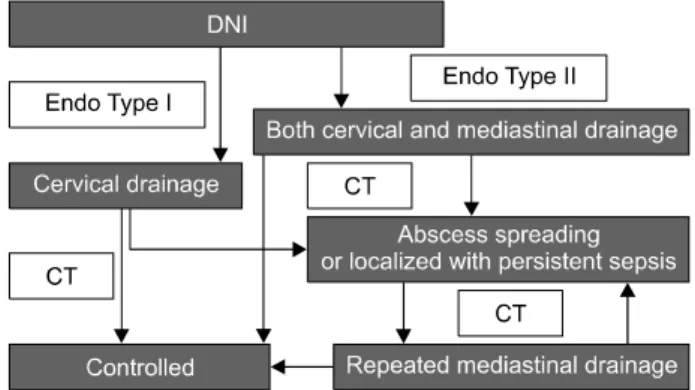
Fig. 1. Algorithm of surgical management for deep neck infections (DNI) and descending necrotizing mediastinitis. CT, computed to- mography.

tis, acute tonsillitis, and peritonsillar abscess [1]. Most pa- tients of DNI can be treated with a broad spectrum of intra- venous antibiotics without complications. However, complica- tions such as airway obstruction in patients with lateral phar- yngeal cavity or peritonsilar abscess, deep vein thrombosis, mediastinitis, pneumonitis, laryngeal edema, and encephalitis can occur [1]. Some DNI require surgical treatment, espe- cially in cases of mediastinal involvement, known as descend- ing necrotizing mediastinitis (DNM). Many acute mediastinal infections result from esophageal perforation or infection fol- lowing a trans-sternal cardiac procedure. However, they may result from oropharyngeal infection spreading along the fas- cial planes into the mediastinum [2-5]. Criteria of diagnosing DNM were clearly established by Estrera in 1983 [2]. These included clinical manifestations such as severe infection, char- acteristic radiology features, necrotizing mediastinal infection revealed at operation or autopsy, and the relationship of or- opharyngeal infection to the development of DNM. Endo et al. [3] classified DNM into three types according to the ex- tension of DNM using computed tomography (CT). Type I is a localized disease above the carina, Type II A is charac- terized by diffuse anterior mediastinal involvement, and Type II B involves both the anterior and posterior mediastinum [3].

We report the surgical results of the cervical drainage group in DNI compared with the group to which mediastinal drainage was added. The clinical features and predisposing factors of DNI progressing to DNM were analyzed.

MATERIALS AND METHODS

The medical records of patients who underwent surgical treatment for DNI and DNM from August 2003 to May 2009 were reviewed retrospectively. Their demographics, etiologies associated with systemic diseases (hypertension, diabetes mel- litus, liver cirrhosis, and chronic renal failure), preoperative condition (sepsis), disease interval, infectious origin, bacteriol- ogy, radiology, duration of hospitalization, and outcomes were reviewed. Sepsis was defined as high fever (>38.2

o

C), unstable vital signs (blood pressure <90 mmHg, respiratory rate >25/min), leucopenia (white blood cell <4,000/mm

3

), thrombocytopenia (platelet <100,000/mm

3

), oliguria (0.5 mL/kg/hr), or prolonged coagulation time (activated partial

thromboplastin time >60 sec or international normalized ra- tio >1.5). In the present article, 56 patients were suffering from DNI; 44 patients received cervical drainage only (CD group) and 12 patients needed both cervical and mediastinal drainage for mediastinal involvement (MD group).

Neck and chest CT scans were performed on all patients clinically suspected of DNI. Shortly after the criteria of Estrera were fulfilled, nil per os and fluid therapy was initiated. Empiric antibiotics, including third-generation cepha- losporin and clindamycin, were administered immediately.

Appropriate antibiotics for causative organisms were given based on the results of culture identification.

Type I DNM was managed with cervical drainage only and Type II DNM was treated with both cervical and mediastinal drainage by Endo’s classification. For the cervical drainage, we used an anterior approach to the DNI and maintained open drainage until the wound was clear. When follow-up CT scans showed that the disease had improved, treatment was terminated. However, when the CT scan showed an abscess spreading or localized persistent septic manifestation, repeated mediastinal drainage was performed. The CT scans were per- formed at the third, seventh, and fourteenth postoperative day routinely, or whenever routine chest X-rays showed abnormal findings (Fig. 1).

All data are expressed as mean±standard deviation. SPSS

ver. 11.5 (SPSS Inc., Chicago, IL, USA) was used to perform

the analysis. Statistical significance was defined as p<0.05.

(3)

Table 1. Bacteriology of the CD group

a)

and MD group

b)

CD group (n=44) MD group (n=12)

Streptococcus 13 (29.5) 3 (25)

Staphylococcus 7 (15.9) 0

Klebsiella 5 (11.4) 0

Pseudomonas 3 (6.8) 0

Not identified 16 (36.4) 9 (75)

Values are presented as number (%).

a)

CD group: cervical drainage only.

b)

MD group: both cervical and mediastinal drainage.

Table 2. Surgical results of the CD group

a)

and MD group

b)

CD group

(n=44)

MD group

(n=12) p-value Sex (female)

Age

Co-morbidity

d)

Disease interval

e)

(day) Infectious origin (dental) Organism identified More than two spaces

involved

Retropharyngeal space involved

Hospital stay (day) Mortality

18 (41) 44.2±23.2

12 (27) 6.8±6.8

5 (11) 28 (64) 14 (32)

12 (27)

21.5±15.9 0

7 (58) 55.6±12.1

7 (58) 6.3±4.0

3 (25) 3 (25) 11 (92)

12 (100)

41.4±29.4 2 (17)

0.28 0.03

c)

0.04

c)

0.79 0.23 0.02

c)

0.00

c)

0.00

c)

0.04

c)

0.01

c)

Values are presented as mean±standard deviation or number (%).

a)

CD group: cervical drainage only.

b)

MD group: both cervical and mediastinal drainage.

c)

Statistically significant.

d)

Hypertension, diabetes mellitus, liver cirrhosis, or chronic re- nal failure.

e)
Duration from initial symptom to admission.

RESULTS

Fifty-six patients with DNI were treated in our institution.

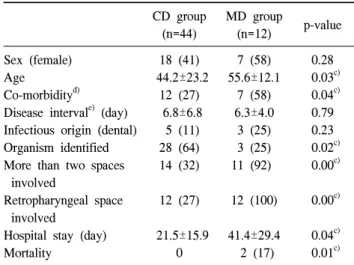
Of those, 44 patients received cervical drainage only (CD group), and 12 patients received both cervical and mediastinal drainage (MD group). The mean age of the CD group, con- sisting of 26 males and 18 females, was 44.2±23.2 years, and the MD group, consisting of 5 males and 7 females, was 55.6±12.1 years. There were no differences between the two groups in gender (p=0.28), but the MD group was older (p=0.03). Preoperative comorbidities were liver cirrhosis, hy- pertension, diabetes mellitus, and chronic renal disease requir- ing regular hemodialysis. The MD group had comorbidity in 7 cases (58%) and the CD group had co-morbidity in 12 cas- es (27%) (p=0.04). The disease interval was similar in both groups (the CD group, 6.8±6.8 days; the MD group, 6.3±4.0 days; p=0.79). The origin of infection for the CD group showed 39 pharyngeal infections (89%) and 5 dental in- fections (11%). The MD group contained 9 pharyngeal in- fections (75%) and 3 dental infections (25%). The difference in the origins of infection between the two groups was not statistically significant (p=0.23). In 28 cases (64%) of the CD group and 3 cases (25%) of the MD group organism identi- fication of the infection was successful. The MD group had more negative identification of causative organisms than the CD group (p=0.02). Causative organisms of the CD group in- fections were 13 cases of Streptococcus (29.5%), 7 of Staphylococcus (15.9%), 5 of Klebsiella (11.5%), and 3 of Pseudomonas (6.8%), while 16 remained unidentified (36.4%) (Tables 1, 2).

The infections of the CD group was involved in two or

more spaces in 14 cases (32%) and had retropharyngeal in- volvement in 12 cases (27%). The infections of the MD group were involved in two or more spaces in 11 cases (92%) and retropharyngeal involvement in 12 cases (100%).

Involvement in two or more spaces, especially the retro- pharyngeal space, indicated a higher risk of mediastinal spreading (p=0.00). The mean hospital stay of the CD group was 21.5±15.9 days and that of the MD group was 41.4±29.4 days. The MD group had a longer hospital stay (p=0.04).

There was no mortality in the CD group but there were 2 cases of mortality (17%) in the MD group (p=0.01) (Table 2).

The two mortalities in the MD group were male, in septic

condition preoperatively, had Type II B disease, and had

Streptococcus identified. The patient who was diagnosed with

DNM 11 days after initial cervical drainage died from mul-

ti-organ failure despite three thoracotomies followed by a me-

dian sternotomy. The other patient’s referral to our institution

was delayed after the onset of symptoms, and he died from

intractable shock.

(4)

DISCUSSION

DNI is caused by pharyngeal infection, odontogenic in- fection, cervical lymphadenitis, parotitis, sinusitis, or cervical trauma [3-6]. The most common cause of DNI is odontogenic infection, arising from the second or third molar. Odontogenic and peritonsillar abscesses can rupture into the submandibular and parapharyngeal spaces. The parapharyngeal space con- nects with all the major fascial spaces [7]. DNI can spread to the mediastinum through four loose connective tissue spaces:

the carotid space, the retropharyngeal space, the prevertebral space, and the retrovisceral space. The retropharyngeal space is bounded by the posterior visceral fascia anteriorly and the alar fascia posteriorly. The prevertebral space is bounded by the prevertebral fascia anteriorly and the vertebral body posteriorly. The most important route of descending infection is the retrovisceral space, lying between the alar fascia and prevertebral fascia [8]. Above all, the retrovisceral space is the space most vulnerable to the extension of oropharyngeal infection to the mediastinum [5,6,9,10], and involvement of two or more spaces is a significant predicting factor for deep neck infection complications [1]. In this study, involving more than two spaces is a predicting factor for DNI spread- ing (p<0.05). The rapid spread of DNI into the mediastinum is facilitated by gravity, respiration, the negative intrathoracic and pleural pressure during inspiration, and the absence of barriers in the fascial planes [4-6,9]. Many studies have shown that coexisting morbidities such as diabetes mellitus (DM), alcoholism, and chronic renal failure can be attributed to the extension of DNI into the mediastinal space [4-6,9].

One study also showed that the presence of coexisting mor- bidities like DM increased the occurrence of complication by more than 5 times [1]. Our study further showed that coexist- ing morbidity is a risk factor for the extension of DNI into the mediastinal space (p<0.05).

History-taking, physical examination, and clinical suspicion are crucial for initial diagnosis of DNM because clear symp- toms may not exist. The interval between the onset of symp- toms and admission is the main reason for delayed diagnosis [4,6]. Simple radiography plays a limited role in diagnosis.

CT can provide high accuracy for the detection and the spread of DNM from DNI [4,6,8,9,11,12]. In 1999, Endo et

al. [3] classified DNM into three types according to the ex- tension of DNM as diagnosed by CT and proposed differ- ential surgical management according to this classification.

Type I is a localized disease above the carina, Type II A is a diffuse disease with anterior mediastinal involvement, and Type II B has both anterior and posterior mediastinal in- volvement. Type I can be managed with transcervical media- stinal drainage. Type II A requires transcervicotomy and me- diastinal drainage through a subxiphoid approach. Type II B should receive treatment through standard thoracotomy [3]. In this article, all the patients of the MD group were Type II B and received thoracotomy. DNM caused by DNI requires ag- gressive medical and surgical management, and surgical man- agement should combine cervical drainage with mediastinal drainage. The primary non-surgical treatment of DNM caused by DNI includes intravenous administration of empirical broad spectrum antibiotics [5,6,9]. In our institution, third-ge- neration cephalosporine and clindamycin were the first-line drugs used for DNI and DNM. Appropriate antibiotics were adapted to the causative organisms based on culture identi- fication. Both aerobic and anaerobic bacteria can be causative organisms of DNI and DNM. The most common pathogen of DNM was mixed aerobic and anaerobic organism although Streptococcus was the most common pathogen [6,7,10,11]. In our study, Streptococcus species were the most common pathogen for DNI and DNM.

A number of surgical approaches have been reported for optimal mediastinal drainage including a transcervical ap- proach and several transthoracic approaches such as thor- acotomy, sternotomy, clamshell incision, a subxiphoid ap- proach, and video-assisted thoracic surgery (VATS) [4,5,11, 13]. Many authors have suggested that transthoracic ap- proaches are mandatory for mediastinal drainage regardless of the level of involvement [11,13,14]. However, some authors have suggested that if DNM is limited to the upper media- stinum, it can be adequately drained using the transcervical approach. Formal thoracotomy should be reserved for cases extending below the plane of the tracheal bifurcation [7].

Median sternotomy and clamshell incision have a possible

risk of osteomyelitis [4,5,11,13]. Some surgeons prefer thor-

acotomy to VATS for several reasons [11,13,14]. Thoracoto-

my tends to be less time-consuming for pleural adhesiolysis

(5)

and provides a tactile sensation for blunt dissection of the paraesophageal space. In our institute, thoracotomy was the standard method for mediastinal approaches. When media- stinal involvement was extensive, bilateral mediastinal drain- age was performed. The mediastinal space was irrigated with warm saline via multiple chest tubes (32 Fr) for very thick and turbid discharge. We did not perform tracheostomy ex- cept when there was a need for prolonged ventilator care.

Thoracoscopic drainage could be useful when the patient is hemodynamically stable, but not under septic conditions [6,9, 14,15]. Follow-up CT was helpful to determine the adequacy of drainage and detect recurrent abscess or progression of DNM [6,9]. A CT scan should be obtained routinely every 48 hours until the disease improves [6,9].

In 1938, Pearse [16] reported the first series of 110 pa- tients with DNM. The mortality rate of DNM is still 20% to 50%, although its incidence is low due to the wide use of antibiotics and improved oral hygiene [4-6,9]. In 1982, Estrera et al. [2] reported on 10 DNI patients who progressed to DNM treated with cervical drainage and mediastinal drain- age, and who showed a 40% mortality rate. The recent re- ported mortality for DNM has been 16.5% to 36% [7,10].

Mortality rates in this study were comparable (17%).

CONCLUSION

Complications in DNI could result in fatal morbidity and mortality in patients with DNM. This article compared DNI patients who progressed to DNM and those who did not.

Among 56 patients, 44 patients underwent cervical drainage only, and 12 patients needed both cervical and mediastinal drainage. Age, co-morbidity, and the number of spaces in- volved, especially the retropharyngeal space, are predicting factors for mediastinal spreading of DNI. The MD group had a longer hospital stay, higher mortality, and more negative identification of causative organisms than the CD group.

Despite appropriate treatment for DNI and DNM, morbidity and mortality rates were not negligible in mediastinal involve- ment.

REFERENCES

1. Lee JK, Kim HD, Lim SC. Predisposing factors of compli- cated deep neck infection: an analysis of 158 cases. Yonsei Med J 2007;48:55-62.

2. Estrera AS, Landay MJ, Grisham JM, Sinn DP, Platt MR.

Descending necrotizing mediastinitis. Surg Gynecol Obstet 1983;157:545-52.

3. Endo S, Murayama F, Hasegawa T, et al. Guideline of sur- gical management based on diffusion of descending necrotiz- ing mediastinitis. Jpn J Thorac Cardiovasc Surg 1999;47:14- 9.

4. Ridder GJ, Maier W, Kinzer S, Teszler CB, Boedeker CC, Pfeiffer J. Descending necrotizing mediastinitis: contempo- rary trends in etiology, diagnosis, management, and out- come. Ann Surg 2010;251:528-34.

5. Marty-Ane CH, Berthet JP, Alric P, Pegis JD, Rouviere P, Mary H. Management of descending necrotizing mediastini- tis: an aggressive treatment for an aggressive disease. Ann Thorac Surg 1999;68:212-7.

6. De Freitas RP, Fahy CP, Brooker DS, et al. Descending ne- crotising mediastinitis: a safe treatment algorithm. Eur Arch Otorhinolaryngol 2007;264:181-7.

7. Wheatley MJ, Stirling MC, Kirsh MM, Gago O, Orringer MB. Descending necrotizing mediastinitis: transcervical dra- inage is not enough. Ann Thorac Surg 1990;49:780-4.

8. Corsten MJ, Shamji FM, Odell PF, et al. Optimal treatment of descending necrotising mediastinitis. Thorax 1997;52:702- 8.

9. Freeman RK, Vallieres E, Verrier ED, Karmy-Jones R, Wood DE. Descending necrotizing mediastinitis: an analysis of the effects of serial surgical debridement on patient mortality. J Thorac Cardiovasc Surg 2000;119:260-7.

10. Yu JH, Lim SP, Lee SK, et al. Clinial analysis of surgical management for descending necrotizing mediastinitis. Korean J Thorac Cardiovasc Surg 2008;41:463-8.

11. Inoue Y, Gika M, Nozawa K, Ikeda Y, Takanami I. Opti- mum drainage method in descending necrotizing mediasti- nitis. Interact Cardiovasc Thorac Surg 2005;4:189-92.

12. Scaglione M, Pinto A, Romano S, Giovine S, Sparano A, Romano L. Determining optimum management of descending necrotizing mediastinitis with CT: experience with 32 cases.

Emerg Radiol 2005;11:275-80.

13. Iwata T, Sekine Y, Shibuya K, et al. Early open thoraco- tomy and mediastinopleural irrigation for severe descending necrotizing mediastinitis. Eur J Cardiothorac Surg 2005;28:

384-8.

14. Marty-Ane CH, Alauzen M, Alric P, Serres-Cousine O,

Mary H. Descending necrotizing mediastinitis. Advantage of

mediastinal drainage with thoracotomy. J Thorac Cardiovasc

Surg 1994;107:55-61.

(6)

15. Min HK, Choi YS, Shim YM, Sohn YI, Kim J. Descending necrotizing mediastinitis: a minimally invasive approach us- ing video-assisted thoracoscopic surgery. Ann Thorac Surg

2004;77:306-10.

16. Pearse HE. Mediastinitis following cervical suppuration. Ann

Surg 1938;108:588-611.

수치

Fig. 1. Algorithm of surgical management for deep neck infections  (DNI) and descending necrotizing mediastinitis
Table 1. Bacteriology of the CD group a)  and MD group b) CD  group  (n=44) MD  group  (n=12) Streptococcus 13  (29.5) 3  (25) Staphylococcus   7  (15.9) 0 Klebsiella   5  (11.4) 0 Pseudomonas   3  (6.8) 0 Not  identified 16  (36.4) 9  (75)

참조

관련 문서