• 검색 결과가 없습니다.

The Association between Sleep Duration and Overweight in a School-Age Population in Seoul

N/A
N/A
Protected

Academic year: 2021

Share "The Association between Sleep Duration and Overweight in a School-Age Population in Seoul"

Copied!
7
0
0

로드 중.... (전체 텍스트 보기)

전체 글

(1)

The Association between Sleep Duration and Overweight in a School-Age Population in Seoul

Sun Mi Shin*

Department of Nursing, Joongbu University, Geumsan, Korea

Background: This study aimed to investigate the association between body mass index standard deviation scores and sleep duration in a school-age population in Seoul.

Methods: By using the secondary data of a sample survey (n=25,182) of the Student Health Examination in 2010, the proportions of those who were overweight (World Health Organization definition of body mass index >1.0 standard deviation score) were identified. The association of overweight with sleep duration was also explored after adjusting for age and for meat and vegetable intake, by using multiple logistic and linear regression analysis.

Results: Only 23.2% of participants slept 8 hours or more per day. The proportions of overweight participants were 34.2% of boys and 19.5% of girls. Significant odds ratios for overweight according to sleep duration (based on ≥8 sleeping hours) were 1.28 (for less than 6 hours), 1.31 (for 6-7 hours), and 1.28 (for 7-8 hours) in boys; and 1.19 (for 6-7 hours) and 1.17 (for 7-8 hours) in girls. Furthermore, significant regression coefficients for standard deviation scores (based on ≥8 sleeping hours) were 0.218 for less than 6 hours, 0.149 for 6-7 hours, and 0.099 for 7-8 hours in boys, and 0.137, 0.101, and 0.079 in girls, respectively.

Conclusion: To prevent and manage overweight, it is necessary to develop a school health policy for ensuring optimal sleep duration in school-age population.

Key words: BMI, Overweight, Sleep, School-age population

Received July 27, 2015 Reviewed August 25, 2015 Accepted February 11, 2016

* Corresponding author Sun Mi Shin

http://orcid.org/0000-0003-4040-6120 Department of Nursing, Joongbu University, 201 Daehak-ro, Chubu- myeon, Geumsan-gun, Chungnam 32713, Korea

Tel: +82-41-750-6255 Fax: +82-41-750-6416

E-mail: [email protected]

INTRODUCTION

Obesity is increasing in the general population due to easily ob- tainable high-calorie foods, abundance of products, and decrease in physical activity associated with the use of latest advancements in modern science. Based on data for the 2010 school-age population in the United States, the incidence of obesity within the past 30 years doubled in children and quadrupled in adolescents. In 2012, more than a third of American children and adolescents were either overweight or obese.

1

Obesity is a state of imbalance caused by ex- cessive caloric intake relative to consumption and results in accumu- lation of fatty tissue.

2,3

Obesity tends to influence an individual’s be- havioral and mental state

4

, causing immediate effects such as a de- crease in self-esteem and activity. It is also associated with long-term

complications in adults such as vascular disease, diabetes, high blood pressure, and tumors. Risk factors for obesity include family history, diet, exercise, and negative lifestyle habits. Preventive measures with respect to these risk factors are the subject of continued research.

An individual spends one-third of his or her life sleeping. In re- cent years, there is an increased interest in the length and quality of sleep as obesity-related variables. Sleep not only restores body func- tion and recharges energy for emotional stability, it also plays an im- portant role in various physiological functions such as weight main- tenance.

5

In particular, sleep has an important influence on a child’s physical growth as well as emotional/behavioral development. In addition, sleep is closely related to a child’s cognitive function, learn- ing, and attention.

6,7

For example, studies have reported that a child with less sleep has a relatively high hyperactivity-impulsivity score

Copyright © 2017 Korean Society for the Study of Obesity

This is an Open Access article distributed under the terms of the Creative Commons Attribution Non-Commercial License (http://creativecommons.org/licenses/by-nc/4.0/) which per-

mits unrestricted non-commercial use, distribution, and reproduction in any medium, provided the original work is properly cited.

(2)

and low cognitive performance compared to a child with more sleep.

8

Moreover, fewer hours of sleep are reported to be related to the obesity and body mass index (BMI) as well as quality of life.

9

Thus, obesity and sleep are important factors to consider regard- ing human health and everyday social adjustment. Internationally, studies have been conducted to determine the relationship between obesity and sleep using various stratifications of a population. Com- pared to international studies, few national studies have been per- formed to evaluate sleep as a causal variable of obesity. In addition, activities that use sleep time to meet health needs have not yet re- ceived significant attention. In this study, the author used the Seoul School Health Examination Standard Survey, which is representa- tive of major metropolitan cities in South Korea, to conduct a re- search study on the relationship between BMI standard deviation scores (SDS) and sleep time in the elementary to high school pop- ulation aged between 6 and 18 years.

METHODS Research materials and subjects

A cross-sectional descriptive study was conducted to identify the association of sleep time with overweight World Health Organiza- tion (WHO) defined as well as BMI SDS in the Seoul school-age population. This study used the secondary data obtained from the 2010 Seoul School Health Examination Standard Survey that was based on school health examination guidelines. The subjects in this study included 25,797 students in elementary, middle, and high school, who were selected using a random sampling method based on the scale of the population (number of schools, number of class- es) and local conditions under consideration. Sex and age-based BMI and BMI SDS were calculated from data for 25,182 subjects aged between 6 and 18 years old, representing 97.6% of the source population.

Data collection and ethical considerations

Raw data of the present study were obtained using a School Health Examination procedural policy model for School Health Examination Standard Survey developed by the Ministry of Educa- tion, Science, and Technology

10

to investigate the health state in the school-age population. In the investigation, physical examination

included actual measurement of height, weight, vision, and hearing.

Health behaviors and symptoms were collected through individual responses to a standardized questionnaire.

Researcher performed an analysis of raw data presented by the Seoul School Health Promotion Center, an institute that analyzes sample surveys for the Seoul School Health examination. At this time, consent was obtained to release and present necessary infor- mation for the development of a school health program based on further analysis. Personal identifiers such as place, name, school, class, and numbers were completely removed from the analysis vari- ables, and individual privacy was protected by performing a group rather than an individual analysis.

Measured variables

From the raw data, variables used in the present study included sex, date of birth, height, weight, meat consumption, vegetable con- sumption, and sleep time. Using subject dates of birth, individual ages as of June 30th, 2010 were calculated. Those less than 5 years and above 19 years were excluded from the study. BMI (kg/m

2

) was calculated by measuring the height and weight, and BMI SDS [(x–μ)/σ] for each individual was calculated against average age- based and sex-based BMI values. Those exceeding BMI SDS 1.0 us- ing the sex and age-specific WHO BMI SDS standards

11

were de- fined as overweight. As a variable of this study, sleep time was classi- fied into 4 categories, and data were obtained based on the answers to the question, “how many hours do you spend sleeping?”: 1) less than 6 hours, 2) 6 to 7 hours, 3) 7 to 8 hours, 4) 8 hours or more.

For dietary habits, data on meat and vegetable consumption were collected from the answers to two questions, “how many times per week do you consume meat (beef, pork, chicken, etc.)” and “how many times per week do you consume vegetables (except kimchi)”, with the following answer choices: 1) none, 2) 1-2 times, 3) 3-5 times, 4) every day.

Analysis method

Descriptive statistics and the Chi-square test were used to con-

firm the proportion of those with WHO-defined overweight in

specific age and sex groups. Odds ratios (ORs) for WHO-defined

overweight according to specific sleep time were calculated in male

and female subjects, using multiple logistic regression analysis that

(3)

controlled for confounding variables of age and consumption of meat and vegetables. Using the same methodology, the influence of sleep time on BMI SDS was analyzed. All analysis was performed with SAS 9.4 (SAS Institute Inc., Cary, NC, USA) and results were presented after excluding missing values for each variable. Statistical significance was reported for P-values less than 0.05.

RESULTS Subject characteristics

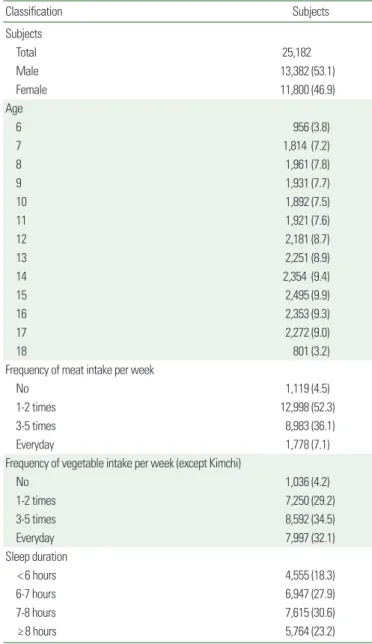
Of the 25,182 study subjects, 13,382 (53.1%) were male and 11,800 (46.9%) were female students. Subject’s ages ranged from 6 to 18 years old. Six-year-old and 18-year-old students comprised 3.8% and 3.2% of total subjects, respectively, and they were relative- ly less represented than other age groups. Weekly intake of meat was reported as none by 4.5% of subjects and 7.1% reported daily in- take. In addition, 4.2% reported no weekly consumption of vegeta- bles excluding kimchi, whereas 32.1% reported daily consumption.

Less than 6 hours of sleep was reported by 18.3% of all students.

Eight hours or more 8 hours of sleep was reported by 23.2% of all students (Table 1).

Proportion with WHO-defined overweight according to sex and age

Respective BMI values of males and females in different age groups based on the WHO standards were as follows: 17.0, 17.3 in 6-year-olds, 21.7, 22.7 in 13-years-olds, and 24.2, 24.5 in 16-year- olds. The percentages of male and female students classified as overweight were as follows: 33.5% and 20.6% of 6-year-olds, 35.7%

and 19.6% of 13-year-olds, and 22.5% and 13.1% of 16-year-olds (Table 2).

ORs for overweight according to sleep time

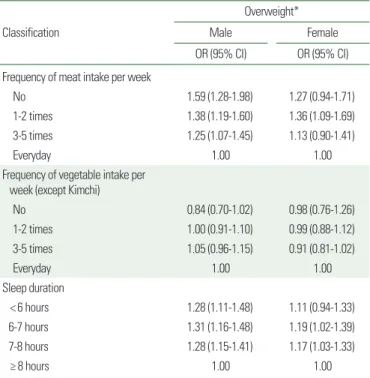
Using 8 hours or more of sleep time as reference, odds ratios for WHO-defined overweight according to sleep time were analyzed with multiple logistic regression, controlling for confounding fac- tors such as age and meat/vegetable consumption. ORs for sleep time in male students were as follows: 1.28 (95% confidence inter- val [CI], 1.11-1.48) with less than 6 hours of sleep, 1.31 (95% CI, 1.16-1.48) with 6-7 hours of sleep, and 1.28 (95% CI, 1.15-1.41)

Table 1. General characteristics of subjects, food intake, and sleep duration

Classification Subjects

Subjects

Total 25,182

Male 13,382 (53.1)

Female 11,800 (46.9)

Age

6 956 (3.8)

7 1,814 (7.2)

8 1,961 (7.8)

9 1,931 (7.7)

10 1,892 (7.5)

11 1,921 (7.6)

12 2,181 (8.7)

13 2,251 (8.9)

14 2,354 (9.4)

15 2,495 (9.9)

16 2,353 (9.3)

17 2,272 (9.0)

18 801 (3.2)

Frequency of meat intake per week

No 1,119 (4.5)

1-2 times 12,998 (52.3)

3-5 times 8,983 (36.1)

Everyday 1,778 (7.1)

Frequency of vegetable intake per week (except Kimchi)

No 1,036 (4.2)

1-2 times 7,250 (29.2)

3-5 times 8,592 (34.5)

Everyday 7,997 (32.1)

Sleep duration

< 6 hours 4,555 (18.3)

6-7 hours 6,947 (27.9)

7-8 hours 7,615 (30.6)

≥ 8 hours 5,764 (23.2)

with 7-8 hours of sleep. Differences based on sleep time were found to be statistically significant. ORs in female students were as fol- lows: 1.19 (95% CI, 1.02-1.39) with 6-7 hours of sleep and 1.17 (95% CI, 1.03-1.33) with 7-8 hours of sleep (Table 3).

Sleep time-specific regression coefficients for BMI SDS

The quantitative impact of sleep time on BMI SDS was assessed

using regression coefficients in males and females, controlling for

age and meat/vegetable intake. In male students, the regression co-

efficients were 0.218 (P<0.0001) for less than 6 hours of sleep

(compared to the reference of 8 hours or more of sleep), 0.149

(4)

(P<0.0001) for 6-7 hours of sleep, and 0.099 (P<0.0001) for 7-8 hours of sleep. In female students, regression coefficients were 0.137 (P<0.0001) for less than 6 hours of sleep (compared to the refer- ence of 8 hours or more of sleep), 0.101 (P<0.001) for 6-7 hours of sleep, and 0.079 (P<0.01) for 7-8 hours of sleep (Table 4).

DISCUSSION

Human health is not only influenced by genetics, but also by health behaviors. In addition, specific health risk behaviors are rein- forced by various social and environmental factors. Individuals are under pressure from having to adapt to ever-changing systems be- cause of excessive competition, and try to achieve better perfor- mance than others by reducing the time spent sleeping. Especially in Korea, it is expected that school-age students will reduce sleep time to achieve more in school and that adolescents will reduce sleep time to develop habits that ensure a successful future.

Table 3. Odds ratio of sleep duration for being overweight after adjusting for age and food intake

Classification

Overweight*

Male Female

OR (95% CI) OR (95% CI) Frequency of meat intake per week

No 1.59 (1.28-1.98) 1.27 (0.94-1.71)

1-2 times 1.38 (1.19-1.60) 1.36 (1.09-1.69)

3-5 times 1.25 (1.07-1.45) 1.13 (0.90-1.41)

Everyday 1.00 1.00

Frequency of vegetable intake per week (except Kimchi)

No 0.84 (0.70-1.02) 0.98 (0.76-1.26)

1-2 times 1.00 (0.91-1.10) 0.99 (0.88-1.12)

3-5 times 1.05 (0.96-1.15) 0.91 (0.81-1.02)

Everyday 1.00 1.00

Sleep duration

< 6 hours 1.28 (1.11-1.48) 1.11 (0.94-1.33)

6-7 hours 1.31 (1.16-1.48) 1.19 (1.02-1.39)

7-8 hours 1.28 (1.15-1.41) 1.17 (1.03-1.33)

≥ 8 hours 1.00 1.00

*WHO defined overweight as BMI > 1.0 standard deviation scores.

OR, odds ratio; BMI, body mass index.

Table 2. BMI Cut-off and proportion of overweight participants according to age and sex

Classification BMI point of 1.0 SDS Proportion (%) of BMI> 1.0 SDS*

Male Female Male Female

Total 34.2 19.5

Age

6 17.0 17.3 33.5 20.6

7 17.4 17.7 35.6 21.5

8 17.9 18.3 37.5 22.4

9 18.4 19 41.7 27.2

10 19.1 19.8 44.2 24.5

11 19.9 20.7 47.1 25.4

12 20.8 21.7 41.8 23.8

13 21.7 22.7 35.7 19.6

14 22.6 23.5 33.7 14.6

15 23.5 24.1 28.7 14.8

16 24.2 24.5 22.5 13.1

17 24.9 24.8 20.6 13.7

18 25.4 25 19.4 11.1

X

2

414.51 189.70

P value < 0.0001 < 0.0001

*World Health Organization defined overweight as BMI > 1.0 standard deviation scores.

BMI, body mass index.

Table 4. Effect of sleep duration on BMI SDS for student health examination data using multiple linear regression analysis

Classification

Overweight*

Male Female

Coefficient± SE P value Coefficient± SE P value Intercept -0.041± 0.046 0.370 -0.078± 0.051 0.124

Age -0.011± 0.003 0.000 -0.007± 0.004 0.049

Frequency of Meat intake per week

No 0.164± 0.051 0.001 0.174± 0.055 0.002

1-2 times 0.078± 0.032 0.014 0.128± 0.037 0.002

3-5 times 0.050± 0.032 0.119 0.065± 0.038 0.087

Everyday Ref Ref

Frequency of vegetable intake per week

(except Kimchi)

No -0.114± 0.043 0.008 -0.039± 0.051 0.441

1-2 times 0.009± 0.022 0.687 -0.010± 0.024 0.677

3-5 times 0.029± 0.021 0.171 -0.029± 0.022 0.200

Everyday Ref Ref

Sleep duration

< 6 hours 0.218± 0.033 < 0.0001 0.137± 0.035 < 0.0001 6-7 hours 0.149± 0.028 < 0.0001 0.101± 0.031 0.001 7-8 hours 0.099± 0.024 < 0.0001 0.079± 0.027 0.003

≥ 8 hours Ref Ref

*World Health Organization defined overweight as BMI > 1.0 standard deviation scores.

BMI, body mass index; SE, standard error.

(5)

In today’s society characterized by abundance, obesity is consid- ered an individual health problem that should be prevented and even as a disease that should be treated. Attempts are being made to identify new factors related to obesity, other than those that are al- ready well known, including eating habits, exercise, and genetic fac- tors. Recently, there has been an increased interest in sleep time as a factor related to obesity.

In this study, only 23.2% of students had 8 hours or more of sleep time. Lack of sleep results in imbalance of hormones that control appetite and energy use, which subsequently increases the risk of obesity.

12,13

Studies on obesity and sleep have been conducted among adult populations, and the results have repeatedly shown a negative correlation between the two factors.

14-16

Studies in middle school and high school students in Korea have demonstrated that increased sleep time may reduce the risk of being overweight or obese.

17

However, these studies excluded elementary school stu- dents, which makes it difficult to assess the entire population of stu- dents. Moreover, studies assessing the influence of sleep using the standard value of BMI SDS have been limited. Thus, this study was conducted among elementary, middle, and high school students in Seoul, a major metropolitan city in Korea, to analyze odds ratios for sleep time-specific WHO-defined overweight and regression coef- ficients for BMI SDS.

Theoretically, BMI SDS 1.0 corresponds to 84.1% of the stan- dard distribution.

18

The present study defined values more than BMI SDS 1.0 as overweight, consistent with the WHO definition.

11

As a result, the proportion with overweight in males and females was 33.5% and 20.6% among 6-year-olds, 35.7% and 19.6% among 13-year-olds, and 22.5% and 13.1% among 16-year-olds. Overall, the rate of overweight was higher in males. This result was in agree- ment with previous research conducted in middle and high school students showing that there is a higher frequency of overweight obesity in boys than in girls.

19

However, a different interpretation is required because of conflicting results presented by previous stud- ies, showing that BMI is higher in girls than in boys and that a high- er age-based increase in BMI occurs in girls compared to boys.

20

Shorter sleep time is associated with a higher frequency of WHO-defined overweight. In males, ORs for each sleep time, with a reference sleep time of 8 hours or more, calculated after control- ling for variables such as age and meat/vegetable consumption were

as follows: 1.28 (95% CI, 1.11-1.48) for sleep time less than 6 hours, 1.31 (95% CI, 1.16-1.48) for 6-7 hours of sleep, and 1.28 (95% CI, 1.15-1.41) for 7-8 hours of sleep. In females, the values were 1.19 (95% CI, 1.02-1.39) for 6-7 hours of sleep time and 1.17 (95% CI, 1.03-1.33) for 7-8 hours of sleep time. These results were similar in males.

Sleep time had a negative correlation with quantitative BMI SDS values. Respective regression coefficients for BMI SDS in males and females after controlling for age and meat/vegetable intake were 0.218 (P<0.0001) and 0.137 (P<0.0001) in those with less than 6 hours of sleep compared to the reference of those with 8 hours or more of sleep, 0.149 (P<0.0001) and 0.101 (P<0.005) in those with 6-7 hours of sleep, and 0.099 (P<0.0001), and 0.079 (P<

0.005) in those with 7-8 hours of sleep. The slope of regression coef- ficients for BMI SDS increased with a decrease in sleep time.

In the present study, meat intake as a confounding variable had an association with WHO-defined overweight and BMI SDS. Especial- ly in males, the OR for overweight with no intake of meat compared to daily intake of meat was 1.59 (95% CI, 1.28-1.98), and the regres- sion coefficient for BMI SDS was 0.164 (P<0.005). In females, the OR for overweight with once or twice weekly intake of meat com- pared to daily intake was 1.36 (95% CI, 1.09-1.69), and the regres- sion coefficient for BMI SDS was 0.128 (P<0.005). This result indi- cates that intake of lean, low-calorie meat is relatively good and may have a positive influence on prevention of overweight. Therefore, ad- equate protein intake is emphasized for the prevention and manage- ment of overweight.

In males, the regression coefficient for BMI SDS with irregular intake of vegetables compared to daily intake of vegetables was low at –0.114 (P<0.01). This result conflicts with the report that BMI increases with high-protein, low-fiber diets, and that vegetarians have lower BMI values than carnivores.

21,22

In females, the regression coefficient was low with irregular intake

of vegetables compared with that for daily intake, but this was not

statistically significant. The difference between these findings is due

to the fact that this is a cross-sectional study and it was not possible

to completely control the confounding variables associated with

BMI. Overweight studies that consider Korea’s economy (meat is

more expensive than vegetables), as well as the possibility of inade-

quate protein intake in vegetarians, should be performed.

(6)

The limitations of the present study are as follows. First, the pur- pose of this study is to identify the proportion with WHO-defined overweight based on BMI SDS. For this information, it would be ideal to have standard values for Korean children and adolescents.

However, the 2007 Korea Pediatrics Growth Chart

23

presents the BMI value as a percentile instead of BMI SDS. The present study utilized growth reference values for 5-19-year-olds reported by WHO.

11

Thus, this study is limited in that a direct comparison to a standard for Korean adolescents is not available.

Second, this study used the school-age population in Seoul, which makes it difficult to generalize the results to the school-age population in Korea. Nevertheless, the school-age population in Seoul comprises 20% of Korea’s school-age population. Thus, it is possible to derive some significance by determining the relationship between overweight and sleep habits of the school-age population in Seoul.

Third, there may be differences in sleep time based on age groups in Korea’s educational environment. However, sleep time is an in- terval variable in this study. Age group-specific sleep time was not under consideration, and analysis was performed against a group with 8 or more hours of sleep. In this case, recommending the im- portance of adequate sleep time can be ambiguous. However, in 2015, the National Sleep Foundation recommended 9-11 hours of sleep in 6–13-year-olds and 8–10 hours of sleep in 14–17-year- olds.

24

Thus, using a threshold of 8 hours or more of sleep in middle or high school in Korea may be reasonable.

Fourth, the data used in this study included variables known to be associated with overweight such as exercise and career-related stress factors. However, responses regarding these items on the sur- vey questionnaire used in elementary, middle, and high schools showed discrepancies, which prevented the use of these variables as confounding factors. This could limit the explanation of the rela- tionship between sleep time and the state of being overweight.

Nevertheless, this can still partially provide evidence for the need to emphasize the importance of sleep time in management policies for school-age overweight and strategies for school health promotion.

In addition, this study used actual measurements of height and weight with a standardized measuring tool and method to calculate BMI. Therefore, over- or underreported values are less likely, which can be considered a strength of this study.

In conclusion, sleep time is independently related to WHO-de- fined overweight and BMI SDS after controlling for confounding factors. However, only 23.2% of students sleep for 8 hours or more.

Therefore, health policies encouraging and ensuring adequate sleep in the youth should be actively established. Further studies are need- ed to the association of meat intake with BMI SDS as well as WHO- defined overweight reported in male population.

CONFLICTS OF INTEREST

There is no conflict of interest.

ACKNOWLEDGMENTS

I would like to thank the Seoul School Health Promotion Center and Hee Woo Lee, M.D. (former provincial, fourth grade official) for their permission to use data and conduct this study.

REFERENCES

1. Ogden CL, Carroll MD, Kit BK, Flegal KM. Prevalence of childhood and adult obesity in the United States, 2011-2012.

JAMA 2014;311:806-14.

2. Daniels SR, Arnett DK, Eckel RH, Gidding SS, Hayman LL, Kumanyika S, et al. Overweight in children and adolescents:

pathophysiology, consequences, prevention, and treatment.

Circulation 2005;111:1999-2012.

3. Krebs NF, Himes JH, Jacobson D, Nicklas TA, Guilday P, Styne D. Assessment of child and adolescent overweight and obesity. Pediatrics 2007;120 Suppl 4:S193-228.

4. Must A, Jacques PF, Dallal GE, Bajema CJ, Dietz WH. Long- term morbidity and mortality of overweight adolescents. a fol- low-up of the Harvard Growth Study of 1922 to 1935. N Engl J Med 1992;327:1350-5.

5. Lumeng JC, Somashekar D, Appugliese D, Kaciroti N, Cor- wyn RF, Bradley RH. Shorter sleep duration is associated with increased risk for being overweight at ages 9 to 12 years. Pedi- atrics 2007;120:1020-9.

6. Anders TF, Eiben LA. Pediatric sleep disorders: a review of

the past 10 years. J Am Acad Child Adolesc Psychiatry 1997;

(7)

36:9-20.

7. Sadeh A, Gruber R, Raviv A. The effects of sleep restriction and extension on school-age children: what a difference an hour makes. Child Dev 2003;74:444-55.

8. Touchette E, Petit D, Tremblay RE, Boivin M, Falissard B, Genolini C, et al. Associations between sleep duration patterns and overweight/obesity at age 6. Sleep 2008;31:1507-14.

9. Gangwisch JE, Malaspina D, Boden-Albala B, Heymsfield SB.

Inadequate sleep as a risk factor for obesity: analyses of the NHANES I. Sleep 2005;28:1289-96.

10. The ministry of Education’s manual of school health examina- tion standard survey, 2009-2011. Seoul: The ministry of Edu- cation; 2009. Introduction of survey; p. 1-9.

11. World Health Organization. Growth reference 5-19 years. [on- line] 2015 [accessed 2016 Jan 18]; Available from: URL: http://

www.who.int/growthref/who2007_bmi_for_age/en/

12. Spiegel K, Tasali E, Penev P, Van Cauter E. Brief communica- tion: Sleep curtailment in healthy young men is associated with decreased leptin levels, elevated ghrelin levels, and increased hunger and appetite. Ann Intern Med 2004;141:846-50.

13. Seicean A, Redline S, Seicean S, Kirchner HL, Gao Y, Sekine M, et al. Association between short sleeping hours and overweight in adolescents: results from a US Suburban High School sur- vey. Sleep Breath 2007;11:285-93.

14. Kripke DF, Garfinkel L, Wingard DL, Klauber MR, Marler MR. Mortality associated with sleep duration and insomnia.

Arch Gen Psychiatry 2002;59:131-6.

15. Gupta NK, Mueller WH, Chan W, Meininger JC. Is obesity associated with poor sleep quality in adolescents? Am J Hum Biol 2002;14:762-8.

16. Kohatsu ND, Tsai R, Young T, Vangilder R, Burmeister LF,

Stromquist AM, et al. Sleep duration and body mass index in a rural population. Arch Intern Med 2006;166:1701-5.

17. Park S. Association between short sleep duration and obesity among South Korean adolescents. West J Nurs Res 2011;33:

207-23.

18. Preedy VR, editors. Handbook of anthropometry: physical measures of human form in health and disease. New York:

Springer Science Business Media; 2012. p. 1-3107.

19. Lee B. Association between sleep duration and body mass in- dex among South Korean adolescents. Korean J Health Pro- mot 2015;15:16-23.

20. Sweeting H, West P. Gender differences in weight related con- cerns in early to late adolescence. J Epidemiol Community Health 2002;56:700-1.

21. Spencer EA, Appleby PN, Davey GK, Key TJ. Diet and body mass index in 38000 EPIC-Oxford meat-eaters, fish-eaters, vegetarians and vegans. Int J Obes Relat Metab Disord 2003;

27:728-34.

22. Burkert NT, Muckenhuber J, Großschädl F, Rásky E, Freidl W.

Nutrition and health - the association between eating behavior and various health parameters: a matched sample study. PLoS One 2014;9:e88278.

23. Moon JS, Lee SY, Nam CM, Choi JM, Choe BK, Seo JW, et al. 2007 Korean National Growth Charts: review of develop- mental process and an outlook. Korean J Pediatr 2008;51:1-25.

24. National Sleep Foundation. National sleep foundation recom- mends new sleep times. [serial online] 2015 Oct [accessed 2015 Oct 15]; Available from: URL: https://sleepfoundation.

org/media-center/press-release/national-sleep-foundation-rec-

ommends-new-sleep-times

수치

Table 1. General characteristics of subjects, food intake, and sleep duration
Table 4. Effect of sleep duration on BMI SDS for student health examination data  using multiple linear regression analysis

참조

관련 문서