• 검색 결과가 없습니다.

Persistent Fifth Aortic Arch with CoarctationSue Hyun Kim, M.D., Eun-Suk Choi, M.D., Sungkyu Cho, M.D., Woong-Han Kim, M.D., Ph.D.

N/A
N/A
Protected

Academic year: 2021

Share "Persistent Fifth Aortic Arch with CoarctationSue Hyun Kim, M.D., Eun-Suk Choi, M.D., Sungkyu Cho, M.D., Woong-Han Kim, M.D., Ph.D."

Copied!
3
0
0

로드 중.... (전체 텍스트 보기)

전체 글

(1)

ISSN: 2233-601X (Print) ISSN: 2093-6516 (Online)

− 39 −

Department of Thoracic and Cardiovascular Surgery, Seoul National University Children’s Hospital, Seoul National University College of Medicine Received: November 11, 2014, Revised: March 22, 2015, Accepted: April 7, 2015, Published online: February 5, 2016

Corresponding author: Woong-Han Kim, Department of Thoracic and Cardiovascular Surgery, Seoul National University Hospital, Seoul National University College of Medicine, 101 Daehak-ro, Jongno-gu, Seoul 03080, Korea

(Tel) 82-2-2072-3637 (Fax) 82-2-3672-3637 (E-mail) [email protected]

C

The Korean Society for Thoracic and Cardiovascular Surgery. 2016. All right reserved.

CC
This is an open access article distributed under the terms of the Creative Commons Attribution Non-Commercial License (http://creative- commons.org/licenses/by-nc/4.0) which permits unrestricted non-commercial use, distribution, and reproduction in any medium, provided the original work is properly cited.

Persistent Fifth Aortic Arch with Coarctation

Sue Hyun Kim, M.D., Eun-Suk Choi, M.D., Sungkyu Cho, M.D., Woong-Han Kim, M.D., Ph.D.

Persistent fifth aortic arch (PFAA) is a rare congenital anomaly of the aortic arch frequently associated with other cardiovascular anomalies, such as tetralogy of Fallot and aortic arch coarctation or interruption. We report the case of a neonate with PFAA with coarctation who successfully underwent surgical repair.

Key words: 1. Aorta, arch 2. Coarctation

CASE REPORT

Persistent fifth aortic arch (PFAA) is an exceedingly rare congenital anomaly of the aortic arch, frequently associated with other cardiovascular anomalies, such as tetralogy of Fallot, transposition of the great arteries, truncus arteriosus, and aortic arch coarctation or interruption [1]. PFAA origi- nates from the distal ascending aorta, proximal and opposite to the ostium of the innominate artery, and is distally con- nected with the descending aorta [2]. We report a case of PFAA with coarctation, in which surgical repair was success- fully performed.

An eight-day-old female neonate was referred to Cardiac Center of Seoul National University Children’s Hospital due to PFAA with coarctation. She was born as the first twin by Caesarean section at 36+4 weeks of gestation after an un- eventful pregnancy. Prenatal echocardiography revealed a per- imembranous ventricular septal defect (VSD). Her birth weight was 2,230 g, and her Apgar score was 8 at one mi- nute and 9 at five minutes. Her blood pressure was 95/59 mmHg in the right arm, 103/51 mmHg in the left arm, 60/44 mmHg in the right leg, and 55/33 mmHg in the left leg.

Echocardiography on admission revealed left PFAA with coarctation, secundum atrial septal defect (ASD), perimem- branous VSD, and closed ductus arteriosus (Fig. 1A). Three- dimensional computed tomography confirmed the diagnosis of PFAA with coarctation (Fig. 1B).

One day after admission, the patient was operated on via a standard median sternotomy. Intraoperative findings revealed that the PFAA was connected to the descending thoracic aor- ta through the isthmus, which was closed by ductal tissue.

Coarctation of the fourth aortic arch with a short and very tight stenotic isthmus was also observed (Fig. 2). The arterial cannula was inserted into the innominate artery, and the ve- nous return cannulae were inserted into the right atrium.

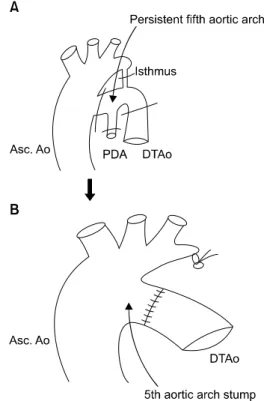
After the isthmus of the fourth aortic arch was divided, the fifth aortic arch and the ductal tissue were resected under re- gional perfusion. The coarctation of the PFAA was repaired by end-to-end anastomosis between the stump of the fifth aortic arch and the descending thoracic aorta (Fig. 3). The VSD and ASD were closed through a right atrial incision.

The perioperative period was uneventful. Immediately after the operation, the patient’s blood pressure was 82/52 mmHg in the left arm and 89/49 mmHg in the left leg. The patient

Korean J Thorac Cardiovasc Surg 2016;49:39-41 Case Report

http://dx.doi.org/10.5090/kjtcs.2016.49.1.39

(2)

Sue Hyun Kim, et al

− 40 − Fig. 2. Intraoperative view of the PFAA. AAO, ascending aorta;

PFAA, persistent fifth aortic arch; PDA, patent ductus arteriosus;

MPA, main pulmonary artery.

Fig. 1. (A) Echocardiogram and (B) three-dimensional computed tomography image showing the persistent fifth aortic arch (arrowhead) with segmental coarctation (arrow).

Fig. 3. Schematic drawing of persistent fifth aortic arch with coarc- tation. (A) The isthmic area and ductus arteriosus were divided.

Dotted lines represent incisions. (B) Coarctoplasty was performed via end-to-end anastomosis between the orifice of the fifth aortic arch and the descending thoracic aorta. Asc. Ao, ascending aorta;

PDA, patent ductus arteriosus; DTAo, descending thoracic aorta.

was discharged home 17 days after the operation without complications. Computed tomography performed before dis- charge showed that the anastomosis of the PFAA was wide and unobstructed (Fig. 4).

DISCUSSION

PFAA was first described by Van Praagh and van Praagh [2] in 1969. PFAA is located between the true aortic arch, which is a derivative of the fourth aortic arch, and the pul- monary artery, which is a derivative of the sixth aortic arch.

The aortic arch is subdivided into superior and inferior paral- lel channels, each consisting of a double-lumen aortic arch.

Previous studies of PFAA showed that patients with this mal-

formation usually do not have hemodynamically significant

(3)

5th Aortic Arch with CoA

− 41 − Fig. 4. Postoperative computed tomography image showing the wide and unobstructed anastomosis site (arrow).

symptoms and are diagnosed incidentally due to upper body hypertension and systolic murmur if the PFAA flow is suffi- cient [3]. According to a review of 26 cases of PFAA by Lambert et al. [1], 76% of cases demonstrated systemic-to- systemic connection via the fifth aortic arch, 38% of cases involved aortic coarctation, and 19% of cases presented with interruption of the fourth aortic arch. Echocardiography and angiography are used as tools to diagnose PFAA. However, magnetic resonance imaging and computed tomography pro- vide more accurate information regarding the relationships with the surrounding structures and the vascular anatomy.

Previous reports have described a range of techniques for repairing PFAA associated with coarctation: (1) interposition of a Gore-Tex tube graft (W.L. Gore & Associates, Flagstaff, AZ, USA) [4], (2) patch aortoplasty augmenting both the fourth and the fifth aortic arch [5], (3) ligation of the fifth aortic arch used to reconstruct the fourth aortic arch [6], and (4) side-to-side anastomosis of the left common carotid artery and the left subclavian artery with patch repair of the coarct- ed segment [7]. In this case, after division of the fourth aort- ic arch isthmus and the ductal tissue, coarctoplasty was per-

formed using an end-to-end anastomosis between the prox- imal stump of the resected fifth aortic arch and the descend- ing thoracic aorta. This procedure produced a good immediate result without complications.

In conclusion, this report describes a rare case of persistent fifth aortic arch associated with coarctation that was success- fully surgically repaired.

CONFLICT OF INTEREST

No potential conflict of interest relevant to this article was reported.

REFERENCES

1. Lambert V, Blaysat G, Sidi D, Lacour-Gayet F. Double-lu- men aortic arch by persistence of fifth aortic arch: a new case associated with coarctation. Pediatr Cardiol 1999;20:

167-9.

2. Van Praagh R, van Praagh S. Persistent fifth arterial arch in man: congenital double-lumen aortic arch. Am J Cardiol 1969;24:279-82.

3. Zhao YH, Su ZK, Liu JF, Cao DF, Ding WX. Surgical treatment of persistent fifth aortic arch associated with inter- rupted aortic arch. Ann Thorac Surg 2007;84:1016-9.

4. Konishi T, Iizima T, Onai K, Kobayashi G, Kawabe M, Anzai T. Persistent fifth aortic arch complicated by coarcta- tion of the aorta and aneurysm of the left subclavian artery (author’s transl). Nihon Kyobu Geka Gakkai Zasshi 1981;29:1243-8.

5. Gibbin CL, Midgley FM, Potter BM, Martin GR. Persistent left fifth aortic arch with complex coarctation. Am J Cardiol 1991;67:319-20.

6. Cabrera A, Galdeano J, Lekuona I. Persistent left sided fifth aortic arch in a neonate. Br Heart J 1985;54:105-6.

7. Yoshii S, Matsukawa T, Hosaka S, Ueno A, Tsuji A. Repair of coarctation with persistent fifth arterial arch and atresia of the fourth aortic arch. J Cardiovasc Surg (Torino) 1990;

31:812-4.

수치

Fig. 3. Schematic drawing of persistent fifth aortic arch with coarc- coarc-tation. (A) The isthmic area and ductus arteriosus were divided

참조

관련 문서

• 파이썬은 연산자와 동일한 결과를 산출하는 함수로서 특수 메소드의 정의를 허용한다.이 메소드들은 파이썬이 인식할 수 있도록 특별한

#define 에서 인자 사용 예제 compoundassign.c... 관계와

▪ 실세계의 객체에서 불필요한 부분을 제거하여 필요한 부분만을 간결하고 이해하기 쉬운 클래스 로 만드는 작업. ▪

Scale Min 과 Scale Max 아래의 각 채널에 Disable 로 표시 되면 기본값으로 설정 되어 있는 상태 입니다.. 스케일 설정 값은 EEPROM에 저장되어 전원

위의 창에서 마우스로 해당 채널을 더블클릭 하거나 채널 선택 후 채널설정(S) 을 클릭 하면 아래와 같이 채널 설정 창이 나타납니다.. 8.1 채널

One might try to solve the problem by copying the first d elements of x to a temporary array, moving the remaining n − d elements left d places, and then copying the first d

(바) “액체 밀봉드럼 (Liquid seal drum)”이라 함은 플레어스택의 화염이 플레어시 스템으로 거꾸로 전파되는 것을 방지하거나 또는 플레어헤더에

일반세제를 사용하면 거품이 많이 발생되어 감전, 고장 및 화재의 원인이 됩니다.. 칼 등 날카로운 기구는 손잡이가 위를