267
© Copyright The Korean Academy of Asthma, Allergy and Clinical Immunology • The Korean Academy of Pediatric Allergy and Respiratory Disease http://e-aair.org INTRODUCTION
Toxocariasis is a helminthozoonosis caused by ascarid larvae of the Toxocara genus.1 It is the most common helminthiasis in industrialized countries,1 including Korea.2 Human toxocariasis is caused by geophagia (pica), close contact with dogs or cats, poor personal hygiene, ingestion of contaminated raw vegeta- bles, or ingestion of raw meat from a paratenic host.1,3,4 As the rate of pet ownership in Korea increases, a concomitant increase in the risk for contracting toxocariasis will require physicians to become familiar with the clinical features and treatment of this disease. Toxocara infection may present with various symptoms affecting different organs.1,3 Dermatologically, toxocariasis may be associated with pruritus, rash, and chronic urticaria, with very few reports of acute urticaria.1,3,5 Toxocariasis is typically treated easily with albendazole,1,3 and recurrent disease has not been reported in Korea. Here, we report a case of recurrent toxocari- asis accompanied by abdominal pain and urticaria that was re- sistant to routine treatment.
A Case of Recurrent Toxocariasis Presenting With Urticaria
Min-Hye Kim,
1,2Jae-Woo Jung,
1,2Jae-Woo Kwon,
1,2Tae-Whan Kim,
1,2Sae-Hoon Kim,
1,2,3Sang-Heon Cho,
1,2Kyung-Up Min,
1,2You-Young Kim,
1,2Yoon-Seok Chang
1,2,3*
1Department of Internal Medicine, Seoul National University College of Medicine, Seoul, Korea
2Institute of Allergy and Clinical Immunology, Seoul National University Medical Research Center, Seoul, Korea
3Department of Internal Medicine, Seoul National University Bundang Hospital, Seongnam, Korea
CASE REPORT
A 35-year-old male visited our emergency room because of cramping epigastric pain; he had no past medical history of this kind. Although the patient had previously consumed raw fish, his most recent ingestion of potentially contaminated food was raw cow liver, 3 weeks prior to presentation. The patient’s blood pressure was 130/70 mmHg; his heart rate was 75/minutes; and his body temperature was 36°C. Blood analyses showed pe- ripheral eosinophilia (leukocytes, 13.11×10³/μL, with 58.6%
neutrophils, 22.4% lymphocytes, 4.9% monocytes, and 12.3%
eosinophils), an aspartate aminotransferase level of 19 U/L,
Case Report
Allergy Asthma Immunol Res. 2010 October;2(4):267-270.
doi: 10.4168/aair.2010.2.4.267 pISSN 2092-7355 • eISSN 2092-7363
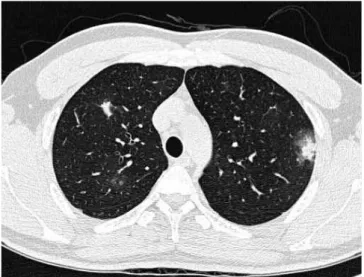
Human toxocariasis is the most prevalent helminthiasis in Korea and other industrialized countries. The clinical features of toxocariasis are diverse, according to the involved organ. Typically, Toxocara spp. infection is easily treated with 400 mg albendazole twice a day for 5 days. However, we ex- perienced a case of recurrent toxocariasis that was refractory to this standard therapy and presented with urticaria, an uncommon symptom in toxo- cariasis. A 35-year-old male visited our emergency room because of abdominal pain. He had recently consumed raw cow liver (3 weeks prior to pre- sentation). Laboratory analyses revealed eosinophilia (1,612 cells/μL) and increased total IgE (3,060 IU/mL). Chest X-ray showed multiple lung nod- ules in both lungs, and computed tomography revealed multiple ground-glass opacities in both lungs and multiple tiny liver abscesses. Liver biopsy revealed an eosinophilic abscess. Enzyme-linked immunosorbent assay findings for Toxocara antigens were positive (optical density, 2.140), leading to a diagnosis of toxocariasis. We initiated a 5-day treatment with albendazole and prednisolone; however, 6 days after completing the treatment, the patient again experienced urticaria and severe itching that could not be controlled by antihistamines or hydrocortisone cream. A second bout of eosinophilia suggested recurring toxocariasis, for which we prescribed a second round of albendazole. Despite an initial improvement in his symp- toms, the patient returned after 6 weeks complaining of abdominal pain for 6 hours, which was reminiscent of his first attack; he also exhibited eo- sinophilia. Accordingly, albendazole was administered once more for an additional 3 weeks, and his symptoms resolved.
Key Words: Abdominal pain; albendazole; toxocariasis; urticaria
This is an Open Access article distributed under the terms of the Creative Commons Attribution Non-Commercial License (http://creativecommons.org/licenses/by-nc/3.0/) which permits unrestricted non-commercial use, distribution, and reproduction in any medium, provided the original work is properly cited.
Correspondence to: Yoon-Seok Chang, MD, PhD, Department of Internal Medicine, Seoul National University Bundang Hospital, 166 Gumi-ro, Bundang- gu, Seongnam 463-707, Korea.
Tel: +82-31-787-7023; Fax: +82-31-787-4052; E-mail: [email protected] Received: March 22, 2010; Accepted: May 7, 2010
•There are no financial or other issues that might lead to conflict of interest.
Kim et al. Volume 2, Number 4, October 2010
Allergy Asthma Immunol Res. 2010 October;2(4):267-270. doi: 10.4168/aair.2010.2.4.267 268 http://e-aair.org
Fig. 3. Patchy and dense eosinophilic infiltration in liver biopsy (H&E stain, A: ×200, B: ×400).
Fig. 2. Multiple ground-glass opacities in both lungs in chest CT.
Fig. 1. Multiple tiny liver abscesses in abdomen CT.
A B
and an alanine aminotransferase level of 17 U/L. The patient tested negative for HBsAg and anti-HCV antibody, and positive for anti-HBs antibody. Prothrombin time and activated partial thromboplastin time were normal. The patient’s level of C-re- active protein was normal at 0.16 mg/dL (0–0.5 mg/dL). Urinal- ysis and stool examination revealed no abnormalities. The pa- tient’s serum total immunoglobulin (Ig) E level was 3,060 IU/
mL, as determined using a paper radioimmunsorbent test.
Physical examination revealed tenderness in the epigastric area. Although no abnormality was observed upon abdominal X-ray, chest X-ray revealed multiple nodules in both lungs, and abdominal and chest computed tomography revealed multiple tiny liver abscesses (Fig. 1) and multiple ground-glass opaci- ties in both lungs (Fig. 2). Liver biopsy showed patchy, dense eosinophilic hepatic infiltrates, suggestive of eosinophilic ab- scess (Fig. 3). Bone marrow biopsy revealed normocellular
A Case of Recurrent Toxocariasis With Urticaria AAIR
Allergy Asthma Immunol Res. 2010 October;2(4):267-270. doi: 10.4168/aair.2010.2.4.267 http://e-aair.org 269 marrow with increased eosinophils. Gastroscopy at the time of
epigastric pain showed no evidence of other parasitic infections such as anisakiasis. When we measured Toxocara canis larva E/S antigen-specific IgG using an enzyme-linked immunosor- bent assay kit (TES-ELISA; Bordier Affinity Products SA, Crissier, Switzerland), the observed optical density (2.140) suggested the presence of Toxocara larva at a relatively high titer when com- pared against the positive (0.616) and negative (0.033) controls.
We then initiated treatment with 400 mg albendazole twice a day (the patient’s weight was 80 kg) and 60 mg prednisolone for 5 days. However, 6 days after the cessation of albendazole, the pa- tient again experienced generalized urticaria and itching that could not be controlled through the use of antihistamines or hydrocortisone cream. The possibility of a drug allergy was con- sidered unlikely given the lapse in time between drug treat- ment and presentation of symptoms. Because the patient showed eosinophilia (increasing from 46 to 1,262 cells/μL) and newly developed urticaria that was refractory to conventional treatment, we suspected the recurrence or inadequate treat- ment of toxocariasis. A second round of 400 mg albendazole once daily for 2 weeks was initiated, and this eliminated both urticaria and itching within 1 day. The patient was discharged with improved symptoms after 1 week. Six weeks after dis- charge, the patient returned to the emergency room, again com- plaining of cramping epigastric pain reminiscent of his first at- tack of toxocariasis. Repeated gastroscopy revealed only chron- ic gastritis. The laboratory test showed an elevated eosinophil count (increasing from 543 to 1,335 cells/μL). We suspected re- current toxocariasis and prescribed 400 mg albendazole once daily. After treatment, the patient’s symptoms appeared to be resolved and his eosinophil count had normalized. After a 3-week treatment with albendazole, he has remained symp-
tom-free with no further relapses for 2 years. His most recent eosinophil count was 188 cells/μL (Fig. 4).
DISCUSSION
Since the first report of human toxocariasis in the 1950s, toxo- cariasis has become the most prevalent helminthiasis in indus- trialized countries.1,3 In 2002, Park et al.2 reported that the sero- prevalence of toxocariasis in Korean rural adults was approxi- mately 5%, based on research in Gangwon province. After in- gestion as embryonated eggs or adults, Toxocara can live in the small intestine of dogs or cats. Eggs escape the intestine through defecation and become embryonated while resting on or in the soil. Humans may ingest the eggs accidentally through contact with pet feces, eating contaminated raw vegetables, or consum- ing raw meat from a paratenic host.1,3 The patient described here most likely contracted toxocariasis as a result of consum- ing raw cow liver (not raw fish); it has been reported that a re- cent history of eating raw cow liver is related to increased risk for toxocariasis in patients with eosinophilia of unknown etiol- ogy in Korea.4
Although Toxocara eggs may hatch in the human small intes- tine, larvae cannot develop into adults in humans and thus re- main in a juvenile stage.1,3 Larvae then penetrate the intestinal wall and migrate to multiple organs via the blood stream; di- verse clinical features may develop according to the involved or- gan.1,3 Toxocariasis is classified as visceral larva migrans (VLM) when it involves the major organs, or ocular larva migrans when it involves the eye and optic nerve.1,3 The patient described here demonstrated the clinical features of VLM: abdominal pain, eo- sinophilia, pulmonary focal ground-glass opacities, and hepatic eosinophilic abscess. Immediate hypersensitivity to dying or Fig. 4. Serial change of eosinophil count according to recurrence.
8,000 7,000 6,000 5,000 4,000 3,000 2,000 1,000 0 (×103/μL)
4/16 4/23 4/30 5/7 5/14 5/21 5/28 6/4 6/11 6/18 6/25 7/2 7/9 Toxocariasis
diagnosed
Albendazole treatment
Abdominal pain recurred Urticaria
Eosinophil count
Kim et al. Volume 2, Number 4, October 2010
Allergy Asthma Immunol Res. 2010 October;2(4):267-270. doi: 10.4168/aair.2010.2.4.267 270 http://e-aair.org
dead larvae in organs may also elicit fever, enlargement of the liver or spleen, lower respiratory symptoms resembling asthma, hypergammaglobulinemia, myocarditis, nephritis, central ner- vous system involvement, and other conditions.1,3 In the pres- ent case, the patient complained of abdominal pain in the first attack, urticaria during the second attack, and abdominal pain again during the third attack.
Many studies have reported an association between chronic urticaria and toxocariasis,5,6 but few reports describe acute urti- caria, particularly in association with recurrent disease.6 Although skin lesions are rarely the only symptom of toxocariasis, previ- ous studies and the case described here demonstrate that urti- caria may be a sign of toxocariasis or other parasitic infections.6 Although we initially considered the possibility of anisakiasis, we excluded this condition because the patient had not recent- ly consumed raw fish and because gastroscopy showed no phys- ical evidence of the parasite. Instead, the patient was diagnosed with toxocariasis based on the detection of T. canis E/S antigens at a high titer. However, given that immunodiagnostic tests can- not discriminate between current and past infections, it is im- portant to determine the blood eosinophil count and serum to- tal IgE together when recurrence is suspected.1
Recurrent disease was resolved through prolonged albenda- zole treatment. Albendazole is the treatment of choice for toxo- cariasis, with a currently recommended regimen of 10 mg/kg/
day in two doses (400 mg twice daily) for 5 days.1,3 Interestingly, recent clinical studies have shown that relatively few patients, only 6 of 19 (32%), are cured after 5-day albendazole therapy.7,8 Instead, in Japan, adults who contract toxocariasis (typically through eating raw liver) are treated with albendazole for 4 weeks
or longer.7,9 Accordingly, further study is required to reach a consensus regarding the appropriate duration of albendazole therapy to eliminate toxocariasis.
REFERENCES
1. Magnaval JF, Glickman LT, Dorchies P, Morassin B. Highlights of hu- man toxocariasis. Korean J Parasitol 2001;39:1-11.
2. Park HY, Lee SU, Huh S, Kong Y, Magnaval JF. A seroepidemiologi- cal survey for toxocariasis in apparently healthy residents in Gang- won-do, Korea. Korean J Parasitol 2002;40:113-7.
3. Despommier D. Toxocariasis: clinical aspects, epidemiology, medi- cal ecology, and molecular aspects. Clin Microbiol Rev 2003;16:
265-72.
4. Choi D, Lim JH, Choi DC, Paik SW, Kim SH, Huh S. Toxocariasis and ingestion of raw cow liver in patients with eosinophilia. Korean J Parasitol 2008;46:139-43.
5. Gavignet B, Piarroux R, Aubin F, Millon L, Humbert P. Cutaneous manifestations of human toxocariasis. J Am Acad Dermatol 2008;
59:1031-42.
6. Humbert P, Niezborala M, Salembier R, Aubin F, Piarroux R, Buchet S, Barale T. Skin manifestations associated with toxocariasis: a case- control study. Dermatology 2000;201:230-4.
7. Yoshikawa M. Duration of treatment with albendazole for hepatic toxocariasis. Nat Clin Pract Gastroenterol Hepatol 2009;6:E1-2.
8. Stürchler D, Schubarth P, Gualzata M, Gottstein B, Oettli A. Thia- bendazole vs. albendazole in treatment of toxocariasis: a clinical trial. Ann Trop Med Parasitol 1989;83:473-8.
9. Takamatsu K, Sumitani M, Nanjyou S, Nishijima M, Syoji S, Takifuji N, Kiyota H, Daga H, Takeda K. Case of Toxocara canis larva migrans cured by additional treatment with albendazole. Nihon Kokyuki Gakkai Zasshi 2008;46:836-41.