• 검색 결과가 없습니다.

Quantitative Evaluation of Rehabilitation Therapy Based on a Two-Finger Force Measurement System

N/A
N/A
Protected

Academic year: 2021

Share "Quantitative Evaluation of Rehabilitation Therapy Based on a Two-Finger Force Measurement System"

Copied!
5
0
0

로드 중.... (전체 텍스트 보기)

전체 글

(1)

http://dx.doi.org/10.5369/JSST.2014.23.6.357 pISSN 1225-5475/eISSN 2093-7563

Quantitative Evaluation of Rehabilitation Therapy Based on a Two-Finger Force Measurement System

Gab-Soon Kim

+

Abstract

This paper describes the evaluation of the effectiveness of rehabilitation therapy for patients with finger paralysis based on a two-finger force measurement system (TFFMS). The paralyzed fingers can be recovered through rehabilitation therapies. The finger pressing force of the patients can be measured utilizing the TFFMS previously developed by the author [7]. The TFFMS, however, has not been fully adopted as a standard method for evaluating the therapy owing to the lack of a standard protocol.

The pressing force of healthy volunteers and patients is analyzed with the TFFMS to explore the feasibility of the TFFMS as an evaluation device. The test confirms that the established standard protocol is useful to quantitatively assess the progress of finger rehabilitation therapy.

Keywords: Rehabilitation, Two-finger force measurement system (TFFMS), Finger pressing force, Finger rehabilitation

1. INTRODUCTION

The number of patients with finger paralysis, which is a condition where the patients are unable to use their fingers, has greatly increased over the recent times. Use of their fingers can be recovered with rehabilitative training; rehabilitation can be assessed by patients being able to pull a hook grasp a cylindrical object, or a plate. At present, most hospitals use cylindrical objects, hooks, plates, and plate objects that cannot measure the forces exerted by the patients when grasping. Therefore, doctors can only roughly estimate the progress of rehabilitation by touching and watching the grasping and pulling actions of patients’ fingers.

The developed finger force-measuring system [1-7] with a force sensor can measure the forces applied by fingers. This finger force-measuring system, however, has not been fully adopted as a standard method for evaluating therapy owing to the lack of a standard protocol.

In this paper, a characteristics test for the finger pressing forces of healthy individuals were performed utilizing a two- finger force measurement system (TFFMS) [7], and an evaluation standard of the rehabilitation therapy for patients’ two fingers (thumb and forefinger) was created by using the results.

In addition, the pressing force of patients’ finger was measured using the TFFMS, and the results were applied to the evaluation of rehabilitation therapy.

2. TFFMS [7]

2.1 Finger Force-measuring Principles

Fig. 1 shows the finger force-measuring principles by the pressing of two plates. If the fingers (thumb and forefinger) apply force to the force sensor in force sensor housing, as shown in Fig. 1, the TFFMS measures the finger force from the force sensor.

Department of Control & Instrumentation Engineering, ERI, Gyeongsang National University, 405-504, 501 Jinju-daero, Jinju 660-701, Republic of Korea

+

Corresponding author: [email protected]

(Received : Jul. 4, 2014, Revised : Nov. 8, Accepted : Nov. 10, 2014)

This is an Open Access article distributed under the terms of the Creative Commons Attribution Non-Commercial License(http://creativecommons.org/

licenses/bync/3.0) which permits unrestricted non-commercial use, distribution,

and reproduction in any medium, provided the original work is properly cited. Fig. 1. Finger force measuring principles by pressing two plates.

(2)

2.2 TFFMS [7]

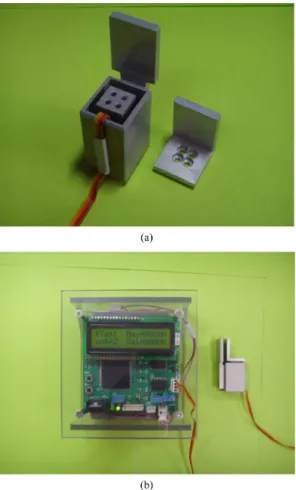
The TFFMS was developed by the author [7], as shown in Fig. 2. Fig. 2(a) shows a finger force instrument composed of a force sensor, force sensor housing without a knob, and a knob. Fig. 2(b) shows the TFFMS composed of a high-speed force-measuring device (HSFMD). The size of the finger force instrument is 17 × 53.5 × 25 mm

3

, and the thickness of the two plates is 9 mm. The force sensor is used to measure the finger pressing forces of normal people and patients with finger paralysis. The rated capacity of the force sensor is 100 N. The maximum repeatability error rate and maximum nonlinearity error rate of the force sensor are less than 0.02% and 0.03%, respectively.

The HSFMD is used to measure the finger pressing forces from the force sensor and to display the values on a liquid-crystal display (LCD). It is composed of a digital signal processor (DSP), a memory cartridge, several amplifiers, a communication feature, power, several switches, etc. The size of the manufactured control system is approximately 100×100 mm

2

.

3. CHARACTERISTICS TEST OF TWO- PLATE OBJECT PRESSING USING TFFMS

3.1 Characteristics Test of Normal People using TFFMS A two-plate pressing force test can be carried out to evaluate the rehabilitation therapy of a patient’s fingers. The rehabilitation can be evaluated by pressing two plates using the standard TFFMS Fig. 2. Two-finger force measurement system (TFFMS); (a) Finger

force instrument without knob and (b) TFFMS.

Fig. 3. Experimental setup for measuring the finger pressing force.

Fig. 4. Graphs of results of pressing force (N); (a) Pressing force of

males and (b) pressing force of females.

(3)

[7], thereby generating the plate pressing force data from the characteristics test. In this paper, a characteristics test of the pressing of two plates was performed using the TFFMS with 45 male and 45 female university participants.

Fig. 3 shows the experimental setup for measuring the finger pressing force; it is composed of the system and a computer.

When the patient presses the two plates, the pressing force is measured by the force sensor, and the force is indicated on an LCD; this data is also transmitted to the computer. The measurement value is acquired by measuring the values three times.

Fig. 4 shows the graphs of the results of the pressing force (N).

The average values of the finger forces for the right and left hands of the males were 60 N and 55 N, respectively, and those of the females were 44 N and 38 N, respectively. The results of the characteristics test clearly indicated that the finger pressing forces for the right hands of both the males and females were greater than those of the left hands. The gap between the maximum and minimum values is large because of the pressing force of each person, the lengths of their fingers, and the method of pressing, etc.

3.2 TFFMS Characteristics Test of Patients and Evaluation of Rehabilitation Therapy

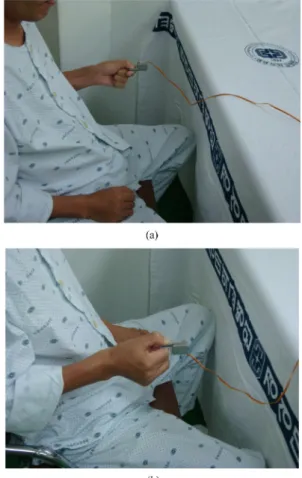
A two-plate pressing test was performed to evaluate the rehabilitation therapy of patients’ fingers. Fig. 5 shows photographs of the characteristics test of the two-plate object pressed by patients with finger paralysis using the TFFMS, The tests were performed by four male and four female patients.

The first standard method of the evaluation of rehabilitation therapy is to estimate the finger pressing force of patients by applying the finger pressing forces of healthy individuals to the graphs.

Fig. 6 shows the finger pressing forces of male and female patients with finger paralysis. Patients A and B of the four male patients have paralyzed right hands and normal left hands; on the other hand, patients C and D had paralyzed left hands and normal left hands. Female patients with similar conditions were chosen.

To evaluate the rehabilitation therapy of patients’ fingers, the finger pressing forces of eight patients are shown in the graphs of Figs. 4(a) and (b). Fig. 6(a) shows the graphs of the finger pressing forces of four male patients with finger paralysis added to the graph of the pressing forces in Fig. 4(a), and Fig. 6(b) shows that of the four females added to the graph from Fig. 4(b).

As shown in Fig. 6(a), the pressing force of the left hand of

patient B was larger than the average force, but that of the right hand with paralyzed fingers was much less than the minimum force of healthy individuals. The pressing force of the left hand of patient A was similar to the average force, but that of the right hand was much less than the minimum force. Therefore, it was roughly assessed that the rehabilitations of the right hands of patients A and B were not complete and that the rehabilitation of the left hand of patient C was almost complete but that of patient D was not complete. As shown in Fig. 6(b), it was assessed that the rehabilitation of the left hand of patient C was almost complete because that of the right hand was closer the average force and that of the left hand was close to the minimum force of healthy people. However, the rehabilitation of the right hands of patients A and B and that of the left hand of patient D was not complete. The results were in accordance with the diagnosis of a medical specialist in that field.

Rehabilitation therapy is evaluated by comparing the measured pressing forces of patients’ paralyzed fingers with the pressing forces of healthy adults, as shown in Fig. 6.

To evaluate the rehabilitation therapy of the left-handed patient Fig. 5. Characteristic test of finger patients with finger paralysis uti-

lizing the TFFMS; (a) Left hand and (b) right hand.

(4)

(where the force of the left hand is greater than that of the right hand), the pressing force graph of the left hand could be used in the first graph, and that of the right hand could be used in the second graph in Figs. 4(a) and (b). It is shown that the finger pressing forces of left-handed patients and right-handed patients

are almost similar.

The second standard method for the evaluation of rehabilitation therapy is as follows: the pressing forces of paralyzed fingers are calculated from those of normal fingers, and the measured pressing forces of paralyzed fingers are compared to the calculated forces. Therefore, the rehabilitations of patients with finger paralysis can be evaluated in a more quantitative manner.

The calculated pressing forces of paralyzed fingers can be obtained from Equations (1) and (2).

(1)

(2)

where F CL is the calculated pressing force of the paralyzed left- hand fingers, F CR is the calculated pressing force of the paralyzed right-hand fingers, F La is the average pressing force of a healthy adult’s left-hand fingers, F Ra is the average pressing force of a healthy individual’s right-hand fingers, F Lm is the measured pressing force of the left-hand fingers of a patient with finger paralysis, and F Rm is the measured pressing force of the right-hand fingers of a patient with finger paralysis.

Tables 1 and 2 show the calculated pressing forces of patients with paralyzed fingers and the estimated effectiveness of rehabilitation therapy for male and female patients, respectively.

The estimated effectiveness of the rehabilitation therapy for male patients A, B, C, and D was approximately 32, 40, 28, and 54%, respectively. The estimated effectiveness of the rehabilitation therapy for female patients A, B, C, and D was approximately 22, 24, 50, and 25%, respectively. Therefore, it was

F

CL

F

La

( F

Ra

– F

Rm

) F

La

F

Ra

---

× –

=

F

CR

F

Ra

( F

La

– F

Lm

) F

Ra

F

La

---

× –

=

Fig. 6. Finger pressing force of male and female patients with finger paralysis; (a) Pressing force of males and (b) pressing force of females.

Table 1. Calculated pressing forces of patients with paralyzed fingers and estimated effectiveness of rehabilitation therapy for male patients No. Average force (N) Pressing force (N) Calculated force(N) Extent of rehabilitation

(%) Stronger hand

F

Ra

F

La

F

Rm

F

Lm

F

CR

F

CL

A 60 55 18 51 56 - 32 Right hand

B 60 55 28 63 69 - 40 Right hand

C 55 60 52 16 - 57 28 Left hand

D 55 60 62 37 - 68 54 Left hand

Table 2. Calculated pressing forces of patients with paralyzed fingers and estimated effectiveness of rehabilitation therapy for female patients No. Average force (N) Pressing force (N) Calculated force(N) Extent of rehabilitation

(%) Stronger hand

F

Ra

F

La

F

Rm

F

Lm

F

CR

F

CL

A 44 38 9 36 42 - 22 Right hand

B 44 38 13 47 54 - 24 Right hand

C 38 44 45 26 - 52 50 Left hand

D 38 44 38 11 - 44 25 Left hand

(5)

determined that male patient D and female patient C had nearly recovered by more than 50%. The difference between the first and second evaluations is that the first makes rough estimates and the second evaluation is quantitatively assessed.

4. CONCLUSION

In this paper, two standard methods for the evaluation of rehabilitation therapy for patients with finger paralysis were presented utilizing the TFFMS [7]. The first standard method of the evaluation of rehabilitation therapy is to estimate the finger pressing force of patients by applying it to the graphs made from the finger pressing forces of normal patients. The second standard method is to estimate the measured finger pressing force of a paralyzed hand compared to the calculated finger pressing force of a paralyzed hand. It was confirmed that the rehabilitation results for patients obtained using the two standard methods of the evaluation were similar to those of a medical specialist. It is believed that the two standard methods of the evaluation can be used to assess rehabilitation therapy for patients with finger paralysis utilizing the TFFMS.

ACKNOWLEDGMENTS

This research was supported by the Basic Science Research Program through the National Research Foundation of Korea (NRF) funded by the Ministry of Education (2012R1A1A2A10041417).

REFERENCES

[1] S. Li, F. Danion, M. L. Latash, J. M. Li, and V. M. Zat- siorsky, “Bilateral deficit and symmetry in finger force pro- duction during two-hand multifinger tasks”, Exp. Brain Res., Vol. 141, pp. 530-540, 2001.

[2] S. A. Mascaro and H. H. Asada, “Measurement of finger posture and three-axis fingertip touch force using fingernail sensors”, IEEE Transctions on Robotics and Automation, Vol. 20, No. 1, pp. 26-35, 2004.

[3] J. W. Lee and K. Rim, “Measurement of finger joint angles and maximum finger forces during cylinder grip activity”, J. Biomed. Eng., Vol. 13, No. 2, pp. 152-162, 1991.

[4] S. Olandersson, H. Lundqvist, M. Bengtsson, M. Lundahl, A. J. Baerveldt, and M. Hilliges, “Finger-force measure- ment-device for rehabilitation”, Proceedings of the 2005 IEEE 9th International Conference on Rehabilitation Robotics, Chicago, IL, USA, June 28 - July 1, pp. 135-138, 2005.

[5] H. M. Kim, J. W. Yoon, H. S. Shin, and G. S. Kim, “Devel- opment of finger-force measuring system with six-axis force/moment sensor for measuring a spherical-object grasping force”, Korean Society Precision Engineering, Vol.

27, No. 11, pp. 37-45, 2010.

[6] G. S. Kim, H. M. Kim, J. W. Yoon, and H. S. Shin, “Devel- opment of cylindrical-type finger force measuring system using force sensors and its characteristics evaluation”, Mech. Syst. Signal Proc., Vol. 27, pp. 513-522, 2012.

[7] H. M. Kim, H. S. Shin, J. W. Yoon, and G. S. Kim, “Devel-

opment of two-finger force measuring system to measure

two-finger gripping force and its characteristic evaluation”,

J. Sensor Sci. & Tech., Vol. 22, No. 3, pp. 25-29, 2011.

수치

Fig. 1 shows the finger force-measuring principles by the pressing of two plates. If the fingers (thumb and forefinger) apply force to the force sensor in force sensor housing, as shown in Fig
Fig. 4. Graphs of results of pressing force (N); (a) Pressing force of males and (b) pressing force of females.
Fig. 3 shows the experimental setup for measuring the finger pressing force; it is composed of the system and a computer.
Fig. 6. Finger pressing force of male and female patients with finger paralysis; (a) Pressing force of males and (b) pressing force of females.

참조

관련 문서