Comparison of the Spiritual Needs of Terminal Cancer Patients and Their Primary Family Caregivers
Kyung-Ah Kang, R.N., Ph.D. and Youngsim Choi, R.N., M.S.*
College of Nursing, Sahmyook University, Seoul, *Palliative care nurse, Hospice Unit, Chungnam National University Hospital, Daejeon, Korea
Purpose: This study was conducted to examine differences in Spiritual Interests Related to Illness Tool (SpIRIT) scores and the degree of spiritual needs (SNs) between patients with terminal cancer and their primary family caregivers and to compare spiritual needs between them. Methods: The study participants were inpatients with terminal cancer and their primary family caregivers at 40 national hospice centers. The final analysis included 120 SpIRIT surveys from patients and 115 from family members, and 99 SNs questionnaires from patients and 111 from family members. Data analysis was conducted using descrip- tive statistics, the t-test, one-way analysis of variance, and Pearson correlation coefficients.
Results: There were no significant between-group differences in SpIRIT scores or SNs. The SpIRIT sub-dimensions that ranked high for both patients and primary family caregivers were “maintaining positive perspective”, “loving others”, and “finding meaning”. The SNs sub-dimensions were ranked identically in both groups, in the order of “love and connec- tion”, “hope and peace”, “meaning and purpose”, respectively. In both groups, the recog- nition of the importance of spiritual matters and religion were major factors influencing SpIRIT scores and SNs. Conclusion: The SpIRIT scores and degree of SNs of patients with terminal cancer and their primary family caregivers were found to be very closely related, and the needs for coherence and meaning were greater than religious needs. When provid- ing spiritual care for patients with terminal illness, family members should also be consid- ered, and their prioritization of spiritual needs and the importance of spiritual matters and religion shall be taken into account.
Key Words: Terminal care, Patient, Family, Spirituality, Needs assessment
Received December 19, 2019 Revised February 7, 2020 Accepted February 9, 2020
Correspondence to Kyung-Ah Kang
ORCID: https://orcid.org/0000-0002- 3799-9554
E-mail: [email protected] This work was supported by the National Research Foundation of Korea (NRF) grant funded by the Korea government (MSIT) (2017R1A2B1009570).
pISSN 1229-1285•eISSN 2287-6189
This is an Open Access article distributed under the terms of the Creative Commons Attribution Non-Commercial License (http://creativecommons.org/licenses/by-nc/4.0/) which permits unrestricted non-commercial use, distribution, and reproduction in any medium, provided the original work is properly cited.
Copyright © 2020 by Korean Society for Hospice and Palliative Care
INTRODUCTION
1. Background
Spiritual well-being is an important component of health care for patients with terminal cancer and their family mem- bers, with impacts on outcomes including quality of life, posi- tive coping, care satisfaction, and decision-making in the last
days of life [1,2]. Spiritual needs increase when people face life-threatening conditions such as terminal cancer, and the spiritual dimension provides important resources when people face physical, psychological, and social pain and struggles that they cannot avoid [2,3].
Human beings are holistic in that their physical, psychologi- cal, and spiritual aspects are organically connected [4] and form an open system that continuously interacts with the en-
www.kjhpc.org
vironment. Therefore, the spiritual needs of terminal cancer patients are closely tied to those of their family members. To provide more effective spiritual care, the spiritual needs of pa- tients and their family members should be considered simul- taneously. Family members provide important resources for patient care by directly influencing recovery, coping with the disease, and facilitating difficult therapeutic processes [5].
In order to understand the spiritual needs of participants in a more realistic manner, the spiritual interests related to illness of both care receivers and care providers should be evaluated [6].
Taylor [7] recommended using the term “interest” when dis- cussing the spiritual needs of patients with terminal cancer and their family members from the perspective of care recipients’, since the term “need” implies a lack and could be interpreted negatively. She also suggested that since the spiritual interests of terminal patients and their family members are intercon- nected, when assessing the spiritual needs of terminal patients, it is important to assess the requirements of patients and fam- ily members simultaneously. Versions of the Spiritual Interests Related to Illness Tool (SpIRIT) for patients and family care- givers have been developed to measure their needs simultane- ously [7].
At the same time, the spiritual dimension, unique to hu- man beings, influences the condition of the body and mind [8]. With the progression of the disease, the interests of pa- tients with terminal illness move from pain and suffering to the meaning of suffering, the meaning of life, and the meaning of death [9]. Extant measurement tools for spiritual needs are based on spiritual characteristics of the general population;
therefore, they are limited in assessing the specific needs of patients with terminal illness [10]. Moreover, these tools are usually developed in Western countries, and considering that spiritual matters are influenced by family, environment, and culture, a tool that is appropriate in the Korean cultural con- text is needed to assess participants’ spiritual needs adequately [11].
Previous research has employed diverse measurement tools to assess spiritual needs. However, since the spiritual dimen- sion is a core health resource for providing spiritual well-being to terminal patients near death and their family members, the lack of research simultaneously measuring SpIRIT scores in patients with terminal cancer and their family members and
comparing their spiritual needs (SNs) with a tool developed based on the Korean cultural context is a major lacuna. In or- der to provide patient-centered spiritual care, it is also neces- sary to understand and compare the priorities of patients’ and families’ needs in terms of the sub-dimensions of SpIRIT and SNs.
2. Purpose
The aim of this study was to compare the SpIRIT scores and the degree of SNs of patients with terminal cancer and their family members in order to understand their needs for spiritual needs and to provide foundational information for patient- centered spiritual care. The specific study aims were as fol- lows:
1) To identify the sociodemographic and disease- and spiri- tual needs-related characteristics of patients with terminal cancer and their family members;
2) To identify differences in SpIRIT scores and the degree of SNs according to the sociodemographic and disease- and spiritual needs-related characteristics of patients with terminal cancer and their family members;
3) To identify differences in sub-dimensions of SpIRIT scores, their relative ranking, and the degree of SNs between patients with terminal cancer and their family members;
4) To identify the correlations between the sub-dimensions of SpIRIT and SNs among patients with terminal cancer and their family members.
5) To identify the factors that influence SpIRIT scores and SNs among patients with terminal cancer and their family members.
METHODS
1. Study design
This comparative study was conducted to shed light on dif- ferences between Spiritual Interests Related to Illness (SpIRIT) scores and the degree of spiritual needs (SNs) in order to un- derstand the spiritual needs of patients with terminal cancer and their family members.
2. Subjects
The study population comprised inpatients with terminal cancer at 40 national hospice centers who gave permission for data collection, as well as their family members. The inclusion criteria were: 1) patients who had been admitted to a national hospice center after being diagnosed with terminal cancer and their family members (primary caregivers), 2) those who pro- vided written consent to participate in the study, and 3) those who could understand and respond to the survey. Sample size calculation using G*Power version 3.1 for the 2-sided t-test with significance level of 0.05, power of 0.95, and effect size of 0.80 [10,11] resulted in a sample size of 42 per group. Thus, the sample size of this study was regarded as adequate.
Patients with terminal cancer and their family members may not be physically and psychologically vigorous enough to complete long surveys. Therefore, to reduce the dropout rate and to improve the accuracy of survey responses, the centers were divided into 2 groups (20 centers in each group) by con- venience sampling, which took into consideration the con- venience of data collection regarding the number of items on
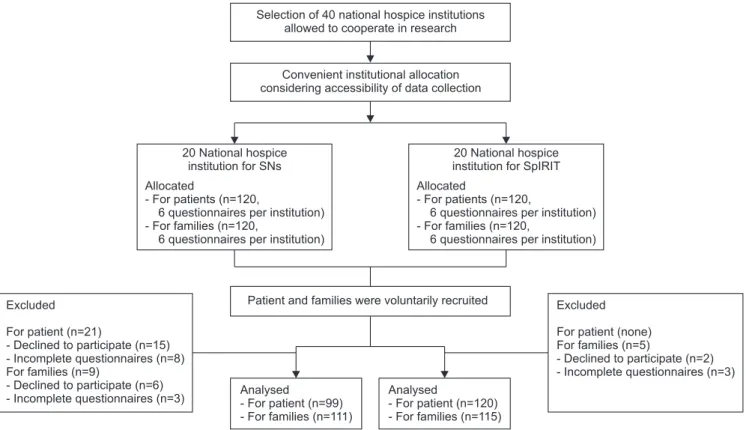
the survey and the circumstances at each center. At the first 20 centers, 120 SpIRIT surveys each were distributed to patients and families (6 patients and 6 family members at each center), and at the remaining 20 centers, SNs surveys were distributed in the same manner. At the 20 centers where SpIRIT surveys were distributed, 120 surveys were completed by patients and 118 surveys were completed by family members, of which 120 surveys from patients and 115 surveys from family members were included in the final analysis. At the 20 centers where SNs surveys were distributed, 105 surveys were completed by patients and 114 surveys were completed by family members, of which 99 surveys from patients and 111 surveys of family members were included in the final analysis (Figure 1).
3. Study tools
1) Sociodemographic and disease- and spiritual needs- related characteristics
The same sociodemographic and disease- and spiritual needs-related characteristics were measured in participants who completed the SpIRIT survey and those who completed the SNs survey. Information was gathered on the general char-
Figure 1. The sampling schema of the present study.
SNs: spiritual needs, SpIRIT: spiritual interests related to illness tool.
Excluded
For patient (n=21)
- Declined to participate (n=15) - Incomplete questionnaires (n=8) For families (n=9)
- Declined to participate (n=6) - Incomplete questionnaires (n=3)
Excluded
For patient (none) For families (n=5)
- Declined to participate (n=2) - Incomplete questionnaires (n=3) Analysed
- For patient (n=99) - For families (n=111)
Analysed
- For patient (n=120) - For families (n=115) Patient and families were voluntarily recruited 20 National hospice
institution for SNs Allocated
- For patients (n=120,
6 questionnaires per institution) - For families (n=120,
6 questionnaires per institution)
20 National hospice institution for SpIRIT Allocated
- For patients (n=120,
6 questionnaires per institution) - For families (n=120,
6 questionnaires per institution) Convenient institutional allocation
considering accessibility of data collection Selection of 40 national hospice institutions
allowed to cooperate in research
www.kjhpc.org
acteristics of the patients with terminal cancer and their family members, including age, gender, marital status, relationship to the patient (only for family members), education level, religion, and average monthly income. The disease-related characteris- tics measured were diagnosis, time since diagnosis, and physi- cal, psychological, and economic suffering due to the disease (using a 5-point Likert scale). The spiritual needs-related characteristics measured were importance of spiritual matters and religion (5-point Likert scale) and spiritual support (mul- tiple choice).
2) Spiritual Interests Related to Illness
The Spiritual Interests Related to Illness Tool (SpIRIT) ques- tionnaire was developed by Taylor [7] to measure the spiri- tual interests of patients with terminal cancer and their family members The translated tool with the permission of the de- veloper was tested content validity. This tool was developed to simultaneously measure the needs of patients and family members, and it measures “interests” rather than “needs” to prevent unintentional negative judgements of the participants.
The tool is structured in 8 sub-dimensions (relating to God, loving others, receiving love and spiritual support, finding meaning, maintaining positive perspective, preparing for death, reevaluating beliefs and life, and asking “why?”) and contains 42 items that are answered using a 5-point Likert scale, with higher scores indicating greater spiritual interest related to ill- ness. The Cronbach’s alpha of this tool was 0.95 in Taylor’s original study [7], and the Cronbach’s alpha in this study was 0.95.
3) Spiritual needs
In order to measure the spiritual needs (SNs) of patients with terminal illness, the SNs tool developed by Yong et al. [11]
for adult patients with cancer was used with the permission of the developer. The tool is structured in 5 sub-dimensions (relationship with God, meaning and purpose, acceptance of dying, hope and peace, and love and connection) and contains 26 items that are answered using a 5-point Likert scale, with higher scores indicating greater SNs. The Cronbach’s alpha of this tool in the study of Yong et al. [8] was 0.92, and the Cronbach’s alpha of this tool in this study was 0.93.
In order to measure the SNs of family members, the SNs
measurement tool developed by Yong et al. [11] was revised and adapted to adequately measure the SNs of family members of cancer patients. The validity and reliability of the revised tool were assessed before administering it [12]. Its content va- lidity was assessed by 4 hospice and palliative care nurses, 1 nursing professor, and 1 hospice doctor, and the content va- lidity index coefficients of each item were greater than or equal to 80%. The tool comprises 26 items scored on a 5-point Lik- ert scale, with higher scores indicating greater SNs. The Cron- bach’s alpha of this tool in the study by Kang et al. [12] was 0.94, and the Cronbach’s alpha of this tool in this study was 0.95.
4. Data collection
This study was approved by the ethical review board of S university (IRB-2017040HR) and was conducted from No- vember 5 to December 28, 2017 at 40 national hospice cen- ters, which gave permission for data collection. The researcher visited the National Council of Hospice Centers and explained the purpose of the research. With the support from the presi- dent of the council, the consent and cooperation of hospice centers were obtained. The aim and purpose of the study were explained to the hospice team leaders at the participating cen- ters, and the surveys were mailed to the participating centers with a small gift. The hospice team leader or the hospice nurse of each center evaluated the physical condition of their patients and explained the research aims, data collection method, and data confidentiality to eligible participants. Written consent was obtained from patients who volunteered to participate in the research, and the participants completed the surveys. It was explained to the participants that they could withdraw from the study at any point. The completed surveys were mailed back to the researcher.
5. Data analysis
The collected data were analyzed using SPSS for Windows version 25.0 (IBM Corp., Armonk, NY, USA).
1. Descriptive statistics such as percentiles, means, and stan- dard deviations were calculated for the participants’ sociode- mographic and disease- and spiritual needs-related charac- teristics and other study variables.
2. Differences in study variables according to the sociodemo-
Table 1. Sociodemographic, Disease, and Spiritual-Related Characteristics of the Study Participants.
Characteristics Categories Patients (N=226) Primary family
caregivers (N=219) t / χ2 P
N (%) or Mean±SD N (%) or Mean±SD Sociodemographic characteristics
Age (yr) 64.06±12.43 52.17±15.29 8.93 <0.001
<50 26 (12.1) 86 (38.6) 58.88 <0.001
50~59 56 (26.2) 64 (28.7)
60~69 56 (26.2) 48 (21.5)
≥70 76 (35.5) 25 (11.2)
Gender Female 102 (46.8) 170 (75.6) 40.51 <0.001
Male 116 (53.2) 54 (24.0)
Marital status Never married 12 (5.5) 34 (15.3) 27.99 <0.001
Married 164 (75.2) 176 (79.3)
Separated/Divorced 18 (8.2) 5 (2.3)
Widowed/Bereaved 24 (11.0) 7 (3.2)
Relationship with patients Spouse - 91 (40.4) - -
Child - 66 (29.3) - -
Parent - 33 (14.7) - -
Other family - 35 (15.6) - -
Education level Middle school 57 (27.8) 29 (13.2) 23.25 <0.001
High school 96 (46.8) 95 (43.4)
Bachelor’s degree 49 (23.9) 82 (37.4)
Graduate 3 (1.5) 13 (5.9)
Religion Protestant 70 (32.4) 69 (30.8) 0.30 0.990
Catholic 35 (16.2) 37 (16.5)
Buddhist 40 (18.5) 44 (19.6)
Other/None 71 (32.9) 74 (33.0)
Average monthly income (chon won) <1,999 86 (43.0) 66 (30.3) 10.66 0.014
2,000~3,999 80 (40.0) 91 (41.7)
4,000~5,999 24 (12.0) 39 (17.3)
>6,000 10 (5.0) 22 (10.1)
Disease-related characteristics Patient’s diagnosis based on site of the primary cancer
Biliary and pancreatic cancer 33 (17.4) 35 (17.6) - -
Small and large intestine cancer
29 (15.3) 26 (13.1) - -
Lung cancer 25 (13.2) 39 (19.6) - -
Urogenital cancer 21 (11.1) 26 (13.1) - -
Liver cancer 19 (10.0) 27 (13.6) - -
Stomach cancer 19 (10.0) 17 (8.5)
Breast cancer 13 (6.8) 10 (5.0)
Blood and lymphatic cancer 5 (2.6) 5 (2.5)
Brain and spinal cancer 2 (1.1) 5 (2.5) - -
Others 24 (12.5) 14 (7.0) - -
Time since diagnosis (mo) 38.79±48.09 28.86±32.72 2.50 0.013
Degree of suffering due to illness (or patient’s illness) (5-point scale*)
Physical suffering 3.98±1.14 3.38±1.08 5.63 <0.001
Psychological suffering 3.80±0.92 3.77±0.90 0.32 0.746
Economic suffering 3.24±1.01 2.97±0.94 2.90 0.004
www.kjhpc.org
graphic and disease- and spiritual needs-related characteris- tics of study participants were analyzed through the t-test and one-way analysis of variance.
3. Differences in study variables between patients with termi- nal cancer and their family members were analyzed using the t-test.
4. Correlations between the sub-dimensions of study vari- ables in patients with terminal cancer and in their family members were analyzed using Pearson correlation coefficients.
5. Factors that influenced study variables in patients with terminal cancer and their family members were analyzed using multiple regression.
RESULTS
1. Sociodemographic and disease- and spiritual needs-related characteristics of the study participants
The sociodemographic characteristics demonstrated signifi- cant differences between patients and family members were age (P<0.001), gender (P<0.001), marital status (P<0.001), education level (P<0.001), average monthly income (P=0.014) (Table 1). Patients’ average age was around 12 years older than that of their family members, and 53.2% of the patients were male and 46% were female, while 75.6% of the caregivers
were female and 24.0% were male. The percentage of mar- ried participants was high in both groups (75.2% of patients and 79.3% of family members). In the patients group, 46.8%
had graduated from high school, 27.8% had graduated from middle school, and 23.9% had graduated from university. In contrast, 43.4% of family members had graduated from high school, 37.4% had graduated from university, and 13.2% had graduated from middle school. There was no significant dif- ference in religious affiliations between the 2 groups, and there was a high proportion of Protestants in the sample, with 32.4% and 30.8% of patients and family members identifying as Protestants, respectively. In terms of average monthly in- come, 43.0% of patients reported an average monthly income of less than 2,000,000 won, and 40.0% of patients reported an income between 2,000,000 and 3,000,000 won. Among family members, 41.7% reported an income between 2,000,000 and 3,000,000 won, and 30.0% reported an income of less than 2,000,000 won.
Biliary and pancreatic cancer was the most prevalent diag- nosis of the patients. There was a significant difference in the reported duration since the cancer diagnosis between the pa- tients and the family members (P=0.013). Regarding the levels of physical, psychological, and economic suffering due to the illness, which were measured on a 5-point Likert scale, sig- nificant differences were found in physical suffering (P<0.001) and economic suffering (P=0.004) between the patients and Table 1. Continued.
Characteristics Categories Patients (N=226) Primary family
caregivers (N=219) t / χ2 P
N (%) or Mean±SD N (%) or Mean±SD Spiritual needs-related characteristics
How important are spiritual matters to you now? (5-point scale†)✝
3.57±1.10 3.50±1.19 0.70 0.486
How important is religion to you now?
(5-point scale†)✝
3.56±1.03 3.47±1.26 0.74 0.458
Spiritual caregiver (multiple choice) Spouse 110 (50.7) 78 (34.8)
Parents 16 (7.4) 71 (31.7)
Children 101 (46.5) 63 (28.1)
Physicians 50 (23.0) 44 (19.6)
Nurses 55 (25.3) 40 (17.9)
Religious leaders 99 (45.6) 68 (30.4)
Others 23 (10.6) 42 (18.8)
*1=not at all; 2=mild; 3=moderate; 4=severe; 5=very severe, †1=not at all; 2=a little bit; 3=some; 4=quite a bit; 5=a great deal.
Table 2. Differences in SpIRIT and SNs by Participants’ Sociodemographic, Disease, and Spiritual Needs-Related Characteristics. Characteristics
SpIRIT (5-point scale)SNs (5-point scale) Patients (N=120)Primary family caregivers (N=115)Patients (N=99)Primary family caregivers (N=111) Mean±SDt/F(P) (Scheffe)Mean±SDt/F(P) (Scheffe)Mean±SDt/F(P) (Scheffe)Mean±SDt/F(P) (Scheffe) Sociodemographic characteristics Age (yr)<503.99±0.391.37 (0.257)3.91±0.490.34 (0.807)3.87±0.530.65 (0.583)3.99±0.500.36 (0.783) 50~593.75±0.413.88±0.443.71±0.594.10±0.53 60~693.70±0.523.95±0.613.89±0.584.06±0.71 ≥703.89±0.694.06±0.523.94±0.553.91±0.81 GenderFemale3.81±0.570.13 (0.901)3.71±0.52-2.71 (0.008)3.92±0.570.91 (0.364)3.97±0.44-0.46 (0.650) Male3.83±0.524.00±0.473.82±0.564.03±0.66 Marital statusNever marrieda 3.61±0.540.10 (0.982)3.72±0.454.69 (0.004)3.76±0.662.93 (0.025)3.86±0.560.47 (0.702) Marriedb3.82±0.513.92±0.47a,b<c3.88±0.514.05±0.64 Separated/Divorcedc3.86±0.655.00±0.003.65±0.574.12±0.43 Widowed/Bereavedd 3.84±0.684.11±0.024.24±0.594.08±0.47 Relationship with patientsSpouse--3.95±0.570.67 (0.578)--4.02±0.660.03 (0.993) Child--3.84±0.44--3.99±0.64 Parent--3.99±0.39--4.04±0.55 Other family--4.01±0.48--4.03±0.57 Education levelMiddle school3.89±0.461.49 (0.221)3.66±0.612.20 (0.092)3.84±0.570.25 (0.863)3.85±0.951.56 (0.205) High school3.74±0.563.90±0.503.92±0.614.01±0.51 Bachelor’s degree3.88±0.493.95±0.483.83±0.454.02±0.51 Graduate4.40±0.204.27±0.283.65±0.004.46±0.41 ReligionProtestant4.05±0.535.86 (<0.001)4.18±0.449.33 (<0.001)4.15±0.4110.58 (<0.001)4.36±0.396.44 (<0.001) Catholic4.00±0.454.10±0.444.31±0.51a,b>d4.14±0.57a>c,d Buddhist3.60±0.473.89±0.323.59±0.53a,b>c3.87±0.57 Other/ None3.58±0.523.58±0.453.57±0.533.72±0.69 Average monthly income (chon won)<1,999a 3.81±0.550.59 (0.623)3.91±0.513.60 (0.016)3.87±0.640.19 (0.902)4.06±0.690.14 (0.939) 2,000~3,999b3.84±0.573.80±0.49b<d3.84±0.494.02±0.61 4,000~5,999c 3.63±0.364.01±0.494.00±0.493.96±0.56 >6,000d 3.79±0.414.25±0.293.90±0.654.07±0.35 Disease-related characteristics Physical sufferingNot at all3.04±0.000.49 (0.782)4.04±0.550.96 (0.449)3.79±0.480.83 (0.481)4.02±0.211.39 (0.241) Mild3.86±0.553.83±0.413.82±0.714.01±0.66 Moderate3.83±0.523.83±0.463.81±0.514.00±0.53 Severe3.79±0.594.03±0.564.02±0.533.89±0.74 Very severe3.85±0.484.00±0.463.87±0.574.33±0.52
www.kjhpc.org
Table 2. Continued. Characteristics
SpIRIT (5 scales)SNs (5 scales) Patients (N=120)Primary family caregivers (N=115)Patients (N=99)Primary family caregivers (N=111) Mean±SDt/F(P) (Scheffe)Mean±SDt/F(P) (Scheffe)Mean±SDt/F(P) (Scheffe)Mean±SDt/F(P) (Scheffe) Psychological sufferingNot at all3.77±1.031.12 (0.356)4.28±0.532.17 (0.096)-1.15 (0.334)3.98±0.030.97 (0.427) Mild4.09±0.513.87±0.524.12±0.603.59±1.64 Moderate3.69±0.503.93±0.423.76±0.704.03±0.49 Severe3.84±0.533.84±0.483.84±0.483.97±0.52 Very severe3.82±0.543.92±0.493.40±0.514.17±0.69 Economic sufferingNot at all3.49±0.542.04 (0.094)3.78±0.441.51 (0.203)3.82±0.860.74 (0.587)3.96±0.230.23 (0.924) Mild3.94±0.403.89±0.563.97±0.474.10±0.62 Moderate3.88±0.573.98±0.473.79±0.663.98±0.69 Severe3.64±0.533.97±0.363.85±0.434.11±0.59 Very severe3.82±0.543.42±0.764.09±0.593.99±0.45 Spiritual needs-related characteristics How important are spiritual matters to you now?
Not at alla 3.02±0.3119.51(<0.001)3.31±0.4621.34(<0.001)2.98±0.5015.45 (<0.001)2.88±1.2219.91 (<0.001) A little bitb3.38±0.51a,b,c,d<e3.58±0.25a,b,c,d<e3.38±0.43a,b,c<e3.57±0.46a,b,c<e Somec 3.63±0.46a,b<d3.81±0.40a,b<d3.69±0.52a,b<d3.87±0.38a,b<d Quite a bitd 3.92±0.393.99±0.37a<c4.01±0.39a<c4.12±0.40a<c A great deale 4.34±0.354.44±0.334.30±0.414.46±0.39 How important is religion to you now?Not at alla 3.31±0.7618.66(<0.001)3.40±0.5514.61 (<0.001)3.06±0.5815.74 (<0.001)3.08±1.1119.51 (<0.001) A little bitb3.40±0.48a,b,c,d<e3.65±0.48a,b,c<e3.35±0.44a,b,c<e3.80±0.43a,b,c<e Somec3.59±0.37b<d3.76±0.36a<d3.68±0.51a,b<d3.81±0.43a<b,c,d Quite a bitd 3.87±0.444.00±0.334.02±0.364.10±0.36 A great deale 4.37±0.304.31±0.404.31±0.434.50±0.35 SNs: spiritual needs, SpIRIT: spiritual interests related to illness tool.
the family members.
Regarding the spiritual needs-related characteristics, no sig- nificant difference was found in the answer to the question
“How important are spiritual matters to you now?” (5-point Likert scale) (P=0.486), and the average score was greater than 3.5 out of 5 in both groups. There also was no significant dif- ference in responses to the question “How important is religion to you now?” (5-point Likert scale) (P=0.458), and the aver- age score was greater than 3.47 in both groups. For the mul- tiple-choice question about spiritual caregivers, the patients reported that their spouses (50.7%), children (46.5%), religious leaders (45.6%), nurses (25.3%), and doctors (23.0%) were their spiritual caregivers, while the family members reported that their spouses (34.8%), parents (31.7%), religious leaders (30.4%), children (28.1%), doctors (19.6%) and nurses (17.9%) were their spiritual caregivers.
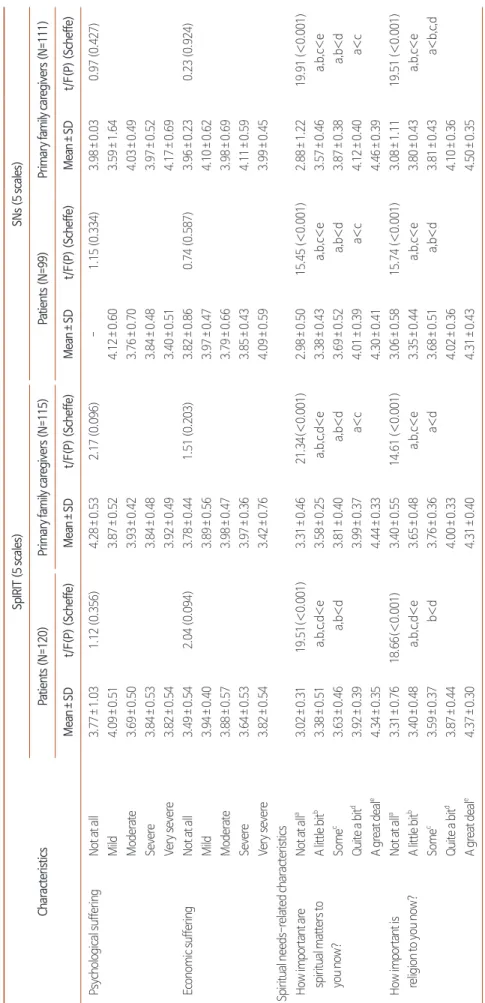
2. Differences in SpIRIT items and SNs by sociodemographic, disease-, and spiritual needs-related characteristics of the participants The SpIRIT items and SNs that demonstrated significant dif- ferences according to the participants’ sociodemographic, dis- ease-, and spiritual needs-related characteristics were religion (P<0.001), the importance of spiritual matters (P<0.001), and the importance of religion (P<0.001) (Table 2). The post-hoc analysis results indicated that SNs were significantly higher among Protestants and Catholics than among Buddhists and participants with no religion. For both the SpIRIT items and SNs, participants who recognized spiritual matters or religion as important had higher spiritual interests related to illness and spiritual needs than those who reported a lower level of rec- ognition.
For the SpIRIT items completed by the family members, sig- nificant differences were found by gender (P=0.008), marital status (P=0.004), and monthly family income (P=0.016), and
Table 3. Comparison of SpIRIT and SNs Sub-Dimensions between Patients and Their Primary Family Caregivers.
Spiritual interests related to illness tool (5-point scale)
Sub-dimensions Patients (N=120) Primary family caregivers
(N=115) t P
Mean±SD Rank Mean±SD Rank
1. Loving others (6 items) 4.05 (0.54) 1 4.13 (0.49) 2 -1.189 0.236
2. Maintaining positive perspective (5 items) 4.03 (0.61) 2 4.23 (0.60) 1 -2.549 0.011
3. Finding meaning (5 items) 3.93 (0.61) 3 4.04 (0.48) 3 -1.538 0.125
4. Preparing for death (4 items) 3.76 (0.72) 4 3.90 (0.55) 5 -1.687 0.093
5. Receiving love and spiritual support (6 items) 3.75 (0.66) 5 3.82 (0.62) 6 -0.771 0.441
6. Reevaluating beliefs and life (4 items) 3.75 (0.68) 5 3.49 (0.67) 8 -2.838 0.005
7. Relating to God (9 items) 3.71 (0.86) 7 3.75 (0.88) 7 -0.366 0.714
8. Asking “why?” (3 items) 3.51 (0.77) 8 3.92 (0.50) 4 0.225 0.822
Total (42 items) 3.82 (0.54) 3.92 (0.50) -1.498 0.136
Spiritual needs (5-point scale)
Sub-dimensions Patients (N=99) Primary family caregivers
(N=111) t P
Mean±SD Rank Mean±SD Rank
Love and connection (2 items) 4.14 (0.70) 1 4.30 (0.74) 1 -1.605 0.110
Hope and peace (5 items) 3.98 (0.64) 2 4.17 (0.63) 2 -2.161 0.032
Meaning and purpose (7 items) 3.90 (0.64) 3 4.16 (0.66) 3 -2.817 0.005
Acceptance of dying (7 items) 3.82 (0.63) 4 3.88 (0.62) 4 -0.747 0.456
Relationship with God (divine, sacred) (5 items) 3.68 (0.96) 5 3.74 (1.06) 5 -0.442 0.659
Total (26 items) 3.87 (0.57) 4.01 (0.61) -1.794 0.074
SNs: spiritual needs, SpIRIT: spiritual interests related to illness tool.
www.kjhpc.org
Table 4. Correlations among Sub-Dimensions of the SpIRIT and SNs. VariablesRGLORLSSFMMPPPDRBLAW r(P)r(P)r(P)r(P)r(P)r(P)r(P)r(P) SpIRIT in patients (n=120) RG1 LO0.530*1 RLSS0.822*0.605*1 FM0.339*0.547*0.447*1 MPP0.447*0.481*0.378*0.358*1 PD0.616*0.615*0.719*0.628*0.389*1 RBL0.652*0.650*0.729*0.657*0.381*0.690*1 AW0.316*0.419*0.358*0.615*0.235**0.447*0.585*1 SpIRIT in primary family caregivers (n=115) RG1 LO0.515*1 RLSS0.848*0.633*1 FM0.332*0.522*0.497*1 MPP0.589*0.626*0.548*0.511*1 PD0.495*0.505*0.594*0.522*0.415*1 RBL0.786*0.596*0.835*0.534*0.523*0.666*1 AW0.1110.369*0.282**0.430*0.1690.419*0.369*1 VariablesRwGMPADHPLC r(P)r(P)r(P)r(P)r(P) SNs in patients (n=99) RwG1 MP0.567*1 AD0.488*0.627*1 HP0.383*0.668*0.640*1 LC0.426*0.499*0.499*0.507*1 SNs in primary family caregivers (n=111) RwG1 MP0.670*1 AD0.499*0.686*1 HP0.479*0.746*0.721*1 LC0.524*0.655*0.644*0.669*1 AD: acceptance of dying, AW: asking “why?”, FM: finding meaning, HP: hope and peace, LC: love and connection, LO: loving others, MP: meaning and purpose, MPP: maintaining positive perspective, PD: preparing for death, RBL: reevaluating beliefs and life, RG: relating to God, RLSS: receiving love and spiritual support, RwG: relationship with God (divine, sacred), SNs: spiritual needs, SpIRIT: spiritual interests related to illness tool. *P<0.001, P<0.05.
post-hoc analysis demonstrated that spiritual interests were higher among those who were separated or divorced than among those who were single or married, and among those who reported a monthly income greater than 6,000,000 won
than among those who reported an income between 2,000,000 to 3,990,000 won.
Table 5. Factors Influencing on SpIRIT and SNs.
SpIRIT
Predictors Patients (n=120) Primary family caregivers (n=115)
B SE β t (P) VIF B SE β t (P) VIF
Constant 3.684 0.134 - 27.589
(<0.001)
- 3.560 0.121 - 29.537
(<0.001) -
Gender D1 (female) -0.116 0.095 -0.108 -1.219
(0.226)
1.443 0.164 0.080 0.145 2.050
(0.043)
1.175
Marital status D1 (Never married)
-0.100 0.308 -0.025 -0.325
(0.081)
1.092 0.149 0.103 0.107 1.445
(0.152)
1.287
Marital status D2 (separated/
divorced)
-0.059 0.163 -0.028 -0.361
(0.719)
1.149 0.727 0.255 0.197 2.845
(0.005)
1.126
Marital status D3 (widowed/
bereaved)
-0.031 0.151 -0.019 -0.208
(0.836)
1.522 0.112 0.268 0.030 0.418
(0.677)
1.237
Family monthly income D1 (<1,999)
-0.136 0.098 -0.124 -1.393
(0.167)
1.467 0.153 0.081 0.142 1.897
(0.061)
1.310
Family monthly income D2 (4,000~5,999)
-0.320 0.134 -0.199 -2.387
(0.019)
1.289 0.318 0.103 0.222 3.095
(0.003)
1.202
Family monthly income D3 (>6,000)
0.136 0.259 0.041 0.524
(0.602)
1.149 0.329 0.116 0.223 2.824
(0.006)
1.458
Religion D1 (Buddhist) 0.006 0.121 0.005 0.050
(0.960)
1.655 0.004 0.104 0.003 0.038
(0.970)
1.559
Religion D2 (None ) 0.174 0.135 0.148 1.287
(0.201)
2.444 -0.148 0.101 -0.143 -1.460
(0.148)
2.249
How important are spiritual matters to you now?
D1 (Not at all) -0.963 0.374 -0.337 -2.575 (0.012)
3.155 -0.747 0.222 -0.474 -3.369
(0.001)
4.625
D2 (A little bit) -0.231 0.145 -0.148 -1.594 (0.114)
1.591 -0.210 0.156 -0.117 -1.348
(0.181)
1.764
D3 (Quite a bit) 0.213 0.160 0.193 1.333
(0.186)
3.854 0.002 0.119 0.002 0.0018
(0.985)
3.075
D4 (A great deal) 0.396 0.240 0.291 1.645 (0.103)
5.761 0.419 0.183 0.335 2.289
(0.024)
5.017
How important is religion to you now?
D1 (Not at all) 0.279 0.321 0.118 0.870
(0.387)
3.419 0.354 0.233 0.216 1.520
(0.132)
4.733
D2 (A little bit) -0.232 0.163 -0.144 -1.419 (0.159)
1.907 0.144 0.137 0.101 1.054
(0.295)
2.136
D3 (Quite a bit) 0.145 0.161 0.131 0.896 (0.373)
3.944 0.196 0.118 0.179 1.657
(0.101)
2.741
D4 (A great deal) 0.450 0.255 0.337 1.768 (0.080)
6.694 0.131 0.164 0.115 0.798
(0.427)
4.853
Statistics R2=.496, Adj R2=.404 R2=.602, Adj R2=.529
F=5.389, P<0.001
Durbin-Watson’ d=1.961 (1.867<d<2.133)
F=8.280, P<0.001
Durbin-Watson’ d=1.821 (1.867<d<2.133)
www.kjhpc.org
3. Differences in SpIRIT scores and SNs and the ranking of their sub-dimensions between patients and their family members
No significant differences were found in SpIRIT items be- tween patients and their family members (P=0.136) (Table 3).
Among the 8 sub-dimensions, those that demonstrated sig- nificant differences between patients and family members were
“maintaining positive perspective” (P=0.011) and “reevaluat- ing beliefs and life” (P=0.005). The sub-dimensions with high scores in both patients and family members were “maintaining positive perspective”, “loving others”, and “finding meaning”
(in descending order), while “relating to God” showed a low score, as it was ranked seventh by both patients and family members.
As shown in Table 4, no significant difference was found in the total average score for SNs between patients and family members (P=0.074). The sub-dimensions that were signifi- cantly different between patients and family members were
“hope and peace” (P=0.032) and “meaning and purpose”
(P=0.005). The order of the sub-dimensions from highest to lowest average scores were: “love and connection”, “hope and peace”, “meaning and purpose”, “acceptance of dying”, and
“relationship with God (divine, sacred).” The order was iden- tical for both patients and family members.
4. Correlations among the sub-dimensions of SpIRIT and SNs in patients and family members
The correlations between the SpIRIT sub-dimensions in the patient group ranged from 0.235 to 0.822, and there was a statistically significant positive correlation (P<0.05) (Table 4).
In the family members, the correlations between “relating to God” and “asking ‘why?’” and between “maintaining positive perspective” and “asking ‘why?’”. All other sub-dimensions showed significant positive correlations, with coefficients ranging from 0.332 to 0.848. The correlations between the SNs sub-dimensions ranged from 0.383 to 0.668 in the patients and from 0.479 to 0.746 in the family members, and these positive correlations were statistically significant (P<0.001).
5. Factors influencing SpIRIT scores and SNs of patients with terminal cancer and their family members.
Before conducting the regression analysis, the presence of autocorrelation in the dependent variables was checked using the Durbin-Watson test, and multicollinearity in the indepen- dent variables was checked with the variance inflation factor (VIF). The Durbin-Watson statistic (d) was within the range that indicates independence (dU<d<4-dU [1.867<d<2.133]) and was close to 2, suggesting the absence of autocorrelation.
The VIF statistic was below 10, indicating that the data were adequate for regression analysis since there was no multicol- linearity in the independent variables (Table 5).
The factors that had a negative influence on SpIRIT scores among patients were “spiritual matters are not important” (β
=-0.337, P=0.012) and a household income between KRW 4,000,000 and 6,000,000 (β=-0.199, P=0.019), and these two factors explained 40.4% of the variation in SpIRIT scores.
Among family members, the factors that had a positive influ- ence on SpIRIT scores were “spiritual matters are very impor- tant” (β=0.335, P=0.024), a household income above KRW 6,000,000 (β=0.223, P=0.006), a household income between KRW 4,000,000 and 6,000,000 (β=0.222, P=0.003), being separated or divorced (β=0.197, P=0.005), and female gender (β=0.145, P=0.043). The factor that had a negative influ- ence was “spiritual matters are not important” (β=-0.474, P=0.001), and these factors collectively explained 52.9% of the variation in SpIRIT scores among family members.
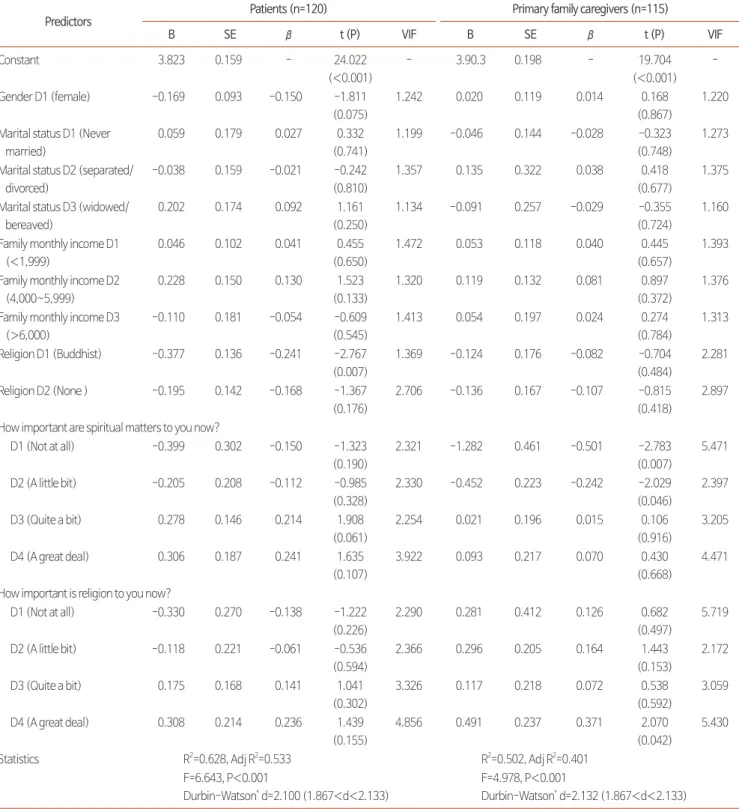
Among patients, SNs were negatively associated with Bud- dhist religion (β=-0.241, P=0.007), and this factor explained 53.3% of the variation. Among family members, negative in- fluences were found between SNs and “spiritual matters are not important” (β=-2.783, P=0.007) and “spiritual matters are a little important” (β=-2.029, P=0.046), and a positive influence was found between SNs and “religion is very impor- tant” (β=2.070, P=0.042). These factors explained 40.1% of the variation.
Table 5. Continued.
SNs
Predictors Patients (n=120) Primary family caregivers (n=115)
B SE β t (P) VIF B SE β t (P) VIF
Constant 3.823 0.159 - 24.022
(<0.001)
- 3.90.3 0.198 - 19.704
(<0.001) -
Gender D1 (female) -0.169 0.093 -0.150 -1.811
(0.075)
1.242 0.020 0.119 0.014 0.168
(0.867)
1.220
Marital status D1 (Never married)
0.059 0.179 0.027 0.332
(0.741)
1.199 -0.046 0.144 -0.028 -0.323
(0.748)
1.273
Marital status D2 (separated/
divorced)
-0.038 0.159 -0.021 -0.242
(0.810)
1.357 0.135 0.322 0.038 0.418
(0.677)
1.375
Marital status D3 (widowed/
bereaved)
0.202 0.174 0.092 1.161
(0.250)
1.134 -0.091 0.257 -0.029 -0.355
(0.724)
1.160
Family monthly income D1 (<1,999)
0.046 0.102 0.041 0.455
(0.650)
1.472 0.053 0.118 0.040 0.445
(0.657)
1.393
Family monthly income D2 (4,000~5,999)
0.228 0.150 0.130 1.523
(0.133)
1.320 0.119 0.132 0.081 0.897
(0.372)
1.376
Family monthly income D3 (>6,000)
-0.110 0.181 -0.054 -0.609
(0.545)
1.413 0.054 0.197 0.024 0.274
(0.784)
1.313
Religion D1 (Buddhist) -0.377 0.136 -0.241 -2.767 (0.007)
1.369 -0.124 0.176 -0.082 -0.704
(0.484)
2.281
Religion D2 (None ) -0.195 0.142 -0.168 -1.367
(0.176)
2.706 -0.136 0.167 -0.107 -0.815
(0.418)
2.897
How important are spiritual matters to you now?
D1 (Not at all) -0.399 0.302 -0.150 -1.323 (0.190)
2.321 -1.282 0.461 -0.501 -2.783
(0.007)
5.471
D2 (A little bit) -0.205 0.208 -0.112 -0.985 (0.328)
2.330 -0.452 0.223 -0.242 -2.029
(0.046)
2.397
D3 (Quite a bit) 0.278 0.146 0.214 1.908
(0.061)
2.254 0.021 0.196 0.015 0.106
(0.916)
3.205
D4 (A great deal) 0.306 0.187 0.241 1.635 (0.107)
3.922 0.093 0.217 0.070 0.430
(0.668)
4.471
How important is religion to you now?
D1 (Not at all) -0.330 0.270 -0.138 -1.222 (0.226)
2.290 0.281 0.412 0.126 0.682
(0.497)
5.719
D2 (A little bit) -0.118 0.221 -0.061 -0.536 (0.594)
2.366 0.296 0.205 0.164 1.443
(0.153)
2.172
D3 (Quite a bit) 0.175 0.168 0.141 1.041 (0.302)
3.326 0.117 0.218 0.072 0.538
(0.592)
3.059
D4 (A great deal) 0.308 0.214 0.236 1.439 (0.155)
4.856 0.491 0.237 0.371 2.070
(0.042)
5.430
Statistics R2=0.628, Adj R2=0.533 R2=0.502, Adj R2=0.401
F=6.643, P<0.001
Durbin-Watson’ d=2.100 (1.867<d<2.133)
F=4.978, P<0.001
Durbin-Watson’ d=2.132 (1.867<d<2.133) D: dummy variable (event), SE: standard error, SNs: spiritual needs, SpIRIT: spiritual interests related to illness tool, VIF: variance inflation factor.