J. Exp. Biomed. Sci. 10 (2004) 507–514
TopoisomeraseII and Topoisomerase IV Gene Mutations Fluoroquinolone Resistance of Pseudomonas aeruginosa
Yuntae Kim
†and Heongseok Baik
1†
Department of Laboratory Medicine, Maryknoll Hospital, Pusan 600-730, Korea
1
Department of Microbiology, Pusan National University, Pusan 609-735, Korea
Abstract: The Pseudomonas aeruginosa isolated from the clinical specimens has a mutation on the QRDR (quinolone resistance determining region). There were obvious mutations in both gyrA and parC gene which are major targets of quinolone. Simultaneous mutations were found two sites or more on these genes in all of ten strains. GyrB or parE gene had only silent mutation without converted amino acids. We confirmed that P. aeruginosa from clinical specimens exhibited decreased sensitivity to fluroquiolone due to changed Thr-83→lle and Asp-87→Asn types on gyrA and altered Ser-87→Leu type on parC. This is the first finding that a new Met-93→Thr type on parC as well as mutations on gyrB or parE genes differed from existing patterns. This study showed more mutations of gyrA rather than parC, suggesting that change of Type IV topoisomerase is more serious than that of type II (DNA gyrase).
Key Words: QRDR (quinolone resistance determining region), Topoisomerase IV, DNA gyrase
서 론
항균제의 치료가 별로 효과가 없던 시절에는 암, 당뇨병, 관절염 , 심혈관계 질병 및 정신질환 등이 차지하는 비율이 높았었다. 하지만 요즈음에는 세균에 의한 감염증이 많이 만연되어 있으며 특히, 만성병을 앓고 있는 환자뿐 만 아니 라 장기이식, 암, 에이즈 등 면역성이 약해진 환자에게서 더 많은 문제를 일으키고 있다. 세균의 감염증은 적절한 항 균제의 치료로 질병을 치유 할 수 있다. 하지만 많은 항생 제의 종류만큼이나 많은 세균들도 항균제내성을 획득하여 항균제치료의 역할을 못하게 하고 있다. 따라서 제약회사 나 의약 화학자들은 항생제의 개발에 노력하고 있으며, 기 존의 약을 개량하거나 새로운 부류의 약을 개발하고 있다.
현재 꾸준히 연구되며 광범위하게 사용되고 있는 quinolone 계 항생제도 그 중 하나이다. 많은 fluoroquinolone계 항생제 가 최근 호흡기계 감염, 비뇨기계 감염, 외상감염, 골관절염, 생식기감염 등의 많은 감염성 질환의 치료에 임상적으로 우수한 효과를 나타내며, 또한 호중구 감소 환자의 균혈증 을 예방하는데도 사용되고 있다 (Cambau et al., 1995).
Quinolone 계 항생제는 세균성 질병의 치료에 매우 효과 적이며 , 항균력이 강력하고 스펙트럼이 넓은 항균제로서 반합성적으로 만들어지는 penicillin이나 cephalosporin 항생 제와는 달리 전합성에 의해서 제조되며 경구투여가 가능하 다는 중요특징을 가지고 있다. 또한 quinolone의 항균작용은 현재 사용 중인 다른 항생제와는 작용 메커니즘이 전혀 다 르며 , plasimid에 의한 내성전달 작용이 이루어지지 않으므 로 내성균이 흔하지 않았다 (Fukuda et al., 1995). 오늘날 전 통적인 항생제인 penicillin과 cephalosporin, β-lactam계 Amin- oglycoside, tetracycline에 내성이 있는 균에도 일반적으로 약 효가 있다. 이러한 장점에도 불구하고 quinolone계 항생제도 역시 이 약제에 내성을 가진 균주가 발생하는 등의 문제점 을 가지고 있으며, 위장관 장애나 간기능 손상 등의 부작용 도 나타낸다. 이러한 문제점들을 극복하고자 계속적으로 특 허나 전문 저널을 통하여 새로운 quinolone계 유도체가 소 개되고 있으며, 국내외적으로 많은 연구가 진행 중에 있다 (Hallett et al., 1991). Quinolone 항균제는 말라리아 치료제인 nalidixic acid가 요로 감염증 치료에 사용된 이후로 ciproflo- xacin과 levofloxacin, ofloxacin, norfloxacin, perfloxacin, sparflo- xacin, trovafloxacin 등이 널리 임상에서 사용되고 있다. Nali- dixic acid는 항균 특이성이 좁고, 경구 투여 시 혈장 단백질 과 친화도가 높고, 몸에서 쉽게 배출되어 몸 안의 농도가 낮게 되며, 또한 내성 균주의 발생이 빈번하게 나타나는 등 여러 가지 단점들을 가지고 있다 (Gallert et al., 1977).
1970년 이후 제2세대 quinolone 항생제가 개발되었으나, 제
*논 문 접 수: 2004년 10월 4일 수정재접수: 2004년 11월 15일
†교신저자: 김윤태, (우) 600-730 부산광역시 중구 대치동 4가 12번지, 메리놀병원 진단검사의학과 미생물
Tel: 051-461-2522, Fax: 051-468-0466 e-mail: [email protected]
1세대 quinolone 항균제에 비해 별로 나은 점이 없었다. 제3 세대 quinolone 항균제는 flumequin-fluorinated quinolone으로 부터 개발되었으며, 여기에는 norfloxacin, enoxacin, ciproflo- xacin 등이 있다. 이것들도 β-lactam 계열의 항균제에 비하 면 발생 빈도는 적으나 저항균이 발생하고 있다. Quinolone 항균제의 target site는 DNA의 supercoil 상태를 유지하면서 DNA복제 중 생기는 DNA 가닥을 끊어주거나 다시 봉합하는 topoisomeraseII (DNA gyrase)로 알려져 있다 (Gellert et al., 1976). 이 효소는 gyrA gene에서 만드는 subunit A (100 kDa)와
gyrB gene에서 만드는 B subunit (90 kDa)구성되어 있다 (Su-gino et al., 1980; Gellert, 1981). DNA가 복제되기 위해서는 수 소결합을 통하여 붙어 있는 두 개의 strand가 분리되어야 하며 이때 strand를 끊어주고 다시 결합시키는 과정은 subu- nit A가 하며, 이에 필요한 에너지를 제공하는 ATPase의 기 능을 sub B가 담당한다 (Mizuuchi et al., 1978; Gellert et al., 1979; Sugino et al., 1980; Maxwell and Gellert, 1984). Quinolone 은 gyrase subunit A에 작용하여 DNA복제를 방해하는 기작 을 일으킨다. Quinolone에 대한 균의 내성화는 다른 항생제 에 비하여 심각하지 않으나 입원환자들에게서 보이는 감염 균으로 요도감염의 Enterobacteriaceae, 기도 감염의 Strepto-
coccus pneumoniae, Staphylococcus aureus, Klebsiella pneumoniae등에 내성이 나타나고 있다. 특히 Pseudomonas aeruginosa와 MRSA (Methcillin resistant Staphylococcus aureus) 등의 균들에 있어서 내성의 문제가 심각해지고 있다.
현재까지 알려져 있는 내성기전으로는 DNA gyrase의 돌 연변이로 Quinolone과의 친화력이 감소되거나 (Cullen et al., 1989; Cambau et al., 1993), 그람 음성균의 경우 세포 외막의 투과력을 떨어뜨려 quinolone이 균의 내부에 들어오는 것을 막거나, efflux pump를 가동시켜 일단 유입된 quinolone을 균 바깥으로 내보내는 기작들이 발견되어 있다 (Cohen et al., 1989; Cohen et al., 1998; Sreedharan et al., 1990; Yoshida et al., 1990). 이러한 내성균을 치료할 수 있는 새로운 항생제를 개발하기 위해서는 무엇보다 내성에 대한 기작을 밝히는 것이 중요하다. 이에 본 연구는 2003년 1년 동안 부산시내
종합병원에 입원한 환자의 검체에서 검출한 Pseudomonas
aeruginosa 384균주 중에서 거의 모든 항생제에 내성을 보이는 다제약제내성균주 10균주를 선택하여 Quinolone계 항생 제의 내성양상에 대해서 연구하였다. 또한 Pseudomonas aer-
uginosa의 Quinolone내성에 대한 메커니즘 중에서 DNA gyr-ase와 topoisomerase IV 상의 QRDR (quinolone resistant deterni- ning region)내에서의 변화를 확인하였다.
재료 및 방법
1. 사용균주
본 실험에 사용된 균주는 2003년 1년 동안 부산 소재 종 합병원인 메리놀병원에 입원한 환자의 검체에서 검출한
Pseudomonas aeruginosa 384균주 중에서 뇌경색 등의 질환으로 장기입원 중인 10명의 환자의 가검물로부터 분리된 10 균주의 다약제 내성 Pseudomonas aeruginosa를 이용하였다.
2. 균주의 동정과 항생제감수성검사
균주의 동정은 Vitek system (bioMerieux, Inc., MO, USA)의 GNI card를, 최소억제농도 (minimum inhibitory concentration;
MIC)는 Vitek system의 GNS434 card를 사용하였다.
3. 사용시약 및 기기
PCR에 사용한 PCR premix는 Accupower PCR PreMix (Bio- neer, Korea)를 사용하여 Gene Amp PCR 2400 (PERKIN ELMER) 로 증폭하였다. PCR product의 정제는 QIAquick Gel Extra- ction Kit (QIAGEN, Germany)를 사용하였으며 DNA sequen- cing은 Big Dye terminator II 와 Template Suppression Reagent (Applied Biosystems, USA)를 사용하여 DNA auto sequencer (ABI PRISM 310 model: Applied Biosystems, USA)를 이용하여 sequencing하였다.
4. Genomic DNA의 분리
P. aeruginosa의 single colony를 LB broth 4 ml에 접종하여
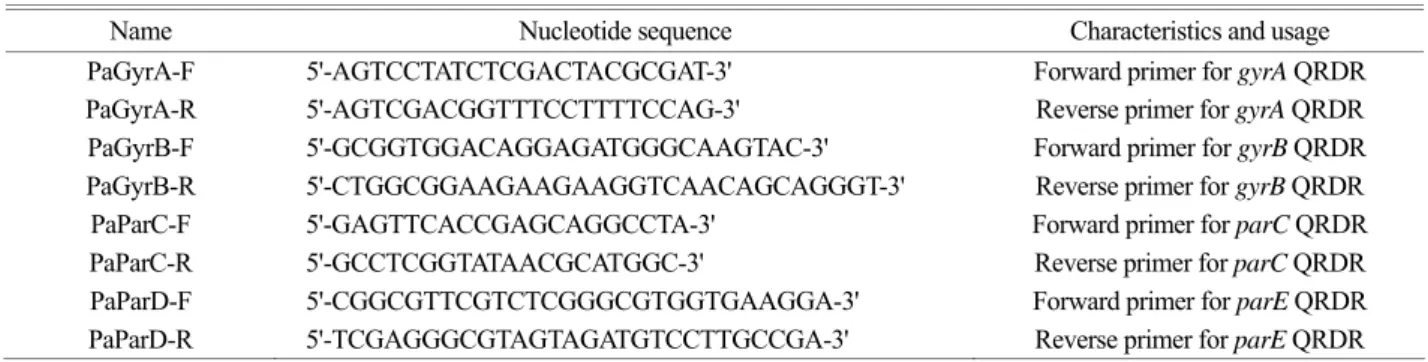
Table 1. Nucleotide sequences of the oligonucleotides used in this study
Name Nucleotide sequence Characteristics and usage
PaGyrA-F 5'-AGTCCTATCTCGACTACGCGAT-3' Forward primer for gyrA QRDR
PaGyrA-R 5'-AGTCGACGGTTTCCTTTTCCAG-3' Reverse primer for gyrA QRDR
PaGyrB-F 5'-GCGGTGGACAGGAGATGGGCAAGTAC-3' Forward primer for gyrB QRDR
PaGyrB-R 5'-CTGGCGGAAGAAGAAGGTCAACAGCAGGGT-3' Reverse primer for gyrB QRDR
PaParC-F 5'-GAGTTCACCGAGCAGGCCTA-3' Forward primer for parC QRDR
PaParC-R 5'-GCCTCGGTATAACGCATGGC-3' Reverse primer for parC QRDR
PaParD-F 5'-CGGCGTTCGTCTCGGGCGTGGTGAAGGA-3' Forward primer for parE QRDR
PaParD-R 5'-TCGAGGGCGTAGTAGATGTCCTTGCCGA-3' Reverse primer for parE QRDR
37℃에서 18시간 동안 배양시켜서 1.5 ml tube로 옮긴 후 원심분리 (4℃, 15,000 rpm, 2분)하였다. Pellet에 TE buffer (100 mM Tris-HCl; pH 8.0, 10 mM EDTA) 500 µl에 재현탁 시 킨 후 10% (w/v) SDS를 최종농도가 0.5%가 되도록 25 µl첨 가하고 inverting하여 65℃에서 10분간 반응시키고 RNase (20 mg/ml)를 1 µl 넣고 37℃에서 1시간 동안 incubation시켰 다. Protein을 제거하기 위해 동일 부피의 phenol을 첨가하 여 vortexing한 후 원심분리 (4℃, 15,000 rpm, 2분)하였다. 상 등액을 새 tube에 옮기고 동일 부피의 phenol/chloroform/
isoamyl alcohol (25:24:1, v/v)을 넣고 vortex 후 원심분리 (4℃, 15,000, 2분)하였다. 이 과정은 두 번 정도 반복하였다. 깨 끗해진 상등액을 새로운 e-tube로 옮겨 두 배 부피의 ice- cold ethanol 과 5 M NaCl 16 µl를 넣고 -70℃에서 15분 이상 방치한 후 원심분리 (4℃, 15,000 rpm, 20분)하였다. 70% (v/v) ethanol로 washing 해서 15,000 rpm, 4℃, 5분간 원심분리 한 후 pellet을 건조시켜 TE buffer 40 µl에 현탁하여 -20℃에 보 관하였다.
5. Primer 제작 및 polymerase chain reaction
P. aeruginosa의 genomic DNA상의 gyrA, gyrB, parC, parE
gene의 QRDR (quinolone resistance determining region)로 알려 진 부위로부터 염기서열을 고안하였다. gyrA는 (Gene Bank accession number L29417) forward와 reverse primer를 각각 nu- cleotide (nt) 320~341, 676~697에서 design하였고 gyrB는 Gene Bank accession number AB005881) nt 2582~2609, 3063~3092에 서 parC는 (Gene Bank accession number AB003428) nt 206~215, 521~540에서 parE는 (Gene Bank accession number AB003429) nt 1223~1250, 1787~1814에서 design 하였다. 각 oligonucle- otide들의 염기서열은 Table 1에 나타내었다. PCR premix [Taq DNA polymerase 1 U, dNTP는 각각 0.25 mM, Tris-HCl (pH 9.0) 10 mM, MgCl
21.5 mM, AccuPower PCR PreMix, Bioneer]를 사
용하여 target gene을 증폭하였다. 10 pM의 농도로 희석한 primer를 각 1 µl씩 첨가하고 genomic DNA를 1,000배 희석 해서 1 µl 넣은 다음, 멸균 증류수를 17 µl 첨가하여 최종부 피가 20 µl가 되도록 하였다. PCR은 thermal cycler (Gene Amp PCR System 2400, perkin Elmer)를 사용하여 수행하였다. 조건 은 P. aeruginosa gyrA gene은 94℃에서 3분간 predenaturation 시킨 후 denaturation 94℃ 30초, annealing 55℃ 30초, extention 72℃ 1분을 30 cycle을 수행한 후 72℃에서 7분간 final incu- bation 하였다. gyrB, parC, parE gene은 annealing 온도만 58℃
로 달리하였다.
6. Agarose gel electrophoresis 및 DNA purification 증폭된 각 PCR product들은 0.8% (w/v) agarose gel 상에서 확인하였다. Gel은 1×Tris-acetate buffe (TAE; 40 mM Tris- acetate and 1mM EDTA; pH 8.0)에 0.8 g의 agarose를 첨가하여 만들고 , 여기에 PCR product를 loading 하여 전기영동 하였 다. Loading이 끝난 후 gel을 0.5 µg/ml의 ethidium bromide 용 액에 담가 염색한 다음 UV transilluminator (302 nm, Hoefer scientific instrument)에서 확인하고 Polaroid type 667 film으로 촬영하였다. DNA는 QIAquick gel extraction kit (QIAGEN)를 사용하여 제조사의 사용법에 따라 분리하였다. 먼저, gel에 서 원하는 크기의 band를 잘라 1.5 ml e-tube에 넣고 gel 무 게의 3배 부피에 해당하는 QG buffer를 첨가하여 50℃에서 10분간 방치하였다. gel조각이 완전히 녹은 후에 column으로 옮겨 15,000 rpm에서 1분간 원심분리하여 column을 통과한 하층액을 버리고 다시 QG buffer 500 µl를 첨가하여 같은 방 법으로 원심분리 한 후 하층액을 버렸다. Washing 단계로 PE buffer 750 µl를 첨가하여 1분간 원심분리 후 하층액을 버 리고 PE buffer를 완전히 제거하기 위하여 다시 1분간 원심 분리하였다. Column을 새로운 e-tube로 옮긴 후 멸균 증류수 20 µl를 넣고 마지막으로 원심분리 한 뒤, -20℃에서 사용할
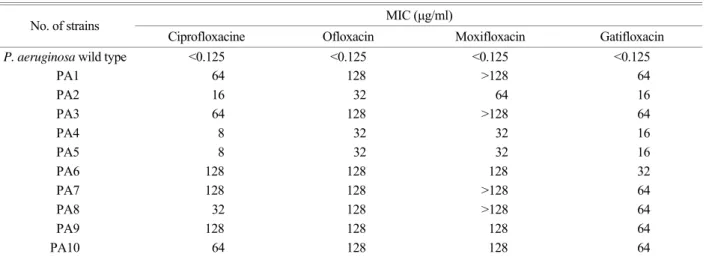
Table 2. MIC of P. aeruginosa used in this study MIC (µg/ml) No. of strains
Ciprofloxacine Ofloxacin Moxifloxacin Gatifloxacin
P. aeruginosa wild type<0.125 <0.125 <0.125 <0.125
PA1 64 128 >128 64
PA2 16 32 64 16
PA3 64 128 >128 64
PA4 8 32 32 16
PA5 8 32 32 16
PA6 128 128 128 32
PA7 128 128 >128 64
PA8 32 128 >128 64
PA9 128 128 128 64
PA10 64 128 128 64
때까지 보관하였다.
7. DNA sequencing
DNA sequencing은 DNA auto sequencer (ABI PRISM 310;
Applied Biosystems)를 사용하여 Big Dye-terminator 기법의 방 법에 따라서 실시하였다. PCR tube에 template DNA 4 µl와 fo- rward 또는 reverse primer를 2 µl, Big Dye 4 µl, 멸균 증류수 10 µl를 넣어 total volume 20 µl로 맞춘 후 sequencing PCR을 실시하였다. PCR 조건은 gyrA fragment는 96℃에서 5분간 predenaturation, 25 cycles (denaturation 96℃, 10초; annealing 53℃, 5초; extension 60℃, 4분), 60℃에서 5분간 final incubation 하였다. gyrB, parC, parE 는 각각 annealing 온도만 55℃로 달리 하였다. PCR product에 각각 ethanol 50 µl와 3 M sodium acetate (pH 4.6) 2 µl를 첨가하여 -70℃에서 1시간 동안 etha- nol 침전시킨 후 15,000 rpm, 4℃에서 25분간 원심 분리하여 pellet을 말리고 TSR (template suppression reagent) 25 µl에 pe- llet을 녹여 94℃에서 4분간 incubation시킨 후 바로 ice에 꽂 아 반응을 정지시킨 다음 DNA auto sequencer로 분석하였다.
Computer 분석은 310 Genetic Analyzer를 통하여 분석하여 P.
aeruginosa PAO1의 gyrA, gyrB, parC, parE sequence와 비교하
여 mutation을 확인하였다.
결 과
1. 항생제 최소억제농도 (MIC)시험
Vitek system의 GNS434 card를 사용하여 항생제 최소억제 농도 (minimum inhibitory concentration; MIC)시험을 실시한 결과는 Table 2과 같다.
2. Pseudomonas aeruginosa 의 gyrA , gyrB , parC , parE QRDR에서의 mutation확인
1) gyrA , gyrB , parC , parE gene의 PCR결과
P. aeruginosa의 4개의 gene을 Table 1과 같이 4 쌍의 primer
를 사용하여 PCR방법으로 얻었다. PaGyrA, PaGyrB, PaparC, PaparE primer를 이용하여 임상검체에서 분리된 10균주의 P.
aeruginosa에서 분리한 DNA를 주형 DNA로 하여 증폭한
결과 gyrA 378 bp, gyrB 512 bp, parC 304 bp, parE 592 bp 크기 의 DNA단편들을 얻을 수 있었다. Fig. 1과 Fig. 2는 PCR 결과 이다 .
2) 10균주의 gyrA , gyrB , parC , parE QRDR에서 아미노 산 변화
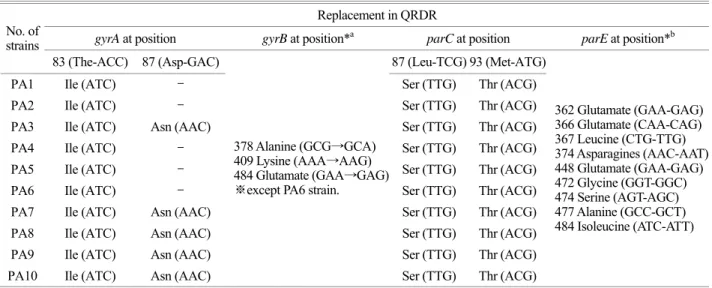
gyrA mutations: 10개 sample 모두에서 gyrA의 QRDR에서
아미노산 치환이 발견되었다. 83번 codon인 threonine (AAC) 이 isoleucine (ATC)으로 바뀌거나 87번 codon인 aspartate (GAC)가 asparagine으로 치환되었다. 이 중에서 6개의 isolate 에서 double point mutation이 일어났다 (Table 3).
gyrB mutations: 일반적으로 mutation이 가장 잘 일어나는
464번 codon인 serine (TCC)에서는 mutation이 발견되지 않았 으며 10균주 모두에서 gyrB 상의 아미노산의 mutation은 발 견되지 않았다. 그러나 378번 codon인 alanine (GCG→GCA), 409번 codon인 lysine (AAA→AAG), 484번 codon인 glutamate (GAA→GAG) 중 2~3가지의 silent mutations을 가진 균주들 이 발견되었다. 하지만 PA6번 균주에서는 아무런 변화도 관찰되지 않았다.
parC mutations: 10개의 균주 모두 87번 codon과 93번 co-
don에서 각각 mutation이 발견되었다. 87번 leucine (TCG)이
Table 3. Amino acid changes resulting from mutations in gyrA, parC and silent mutations in gyrB, parE Replacement in QRDR
gyrA at position gyrB at position*a parC at position parE at position*b
No. of
strains
83 (The-ACC) 87 (Asp-GAC) 87 (Leu-TCG) 93 (Met-ATG)
PA1 Ile (ATC) - Ser (TTG) Thr (ACG)
PA2 Ile (ATC) - Ser (TTG) Thr (ACG)
PA3 Ile (ATC) Asn (AAC) Ser (TTG) Thr (ACG)
PA4 Ile (ATC) - Ser (TTG) Thr (ACG)
PA5 Ile (ATC) - Ser (TTG) Thr (ACG)
PA6 Ile (ATC) - Ser (TTG) Thr (ACG)
PA7 Ile (ATC) Asn (AAC) Ser (TTG) Thr (ACG)
PA8 Ile (ATC) Asn (AAC) Ser (TTG) Thr (ACG)
PA9 Ile (ATC) Asn (AAC) Ser (TTG) Thr (ACG)
PA10 Ile (ATC) Asn (AAC)
378 Alanine (GCG→GCA) 409 Lysine (AAA→AAG) 484 Glutamate (GAA→GAG)
※except PA6 strain.
Ser (TTG) Thr (ACG)
362 Glutamate (GAA-GAG) 366 Glutamate (CAA-CAG) 367 Leucine (CTG-TTG) 374 Asparagines (AAC-AAT) 448 Glutamate (GAA-GAG) 472 Glycine (GGT-GGC) 474 Serine (AGT-AGC) 477 Alanine (GCC-GCT) 484 Isoleucine (ATC-ATT)
*
a: 2 or 3 slient mutation seen in Each strains. *
b: 5 or 6 slient mutation seen in Each strains.
serine (TTG)으로, 93번 methinone (ATG)이 threonine (ACG)으 로 아미노산들이 치환되었다.
parE mutations: parE도 gyrB와 마찬가지로 아미노산의 변
화는 없었고, 362번 glutamate (GAA→GAG), 366번 gluta- mine (CAA→CAG), 367번 leucine (CTG→TTG), 374번 aspa- ragine (AAC→AAT), 448번 glutamate (GAA→GAG), 472번 glycine (GGT→GGC), 474번 serine (AGT→AGC), 477번 ala- nine (GCC→GCT), 484번 isoleucine (ATC→ATT) 중 5~6가지 이상의 silent mutation들을 포함하였다.
고 찰
Fluoroquinolone제는 그람음성과 양성 세균 감염치료에 널리 사용되고 있으며, 폐렴구균 등 그람양성구균에 대한 항균력이 강화된 새로운 제제들이 사용되기 시작하였거나 연구되고 있다. 초기의 약제인 nalidixic acid, pipemidic acid, oxolinic acid 및 flumequine은 그람음성 세균에 대한 항균력
도 비교적 약하며 이를 협범위, 제1세대, 또는 group I qui- nolone이라 한다. 1980~1990년대에 사용되기 시작한 cipro- floxacin, enoxacin, ofloxacin, pefloxacin, fleroxacin, sparfloxacin, levofloxacin은 항균범위가 P. aeruginosa 등에 까지 넓어지고 항균력이 강해졌으며, 이들을 광범위 또는 group II quinolone 이라고 한다. 1990년대에 들어서 개발된 그람양성 세균 또 는 혐기성 세균에 대한 항균력을 높인 moxifloxacin, gatiflo- xacin, gemifloxacijn, sitafloxacin은 group III (제4세대라고도 함), 또는 호흡기 감염 치료용 quinolone이라고 한다. 근래 개발 된 fluoroquinolone의 대부분은 그람양성 세균에 대한 항균 력을 높이기 위한 것이었다. 최근 fluoroquinolone 내성균이 증가되고 있는데 fluoroquinolone 제에 따라서는 교차내성 정도가 다른 것이 있고, 내성균의 출현과 확산을 막기 위한 연구들이 늘고 있다.
Quinolone약제의 작용표적은 세균의 type II topoisomerase 즉 , DNAgyrase (topoisomeraseII)와 topoisomerase IV이다. DNA- gyrase와 topoisomerase IV는 DNA를 negative 초라선화 함으
M 1 2 3 4 5 6 7 8 9 10 M M 1 2 3 4 5 6 7 8 9 10 M500 bp→
Fig. 1. Agarose gel electrophoresis of the PCR products (512 bp) amplified using PaGyrB-F and PaGyrB-R primers. M; 100 bp ladder maker. Lane 1~10; PCR products from P. aeruginosa (PA1-PA10).
<gyrA> <gyrB>
M 1 2 3 4 5 6 7 8 9 10 M M 1 2 3 4 5 6 7 8 9 10 M
400 bp→
300 bp→
Fig. 2. Agarose gel electrophoresis of the PCR products amplified using PaParC (304 bp) and PaParE (592 bp) primers. M; 100 bp ladder maker. Lane 1~10; PCR products from P. aeruginosa (PA1-PA10).
<parC> <parE>
←500 bp
로서 DNA 복제를 가능케 하는 효소인데, quinolone은 이 작 용을 방해하여 세균의 증식을 억제한다. 따라서 세균이 qu- inolone의 작용표적인 DNAgyrase (topoisomeraseII)와 topoiso- merase IV의 gene mutation을 일으킴으로서 곧 quinolone약제 의 내성이 야기된다. 본 연구에서는 target gene QRDR의 mutation에 의한 내성기전의 연구를 실행하였다.
Gyrase A subunit의 아미노산 변화는 촉매작용 부위인 Tyr 122 근처의 보존서열에서 일어남이 여러 세균에서 관찰되 었다. 변화는 Ala67과 Gln106사이의 한정된 영역에서 일어 나며, 이 영역을 quinolone 내성 결정 영역 (QRDR)이라고 한다 . 아미노산의 변화 중에서는 Ser83이 가장 흔한데, 이 잔기가 소수성이고 부피가 큰 아미노산으로 바뀌면 고도의 quinolone내성을 나타낸다. 대부분의 균종에 있어서 감수성 균주의 GyrA83 위치는 serine이다. 그러나 P. aeruginosa에서 는 serine 대신에 threonine이 있다. P. aeruginosa 가 E. coli 보 다 원래부터 quinolone에 대한 감수성이 낮은 것은 이 차이 때문으로 해석된다. 본 연구에서도 10균주 모두 gyrA의 변 화는 83번 threonine이 isoleucine으로 아미노산의 변이가 나 타났다. 또한 몇 균주는 87번 Aspartic acid가 Asparagine으로 변이를 나타냈다. 이러한 gyrA의 변화는 기존의 다른 연구 결과와 일치한다 (Takaaki et al., 2001). parC gene의 mutation은 고도내성의 원인이 된다고 보고되었다 (Takaaki et al., 2001).
본 연구에 사용된 모든 균주의 MIC 값이 기존에 보고된 다른 연구들에 비해 현저히 높은 것은 parC gene의 point mutation에 기인한 것으로 사료된다. 10균주 모두가 parC에 서의 Ser-87→Leu 변화 역시 기존의 변화와 일치함을 나타 내었다. 하지만 지금까지 문헌상에는 없었던 parC의 Met- 93→Thr type이 10균주 모두에서 나타난 것은 새로이 밝혀 진 것으로 생각된다. 그리고, gyrB와 parE상의 mutation들도 지금까지의 형태와는 다른 양상을 보였다. 아미노산의 변화는 없이 salient mutation이 다양하게 여러 균주에서 나타났다.
본 연구에서는 quinolone의 주된 표적인 gyrA 보다 parC 에서의 mutation이 더 많은 것으로 나타나 Type II보다 Type IV topoisomerase의 변화가 더 많이 나타남을 보여주었다.
Fluorquinolone의 내성기전에는 target gene (QRDR)의 muta- tion외에 porin 소실에 의한 막 투과성의 감소 그리고 efflux pump에 의한 항생제의 유출 등이 있다. 본 연구에서는 target gene의 mutation에 관한 연구만 시행되었다. 본 연구에 사용 된 균주들의 quinolone 고도내성의 포괄적인 기전을 밝히기 위해서는 차후, porin 소실과 efflux pump에 대한 내성기전의 연구가 수행되어야 할 것으로 생각된다. 본 연구는 Seque- ncing 을 통하여 임상검체에서 분리된 Pseudomonas aerugi-
nosa의 QRDR에 mutation이 존재함을 알 수 있었다. 기대했던 바와 같이 quinolone의 주 표적인 gyrA, parC gene에서의 mutation이 두드러졌으며 10균주 모두 이들 유전자의 두 군
데 이상에서 동시에 mutation이 일어났음을 확인 하였다.
gyrB 나 parE gene에서는 silent mutation만 관찰되었을 뿐 아