• 검색 결과가 없습니다.

Comparison of Silymarin, Penicillin, N-acetylcysteine in Patient with Amatoxin Poisoning: A Systematic Review

N/A
N/A
Protected

Academic year: 2021

Share "Comparison of Silymarin, Penicillin, N-acetylcysteine in Patient with Amatoxin Poisoning: A Systematic Review"

Copied!
9
0
0

로드 중.... (전체 텍스트 보기)

전체 글

(1)

저저

서 론

국내 야생 버섯들 중 식용 가능한 버섯은 20-30종 정도 에 불과하며, 160여 종 이상의 독버섯이 존재한다. 국내 버섯 중독 사망 사고의 대부분은 amatoxin을 함유한 독 버섯에 의한 것이다. Amatoxin을 함유한 독버섯으로는 양파광대버섯(Amanita abrupta), 흰오뚜기광대버섯 (Amanita castanopsidis), 개나리광대버섯(Amanita subjunquillea), 흰알광대버섯(Amanita verna), 독우산

Amatoxin 중독 환자에서 Silymarin, Penicillin, N-acetylcysteine의 효과 비교: 체계적 고찰

연세대학교 의과대학 응급의학교실

최민우∙고동률∙공태영∙좌민홍∙유제성∙정성필

Comparison of Silymarin, Penicillin, N-acetylcysteine in Patient with Amatoxin Poisoning: A Systematic Review

Min Woo Choi, M.D., Dong Ryul Ko, M.D., Taeyoung Kong, M.D., Min Hong Choa, M.D., Je Sung You, M.D., Sung Phil Chung, M.D.

Department of Emergency Medicine, Yonsei University College of Medicine, Seoul, Korea

Purpose: This study was conducted to evaluate the clinical efficacy of pharmacologic treatment of amatoxin poison- ing patients.

Methods: Literature was accessed through PubMed, EMBASE, Cochrane library, KoreaMed, KISS and KMBASE.

Studies relevant to human use of pharmacologic therapy including silymarin, penicillin and N-acetylcysteine (NAC) for amanita poisoning were included. Case reports, letters, editorials and papers with insufficient information were excluded. Comparison of clinical outcomes (especially mortality and liver transplantation rate) in each study was analyzed.

Results: The final analysis included 13 retrospective studies. None of these studies showed direct comparisons of individual agents. Among 12 studies comparing silymarin vs penicillin, eight showed clinical superiority of silymarin.

Among eight studies comparing silymarin with NAC, six showed clinical superiority of silymarin. Among seven stud- ies of NAC vs penicillin, five showed clinical superiority of NAC.

Conclusion: This systematic review suggested that clinical superiority of various pharmacological agents used to treat amatoxin poisoning is debatable. Nevertheless, the available evidence suggests it is reasonable to consider combinations of multiple agents for patients with amanita poisoning. Further studies are required to establish a treatment regimen for amanita poisoning.

Key Words: Amatoxin, Poisoning, Silymarin, Silibinin, Penicillin, Acetylcysteine

책임저자: 정 성 필

서울특별시 강남구 언주로 211 연세대학교 의과대학 응급의학교실 Tel: 02) 2019-3030, Fax: 02) 2019-4820 E-mail: [email protected]

투고일: 2018년 5월 6일 1차 심사일: 2018년 5월 6일 게재 승인일: 2018년 6월 11일

* 이 논문은 특정단체의 재정적 지원이나 관련된 이해관계가 없습니다.

(2)

광대버섯(Amanita virosa) 등이 있다

1)

.

Amatoxin 중독의 치료는 보존적 치료와 약물요법, 투 석요법 그리고 간 이식까지 다양한 치료법이 사용되고 있 다. 이중 약물요법의 경우 silymarin, penicillin, N- acetylcysteine (NAC) 등이 대표적이며 이외에도 다양한 치료 약제가 단독 또는 혼합요법으로 사용되고 있다

2)

. Silymarin은 흰 무늬 엉겅퀴(milk thistle)의 추출물로 1) amatoxin의 간세포막 결합 억제, 2) 막간 수송에서 독소 와 경쟁적으로 작용, 3) 독소의 담즙산 배설과 장내순환 억제, 4) 손상된 간세포에서의 TNF-α분비 억제, 5) 손상 된 간세포의 단백질 합성 자극 기전을 통해 항독소 효과를 보인다고 알려져 있다

3)

. Penicillin은 Amatoxin 중독에 가장 많이 사용되어온 치료제 중 하나로 막 수송체인 OATP1B3에 경쟁적으로 결합하여 간 내로의 amatoxin 의 이동을 막는 기전을 통해 항독소 효과를 보인다고 보고 있다

4)

. NAC는 ROS scavenger와 glutathione 전구체로 작용하여 항독소 효과를 나타낸다고 보고 있다

2,5)

.

저자들은 Amanita species 버섯 중독 환자를 대상으로 대표적인 3가지 약물요법의 치료 효용성을 알아보기 위하 여 체계적 문헌고찰을 시행하였다.

대상과 방법

1. 문헌 검색 및 선정

본 연구는 기존 문헌들의 체계적 고찰 연구로 Preferred Reporting Items for Systematic reviews and Meta- Analyses (PRISMA) 그룹이 제시한 체계적 문헌고찰 보 고지침에 따라 수행되었다. 문헌의 선정기준은 amatoxin 중독 환자를 대상으로 치료에 관한 내용이 포함된 경우로 하였다

6)

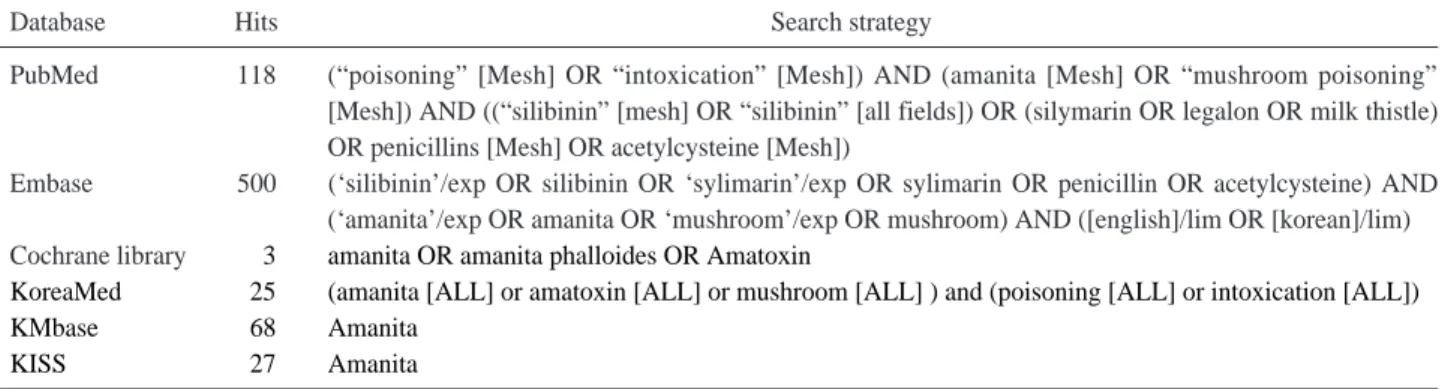
. 문헌 검색에 사용된 데이터베이스는 PubMed, Embase, Cochrane library, KoreaMed, Korean Studies

Information Service System (KISS), Korean Medical Database (KMbase) 등이었으며 데이터베이스에 사용한 검색식은 Table 1에 표기하였다.

검색은 두 명의 연구자에 의해 시행되었으며, 제외기준 으로는 1) 약물 투여군과 대조군을 비교한 경우 2) 주제와 관련이 없는 경우, 3) 환자의 임상 양상이 자세히 언급되 지 않은 증례 보고, 4) 학회 초록, 5) 영어나 한국어 이외 의 언어로 출판된 경우(영문 초록이 있는 경우는 포함) 등 은 제외 하였다. 최종 선정된 문헌은 EndNote (X8, Thomson Reuters)에 정리하여 중복된 문헌을 제거하였 다. 또한 문헌에 이용된 참고문헌들을 검토하여 빠진 문헌 이 있으면 추가하였다.

2. 논문의 질 평가

선택된 문헌의 질은 영국 Scottish Intercollegiate Guideline Network (SIGN)의 체크리스트를 이용하여 평가하였다. SIGN의 질 평가도구는 연구 유형에 따라 필 수 항목을 선정하고, level 1은 메타분석, 무작위 대조 실 험의 체계적 문헌고찰, 무작위 대조 실험이 해당하고, level 2는 환자 대조군 연구나 코호트 연구, 또는 이를 이 용한 체계적 문헌고찰이 해당하며, level 3는 증례보고 같 은 비 분석 연구, level 4는 전문가 의견 등이 해당된다.

해당 level의 조건에 모두 잘 또는 적절하게 수행되었을 경우‘++’로, 일부 항목이 불충분할 경우‘+’로, 대부분 충족되지 않았을 경우‘-’로 판정하였다

7)

.

3. 자료의 요약

필요한 항목과 문헌에 대한 간단한 요약표를 작성하였 다. 최종 선정된 문헌들을 검토하여 각 약제(silymarin, penicillin, NAC) 각 약제간의 치료 효과를 사망 및 간이

Table 1. Search strategy of databases

Database Hits Search strategy

PubMed 118 (“poisoning” [Mesh] OR “intoxication” [Mesh]) AND (amanita [Mesh] OR “mushroom poisoning”

[Mesh]) AND ((“silibinin” [mesh] OR “silibinin” [all fields]) OR (silymarin OR legalon OR milk thistle) OR penicillins [Mesh] OR acetylcysteine [Mesh])

Embase 500 (‘silibinin’/exp OR silibinin OR ‘sylimarin’/exp OR sylimarin OR penicillin OR acetylcysteine) AND (‘amanita’/exp OR amanita OR ‘mushroom’/exp OR mushroom) AND ([english]/lim OR [korean]/lim) Cochrane library 003 amanita OR amanita phalloides OR Amatoxin

KoreaMed 025 (amanita [ALL] or amatoxin [ALL] or mushroom [ALL] ) and (poisoning [ALL] or intoxication [ALL])

KMbase 068 Amanita

KISS 027 Amanita

* KISS: Korean studies information service system, KMbase: Korean medical database

(3)

식 비율을 기준으로 정리하였다.

결 과

1. 문헌 검색 결과

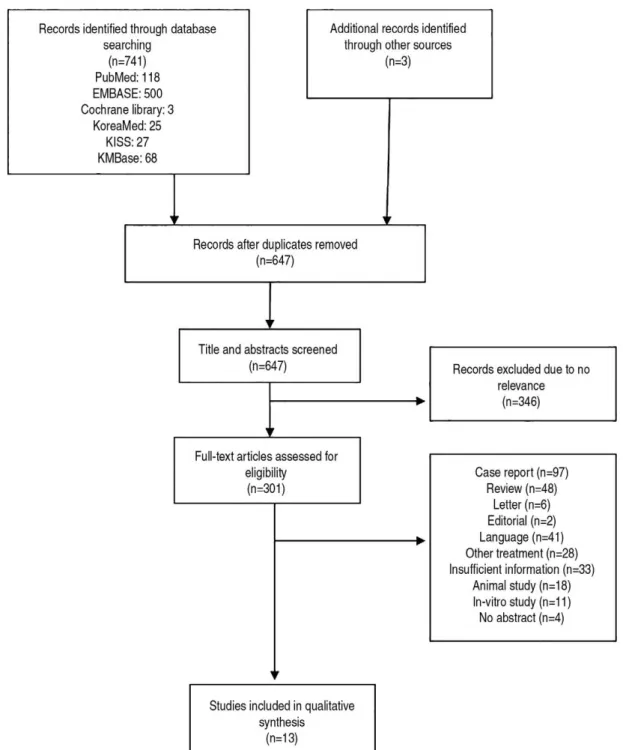
문헌검색을 통해 PubMed 118건, Embase 500건, Cochrane library 3건, KoreaMed 25건, KISS 27건,

KMbase 68건, 수기 검색으로 추가 3건이 검색되었다. 중 복을 제외하고 제목과 초록을 검토하여 본 연구의 목적과 관련이 없는 문헌을 제외하고 647편을 분석하였다(Fig.

1). 이중 관련 없는 내용을 포함한 301편, 증례보고 97편, 치료 정보가 불충분한 연구 33편, 서신 6편, 사설 2편, 영 문 및 한국어 이외의 언어로 저술된 41편, 다른 치료법을 다룬 28편, 동물 대상 실험 18편, in-vitro study 11편을 제외하고 총 13편을 대상으로 하였다. 논문 형식은 후향

Fig. 1. Flow diagram according to PRISMA format.

(4)

적 연구 13편이었다.

2. 논문의 질 평가 결과

SIGN의 질 평가 도구에 의해 후향적 연구에 대하여 질 평가를 시행하였으며, 평가 결과 2++이 2편, 2-가 11편이 었다(Table 2, 3, 4). 문헌의 질 평가 과정은 2명의 연구자 에 의해 수행되었으며, 의견 불일치가 있는 경우는 사전에 검토 원칙을 정하였으나 연구자간 이견은 없었다.

3. 치료 효과의 비교
Silymarin, penicillin, NAC가 단일로 사용된 경우는 없 었고, 보존적 치료와 더불어 2가지 이상의 약제가 혼용되어 사용된 연구가 대부분 이었다. 각 약제간의 치료효과를 임상 적 결과(사망률/간이식 비율)에 따라 비교 분석 하였다.

1) Silymarin과 penicillin 간의 치료효과 비교

12편에서 silymarin과 penicillin 간의 치료효과를 직간 접으로 비교 가능하였으며, 치료효과 간 다양한 결과가 보 고되었다(Table 2). Silymarin이 penicillin보다 우월한 치료효과를 보인다고 보고한 후향적 연구는 총 8편으로 silymarin 단일치료 또는 복합치료로 치료에 사용한 경우 에서 전반적으로 나은 임상 경과를 보고하였다.

4편의 후향적 연구에서 silymarin과 penicillin 간의 치 료적 우위가 동일하거나(1편), penicillin이 더 치료적으 로 우월하다고(3편) 보고하였다.

2) Silymarin과 NAC 간의 치료효과 비교

8편에서 silymarin과 NAC간의 치료효과를 직간접으로 비교 가능하였으며, 치료효과 간 다양한 결과가 보고되었 다(Table 3). 8편 중 silymarin의 치료효과가 우월하다고 보고한 논문은 총 6편이었다. 나머지 2편의 논문에서는 두 약제 치료효과간에 큰 차이가 없다고 보고하였다.

3) NAC와 penicillin 간의 치료효과 비교

7편에서 NAC와 penicillin 간의 치료효과를 직간접으 로 비교 가능하였으며, 치료효과 간 다양한 결과가 보고되 었다(Table 4). 이 중 NAC의 치료효과가 우월하다고 보 고한 논문은 5편이었다. 나머지 2편의 논문에서는 peni- cillin이 더 우월하다고 보고하였다.

고 찰

Amatoxin은 현재까지 가장 잘 알려진 버섯 독소로서 대부분 cyclopeptides 계열의 독버섯에 함유되어 있다.

현재까지 9가지의 amatoxin이 동정되었으며 α-amanitin 은 이중 생화학적으로 활성이 가장 높은 물질이다. 이는 DNA 의존 RNA 중합효소 II를 억제 함으로서 단백질 합 성을 저하시키고 결과적으로 대사적 활발한 세포들(위장 관 세포, 간세포, 신세관 세포)에 손상을 입히게 된다. 독 소는 장상피의 OATP1B3 수용체를 통해 흡수 된 후 혈장 에서 빠르게 사라지지만, 일부는 혈장 단백질에 약하게 결 합하여 잔존할 수 있다. 섭취 후 48시간이 지나면 대부분 의 독소는 혈장에서 사라지나 일부의 경우 장-간 순환 (enterohepatic circulation)을 통해 최대 4일까지도 남아 있을 수 있는데 이를 통해 흡수, 배설, 재흡수를 반복하며 간세포의 중심소엽괴사(centrilobular necrosis)를 일으 키고 이후 소변을 통한 배설 과정에서 사구체와 신세관에 흡수되어 급성 신세관 괴사를 일으켜 간 기능 부전과 신 기능 부전으로 이어지게 된다

2,8)

.

Amatoxin 중독에 대한 치료는 일반적 약물중독에 대한 보존적 치료와 약물요법 그리고 molecular adsorbents recirculating system (MARS)와 같은 장비의 사용, 전격 성 간 부전에 대한 최종 치료인 간이식까지 다양한 치료적 접근이 이루어져 왔다. 약물요법의 경우 베타락탐계 항생 제(benzylpenicilin, ceftazidime), cimetidine, vitamin C, NAC, silymarin 등과 함께 최근에는 polymyxin B 같은 항진균제까지 다양한 약제가 실험적으로 사용되고 있다.

Silymarin은 흰 무늬 엉겅퀴(milk thistle)의 추출물 중 65-80%를 구성하는 물질로 7개 이상의 flavolignan으로 이루어져 있다. Silibinin은 silymarin에서 상업적으로 이 용 가능한 반 순수 분획 물질로 두 가지 부분입체이성질체 (diastereoisomer)인 silybin A와 silybin B이 1:1로 혼합 되어 있다

9)

. 본문에 인용된 논문에서는 silymarin/silib- inin/silybin이 혼용되어 사용되나 모두 흰 무늬 엉겅퀴의 추출물 및 유도물질로 동일한 의미로 사용 하였다

10)

.

치료 용량의 경우 각 연구 별로 차이가 있으나, 일반적

으로 정맥 주사로 50 mg/kg을 5-24시간 동안 투여하며

치료 효과는 프로트롬빈 시간 및 혈청 간 효소 수치

(AST/ALT)의 정상화로 평가한다

3)

. 가장 흔하게 보고되는

합병증은 위장관 부작용 이지만 대조군에 비해 전반적인

발생률은 낮다고 알려져 있다. 알레르기 반응(소양감, 습

진, 아나필락시스)은 거의 없다고 알려져 있으며, 1,500

mg/day 이상 투여 시 가벼운 알레르기 반응이 있다고 보

고된바 있다

11)

. Rambaldi 등

12)

이 915명의 알코올 유발성

(5)

Table 2. Comparison of clinical outcome based on retrospective studies (Silymarin vs penicillin) Author, year Patient group Case/control Outcomes Key results LOE Zilker

20)

154 cases of Amanita species 26 cases (21% of 1632) silymarin only chemotherapy Mortality 0% (Sil alone) 2- 1993 poisoning 128 cses (79% of 1,632) silymarin+penicillin chemotherapy vs 9.4% (Sil+Pen) Enjalbert

14)

Clinical data from 2018 hospitalized 550 cases (33.7% of 1632) silymarin chemotherapy Mortality 5.4% (Sil) vs 11.6% (Pen) 2++ 2002 amatoxin poisoning 1411 cases (86.5% of 1,632) penicillin chemotherapy Rengstrorff

23)

8 patients who presented with severe 6 cases (25% of 8) penicillin+NAC chemotherapy Mortality and liver 0% (Sil+Pen+NAC) 2- 2003 hepatitis after mushroom ingestion 2 cases (25% of 8) penicillin+NAC+silymarin chemotherapy transplant vs 0% (Pen+NAC) Krenova

27)

34 patients hospitalized for 5 cases (14.7% of 34) silymarin in the regimen Mortality 20% (Sil) vs 4.3% (Pen) 2- 2007 Amatoxin poisoning 18 cases (52.9% of 55) penicillin in the regimen Ganzert

22)

Among 604 patients with suspected 118 cases (32.2% of 367) Patients silymarin alone chemotherapy Mortality and liver 5.5% (Sil alo ne) 2- 2008 diagnosis of amatoxin poisoning 367 249 cases (67.8% of 367) silymarin+penicillin chemotherapy transplant vs 8.8% (Sil+Pen) retrospectively analyzed Zilker

21)

367 cases with suspected diagnosis 118 cases (32.2% of 367) silymarin only chemotherapy Mortality and liver 5.1% (Sil alone) 2- 2009 of amatoxin poisoning 249 cses (67.8% of 367) silymarin+penicillin chemotherapy transplant vs 8.8% (Sil+Pen) Poucheret

15)

Total 2110 cases : 2018 cases from 624 cases (29.6% of 2110) silymarin chemotherapy Mortality 5.6% (Sil) vs 10.68% (Pen) 2++ 2010 Enjalbert et al.(2002) report and 2 1411 cases (66.9% of 2110) penicillin chemotherapy complementary cases from the original databases Fix

28)

12 patients presented with ALF due to 3 cases (25% of 12) silymarin in the regimen Mortality and liver 66.7% (Sil) vs 85.7% (Pen) 2 - 2011 mushroom poisoning 7 cases (58.3% of 12) penicillin in the regimen transplant Ahishali

24)

77 patients hospitalized for mushroom 75 cases (97.4% of 77) penicillin+NAC+silymarin chemotherapy Mortality and liver 2.6% (Sil+P en+NAC) 2- 2012 intoxication 2 cases (2.6% of 77) penicillin+NAC+chemotherapy transplant vs 0% (Pen+NAC) Roberts

25)

12 patients presented with a history 9 cases (75% of 12) silymarin chemotherapy Mortality 33.3% (Sil) vs 25% (Pen) 2- 2013 suggesting Amatoxin poisoning 4 cases (33.3% of 12) penicillin chemotherapy Karvellas

29)

A total of 18 patients were identified Unclear Mortality and liver 28.6% (Sil) vs 66.7% (Pen) 2- 2016 as having developed severe transplant hepatotoxicity from Amatoxin Trakulsrichai

30)

55 patients with suspected amatoxin- 8 cases (14.5% of 55) silymarin in the regimen Mortality 12.5% (Sil) vs 22.2% (Pen) 2- 2017 containing mushroom poisoning 18 cases (32.7% of 55) penicillin in the regimen * LOE: level of evidence, Sil: silymarin, Pen: penicillin, NAC: N-acetylcysteine

(6)

또는 바이러스성 만성 간질환 환자 를 대상으로 한 13개의 임상시험의 체계적 고찰에서 대조군에 비해 의 미 있는 유해사례를 보이지 않았다.

또한 silymarin은 CYP2D6, CYP2E1, CYP3A4의 활성을 억제할 수 있으 나 생리학적 농도가 임상적으로 투 여되는 농도에 비해 높아 실질적으 로 투여 시 이와 관련한 합병증은 유발하기 어렵다고 알려져 있다

13)

.

Silymarin 또는 silibinin은 불용 성으로 대개 경구 제제로 투여하는 데, 약제 자체의 낮은 흡수율과 인 체 내 짧은 반감기로 천연물 자체의 효 능 을 전 부 발 휘 하 지 못 한 다 . Silymarin은 경구섭취 후 1-2시간 내로 혈중 최고 농도에 이르고 4-6 시간 후 제거된다. Legalon-SIL의 경우 silibinin의 정맥제제로 Amanita 버섯 중독의 치료로 승인된 의약품 이다

11)

.

Penicillin은 전술된 OATP1B3 막 수송체에 대한 경쟁적 결합 기전 이외에도, 알부민과의 결합을 통한 amatoxin의 소변 배출 증가, 항균 작용을 통한 정상 균총 감소를 통해 결과적으로 이들에 의해 생성되는 감마아미노뷰티르산(GABA)를 줄 여 뇌증 예방을 하는 기전을 통해 항독소 효과를 보인다고 보고되고 있다. 치료용량의 경우 일반적으로 1,000,000 U/kg의 penicillin G를 첫날 투여 후 이후 500,000 U/kg/

day를 2일차부터 투여한다고 알려

져 있다

2)

. 일부 치료적 효용성이 있

다고 하나 다른 치료 대비 높은 사

망률과 전해질 불균형, 알레르기 반

응, 일부 신경독성에 의한 증상 등

을 유발할 수 있는 점을 고려해볼

때 이상적인 치료와는 거리가 멀고,

여러 치료 옵션중의 하나로 신중하

게 투여를 고려해야 될 것으로 사료

된다. Penicillin과 유사한 치료기전

을 보 인 다 고 추 정 되 는 3세 대

Table 3. Comparison of clinical outcome based on retrospective studies (Silymarin vs NAC) Author, year Patient group Case/control Outcomes Key results LOE Enjalbert

14)

Clinical data from 2018 550 cases (33.7% of 1632) silymarin chemotherapy Mortality 5.4% (Sil) vs 6.7% (NAC) 2++ 2002 hospitalized amatoxin poisoning 192 cases (11.8% of 1,632) NAC chemotherapy Rengstrorff

23)

8 patients who presented with 6 cases (25% of 8) penicillin+NAC chemotherapy Mortality and liver 0% (Sil+Pen+NAC) 2- 2003 severe hepatitis after mushroom 2 cases (25% of 8) penicillin+NAC+silymarin chemotherapy transplant vs 0% (Pen+NAC) ingestion Poucheret

15)

Total 2110 cases : 2018 cases 624 cases (29.6% of 2110) silymarin chemotherapy Mortality 5.6% (Sil) vs 6.8% (NAC) 2++ 2010 from Enjalbert et al.(2002) report 192 cases (9.1% of 2110) NAC chemotherapy and 2 complementary cases from the original databases Fix

28)

12 patients presented with ALF 3 cases (25% of 12) silymarin in the regimen Mortality and liver 66.7% (Sil) vs 75% (NAC) 2- 2011 due to mushroom poisoning 8 cases (66.7% of 12) NAC in the regimen transplant Ahishali

24)

77 patients hospitalized for 75 cases (97.4% of 77) penicillin+NAC+silymarin chemotherapy Mortality and liver 2.6% (Sil) vs 0% (Pe n+NAC) 2- 2012 mushroom intoxication 2 cases (2.6% of 77) penicillin+NAC+chemotherapy transplant Roberts

25)

12 patients presented with 9 cases (75% of 12) silymarin chemotherapy Mortality 33.3% (Sil) vs 33.3% (NAC) 2- 2013 a history suggesting Amatoxin 6 cases (50% of 6) NAC chemotherapy poisoning Karvellas

29)

A total of 18 patients were Unclear Mortality and liver 28.6% (Sil) vs 46.7% (NAC) 2- 2016 identified as having developed transplant severe hepatotoxicity from Amatoxin Trakulsrichai

30)

55 patients with suspected 8 cases (14.5% of 55) silymarin in the regimen Mortality 12.5% (Sil) vs 34.3% (NAC) 2- 2017 amatoxin-containing mushroom 35 cases (63.6% of 55) NAC in the regimen poisoning * LOE: level of evidence, Sil: silymarin, Pen: penicillin, NAC: N-acetylcysteine

(7)

cephalosporin ceftazidime의 경우 peni- cillin 대체제로 거론되고는 있으나, 현재 까지 치료에 사용된 예가 적고 사용시 대 부분 silymarin과 같이 사용되어 순수한 ceftazidime 자체의 치료효과를 파악하는 데 편향이 있어 좀더 추가적인 연구가 필 요한 약제로 생각된다

5,14,15)

.

NAC는 아세트아미노펜 중독 치료에 사 용되는 치료제로 amatoxin 중독과 아세 트아미노펜 중독의 임상적 유사성(간 독 성과 신 독성)으로 인해 사용되고 있는 약 물요법이다.

치료 프로토콜의 경우, 1) 15분간 150 mg/kg의 투여, 2) 4시간 동안 50 mg/kg 투여, 3) 16시간 동안 100 mg/kg 순서로 투여하게 된다. 일부 경우에서 아나필락 시스 또는 INR 연장 소견을 보인다고 보 고되고 있어 주의 깊은 투여가 요구되며 특별한 금기사항이 아니라면 여러 치료방 법 중의 하나로 고려해볼 수 있겠다

2,4,5)

.

Vitamin C의 경우 지질의 과산화에 의 해 발생한 간섬유화를 억제한다고 보고 있는데 이런 기전을 통해 amatoxin에 의 해 생성되는 활성 산소종에 의한 간 괴사 를 막는다고 보고 있다. Cimetidine의 경 우 동물실험에서 CYP450 효소들을 억제 하여 최종적으로 간세포 괴사와 간세포의 미토콘드리아 손상을 막는다고 보고되고 있으며 해당 기전을 통해 amatoxin에 의 한 간 독성을 억제한다고 보고 있다.

Vitamin C나 cimetidine의 경우 대규모 로 시행된 치료 효용성 비교 연구는 없으 며 acetaminophen이나 CCl

4

에 의한 간 독성을 억제하던 기전에 착안하여 20년전 부터 다른 치료요법의 일부로 포함되어 경험적으로 사용되었다

14)

. 치료 효용성을 비교할 만한 적절한 연구가 불충분하여 다른 치료약제가 있는 현재에는 1차적으 로 고려할 대상은 아닌 것으로 사료된다.

최근 in-vitro 연구 및 동물실험 연구에

서 연구중인 polymyxin B의 경우 α-

amanitin이 결합하는 RNA 중합효소 II에

경쟁적으로 결합하여 독소의 작용을 방해

한다고 보고 있으며, 해당 기전으로 간 및

Table 4. Comparison of clinical outcome based on retrospective studies (NAC vs penicillin) Author, year Patient group Case/control Outcomes Key results LOE Enjalbert

14)

Clinical data from 2018 192 cases (11.8% of 1,632) NAC chemotherapy Mortality 6.7% (NAC) vs 11.6% (Pen) 2++ 2002 hospitalized amatoxin poisoning 1411 cases (86.5% of 1,632) penicillin chemotherapy Poucheret

15)

Total 2110 cases: 2018 cases 624 cases (29.6% of 2110) silymarin chemotherapy Mortality 6.8% (NAC) vs 10.68% (Pen) 2++ 2010 from Enjalbert et al.(2002) report 192 cases (9.1% of 2110) NAC chemotherapy and 2 complementary cases from the original databases Fix

28)

12 patients presented with ALF 8 cases (66.7% of 12) NAC in the regimen Mortality and liver 75% (NAC) vs 85.7% (Pen) 2- 2011 due to mushroom poisoning 7 cases (58.3% of 12) penicillin in the regimen transplant Roberts

25)

12 patients presented with 6 cases (50% of 6) NAC chemotherapy Mortality 33.3% (NAC) vs 25% (Pen) 2- 2013 a history suggesting Amatoxin 4 cases (33.3% of 12) penicillin chemotherapy poisoning Akin

26)

40 patients with Amatoxin 24 cases (60% of 40) NAC+Standard regimen Mortality 4.4% (NAC) vs 18.7% (Pen) 2- 2013 intoxication 16 cases (405 of 40) Standard regimen *Standard regimen: Penicillin+conservative care Karvellas

29)

A total of 18 patients were Unclear Mortality and liver 46.7% (NAC) vs 66.7% (Pen) 2- 2016 identified as having developed transplant severe hepatotoxicity from Amatoxin Trakulsrichai

30)

55 patients with suspected 35 cases (63.6% of 55) NAC in the regimen Mortality 34.3% (NAC) vs 22.2% (Pen) 2- 2017 amatoxin-containing mushroom 18 cases (32.7% of 55) penicillin in the regimen poisoning * LOE: level of evidence, Sil: silymarin, Pen: penicillin, NAC: N-acetylcysteine

(8)

신장의α-amanitin에 의한 손상을 상당히 줄인다고 보고되 고 있다

16)

.

약물요법으로 해결되지 않은 간부전의 경우 결국 간이 식을 필요로 하게 되는데, 간이식까지의 교가요법으로 Molecular Adsorbent Recirculating System (MARS

) 또는 Fractionated Plasma Separation and Adsorption System (FPSA, Prometheus

) 등이 있다. 이는 현재까지 중독에 의한 급성 간 부전 치료에 임상적 효과를 보인다고 보고되고 있다. 전반적인 기전을 알부민 결합 독성물질 및 친수성 분자를 기존의 투석을 통해 독성물질을 인체에서 제거하게 된다

17,18)

.

문헌 고찰의 대상이 된 세 약제 중 NAC, penicillin의 경우 국내 모두 정맥제제 및 경구제제 처방이 가능하나, 미국의 경우 정맥주사제가 사용되고 있는 silymarin은 국 내에서는 사용 가능한 정맥제제가 없고, 경구용 silymarin 인 Legalon 캡슐(현재 70 mg, 140 mg 단위로 처방 가능 함)이 시판 중이다

1,19)

.

문헌 고찰 결과 단일 약제 치료와 다른 단일 치료간의 직접 비교를 시행한 연구는 없었으며, 다른 약제와 병합치 료를 통한 비교 연구가 대부분이었다. 검색된 후향적 연구 들 대부분은 100명 이하의 적은 그룹을 대상으로 시행된 연구이고, 연구 대상 약제 투여군과 비 투여군 간의 수 차 이가 큰 경우가 많아 통계적 비교가 어려운 경우가 많았다.

1) Silymarin과 penicillin 간의 치료효과 비교

비교 분석한 12편의 연구 중 8편에서 silymarin의 더 나 은 임상적 결과를 보였으나 일부 연구에서는 결과 해석에 여러 제한 점이 존재했다. Silymarin이 치료적으로 우위 를 보고한 연구 중 Zilker 등

20,21)

의 연구과 Ganzert 등

22)

의 연구는 silymarin 단독 요법과 silymarin+penicillin 요법 간의 비교로 silymarin 단독 요법의 낮은 사망률을 근거로 silymarin이 penicillin에 비해 치료적으로 우월하다고 보 고한 연구였다. 허나 이는 Silymarin과 penicillin 간의 상 호작용에 의한 치료효과 저하 가능성도 있어 연구 결과 해 석에 제한 점이 있다고 본다. 두 약제간 치료효과가 비슷 하거나, penicillin이 더 우위에 있다고 보고한 Renstroff 등

23)

의 연구와 Ahishali 등

24)

의 연구의 경우 silymarin+

penicillin+NAC 치료군과 Penicillin+NAC 치료군을 비 교한 것으로 Penicillin과 NAC 간의 영향 여하를 완전히 분리 할 수 없어 이 또한 연구결과 해석의 제한 점으로 생 각된다.

2) Silymarin과 NAC 간의 치료효과 비교

비교 분석한 8편의 연구 중 6편에서 silymarin의 더 나

은 임상적 결과를 보였으나 일부 연구에서는 결과 해석에 여러 제한점이 존재했다. Roberts 등

25)

이 12명의 Amatoxin 중독 환자를 대상으로 한 연구에서는 silymarin, peni- cillin, NAC 등이 혼재되어 사용되어 결과론적으로는 silymarin과 NAC의 치료효과가 비슷하다고 보고하였으 나 약제간의 상호 영향을 완전히 배제할 수 없는 제한 점 이 있었다.

3) NAC와 penicillin 간의 치료효과 비교

비교 분석한 7편의 연구 중 5편에서 NAC가 더 나은 임 상적 결과를 보였다. NAC의 치료적 우위를 보고한 연구 중 Akin 등

26)

이 40명의 Amatoxin 중독 환자를 대상으로 시행한 연구의 경우 보존적 치료를 공통적으로 시행하는 전제하여 penicillin 치료군과 NAC 치료군을 비교한 것으 로 분석 대상 중 외부적인 요소를 가장 잘 배제하여 약제 간의 비교가 매우 용이한 연구로 생각된다.

본 연구는 여러 제한 점을 가지고 있다. 첫째, 후향적 연 구로 환자간의 자세한 병력 비교가 어려우며 일부 연구의 경우 치료군과 대조군의 수 차이가 커 치료효과의 비교가 어려웠다. 둘째, 치료에 사용된 약물의 용량 및 투여방법 이 서로 다르고 일부 논문의 경우 이에 대한 정확한 내용 파악이 어려워 치료간의 정량적 비교가 어려웠다. 셋째로 대부분의 단일 약제간의 비교를 한 경우는 없고 다른 약제 와 함께 연구 대상 약제가 포함된 병합치료와 연구 대상 약제가 포함되지 않은 병합치료간의 비교로 다른 약제 및 치료방법에 의한 영향 여하를 명확히 구분할 수 없다는 점 이었다. 마지막으로 출판된 좋은 결과만을 근거로 결론을 내리게 되는 출판편향(publication bias)이 있을 수 있는 점이었다.

결 론

Amanita 중독의 치료에 대한 체계적 고찰 결과 높은 근 거수준으로 뒷받침되는 치료방침은 없는 상태이다. 비교 대상이 된 연구들은 대부분 약제간의 직접 비교가 원활하 지 않고 출판편향의 가능성이 높아 명확한 치료상의 이점 을 추정하기 어렵다. 따라서 추후 더 많은 연구 결과를 기 다릴 필요가 있으며, 그때까지는 보존적 치료와 더불어 silymarin, penicillin, NAC 등의 치료법을 고려하는 것이 필요하다.

ORCID

Min Woo Choi (https://orcid.org/0000-0002-0398-6835)

(9)

Sung Phil Chung (https://orcid.org/0000-0002-3074-011X)

참고문헌

01. Sohn CH. Type and treatment of toxic mushroom poisoning in Korea. J Korean Med Assoc 2015; 58:818-24.

02. Smith MR, Davis RL. Mycetismus: a review. Gastroenterol Rep 2016;4:107-12.

03. Mengs U, Pohl RT, Mitchell T. Legalon

SIL: the antidote of choice in patients with acute hepatotoxicvity from ama- toxins poisoning. Curr Pharm Biotechnol 2012;13:1964-70.

04. Ye Y, Liu Z. Management of Amanita phalloides poisoning;

A literature review and update. J Crit Care 2018;46: 17-22.

05. Garcia J, Costa VM, Carvalho A, Baptista P, de Pinho PG, de Lourdes Bastos M, et al. Amanita phalloides poisoning:

Mechanisms of toxicity and treatment. Food Chem Toxicol 2015;86:41-55.

06. Moher D, Liberati A, Tetzlaff J, Altman DG; PRISMA Group. Preferred reporting items for systematic reviews and meta-analyses: the PRISMA statement. J Clin Epidemiol 2009;62:1006-12.

07. Available at: http://www.sign.ac.uk/checklists-and-notes.

html. Accessed April 13, 2018.

08. Berger KJ, Guss DA. Mycotoxins revisited: part I. J Emerg Med 2005;28:53-62.

09. Polyak SJ, Oberlies NH, Pecheur EI, Dahari H, Ferenci P, Pawlotsky JM. Silymarin for HCV infection. Antivir Ther 2013;18:141-7.

10. Saller R, Meier R, Brignoli R. The use of silymarin in the treatment of liver disease. Drugs 2001;61:2035-63.

11. Post-White J. Advances in the use of milk thistle. Intergrr Cancer Ther 2007;6:104-9.

12. Rambaldi A, Jacobs BP, Iaquinto G, Gluud C. Milk thistle for alcoholic and/or hepatitis B or C virus liver diseases. Cochrane Database Syst Rev 2005;2:CD003620.

13. Zuber R, Modriansky M, Dvorak Z, Rohovsky P, Ulrichova J, Simanek V, et al. Effect of silybin and its congeners on human liver microsomal cytochrome P450 activities. Phytother Res 2002;16:632-8.

14. Enjalbert F, Rapior S, Nouguier-Soule J, Guillon S, Amouroux N, Cabot C. Treatment of amatoxin poisoning: 20-year ret- rospective analysis. J Toxicol Clin Toxicol 2002;40:715-57.

15. Poucheret P, Fons F, Dore JC, Michelot D, Rapior S.

Amatoxin poisoning treatment decision-making: Pharmaco- therapeutic clinical strategy assessment using multidimen- sional multivariate statistic analysis. Toxicon 2010;55:

1338-45.

16. Garcia J, Costa VM, Carvalho AT, Silvestre R, Duarte JA, Dourado DF, et al. A breakthrough on Amanita phalloides poisoning: an effective antidotal effect by polymyxin B.

Arch Toxicol 2015;89:2305-23.

17. Rifai K, Ernst T, Kretschmer U, Bahr MJ, Schneider A, Hafer C, et al. Prometheus--a new extracorporeal system for the treatment of liver failure. J Hepatol 2003;39:984-90.

18. Pillukat MH, Schomacher T, Baier P, Gabriels G, Pavenstadt H, Schmidt HH. Early initiation of MARS(R) dialysis in Amanita phalloides-induced acute liver injury prevents liver transplantation. Ann Hepatol 2016;15:775-87.

19. Available at: http://drug.mfds.go.kr/html/index.jsp. Accessed May 20, 2018.

20. Zilker TR, Felgenhauer NJ, Michael H, Strenge-Hesse A.

Grading of severity and therapy of 154 cases of Amanita poisoning. Vet Hum Toxicol 1993;35:331-6.

21. Zilker TH. Prognosis and treatment of amatoxin poisoning.

Clin Toxicol 2009;47:467.

22. Ganzert M. Felgenhauer N. Schuster T, Eyer F, Gourdin C, Zilker T. Amanita poisoning-conparison of silibinin with a combination silibinin and penicillin. Dtsch Med Wochenschr 2008;133:2261-7.

23. Rengstorff DS, Osorio RW, Bonacini M. Recovery from severe hepatitis caused by mushroom poisoning without liver transplantation. Clin Gastroenterol Hepatol 2003;1:

392-6.

24. Ahishali E, Boynuegri B, Ozpolat E, Surmeli H, Dolapcioglu C, Dabak R, et al. Approach to mushroom intoxication and treatment: can we decrease mortality? Clin Res Hepatol Gastroenterol 2012;36:139-45.

25. Robert DM, Hall MJ, Falkland MM, Strasser SI, Buckley NA. Amanita phalloides poisoning and treatment with sili- binin in the Australian capital territory and New South Wales. Med J Austr 2013;198:43-7.

26. Akin A, Keskek SO, Kilic DA, Aliustaoglu M, Keskek NS.

The effect of N-acetylcysteine in patients with Amanita phalloides intoxication. J Drug Metab Toxicol 2013;4:1-3.

27. Krenova M, Pelclova D, Navratil T. Survey of Amanita phalloides poisoning: clinical findings and follow-up eval- uation. Hum Exp Toxicol 2007;26:955-61.

28. Fix OK, Davern TJ, Doo E, Zaman A, Ganger DR, Reddy R, et al. Acute liver failure due to mushroom poisoning in the United States: Results from the ALFSG registry. Hepatology 2011;54:497A.

29. Karvellas CJ, Tillman H, Leung AA, Lee WM, Schilsky ML, Hameed B, et al. Acute liver injury and acute liver failure from mushroom poisoning in North America. Liver Int 2016;36:1043-50.

30. Trakulsrichai S, Sriapha C, Tongpoo A, Udomsubpayakul U, Wongvisavakorn S, Srisuma S, et al. Clinical characteristics and outcome of toxicity from Amanita mushroom poisoning.

Int J Gen Med 2017;10:395-400.

수치

Table 1. Search strategy of databases
Fig. 1. Flow diagram according to PRISMA format.
Table 2.Comparison of clinical outcome based on retrospective studies (Silymarin vs penicillin) Author, yearPatient groupCase/controlOutcomesKey resultsLOE Zilker20)154 cases of Amanita species26 cases (21% of 1632) silymarin only chemotherapyMortality0% (

참조

관련 문서