JESK
http://jesk.or.kr eISSN:2093-8462Development of Usability Evaluation Criteria for Senior-Friendly Autonomous Transportation Robot
Seon Chil Kim1, Sun Jung Kim2, Kyongon Choi3
1Department of Radiology Daegu Health College, 15 Youngsong-Ro, Buk-gu Daegu, 702-722
2Department of Nursing Daegu Health College, 15 Youngsong-Ro, Buk-gu Daegu, 702-722
3Strategy & Marketing, Storyhenge, Inc. 9 Dosandaero13-Gil, Gangnamgu Seoul, 135-889
Corresponding Author Kyongon Choi
Strategy & Marketing, Storyhenge, Inc.
9 Dosandaero13-Gil, Gangnamgu Seoul, 135-889, Republic of Korea
Mobile : +82-10-8991-0991 Email : [email protected]
Received : September 12, 2014 Accepted : October 27, 2014
Copyright@2014 by Ergonomics Society of Korea. All right reserved.
○cc This is an open-access article distributed under the terms of the Creative Commons Attribution Non-Commercial License (http://
creativecommons.org/licenses/by-nc/3.0/), which permits unrestricted non-commercial use, distribution, and reproduction in any medium, provided the original work is properly cited.
Objective: The purpose of the study is to develop quantitative usability evaluation criteria for senior-friendly autonomous transportation robot.
Background: The Republic of Korea has become the most rapidly aging society, and is anticipated to enter the post-aged society in 2026. To raise the quality of life of a senior with limited mobility and to reduce the burden of caregivers, many high- tech assistive products with information technologies are developed nowadays. The senior-friendly autonomous transportation robot is one person robot vehicle to move a senior to the destination for hospitals, nursing homes or silver town complex. With built-in navigation system and environmental monitoring censors, it automatically seeks the path to the destination and avoids collision to obstacles and pedestrians on the way. Due to the early stage of the product, few usability studies in this field have been done, mostly on general service robots to assist seniors, power wheelchairs and delivery robots. ISO and KS standards for the service robots are focused on safety.
Method: Based on the reference usability index, the early draft of the usability evaluation questionnaires was developed. After small group tests and interviews, the experts modified the initial draft to the Usability Evaluation Criteria for Senior- Friendly Autonomous Transportation Robot (UEC-SFATR).
Result: UEC-SFATR consisted of 4 subscales - Safety, Controllability, Efficiency and Satisfaction. All of the 4 subscales of UEC-SFATR were passed the reliability criteria by 4 groups of seniors, divided by gender and familiarity of smart-devices.
Conclusion: UEC-SFATR covers wider area of user experiences of the SFATR and is a good measurement tool to help both the users and developers of the robot.
Application: This study provides guide to the future product development and product competitiveness evaluation by quantifying user experiences for the SFATR.
Keywords: Usability evaluation, Autonomous transportation robot, Senior, Mobile service robot
1. Introduction
The republic of Korea is one of the most rapidly aging societies in the world. If the current trend continues, Korea will enter an aging society (aging population: 14.3%) in 2018, and a super aging society (aging population: 20.8%) in eight years since then, namely in 2026. Korea's aging population ratio aged 65 years and older will be
38.2% in 2050, and is concerned about becoming the most aged society in the world (Choi, 2007). In terms of economic terms, post-war baby boom generation in Korea embracing the retirement age and reaching their 50s emerges as the new consumer class so called 'New Seniors', in the aging society. Unlike the previous senior generation, they are mainly the generation with active consumption activities, based on surplus assets. While the population aged 50 and older surpassed 13.7% of the total population in Korea, but the consumption expenditure ratio of the households, of which householder age is 50s, reached 22.5% of total Koreans' consumption (Ahn, 2011). The new aging generation, New Seniors, is distinguished from the existing seniors in that they are the generation witnessing rapid cultural and economic development during their life cycle. The New Seniors value youth and creativity, since they spent their childhood and adolescence in the 1960s and 1970s, when foreign popular cultures were introduced, and Korean pop culture quickly evolved from the quality and diversity aspects in terms of culture. Along with their cultural sensitivity developed, they became the main players of remarkable economic development in their young years and late middle age, and thus the New Seniors have the unique sense of achievement and pride. While the New seniors are about to retire but are free from the burden to raise their children and regain composure, they eager to learn about the New Senior lifestyle. Still they keep deep nostalgia to recover sensibility during their glory younger years. Meanwhile, the New Seniors have anxiety as well, as the life phase change, due to retirement and children's independence (SERI, 2011).
In such an aging society, spending healthy and active life, and maintaining adequate quality of life in old age can be the most important tasks. The policy establishment to cope with aging was evolved from solving discomfort, due to decline of physical and mental functions, to focusing on ensuring the quality of life, even after retirement. Most studies regard the seniors' personality and emotion among psychological factors as affecting satisfaction on life as the most influencing factors for the quality of life in the old age. Other factors affecting the quality of life are 'social network' based on age, religion, social clubs or gatherings, marriage and friends and 'participation level' (Cutler, 1973).
While the seniors overcome the physical, mental and social limitations in the aging society, one of the promising ways to guarantee the quality of life is active introduction of information technology (IT). Thanks to the information technologies, Korea provides not only convenience throughout overall human life but also high quality leisure service with no temporal and spatial constraints of human relations for the past ten years (Lee & Seo, 2010). Among the IT and digital home appliance technologies, robots carrying out various functions in the environment coexisting with humans have been developed and commercialized.
Various types of robots, such as gait training robots, autonomous transportation robots and nursing robots are developed to offer better health care services (Lee, 2004).
As an effort to overcome physical constraints, the location-based IT such as location tracking, navigation, and object recognition emerged to the transportation robots to support seniors. While a power wheelchair fully requires human to control the direction, the Autonomous Transportation Robot is developed to assist the seniors who have poor judgment and weak mental condition.
Although, usability evaluations for such transportation robots are conducted in diverse ways in many industrial fields, more objective and systematic usability evaluation is not carried out yet. Especially it is hard to find the usability criteria for the senior friendly robot products. According to the preceding studies, physical functions (sensibility, muscular strength, flexibility and motion function) and mental ability (memory and learning capability) of seniors are remarkably lower than those of young adults and middle-aged people. Therefore, an approach from the perspective used equally to general products on the development and research of senior-friendly products can cause many issues and biases (Rogers, et al., 1998).
In this regard, it is urgent to construct senior-friendly products' usability evaluation system that can become the basis to cope with the demand from the senior-friendly industry according to social environmental change, and Korean industry's development and technological competitiveness, and the development of usability evaluation index by item.
This study presents the evaluation criteria for usability evaluation index on senior-friendly autonomous transportation robot (SFATR), which is the most technologically developed product among the senior-friendly products. The goal is establishing the criteria to measure actual user group satisfaction required for company's new product development, and offering new concept of transportation robots and user feedback in a systematic way. This study is expected to offer more opportunities to actively diffuse IT convergence technology-adopted products for seniors to overcome physical and mental constraints.
2. Method
In order to develop the usability evaluation index of SFATR, this study conducted the following:
1) Analysis of the product concept of SFATR
2) Examining the existing usability evaluation index cases of the products sharing relevant product concepts through literature review
3) Drawing of preliminary index items of usability evaluation to be in line with the usability evaluation of senior-friendly products developed on the basis of ISO usability evaluation factors ((ISO 9241-11)
4) Development, verification and application of the evaluation index through the evaluation of experts and users
2.1 Concept of the SFATR (Senior Friendly Autonomous Transportation Robot)
The SFATR is a product that enables seniors with constraints in everyday life to move around various closed spaces of convenience facilities including large scale silver town complex, hospitals, and welfare spaces, with minimum help from others. If a senior rides on the SFATR, and designates a destination through simple control, the robot finds optimal path by its location recognition system, electronic map and surrounding object recognition system, and automatically drives to the destination safely. In addition, rehabilitation exercise through aid to mobility, guide-following driving, and spatial information service by location estimation system in complex everyday life spaces are also offered.
The SFATR for the seniors, weak, or blind people has been developed from several organizations worldwide including the Care- O-Bot of Germany's Fraunhofer Institute for Manufacturing and Autpmation PAM-AID (Personal Adaptive Mobility AID for frail visually impaired) developed as the research project of EU Telematics Applications Programme, the Nursebot of Carnegie Melon University and PAMM (Personal Aid for Mobility and Health Monitoring) of MIT. Korea's ED and ISAN Solution have recently shown prototype products.
The core component of the typical SFATR are 1) sensor modules to identify the current location using various location information aid systems installed in the surrounding environment and to recognize unexpected situations such as obstacles on the way to the destination to drive automatically, 2) navigation modules to seek the safest and most efficient way to reach the destination, 3) driving module embodying physical movement to actual destination, and 4) UI module in charge of information input and output from a user. By product type, there are power wheelchair type aiding the elderly and weak, who cannot walk at all, and a powered walker type targeting the elderly and weak, who can walk to some degree, although mobility is uncomfortable.
The operation scope of the commercial SFATRs so far in 2014 are mostly limited to indoor, namely, within a building such as nursing home and hospital, or in a silver town complex, despite the most developed type.
As mentioned above, the concept of SFATR is not at the commercialization and diffusion stage yet, and the product types are widely diversified, and thus, the usability evaluation index cannot include all the functions but be made on the basis of product's core functions. This study develops the index that can evaluate basic function commonly included in most of SFATRs, rather than specific function of a specific product.
2.2 Process to develop the usability evaluation criteria for the SFATR
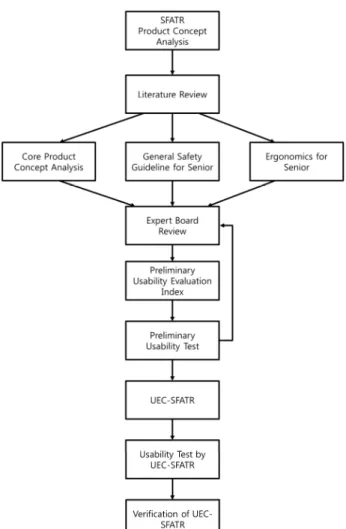
The UEC-SFATR (Usability Evaluation Criteria for Senior Friendly Autonomous Transportation Robot) were drawn through the following steps (Figure 1):
Step 1: Checking core functions shared by various types of SFATRs.
Step 2: Benchmarking the usability index of similar products containing the core functions.
Step 3: Examining the preceding studies on the usability index and evaluation criteria related to the products for senior s or the elderly and weak concerned with the service robots of Korea and foreign countries.
Step 4: Arranging preliminary usability index items and detailed questions on the SFATR based on the usability evaluation index collected in the steps 2 and 3.
Step 5: Revising, supplementing and improving the arranged question list through advisory of the expert group consisting of five experts on robot, usability evaluation and product.
Step 6: Distributing the revised usability evaluation index and question list to the senior citizen users who used the SFATR for sufficient time, and receiving evaluation.
Step 7: Statistically analyzing the questionnaire results targeting experts and ordinary people, and undergoing verification process to ensure reliability and validity.
Figure 1. Development process of the UEC-SFATR
2.2.1 Core product concepts of the SFATR
As stated above, although various types of SFATRs are developed, the service robot that is the most proximate to commercialization, and that can carry out autonomous transportation function the most flexibly has been made on the basis of power wheelchair.
Also, it was made with the product type enabling safe and comfortable driving through GUI (Graphic User Interface)-based input/output function, navigation function and various sensors. Namely, the SFATR can be a product having many complex characteristics of power wheelchair, smart devices such as smartphone/tablet PC, navigation and care workers in terms of benchmarking-targeted product line.
2.2.2 Related studies of the SFATR
The usability evaluation on the SFATR for the elderly and weak is based on the usability evaluation of assistive technology. As a tool for evaluation of the products, to which technology to assist activities of the elderly, the weak or the disabled, whose body partially carry out proper functions, is applied, there is USAT (Usability Scale of Assistive Technology) of S. Arthanat, Bauer, Lenker, Nochajski, and Wu (2007). A study on usability that applied USAT to a power wheelchair was carried out by Sajay, et. al (2009).
A study on the usability of a power wheelchair equipped with collision prevention function with enhanced safety, rather than just a simple power wheelchair, was conducted by Wang et al. in 2011. No study on the usability index of power wheelchair was performed in Korea, and most of the studies on manual wheelchair are focused on the design of environment to use the wheelchair and accessibility. A study on the usability evaluation index of wheelchair is limited to the usability evaluation index R&D through the usability evaluation index development in the senior-friendly industry (2011).
Concerning research on the GUI-based input/output function, there is the usability evaluation of Website by Kim and Noh (2013).
The research of usability evaluation on mobile navigation application was carried out by Jeong & Jeong (2013).
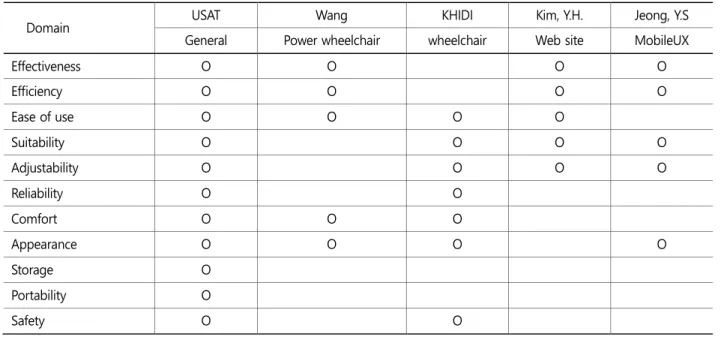
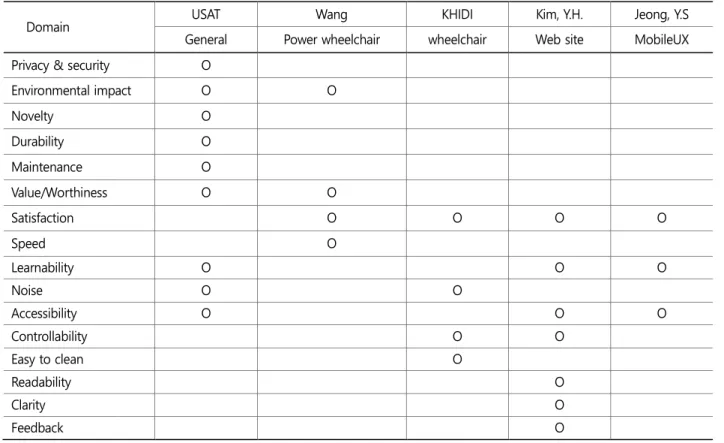
Table 1 shows the items related with the usability evaluation of autonomous transportation robots in the preceding studies relevant with the service robot products mentioned above as follows:
Table 1. Comparison of usability criteria for autonomous transportation robot-related studies
Domain USAT Wang KHIDI Kim, Y.H. Jeong, Y.S
General Power wheelchair wheelchair Web site MobileUX
Effectiveness O O O O
Efficiency O O O O
Ease of use O O O O
Suitability O O O O
Adjustability O O O O
Reliability O O
Comfort O O O
Appearance O O O O
Storage O
Portability O
Safety O O
Current service robot-related national standards are Safety Guidelines for KS Service Robots (KS B 6936) and General Rules for Safety of Service Robots (KS B 6935) of Korean Agency for Technology and Standard (KATS) affiliated with the Ministry of Knowledge Economy. In Japan, more advanced than Korea in the perception of an aging society, no exclusion of aging population on all government-procured goods is required through Japanese Industrial Standards, JIS. In 2004, JIS X8341 Series (IT devices, aging population on software and service, and design guidelines taking into account disabled people) were enacted. In 2014, Japan's Safety Standard for Everyday Life Supporting Robots was appointed as an international standard (ISO 13482). The U.S.
set the products considering information accessibility as government procurement standard through the revision of Article 508 of the Rehabilitation Act in 2001.
2.2.3 Preliminary usability evaluation criteria of the SFATR
The preliminary index was drawn through expert meeting under the following principles, based on the safety guidelines for service robots in major countries including Korea and Japan, as well as through preceding studies on the usability evaluation of SFATR-associated products:
First, core function analysis from the product and service aspect of SFATR
Second, comparison of things in common/similarities with the core functions offered by the preceding studies-targeted products and services
Third, analysis of safety standards commonly required for senior-friendly products Fourth, reflection of the physical and mental characteristics of users (seniors) Fifth, merchantable quality for full swing diffusion of SFATR
Table 1. Comparison of usability criteria for autonomous transportation robot-related studies (Continued)
Domain USAT Wang KHIDI Kim, Y.H. Jeong, Y.S
General Power wheelchair wheelchair Web site MobileUX
Privacy & security O
Environmental impact O O
Novelty O
Durability O
Maintenance O
Value/Worthiness O O
Satisfaction O O O O
Speed O
Learnability O O O
Noise O O
Accessibility O O O
Controllability O O
Easy to clean O
Readability O
Clarity O
Feedback O
On the basis of the principles mentioned above, the preliminary index in the four domains - Safety, Controllability, Efficiency, and Satisfaction - were drawn through expert advisory (Table 2).
Safety
As the SFATR is a product targeting the elderly or the disabled who has lower mobility and slower reflexes than those of ordinary people, we must consider safety is the first component in the usability evaluation index. According to Safety Guidelines for KS Service Robots (KS B 6936), and General Rules for Safety of Service Robots (KS B 6935) of KATS, the service robot’s hazard sources are divided into mechanical, electric, thermal and noise hazard sources, and the hazard source caused when ergonomic principles are ignored, and the hazard source caused when a human rides. This study drew safety evaluation items taking into account product characteristics, based on those hazard sources.
To guarantee the safe operation has become the most basic evaluation item in various situations, because the product itself has mobility under diverse environments such as indoor and outdoor, as well as heavy enough to give burden to a senior. For preliminary user evaluation, the hazard of the product's tripping or the hazard caused to human body was evaluated in the two situations of 'stop' and 'move'. In consideration of senior's physical characteristics with high risk of injury even by relatively weak stimulation, the user's injury risk degree was carefully evaluated as a contact hazard item by assuming the time when the robot contacts with the user.
In addition, the evaluation on moving speed and reaction degree, which can be whether senior citizens can sufficiently recognize and respond in the case of robot's operation, or riding in while the robot moves, and the evaluation of electric shock risk as an electric motor operation equipment were included in the evaluation scope.
Controllability
The SFATR's basic function is to move to senior citizen's desired destination automatically or manually by controlling the robot.
As a senior handles the robot without assistant's help, it is essential to ensure controllability that is intuitive, easy to learn. In addition, the senior should handle the risk situation easily. Therefore the controllability criterion must reflect the behavioral characteristics and learning abilities of the seniors as well as the characteristics of the equipment and operating environment.
Because, SFATR is a product carrying a user to the user's desired destination, the evaluation index of driving attributes was included to measure directivity precisely indicating moving to the desired location. To cope with emergency and other situations while moving, a brake function, through which the SFATR can stop immediately when the user wants, was evaluated. Here, the questions on brake operation and release were included.
Table 2. Preliminary criteria of the UEC-SFATR
Domain Item
Safety Stability (Moving, Stop, Heel), Contact hazard, Moving speed, Responsiveness, Electric shock safety Controllability Power switch, Display, Charge, Moving, Installation, Contents, Driving, Break, Arm rest, Foot stand, Leg
support, Frame
Efficiency Ease of learning, Accessibility, Accuracy, Consistency, Visibility, Simplicity
Satisfaction
Ease to use, Driving stability, Machine weight, Ergonomics, Mobility, Driving comfort, Noise, Aesthetics, Expandability, Customizability, Exterior design, Manual comprehensibility, User environment, Persistency, Product recommendation, Service quality
Efficiency
Because, the SFATR is a machine focusing on moving, easy manipulation by anyone, offering consistent and accurate information and user's convenience in use are key factors. Along with controllability, the ease of learning on how easily and quickly a user can learn how to manipulate the robot becomes an important evaluation criterion, when a user uses the robot in order to go to his/her desired destination. While the SFATR moves or stops, evaluation on whether a user can receive accurate information of POI (Point of Interest) and search result is also essential. Besides, such evaluation items as accessibility evaluating whether a user can immediately use without previous knowledge or experience of IT devices, consistency on whether the interface causes confusion to a user, visibility on how easily a user can recognize the information offered by the robot in the driving situation, and simplicity on whether only the information that a user needs is provided were included.
Satisfaction
In the usability evaluation of SFATR, the product functions mentioned above is are important; however, the evaluation on the experience of using the product becomes an important index judging the quality of the product. The satisfaction evaluation item is the index to evaluate satisfaction on use experience of SFATR. This item evaluates how sincerely the product reflects user-expected functions.
2.3 Verification of the preliminary criteria of the UEC-SFATR 2.3.1 Participants
The required number of participants for the preliminary user evaluation was asserted by Virzi (1992), Nielsen and Landauer (1993), and Wharton, et al. (1994) for the first time, and this study selected five actual user participants under the magic number five of user evaluation arranged by Nielsen (2000).
The five actual users, who participated in the preliminary evaluation, were those who voluntarily revealed their will to participate among the seniors aged 60 or so having experience of using smart devices. The participants who obtained 23 points and higher, and who could read and write Korean enough to respond to the questionnaire survey were selected in this study.
The expert group consisted of the experts, who sufficiently understood the functions and attributes of senior-friendly products, considered the physical and mental characteristics of the elderly, and evaluated and analyzed the target equipment by identifying the smart equipment characteristics. One robot technology expert, one usability evaluation expert, one smart device UX expert, one senior-friendly product expert, and one expert for medical care of elderly people participated in drawing the usability evaluation index.
2.3.2 Preliminary test procedure
The test of the preliminary evaluation items of SFATR targeted five senior citizens who would be an actual user group. After letting them use the SFATR, the usability and understanding of the questionnaire were evaluated through the questionnaire of preliminary evaluation items and interview.
The evaluation results were revised and supplemented through the review of the expert group (five people), and then, the final usability evaluation index was drawn.
2.3.3 Preliminary results review
The test of preliminary evaluation items was focused on the following:
First, whether the general users accurately understand and answer the questions.
Second, whether the detailed questions precisely ask the concepts to evaluate.
Third, whether there are duplicate or vague items.
The preliminary evaluation questionnaire survey results targeting five people, supplementary interviews, expert group evaluation results, and questions with strong duplicate attributes of "stop stability" were integrated, and more clear and detailed descriptions were made on hard to understand and vague contact hazard and consistency items. Also, some questions were added to improve for the items of safety and satisfaction that did not properly reflect the SFART characteristics.
The evaluation form was developed by reflecting all these.
2.4 Usability tests by the UEC-SFATR
The main evaluation was carried out targeting the seniors using the confirmed usability evaluation index of SFATR and questionnaire.
2.4.1 Participants
As shown in the preliminary user evaluation, the real SFATR users who participated in the main evaluation were the seniors aged 60 or so with experience of using smart devices. Among these people, those who voluntarily revealed their will to participate in the usability evaluation, and those who scored 23 points and higher as a result of Korean simple mental state examination, and those who could read and write Korean were selected.
The number of the participants was based on the user evaluation magic number five of Nielsen, but the participants were divided into four groups (five people for each group) having different characteristics with one another. The principle of Nielsen's magic number five (2003) is the principle for target number calculation principle to find out the usability problems of a specific product the most efficiently from the cost vs. effect aspect: namely, five users having representation can find the usability problems by more than 80%.
Given that the product of this study is smart equipment based on cutting-edge technology, and the target users are the elderly, various factors had to be considered in selecting the users having representation.
Mayes and Fowler (1999), Massey, Khatri, and Montoya-Weiss (2007) say the factors affecting technology acceptance and usability the most are gender and familiarity with technology in the research on technology-intensive products and information technology.
In other words, the gender and familiarity with technology, namely, experience and familiarity on technology should be essentially considered in order to select user group that can clearly represent the users of target product in usability evaluation on the cutting-edge technology product, which is the target product of this study.
Therefore, this study chose that it would be the most efficient and desirable study target groups to find the problems of the target product line by selecting 20 people: five by each group through dividing them by gender (male vs. female) and familiarity with technology (familiar vs. unfamiliar).
From the criterion of familiarity with technology in this study, unfamiliarity with smart equipment is the case of simple phone
calling and text messaging, despite using a smartphone, or simple viewing Internet articles, despite using a computer. Familiarity with smart equipment is the case of utilizing other applications (SNS App, memo App, etc.) well in addition to phone calling and text messaging, while using a smartphone, or the case of using social network service, instant messenger and community activities in addition to simple Internet article search, while using a computer.
Table 3 shows the test participants groups of the UEC-SFATR for the study.
The average age of the 20 experiment participants was 68.5±6, and they consisted of ten males and ten females.
2.4.2 Process
For usability evaluation under the same conditions, the usual experimental environment was set up within Daegu Senior Convention Center, a usability evaluation agency. In the center, the participants used the target equipment, and scored each evaluation item. For the seniors, it might be difficult to evaluate the SFATR while using it. Therefore, the equipment use manual and evaluation items were known to them in advance to make the evaluation easily during the use and post-use. Also, the accuracy of evaluation was enhanced by letting them answer the positive/negative degree, after obtaining the positive/negative answers in detailed questions.
Figure 2 shows the usability test photo of a participant and a researcher at Daegu Senior Convention Center.
Table 3. Test Participants by group of the UEC-SFATR
Technology
Expert group
Unfamiliar Familiar
Gender Male 5 5
5
Female 5 5
Figure 2. Usability test photo
2.5 Statistical analysis
The internal validity of the developed usability evaluation index items were evaluated by the expert group, and consistency was tested through ICC (Intraclass Correlation Coefficient).
For the index to check consistency verification between researchers, Cohen's Kappa Coefficient, Fleiss' Kappa Coefficient, and ICC are commonly used (Richman, Makrides, & Prince, 1980). While Cohen's Kappa Coefficient or Fleiss' Kappa Coefficient is used for consistency verification between the test-retest results of the same subjects mainly, the statistical analysis using ICC is a proper method in the event that three or more of evaluators evaluated the usability evaluation items as demonstrated in this study. The evaluation scale is an ordinal scale by four-point Likert scale, not nominal evaluation. In usability evaluation index development, it is not important that each evaluator conducts the same evaluation, but it is a key to evaluate with the consistent tendency on the same issue. Therefore, it is general to verify through ICC with consistency as the index of reliability. The ICC evaluation criteria were presented by Fleiss (2004), Nunnally, Bernstein, and Berge (1967), and Richman et al. (1980). If the index is 0.8-1.0, it means very reliable, if it is 0.6-0.79, it means middle level of reliability, and reliability is suspected, if the score is 0.59 and lower, according to general evaluation criteria in the academia.
For ICC reliability statistics, SPSS 21 for Windows was used for the analysis.
3. Results
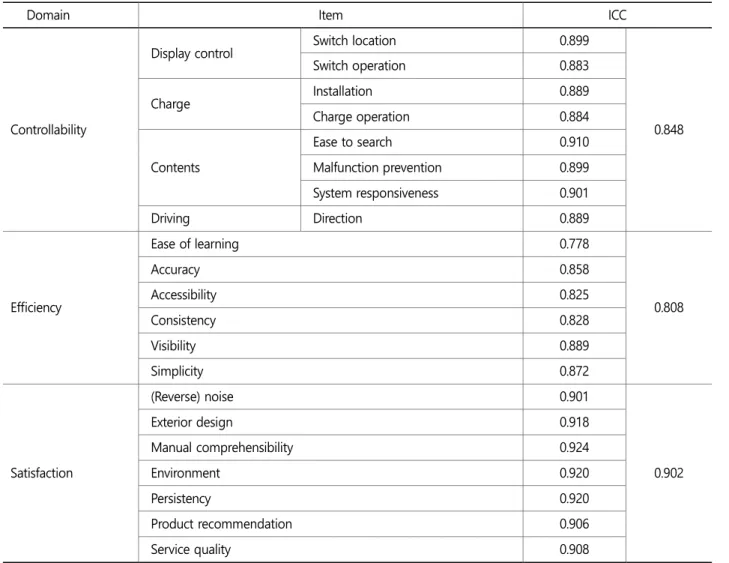
As a result of reliability analysis between evaluators by item of the SFATR, very reliable ICC was acquired in all items including safety, controllability, and satisfaction (Table 4).
The ICC in safety domain was 0.850, which was within the very reliable ICC range of 0.8-1.0, and thus, reliability between evaluators was secured. Looking into ICC by detailed item of safety domain, moving stability was 0.882, stop stability was 0.879, electric shock hazard was 0.874, and responsiveness was 0.868: stable reliability was shown in all the detailed items at 0.8 and higher.
The ICC in controllability domain was 0.848, which was very reliable level, and the remaining items except some items (ease of learning) showed very high reliability as well at 0.82 and higher. In this regard, reliability was ensured in designing the usability evaluation index. ICC in satisfaction domain also showed very high reliability at 0.902.
Table 4. ICC summaries of the UEC-SFATR
Domain Item ICC
Safety
Stability (Stop) 0.879
0.850
Contact hazard 0.861
Moving speed 0.858
Responsiveness 0.868
Electric shock safety 0.874
Stability (Moving) 0.882
Controllability Power switch Location 0.878
0.848
Operation 0.891
4. Discussion
The purpose of this study is to develop objective usability evaluation index on the SFATR (senior-friendly autonomous transportation robot) to overcome the problem of mobility, one of the factors hugely constraining the everyday life of disabled people and seniors whose mobility is uncomfortable, by cutting-edge IT technology, and to validate the index.
The SFATR is a robot product helping disabled people and seniors move from the current location to desired place in the closed spaces (indoor or outdoor) that can be monitored, such as hospital and nursing home. Unlike a power wheelchair fully depending on a rider in terms of operation in the state of a person riding the wheelchair, the SFATR, equipped with a monitoring function of the surrounding environment and a navigation function, finds optimal path by receiving the inputted destination information, automatically operates, and detects and avoids obstacles, pedestrians and unexpected situation on its own on the way. In this regard, the SFATR is a state of art technology service robot having the functions mentioned above.
Table 4. ICC Summaries of the UEC-SFATR (Continued)
Domain Item ICC
Controllability
Display control Switch location 0.899
0.848
Switch operation 0.883
Charge Installation 0.889
Charge operation 0.884
Contents
Ease to search 0.910
Malfunction prevention 0.899
System responsiveness 0.901
Driving Direction 0.889
Efficiency
Ease of learning 0.778
0.808
Accuracy 0.858
Accessibility 0.825
Consistency 0.828
Visibility 0.889
Simplicity 0.872
Satisfaction
(Reverse) noise 0.901
0.902
Exterior design 0.918
Manual comprehensibility 0.924
Environment 0.920
Persistency 0.920
Product recommendation 0.906
Service quality 0.908
※ ICC: 0.80-1.00 Highly Reliable, 0.60-0.79 Reliable
This actually minimizes the need for an assistant who support for mobility within facilities, and transports a rider who has difficulties in mobility without intervention of others. Therefore, the SFATR can be expanded into many applied fields, compared with a power wheelchair, and has another merit that senior’s privacy can be protected. Only a handful of developed countries are actually developing the SFATR such as the U.S., Europe and Japan, as well as in Korea.
Although, the existing international standard, ISO, and Korean standard, KS, are presented as the standards for service robots to assist everyday life of the elderly and weak, they have limitations in that they are focused on safety, and are not specialized for specific field product, namely, SFATR.
Even though there were studies on the usability of similar products, such as manual wheelchair or power wheelchair, almost no study on the usability of the SFATR has been conducted domestically and internationally.
Few studies on the usability index considering distinct characteristics of a silver product targeting the elderly, whose understanding and learning on smart devices are low, have been conducted.
This study aims to present a direction on the usability index development that sufficiently considers the product features of the SFATR and its users.
5. Conclusion
The usability index on the SFATR was developed as follows in consideration of various safety standards on relevant products and service robots: preliminary evaluation questions were designed, the understanding on the SFATR was reviewed on the detailed questions through questionnaire survey and interview for the seniors, who have experience in a service robot under the advisory of the expert group. Also, through the removal of duplicate questions, development and supplementation of detailed questions, the highly efficient final usability evaluation index was developed.
Concerning the usability evaluation index drawn as above, the participants were divided into four small groups that can represent users in consideration of gender, and familiarity with smart devices, and they were let experience the product. After collecting the experiences through questionnaire, reliability by detailed item was verified using a statistical package.
This study provides guide to the future product development and product competitiveness evaluation by quantifying user experiences, after developing a tool to objectively evaluate the usability, safety, and satisfaction of the product on specified service robot, namely, SFATR, at its early stage.
While existing KS or ISO standards are the guidelines verifying safety on the general service robots, the usability index of this study has become the basis that can measure not only essential safety, but overall satisfaction and competitiveness of a product.
In this regard, this study has huge significance.
The further study aims to offer a physical standard necessary for the actual product operation, focusing on product use environment, and ergonomic guidelines with which users can conveniently use the product. In addition, a study to standardize the usability index as national index, develop it into an international standard, and make the index sophisticated will be conducted as well.
Acknowledgements
This work was funded by grants from Korea Health Industry Development Institute (Grant-2013-63).
References
Amendments, US Rehabilitation Act. Section 508. PL., 1998.
Ahn, Shinjyun, 3 Keywords of New Senior Generation,
SERI Management Note
, 96, Samsung Economic Research Institute, 2011.Arthanat, S., Bauer, S.M., Lenker, J.A., Nochajski, S.M. and Wu, Y.W., Conceptualization and measurement of assistive technology usability.
Disabil Rehabil Assist Technol
, 2(4), 235-48, 2007.Arthanat, Sajay, Yow Wu B. Wu, Stephen M. Bauer, James A. Lenker, and Susan M. Nochajski, Development of the Usability Scale for Assistive Technology-Wheeled Mobility: A preliminary psychometric evaluation.
Technology & Disability
, 21(3), 79-95, 2009.Bevan, Nigel, Carol Barnum, Gilbert Cockton, Jakob Nielsen, Jared Spool, and Dennis Wixon , The magic number 5: is it enough for web testing?
Paper read at CHI'03 extended abstracts on Human factors in computing systems
, 2003.Choi, Sookhi, The influence and impact of Aging Society in Korea and Japan,
SERI Research Report
, Samsung Economic Research Institute, 2007.Cutler, Stephen J , Voluntary association participation and life satisfaction: A cautionary research note.
Journal of Gerontology
, 28(1), 96-100, 1973.Fleiss, J.L.,
The design and analysis of clinical experiments
, 1986. New York, John Wiley& Sons, 2004.ISO, ISO. DIS 13482: Robots and robotic devices-Safety requirements-Non-medical personal care robot. Geneva, Switzerland:
International Organization for Standardization, 2011.
Jeong, Y.S. and Jeong, B.Y., Usability Evaluation Criteria for Mobile Navigation Using AHP.
Journal of the Ergonomics Society of Kore
a, Vol. 32 (No. 5), pp.443-448, 2013. doi: 10.5143/JESK.2013.32.5.443JIS, X, 8341 Guidelines for older persons and persons with disabilities. In Information and communications equipment, software and services, 2004.
Kim, Yeon Hee and Roh, Seungwan, Development of website usability test scale for reinforcement of design consulting,
Journal of Korea Design Knowledge
, 25(-), 67-78, 2013.Development of Usability Criterior for Senior Friendly Products, Korea Health Industry Development Institute, 2011.
Lee, Eunghyuk, Service Robot for Home,
IT Report
, Korea Electronics Technology Institute, 2004.Lee, Hoyoung and Seo, Wooseok, Rethinking Cultural Capital and Inequality in the Digital Age ,
Journal of cultural policy
, 23(-),69-95, Korea Cultural Policy Institute, 2010.
Massey, Anne P, Vijay Khatri, and Mitzi M Montoya-Weiss, Usability of Online Services: The Role of Technology Readiness and Context*.
Decision Sciences
, 38(2), 277-308, 2007.Mayes, John T. and Chris J Fowler, Learning technology and usability: a framework for understanding courseware.
Interacting with computers,
11(5), 485-497, 1999.Nielsen, Jakob, and Thomas K Landauer, A mathematical model of the finding of usability problems.
Paper read at Proceedings of the INTERACT'93 and CHI'93 conference on Human factors in computing systems
, 1993.Nielsen, J.
Why you only need to test with 5 users
. Alertbox, 2000. www.useit.com/alertbox/2000319.html (retrieved by Oct.14, 2014).Nunnally, Jum C, Ira H Bernstein, and Jos MF ten Berge,
Psychometric theory
, Vol. 226: McGraw-Hill New York, 1967.Richman, J., Makrides, L. and Prince, B.,
Research methodology and applied statistics, part 3: measurement procedures in research
, Physiother Canada, 32(4), 253-257, 1980.Rogers, Wendy A, Beth Meyer, Neff Walker, and Arthur D Fisk, Functional limitations to daily living tasks in the aged: A focus group analysis.
Human Factors: The Journal of the Human Factors and Ergonomics Society
, 40(1), 111-125, 1998.Samsung Economic Research Institute.
Three keywords of New Senior generation
, 2011.Section 508 of The Rehabilitation Act: The Road to Accessibility
, http://www.section508.gov (retrieved Oct 14, 2014).Standard, Korean. KS B 6935 Service robots - safety guidelines, 2006a.
KS B 6936, Service robots - safety instructions, 2006b..
Virzi, Robert A, Refining the test phase of usability evaluation: how many subjects is enough?
Human Factors: The Journal of the Human Factors and Ergonomics Society
, 34(4), 457-468, 1992.Wang, Rosalie H, Alex Mihailidis, Tilak Dutta, and Geoff R Fernie, Usability testing of multimodal feedback interface and simulated collision-avoidance power wheelchair for long-term-care home residents with cognitive impairments.
Journal of Rehabilitation Research & Development
, 48(7), 801-22, 2011.Wharton, Cathleen, John Rieman, Clayton Lewis, and Peter Polson, The cognitive walkthrough method: A practitioner's guide.
Paper read at Usability inspection methods
, 1994.Author listings
Seon Chil Kim: [email protected]
Highest degree: RT, Ph.D, Department of Medical Informatics, College of Medicine Kunngpook National University
Position title: Associated professor
Areas of interest: Health informatics, Medical Image, Information, Radiology, Senior Industry
Sun Jung Kim: [email protected]
Highest degree: PhD, Graduate School of Nursing, Yonsei University Position title: Assistant professor
Areas of interest: Acculturation, health promotion behavior, Medical device, clinical trial, Medical marketing, health communication
Kyongon Choi: [email protected]
Highest degree: Ph.D, Yonsei School of Business, Yonsei University
Position title: Executive Vice President, Strategy & Marketing, Storyhenge Inc.
Areas of interest: Human brand marketing, consumer behavior, entertainment marketing, health communication