Journal of the Ergonomics Society of Korea
Vol. 30, No. 2 pp.331-338, April 2011 DOI:10.5143/JESK.2011.30.2.331
Development of a Comprehensive Usability Testing and Analysis Framework for the Physical Interface
Between Product and User
Wonsup Lee
1, Kihyo Jung
2, Hyunju Lee
3, Hwagyu Song
3, Jangkeun Oh
3, Heecheon You
11
Department of Industrial and Management Engineering, POSTECH, Pohang, South Korea, 790-784
2
2nd R&D Institute, Agency for Defense Development, Daejeon, South Korea, 305-152
3
Vacuum Cleaner R&D Group, Samsung Gwangju Electronics, Gwangju, South Korea, 506-723
ABSTRACT
Objective: The present study developed a comprehensive usability testing and analysis framework based on a physical interface model of product and user and applied the proposed framework to usability testing of canister-type vacuum cleaner.
Background: The development of a user-centered product design is important to satisfy customers who want to use the product with ease of use and to keep the manufacturer competitive in the market. Method: The proposed testing and analysis framework consists of (1) characterization of physical product-user interface, (2) preparation and administration of usability testing questionnaire, and (3) analysis and interpretation of usability testing results. A usability evaluation of five vacuum cleaners was planned and administered based on the proposed framework and its analysis produced detailed and overall usability testing results for various aspects such as tasks, usability criteria, and design components. Results: The testing results were further utilized to identify usability problems and preferred design features of the vacuum cleaners. Conclusion: The proposed usability testing and analysis framework was found effective to identify preferred features and problems of a product design in a systematic, holistic manner. Application: The proposed framework can be of effective use for practitioners of product design and development to obtain comprehensive, quantitative usability testing information in a systematic manner.
Keywords: Physical user interface; Comprehensive usability testing; Multi-faceted evaluation; Preferred design features and problems
1. Introduction
사용성 평가는 제품의 성능과 만족도를 분석함으로써 사 용이 편리한 제품을 개발하는데 유용하다. 사용성 평가는 제 품의 사용 편의성 향상을 위해 내재되어 있는 사용상의 문 제점을 파악하는 방법으로(Bowman et al., 2002; Hartson et al., 1996), 제품이나 서비스의 효율성(efficiency), 유효 성(effectiveness) 및 사용자 만족도(satisfaction)에 대한 평가를 통해 이루어진다(ISO, 1991). 예를 들면, Kuijt-
Evers et al.(2007)은 수공구 사용 시 EMG, 접촉 힘, 그 리고 주관적 만족도를 평가하여 손잡이 설계에 적용하였고, Paschoarelli et al.(2008)은 의료 진단용 handheld 초음파 측정기 사용 시 electrogoniometer를 활용하여 측정된 자 세 정보를 기기 형상 설계에 반영하였다. 제품에 대한 사용 성 평가 및 사용성 평가 결과의 제품 설계 반영은 사용이 편리한 인간친화적 제품 개발에 유용하다(Courage and Baxter, 2005; Jordan, 1996).
사용성 평가 연구는 평가 범위 측면에서 주로 제품의 특 정 설계 요소에 한정하여 평가를 수행하고 있다. 특정 설계 Corresponding Author: Heecheon You. Division of Mechanical and Industrial Engineering, POSTECH, Pohang, Kyungbuk, 790-784.
Mobile: 010-3213-2210, E-mail: [email protected]
Copyright@2011 by Ergonomics Society of Korea(pISSN:1229-1684 eISSN:2093-8462). All right reserved.
요소 평가를 위해서는 관련 제품 사용 작업과 인간공학적 평 가 척도가 선정된다. 예를 들어, Brand and Hollister(1999), Colle and Hiszem(2004), 그리고 Drury and Hoffmann (1992)은 문자 입력이 편리한 휴대전화기의 버튼 형상과 크기를 파악하기 위해 버튼 입력 작업 시 작업 속도와 정확 도를 측정하였다. 이러한 특정 설계 요소에 대한 사용성 평 가는 평가 대상 설계 요소에 대해 심층적으로 분석할 수 있 는 장점이 있으나, 평가 대상 제품의 전반적인 설계 요소에 대해 설계 개선이 요구되는 사항을 체계적으로 파악할 수 없다는 한계가 있다.
평가 대상 제품의 다양한 설계 요소들 중에서 개선이 필 요한 항목을 체계적으로 파악하기 위해서는 종합적인 사용 성 평가 체계가 필요하다. 종합적 사용성 평가는 평가 제품 의 전반적인 설계 요소 및 사용 작업을 평가함으로써 다양 한 설계 개선 사항들을 파악하는데 유용할 것이다. 또한, 설계 특성이 다른 여러 제품을 대상으로 한 종합적 사용성 평가 결과는 설계 요소별 설계 특성의 선호도 차이를 비교 할 수 있게 하여 설계 요소별 개선 방향 파악 시 유용하게 활용될 것이다.
본 연구는 제품을 구성하고 있는 다양한 설계 요소들에 대해 종합적으로 사용성을 평가할 수 있는 방안을 제안하고, 제안된 사용성 평가 방안을 특정 제품의 사용성 평가에 적 용함으로써 종합적 사용성 평가 방안의 유용성을 파악하였 다. 본 연구에서 제안된 종합적 사용성 평가 방안은 제품- 사용자 상호작용 모형을 기반으로 개발되었으며, 진공 청소 기 5종에 대한 사용성 평가에 적용되었다.
2. Comprehensive Usability Testing Methodology
본 연구는 세 단계(제품 특성 분석, 사용성 평가, 개선 설 계 분석)로 구성된 종합적 사용성 평가 방안을 제시하였다.
첫째 단계는 평가 대상 제품에 대한 체계적 이해를 위해 제 품-사용자간 신체적 상호작용 평가 모형을 기반으로 제품의 특성(예: 제품 설계 요소, 제품 사용 작업)을 분석한다. 둘째 단계는 파악된 제품 특성에 근간하여 사용성 평가 설문지를 개발하고 사용성 평가를 수행한다. 마지막 단계는 사용성 평가 결과를 정량적으로 분석하여 평가 대상 제품의 개선 대상 설계 요소 및 개선 방안을 파악한다.
2.1 Analysis of the human-product system
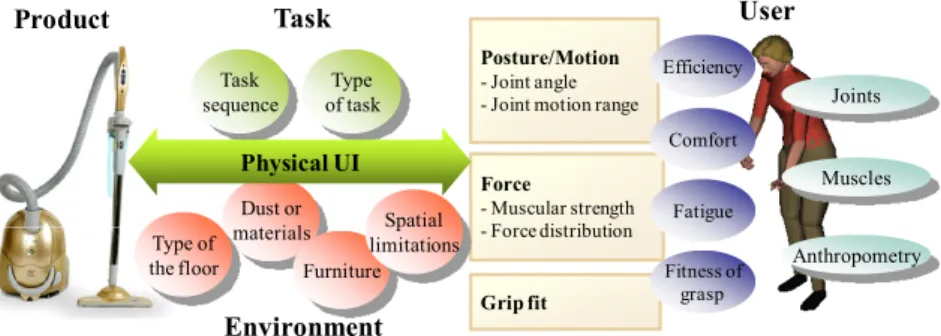
그림 1과 같은 평가 제품에 대한 제품-사용자간 신체적 상호작용 평가 모형을 기반으로 평가 대상 제품의 특성을 전반적이고 체계적으로 파악한다. 제품-사용자간 신체적 상 호작용 평가 모형은 네 가지 부문(제품, 사용자, 사용 작업, 그리고 사용 환경)으로 구성되며 이들 개별 부문들은 일련 의 사용 작업을 수행하기 위해 상호 연계된다.
2.1.1 Analysis of human-product subsystems
평가 대상 제품의 특성을 이해하기 위해 제품-사용자간 신체적 상호작용 평가 모형의 네 가지 개별 부문(제품, 사용 자, 사용 작업, 그리고 사용 환경)에 대한 세부 구성 요소를 분석한다. 진공 청소기를 예로 들면, 제품 부문에 대한 특성 분석은 표 1.a와 같이 진공 청소기의 설계 요소를 파악하고, 사용 작업 부문에 대한 특성 분석은 표 1.b와 같이 진공 청 소기를 사용하여 수행되는 단위 작업을 파악한다. 또한, 사 용자 부문에 대한 특성 분석은 설계 대상 인구의 인구학적 특성(예: 연령대, 성별, 체형 특성 등)을 명시하고, 표 1.c와 같이 제품의 사용성에 영향을 주는 인간공학적 기준을 제품 개발 산업체 실무자 및 인간공학 전문가들이 협의를 통하여 설정한다. 마지막으로, 사용 환경 부문에 대한 특성 분석은 표 1.d와 같이 제품을 사용하는 주변 환경 특성을 파악한다.
Force
- Muscular strength - Force distribution Posture/Motion - Joint angle - Joint motion range
Grip fit Dust or
materials Furniture Task
sequence Type of task
Efficiency
Comfort
Fatigue
Fitness of grasp Spatial
limitations
Joints
Muscles
Anthropometry
Product Task User
Type of the floor
Physical UI
Environment
Figure 1. Evaluation model of physical interaction between user and product
2.1.2 Analysis of relationships between human-product subsystems
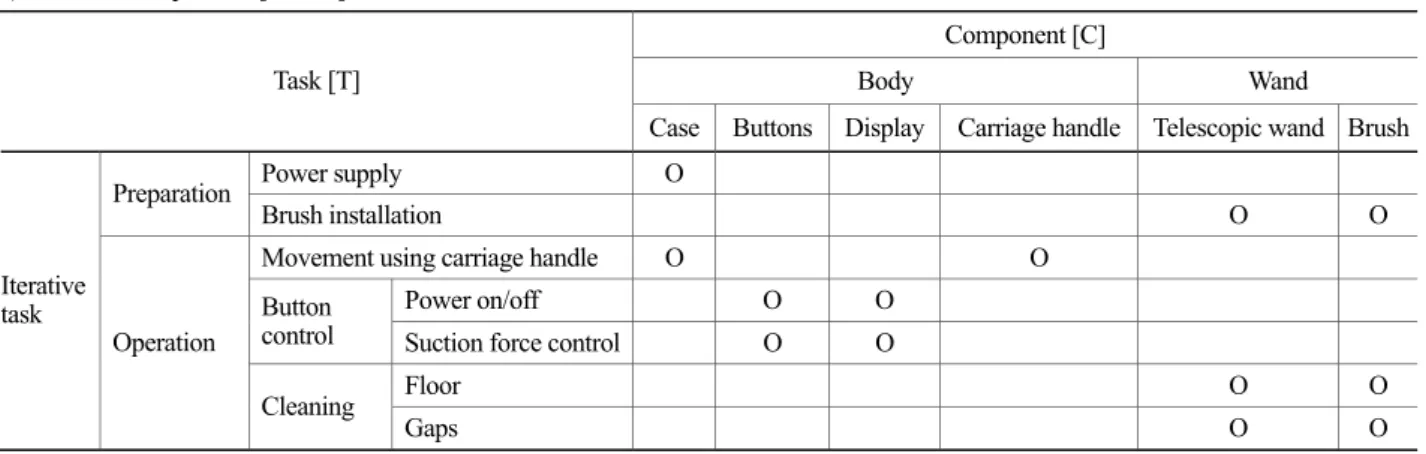
제품-사용자간 신체적 상호작용 평가 모형의 부문들 간 연관성은 사용 작업을 중심으로 제품(사용 작업 × 제품 설 계 요소)과 사용자(사용 작업 × 인간공학적 평가 기준)에 대해 각각 분석된다. 제품 사용 작업과 설계 요소의 연관관 계 분석은 제품 사용 작업별로 사용이 되는 제품 설계 요소 파악을 통해 이루어진다. 표 2.a를 예로 들면, 진공 청소기 의 brush 체결 작업은 청소대 연장관 및 brush와 연관이 있고, button 조작 작업은 청소기 본체에 장착된 button 및 display와 연관이 있다. 한편, 제품 사용 작업과 인간공학적 평가 기준의 연관관계 분석은 제품 사용 작업별 연관성이 있 는 인간공학적 평가 기준 파악을 통해 이루어진다. 표 2.b를 예로 들면, 진공 청소기의 brush 체결 작업은 인간공학적 평가 기준 중에서 사용 용이성과 연관이 있으며, 청소기 본 체 손잡이를 잡고 이동하는 작업은 편안한 자세, 효율적 힘 사용, 파지감, 그리고 사용 용이성과 연관이 있다. 개별 부 문들간의 연관성 여부는 제품 개발 실무자 및 인간공학 전 문가에 의해 분석된다.
2.2 Usability testing
평가 대상 제품에 대한 사용성 평가는 사용성 평가 설문지 개발, 사용성 평가 실험 계획 수립, 그리고 사용성 평가 실험 진행으로 이루어진다. 첫째, 파악된 제품 사용 작업, 제품 설 계 요소, 그리고 인간공학적 평가 기준간의 연관성 분석 결 과(2.1.2장 참조)에 근간해 사용성 평가 설문지를 개발한다.
표 3에 예시된 청소기 이동 작업에 대한 설문 항목들은 표 2에서 파악된 청소기 이동 작업과 관련된 두 가지 제품 설 계 요소(본체 케이스와 본체 손잡이)와 인간공학적 평가 기 준(예: 편안한 자세, 효율적 힘 사용, 파지감, 사용 용이성) 에 대해 평가되도록 구성되었다. 둘째, 다양한 사용자를 적 합하게 대표하는 실험 참가자가 개발된 사용성 평가 설문지 를 이용하여 제품 사용 환경과 유사한 환경에서 다양한 제품 사용 작업을 수행할 수 있도록 사용성 평가 실험을 계획하고 진행한다. 사용성 평가를 위한 평가 환경은 파악된 제품 사 용 환경 특성(2.1.1장 참조)에 근간해 구성한다. 예를 들면, 진공 청소기 사용성 평가를 위한 환경은 청소기 사용 환경을 고려해 청소 바닥 재질(예: 일반 마루 재질) 및 청소기 사용 장소(예: 가구 위와 밑, 틈새, 창틀)를 결정한다.
2.3 Analysis of improved design
사용성 평가 점수는 제품 설계 요소별로 연관된 작업별 각
Table 1. Analysis of product characteristics(illustrated)
a) Product: components [C]
Category Component Carriage handle
Buttons Body
Display Wand handle Hose
Telescopic wand Wand
Brush
b) Task [T]
Frequency Category Task
Hose installation/uninstallation Infrequent
task Assembly
Brush exchange Power supply Preparation
Brush installation
Movement using carriage handle Power on/off Button
control Suction force control Floor
Iterative task
Operation
Cleaning Gaps
c) User: usability measures [M]
Measure Definition Comfortable
posture The extent to which comfortable postures are maintained while operating the product Efficient motion The extent to which motions are efficientlyused to operate the product Natural motion The extent to which natural motions are used
to operate the product Effective use of
force The extent to which forces applied to operate the product are acceptable
Fit to the hand The extent to which the handle or grip fits to the size and shape of the hand
Ease of use The extent to which a user easily operates the product
d) Environment
Area under the furniture Area on the top of the furniture Furniture
Gap between furniture pieces Door threshold
Entrance and veranda Bed and blanket
Table 3. Usability evaluation questionnaire(illustrated)
Component Task Usability questions Score
The extent to which the brush is connected to the tube at a
single trial without error Low High
Connection of
brush to tube Ease of use
The extent to which the brush is easily connected to the tube The extent to which the button on the brush is pressed by
applying a proper force Brush
Disconnection of
brush from tube Ease of use
The extent to which the brush can be easily disconnected from
the tube
Comfortable
posture The extent to which the handle is operated with a comfortable
posture at the hand and arm The extent to which the handle is operated with a evenly
distributed force
Effective use
of force The extent to which the handle is operated by a proper amount
of force to move the cleaner The extent to which the handle is easily grasped Fit to the hand The extent to which the handle fits the hands in various sizes
and shapes
Carriage
handle Movement
Ease of use The extent to which the handle is effective to keep the cleaner
body balanced during movement
Table 2. Analysis of relationships between human-product subsystems(illustrated)
a) Tasks × Components [T × C]
Component [C]
Body Wand Task [T]
Case Buttons Display Carriage handle Telescopic wand Brush
Power supply O
Preparation
Brush installation O O
Movement using carriage handle O O
Power on/off O O
Button
control Suction force control O O
Floor O O
Iterative task
Operation
Cleaning
Gaps O O
b) Tasks × Usability measures [T × M]
Usability measure [M]
Task [T] Comfortable
posture Efficient
motion Natural
motion Effective use
of force Fit to the
hand Ease of use
Power supply O O O
Preparation
Brush installation O O O
Movement using carriage handle O O O O
Power on/off O O
Button
control Suction force control O O
Floor O O O O
Iterative task
Operation
Cleaning
Gaps O O O O
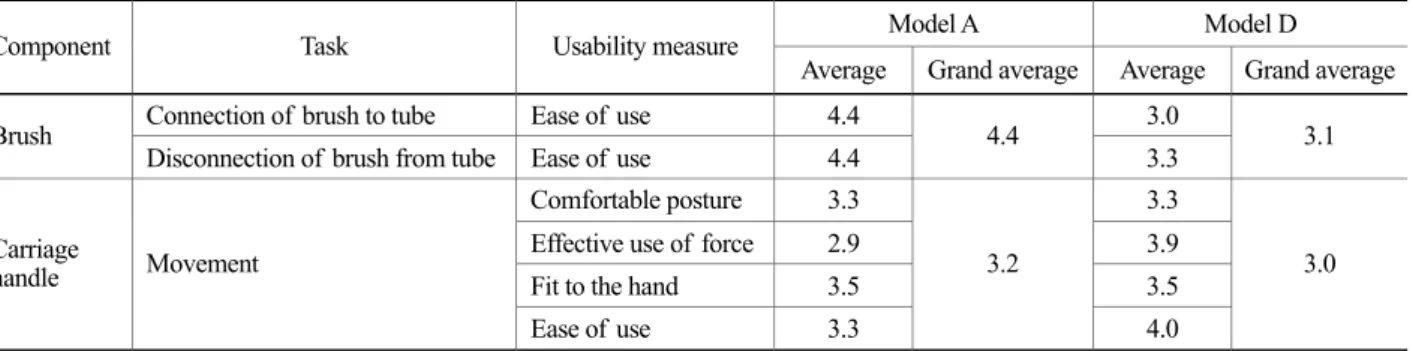
인간공학적 평가 기준에 대한 사용성 평가 결과를 종합하여 계산된다. 예를 들면, 표 4는 brush에 대한 사용성 점수는 brush를 사용하는 작업들(예: brush 체결과 분리)의 사용 성 점수를 산술 평균하여 산출되었으며, brush 사용 작업별
사용성 평가는 관련 인간공학적 평가 기준들에 대한 사용성 점수를 산술 평균하여 산출됨을 보여준다.
마지막으로, 개선 대상 설계 요소는 설계 요소별 산출된 사용성 점수 및 사용성 분석 시에 수행된 실험 후 의견 조
Table 4. Usability testing results by task(illustrated)
Model A Model D
Component Task Usability measure
Average Grand average Average Grand average Connection of brush to tube Ease of use 4.4 3.0
Brush
Disconnection of brush from tube Ease of use 4.4 4.4
3.3 3.1 Comfortable posture 3.3 3.3
Effective use of force 2.9 3.9
Fit to the hand 3.5 3.5
Carriage
handle Movement
Ease of use 3.3
3.2
4.0
3.0
Table 5. Design characteristics of canister-type vacuum cleaner(illustrated)
Component Dimension Model A Model B Model C Model D Model E
Visual feedback
Yes
same as left same as left
no feedback no feedback
Auditory
feedback clicking sound
when connected same as left same as left no feedback no feedback Brush
Weight(g) 314 314 314 460 632 Location of
controller wand handle wand handle wand handle main body main body Suction force
controller Controller type
button type button type sliding type dial type dial type
Size: W×L×T
(unit: cm) 18.5×8.5×2.0 20.5×12×1.5 18.0×7.0×1.5 11.0×5.5×2.3 13.0×2.0×3.0 The number
of handle 1 2 2 1 1
Location top top and front top and front front front
Shape & type
U-shape, folding U-shape, folding U-shape, folding U-shape, fixed U-shape, fixed
Shape of grip rectangular
(inside sloped) round
(inside curved) rectangular
(inside straight) rectangular
(inside curved) round (inside curved) Carriage
handle
Material Plastic Plastic Plastic Plastic Plastic (rubber padding) Size: W×L×H
(unit: cm) 28.3×40.0×30.0 26.1×36.4×22.6 26.7×33.5×20.0 27.5×23.0×36.5 25.0×46.0×26.0 Body
Weight(kg) 5.8 4 4.3 3.8 6.2
사(debriefing)에 근간하여 파악된다. 표 4를 예로 들면, D 모델의 brush에 대한 사용성 평가 점수(2.8점)는 A 모델 의 관련 사용성 평가 점수(4점) 보다 낮아 개선 설계 대상 이 된다. 한편, 다양한 제품 모델에 대한 사용성 평가 결과 및 debriefing 내용은 설계 요소별 상대적으로 선호되는 특성 파악에 활용될 수 있다. 표 4를 예로 들면, D 모델 의 brush 설계는 상대적으로 사용성 점수가 높고 사용자 가 선호하는 것으로 파악된 A 모델의 brush 설계 특성을 benchmarking하여 개선될 수 있을 것이다.
3. Case Study: Canister Vacuum Cleaner
3.1 Evaluation method
본 연구에서 제안한 종합적 사용성 평가 방안을 진공 청 소기 사용성 평가에 적용하였다. 진공 청소기 사용성 평가에 는 진공 청소기를 사용하고 있는 주부 35명(연령대: 30~
50대; 평균 연령 = 40세, SD = 6)이 참여하였다.
본 연구의 사용성 평가는 설계 특성이 상이한 진공 청소 기 5종(표 5 참조)에 대해 이루어졌다. 사용성 평가는 실험 소개, 평가 실험, 그리고 실험 후 의견 조사(debriefing) 순 으로 진행되었다. 사용성 평가 실험은 2~3명이 한 조가 되 어 진행되었으며, 평균 3시간 30분(중간 휴식 시간 30분 포함)이 소요되었고, 실험 참여자에게 소정의 사례비가 지급 되었다.
3.2 Evaluation result
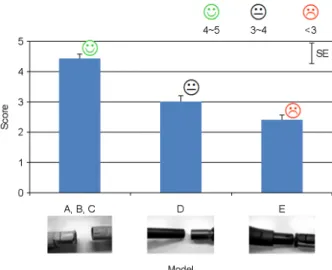
본 연구는 진공 청소기 5종의 다양한 설계 요소에 대한 평가 결과 중에서 세 가지 설계 요소(brush 체결 장치, 흡입 력 조작 버튼, 본체 손잡이)에 대한 사용성 평가 사례를 소 개한다. 먼저, brush 체결 장치는 체결을 위한 시각적 정보 및 체결 완료 후 청각적 정보를 제공할 때 그림 2와 같이 사용 점수가 유의하게 다른 것으로 분석되었다(
F
(2, 102)= 27.4,
p
< 0.001). 설계 특성 분석을 통해 brush 체결을 위한 시각적, 청각적 정보를 제공하는 청소기 A, B, C(동일 한 설계로 인해 하나의 모델에 대해서만 사용성 평가가 진 행되었음)는 사용성 점수가 평균 4.4(SD = 1.0)로 상대적 으로 높으나, 체결을 위한 시각적, 청각적 정보를 제공하지 않는 청소기 D와 E는 사용성 점수가 각각 3.0점(SD = 1.3) 과 2.4점(SD = 1.0)으로 상대적으로 낮은 것으로 나타났다.D와 E의 차이는 실험 참여자들이 debriefing시 제시한 내 용과 설계 특성 분석(표 5 참조)을 통해 E의 brush 무게 (632g)가 D의 brush 무게(460g) 보다 무거워 brush 체
결 시 다소 힘이 많이 사용되기 때문인 것으로 파악되었다.
진공 청소기의 흡입력 조작 버튼은 청소기 본체에 설치되 었을 때에 비해 청소대 손잡이에 설치되었을 때 유의하게 사용성 점수가 높은 것으로 분석되었다(
F
(2, 102) = 18.7,p
< 0.001). 흡입력 조작 버튼이 청소대 손잡이에 부착된 청소기 모델 A, B, C의 사용성 점수는 그림 3과 같이 각각 4.1점(SD = 0.9), 3.6점(SD = 1.0), 4.0점(SD = 0.9)으로 높게 나타났다. 그러나 흡입력 조작 버튼이 청소기 본체에 부착되어 있는 D와 E 모델의 사용성 점수는 각각 2.4점 (SD = 1.1)과 2.4점(SD = 1.2)으로 낮게 나타났다.마지막으로, 본체 손잡이에 대한 사용성 점수는 평가 대 상 5종 청소기에 대해 3.0~3.7점으로 전반적으로 낮은 것
Figure 3. Usability evaluation: suction force control button
Figure 2. Usability evaluation: brush connection mechanism
으로 분석되었다(
F
(4, 170) = 4.06,p
< 0.004). 평가 대상 청소기에 따라 사용성 점수는 그림 4와 같이 일부 차이(최 대 차이 = 0.7점)가 있는 것으로 나타났으나, 전반적으로 4 점 미만으로 낮은 분포를 보였다. 평가 결과의 세부 분석을 위해 인간공학적 평가 기준별 점수를 파악하였다. 평가 점수 가 낮은 인간공학적 평가 기준은 편안한 자세(3.2점; SD = 1.2)와 효율적 힘 사용(3.1점; SD = 1.1)인 것으로 파악되 었으며(표 3 참조), 이는 debriefing을 통해 주부들에게는 본체가 크고 무거워서(표 5 참조) 청소기 운반 시 자세가 불편하고 힘이 많이 사용되기 때문인 것으로 파악되었다.4. Discussion
본 연구는 제품-사용자간 신체적 상호작용 평가 모형에 근간해 제품의 사용성을 종합적으로 평가하는 방법을 제안 하였다. 제안된 종합적 사용성 평가 방법은 제품 사용과 관 련된 다양한 부문(제품, 사용자, 사용 작업, 그리고 사용 환 경)과 이들 부문간의 연관관계(예: 사용 작업 × 제품 설계 요소)에 대한 분석을 토대로 종합적인 사용성 평가를 가능 하게 하였다. 사용성 평가 결과는 제품 설계 요소별로 종합 되어 개선이 요구되는 설계 요소 및 여러 설계 대안들 간의 상대적 선호도를 파악할 수 있게 하였다. 또한, 제품 설계 요소별 관련 작업과 인간공학적 평가 기준에 따른 사용성 평가 결과 정보는 개선이 요구되는 설계 요소에 대해 심층적 인 설계 문제 진단 정보를 제공하였다. 예를 들어, 본체 손 잡이는 관련 작업(청소기 이동 작업)과 인간공학적 평가 기 준(편안한 자세, 효율적 힘 사용, 파지감, 그리고 사용 용이
성)별로 세부적인 사용성 개선 사항들이 파악되었다. 반면, 사용 환경은 제품 설계 요소, 사용 작업, 그리고 인간공학적 평가 기준에 대해 전반적으로 연관이 되므로 세부적인 연관 성 분석은 불필요하다. 예를 들어, 청소기 brush, 청소 작업, 그리고 힘 사용 적절성은 바닥, 가구 아래, 틈새 등의 전반 적인 청소기 사용 환경과 연관된다.
본 연구에서 제안된 사용성 평가 방법은 5점 척도를 활용 하여 사용 작업과 인간공학적 평가 기준별로 평가된 다양한 평가 항목의 점수를 산술 평균하여 설계 요소별 점수를 산 출하였다. 본 연구는 사용성 평가 시 5점 척도를 사용하였으 나, 평가자가 양 극단의 점수를 잘 선택하지 않는 경향성에 의하여 점수가 2~4점에 집중될 수 있다. 따라서 주관적 평 가의 변별력을 높이기 위해서는 7점 혹은 9점 척도를 사용 하는 것이 권장된다. 또한, 설계 요소별 사용성 점수는 관련 작업의 상대적 빈도와 관련 인간공학적 평가 기준의 상대적 중요도를 고려하여 가중 평균 점수로서 산출될 수 있다. 그 런데, 사용성 평가 점수 종합에 적용될 수 있는 단순 산술 평균 방법과 가중 산술 평균 방법은 시간, 비용 및 타당성 측면에서 상호 절충 관계가 있다.
본 연구는 제품-사용자간 신체적 상호작용의 특성(예: 인 간공학적 평가 기준, 부문간 연관성)을 전문가들의 의견을 사용하여 평가하였다. 인간공학적 사용성 평가 시 객관적이 며 구체적인 기준(예: 편안한 자세의 경우 각 관절에 대한 편안한 자세 범위 제공)을 사용할 수 있으나 적용 대상 제 품에 따라 달라질 것이며 본 연구에서 예시하는 청소기에 대해 일반적으로 인정되는 객관적인 평가 기준은 부재하다.
또한 객관적이고도 구체적인 평가 기준을 제공하더라도 주 관적으로 평가하는 상황에서는 관련 정보의 활용성 및 효용 성에 한계가 있을 수 있다. 이와 같은 다양한 상황들을 종 합적으로 고려하였을 때, 본 연구에서와 같이 연구자나 제품 개발 담당자가 필요에 따라 인간공학적 평가 기준을 선정하 여 사용하는 것이 효율성 및 적용성 측면에서 적절하다고 판단된다. 또한, 부문간의 연관성(사용 작업 × 제품 설계 요 소, 사용 작업 × 인간공학적 평가 기준)은 체계적이고 공학 적인 분석 방법(예: 빈도 분석, 요인 분석, 중요도 분석)을 적용하여 파악할 수 있다. 하지만 모든 세부 항목을 체계적 이고 과학적인 방법과 측정 자료를 사용하여 분석하기에 시 간과 비용적 한계가 있다. 본 연구의 진공 청소기 사례에서 는 연구자들(인간공학 전문가 4명과 산업체 실무자 3명)의 토의를 근간으로 제품-사용자간 신체적 상호작용 특성을 분 석하여 청소기 사용성 평가에 적용하였으며, 이러한 방법으 로 제품 전반에 대한 평가를 수행함에 있어 특이한 문제는 관찰되지 않았다.
마지막으로, 제안된 종합적 사용성 평가 방법을 적용해 보다 신속하게 사용성 점수를 통합 및 분석하기 위해서는
Figure 4. Usability evaluation: carriage handle
전문화된 분석 시스템의 개발이 필요하다. 본 연구에 제안 된 사용성 평가 방법을 통해 특정 제품에 대한 방대한 평 가 결과가 수집되므로, 수집된 평가 결과를 분석하는 과정 에 많은 시간과 노력이 소요된다. 따라서, 수집된 평가 결과 를 보다 신속하고 용이하게 분석하기 위해서는 전문화된 분 석 시스템의 활용이 필요하다.
Acknowledgements
This research was supported by Samsung Gwangju Electronics and the Basic Science Research Program through the National Research Foundation of Korea(NRF) funded by the Ministry of Education, Science, and Technology(2010-0012291).
References
Bowman, D. A., Gabbard, J. L. and Hix, D., A Survey of Usability Evaluation in Virtual Environments: Classification and Comparison of Methods, Presence: Teleoperators and Virtual Environments, 11(4), 404-424, 2002.
Brand, P. W. and Hollister, A. M. D., Clinical Mechanics of the Hand, 3rd ed., Mosby, St. Louis, MO, 1999.
Colle, H. and Hiszem, K., Standing at a kiosk: Effects of key size and spacing on touch screen numeric keypad performance and user preference, Ergonomics, 47, 1406-1423, 2004.
Courage, C. and Baxter, K., Understanding Your Users: A Practical Guide to User Requirements, Morgan Kaufmann, San Francisco, CA, 2005.
Drury, C. G. and Hoffmann, E. R., A model for movement time on data- entry keyboards, Ergonomics, 35, 129-147, 1992.
Hartson, H. R., Castillo, J. C., Kelso, J., Kamler, J. and Neale, W. C.,
"Remote Evaluation: The Network as an Extension of the Usability Laboratory", Proceedings of CHI '96 Human Factors in Computing Systems, Vancouver, BC Canada, 228-235, 1996.
Kuijt-Evers, L. F. M., Bosch, T., Huysmans, M. A., de Looze, M. P. and Vink, P., Association between objective and subjective measurements of comfort and discomfort in hand tools, Applied Ergonomics, 38(5), 643-654, 2007.
ISO 9126, Software Engineering Product Quality, 1991.
Jordan, P. W., Thomas, B. and Weerdmeester, B., Usability Evaluation in Industry, Taylor & Francis, Inc., London, UK, 1996.
Paschoarelli, L. C., de Oliveira, A. B. and Gil Coury, H. J. C., Assessment of the ergonomic design of diagnostic ultrasound transducers through wrist movements and subjective evaluation, International Journal of Industrial Ergonomics, 38(11-12), 999-1006, 2008.
Author listings
Wonsup Lee: [email protected]
Highest degree: BS, Industrial and Media Design, Handong University Position title: PhD student, Department of Industrial & Management Engineering, POSTECH
Areas of interest: Ergonomic product design, Product shape design based on 3D scanning, 3D human modeling, Engineering design
Kihyo Jung: [email protected]
Highest degree: PhD, Industrial Engineering, POSTECH Position title: Senior Researcher, Agency for Defense Development Areas of interest: Digital human model simulation, Anthropometric product design, Human performance evaluation
Hyunju Lee: [email protected]
Highest degree: BS, Industrial Design, Vision University of Jeonju Position title: Engineer, Vacuum Cleaner R&D Group, Samsung Gwangju Electronics
Areas of interest: Engineering design, Product design
Hwagyu Song: [email protected]
Highest degree: MS, Mechanical Design, Chonbuk National University Position title: Senior Engineer, Vacuum Cleaner R&D Group, Samsung Gwangju Electronics
Areas of interest: Ergonomic product design, Sound design, Vibration
Jangkeun Oh: [email protected]
Highest degree: BS, Mechanical Design, Yuhan University
Position title: Principal Engineer, Vacuum Cleaner R&D Group, Samsung Gwangju Electronics
Areas ofinterest: Mechanical design, Engineering design
Heecheon You: [email protected]
Highest degree: PhD, Industrial Engineering, Pennsylvania State University Position title: Associate Professor, Department of Industrial & Management Engineering, POSTECH
Areas of interest: Ergonomic product design & development, User interface design & evaluation, Digital human modeling & simulation, Human performance & workload assessment, Work-related musculoskeletal disorders (WMSDs) prevention, Usability testing
Date Received : 2009-11-27 Date Revised : 2010-10-25 Date Accepted : 2010-12-02