DOI : http://dx.doi.org/10.5394/KINPR.2013.37.6.709
A Study on Risk Management for Export Control on Strategic Trade in Supply Chain Management
Tae-Hyun Roh * ․†Jin-Hee Park
* Department of International Logistics, National Korea Maritime and Ocean University, Busan 606-791, Korea
†Department of Logistics System Engineering, National Korea Maritime and Ocean University, Busan 606-791, Korea
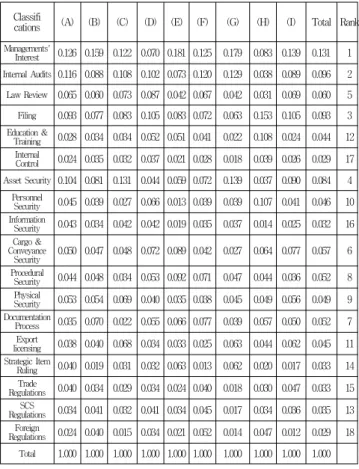
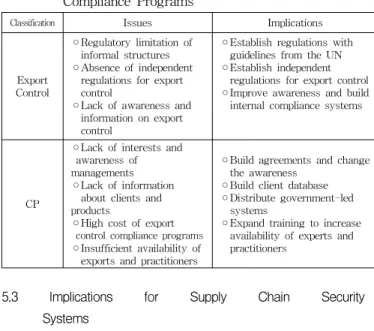
Abstract : In this study, AHP analysis was conducted through a survey that was organized by 9 job categories. The results show that sustainable operation risks have the highest priority level among all criteria with management interest having the highest priority level within sustainable operation risks related attributes. The most important risk attributes among stakeholder risks appeared to be asset security and cargo and conveyance security, with education and training being the most important among regulatory risks. Effective management and response to the risks from export controls on strategic trade require an understanding of supply chain security and compliance programs, effective training programs, investments for development of security systems that meet international standards. In addition, the government needs to focus on developing professionals and providing support for companies with compliance programs, working closely with businesses.
Key Words : AHP(Analytic Hierarchy Process), SCRM(Supply Chain Risk Management), Export Control on Strategic Trade, CP(Compliance Program), SCS(Supply Chain Security)
,
* Primary Author : General Member, [email protected] 1-404-559-9300
†Corresponding Author : life member, [email protected] 051)410-4337
1. Introduction
In the increasingly globalized world, supply chains are becoming ever more complex and different interests are becoming ever more interconnected along all facets of supply chains. As the stakes are getting higher to protect these interests, governments around the world are adopting Supply Chain Security (SCS) to prevent loss of life and property damages in terrorist attacks and other security vulnerabilities.
In particular, developed countries like the U.S. have increased the enforcements of export controls on strategic items since the terrorist attacks on September 11, 2001.
After Resolution 1540 was adopted by the UN Security Council Committee in September, 2004, export control was expanded from simply targeting state sponsors of terrorism and countries that proliferated Weapons of Mass Destruction (WMD) to including individual terrorists and terrorist groups as well as exports, re-exports, transfers, financial support, end users, and intangible transfer of technology (ITT) of strategic items. Each participating country is also requiring enforcements for the newly
adopted export control laws and regulations.
As supply chains become increasingly complex and interconnected, conflicting interests among different groups give rise to terrorist attacks, provocations of war, nuclear proliferation and other risks threatening the international community. The impacts that these threats can have on all facets of international community are getting stronger than ever, potentially creating new trade barriers.
While countries are placing greater emphasis on national security as a result, there seems to be a lack of interest and research on risk management at the business level for export controls on strategic trade for supply chains. As will be shown throughout this study, the importance of understanding export controls and managing related risks will continue to grow for businesses as management, supervisors and team leaders at all levels make decisions faced with uncertainties.
Therefore, the purpose of this study is to identify
relevant risks by category and provide helpful
recommendations in order to assist with policy making at
both business and national levels. In understanding export
controls on strategic items, a more holistic approach of
considering politics, economy, stakeholders, regulations, security and all other related factors will be taken, instead of merely looking at supply and demand of strategic items.
2. Theoretical Backgrounds and Previous Studies
2.1 Theoretical Backgrounds
The term ‘strategic item’ refers to materials, software and technologies that can be used to develop WMD, conventional weapons and missiles which are used to transport them. 1) These are divided into two categories:
'strategic items' and 'catch-all items'. The former refers to items that are designated and announced as export control items and the latter refers to dual-use items that have a high likelihood of being used for the manufacturing, development, deployment, and storage of WMD and the missiles that can be used to transport them 2) .
Export Controls of strategic items is designed to restrict the trade of strategic items through export license and other means, thus preventing the use of these items from becoming a threat to international peace and security. Such international nonproliferation systems consist of multiple levels. At the first level are international nonproliferation treaties include the Nuclear Nonproliferation Treaty (NPT), the Biological Weapons Convention (BWC), the Chemical Weapons Convention (CWC), and the Convention on Certain Conventional Weapons (CCW). At the second level, multilateral export control systems on strategic trade include the Nuclear Supply Group (NSG), the Zangger Committee (ZC), the Wassenaar Agreement (WA), the Australia Group (AG), and the Missile Technology Control Regime (MTCR). Finally, there are Resolution #1540 by the UN Security Council, the WMD Proliferation Security Initiative (PSI), and the export control system on strategic trade used by the U.S. government to control American products.
In addition, because a majority of corporations in the developed countries consider export compliance of strategic items to be a corporate social responsibility for achieving international peace and security, they are proactively establishing internal compliance programs as a preventive measure to forestall any tangible or intangible damage, such as financial loss or negative public image that could arise from failure to comply with regulations.
As businesses are increasingly participating in internal compliance programs, voluntary compliance and efficiency of execution from doing so are becoming more commonplace. Because compliance programs provide businesses with more autonomy and are more effective in managing compliance efficiently, the importance of Compliance Programs (CP) 3) as an alternative to export licenses issued by each government is growing. Adding to this, adoption of the Catch-All system requiring exporters to verify the end use and end user of the dual-use items further necessitates the need for compliance programs by each of the exporting businesses 4) .
The Supply Chain Security (SCS) is becoming established as a global mega trend, strengthening security measures along the entire supply chain since becoming enforced for national security reasons after the 911 attacks. The SCS is designed to systematically eliminate any risk that can be caused by illegal cargo while ensuring safety of people, property and other assets.
However, there are negative views on the SCS as opponents claim that building and maintaining the SCS add to the higher costs while creating new trade barriers and distorting the trade relations.
Ensuring supply chain security has emerged as a key factor in protecting national security and achieving national competitiveness in logistics. Moreover, security management systems and certifications for supply chain that can simplify customs clearance procedures on low-risk items and enforce stringent control on high-risk items are becoming more widespread.
1) Korea Strategic Trade Institute (2009), “Compliance Guidance for Strategic Trade", Korea Strategic Trade Institute website publication, p.11
2) Oh, Hyunseok and Yang, Jeongho(2009), "A Study on Export Control on Strategic Trade Status and Vision", Korean Research Institute of International Commerce and Law Publication Vol.42, pp. 311
3) Compliance Program (CP) is a program capable of managing internal compliance, strategic item ruling and making decisions to stop exports on possible violations, independent of sales departments with a purpose of getting export licensing through close collaboration with government agencies.
4) Lee, Haknoh, Choi, Seunghwan, Lee, Gwangmin, Hwang, Yonggun, and Paek, Gwanyong(2011), "A Study of Planning the Strategic Trade Management Paradigm that Meets 1 Trillion Trade Era", Donggook University, Final Report from Ministry of Knowledgable Economy, pp. 18-22.
Categories Contents
Definition of Strategic Item
◦ Korea Strategic Trade Institute: WMD + conventional weapons + transportation tools + software + technologies
◦ Oh, Hyunseok, Yang, Jeongho: strategic items + catch-all
◦ Lee, Gihee: munitions + dual-use
Control System on Strategic
Item
◦ Korea Strategic Trade Institute: Export control system on strategic items to prevent applications that can threaten international peace and security
◦ Jeon, Bongeun: Multi-layered structure of international nonproliferation regime
Export Control Trends
◦ Lee, Haknoh, et al: Trend of continuous expansion, enforcement and emphasis on legal and corporate preparation
◦ Lee, Heeyong, et al: Enforcement and compliance programs for export control are yet to be well established in South Korea. Concerns about export constraints and other regulatory challenges ahead
Corporate Certification
◦ Lee, Seokgi: Emphasis on the importance of adopting corporate certification system. Introduces the possibility of the standardization of customs clearance procedures
◦ Lee, Sangjin and other: Recommends that exporter be responsible for managing end uses and end-users for exports
Compliance Program
◦ Lee, Chungbae and other: Emphasis on the importance of participation in compliance programs to trade with firms in the developed countries
◦ Kim, Hyunji, Korea Strategic Trade Institute:
One of the corporate social responsibilities and calls for a change in perspective to recognize it as a new international order
Supply Chain Security
◦ J. Martens: Emphasis on preventive measures and management support based on the perceived effect that security management customs have on supply chain security.
2.2 Understanding Previous Studies
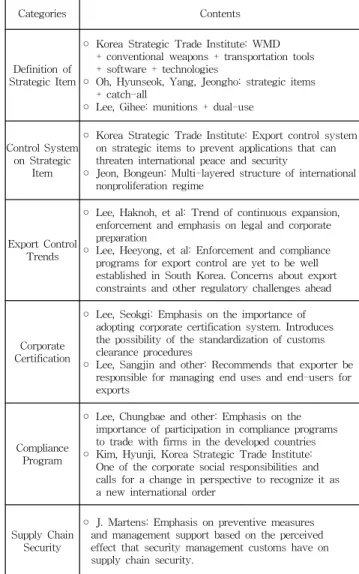
While The Korea Strategic Trade Institute (2009) defined strategic items as recognized in the above 2.1 Theoretical backgrounds, Oh, Hyunseok and Yang, Jeongho (2009) viewed that Catch-All items, under which dual-use items and the items that are covered by multilateral export control regimes fall in, were to be added to Strategic Items.
Lee, Gihee (2006) saw that strategic items included not only munitions, but also dual-use items that are used in everyday lives for improving quality of life as well.
As for strategic trade control regimes, the Korea Strategic Trade Institute (2009) saw them as a restrictive mechanism as described in the above 2.1 Theoretical backgrounds. Jeon, Bongeun (2005) considered the international nonproliferation regime to be a multi-layered structure.
Lee, Haknoh et al. (2011) emphasize the need for preparation for regulatory and business operational changes as they determine that an increasing number of exports from South Korea will soon become subject to export control for strategic items given the advanced technologies and accumulated knowledge that South Korean exports are based on.
According to the Strategic Item Control Status Report by Lee, Heeyong, et al., the level of compliance and enforcement of export control in South Korea is similar to that of Cuba and China, and as a result, South Korea is likely to face regulatory setbacks including penalties and exports restrictions abroad while experiencing difficulties in adopting advanced technologies from countries concerned about consequences of possible incompliance.
Lee, Seokgi (2006) emphasized the importance of adopting corporation certification standards and discussed the possibility of national and international standardization of customs/customs clearance through the introduction of C-TPAT in the U.S. and AEO in the EU. Lee, Sangjin et al. (2006) recommended a system that obligates exporters to manage compliance.
In regards to Compliance Programs (CP), Lee, Chungbae et al., (2011) suggest that participation in CP presents businesses with new opportunities to build a credible corporate image, Furthermore, Kim, Hyunji (2008) and the Korea Strategic Trade Institute (2009) argue that compliance is within the domain of corporate social responsibility to contribute to sustaining international peace.
Table 1 Summarized Previous Studies by Categories
J. Martens (2011) analyzed the perceived effect that security management customs have on supply chain security. His survey, which targeted logistics professionals, revealed that preventive measures are more effective than corrective measures while management support and sufficient access to resources play a greater role than other factors on supply chain security.
In summary, existing research papers on export control
for strategic trade tend to only have a theoretical focus,
consisting primarily of literary studies and some surveys
from those in academics and other related experts. While
they have helped emphasize the importance of the field
academically, there is still room for studies that produce
more practical insights for daily business operations in the
real world. Therefore, this paper seeks to supplement
previous studies by providing policy implications through
taking a more practical approach that takes into account
various environmental factors for corporations.
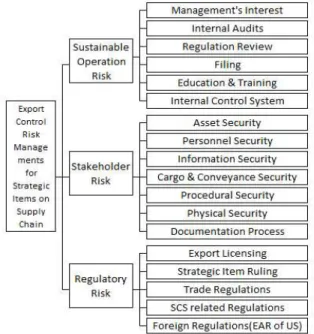
Fig. 1 Risk Management Hierarchy
3. Methods
3.1 Selecting Study Methods
This study uses empirical analysis based on Analytic Hierarchy Process (AHP) for survey analytics. Nine classifications were used to categorize the survey respondents in accordance with AEO company classification standards: exporters, importers, customs brokers, airlines, shipping companies, freight forwarders, bonded area operators, bonded carriers, and foreign suppliers. The AHP method allows for evaluation of multiple selections and alternative solutions as well as qualitative analysis. Due to its advantages, the method was used on survey results based on experts’ subjective and qualitative views to generate an analysis of the hierarchical structure of risk management of export controls on strategic trade in supply chains. Also, brainstorming, hierarchic design, weight determination, consistency validation, grade measurement and sensitivity analysis were carried out through pairwise comparison between each element in order to give confidence to decision-makers in their choices and outcomes.
3.2 Hierarchy Design
The Analytic Hierarchy Process (AHP) involves three steps that include setting a goal, making criteria and coming up with alternatives to a problem. This study also consists of three hierarchical steps as shown in Fig 1, for analyzing risk management in strategic trade export controls on supply chain. As a first step, the goal was set to evaluating priority levels of corporate risk management for strategic trade export control, among other risk managements for corporate sustainability.
In setting criteria for evaluating effective risk management as a second step, risks were divided into three large categories: sustainable operation risks, for internal risks and stakeholder risks and regulatory risks, for external risks. In the final step, attributes were designed for each criteria set from the second step.
As a result, 18 assessment attributes were derived based on assessment items of ISO 28000, AEO, and interviews with professionals. Eight categories from security manuals related to ISO 28000 security risk assessments were used to make up the 18 assessment attributes and these are largely divided into two large groups. The first of these is stakeholder risks covering the first attribute through the seventh attribute and includes 1) physical failure threats and risks, 2) operational threats and risks, 3) natural environmental events, 4) factors outside the organization's control, 5) stakeholder threats and risks, 6) design and installation of security equipment, and 7) information and data management and communication. The second group is threats and risks involved in sustainable operations.
Sustainable operation risks are then divided into six attributes in accordance with AEO assessment criteria.
Attributes for regulatory risks took into account security policies and legal requirements in establishing procedures for security system planning as specified in ISO 28000 security management manuals. The rest of the attributes are based on strategic item ruling, SCS regulations, foreign export control regulations including those of the U.S and other regulatory references that are specific to supply chain and export controls 5) .
5) Korea Strategic Trade Institute(2010), Guideline to Introduce Security Management System ISO28000 for Supply Chain", Parkyongsa pp.78-79, p.85, p.247-249.
3.3 Survey Design
The survey conducted in this study was designed for Analytic Hierarchy Process (AHP) and included general characteristics of the respondents. For general characteristics, respondents were requested to enter their personal information such as job title, experience, and position within their company. General questions were divided into a total of eight categories, including risk management needs, system management, history of executing risk management within the firm and knowledge on regulations and rulings. The table below summarizes assessment attributes in detail to assist understanding of figures and terminologies.
Classifications Company Population Number of Total Samples
Survey Response Valid
Samples Invalid Samples Remarks
Korea Strategic Trade Institute
Exporters 152 152 23 16 7
CP approved companies
Importers 18 18 5 4 1
Freight Forwarders 6 6 6 4 2
Bonded Area
Operators 5 5 8 5 3
Bonded Carriers 4 4 3 2 1 Member List
Korea Customs Brokers Association
Customs
Brokers 1,478 7 7 6 1 Member List
Korea Shipowner Association
Shipping
Companies 178 19 19 6 13
Incheon International
Airport
Airlines 91 4 4 2 2 Airlines list
Trade Association
Foreign
Suppliers 1,870 5 3 2 1 Foreign
supplier list
Total 3,802 220 78 47 31
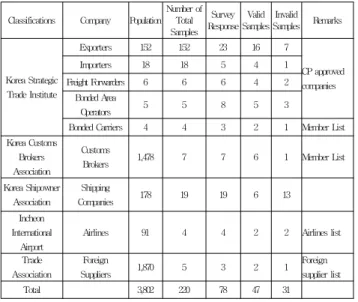
Table 2 Survey Subject Groups and Number of Samples
Note 1: Exporters, importers, freight forwarders, bonded area operators, and bonded carriers are based on a list of companies registered for compliance with Korea Strategic Trade Institute as of Dec, 31, 2012.
Note 2: For customs brokers, companies registered in Korea with Customs Broker Association that are representative of the group were selected as of the end of April, 2013.
Note 3: For shipping companies, companies registered in Korea with Korea Shipowner Association that are representative of the group were selected as of the end of April, 2013.
Note 4: For airlines, companies registered in Korea with Incheon International Airport that are representative of the group were
selected as of the end of April, 2013.
Note 5 : For foreign suppliers, 5 representative companies in the industry were selected.
The survey was limited to professionals working with export controls on strategic trade instead of those without any exposure to the field. The list of people to survey was collected based on the data of companies registered for CP on the Korea Strategic Trade Institute website. The surveys then were distributed through emails, visits as well as at seminars and trainings held by Korea Strategic Trade Institute. Other surveys for professionals from companies representative of their respective field were also distributed through individual contacts.
Because this study holds significance in that research was done on managers and team leaders with five or more years of experience at manufacturing firms, general trading companies, shipping companies, airlines, customs brokers, freight forwarders and bonded carriers among business professionals who have knowledge and experience with export control in supply chain. First and second round of surveys were conducted from May 16, 2013 to May 23, 2013, for a total of eight days, and additional surveys were conducted for another 12 days from June 3, 2013 to June 14, 2013.
4. Results
4.1 Consistency Validation
In the data used for AHP analysis, consistency in survey responses is essential. Since priorities are used in each step, it was necessary to generate a consistency ratio (CR). The Consistency Ratio was calculated as per Table 3. As consistency ratio decreases, each value of Consistency Index (CI) and CR increases. As a result, CR is only reliable at less than 0.2. (Satty, 1990). Priorities are then derived using the consistency analysis based on 47 valid samples.
n 3 4 5 6 7 8 9 10 11 12
R.1. 0.58 0.9 1.12 1.24 1.32 1.41 1.45 1.49 1.51 1.48
Table 3 Average Value of Consistency Index
Note : Consistency Ratio (C.R.=Consistency Ratio)
C.R. = C.I. R.I. =
λ max -n
n -1 × 1
R.I.
4.2 Priority Analysis by Step
1) Analysis Results on General Survey by Job Category This part shows the results of survey responses and perceived direct effect that internal, external risks as well as keywords related to the hierarchy questions have on job performance. In order to get a more comprehensive view of the data in each job category, survey was conducted with consideration for invalid samples.
Table 4 below shows opinions of survey respondents on
each assessment attribute in risk management for export
controls on strategic items in supply chain. The need for
risk management has the highest score while document
management and in-house training have the lowest score
for priority.
Classification Sustainable
Operation Stakeholders Regulations Sum of
Rows Row N/G Value Sustainable
Operation 0.505 0.652 0.390 1.547 3.066
Stakeholders 0.267 0.346 0.447 1.060 3.066
Regulations 0.193 0.116 0.150 0.459 3.066
λmax = 3.066 CI= 0.033
CR= 0.057
Table 6 Consistency Validation by Assessment Criteria in Step 1
Classification (A) (B) (C) (D) (E) (F) (G) (H) 1.Exporters 6.2 5.1 4.8 5.0 5.4 5.0 5.0 5.4 2.Importers 6.0 4.6 4.4 5.2 5.6 4.6 4.8 5.4 3.Customs Brokers 6.6 5.4 5.3 5.6 5.9 5.0 5.9 5.9 4.Shipping Companies 5.5 5.2 4.8 5.8 5.6 4.8 5.3 5.5 5.Airlines 5.5 3.3 3.0 6.5 5.5 5.3 5.3 5.8 6.Freight Forwarders 6.3 5.3 5.2 6.3 6.0 5.7 6.2 6.0
7.Bonded Area Operators
6.4 5.0 4.5 5.6 5.9 4.4 5.5 5.9 8.Bonded Carriers 5.7 4.3 3.7 5.7 5.7 4.0 5.3 5.3 9.Foreign Suppliers 7.0 6.7 6.0 5.7 6.3 5.7 5.7 6.7 Total 6.1 5.1 4.7 5.5 5.7 4.9 5.3 5.6Table 4 Analysis Results on General Survey
(A): Risk Management (B): Management Interest (C): Document Management /In-House Training (D): SCS Certification System (E): Information System Management (F): Prior Ruling System (G): Restricting Illegal Activities (H): Need for Training on Foreign Regulations
2) Weight Analysis Results by Three Criteria in Step 1 According to the weight analysis results by each of the three criteria from the first step, sustainable operation showed to have a relatively higher priority than the two others. This shows that professionals prioritize internal risks over external risks.
Classification
Sustainable
Operation Stakeholder Regulations Geometric
Mean Weights Rank
SustainableOperation 1.000 1.887 2.608 1.701 0.505 1 Stakeholders 0.530 1.000 2.985 1.165 0.346 2 Regulations 0.383 0.335 1.000 0.505 0.150 3
Total 3.371 1.000
Table 5 Weight Analysis Results by Three Criteria in Step 1
Table 6 shows consistency validation in regards to the weight analysis by criteria from step 1 with RI value of 0.58.
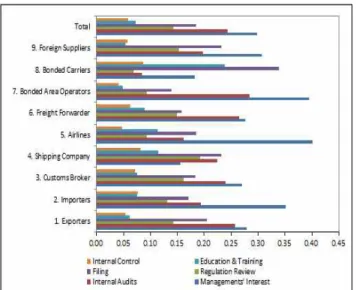
For priorities placed for each criteria in step 1 by job category, shipping companies tend to prioritize sustainable operation risks while airlines prioritize stakeholder risks
more than any other job category. Despite small differences, freight forwarders among all job categories assigned the highest priority on the importance of regulatory risks.
Fig. 2 Analysis Results of Priorities for Each Criterion from Step 1 by Job Category
3) Analysis Results on attributes of internal risk criteria from step 2
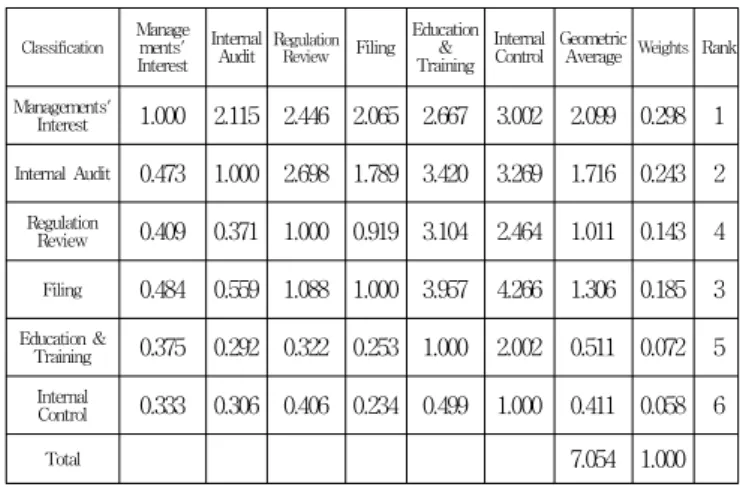
As in Table 7, management interest is shown to have the highest importance while internal control risk has the lowest importance of all assessment attributes. The difference in weights between the attributes is significant and the combination of management interest and internal audit, which have the highest and the second highest weight each, is more than half of the total sum of all weights. According to these results, management interest and internal audit alone can help manage internal risks well.
Classification Manage ments' Interest
Internal Audit Regulation
Review Filing Education
&
Training Internal Control Geometric
Average Weights Rank Managements'
Interest
1.000 2.115 2.446 2.065 2.667 3.002 2.099 0.298 1Internal Audit
0.473 1.000 2.698 1.789 3.420 3.269 1.716 0.243 2Regulation
Review
0.409 0.371 1.000 0.919 3.104 2.464 1.011 0.143 4Filing
0.484 0.559 1.088 1.000 3.957 4.266 1.306 0.185 3Education &
Training
0.375 0.292 0.322 0.253 1.000 2.002 0.511 0.072 5Internal
Control
0.333 0.306 0.406 0.234 0.499 1.000 0.411 0.058 6Total
7.054 1.000Table 7 Analysis Results by Sustainable Operation Risk Assessment Attributes in Step 2
The table 8 shows consistency validation for sustainable
operation risk assessment attributes with RI value of 1.24.
Classification Manage ments' Interest
Internal Audit Regulation
Review Filing Education
&
Training Internal Control
Sum of Rows
Row N/G Value Managements'
Interest 0.298 0.514 0.350 0.382 0.193 0.175 1.913 6.430 Internal Audit 0.141 0.243 0.387 0.331 0.248 0.191 1.540 6.333
Regulation
Review 0.122 0.090 0.143 0.170 0.225 0.144 0.894 6.240 Filing 0.144 0.136 0.156 0.185 0.287 0.249 1.157 6.246 Education &
Training 0.112 0.071 0.046 0.047 0.072 0.117 0.465 6.413 Internal
Control 0.099 0.074 0.058 0.043 0.036 0.058 0.370 6.339