*Corresponding author: Kyung-Taek Rim, Tel: +82-42-869-0345, E-mail: [email protected]
Center for Chemicals, Occupational Safety&Health Research Institute, Korea Occupational Safety&Health Agency, #339-30 Expo-ro, Yuseong-gu, Daejeon, 305-380, Korea
Received: February 17, 2014, Revised: August 7, 2014, Accepted: August 8, 2014
This is an Open-Access article distributed under the terms of the Creative Commons Attribution Non-Commercial License (http://creativecommons.org/licenses/by-nc/3.0) which permits unrestricted non-commercial use, distribution, and reproduction in any
http://dx.doi.org/10.15269/JKSOEH.2014.24.3.330
미생물복귀돌연변이(Ames)시험을 통한 탄산리튬의 변이원성 고찰
임경택*ㆍ김수진
한국산업안전보건공단 산업안전보건연구원
Mutagenicity of Lithium Carbonate Assessed by Bacterial Reverse Mutation(Ames) Test
Kyung-Taek Rim* and Soo-Jin Kim
Occupational Safety&Health Research Institute, Korea Occupational Safety&Health Agency, Daejeon, Korea
ABSTRACT
Objectives: To evaluate the mutagenicity of lithium carbonate, a bacterial reverse mutation(Ames) test was carried out using four strains of S. typhimurium(TA1535; TA1537; TA98; and TA100) and one strain of E. coli(WP2uvrA).
Materials: This was carried out in a dose range from 312.5 to 5,000 μg/plate in triplicate with and without S9 activation, which is the most commonly used metabolic activation system supplemented by a post-mitochondrial fraction prepared from the livers of rodents treated with enzyme-inducing agents such as Aroclor 1254 or a combination of phenobarbitone and β-naphthoflavone.
Results: No significant increases in the number of revertants were observed under the conditions examined in this study.
Conclusions: Based on the above observations, it can be concluded that lithium carbonate has no mutagenic activity. Despite the results, it can have an effect by inducing acute oral toxicity, eye irritation and acute aquatic toxicity. Based on this study, we suggest that future studies should be directed toward chronic, carcinogenic testing and other related areas.
Key words: genotoxicity, Lithium carbonate, mutagenicity, reverse mutation
I. INTRODUCTION
The evaluation of a mutagenic substance is an important procedure in safety analysis. Drugs that induce mutations can potentially damage the germ lines leading to fertility problems and mutations in future generations.
Gene mutations are widely studied in bacteria whereas chromosome damage in mammalian cells is typically measured by analyzing chromosome breaks or re-arrangements. In recent years, genotoxicity has become more and more important in the process of early screening for potential compound(OECD, 1997). Ames
test is a rapid, convenient and widely accepted test for identifying substances which can produce genetic damage that leads to mutation(Gatehouse et al., 1994).
It being increased the necessity of hazard assessment
with many chemicals because of the increase of exposure
frequency to workers as developing the chemical
industries. The lithium carbonate(CAS No. 554-13-2) is
not sufficient its definite information but increased the
necessity of hazard assessment. The major use of lithium
carbonate is the field of medication such as antimanic,
in the production of glazes on ceramic and electrical
porcelain(O’Neil, 2006), catalyst with manufacturing
other lithium compound, coating of arc welding electrodes, nucleonic, luminescent paints, dyes, glass ceramics, aluminum production, pharmaceuticals(Lewis, 2001) and flux(glass, enamel, and ceramics production), aluminum melt electrolysis adjunct and psychiatric drug(Ashford, 1994). Also it is used to prepare lithium aluminosilicate glass ceramics which have low thermal coefficients of expansion, allowing use over a wide temperature range. It also finds uses in specialty glasses and ceramics(Kirk-Othmer, 1995). Mixtures of lithium and potassium carbonate are used as electrolytes in molten carbonate fuel cells, and the specialty prepared high-purity lithium carbonate is used increasingly for the treatment of manic-depressive conditions. The addition of lithium carbonate to cement leads to quicker setting.
Amounts of 1-5% are used to control setting times. In quick setting tile adhesives, lithium carbonate leads to faster adhesion of the tiles. It is the starting material for the industrial production of all other lithium compounds and is itself used in industry in large quantities(Ullmann, 2003). With probable routes of human exposure, National Institute for Occupational Safety and Health(NIOSH;
NOES survey 1981-1983) has statistically estimated that either 198(Hazard code X6906) and 39,147 workers(Hazard code 84414) were potentially exposed to lithium carbonate in USA(NIOSH, 2007).
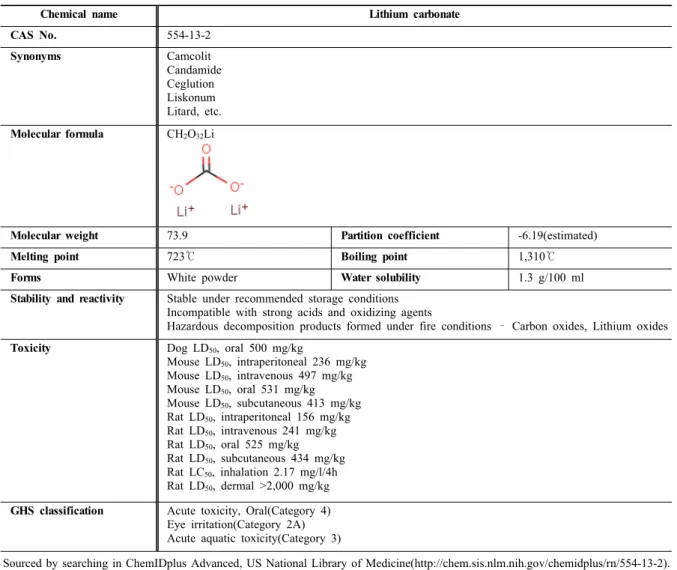
According to toxicity data in table 1, the half lethal dose is 525 mg/kg, it is ranked category 4 of the globally harmonized classification system with oral route, but the available genotoxicity data on this chemical are still nothing. Thus it was evaluated to determine the genotoxicity or mutagenicity with Ames test with GLP guideline. So it is the first trial to evaluate the mutagenicity of lithium carbonate.
Ⅱ. MATERIALS AND METHODS
Chemicals and reagents
The lithium carbonate(99.997%, Sigma-Aldrich, MO, USA) was dissolved in vehicles(sterilized distilled water, Dai Han Pharm. Co., Ltd., Seoul, Korea) and diluted
if appropriate prior to treatment of the bacteria.
Concurrent strain-specific positive and negative (solvent or vehicle) controls, both with and without metabolic activation, was included in each assay.
Positive control concentrations that demonstrate the effective performance of each assay was selected. In this study, sodium azide(98%, WAKO, Osaka, Japan), 9-aminoacridine(9AA)(98%, Sigma-Aldrich, MO, USA), 2-(2-furyl)-3-(5-nitro-2-furyl)acrylamide(AF-2)(98%, WAKO, Osaka, Japan) and 2-aminoanthracene(2AA) (98%, WAKO, Osaka, Japan) were used as positive controls. Dimethyl sulfoxide(99.5%, Sigma-Aldrich, MO, USA) was used as a solvent.
Test bacterial strains
The culture containing a high titer of viable bacteria(MDF-U3086S, Sanyo, Osaka, Japan) was used in the experiment. Five strains include four strains of S. typhimurium(TA1535; TA1537 or TA97a or TA97;
TA98; and TA100, Moltox, NC, USA) that have been shown to be reliable and reproducibly responsive between laboratories The other one was E. coli (WP2uvrA). The strains also yield spontaneous reverting colony plate counts within the frequency ranges expected from the laboratories historical control data.
An appropriate minimal agar(e.g. containing Vogel- Bonner minimal medium E and glucose, Junsei, Tokyo, Japan) and an overlay agar containing histidine and biotin or tryptophan(Bacto-agar, DB, NJ, USA), to allow for a few cell divisions, was used(No. 2 Nutrient Broth, Oxoid, Cambridge, UK; Shaker bath Model 50, 180 rpm, Precision, VA, USA).
Mutagenicity assay
The most commonly used metabolic activation system with a cofactor supplemented post-mitochondrial fraction(S9, Moltox, NC, USA) prepared from the livers of rodents treated with enzyme-inducing agents such as Aroclor 1254 or a combination of phenobarbitone and β -naphthoflavone.
The cytotoxicity test was detected by a reduction in
Chemical name Lithium carbonate
CAS No. 554-13-2
Synonyms Camcolit
Candamide Ceglution Liskonum Litard, etc.
Molecular formula CH2O32Li
Molecular weight 73.9 Partition coefficient -6.19(estimated)
Melting point 723℃ Boiling point 1,310℃
Forms White powder Water solubility 1.3 g/100 ml
Stability and reactivity Stable under recommended storage conditions Incompatible with strong acids and oxidizing agents
Hazardous decomposition products formed under fire conditions – Carbon oxides, Lithium oxides
Toxicity Dog LD50, oral 500 mg/kg
Mouse LD50, intraperitoneal 236 mg/kg Mouse LD50, intravenous 497 mg/kg Mouse LD50, oral 531 mg/kg Mouse LD50, subcutaneous 413 mg/kg Rat LD50, intraperitoneal 156 mg/kg Rat LD50, intravenous 241 mg/kg Rat LD50, oral 525 mg/kg Rat LD50, subcutaneous 434 mg/kg Rat LC50, inhalation 2.17 mg/l/4h Rat LD50, dermal >2,000 mg/kg GHS classification Acute toxicity, Oral(Category 4)
Eye irritation(Category 2A) Acute aquatic toxicity(Category 3)
Sourced by searching in ChemIDplus Advanced, US National Library of Medicine(http://chem.sis.nlm.nih.gov/chemidplus/rn/554-13-2).
Rockville Pike, Bethesda, MD 20894, and Material Safety Data Sheet, Sigma-Aldrich(http://www.sigmaaldrich.com/MSDS/MSDS /DisplayMSDSPage.do?country=US&language=en&productNumber=203629&brand=ALDRICH&PageToGoToURL=http%3A%2F%2F www.sigmaaldrich.com%2Fcatalog%2Fsearch%3Finterface%3DCAS%2520No.%26term%3D554-13-2%26lang%3Den%26region%3DU S%26focus%3Dproduct%26N%3D0%2B220003048%2B219853269%2B219853286%26mode%3Dmatch%2520partialmax), MO, USA.
Table 1. Physicochemical and toxicological information of lithium carbonate
the number of reverting colonies, a clearing or diminution of the background lawn, or the degree of survival of treated cultures. The cytotoxicity of a substance may be altered in the presence of metabolic activation systems. The recommended maximum test concentration for soluble non-cytotoxic substance was 5 mg/plate or 5 ml/plate. Five different analyzable concentrations(312.5, 625, 1250, 2500, 5000 μg/plate) of the test substance were used.
For the pre-incubation method, without metabolic
activation, usually 0.05 ml or 0.1 ml of the test solutions,
0.1 ml of fresh bacterial culture(Containing approximately
10
8viable cells) and 0.5 ml of sterile buffer were mixed
with 2.0 ml of overlay agar. For the assay with metabolic
activation, usually 0.5 ml of metabolic activation mixture
containing an adequate amount of post-mitochondrial
fraction(in the range from 5 to 30% v/v in the metabolic
activation mixture) were mixed with the overlay agar(2.0
mL), together with the bacteria and test substance/test
solution. The contents of each tube were mixed and
poured over the surface of a minimal agar plate. The overlay agar was allowed to solidify before incubation.
For the pre-incubation method, the test substance/test solution was preincubated with the test strain(Containing approximately 10
8viable cells) and sterile buffer or the metabolic activation system(0.5 mL) usually for 20 min at 37℃ prior to mixing with the overlay agar and pouring onto the surface of a minimal agar plate. Usually, 0.05 mL of test substance/test solution, 0.1 mL of bacteria, and 0.5 mL of S9-mix or sterile buffer, were mixed with 2.0 mL of overlay agar. Tubes were aerated during pre-incubation by using a shaker.
For an adequate estimate of variation, triplicate plating was used at each dose level. All plates in a given assay were incubated at 37℃ for 48 hr. After the incubation period, the number of reverting colonies per plate was counted.
Evaluation and analysis of results
Besides cytotoxicity, precipitation and viability the number of reverting colonies per plate was determined (Bio-multiscanner, BMS-400 system, Toyo Sokki, Kanagawa, Japan). The mutant frequency was expressed as the quotient of the number of reverting colonies over the number of colonies in the negative control.
A mutagenic potential of a test item was assumed if the mutant frequency was over 2.0. A possible mutagenic potential was assumed if the quotient ranges between 1.7 and 1.9 in combination with a dose effect relationship. No mutagenic potential was assumed if all quotients range between 1.0(and lower) to 1.6.
Ⅲ. RESULTS
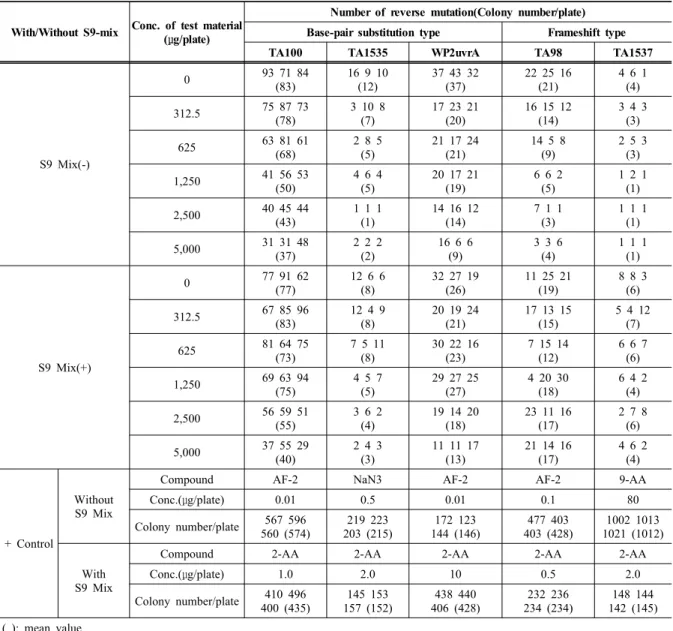
In this test, treatment of lithium carbonate at each five dose did not induce mutagenicity in Salmonella typhimurium TA98, TA100, TA1535, TA1537 and Escherichia coli WP2uvrA with and without metabolic activation. These results indicate that the lithium carbonate do not have mutagenic potentials under the conditions examined in this study.
All Salmonella strains are histidine-, the used E. coli strain tryptophan dependent. Revertants are identified as colonies that grow in low levels of histidine or tryptophan. Frameshift and base-pair substitution defects are represented to identify of both types. Additional genetic markers serve to make the strains more sensitive to certain types of mutagens. Table 2 shows the results of the reverse mutation(Ames) test using S. typhimurium and E. coli treated with lithium carbonate without and with metabolic activation.
Ⅳ. DISCUSSION
It is the first trial to evaluate the mutagenicity of this chemical with GLP level. From this study, it was performed the reverse mutation assay both in direct method and metabolism activated method for 6 hr treatment in test with several strains. This study should help to improve testing of this chemical by generally used genotoxicity testing methods as well as investigations on the underlying mechanism and the interpretation of genotoxicity data on this chemical with hazard, and could applicative for workers’ health.
The procedures of this Ames test were described in a series of papers from the early 1970s by Bruce Ames and his group at the University of California, Berkeley (Ames et al., 1975). Many studies have been performed to determine the sensitivity and correlation of the Ames test with animal carcinogenicity studies. It has indeed been established that there is a high predictability of a positive mutagenic response in the Ames test for rodent carcinogenicity, ranging from 90% to 77%, the primary differences being the chemical composition of the compiled databases(Zeiger, 1998).
The Salmonella and E. coli strains used in the test
have different mutations in various genes in the histidine
and tryptophan operon; each of these mutations is
designed to be responsive to mutagens that act via
different mechanisms. Additional mutations were engineered
into these strains to make them more sensitive to a wide
variety of substances. Chemicals that cause mutation can
With/Without S9-mix Conc. of test material (μg/plate)
Number of reverse mutation(Colony number/plate) Base-pair substitution type Frameshift type
TA100 TA1535 WP2uvrA TA98 TA1537
S9 Mix(-)
0 93 71 84
(83)
16 9 10 (12)
37 43 32 (37)
22 25 16 (21)
4 6 1 (4)
312.5 75 87 73
(78)
3 10 8 (7)
17 23 21 (20)
16 15 12 (14)
3 4 3 (3)
625 63 81 61
(68)
2 8 5 (5)
21 17 24 (21)
14 5 8 (9)
2 5 3 (3)
1,250 41 56 53
(50) 4 6 4
(5) 20 17 21
(19) 6 6 2
(5) 1 2 1
(1)
2,500 40 45 44
(43)
1 1 1 (1)
14 16 12 (14)
7 1 1 (3)
1 1 1 (1)
5,000 31 31 48
(37)
2 2 2 (2)
16 6 6 (9)
3 3 6 (4)
1 1 1 (1)
S9 Mix(+)
0 77 91 62
(77)
12 6 6 (8)
32 27 19 (26)
11 25 21 (19)
8 8 3 (6)
312.5 67 85 96
(83)
12 4 9 (8)
20 19 24 (21)
17 13 15 (15)
5 4 12 (7)
625 81 64 75
(73)
7 5 11 (8)
30 22 16 (23)
7 15 14 (12)
6 6 7 (6)
1,250 69 63 94
(75)
4 5 7 (5)
29 27 25 (27)
4 20 30 (18)
6 4 2 (4)
2,500 56 59 51
(55) 3 6 2
(4) 19 14 20
(18) 23 11 16
(17) 2 7 8
(6)
5,000 37 55 29
(40)
2 4 3 (3)
11 11 17 (13)
21 14 16 (17)
4 6 2 (4)
+ Control
Without S9 Mix
Compound AF-2 NaN3 AF-2 AF-2 9-AA
Conc.(μg/plate) 0.01 0.5 0.01 0.1 80
Colony number/plate 567 596 560 (574)
219 223 203 (215)
172 123 144 (146)
477 403 403 (428)
1002 1013 1021 (1012)
With S9 Mix
Compound 2-AA 2-AA 2-AA 2-AA 2-AA
Conc.(μg/plate) 1.0 2.0 10 0.5 2.0
Colony number/plate 410 496 400 (435)
145 153 157 (152)
438 440 406 (428)
232 236 234 (234)
148 144 142 (145) ( ): mean value
Table 2. Reverse mutation(Ames) assay using Salmonella and E. coli treated with lithium carbonate without(upper panel) and with metabolic activation(middle panel), respectively. The lower panel is positive control(without and with metabolic activation)