• 검색 결과가 없습니다.

The characteristics of zoster-associated prodromal symptoms in Korea

N/A
N/A
Protected

Academic year: 2021

Share "The characteristics of zoster-associated prodromal symptoms in Korea"

Copied!
7
0
0

로드 중.... (전체 텍스트 보기)

전체 글

(1)

The characteristics of zoster-associated prodromal symptoms in Korea

Yeon-dong Kim

1

, Gong-heui Lee

2

, Cheolhyeong Lee

3*

1

Professor, Wonkwang University School of Medicine, Wonkwang University

2

Medical doctor, Department of Anesthesiology and Pain Medicine, Wonkwang University Hospital

3

Clinical Professor, Department of Anesthesiology and Pain Medicine, Wonkwang University Hospital

한국의 대상 포진 관련 전구 증상의 특징

김연동

1

, 이공희

2

, 이철형

3*

1

원광대학교 의과대학 교수,

2

원광대학교 의과대학 병원 마취통증의학과 전공의,

3

원광대학교 의과대학 병원 마취통증의학과 임상조교수

Abstract Zoster-associated pain (ZAP) in patients with herpes zoster (HZ) may persist for a long time, occurring even years after the rash has healed. In this case, the patient is diagnosed as having postherpetic neuralgia (PHN). Prodromal symptoms can present with constant or intermittent pain, and are often accompanied by other symptoms, resulting in misdiagnosis and/or inappropriate treatment.

The aim of this study is to investigate the characteristics of the prodromal symptoms of ZAP through a multicenter study in Korea.

Key Words : Herpes zoster, Zoster-associated pain, Postherpetic neuralgia, Prodromal symptoms, Multicenter survey

요 약 대상포진 환자의 대상포진 연관통증은 발진이 치유된 후에도 수년 동안 발생하여 오랫동안 지속될 수 있다.

이 경우 환자는 포진 후 신경통이 있는 것으로 진단된다. 대상포진의 전구 증상은 지속적이거나 간헐적인 통증과 함께 나타날 수 있으며 종종 다른 증상을 동반하여 오진 및 부적절한 치료를 초래한다. 이 연구의 목적은 국내 다기관 연구 를 통해 대상포진 연관통증의 전구 증상 특성을 조사하는 것이다.

주제어 : 대상포진, 대상포진 연관통증, 대상포진 후 신경통, 전구 증상, 다기관 연구

*Corresponding Author : Cheolhyeong Lee([email protected]) Received June 30, 2021

Accepted August 20, 2021 Revised July 15, 2021

Published August 28, 2021

1. Introduction

The varicella zoster virus (VZV) establishes latency in sensory ganglia following a primary varicella infection. Herpes zoster (HZ) is the reactivation of VZV and its spread from a single ganglion of the dorsal root to the corresponding dermatome[1]. According to the Health Insurance

Review and Assessment Service data, the number of HZ patients in Korea was 735,000 in 2019.

Among them, the number of female patients was 446,000, and male patients were 289,000, 1.5 times more female. This is an 11% increase compared to 2015 and is increasing by an average of more than 2% per year[2].

In the initial reactivation stage of VZV, also

(2)

called the prodromal phase, symptoms commonly begin with pain, headache, mild fever, malaise and abnormal skin sensation. After the prodromal phase, the acute phase is started with characteristic dermatomal rash. In general, HZ is characterized by the unilateral dermatomal distribution of vesicular eruptions as well as pain[3]. As a prodromal symptom, the most common manifestation of HZ which precedes the rash is pain, ranging from mild to severe. The pain may be sharply localized or diffuse, and has been described as aching, burning, throbbing, or lancinating. In a large portion of patients with HZ, pain persists after the rash has healed, resulting in a secondary diagnosis of postherpetic neuralgia (PHN). There is currently no consensus definition for PHN based on the duration after rash onset, but definitions used have ranged from 60 days to 6 months[4,5]. However, for a conventional definition, it has been suggested that PHN might be defined as pain lasting at least 3 months after the onset of the rash[6,7].

The rate of occurrence varies between reports, but it is estimated that 52.0% of patients with HZ will develop PHN, and the probability of developing PHN increases with age[8].

Of all the clinical symptoms associated with HZ and PHN, the one of most concern is pain.

Zoster-associated pain (ZAP) is one of the common, debilitating, and challenging complications of HZ and PHN, and is known to have a considerably negative impact on health-related quality of life, and as it may persist for years, or even life, it can become a significant economic burden[9]. Although some progress has been made in the treatment of HZ and PHN, management of ZAP is still a challenge to the pain management physician, as the pathogenesis is not fully understood. Preventing the progression from HZ to PHN, which continues as persistent pain, seems to be the best management strategy. Early intervention with an antiviral agent and nerve block has been shown

to be an effective preemptive strategy, as it can reduce acute HZ pain and the development of PHN[10]. As there are still clinical limitations with these current strategies, predictors of PHN during the acute phase of HZ have been extensively investigated in order to assess which patients are at higher risk of developing this painful syndrome and need to be monitored more carefully during their follow-up period.

Prodromal symptoms may occur concurrently with pain, and are often characterized by a variety of features[11].

The aim of this study was to investigate the various characteristics of prodromal symptoms in patients with ZAP through a multicenter study in Korea, and the possible usefulness of these symptoms as a predictor of the progression of HZ and PHN.

2. Methods

A total of 235 patients who presented with a chief complaint of pain to the department of anesthesia and pain medicine at the 3 included training hospitals in Korea from 2017 to 2019, and were diagnosed with HZ or PHN, were enrolled in our survey. The surveys were anonymous questionnaires regarding the various characteristics of prodromal symptoms, including their duration and characteristics. The survey was administered to the enrolled patients at each hospital by pain management physicians.

Multiple responses to each of the various symptoms were possible. Other symptoms that were not included in the survey were requested to be freely described. Patients who failed to respond to the survey or those with unreliable memories were excluded from analysis. The institutional review board of the university hospital approved this study (approval number WKUH 2019-08-020-002).

The sample size of this study was calculated

(3)

using the G*power 3.1 program with an effect size of 0.40, a significance level of 0.05, and a power of 0.95 according to Cohen's law required for correlation analysis. At least 132 study participants were required.

Statistical analysis were performed using SPSS version 17 (SPSS Inc., Chicago, IL, USA).

Demographic data including gender, age, type of disease (HZ, PHN) were reported as mean SD, and were examined using separate Kruskal-Wallis tests for each of the samples.

Descriptive data regarding the prodromal symptoms for each disease group were expressed as frequencies and percentages, and were examined using Chi-Squared and Fisher's Exact tests. The association between the two disease groups based on gender, age, prodromal symptom(s), and skin lesion(s) were analyzed.

Prodromal symptoms based on gender, age group, and disease type were analyzed using Wilcoxon Rank-Sum and Kruskal-Wallis tests.

The difference in the occurrence of prodromal symptoms based on gender was analyzed using Chi-Squared and Fisher's Exact tests. The level of statistical significance was set at P < 0.05.

3. Results

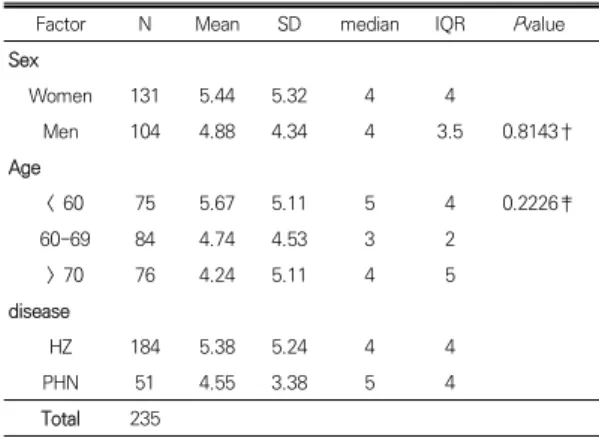
The demographic data regarding the duration of prodromal symptoms are shown in Table 1.

Data was analyzed included sex, age, and disease group. The duration of the prodromal symptoms was about 5.38 days in patients with HZ and 4.55 days in patients with PHN, and was found to be longer in women, at 5.44 days. When categorized according to age, the results showed the longest duration to be 5.67 days, for those under 60 years old. It was estimated that the patients' HZ episodes commenced with a period of about 5 days with prodromal symptoms.

Factor N Mean SD median IQR Pvalue

Sex

Women 131 5.44 5.32 4 4

Men 104 4.88 4.34 4 3.5 0.8143†

Age

< 60 75 5.67 5.11 5 4 0.2226‡

60-69 84 4.74 4.53 3 2

> 70 76 4.24 5.11 4 5

disease

HZ 184 5.38 5.24 4 4

PHN 51 4.55 3.38 5 4

Total 235

*P<0.05. †Wilcoxon Rank-Sum test, ‡Kruskal-Wallis test

Table 1. Difference of prodromal time duration by the sex, age and disease

However, there were no statistically significant differences in the duration of prodromal based on sex, age, or disease type. As seen in Table 2, the number of cases in which there were no prodromal symptoms was higher in patients with PHN, at 15.69%, versus 5.43% for HZ.

Disase N(%) Pvalue

HZ 10(5.43) 0.0315

PHN 8(15.69)

*P<0.05

Table 2. Presence of case with non-prodromal symptoms by disease

The affected sites and duration of prodromal

symptoms are seen in Table 3. The most

commonly affected site was the thoracic area (62

patients, 26.3%), followed by the trigeminal area

(45 patients, 19.1%). Although the duration was

longest in the upper extremity area, there were

no significant differences in duration among any

of the affected areas.

(4)

Affected area N Mean

(days) SD median IQR Pvalue head,

neck 45 4.89 4.72 4 3 0.1088

upper

extremity 36 7.03 7.17 4.5 5

Thorax 62 4.29 3.21 3.5 2

Back 33 3.76 2.87 3 4

lower

extremity 32 6.28 4.89 5 3

Abdomen 27 5.81 5.97 5 5

Total 235

*P<0.05.KruskalWallisTest.

Table 3. Difference of prodromal time duration by affected area (days)

As shown in Fig. 1 and Fig. 2, Both the HZ and PHN groups showed that lancinating pains, myalgia, and general weakness were the most common symptoms. However, we found no statistically significant differences, which would specify the prognosis of the disease. There were also no significant differences based on age group or gender. Other unusual symptoms found included diarrhea, nightmares, headache, toothache, peripheral edema, hair loss, tooth extraction, and weight loss.

Fig. 1. Prevalence of prodromal symptoms related to disease: Herpes zoster

Fig. 2. Prevalence of prodromal symptoms related to disease: Postherpetic neuralgia

4. Discussion

Is it possible to predict the occurrence of HZ and PHN with the presence of specific symptoms other than pain? This question is one of the main concerns for both physicians and patients, as the pain itself is a very subjective symptom[12]. The main treatment for HZ is medicating with an antiviral agent, and to reach optimal efficacy, treatment should be started within 72 hour of the onset of the rash[13].

Unfortunately, this short therapeutic window is difficult to achieve in clinical practice, as many patients may wait for several days to be seen, or are misdiagnosed[14]. ZAP in patients with HZ and PHN significantly affects the quality of life and functional status. It can have marked impact on sleep, mood, and general activities, leading to an increased socioeconomic burden[15,16].

Currently available treatments for ZAP are only partially effective, and are often associated with severe adverse effects, presenting a challenge to pain management physicians. Thus, the currently available therapeutic options are largely suboptimal, and the subsequent treatment results are often unsatisfactory for patients[17].

In HZ, pain often begins in the same area where the cutaneous lesions present, even before the onset of the skin rash, with other various symptoms, which could possibly be the clue leading to the early diagnosis of HZ. In this phase, these symptoms, including pain, are referred to as prodromal[18]. The only way to reduce the burden of ZAP is to actively establish preventive strategies for HZ and PHN, such as vaccination, or other early interventions[19].

Therefore, the early diagnosis of HZ using prodromal symptoms would be helpful to prevent the development of PHN, which would subsequently improve the patient's prognosis.

The risk factors for HZ and PHN have been

explored in previous studies. In addition to age

and an immunocompromised status, gender

(5)

(particularly female), family history, and comorbidities such autoimmune diseases, asthma, diabetes mellitus, and chronic obstructive pulmonary disease, have been shown to also be risk factors for HZ[20-22]. In regards to PHN, another study has found advanced age, severe pain in the acute phase of HZ, more severe skin rash lesions, and the presence of a pain preceding the rash have been reported to be additional risk factors[6].

When looking at prodromal symptoms, most previous studies focused only on pain, confirming it to be a risk factor for PHN. The higher the intensity and the longer the duration of pain, the more the probability increases that PHN may occur after the rash heals[3,23,24].

Though it is still unclear, it appears the pathogenesis of the pain is the result of damage to the dorsal horn and afferent nociceptor in the neuro-inflammatory process[25]. Another study investigated prodromal pain in the Western population[11]. In this study, the severity and duration of prodromal pain were measured retrospectively in 251 patients; however, these patients were restricted to the HZ disease group.

The mean duration of prodromal pain was found to be 5.1 days in men and 4.4 days in women. In contrast, in Asian populations, our study showed a longer duration in women, 5.4 days, compared to men, at 4.8 days.

Additionally, we also compared the prodromal symptoms based on age and the disease group, and concluded that there were no significant differences. These factors have never been compared in previous studies. Through this, it was confirmed that there was no correlation between age and prodromal symptoms. Cases with non-prodromal symptoms were higher in patients with PHN than those with HZ.

Unfortunately, it is difficult to reach a conclusion on the significant of this because of the small number of subjects studied.

When looking at the rash-affected areas, previous studies have reported that severe

prodromal pain and the thoracic localization of HZ were associated with an increased risk of developing PHN[6,26]. However, irrespective of the severity of pain in previous studies, our results showed no significant differences in the duration of prodromal symptoms based on the affected region.

The results of previous studies, however, suggest that pain may be interpreted as the only prodromal symptom. We focused on the various characteristics of the prodromal symptoms other than pain, and tried to find out the associations of those symptoms with the development of PHN. Our results showed that there are many symptoms other than pain that can be considered prodromal. Both the HZ and PHN groups showed that myalgia and general weakness were the most common symptoms.

Other common symptoms were chills, itchiness, sleep disturbance, loss of appetite, indigestion, and nausea and vomiting. In rare cases, unusual symptoms such as diarrhea, nightmares, headache, toothache, peripheral edema, hair loss, tooth extraction, and weight loss were founded. The existence of these symptoms should not be overlooked, although we did not find any additional symptoms that were of statistic significance. The overall duration of these symptoms as found in our study was less than six days, and we therefore recommend that the physician consider the importance of this period when treating a suspected patient.

The present study has some limitations, such as a small cohort and being geographically restricted to a regional area in Korea. In particular, there were a small number of patients in the PHN group as compared to the HZ group.

It is assumed that not many patients remember

their illness and symptoms correctly, as the

course of PHN is time-consuming. Larger studies

with a nationwide sample population would

address the limitations of our results, and may

elucidate some of the as yet unknown risk factors

(6)

for PHN.

In the present study, prodromal symptoms related to ZAP in a Korean population was analyzed for the first time, through a multicenter study. Various clinical prodromal symptoms were investigated; however, no conclusive prodromal symptoms of HZ or PHN were found to specify a prognosis. Nevertheless, it is meaningful that it was a study that could enhance the understanding of zoster-related prodromal symptoms in Koreans. It is believed that more accurate data can be obtained if national wide studies are conducted in the future.

In future research, it would be important to examine whether additional risk factors and various methods of weighing risk factors could increase the accuracy of this prediction. Such continuing research regarding the risk factors of PHN would not only assist ongoing efforts to develop methods to prevent PHN and identify which patients have the greatest need for such preventive measures, but would also increase our knowledge of the pathogenesis of PHN.

REFERENCES

[1] J. I. Cohen. (2013). Clinical practice: Herpes zoster.

New England Journal of Medicine 369(3) , 255-263.

DOI : 10.1056/NEJMcp1302674

[2] Health insurance review and assessment service, Helath bigdata hub. https://opendata.hira.or.kr/

[3] R. H. Dworkin. & R. K. Portenoy. (1996). Pain and its persistence in herpes zoster. Pain, 67(2-3) , 241-251.

DOI : 10.1016/0304-3959(96)03122-3

[4] M. N. Oxman et al. (2005). A vaccine to prevent herpes zoster and postherpetic neuralgia in older adults. New England Journal of Medicine 352(22), 2271-2284.

DOI : 10.1056/NEJMoa051016

[5] H. G. Thyregod, M. C. Rowbotham, M. Peters, J.

Possehn, M. Berro & K. L. Petersen. (2007). Natural history of pain following herpes zoster. Pain, 128(1-2), 148-156.

DOI : 10.1016/j.pain.2006.09.021

[6] B. F. Jung, R. W. Johnson, D. R. Griffin & R. H.

Dworkin. (2004). Risk factors for postherpetic

neuralgia in patients with herpes zoster. Neurology, 62(9) , 1545-1551.

DOI : 10.1212/01.wnl.0000123261.00004.29

[7] J. Fashner & A. L. Bell. (2011). Herpes zoster and postherpetic neuralgia: prevention and management.

Am Fam Physician, 83(12) , 1432-1437.

DOI : 15;96(10):656-663

[8] S. Helgason, G. Petursson, S. Gudmundsson & J. A.

Sigurdsson. (2000). Prevalence of postherpetic neuralgia after a first episode of herpes zoster:

prospective study with long term follow up. British medical journal, 321(7264) , 794-796.

DOI : 10.1136/bmj.321.7264.794

[9] K. E. Schmader. (2002). Epidemiology and impact on quality of life of postherpetic neuralgia and painful diabetic neuropathy. Clinical journal of pain, 18(6) , 350-354.

DOI : 10.1097/00002508-200211000-00002

[10] C. L. Wu, A. Marsh & R. H. Dworkin. (2000). The role of sympathetic nerve blocks in herpes zoster and postherpetic neuralgia. Pain, 87(2) , 121-129.

DOI : 10.1016/S0304-3959(00)00230-X

[11] A. Benbernou et al. (2011). Association between prodromal pain and the severity of acute herpes zoster and utilization of health care resources.

European Journal of Pain, 15(10) , 1100-1106.

DOI : 10.1016/j.ejpain.2011.04.014

[12] P. M. Coplan et al. (2004). Development of a measure of the burden of pain due to herpes

zoster and postherpetic neuralgia for prevention trials: adaptation of the brief pain inventory.

Journal of Pain, 5(6) , 344-356.

DOI : 10.1016/j.jpain.2004.06.001

[13] A. Saguil, S. Kane, M. Mercado & R. Lauters. (2017).

Herpes Zoster and Postherpetic Neuralgia: Prevention and Management. American Family Physician, 96, 656-663.

[14] K. E. Schmader & R. H. Dworkin. (2008). Natural history and treatment of herpes zoster. Journal of Pain, 9(1), 3-9.

DOI : 10.1016/j.jpain.2007.10.002

[15] M. Drolet et al. (2010). The impact of herpes zoster and postherpetic neuralgia on health-related quality of life: a prospective study. Canadian Medical Association Journal,

182(16) , 1731-1736.

DOI : 10.1503/cmaj.091711

[16] M. J. Hong, Y. D. Kim, Y. K. Cheong, S. J. Park, S. W.

Choi & H. J. Hong. (2016). Epidemiology of Postherpetic Neuralgia in Korea: An Electronic Population Health Insurance System Based Study.

Medicine (Baltimore), 2016, 95(14) , e3304.

DOI : 10.1097/MD.0000000000003304

[17] L. Feller , R. A. G. Khammissa, J. Fourie, M. Bouckaert

& J. Lemmer. (2017). Postherpetic Neuralgia and

(7)

Trigeminal Neuralgia. Pain Research and Treatment, 1681765, 6.

DOI : 10.1155/2017/1681765

[18] A. Volpi et al. (2007). C linical and psychosocial correlates of acute pain in herpes zoster. Journal of Clinical Virology, 38(4) , 275-279.

DOI : 10.1016/j.jcv.2007.01.010

[19] S. M. Langan, L. Smeeth, D. J. Margolis & S. L.

Thomas. (2013). Herpes zoster vaccine effectiveness against incident herpes zoster and

post-herpetic neuralgia in an older US population: a cohort study. PLoS Medicine, 10(4), e1001420.

DOI : 10.1371/journal.pmed.1001420

[20] K. Kawai & B. P. Yawn. (2017). Risk Factors for Herpes Zoster: A Systematic Review and Meta-analysis.

Mayo Clinic Proceedings, 92(12) , 1806-1821.

DOI : 10.1016/j.mayocp.2017.10.009

[21] Y. C. Lai & Y. W. Yew. (2016). Risk of Herpes Zoster and Family History: A Meta-analysis of Case-control Studies. Indian Journal of Dermatology, 61(2) , 157-162.

DOI : 10.4103/0019-5154.177748

[22] H. J. Kwon et al. (2016). Asthma as a risk factor for zoster in adults: A population-based case-control study. Journal of Allergy Clinical Immunology, 137(5) , 1406-1412.

DOI : 10.1016/j.jaci.2015.10.032

[23] R. H. Dworkin, R. J. Boon, D. R. Griffin & D. Phung.

(1998). Postherpetic neuralgia: impact of famciclovir, age, rash severity, and acute pain in herpes zoster patients. Journal of Infectious Diseases, 178(1), S76-S80.

DOI : 10.1086/514260

[24] R. J. Whitley, H. L. Weiss, S. J. Soong & J. W. Gnann.

(1999). Herpes zoster: risk categories for persistent pain. Journal of Infectious Diseases, 179(1), 9-15.

DOI : 10.1086/314562

[25] G. J. Bennett. (1994). Hypotheses on the pathogenesis of herpes zoster-associated pain. Annals of Neurology, 35(Suppl) , S38-41.

DOI : 10.1002/ana.410350712

[26] P. Sampathkumar, L. A. Drage & D. P. Martin. (2009).

Herpes zoster (shingles) and postherpetic neuralgia.

Mayo Clinic Proceedings, 84(3), 274-280.

DOI : 10.4065/84.3.274

김 연 동(Yeon-Dong Kim) [정회원]

․ 2002년 2월 : 전북대학교 의과대학 의학과 (의학사)

․ 2005년 2월 : 전북대학교 의과대학 의학과 (의학석사)

․ 2013년 2월 : 전북대학교 대학원 의 학과 (의학박사)

․ 2018년 9월 ~ 현재 : 원광대학교 의 과대학 의학과 부교수

․ 관심분야 : 마취통증의학, 통증의학, 만성통증관리

․ E-Mail : [email protected]

이 공 희(Gong-heui Lee) [정회원]

․ 2018년 2월 : 원광대학교 의과 대학 의학과(의학사)

․ 2019년 2월 ~ 현재 : 원광대학교 병원 전공의(마취통증의학과)

․ 관심분야 : 마취통증의학, 통증의학

․ E-Mail : [email protected]

이 철 형(Cheolhyeong Lee) [정회원]

․ 2014년 2월 : 원광대학교 의과대학 의학과(의학사)

․ 2019년 2월 : 원광대학교 병원 전공 의(마취통증의학과)

․ 2021년 2월 : 원광대학교 의과대학 의학과 (의학석사)

․ 2019년 2월 ~ 현재 : 원광대학교 병 원 임상조교수

․ 관심분야 : 마취통증의학, 통증의학, 만성통증증후군

․ E-Mail : [email protected]

수치

Table  1.  Difference  of  prodromal  time  duration  by  the  sex,  age  and  disease
Fig.  1.  Prevalence  of  prodromal  symptoms  related  to  disease:  Herpes  zoster

참조

관련 문서

medical students 9). The results of studies, conducted with Korean medical students, showed the same pat- tern; that is, statistically significant differences in the

In previous studies, it was shown that Monotropa spe- cies are able to form symbiotic relationships with differ- ent species of Russulaceae depending on the area, even though