http://dx.doi.org/10.12925/jkocs.2018.35.3.787
혼합 생균제가 열 스트레스에 노출된 산란계의 생산성, 계란품질, 면역반응 및 맹장 미생물에 미치는 효과
송영한․고용균
✝․엄경환․박병성
✝ 강원대학교 동물생명과학대학(2018년 8월 8일 접수: 2018년 9월 10일 수정: 2018년 9월 15일 채택)
Effects of Dietary Probiotic Mixture on Caecal Microflora, Immune Response, Egg Quality and Production of Layerunder Heat Stress
Young-Han Song․Yong GyunGoh✝․Kyung-Hwan Um․Byung-Sung Park✝
College of Animal Life Science, Kangwon National University, Chuncheon, Gangwondo,
200-701, Republic of Korea
(Received August 8, 2018; Revised September 10, 2018; Accepted September 15, 2018)
요 약 : 본 연구는 열 스트레스 (heat stress, HS)에 노출된 산란계에서 혼합 생균제의 급여가 생산 성, 계란품질, 면역반응, 맹장 미생물 및 분 암모니아에 미치는 효과를 조사하였다. 총 400마리의 50주 령 Hy-Line brown 산란계를 무작위로 각각 100마리씩 4 그룹, C (대조군, 실온 25℃), HS (열 스트레 스 33℃), HSP (HS 플러스 혼합 생균제 500, 750 mg/kg)로 배치하였다. 산란계의 생산성, 계란품질, 비장 무게, 혈액 IgG 및 lymphocyte 농도는 HSP 그룹에서 HS 그룹과 비교했을 때 증가하였고, 코르티 코스테론, heterophil과 lymphocyte의 비율 (H:L) 및 폐사율은 유의하게 낮았다.
Lactobacillus
는 HSP 그룹에서 HS 그룹과 비교했을 때 증가하였으나Escherichiacoli (E. coli),
coliform bacteria 및 aerobic bacteria는 유의하게 낮았다. 분에서 암모니아 발생은 HS 그룹이 HSP 그룹에 비해서 유의하게 증가하 였다. 결론적으로, 이러한 혼합 생균제가 여름철 산란계의 더위 피해를 방해주고 면역반응, 맹장 미생물 균형을 경유하여 생산성, 계란품질 및 계분으로부터 악취 발생을 줄이는 데 효율적인 영양전략이 될 수 있음을 나타낸다.주제어 : 혼합 생균제, 산란계, 열 스트레스, 생산성, 계란품질
Abstract : This study was conducted to investigate the effects of probiotic mixture on fecal ammonia, caecal microorganism, immune response, egg quality and production in layer under heat stress (HS).A total of four hundred 50 week olds Hy-Line Brown layers were randomly divided into four groups of 100 heads each: C (control, room temperature 25℃), HS (heat stress 33℃), PM (HS plus probiotic mixture 500, 750 mg/kg of diets). Egg production, egg quality, spleen
✝
Corresponding author
(E-mail: [email protected]; [email protected])
weight, blood IgG and lymphocyte concentrations were increased in the PM group compared to the HS group, while mortality, the heterophil:lymphocyte (H:L) ratio, and corticosterone levelswere significantly decreased.
Lactobacillus
was increased in the PM group compared to the HS group, butE. coli
, coliform bacteria and aerobic bacteria were significantly reduced. Fecal ammonia production was significantly increased in the HS group compared to the PM group. In conclusion, the results of this study that these mixed probiotics can reduce the heat damage of the summer laying hens and can be an effective nutritional strategy to reduce odor generation from feces, and to improve egg quality and laying production through immune response and caecal microbial balance.Keywords : Probiotic mixture, layer, heat stress, production, eggquality
1. 서 론
기후변화는 생체 활동에 해로운 열 스트레스 (heat stress, HS)에 노출시킴으로써 인간과 동물 에게 막대한 피해를 주고 있다. HS는 동물복지, 산란계의 생산성, 가축질병 및 생물다양성에 영향 을 미치고 가금의 폐사율을 높이는 원인이다. 지 속적인 가축생산으로의 전환에서 기후변화 적응 및 완화를 위한 더위피해 예방은 대단히 중요하 다[1]. 양계산업은 HS와 관련하여 매우 열악한 환경에 직면해있으며 매년 산란계의 생산성과 계 란품질이 크게 손실된다[2]. 조류의 일정한 대사 특성과 높은 계란 생산성에 덧붙여서 산란계는 땀샘이 부족하고 비효율적인 열을 방출하기 때문 에 HS에 더욱 민감하며 체온상승, 항체 생성 억 압에 의해 면역기능 억제, 사료섭취량, 계란 생산 성, 계란품질 및 난각두께를 감소시킨다[3].
생균제는 소화관을 통해 공급되는 비병원성 및 비독성 살아있는 미생물이다. FAO (2001)는 생 균제를 적절한 양으로 투여했을 때 숙주에게 건 강상의 이익을 주는 살아있는 미생물이라고 정의 하였다. 생균제는 유해세균의 장 부착을 방지하며 면역체계를 향상시켜 숙주동물에게 유익한 효과 를 준다[4].가금 영양에서 주로 사용되는 생균제 는
Lactobacillus
spp.,Enterococcus
spp.,Pediococcus
spp.,Streptococcus
spp.,Bifidobacterium
spp.,Bacillus
spp., 그리고Saccharomycescerevisiae
및Candida
spp. 와 같 은 효모이다[5]. 산란계에서 생균제의 급여가 생 산성 및 계란품질을 개선한다는 보고가 있다[6].산란계의 사료 내 생균제를 공급하면 사료섭취, 사료 요구율을 개선하여 면역기능 증가[7] 및 소 화관 미생물 균형에 의한 암모니아 배출 감소[8]
가 보고되었다.
최근, 2개 또는 그 이상의 살아있는 미생물 균 주를 함유하는 혼합 생균제가시너지 효과를 발휘 하며 HS 하에서 산란계의 생산성 및 계란품질을 높인다는 보고가 있다[3,9]. 지렁이 분변토로부터 분리하여 제조한 혼합 생균제는 그들의 생태와 대사특성이 서로 다른 3가지 미생물:
Bacillus subtilis
KCTC2213,Streptomyces galilaeus
KCTC31133,Sphingobacteriaceae
BRO29의 최 소농도 3.5×10⁸포자수/g의 동일한 혼합물을 함 유하고 있다 (South Korea Patent No.0092670). 혼합생균제의균주 내
B. subtillus
는 탄수화물, 단백질 및 지질을 분해하는 효소 및 병원성 미생물에 효과적인 항균물질을 생성한다 [10].S. galilaeus
균주는 토양에 존재하는 세균으로서 항생물질을 생성한다[11].
Sphingobacteriaceae
는 부엽토양에 존재하여 생태 환경 조절 및 식물의 영양대사를 촉진한다[12].따라서 제조자는 산란계, 브로일러, 돼지 및 소 사료에 대한 첨가제로서 혼합생균제의 사용을 제 안하였다. 그러나 HS에 노출된 산란계에게 본 연 구에서 사용한 혼합생균제의 급여효과에 대한 과 학적 자료는 없다. 연구의 목적은 열 스트레스에 노출된 산란계에서생산성, 계란품질, 면역반응, 맹장 미생물 및 분 암모니아에 대한 혼합생균제 의 효과를 조사하는 것이었다.
2. 재료 및 방법
2.1. 혼합 생균제의 제조연구에 사용된 혼합 생균제는 경기도 김포시에 소재한 (주)후인바이오에서 제조하였다. 제품은 동결건조 포자를 형성하는
B. subtillus
KCTC2213,S. galilaeus
KCTC31133,Sphingobacteriaceae
BRO29 (2%), 그리고 지렁 이 분변토(98%)로 구성되어있다.B. subtillus
KCTC2213,S. galilaeus
KCTC31133 및Sphingobacteriaceae
BRO29는 지렁이 분변토부 터 분리한 균주로써 한국균주은행(KCTC)으로부 터 공급받았다. 제품 1 g은B. subtillus
KCTC2213,S. galilaeus
KCTC31133 및Sphingobacteriaceae
BRO29를 최소 3.5×10⁸ colony forming unit (CFU/g)의 동일한 량을 함 유하였다[13].2.2. 실험동물, 실험설계 및 사양관리
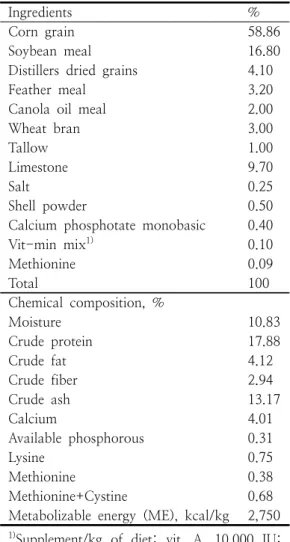
실험동물에 대한 과학적인 절차는 미국의 실험 동물관리 가이드라인 (2010)에서 제시된 과학적 이고 윤리적인 절차를 따랐으며[13] 강원대학교 실험윤리위원회(IACUC)의 승인을 받아서 진행하 였다(승인번호: KW-151117-1). 총 400마리의 Hy-Line brown 산란계50주령을 4처리, 각 처리 그룹은 100마리로써 케이지 당 2마리씩을 갖는 50반복으로 완전임의배치 하였다. 케이지의 직경 은 폭 195 cm×길이 45 cm×높이 40 cm였으며 암탉 마리 당 사육밀도는 405 cm2였다. 4개의처 리군은 C (대조군, 25℃ 실온), HS (33℃ 열스트 레스), HSP (HS 플러스 혼합 생균제 500, 750 mg/kg)로 구분하였다. 실험사료는 미국의 가금영 양소 요구량 (1994) 사양표준에서 제시한 산란계 의 영양소 요구량[14]을 충족 또는 약간 초과하 도록 배합하였으며 사료배합표와 영양소 함량은 Table 1과 같다. 암탉은 실험기간 동안 물, 사료, 내부 환기 및 조명에 자유롭게 접근할 수 있었 다. 대조군의 경우 실험기간 동안 18시간 조명 (08:30- 24:30), 그리고 닭들의 눈 높이에서 20 룩스의 조명을 유지하였다. HS는 52주령부터 60 주령까지 유도하였으며 온도, 습도가 자동으로 조 절되는 사육실에서 11:00부터 16:00까지 각각 34±2℃, 상대습도 70%로써 HS를 유도하였으며 그 이후에는 25℃ 실온으로 유지하였다.
2.3. 생산성과 계란품질
실험사료를 공급한 후 2주째부터 HS를 부여하 여 HS 노출 3주째부터 생산한 계란을 수집하여 (55-60주령) 생산성 및 계란품질을 조사하여 평 균값으로 나타냈다. 사료섭취량은 일주일 간격으 로 측정하였으며 일일 계란 생산성 및 난중을 기 록하였다. 호우유닛(Haugh unit, HU, Egg Multi-Tester; Touhoku Rhythm Co., Tokyo, Japan)를 평가하였다. 난각두께(Dial Pipe Gauge; Ozaki MFG. Co., Tokyo, Japan),난황지 수, 파란강도(kg/cm2)와 알부민 높이는 계란품질 측정기계(Eggshell Force Gauge Model II;
Robotmation Co., Tokyo, Japan)를 이용하였다.
2.4. 혈액 생체지표
55주령과 60주령의 산란계에서 처리구 당 각 각 5마리씩을 선정하여 혈액을 수집하였고 혈액 생체지표로써 IgG, heterophil (H), lymphocyte (L) 그리고 코르티코스테론을 측정하였다. 혈액 5 mL를 산란계의 상완정맥(brachial vein)을 경유 하여 채혈해서 K3 EDTA-coated test tubes 속 으로 수집하였다. 모든 혈액 샘플을 얼음 위에 두고 실험실로 이송하여 4℃에서 3000 rpm에서 30 분간 원심분리 하였다. 상등액 혈장을 수집하 여 분석할 때까지 -20℃에서 보관하였다. 혈액 immunoglobulin G (IgG) 농도는 chicken ELISA kit (Bethyl Laboratories, Montgomery, TX, USA), 코르티코스테론 농도는 HS EIA kit (Enzyme immunoassay kit, IDS, Boldon, UK)를 이용하여 측정하여 생화학적 처리를 실시한 후 Precision microplate reader (Molecular Devices Inc, New York, USA)에 의해서 450 nm에서 흡 광도를 측정하여 정량하였다. 광학현미경을 통하 여 heterophil(H)과 lymphocyte (L)을 분리하였 으며 슬라이드 당 백혈구100개, 암탉 당 총 200 개의 세포를 카운트한 다음 H:L ratio를 계산하 였다[15].
2.5. 맹장 미생물
55주령과 60주령의 처리군에서 각각 5마리씩 을 선정하여 경추탈골에 의해서 안락사 하였다 [13]. 비장 무게를 측정하였으며 맹장 미생물수를 측정하였다. 도계 후 곧 바로 장내 미생물을 조 사하기 위해서 혐기적인 방법으로 맹장을 채취한 후 얼음 상자 위에서 유지하였다. 맹장은 분석할 때까지 anaeroGen sachets (Oxoid, Hampshire,
Ingredients %
Corn grain 58.86
Soybean meal 16.80
Distillers dried grains 4.10
Feather meal 3.20
Canola oil meal 2.00
Wheat bran 3.00
Tallow 1.00
Limestone 9.70
Salt 0.25
Shell powder 0.50
Calcium phosphotate monobasic 0.40
Vit-min mix1) 0.10
Methionine 0.09
Total 100
Chemical composition, %
Moisture 10.83
Crude protein 17.88
Crude fat 4.12
Crude fiber 2.94
Crude ash 13.17
Calcium 4.01
Available phosphorous 0.31
Lysine 0.75
Methionine 0.38
Methionine+Cystine 0.68
Metabolizable energy (ME), kcal/kg 2,750
1)Supplement/kg of diet: vit. A, 10,000 IU;
vit.D3, 3,500 IU; vit.E, 15.0 IU; vit.K3, 2,000 mg; vit.B1, 1,500 mg; vit.B2, 5,000 mg; vit.B6, 3,000 mg; vit. B12, 20 mg;
niacin, 25,000 mg; pantothenic acid, 6,000 mg; folic acid, 500 mg; biotin, 50 mg; Cu, 9,000 mg; I, 1,500 mg; Mn, 80,000 mg;
Zn, 80,000 mg; Se, 250 mg; Fe, 50,000 mg; Co, 100 mg.
Table 1. Chemical composition and ingredients of basal diets
UK)가 갖춰진 sealed anaerobic jars (Oxoid, Basingstoke, UK)에서 혐기상태로 유지하였다.
맹장 내용물을 멸균된 혐기성 생리식염수 (phosphorus buffered saline; PBS 0.1 M, pH 7.0)로 혼합하여 10배 희석 (1:9, wt/vol) 한 다 음에 일련의 희석을 계속하였다. 모든 절차는 anaerobic chamber (5% hydrogen, 5% CO2, balanced nitrogen)에서 혐기상태로 이루어졌다.
배양은 희석된 10-2~10-7에서 각각 100 uL 를 분주하여 멸균된 평판 선택배지 즉
E. coli
(McConkey purple agar, Difco, Becton Dickinson, Franklin Lakes, NJ),Lactobacillus
(MRS agar, Oxoid, Basingstoke, UK),Salmonella
(SS agar, Difco), Total aerobic bacteria (Nutrient agar, Difco), Coli form (Violet red bile agar, (Difco, Becton Dickinson, Franklin Lakes, NJ)에서 실행하였다.Escherichia coli, Salmonella,
Total aerobic bacteria 는 37℃에서 24시간 호기배양 하였고Lactobacillus
는 anaeroGen sachets 가 갖춰진 sealed anaerobic jars 를 이용한 혐기상태 하에서 37℃ 48시간 정치배양한 후 각각의 평판배지에서 미생물 카운터로써 콜로니 수를 조사하였다. 모든 미생물 군락의 수는 맹장내용물 g 당 균수(CFU, colony-forming unit/g of wet of cecum content)로써 상용로그를 취하여 제시하였다[16].2.6. 분 암모니아
55주령과 60주령의 산란계로부터 각 처리군 당 배설된 신선한 계분에서 암모니아를 측정하여 평균값으로 나타냈다. 계분 2,500 g을 가스 측정 을 위해 상부에 5cm 구멍을 갖도록 제작된 polycarbonate 상자 (폭 27cm×깊이 22.5 cm×
높이 13.5cm)에 담아서 25℃에서 5일 동안 보관 하였다. 1, 3, 5일 순서로 발생하는 암모니아 농 도를 Gas sampling pump GV-100S (Gastec Co., Japan)를 이용하여 측정하였다.
2.7. 통계처리
얻어진 자료의 통계처리는 SPSS/Windows version 21.0 (statistical package for the social science, SPSS Inc., Chicago, IL, USA)를 사용하 였다. 각 처리군의 평균 값에 대하여 일원분산 분석을 진행한 다음에 던칸의 다중검정법으로 95% 신뢰수준에서 통계적인 유의차를 검정하였 다 (p<0.05).
3. 결과 및 고찰
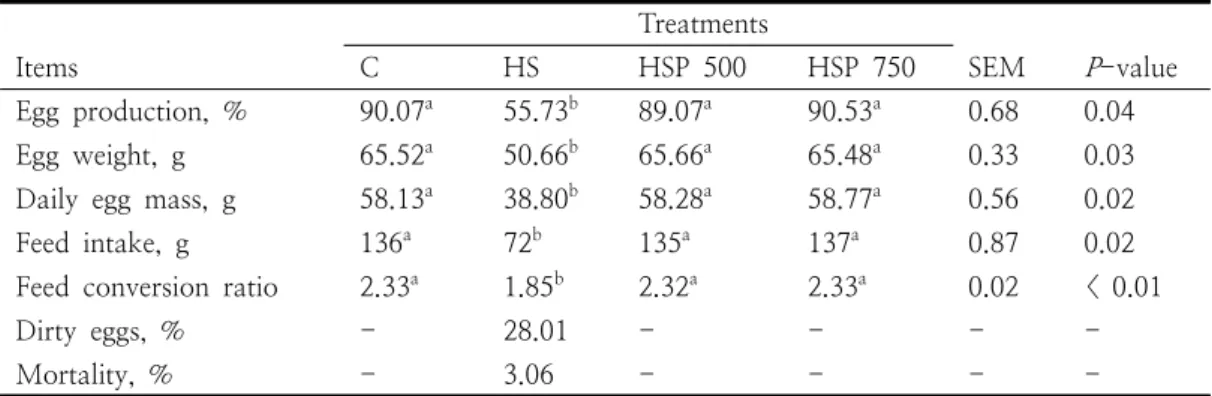
3.1. 산란성적HS 하에서 혼합 생균제를 섭취한 산란계의 사
Treatments
Items C HS HSP 500 HSP 750 SEM
P
-valueEgg production, % 90.07a 55.73b 89.07a 90.53a 0.68 0.04 Egg weight, g 65.52a 50.66b 65.66a 65.48a 0.33 0.03 Daily egg mass, g 58.13a 38.80b 58.28a 58.77a 0.56 0.02
Feed intake, g 136a 72b 135a 137a 0.87 0.02
Feed conversion ratio 2.33a 1.85b 2.32a 2.33a 0.02 < 0.01
Dirty eggs, % - 28.01 - - - -
Mortality, % - 3.06 - - - -
C: control, HS: heat stress, HSP 500 (HS plus probiotic mixture 500 mg/kg diet), HSP 750 (HS plus probioticmixture 750 mg/kg diet. The different alphabets have mean values that are significantly different (p<0.05).
Table 2. Productivity of layer fed dietary probiotic mixtureunder heat stress
Treatments
Items C HS HSP 500 HSP 750 SEM
P
-valueHaugh unit (HU) 93.88a 88.02b 91.09ab 94.17a 1.78 0.03 Egg yolk index 9.10a 7.78b 8.86a 9.18a 0.09 0.02 Eggshell thickness, mm 0.32a 0.26b 0.31a 0.34a 0.002 < 0.01 Eggshell breaking
strength, kg/cm2 3.72a 2.79b 3.80a 3.84a 0.02 < 0.01 Albumin high, mm 7.92a 7.78b 7.97a 7.97a 1.24 0.02 C: control, HS: heat stress, HSP 500 (HS plus probiotic mixture 500 mg/kg diet), HSP 750 (HS plus probiotic mixture 750 mg/kg diet). The different alphabets have mean values that are significantly different (p<0.05).
Table 3. Egg quality of layer fed dietary probiotic mixture under heat stress 양성적(Table 2)은 C와 HSP 그룹 사이의 차이는
나타나지 않았다. 계란 생산성은 C, HSP 그룹과 비교할 때 HS 그룹에서 38.13% 유의하게 감소 하였다(p<0.05). 난중은 C, HSP 그룹과 비교할 때 HS 그룹에서 22.85% 감소하였으며 일일 계 란 생산성은 C, HSP 그룹과 비교할 때 HS 그룹 에서 33.98% 유의하게 감소하였다(p<0.05).사료 섭취량은 C, HSP 그룹과 비교할 때 HS 그룹에 서 47.45% 감소하였으나, 사료요구율은 HS 그룹 이 C, HSP 그룹에 비해서 1.10배 유의하게 높았 다(p<0.05). HS 그룹의 경우 다른 모든 그룹에 비해서 불량 계란 및 폐사율이 크게 증가하였다.
계란 품질의 측정결과(Table 3), HU는 C, HSP 그룹과 비교할 때 HS 그룹에서 6.24% 유의하게
감소하였으나(p<0.05), C, HSP 500, HSP 750 그룹 사이, 그리고 HS, HSP 500 그룹 사이의 차 이는 없었다. 난황 지수는 C, HSP 그룹과 비교 할 때 HS 그룹에서 15.25% 유의하게 감소하였 으나(p<0.05), C, HSP 500, HSP 750 그룹 사이, 그리고 HS, HS 500 그룹 사이의 차이는 나타나 지 않았다. 난각두께는 C, HSP 그룹과 비교할 때 HS 그룹에서 27.34% 유의하게 감소하였으나 (p<0.05), C, HSP 500, HSP 750 그룹 사이의 차이는 없었다. 파란강도는 C, HSP 그룹과 비교 할 때 HS, HSP 500 그룹에서 각각 25.00, 19.08% 유의하게 감소하였으나(p<0.05), C, HSP 750 그룹 사이의 차이는 나타나지 않았다. 알부 민 높이는 HS 그룹이 C, HSP 500, HSP 750 그
Treatments
Items C HS HSP 500 HSP 750 SEM
P
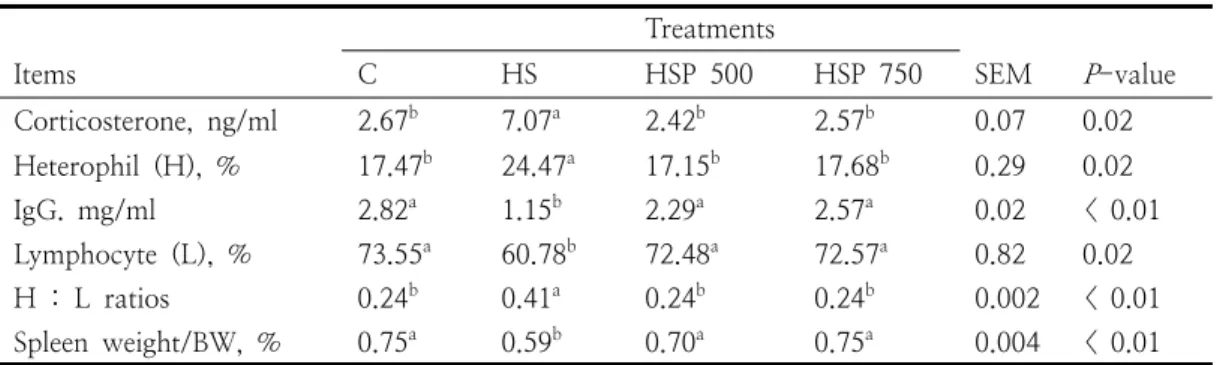
-valueCorticosterone, ng/ml 2.67b 7.07a 2.42b 2.57b 0.07 0.02 Heterophil (H), % 17.47b 24.47a 17.15b 17.68b 0.29 0.02 IgG. mg/ml 2.82a 1.15b 2.29a 2.57a 0.02 < 0.01 Lymphocyte (L), % 73.55a 60.78b 72.48a 72.57a 0.82 0.02 H : L ratios 0.24b 0.41a 0.24b 0.24b 0.002 < 0.01 Spleen weight/BW, % 0.75a 0.59b 0.70a 0.75a 0.004 < 0.01 C: control, HS: heat stress, HSP 500 (HS plus probiotic mixture 500 mg/kg diet), HSP 750 (HS plus probiotic mixture 750 mg/kg diet). The different alphabets have mean values that are significantly different (p<0.05).
Table 4. Blood biomarkers and spleen weight of layer fed dietary probiotic mixture under heat stress
룹에 비해서 3.27% 유의하게 증가하였다 (p<0.05).산란계에서 HS는 사양성적과 계란 품질 을 낮춤과 동시에 설사 및 폐사율을 높이는 것으 로 알려졌다. HS를 받은 가금의 사양성적 감소는 식욕부진, 사료섭취량 감소, 영양대사불량 및 코 르테코스테론 증가 등 다양한 요인과 관련이 있 다[9]. 가금에 대한 영양전략의 일환으로 사료에 생균제를 첨가하면 HS를 완화하여 동물에게 유 익한 효과를 나타낼 수 있다[17]. 본 연구에서, 계란 생산성, 난중을 비롯한 사양성적, 그리고 계 란 품질은 생균제를 포함시킴으로써 개선되었다.
HS 하에서
B. subtillus
,S. galilaeus, Sphingobacteriaceae
등 3가지 균주의혼합 생균 제를 섭취한 산란계는 C와 HS 그룹에 비해서 사 양성적 및 계란품질이 높았던 점은 이러한 생균 제의시너지 효과로써 나타난 소장 융모 활성화를 통한 영양소의 생체이용성(not determined), 면역 기능 증가(Table 4) 및 맹장 미생물의 균형(Table 5)을 경유한 칼슘 등 미네랄의 흡수율(not determined)이 향상되었을 것으로 볼 수 있다[3, 6, 7, 18].3.2. 면역반응
혈액 생체지표로써 코르티코스테론, heterophil 농도(Table 4)는 HS 그룹에서 C, HSP 그룹과 비교할 때 2.92, 1.42배 증가하였으나
IgG,
lymphocyte 농도는 각각 59.22, 16.11% 유의하 게 감소하였다(p<0.05). H:L 비율은 HS 그룹이 C, HSP 그룹에 비해서 1.7배 증가하였으나 비장무게는 21.00% 유의하게 낮았다(p<0.05). 생균제 가 지닌 가장 중요한 역할 중 하나는 침입하는 병원성 미생물에 대한 면역력을 자극하는 것이다.
소화관의 정상적인 미생물을 비롯한 다양한 생균 제는 숙주동물에서 면역을 자극하는 것으로 알려 져 있다[19]. 본 연구에서, 우리는 HS에 노출된 산란계에게
B.subtillus
외 2가지 균주를 포함하는 생균제의 급여로 비장 무게와 함께 IgG의 농도가 증가함을 발견했다. 생균제를 급여한 산란계에서 비장 무게와 혈액 immunoglobulin이 증가한 점 은 생균제가소화기관을 경유한 사료섭취량을 자 극하고 영양소의 흡수이용율을 높임으로써 면역 세포 조직의 발육을 촉진시켰을 것으로 볼 수 있 다[20]. HS를 받은 산란계에서 H:L 비율이 증가 했다는 보고는 본 결과를 지지해준다[21]. HS는 H:L 비율, 코르티코스테론과 같은 특이적인 면역 생체지표를 높여줌으로써 조류에서의 면역반응에 영향을 미치는 것으로 보고되었다[22]. 비장은 항 원에 대한 면역반응의 중요한 부위로서 비장 무 게가 더 큰 암탉은 더 높은 면역능력을 갖는다 [23].3.3. 맹장 미생물
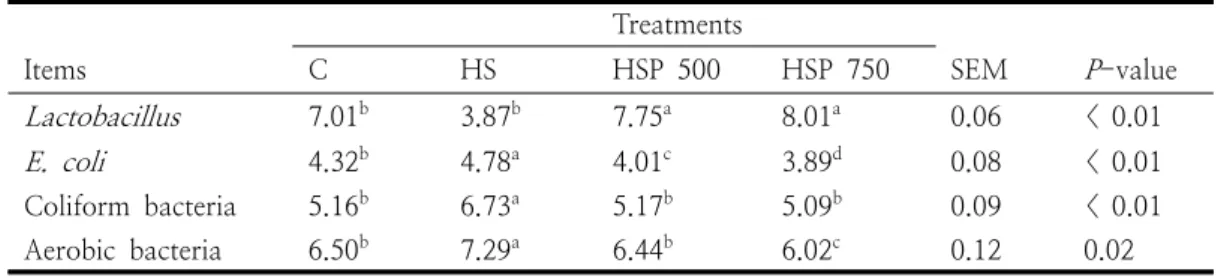
맹장 미생물(Table 5) 가운데
Lactobacillus
는 HS 그룹이 C, HSP그룹에 비해서 51.69% 유의 하게 낮아졌으나(p<0.05) C와 HSP 그룹 사이의 차이는 없었다.E. coli,
coliform bacteria, aerobic bacteria는 HS 그룹이 C, HSP 그룹에 비해서 각각 1.23, 1.32, 1.21배 증가하였으며 처Treatments
Items C HS HSP 500 HSP 750 SEM
P
-valueLactobacillus
7.01b 3.87b 7.75a 8.01a 0.06 < 0.01E. coli
4.32b 4.78a 4.01c 3.89d 0.08 < 0.01Coliform bacteria 5.16b 6.73a 5.17b 5.09b 0.09 < 0.01 Aerobic bacteria 6.50b 7.29a 6.44b 6.02c 0.12 0.02 C: control, HS: heat stress, HSP 500 (HS plus probiotic mixture 500 mg/kg diet), HSP 750 (HS plus probiotic mixture 750 mg/kg diet). The different alphabets have mean values that are significantly different (p<0.05).
Table 5. Caecal microorganism of layer fed dietary probiotic mixtureunder heat stress(CFU/g)
Treatments
Days C HS HSP 500 HSP 750 SEM
P
-value1 d 1.76b 2.63a 1.67b 1.70b 0.02 < 0.01
3 d 152b 285a 106c 89d 0.80 0.03
5 d 236b 320a 157c 90d 1.15 0.02
C: control, HS: heat stress, HSP 500 (HS plus probiotic mixture 500 mg/kg diet), HSP 750 (HS plus probiotic mixture 750 mg/kg diet). The different alphabets have mean values that are significantly different (p<0.05).
Table 6. Fecal ammonia concentration from layer fed dietary probiotic mixtureunder heat stress(ppm)
리군 사이의 차이가 인정되었다 (p<0.05).혼합생 균제가맹장의 미생물 균형을 유지해줌으로써 세 균의 침입을 억제하였으며 이전의 보고와 일치한 다[3]. 맹장 미생물은 주로
Clostridia
와Lactobacilli
이며 생균제의 급여는 장내 미생물 균형을 유지해주고 HS에 의해 유발된 변화에 대 한 내재성 미생물 균총의 안정성을 유지해주는 것으로 알려졌다[23].3.4. 분 암모니아
분에서 암모니아의 발생(Table 6)은 HS 그룹이 C, HSP 그룹에 비해서 1일째 1.57, 3일째 3.20, 5일째 3.56배 유의하게 증가하였다(p<0.05). 한 편, 3일째 이후부터 암모니아의 발생은 HSP 750, 500, C 그룹 순서로 유의하게 낮아지는 경 향을 나타냈다(p<0.05). 암모니아는 가축 분에서 기인한 주요한대기 오염원 이며 특히, 가금 산업 에서 분에서 발생하는 악취와 관련한 심각한 민 원 발생이 증가하고 있다[8, 24]. 산란계에서생균 제의 급여는 장 내 미생물 균총의 변화와 함께
사료요구율, 영양소 활용 및 질소대사를 개선함으 로써 가축 분으로부터 암모니아 방출을 낮추는 것으로 보고되었다[25]. 본 연구결과, HS 하에서
B.subtillus
외 2개의 균주를 포함하는 혼합 생균제 를 산란계에게 급여했을 때 장 미생물의 균형이 관찰되었으며(Table 5), 이러한 결과가 분에서 암 모니아의 발생량을 낮추는데 기여했을 것으로 볼 수 있다[26].4. 결 론
총 400마리의 Hy-Line brown 산란계 50주령 을 4처리로 완전임의배치 하였다. 처리군은 C (대조군, 25℃ 실온), HS (33℃ 열스트레스), HSP (HS 플러스 혼합 생균제 500, 750 mg/kg) 로 구분하였다. 열 스트레스에 노출된 산란계에게
B. subtillus
,S. galilaeus, Sphingobacteriaceae
등 3개의 균주가 포함된 혼합 생균제를 급여하여 생 산성, 계란품질 개선 및 계분으로부터 암모니아의발생량을 조사하였으며 그 결과는 다음과 같다.
1. 계란 생산성, 계란품질은 혼합생균제 그룹에 서 열 스트레스 그룹과 비교할 때 증가하였 다.
2. 코르티코스테론, heterophil 농도는 혼합 생 균제 그룹이 열 스트레스 그룹과 비교할 때 낮았으나 IgG, lymphocyte 농도 및 비장 무게는 높았다.
3. 맹장의
Lactobacillus
수는 혼합 생균제 그룹 이 열 스트레스 그룹과 비교할 때 증가했으 나 유해균수는 감소하였다.4. 분변 중 암모니아 발생량은 혼합 생균제 그 룹이 열 스트레스 그룹과 비교할 때 낮아졌 다.
References
1. M. M. Rojas-Downing, A. P.
Nejadhashemi, S.A. Woznicki, “Climate change and livestock: Impacts, adaptation, and mitigation”,
Climate Risk Management,
Vol. 16, pp. 145-163, (2017).2. W. Deng, X. F. Dong, J. M. Tong, Q.
Zhang, “The probiotic
Bacillus licheniformis
ameliorates heat stress-induced impairment of egg production, gut morphology, and intestinal mucosal immunity in laying hens”,Poultry Science,
Vol. 91, pp. 575–582, (2012).3. P. Zhang, T. Yan, X. Wang, S. Kuang, Y.
Xiao, W. Lu, D. Bi, “Probiotic mixture ameliorates heat stress of laying hens by enhancing intestinal barrier function and improving gut microbiota”,
Italian Journal of Animal Science
, Vol. 16, pp. 292-300, (2017).4. S. Hemaiswarya, R. Raja, R. Ravikumar, I. S. Carvalho, “Mechanism of action of probiotics”,
Brazilian Archives of Biology and Technology,
Vol. 56, pp. 113-119,(2013).
5. C. Forte, L. Moscati, G. Acuti, C. Mugnai, M. P. Franciosini, S. Costarelli, G.
Cobellis, M. Trabalza-Marinucci, “Effects of dietary
Lactobacillus acidophilus
andBacillus subtilis
on laying performance, egg quality, blood biochemistry and immune response of organic laying hens”,Journal of Animal Physiologyand Animal Nutrition
, Vol. 100, pp. 977–987, (2016).6. M. Gnanadesigan, S. Isabella, P. Saritha, L. Ramkumar, N. Manivannan, R.
Ravishanka, “Quality evaluation of egg composition and productivity of layers in EM (effective microorganisms) treatments:
A field report”,
Egyptian Journal of Basic and Applied Science,
Vol. 1, pp. 161-166, (2014).7. M. E. Koenen, J. Kramer, R. Van Der Hulst, L. Heres, S. H. M. Jeurissen, W. J.
A. Boersma, “Immunomodulation by probiotic
lactobacilli
in layer and meat-type chickens”,British Poultry Science,
Vol. 45, pp. 355–366, (2004).8. Z. F. Zhang, I. H. Kim, “Effects of probiotic supplementation in different energy and nutrient density diets on performance, egg quality, excreta microflora, excreta noxious gas emission, and serum cholesterol concentrations in laying hens”,
Journal of Animal Science,
Vol. 91, pp. 4781–4787, (2013).9. S. Sugiharto, T. Yudiarti, I. Isroli, E.
Widiastuti, E. Kusumanti, “Dietary supplementation of probiotics in poultry exposed to heat stress-A review”,
AnnalsAnimal Science,
Vol. 17, pp.591-604, (2017).
10. S. Han, M. H. Cho, K. S. Whang,
“Comparison of phylogenetic characteristics of bacterial populations in a quercus and pine humus forest soil”,
Korean Journal of Microbiology,
Vol. 44, pp. 237-243, (2008).11. H. S. Kim, Y. H. Kim, O. J. Yoo, J. J.
Lee, “Aclacinomycin X, a novel
anthracycline antibiotic produced by
Streptomyces galilaeus
ATCC 31133”,Journal of Pharmacology Science,
Vol. 12, pp. 222-224, (1996).12. V. Kurtoglu, F. Kurtoglu, E. Seker, B.
Coskun, T. Balevi, E. S. Polat, “Effect of probiotic supplementation on laying hen diets on yield performance and serum and egg yolk cholesterol”,
Food Additives &
Contaminants,
Vol. 21, pp. 817–823, (2004).13. NRC, Guide for the care and use of laboratory animals, Eighth Edition. The national academies press. Washington, DC.
USA, (2010).
14. NRC, Nutrient requirements of poultry.
9th rev. ed. Natl. Acad. Press, Washington, DC.USA, (1994).
15. H. W. Cheng, S. D. Eicher, Y. Chen, P.
Singleton, W. M. Muir, “Effect of genetic selection for group productivity and longevity on immunological and hematological parameters of chickens”,
Poultry Science,
Vol. 80, pp. 1079-1086, (2001).16. J. S. Shin, B. K. Yang, B. S. Park,
“Influence of metabolizable energy on histology of liver and duodenal villus, microflora, heat shock protein gene in duck under heat stress”,
Journal of Korean Oil Chemists' Society
, Vol. 34,pp.613-622, (2017).
17. L. J. Lara, M. H. Rostagno, “Impact of heat stress on poultry production,
Animals”,
Vol. 3, pp. 356–369, (2013).18. C. Lexopoulus, L. E. Georgoulakis, A.
Tzivara, S. K. Kritas, A. Siochu, S. C.
Kyriaki, “Field evaluation of the efficacy of a probiotic containing
Bacillus licheniformis
andBacillus subtilis
spores, on the health status and performance of sow and their litters”,Journal of Animal Physiology and Animal Nutrition,
Vol. 88, pp. 381-392, (2004).19. S. U. Mahfuz, M. J. Nahar, C. Mo, Z.
Ganfu, L. Zhongjun, S. Hui, “Inclusion of
probiotic on chicken performance and immunity: A review”,
International Journal of Poultry Science.
Vol. 16, pp. 328-335, (2017).20. S. M. L. Kabir, “The role of probiotics in the poultry industry”,
International Journal of Molecular Science,
Vol. 10, pp. 3531–3546, (2009).
21. M. Fathi, I. Al-Homidan, A. Al-Dokhail, T. Ebeid, O. Abou-Emera, A. Alsagan,
“Effects of dietary probiotic (
Bacillus subtilis
) supplementation on productive erformance, immune response and egg quality characteristics in laying hens under high ambient temperature”,ItalianJournal of Animal Science.
Published online: 16 Jan. https://doi.org/10.1080/1828051X.2018.1425104, pp. 1-11, (2008).
22. J. N. Felver-Gant, L.A. Mack, R.L.
Dennis, S. D. Eicher, H. W. Cheng,
“Genetic variations alter physiological responses following heat stress in 2 strains of laying hens”,
Poultry Science,
Vol. 91, pp. 1542-1551, (2012).23. P. T. N. Lan, M. Sakamoto, Y. Benno,
“Effects of two probiotic
Lactobacillus
strains on jejunal and cecal microbiota of broiler chicken under acute heat stress condition as revealed by molecular analysis of 16S rRNA genes”,Microbiology and Immunology,
Vol. 48, pp. 917-929, (2004).24. Z. F. Zhang, J. H Cho, I. H. Kim,
“Effects of
Bacillus subtilis
UBT-MO2 on growth performance, relative immune organ weight, gas concentration in excreta, and intestinal microbial shedding in broiler chickens”,Livestock Science,
Vol. 155, pp.343–347, (2013).
25. H. Wang, J. Gong, W. F. Wang, Y. Q.
Long, X. C. Fu, Y. Fu, W. Qian, X. H.
Hou, “Are there any different effects of
Bifidobacterium, Lactobacillus
andStreptococcus
on intestinal sensation, barrier function and intestinal immunity in PI-IBS mouse model?”, PLoS ONE.9:e90153. doi: 10.1371/journal.pone.
0090153, (2014).
26. J. W. Park, J. S. Jeong, S. I. Lee, I. H.
Kim, “Effect of dietary supplementation with a probiotic (Enterococcus faecium) on production performance, excreta microflora, ammonia emission, and nutrient utilization in ISA brown laying hens”,
Poultry Science,
Vol. 95, pp.2829-2835, (2016).