• 검색 결과가 없습니다.

Employee ownership in Defined Contribution and the Effect of the Pension Protection Act of 2006

N/A
N/A
Protected

Academic year: 2021

Share "Employee ownership in Defined Contribution and the Effect of the Pension Protection Act of 2006"

Copied!
10
0
0

로드 중.... (전체 텍스트 보기)

전체 글

(1)

Employee ownership in Defined Contribution and the Effect of the Pension Protection Act of 2006

Heejin Park

Assistant Professor, School of Business, Pusan National University

확정기여형 연금에서의 우리사주와 2006년 연금보호법의 효과

부산대학교 경영학과 조교수 박희진

Abstract We posit that employee ownership through defined contribution (DC) plans results in managerial entrenchment, and then examine the effect of the enactment of the Pension Protection Act of 2006 on the relation between the employee ownership and firm performance. By conducting Ordinary Least Square regression with the data from Form 5500 over the period of 1999-2014, we find that firms with large employee ownership increase their firm value measured by Tobin’s Q after the adoption of the Act. These findings suggest that the adoption of the Act has been effective to mitigate the negative effect of managerial entrenchment by decreasing the employee ownership and reinforcing the fiduciary duty of plan trustees. Given the fact that we test the effects of the diversification rule on employee ownership using firm performance, further research could aim to examine the effects of the rule on employee ownership using stock return or market reaction.

Key Words : Pension Protection Act of 2006, Defined contribution plan, Company stock, Managerial Entrenchment, Tobin’s Q

요 약 우리는 확정기여금 제도를 통한 근로자의 우리사주 소유가 경영진의 경영권 통제로부터 비롯되었다고 보고, 2006년 미국 연금보호법 제정이 근로자의 우리사주 소유와 기업성과의 관계에 미치는 영향을 살펴본다. 이를 위해서 1999년부터 2014년까지의 Form 5500 데이터를 이용해서 선형 회귀분석(Ordinary Least Square Regression)을 실시했다. 그 결과 우리는 근로자의 우리사유 소유가 높은 회사는 법이 채택된 이후 토빈의 Q로 측정한 기업 가치가 증가한 것을 발견했다. 이러한 결과는 2006년 연급보호법은 인해서 근로자의 우리사주 소유를 감소시키고 수탁자의 충실의무를 강화함으로써 경영권 통제 동기의 부정적인 영향을 완화하는데 효과적이라는 것을 시사한다. 본 연구의 결과를 기반으로 향후 2006년 연금보호법 제정이 근로자의 우리사주 소유와 주식성과 혹은 시장반응에 대한 연구를 진행할 수 있을 것이다.

주제어 : 2006년 연금보호법, 확정기여형, 우리사주, 경영권 통제, 토빈의 Q

*This work is supported by a 2-year Research Grant of Pusan National University.

*Corresponding Author : Heejin Park([email protected]) Received November 17, 2020

Accepted December 20, 2020 Revised December 9, 2020

Published December 28, 2020

(2)

1. Introduction

When the Enron stock suddenly became worthless in 2001, the firm’s employees found that they lost not only their jobs but also a considerable amount of their retirement savings, coincidently. At that time, more than half of the Enron 401K plan assets were held in the shares of the company stock. As evidenced by the Enron case, employees holding a large share of company stock in their pension plans are exposed to an unnecessary level of diversifiable risk[1-3].

Layoffs at companies like Enron and WorldCom and plummeting prices in the company stock have triggered debate over the potential risk of a large share of company stock in DC pension plans among policymakers and academics. As a result of the debate over several years, the Pension Protection Act of 2006 (PPA 2006, hereafter) was enacted as a federal law to respond to the pension crisis in August, 2006.

Although the PPA 2006 includes main provisions applied to defined benefit plans, it also contains a number of important changes for the diversification of DC plan assets. The adoption of the PPA 2006 have been functioned as a step toward the diversification of DC plan assets away from employer stock. The Act ensures that employee accounts are invested in a diversified portfolio, which is a change from the earlier management of 401K plans, when investment in company stock was not uncommon.

After the adoption of the rule, the trend in 401k investment options shows a steady move away from company stock as an investment vehicle. Even though extant literature has studied the effect of company stock in DC plans in various aspects, it has not explicitly investigated the relation between company stock in DC plans and firm performance. Using a quasi-experiment empirical framework, we try to fill the gap by examining the change in the relation between

company stock in DC plans and firm performance before and after the enactment of the PPA 2006. In this study, we focus on whether the firm performance of firms with company stock in their DC plan assets has changed after the adoption of the Act.

Employees can bear another potential costs from weak corporate governance by holding company stock in their DC plan assets. Employee ownership through DC plans tends to support management in key corporate decisions such as director elections and takeover issues, possibly helping the top management entrenched. A few studies have tested the relation between employee ownership through DC plans and managerial entrenchment[4,5].

We hypothesize that employee ownership through DC plans results in managerial entrenchment, and then test the relation between the employee ownership and the firm performance. If managers are insulated from takeover threats or shareholder pressures, they tend to overinvest for empire-building [6] or increase workers’ wages and make no changes in capital expenditures to enjoy the quiet life [7].

The weakened corporate governance due to large employee ownership through DC plans would negatively affect firm performance. After the adoption of the PPA 2006, DC plans have steadily decreased their holdings of company stock, and the fiduciary duty of plan trustees have been reinforced.

As such, we test whether the value of firms

with employee ownership through DC plans have

increased after the enactment of the PPA 2006

using Tobin’s Q. We find that one-year lagged

firm’s equity market value held by employees in

DC plans is significantly negatively associated

with Tobin’s Q even after controlling for other

determinants in multivariate regressions. We then

document that the coefficients on the interaction

terms between the employee ownership and a

dummy variable indicating the post period of the

(3)

PPA 2006 are significantly positive. These results corroborate our argument that employee ownership has a negative effect on firm value due to managerial entrenchment and the negative effect have been mitigated after the adoption of the PPA 2006.

Our research makes contribution to extant research by investigating whether the enactment of the PPA 2006 has been effective to decrease the cost of managerial entrenchment stemming from holding company stock through DC plans.

We posit that the employees’ holdings of company stock incurs the cost of managerial entrenchment because the firm’s top management with the support of employee ownership is isolated from market disciplines like hostile takeovers and shareholder activism. We find that the DC plans of US firms have steadily reduced the portion of their assets invested in their own company stock after 2006. We also document that firms with large employee ownership underperform the market before the enactment of the Act, but they do not underperform the market since 2007. Our results suggest that the adoption of the PPA 2006 has been effective to make the assets of DC plans diversified and reinforce the fiduciary duty of plan trustees, and accordingly it has decreased the cost of managerial entrenchment due to the employee ownership.

Section II explains institutional background related to our research. Section III describes the data used in the paper and Section IV presents empirical findings. Section V concludes the paper.

2. Institutional background 2.1 Company Stock in DC Plans

Retirement pension plans in the US have been shifted from defined benefit plans (DB plans) to defined contribution plans (DC plans) over the

last three decades. Given that DC plans allow employees to decide how their savings are invested, employees bear all of the risk of their investment. The most common type of DC plan is the 401(k), whereby employees choose investment options from a menu of 401(k) plans.

Holding company stock is inefficient for two main reasons. First, it carries high levels of diversifiable risk. Second, there are high correlations among employee human capital, firm profit, and the value of retirement savings [8-10]. Nevertheless, The previous studies show that a non-trivial number of firms provide employees company stock as an investment option in 401(k) plans, even if employees choose investment options other than employer stock[11,12].

Employee stock ownership plans (ESOPs) have traditionally been used to either align the interests of workers with those of shareholders and management, or to make hostile takeovers more difficult [13-17]. From the 1990s, firms started to offer employee ownership through pension plans such as 401(k) rather than ESOPs.

2.2 The Pension Protection Act of 2006

The Pension Protection Acts of 2006 (PPA

2006) has been considered as one of the most

significant legislative reforms of pension law in

the U.S. since The Employee Retirement Income

Security Act of 1974 (ERISA). Although the PPA

2006 primarily aims at improving financial

securities of DB plans (including more stringent

funding requirements), it also provides important

improvements to DC plans. Given that the major

goal of reform for DC plans is to increase

participation by making it easier for participants

to enroll in a plan, the most notable

developments in DC plans of PPA 2006 are the

introduction of Auto-Enrollment and

establishment of Qualified Investment Default

Alternative (including target-date funds).

(4)

Another significant provision covered by the PPA 2006 is the introduction of a diversification rule. Prior to the passage of the Act, a nontrivial number of DC plans with employer stock imposed restrictions on diversification of company stock holdings. There have been debates on the inclusion of company stock in DC plans due to cases like Enron and Worldcom.

Under the diversification provision of the PPA 2006, participants are allowed to immediately diversify elective deferrals (employee contributions) invested in employer securities.

With respect to non-elective and matching contribution (employer matching contribution), the diversification requirements apply only to participants who have at least three years of service under the plan. Besides, plans must provide at least three diversified investment options other than company stock.

The diversification rule has been effective for plan years beginning on or after January 1, 2007 and previously existing plans are subject to a phase-in period over the three years (33 percent in the first plan year; 66 percent in the second year; and 100 percent in the third plan year).

Certain ESOPs that hold no employee or employer matching contributions are not subject to the diversification provision (called by stand-alone ESOPs).

Although the PPA 2006 is considered one of the biggest regulatory reforms of pension law since ERISA, there has been relatively little literature on its impact [18]. compares plans with company stock in DC plans subject to the diversification provision and plans with company stock in DB plans not subject to the provision before and after the PPA 2006, using difference in difference analysis. The author finds a 7 percent decline in company stock in DC plans, while with no decline in company stock in DB plans. However, given that company stock in DB plans had been already under the restriction of a 10% cap and PPA 2006 does not require those

plans to follow the diversification rule, the findings of the paper are not surprising.

3. The data and variables

The pension data is obtained from the Form 5500 filings from the Department of Labor.

Under the provisions set by the Employee Retirement Income Security Act of 1974 (ERISA), plans are required to report certain information annually by the end of July if they have 100 or more eligible participants at the beginning of the plan year.

The initial data begin with firms that have at least one DC plan listed on Form 5500. We use the Compustat to map GVKEY identifiers into the IRS Employer Identification Number of Form 5500. Then, the companies in the sample satisfy a number of selection criteria. First, we select only NYSE, Amex, and NASDAQ firms from the Center for Research in Security Prices (CRSP) monthly and daily return data. Firms are also required to have sufficient financial data to compute accruals, cash flows, earnings, market capitalization, book-to-market ratio, and so on.

Finally, we only include companies that have at least 3 years of accounting or return data to prevent from survival bias. This process yields 21,545 firm-year observations across 2,343 unique firms over fiscal year periods from 1999-2014. For the analysis of firm performance in the later section, we gather additional information about the sample firms from Risk Metrics, Thomson Financial’s CDA/Spectrum, and Standard & Poor’s ExecuComp.

As we are interested in the relation between

company stock in DC plans and firm

performance before and after the enactment of

PPA 2006, the main variable of this study is

company stock in DC plans. Form 5500 includes

the variable showing the amount of plan assets

that is invested in company stock at the end of

(5)

Year # of firms in sample # of firms with

employee ownership % of firms with employee ownership

% of employee DC holdings invested in company stock (nonzero employee ownership only)

% of firm’s equity market value held by employees

in DC plans (nonzero employee ownership only)

1999 896 370 41.3 23.7 2.9

2000 1,266 463 36.6 22.5 2.8

2001 1,425 523 36.7 21.7 2.8

2002 1,494 554 37.1 22.5 2.5

2003 1,497 559 37.3 21.2 2.7

2004 1,461 556 38.1 20.8 2.4

2005 1,415 547 38.7 20.3 2.2

2006 1,347 523 38.8 19.1 2.1

2007 1,337 502 37.5 18.3 1.8

2008 1,346 493 36.6 15.9 1.6

2009 1,458 549 37.7 14.2 2.0

2010 1,405 529 37.7 14.4 1.9

2011 1,378 507 36.8 14.2 1.8

2012 1,338 478 35.7 13.8 1.8

2013 1,278 458 35.8 12.9 1.7

2014 1,204 435 36.1 13.3 1.5

Total 21,545 8,046 37.3 18.1 2.2

Table 1. Employer stock in DC Plans by Year

This table reports summary statistics for the employee ownership variable of the final sample by year.

a plan year, and we divide this by a firm’s equity market value. This is the proportion of a firm’s equity market value that employees hold through DC plans. We use this variable because the same dollar amount of company stock in pension plans would have a different impact on firms depending on their market value.

The descriptive statistics of employee ownership for the final sample by year is presented in Table 1. The total number of firms in the sample and the total number of firms with nonzero employee ownership exclusively in DC plans are reported in the first two columns. The next column shows the proportion of firms with nonzero employee ownership in the sample. The final two columns indicate the proportion of employee DC holdings invested in company stock and the proportion of DC holdings by employees in a firm’s equity market value.

As is evident from Table 1, the number of firms with nonzero DC employee ownership and both measures of employee ownership show a steady decline over time. For example, the

percentage of company stock in a firm’s DC assets (the percentage of company stock in a firm’s market capitalization) falls from 23.7 % (2.9%) in the fiscal year of 1999 to 13.3% (1.5%) in 2014, showing a steady move away from company stock as an investment option from the menu of DC plans. In particular, the proportion of company stock in a firm’s market capitalization largely drops from 2.1% to 1.8%

and has remained below 2% since 2007. One potential explanation for this could be the passage of the Pension Protections Act (PPA) of 2006. Seemingly, participants are able to diversify their own contributions to employer stock at any time.

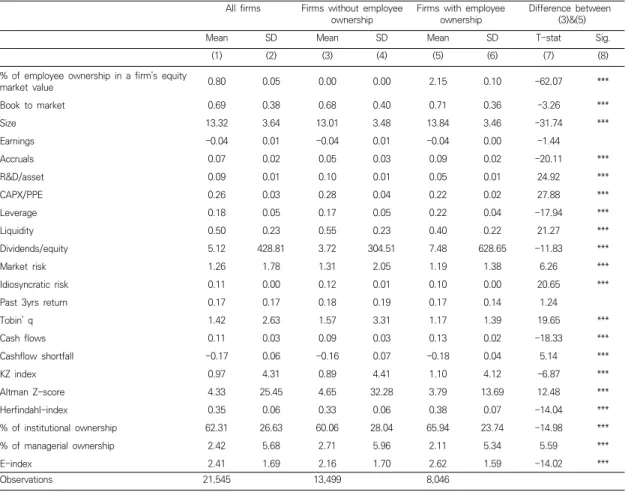
Table 2 reports descriptive statistics of sample

firms. The mean and standard deviation of

variables for firms with employer stock are

reported in the first two columns and those

without employee ownership in the next two

columns. On average, firms with DC holdings

invested in employer stock have a higher

book-to-market than firms without employer

(6)

All firms Firms without employee

ownership Firms with employee

ownership Difference between (3)&(5)

Mean SD Mean SD Mean SD T-stat Sig.

(1) (2) (3) (4) (5) (6) (7) (8)

% of employee ownership in a firm’s equity

market value 0.80 0.05 0.00 0.00 2.15 0.10 -62.07 ***

Book to market 0.69 0.38 0.68 0.40 0.71 0.36 -3.26 ***

Size 13.32 3.64 13.01 3.48 13.84 3.46 -31.74 ***

Earnings -0.04 0.01 -0.04 0.01 -0.04 0.00 -1.44

Accruals 0.07 0.02 0.05 0.03 0.09 0.02 -20.11 ***

R&D/asset 0.09 0.01 0.10 0.01 0.05 0.01 24.92 ***

CAPX/PPE 0.26 0.03 0.28 0.04 0.22 0.02 27.88 ***

Leverage 0.18 0.05 0.17 0.05 0.22 0.04 -17.94 ***

Liquidity 0.50 0.23 0.55 0.23 0.40 0.22 21.27 ***

Dividends/equity 5.12 428.81 3.72 304.51 7.48 628.65 -11.83 ***

Market risk 1.26 1.78 1.31 2.05 1.19 1.38 6.26 ***

Idiosyncratic risk 0.11 0.00 0.12 0.01 0.10 0.00 20.65 ***

Past 3yrs return 0.17 0.17 0.18 0.19 0.17 0.14 1.24

Tobin' q 1.42 2.63 1.57 3.31 1.17 1.39 19.65 ***

Cash flows 0.11 0.03 0.09 0.03 0.13 0.02 -18.33 ***

Cashflow shortfall -0.17 0.06 -0.16 0.07 -0.18 0.04 5.14 ***

KZ index 0.97 4.31 0.89 4.41 1.10 4.12 -6.87 ***

Altman Z-score 4.33 25.45 4.65 32.28 3.79 13.69 12.48 ***

Herfindahl-index 0.35 0.06 0.33 0.06 0.38 0.07 -14.04 ***

% of institutional ownership 62.31 26.63 60.06 28.04 65.94 23.74 -14.98 ***

% of managerial ownership 2.42 5.68 2.71 5.96 2.11 5.34 5.59 ***

E-index 2.41 1.69 2.16 1.70 2.62 1.59 -14.02 ***

Observations 21,545 13,499 8,046

Table 2. Descriptive Statistics

This table compares the mean and standard deviation of variables between firms with and without company stock in DC plans. The sample consists of 21,545 firm-year observations from fiscal year 1999 to 2014. I winsorized all continuous variables at the 1st and 99th percentiles to avoid outliers.

stock. They are also greater in size, higher accruals, and higher leverage and dividend-equity ratio. Conversely, firms without company stock in DC plans have a relatively higher R&D to asset ratio, higher CAPEX/PPE, greater market risk and idiosyncratic risk, a greater past three years return, and a higher Tobin’q. Given the findings in the previous evidence showing that cash constrained firms are more likely to provide employer stock instead of cash[17], we include variables such as cash flow, cash flow shortfall, KZ index, and Altman Z-score. The results are mixed, as firms with company stock have lower cash flow, KZ index, DB funding ratio while firms without company

stock have higher cashflow shortfall and Altman Z-score.

To determine whether there is any difference

in governance proxies between firms with zero

employer stock versus firms with nonzero

employer stock, we compare Herfindahl index, %

of institutional ownership, % of managerial

ownership, and E-index for firms with nonzero

employer stock versus firms without. As we

expect that firms with company stock have worse

governance than firms without, the former has a

higher Herfindahl-index (lower industry

competition), higher E-index, lower institutional

ownership. Further, we show that firms with

employee ownership have lower managerial

(7)

(1) (2) (3) (4)

% of employee ownership t-1 -0.0310*** -0.0294*** -0.0377*** -0.0259***

(0.0062) (0.0063) (0.0073) (0.0070)

PPA dummy 0.0261 -0.0247 -0.0700 -0.5350***

(0.0620) (0.0616) (0.0670) (0.0839)

% of employee ownership t-1* 0.0250*** 0.0242*** 0.0304*** 0.0166*

PPA dummy (0.0086) (0.0087) (0.0093) (0.0096)

Cashflows 1.3939*** 1.3442*** 3.0734*** 2.9500***

(0.2128) (0.2122) (0.2910) (0.3360)

Logged asset -0.0172 -0.0520*** -0.0899*** -0.0493**

(0.0123) (0.0141) (0.0161) (0.0197)

Dividends/equity 0.0058*** 0.0069*** 0.0061*** 0.0068***

(0.0009) (0.0009) (0.0008) (0.0011)

CAPX/PPE 1.6182*** 1.5517*** 1.3885*** 1.7640***

(0.1041) (0.1056) (0.1368) (0.1849)

Market risk 0.0640*** 0.0610*** 0.0450*** 0.0603***

(0.0081) (0.0081) (0.0107) (0.0126)

Idiosyncratic risk -0.5182** -0.3745* -0.5995** -0.2755

(0.2136) (0.2101) (0.2955) (0.3599)

Herfindahl-index -0.2297***

(0.0709)

% of institutional ownership 0.0039***

(0.0007)

% of managerial ownership -0.0004***

(0.0001)

E-index -0.0374**

(0.0155)

Constant 1.3509*** 1.2757*** 2.0782*** 1.2652***

(0.1147) (0.1094) (0.1987) (0.2484)

Observations 16752 16752 11075 6386

Adjusted R-squared 0.2509 0.2550 0.3304 0.3420

Table 3. Tobin’s Q

This table reports OLS regressions of Tobin’s q on company stock in DC plans, ownership, corporate governance, and control variables. The dependent variable (Tobin’s q) is measured as the ratio of the firm’s market value to total assets, where market value is the total number of shares outstanding times the closing price at the end of the previous year. All other variables are defined in Table AI in the Appendix. Fama-French 12 industry fixed effects are included but not reported. Standard errors are clustered by industry in parentheses. All continuous variables are winsorized at the 1

st

and 99

th

percentiles except the E-index. ***, **, * indicate significance at the 0.01, 0.05, and 0.10 levels, respectively.

ownership than firms without employee ownership This is consistent with the argument that employee ownership can be used as a substitute for insider ownership[4].

4. Empirical results

As previously mentioned, we posit that managerial control motive leads firms to offer their own stock through DC plans. If the motive of offering employee ownership is related to managerial entrenchment, the managers in these firms are more likely pursuing their private

benefits rather than value maximization for their shareholders. If this is the case, we would expect that firms with higher employee ownership have lower operating performance than firms with zero employee ownership.

To test this, we explore whether or not firms

with higher employer stock in DC plans have

lower Tobin’ q compared to firms with no or

lower company stock in DC plans. We also

explore the relation between employer stock in

DC plans and operating performance has

changed due to the Pension Protection Act of

2006. If PPA 2006 has an impact on mangers less

likely to offer employee ownership, we would

(8)

observe different effects of employee ownership on operating performance before PPA and after.

Table 3 presents the regression results estimated from Equation (1). The dependent variable is Tobin’q, while the independent variables are the lagged value of employee ownership, the dummy of PPA to indicate Pension Protection Act of 2006, and the interaction term between the lagged value of employee ownership and Pension Protection Act of 2006. Considering that the interaction term captures whether there are changes in Tobin’q after PPA, we posit that would become positively significant if the Pension Protection Act of 2006 has an impact on managers that offer company stock in DC plans.

Based on previous literature, we include cashflows, logged value of asset, R&D to assets, dividend to equity, CAPEX to PPE, market risk, and idiosyncratic risk as control variables. Given that we infer the main motivation of providing employee ownership is managerial entrenchment, we also include governance proxies as control variables. Those are Herfindale index, institutional ownership, managerial ownership, and E-index.

As the results of Table 3 indicate, lagged employee ownership is significantly negative whereas the interaction term of lagged employee ownership with PPA dummy is positively significant in all specifications. Given the fact that PPA dummy itself is sometimes marginally significant at most, the positive coefficient of the interaction term between lagged employee ownership and PPA dummy indicates that company stock in DC plans increase Tobin’q after the adoption of the Pension Protection Act of 2006.

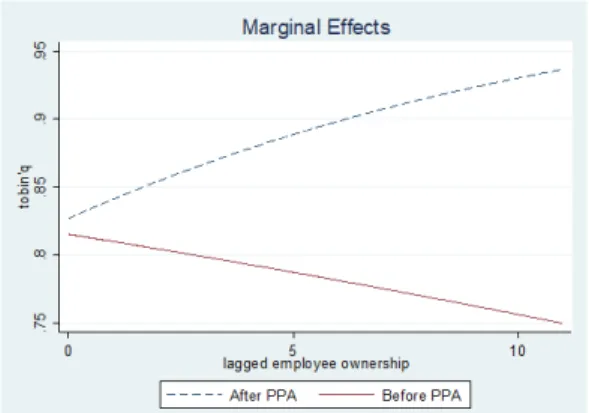
Fig. 1. Marginal Effects of Employee Ownership on Tobin’q

To confirm this result, we present the marginal effects of Tobin’q on lagged employee ownership in Fig. 1. Tobin’q declines as lagged employee ownership increases before PPA 2006, while Tobin’q increases after PPA 2006. For example, Tobin’q rises from about 89 % to about 93% as lagged employee ownership increases from 5% to 10%. Conversely, Tobin’q decreases from about 79% to about 74% as lagged employee ownership increases from 5% to 10%. These results suggest that the negative effects of employee ownership on firms’ operating performance have been mitigated after the adoption of PPA 2006.

5. Conclusion

We explore the effect of the PPA 2006 on the

relation between employee ownership through

defined contribution plans and firm

performance. By doing so, our research makes

contribution to extant research by investigating

whether the enactment of the PPA 2006 has been

effective to decrease the cost of managerial

entrenchment stemming from holding company

stock through DC plans. The PPA 2006 includes

a number of important changes for the

diversification of DC plan assets as well as many

provisions applied to DB plans. We find that the

negative relation between the employee

(9)

ownership and the firm performance is mitigated after the adoption of the PPA 2006. In particular, we show that firms with large employee ownership increase their Tobin’s Q after the adoption of the PPA 2006. We interpret this evidence as the cost of managerial entrenchment since firm managers with the support of employee ownership is isolated from market disciplines like hostile takeovers and shareholder activism in the pre-adoption period of the Act.

In addition, our results suggest that the enactment of the PPA 2006 has been very effective to make DC plan assets diversified and decrease the cost of weak corporate governance stemming from the employee ownership. Given the fact that we test the effects of the diversification rule on employee ownership using firm performance, further research could aim to examine the effects of the rule on employee ownership using stock return or market reaction.

The limitation of this paper is that our results could be affected by endogeneity issues.

Therefore, further robustness check and tests for alternative explanation would help to increase plausibility of the interpretation of results and reduce endogeneity concerns.

The results of this study provide valuable insight to policymakers in korea. Although company stock is not allowed as an investment product under the Employee Retirement Security Act, the proportion of DC plans in the total retirement pension assets has been gradually increasing. In order to prevent the management from sacrificing worker’s retirement assets while using employee stock ownership for managerial entrenchment purpose, the fiduciary duty for trustees should be reinforced by law.

REFERENCES

[1] M. J. Brennan & W. N. Torous. (1999). Individual decision making and investor welfare. Economic

Notes , 28(2), 119-143. DOI: 10.1111/1468-0300.00007 [2] L. Meulbroek. (2005). Company stock in pension

plans: How costly is it?. The Journal of Law and Economics, 48(2), 443-474.

[3] J. Douglass, O. Wu. & W. Ziemba. (2016). Stock ownership decisions in defined contribution pension plans. World Scientific Book Chapters, 47-63.

[4] J. D. Rauh. (2006). Own company stock in defined contribution pension plans: A takeover defense?.

Journal of Financial Economics , 81(2), 379-410.

DOI: 10.1016/j.jfineco.2005.07.004

[5] H. Park. (2017). Company stock in defined contribution plans: Evidence from proxy voting.

Financial Management, 46(1), 155-202.

DOI: 10.1111/fima.12147

[6] M. C. Jensen. (1986). Agency costs of free cash flow, corporate finance, and takeovers. The American economic review , 76(2), 323-329.

[7] M. Bertrand, & S. Mullainathan. (2003). Enjoying the quiet life? Corporate governance and managerial preferences. Journal of political Economy, 111(5), 1043-1075. DOI: 10.1093/wber/lhg014

[8] M. J. Brennan & W. N. Torous. (1999). Individual decision making and investor welfare. Economic Notes, 28(2), 119-143.

DOI: /10.1111/1468-0300.00007

[9] J. M. Poterba. (2003). Employer stock and 401 (k) plans. American Economic Review , 93(2), 398-404.

DOI: 10.1257/000282803321947416

[10] L. K. Meulbroek. (2002). Company stock in pension plans: how costly is it?. Harvard Business School Working Paper No. 02-058; AFA 2003 Washington, DC Meetings.

[11] S. Holden & J. VanDerhei. (2003). 401 (k) plan asset allocation, account balances, and loan activity in 2002.

EBRI Issue Brief, (261).

[12] J. R. Brown., N. Liang., & S. Weisbenner. (2006). 401 (k) matching contributions in company stock: costs and benefits for firms and workers. Journal of Public Economics, 90(6-7), 1315-1346.

DOI: 10.1016/j.jpubeco.2005.05.007

[13] D. Kruse. (2002). Research evidence on prevalence and effects of employee ownership. Journal of Employee Ownership Law and Finance, 14(4), 65-90.

[14] S. Chang & D. Mayers. (1992). Managerial vote ownership and shareholder wealth: Evidence from employee stock ownership plans. Journal of Financial Economics , 32(1), 103-131.

DOI: 10.1016/0304-405X(92)90027-U

[15] S. Chaplinsky & G. Niehaus. (1994). The role of ESOPs in takeover contests. The journal of finance , 49(4), 1451-1470.

DOI:10.1111/j.1540-6261.1994.tb02461.x

(10)

[16] A. Beatty. (1995). The cash flow and informational effects of employee stock ownership plans. Journal of financial economics , 38(2), 211-240.

DOI: 10.1016/0304-405X(94)00812-F

[17] P. Bova, K. Kolev, .JK. Thomas & X. F. Zhang. (2015).

Non-executive employee ownership and corporate risk. The Accounting Review , 90(1), 115-145.

DOI: 10.2308/accr-50860

[18] G. V. Engelhardt. (2011). The Pension Protection Act of 2006 and diversification of employer stock in defined contribution plans. Available at SSRN 2316945.

박 희 진(Heejin Park) [정회원]

․ 2002년 8월 : 이화여자대학교 경영학 과(경영학사)

․ 2008년 8월 : 펜실베니아 주립대학교 응용통계학과(통계석사)

․ 2014년 6월 : 오레곤주립대학교 경영 학과 (재무박사)

․ 2019년 3월 ~ 현재 : 부산대학교 경영 대학 조교수

․ 관심분야 : 기업재무, 기업거버넌스, 연금

․ E-Mail : [email protected]

수치

Table  1.  Employer  stock  in  DC  Plans  by  Year
Table  2.  Descriptive  Statistics
Table  3  presents  the  regression  results  estimated  from  Equation  (1).  The  dependent  variable  is  Tobin’q,  while  the  independent  variables  are  the  lagged  value  of  employee  ownership,  the  dummy  of  PPA  to  indicate  Pension  Protec

참조

관련 문서