Vol. 12, No. 2, p. 151 − 157, June 2008 DOI 10.1007/s12303-008-0016-7
Arsenic reduction and precipitation by shewanella sp.: Batch and column tests
ABSTRACT: The effect of bio-geochemical processes on specia- tion, fate, and transport of arsenic was investigated through the laboratory tests. Shewanella sp., iron-reducing bacteria, was used for batch and column tests. In contrast to the control batch test, the bio-active batch test indicated that Shewanella sp. reduced As(V) to As(III) with concurrent oxidation of lactate to acetate and the decrease of Eh. As time went, a significant amount of the pre- cipitates were formed, and the removal of arsenic species from the solution was attributed to precipitates. SEM-EDX and chemical analyses of the precipitates suggested that As(III) and As(V) were precipitated with sulfides. The reduction and subsequent precipi- tation of arsenic species were also observed in the column tests.
The batch and column tests suggest that in natural groundwater system, Shewanella sp. participates in the reduction of As(V) and sulfate, and sulfides produced by the microbial activity precipitate As(V) and As(III).
Despite its low crust abundance (0.0001%), arsenic is widely distributed in nature and is commonly associated with the ores of metals like copper, lead, and gold (Orem- land and Stoltz, 2003). Arsenic occurs as four oxidation states (-3, 0, +3, and +5), but it mostly exists in inorganic forms as oxyanions of arsenite, As(III) or arsenate, As(V) in natural water (Adriano, 2001). In general, inorganic forms of arsenic are more toxic than the organic forms. The inor- ganic forms of As(V) and As(III) have different sorption properties and different toxicity levels (Anderson and Bru- land, 1991; Bowell, 1994). As(III) is always more toxic than As(V) (Matschullat, 2000). The predominant form of inorganic arsenic is As(V) (H 2 AsO 4- and HAsO 42- ) under oxidizing conditions and As(III) (H 3 AsO 30 and H 2 AsO 3- ) is more prevalent under reducing conditions (Oremland and Stoltz, 2003). Arsenic speciation in natural water is highly dependent on redox potential (hereafter Eh) and pH vales (Smedley and Kinniburgh, 2002).
Physical, chemical, and biological factors affect arsenic speciation and transport in natural water system. As sorp-
tion affects the mobility of arsenic in ground water systems, several controlled laboratory studies have been conducted to understand the sorption of arsenic species on various types of soil minerals. These studies have reported that As(III) is primarily adsorbed onto sulfide minerals and metal oxides/oxyhydroxides (Dzombak and Morel, 1990;
Huera-Diaz and Morse, 1992; Bostick and Fendorf, 2003).
It was reported that microorganism mobilized arsenic by reducing absorbed As(V) (Zobrist et al., 2000). Islam et al.
(2004) also indicated that arsenic adsorbed onto sediment surfaces could be mobilized into groundwater by anaerobic respiration of Fe(III) reducing bacteria. In another study, Newman et al. (1997) reported that As(V) reducing bacteria, Desulfotomaculum auripigmentum, could simultaneously reduce As(V) and SO 4 , and the H 2 S produced by the met- abolic activity could precipitate the reduced As(III).
Haque and Johannesson (2006) investigated the evolution of arsenic species along groundwater flow path over 100 km in Florida, USA. This study revealed that As(V) was the dominant species near the recharge area and the concentra- tion of As(III) progressively increased along the flow path, where redox conditions changed from oxic to anoxic con- ditions. At further down-gradient, where sulfide concentra- tions produced by microbially-mediated SO 4 reduction were considerably high, the reduced arsenic was removed from groundwater. The field data showed that microbial oxidation of organic matter, reductive dissolution of Fe(III) oxides/oxyhydroxides, and SO 4 reduction and pyrite pre- cipitation reactions influenced the evolution of arsenic con- centration and speciation along the flow path.
The above mentioned studies suggest that the effect of microorganisms on the speciation and mobility of arsenic in natural groundwater system is extensive. In this study, since arsenic has a strong geochemical association with iron, Shewanella sp., a facultative and versatile iron-reducing bacterium (Tiedje, 2002; Lee, 2007), was used to investi- gate its effect on arsenic speciation and subsequent trans- port in static and flow conditions through batch and column tests.
Mi-Sun Lim In Wook Yeo*
Yul Roh Kang-Kun Lee Myung Chae Jung
} Korea Eco-Products Institute, Seoul, Korea
Department of Earth and Environmental Sciences, Chonnam National University, Gwangju 500-757, Korea School of Earth and Environmental Sciences, Seoul National University, Seoul 151-747, Korea Department of Earth and Environmental Sciences, Sejong University, Seoul 143-747, Korea
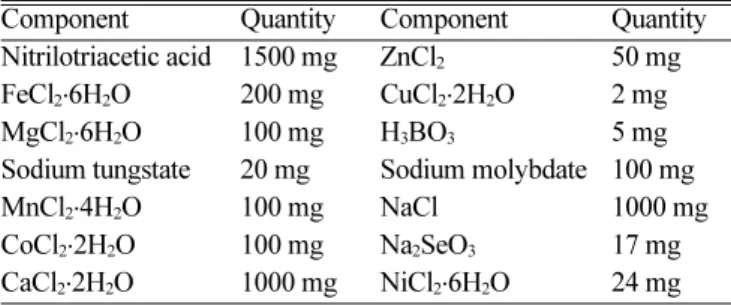
A facultative mixed culture that included Fe(III)-reducing bacteria, mainly Shewanella sp., was used to inoculate the column (Lee, 2007). Shewanella sp. is a rod-shaped, fac- ultative and versatile anaerobe that grows well either aer- obically in the presence of oxygen or anaerobically coupled with the reduction of various metals including Fe(III), Co(III), and Mn(IV) (Tiedje, 2002). Shewanella sp. is capa- ble of anaerobic growth using lactate as an electron donor and As(V) as an electron acceptor (Zobrist et al., 2000). The microbial culture was isolated from the inter-tidal flat sed- iments in Muan, Korea. Shewanella sp. grew in 100 mL basal culture medium (Table 1), supplemented with 10 mM lactate as an electron donor and 10 mM Fe(III) as an elec- tron acceptor. Trace elements and vitamins were added to basal culture medium and their detailed components are described in Tables 2 and 3.
Basal culture medium to facilitate microbial growth was adjusted to have a pH value of 7.5~8.0. The medium was
boiled on a hot plate under a stream of N 2 gas to remove dissolved oxygen (hereafter DO), and was cooled to room temperature. The boiling method effectively removed dis- solved oxygen and dropped DO around 1.0 mg/L. The basal culture medium was dispensed into 500-mL and 155-mL serum bottles for batch tests and cultivations of bacteria under a stream of N 2 gas, respectively.
2.2. Batch Test
In the batch test, the bottles with the growth medium were sealed with butyl rubber stopper and aluminum caps to keep an anaerobic condition. Then, the bottles were ster- ilized at 120 °C and 16 psi for about 20 minutes. Biologi- cally active batch tests were first conducted to evaluate arsenic biotransformation. The batch tests were initiated with the addition of 10 mM of lactate, 0.01 mM of As(V) and 5 mL of cell suspension, prepared with Shewanella sp.
as described in section 2.1, to 400 mL of basal medium under a headspace of N 2 gas. After this initiation process, DO concentration and Eh of the basal medium for the con- trol and microbial batch tests were 1.0 mg/L and 71.3 mV, and the initial concentrations of As(V) and As(III) of the medium were measured as 492.7 µg/L and 117.2 µg/L, respectively, where the occurrence of As(III) will be explained in the next section. Batch tests were performed in duplicates under a strict anaerobic condition at 25 degrees centigrade without shaking. Batch control tests were also conducted without bacteria to quantify the abiotic losses in the system.
2.3. Column Test
The schematic diagram of the experimental setup used for column tests is shown in Figure 1. As shown in the figure, the circular column consists of a feed jar, a feed pump (pis- ton pump), an inlet, an outlet, and five sampling ports. The Table 1. Components of basal medium (per liter of deionized water)
Component Quantity Component Quantity
NaHCO 3 2.5 g NaCl 10.0 g
CaCl 2 0.06 g HEPES † 7.2 g
Na 2 HPO 4 0.008 g Yeast extract 0.5 g NH 4 Cl 1.0 g Trace element solution ‡ 10.0 mL MgCl 2 ⋅6H 2 O 0.2 g Vitamin solution § 1.0 mL
CoCl 2 ⋅2H 2 O 100 mg Na 2 SeO 3 17 mg CaCl 2 ⋅2H 2 O 1000 mg NiCl 2 ⋅6H 2 O 24 mg
Table 3. Components of vitamin solution (per liter of deionized water)
Component Quantity Component Quantity
Biotin 0.02 g Nicotinic acid 0.05 g
Folic acid 0.02 g Pantothenic acid 0.05 g Pyridoxine 0.1 g Cyanobalamine 0.001 g Thiamine 0.05 g P-aminobenzoic acid 0.05 g
Riboflavin 0.05 g Lipoic acid 0.05 g Fig. 1. Schematic diagram of an experimental setup of column
system.
(3)
length of the column is 100 cm and the diameter of the col- umn is 10 cm. The column was fitted with a pair of pie- zometers to measure the overall head loss through the system. The column was packed with synthetic silica beads of diameters ranging from 0.18 to 0.25 mm. As(V) and As(III) have distinct adsorption properties when interacting with natural soil minerals; this would considerably compli- cate the analysis of the microbial reduction of As(V) to As(III) in soil-water systems. Synthetic silica beads as the porous medium were used to avoid the complexities due to differential sorption. Hydrodynamic properties of the porous medium were determined by flow and tracer tests.
Flow tests conducted at various constant flow rates gave the hydraulic conductivity of 150 cm/hour. The column was initially saturated with distilled water. For a tracer test, bro- mide (Br - ) and arsenic were added to the solution prepared by the boiling method. The tracer test was conducted by continuously injecting bromide (Br - ) and arsenic solution into the column not inoculated with bacteria.
As a second phase, biologically active, column-scale transport experiments were completed to investigate arsenic transformation and its subsequent reactive transport. To inoculate the column, about 10 ml of lactate solution (0.5 M) and 6 mL of cell suspension were injected into sterilized column via each sampling port and the influent port; the column was left alone for 24 hours to facilitate microbial adaptation to column surroundings and remove the dis- solved oxygen in the column. The influent solution was prepared by adding 10.0 mM of lactate and 0.01 mM of As(V) to the basal medium. DO concentration and Eh of the influent solution were 0.63 mg/L and 15 mV, and the initial concentrations of As(V) and As(III) were measured as 271.44 µg/L and 450 µg/L, respectively, where the occurrence of As(III) will be explained in the next section.
The prepared solution was injected at a rate of 1.0 mL/min through the column. Laboratory temperature was main- tained at 25 degrees centigrade to facilitate microbial growth.
Water samples were taken at 60 cm from the inlet (i.e., sam- pling port C in Fig. 1).
2.4. Sampling and Analysis
Samples were withdrawn from sampling ports of the col- umn or from the serum bottles using 5 ml plastic syringe fitted with 23G 1 1/2 needle. The samples were filtered (0.2 µm), and analyzed for redox potential(Eh), dissolved oxygen(DO), pH, total As, As(III), lactate, and acetate. Fil- tering the samples helps remove most of the colloidal mate- rial and microorganisms that can affect the dissolved As(III/
V) ratio. The values of Eh, DO, and pH were determined at room temperature in an anoxic environment using Orion model 9678BN platinum redox electrodes, 083010F DO probe and 9107BN pH electrode, respectively. The mea- surement of total arsenic and As(III) was performed by
hydride generation atomic absorption spectrometry (Perkin Elmer-5100). The separation of As(III) from the total arsenic was performed with solid-phase extraction cartridge (Supelco, 3 mL LC-SAX). Solid-phase extraction cartridge separates As (V) from samples by retaining As(V) and allow- ing As(III) to pass through the cartridge. The measurement of lactate and acetate was performed by high-performance liquid chromatography (HPLC). Scanning electron micros- copy with energy dispersive X-ray (SEM-EDX) analysis was used to examine the morphology and chemistry of the precipitates.
3. RESULTS
3.1. Abiotic Reduction of Arsenic by Boiling Method As(V) can be also reduced to As(III) by abiotic process.
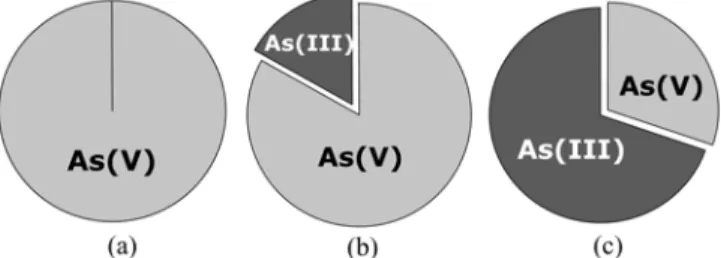
The effect of boiling method, adopted for the removal of DO from the solution, on the abiotic reduction of As(V) to As(III) was evaluated. The chemical analysis of the boiled basal medium showed that the boiling method resulted in the reduction of As(V) to As(III) (Fig. 2). The longer the basal culture medium was boiled, the more DO and Eh val- ues were decreased. However, Eh did not drop Eh below 0.0 mV. As DO concentration and Eh became lower, more As(V) in the aqueous phase was rapidly reduced to As(III) (Fig. 2). This abiotic reduction of As(V) to As(III) could be due to the depletion of DO and the drop of Eh. As the amount of the transformation of As(V) to As(III) depends on DO and Eh values of the basal medium, the initial con- centrations of As(V) and As(III) were different between the batch and column tests. This result agrees with a previous research indicating that the depletion of DO leads to the reduction of As(V) to As(III) and the stoichiometry can be written as follows (McNeill et al., 2002):
←
+ O 2 (1)
O
2
≈0
The experimental result suggests that the boiling of drink- ing water for the purpose of disinfection has an adverse effect on human health due to the transformation of As(V) to more toxic As(III).
2AsO 43- 2AsO 43-
Fig. 2. Arsenic speciation by the boiling method. (a) 100 % of
As(V) at Eh of 234 mV and DO of 8.34 mg/L; (b) 83 % of As(V)
and 17 % of As(III) at Eh of 75 mV and DO of 1.0 mg/L; (c) 38 %
of As(V) and 62 % of As(III) at Eh of 15 mV and DO of 0.63 mg/L.
(4)
3.2. Batch Test
Figure 3 shows the comparison of As(III), acetate (byprod- uct of lactate), and Eh value between the control and micro- bial batch tests. Controls without Shewanella sp. did not show any appreciable changes in lactate, As(V) levels, and Eh values during the course of the tests, even though As(III) concentration steadily increased with time due to the abiotic transformation caused by the reduced DO and Eh values in the medium. However, the more reduced As(III), increase of acetate, and a sharp drop of Eh indicated that active microbial metabolism occurred in the microbial batch tests.
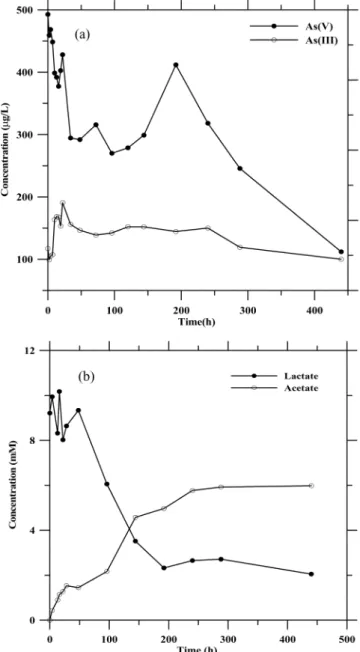
In the bio-active reactors, Shewanella sp. reduced dis- solved As(V) to As(III) within 28 hours with concurrent
Fig. 3. Variations of concentration of (a) As(III), (b) acetate, and (c) Eh in the control and bio-active batch tests. Data shown in the figure are the average of two separate batch experiments.
Fig. 4. Variations of concentration of arsenic species, lactate, and
acetate in the batch test inoculated with Shewanella sp. Data shown
in the figure are the average of two separate batch experiments.
(5)
oxidation of lactate to acetate (Fig. 4). Lactate concentration levels decreased from 10 to 3 mM (Fig. 4b) and As(V) decreased from ~0.5 to 0.28 mg/L (Fig. 4a) due to micro- bial respiration within 200 hours. In addition to lactate oxi- dation as an electron donor for As(V) reduction, Shewanella sp. may use lactate for reduction of dissolved oxygen in the medium. Eh also declined from +71.3 mV to -207.3 mV (Fig. 3c). The bacteria, Shewanella sp. used in this exper- iment, can begin to reach the death phase within 50 hours (Lee, 2007). In addition to Shewanella sp, other bacteria may use lactate for their respiration during the experiments because microcosm used in this study mainly contains Shewanella sp. Although the decrease of lactate concentra- tion stopped within 200 hours, the value of As(III) slightly increased beyond 200 hours and this may be attributed to changes in thermodynamic conditions (reducing condition, low Eh) generated by the microbial respiration process.
Several specific details of the underlying biological As(V) reduction processes remain unanswered, but from an elec- trochemical viewpoint the bacteria alter the local Eh and pH conditions that in turn, shift thermodynamic conditions, which can facilitate arsenic reduction.
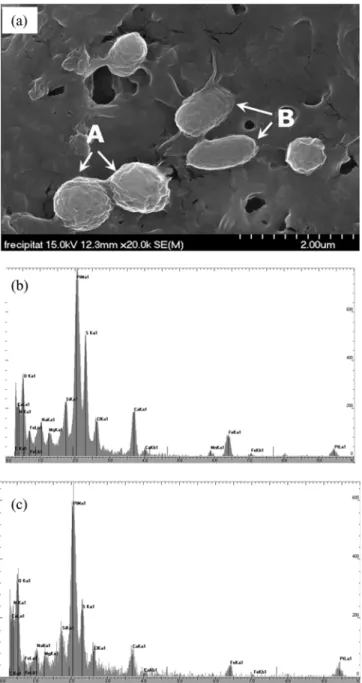
In the microbial batch tests, a significant amount of black precipitates were formed after 13 days. SEM-EDX analysis of the precipitates formed during the experiments showed that bacteria formed ~1 µm-sized ball shaped precipitates that mainly consisted of iron, calcium and sulfur (Fig. 5).
The chemistry of the precipitate indicates that reduced arsenic may be precipitated as arsenic sulfide. The precip- itates formed during the experiments were separated from the media by using 0.2 µm filter after centrifugation. Parts of the precipitates were dissolved with 4.5 mL of 1M HCl to extract As and diluted with 4.5 mL of deionized water.
The contents of total arsenic, As(III), and As(V) in precipitates were 38.5 mg/kg, 18.1 mg/kg, and 20.4 mg/kg, respectively.
It may photolytically oxidize As(III) in the precipitates dur- ing the dissolution of the precipitate using HCl for quanti- fying arsenic in the precipitates. Lee (2007) showed that sulfate could be reduced by Shewanella sp. and reduced sul- fides could be subsequently precipitated. It could be thought that as the condition became more reducing (as shown in Fig. 3c), Shewanella sp. reduced sulfate, whose sulfur orig- inated from HEPES of the basal medium, and then arsenic species was precipitated with sulfides. The decrease of As(V) was caused by both microbial reduction and precip- itation. As(III) increased at early times due to microbial reduction of As(V), but was removed from the solution by precipitation at later times.
3.3. Column Test
Table 4 shows the normalized concentrations of Br - , As(III) and As(V) in both control and microbial column tests.
Tracer test using a conservative bromide (Br - ) solution was conducted to evaluate the transport of arsenic species. For tracer test, as described in the above section, the basal Fig. 5. (a) Scanning electron micrographs; and (b-c) energy dis- persive X-ray analysis of precipitates A and B shown in (a).
Table 4. Normalized concentrations of bromide, As(III), and As(V) in both control and microbial column tests
Time (hour) Tracer test Control column test Microbial column test
medium with Br - , As(III) and As(V) was prepared for tracer and control column tests, and was injected through the col- umn packed with synthetic silica beads saturated with dis- tilled water, where DO and Eh values of the basal medium were lower than distilled water. In the control column test, at 30.5 hour when the influent basal solution was displacing and being mixed with the distilled water, As(III) in the influent solution was oxidized to As(V) due to more oxi- dizing condition of distilled water, resulting in the higher C/C 0 of As(V) and the lower C/C 0 of As(III) than C/C 0 of Br - . This indicates that when groundwater in reducing con- dition meets a fresh water with a plenty of DO, As(III) can be oxidized to As(V). However, for bio-active column test, the porous medium was inoculated with Shewanella sp., and kept for one day. When the influent basal solution was injected, the porous medium was in a reducing condition due to microbial activity. At 30.5 hour in the microbial col- umn, As(V) in the influent solution was reduced to As(III) by active microbial respiration, resulting in the higher C/C 0 of As(III) and the lower C/C 0 of As(V) than C/C 0 of Br - .
In later times (59.5 hours) when the influent solution was replaced with the distilled water initially existing in the col- umn, C/C 0 of As(V) and As(III) became relatively close to 1.0, but in the microbial column, that of As(V) and As(III) were less than 1, which was mainly caused by the microbial reduction of As(V) to As(III) and the subsequent precipi- tation of arsenic species. These results agree well with those of bio-active batch tests.
The variation of As(III) and As(V) concentrations with time are shown in Figure 6(a). The data showed that Eh val- ues declined continuously to -266.8 mV until 34.5 hours;
this indicated that microbial respiration was actively occur- ring in the column test. The breakthrough concentration curves of Figure 6(a) were redrawn using a derivative of normalized arsenic concentration (Fig. 6b). The higher derivative curve of As(III) and its earlier peak than those of As(V) indicated that As(V) was more susceptible to pre- cipitation with or sorption on sulfides than As(III). In par- ticular, the ratio of As(III) to total arsenic, at the time at the highest derivative value of normalized As(III) concentra- tion, increased to 75 % of total arsenic as shown in Figure 6(c). The initial ratio of As(III) to total arsenic was 0.62.
Figure 6(c) indicated that about 13 % of As(V) was reduced to As(III) by microbial reduction in early times.
4. CONCLUSION
Arsenic is strongly associated with iron, and it is needed to study the effect of iron-reducing bacteria on the fate and transport of arsenic species. Therefore, in this study, the reduction, precipitation, and transport of arsenic species by Shewanella sp., a facultative and versatile iron-reducing bacterium, were investigated through batch and column tests.
Distilled water was boiled to remove DO for the basal Fig. 6. Arsenic concentration of the bio-active column test. (a)
variations of As(V) and As(III) concentrations, (b) derivative
curves of normalized arsenic concentrations, and (c) variations of
the ratio of As(III) to total As.
(7)
culture medium, which resulted in the abiotic reduction of As(V) to much more toxic As(III). The boiling of arsenic- rich water for disinfection could be very harmful to health.
Control batch test did not show an appreciable change in As(III), acetate, and precipitates, but for the batch tests inoculated with Shewanella sp., microbial reduction of As(V) to As(III) occurred with concurrent oxidation of lac- tate to acetate and the decrease of Eh. In later times, a sig- nificant amount of precipitates were formed, and precipitates caused the removal of arsenic species from the solution.
SEM-EDX and chemical analyses of the precipitates indi- cated that As(III) and As(V) could be precipitated with sul- fides. It was assumed that Shewanella sp. reduced As(V) to As(III) and as the condition of solution became more reduc- ing, Shewanella sp. reduced sulfate, which resulted in the precipitation of arsenic precipitation with sulfides. As(V) was subject to both microbial reduction and precipitation.
As(III) increased at early times due to microbial reduction of As(V), but was removed from the solution by precipi- tation at later times.
Compared with the normalized concentrations of Br - , As(V), and As(III) in control column test, those of As(III) and As(V) in bio-active column test indicated that the reduction of As(V) to As(III) and the subsequent precipi- tation of As(III) and As(V) occurred. The breakthrough concentration curves and their normalized derivative curves, obtained from the transport test of As(III) and As(V) through inoculated column, suggested that As(V) was reduced to As(III) and could be more susceptible to precipitation with or sorption on sulfides than As(III). The batch and column tests suggests that in natural groundwater system, Shewanella sp. participates in the reduction of As(V) and sulfate, and sulfides produced by the microbial activity precipitate As(V) and As(III).
ACKNOWLEDGMENTS: This study was financially supported by the research grant from the Korean Institute of Environmental Science and Technology (KIEST) (grant No. 20050000000000-50-0-004-0-0-2005).
REFERENCES
Adriano, D. C., 2001, Trace elements in terrestrial environments: bio- geochemistry, bioavailability, and risks of metals. Springer.
Anderson, L.A. and Bruland, K.W., 1991, Biogeochemistry of arsenic in natural waters: the importance of methylated species. Envi- ronment Science Technology, 25, 420 −427.
Bostick, B. C. and Fendorf, S., 2003, Arsenite sorption on troilite (FeS) and pyrite (FeS 2 ). Geochimica Et Cosmochimica Acta, 67, 909 −921.
Bowell, R.J., 1994, Sorption of arsenic by iron oxides and oxyhy- roxides in soils. Applied Geochemistry, 9, 279 −286.
Dzombak, D.A. and Morel, F.M.M, 1990, Surface complexation modeling: hydrous ferric oxide. Wiley, New York.
Haque, S.E. and Johannesson, K.H., 2006, Concentrations and spe- ciation of arsenic along a groundwater flow-path in the Upper Floridan aquifer, Florida, USA. Environment Geology, 50, 219 − 228.
Huerta-Diaz, M.A. and Morse, J.W., 1992, Pyritization of trace met- als in anoxic marine sediments. Geochim. Cosmochim. Acta., 56, 2681 −2702.
Islam, F., Gault, A., Boothman, C., Polya, D., Charnock, J., Chat- terjee, D. and Lyond, J., 2004, Role of metal-reducing bacteria in arsenic release from Bengal delta sediments. Nature, 430, 68 −71.
Lee, J.-H., 2007, Environmental and Biogeochemical Significances of Metals Biotransformation by Shewanella sp. HN-41. Ph.D.
thesis, Gwanju Institute of Science and Technology, Korea, 177p.
Matschullat, J., 2000, Arsenic in the geosphere - a review. Science Total Environment, 249, 297 −312.
McNeill, L.S., Chen, H.-W. and Edwards, M., 2002, Aspects of Arsenic Chemistry in Relation to Occurrence, Health, and Treat- ment, Environmental Chemistry of Arsenic, Marcel Dekker, Inc., pp. 141 −153.
Newman, D.K., Beveridge, T.J. and Morel, F.M.M., 1997, Precipi- tation of Arsenic Trisulfide by Desulfotomaculum auripigmen- tum. Applied and Environmental Microbiology, 63(5), 2022−2028.
Oremland, R.S. and Stolz, J.F., 2003, The Ecology of Arsenic. SCI- ENCE, 300(9), 939 −944.
Smedley, P.L. and Kinniburgh, D.G. (2002) A review of the source, behaviour and distribution of arsenic in natural waters, Applied Geochemistry, 17, 517 −568.
Zobrist, J., Dowdle, P.R., Davis, J.A. and Oremland, R.S., 2000, Mobilization of arsenite by dissimilatory reduction of adsorbed arsenate. Environment Science Technology, 34, 4747 −4753.