JDCS Vol. 18, No. 8, pp. 1481-1487, Dec. 2017
공감을 위한 VR 인터랙티브 스토리텔링 연구
배 병 철 · 김 동 균· 서 갑 열 *
홍익대학교 게임학부
A Study of VR Interactive Storytelling for Empathy
Byung-Chull Bae · Dong Gyun Kim · Gapyuel Seo
*School of Games, Hongik University, Sejong 30016, Korea
[요 약]
본 논문은 VR 인터랙티브 스토리텔링 콘텐츠 개발에서 특히 독자 (또는 플레이어)와 스토리 캐릭터간 공감 형성에 목표를 갖 고, 공감 기반 VR 인터랙티브 스토리 개발을 위한 실질적 지침으로 4가지 주요 요소를 다음과 같이 제안한다. 첫째는 서사 요소로 서 서사학자인 제넷의 초점화 (focalization)를 적용한 서사 이론이고, 둘째는 인터랙티브 스토리텔링에서 서사와 플레이어 제어 사 이의 균형을 고려한 양방향성 (interactivity)이며, 셋째는 인간과 컴퓨터의 상호작용에서 고려하는 가상 현실 요소이며, 넷째는 심 리학과 인지과학 측면에서 고려한 공감 (empathy) 요소이다. 본 논문은 또한 전래 동화인 빨간 망토 이야기를 기반으로 한 VR 인터 랙티브 스토리 시나리오를 소개하고, 언리얼 게임 엔진과 HTC Vive를 활용한 VR 구현을 논의한다.
[Abstract]
In this article we describe our preliminary work to create VR interactive storytelling particularly for building empathic relationships between the reader (or the player) and story characters. As a practical guideline for developing empathy-based VR interactive story, we propose four key factors: first, narrativity considering narrative theories and concepts including the notion of focalization by Gerald Genette; second, interactivity for balancing between narrative and player control in interactive storytelling domain; third, consideration of virtual reality in human computer interaction domain; fourth, empathy in narrative from the viewpoint of psychology and cognitive science. We also introduce an example interactive storytelling scenario based on Little Red Riding Hood story. Finally we conclude with our VR implementation using Unreal game engine and HTC Vive.
색인어 :
가상 현실, 공감, 서사, 빨간망토, 인터랙티브 스토리텔링
Key word : Virtual Reality, Empathy, Narrative, Red Riding Hood, Interactive Storytelling
http://dx.doi.org/10.9728/dcs.2017.18.8.1481
This is an Open Access article distributed under the terms of the Creative Commons Attribution Non-CommercialLicense(http://creativecommons .org/licenses/by-nc/3.0/) which permits unrestricted non-commercial use, distribution, and reproduction in any medium, provided the original work is properly cited.
Received 01 December 2017; Revised 18 December 2017 Accepted 25 December 2017
*Corresponding Author; Gapyuel Seo Tel: +82-44-860-2074
E-mail: [email protected]
Ⅰ. Introduction
Narrative includes an effective communication between the author and the reader, where the reader can feel a variety of emotions through the perception of the story that is conceived in the author’s mind. The author’s intention is carefully crafted via both content (that is, story) and its presentation structure/media (that is, narrative discourse) [1].
Among various narrative media, text has traditionally been a preferred medium which now includes digital narrative such as interactive fiction (IF) and interactive storytelling (IS). The reader (or the player) in IF and IS can feel a sense of control over the story progression by exploring different story paths/endings or by interacting with objects in the story while reading (or playing).
These digital narratives have advantages in many ways, and yet have been only partially successful in some particular domains such as indie games (e.g., Queers in love at the end of the world [2]).
On the other hand, VR (Virtual Reality), due to its inherently immersive nature, is rapidly growing as a powerful and promising medium in simulation, training and games, though its current limitations such as physical discomfort (e.g., feeling nausea, uncomfortableness with wearing a head mount display device) and relatively high cost for purchasing additional VR HMD (Head Mount Display). In the virtual reality, controllers are also available with user-friendly and hands-on interactivity. This is to provide a more interactive opportunity for users in the virtual reality environment, thereby making the content more immersive [3]. To our knowledge, however, only a few studies have been conducted on VR storytelling, particularly focusing on empathy in digital narrative and journalism domain [4][5].
In this article we introduce our ongoing effort to develop an interactive digital storytelling, particularly aiming at developing appropriate interactive narrative that can evoke empathy to the reader through VR medium.
Ⅱ. CONSIDERATIONS FOR EMPATHIC INTERACTIVE STORYTELLING IN VR
Designing VR interactive storytelling for empathy requires lots of considerations. We suggest four major guidelines to design our VR interactive storytelling project as follows.
2-1 Narrativity
As key narrative theories, we adopt Genette’s notion of focalization (or perspectives) [1] and employ temporal narrative
devices such as foreshadowing and flashback. Focalization refers to “the focus of narration” and can serve as information filtering to the reader, influencing the reader’s empathic relationship with specific story characters. Similarly, flashback can provide character’s backstory; foreshadowing works as implicit advance mention or explicit advance notice [1] to build the reader’s expectations for upcoming events or overall coherency in retrospect (that is, postdictability [7]).
2-2 Interactivity
In interactive storytelling, users are allowed to influence the story progression and ending, having a feeling of control[8].
Among many features in interactive storytelling, our main concern is to give appropriate player agency without harming the narrativity. As the players in VR can be often distracted by immersive environment, it’s crucial to make balance between player agency and narrativity. In particular, this interactivity feature should be taken into account together with VR and HCI (Human-Computer Interaction) features described below.
2-3 Virtual Reality and Human-Computer Interaction Virtual Reality (VR), compared to other media such as hypertext for interactive fiction or virtual environment for digital interactive narrative, could be an effective medium for building empathic relationship between the player and story characters.
Along with the advantages such as immersion and presence, however, the content designer should consider carefully its adverse effects (e.g., motion sickness, physical fatigue, hygiene, injury, etc.) [9]. Thus, the measurement of usability (including ease of use, safety, ease of learning controller, etc.) and the concept of affordance [10] in Human-Computer Interaction (HCI) is important and needs to be considered as an evaluation.
2-4 Empathy
Empathy is one of key concepts in our research. Although
empathy is an important social emotion in our everyday life, it is
elusive to define precisely [6]. First, researchers often
differentiate emotional empathy (that is, feeling the same
emotions of someone else by mirroring or reflecting her emotions
into one’s mind) from cognitive empathy (i.e., cognitively
understanding someone else’s emotions or feelings by putting
oneself in his or her shoes)[11]. Among diverse distinctions of
affective and cognitive empathy from different researchers, we
adopt Strayer’s distinction - affective empathy as the content and
cognitive empathy as the process of forming empathy [6][12]. In
other words, as our working definitions, affective empathy refers
to the player’s feeling over the situation; cognitive empathy refers
to the cognitive process or reasoning to reach the player’s
affective empathy. Second, empathy can be viewed as either situational (that is, influenced by context) or dispositional (that is, considered as a trait and depending on gender, education, etc.) [6]. In our study we consider both aspects of empathy.
In a different vein, the OCC emotion model [13] defines two types of empathy-relating emotions: (1) happy-for as “feeling pleased when a desirable event occurs to someone else”; (2) sorry-for as “feeling displeased when an undesirable event occurs to someone else”. The OCC emotion model suggests possible parameters regarding these emotions but does not explain any implementation details for developing a computational model of empathy, though there have been lots of studies based on it.
Empathic narrative techniques can include “character identification (e.g., naming, indirect implication of traits, relative flatness or roundness, etc.) and “narrative situation” via perspectives [14]. In particular, identification with story character is one of the key emotions in narrative apprehension [15].
As an evaluation, in addition to the four factors above (see Figure 1), we are considering three types of metrics to measure:
narrative engagement (narrative understanding, attentional focus, emotional engagement, and narrative presence introduced in [16]), VR experience (sickness and presence), HCI (usability and user experience), and empathy (empathy scales for fictional characters such as Sherman-Stoland scale) [14].
Ⅲ. Our Approach
3-1 Story: Little Red Riding Hood
As a base story for our VR storytelling project we chose Little Red Riding Hood. This well-known fairy tale has many different versions so that it can be easily converted to interactive (or branching) story. We chose the texts translated/edited by Dr.
Ashliman [17].
While there could exist a variety of interactive versions of Little Red Riding Hood, we created two different versions consisting of 5 scenes as in Fig.2. In one story Wolf deceives Red and eats up Red and Granny, but Huntsman saves them. In the other story Red deceives Wolf, and then she and Granny outwit Wolf without the help of Huntsman. Originally, these two stories are separate, but we combined them into one interactive story having two different versions. The story’s beginning and ending are similar in both versions.
The base storyline depicted in Figure 2 has foreshadowing as narrative device using the concept of Chekhov’s Gun. In other words, an important object (or person) is introduced early to the reader - Huntsman in one story and sausage in the other story.
This Chekhov’s gun-style foreshadowing can enhance the reader’s (or player’s) overall apprehension of narrative as a whole (that is, postdictability [7]).
We also employ the notion of “multiple internal focalization”
[1][18] at discourse level. In multiple internal focalization, a certain period of story events is repeated by multiple story characters from the perspective of them. Akira Kurosawa’s film Rashomon (1950) is a good example of multiple internal focalization in which different story characters (the thief, the wife, the samurai, and the woodcutter) repeatedly tell the story from their own perspectives [18]. As a result, the audience can be contemplating what would actually happen and what the real truth is. In our VR interactive story, the audience can experience two different versions from different character’s viewpoints (the wolf and the Red).
3-2 VR Implementation
We are currently implementing our VR interactive story using the Unreal game engine and HTC Vive. While Vive provides functions and sensors to recognize and respond to the player’s motions, we did not employ those functions in our current version.
Based on the scenario depicted in Figure 2, we first made a cue sheet where dialogues and other important pieces of information (e.g., sound effects, character emotions and actions, etc.) are displayed. The information in the cue sheet is stored in the JSON format so that our storytelling system can easily access it and execute appropriately through C++ scripts in Unreal.
To prevent the player’s diversion from the original Red Riding Hood story, we put interactivity as least as possible. In our current version, the player can choose two different options when Red and Wolf meet in the second scene (see Figure 2). When the player plays a role of Red, she can choose either telling the right path to the Wolf or deceiving the Wolf by telling the wrong path.
On the other hand, when the player plays the Wolf, he can also Fig. 1. Considering Factors of VR Interactive Storytelling
for Empathy
choose two options - either following the path that Red tell or following the opposite path. In either case, the player can select arrow marks with simple text and the ending is the same - the wolf is dead. In addition, the player can pick up some flowers, stones, and sausages.
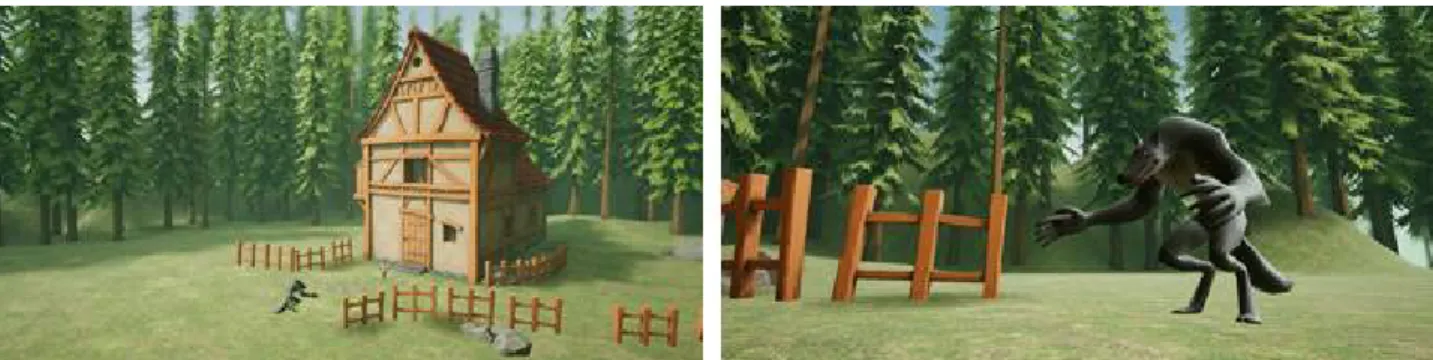
Figure 3 shows some screenshot examples, where the picture in the left depicts a preliminary concept art of Granny’s house in the woods including Wolf and Red. The picture in the right portrays the image of Wolf.
Ⅳ. Discussion
While working on developing a VR interactive story, we have encountered lots of questions besides the four issues specified earlier in Section 2. For example, who will be the target player of our VR interactive story? How much do we need to stick to the original Red Riding Hood story? (For example, in The Path [19]
— a horror game inspired by Red Riding Hood story— players
can choose six different characters who have different personality traits and actions.) How much interactivity will be appropriate for making balance between the player agency and narrativity?
Between text and audio dialogue, which will be better for the player to be immersed in? And so on.
Through quite a few tests and experiments, we have decided to follow the original story as much as possible with the least modification. As target players we are considering all ages from young children to adults who can think about different situations of different characters experiencing the same events. In our VR interactive story, the player can play/experience the situations of two opposing characters - Red and Wolf - in turn. Finally, as for the choice between texts and audio-recorded dialogues, we chose the latter because texts are very often hard to read in the VR environment). In particular, as for the voices of Red, we asked two 10 year-old girls to record the dialogues in English and in Korean, respectively.
Fig. 2. Two possible branching stories of Little Red Riding Hood, based on the texts described in [17]
Ⅴ. Conclusion and Future Work
In this paper we proposed four key considerations to create VR interactive storytelling particularly for empathy, which are narrativity (focusing on focalization), interactivity (balancing between narrativity and agency), HCI in VR, and (cognitive and emotional) empathy. As implementation we are creating two branching interactive stories in VR using Unreal game engine and HTC Vive, based on the well-known Red Riding Hood folk story.
We expect that our study can contribute to the development of empathy as well as the variety of contents in interactive narrative.
As future work we plan to conduct a pilot study to investigate how such factors as focalization, interactivity, and VR medium can have an influence on the player’s empathic relationships with story characters.
Acknowledgement
This research was supported by Basic Science Research Program through the National Research Foundation of Korea (NRF) funded by the Ministry of Science and ICT (2017R1A2B4010499). This work was also supported by 2017 Hongik University Research Fund.
References
[1] G. Genette, Narrative Discourse: An Essay in Method , Cornell University Press, 1980.
[2] Queers in love at the end of the world [Internet]. Available:
http://auntiepixelante.com/endoftheworld
[3] Jiyoung Kang. “Study on Characteristics of Digital Realism Aspect for HMD based Virtual Reality Films,” Journal of Digital Contents Society, Vol.18, No.5, pp. 849-858, 2017.
[4] E. Darnell and M. Hutchinson, “Invasion! Exploring
Empathy and Agency in VR,” in Proceeding of ACM SIGGRAPH 2016 VR Village, New York: NY, USA, 2016.
[5] D. Shin and F. Biocca, (In-press) “Exploring Immersive Experience in Journalism,” New Media and Society. First published online: September 30, 2017.
https://doi.org/10.1177/1461444817733133
[6] B.M.P. Cuff, S.J. Brown, L. Taylor, and D.J. How,
“Empathy: A Review of the Concept,” Emotion Review , Vol. 8, No. 2, pp. 144-153, 2016
[7] W. Kintsch, “Learning from text, levels of comprehension, or: Why anyone would read a story anyway?,” Poetics, Vol.
9, No.1-3, pp. 87–98, 1980.
[8] M. Cavazza and R.M. Young, “Introduction to Interactive Storytelling”, In R. Naktsu, M. Rauterberg, and P.
Ciancarini (eds.), Handbook of Digital Games and Entertainment Technologies, Springer, pp. 377-392, 2016.
[9] J. Jerald, The VR Book: Human-Centered Design for Virtual Reality. Association for Computing Machinery and Morgan
& Claypool, New York, NY, 2016
[10] D. Shin, “The role of affordance in the experience of virtual reality learning: Technological and affective affordances in virtual reality,” Telematics and Informatics, Vol. 34, No. 8, pp. 1826-1836, 2017.
[11] A. Smith, “A Cognitive empathy and emotional empathy in human behavior and evolution,” The Psychological Record Vol. 56, No. 1, pp. 3 – 21, 2006.
[12] J. Strayer, “Affective and cognitive processes in empathy”.
In N. Eisenberg & J. Strayer (Eds.), Empathy and its development. New York, NY: Cambridge University Press.
pp. 218-244, 1987.
[13] A. Ortony, G. Clore, and A. Collins, The cognitive structure of emotions, Cambridge University Press, 1988.
[14] S. Keen, “A theory of narrative empathy,” Narrative, Vol.
14, No. 3, pp. 207–236, 2006.
Fig. 3. Screenshot Examples of Little Red Riding Hood Interactive Story in VR Implementation
[15] K. Oatley, “A taxonomy of the emotions of literary response and a theory of identification in fictional narrative,” Poetics, Vol.23, pp. 53 – 74, 1994.
[16] R. Busselle and H. Bilandzic, “Measuring Narrative Engagement,” Media Psychology, Vol. 12, No. 4, pp. 321–
347, 2009.
[17] Little Red Riding Hood and other tales (translated and/or edited by D.L. Ashiliman) [Internet]. Available:
http://www.pitt.edu/~dash/type0333.html.
[18] B.-C. Bae, Y.-G. Cheong, and R.M. Young, “ Automated story generation with multiple internal focalization,” in Proceedings of the IEEE Computational Intelligence in Games, Seoul, Korea, pp. 211–218, 2011.
[19] The Path by Tale of Tales [Internet]. Available:
http://tale-of-tales.com/ThePath/
Byung-Chull Bae
1993: Korea University (B.S. in Electronics Engineering) 1998: Korea University (M.S. in Electronics Engineering)
2009: North Carolina State University (Ph.D. in Computer Science)
1996~2002: Assistant Research Engineer at LG Electronics
2009~2011: Research Engineer at Samsung Advanced Institute of Technology
2012~2014: Visiting Researcher/Part-time Lecturer at IT University of Copenhagen, Denmark 2014~2015: BK21 Research Professor of Interaction Science Department at Sungkyunkwan University 2015~Present: Assistant Professor of School of Games at Hongik University
※Interest:Interactive Storytelling, Affective Computing, Game AI, HCI Dong-Gyun Kim
2014: Game Software, Hongik University(B.S Degree)
2007~2014: Game Software, Hongik University
2016~now: Graduate School of Game, Hongik University
※ Research Interests: HCI(Human Computer Interaction), Affective Computing, Biometrics Analysis Gapyuel Seo
1998 : Pratt Institute (B.F.A Degree)
2009 : Savannah College of Art and Design (M.A. Degree)
1999~2010: Activision Blizzard, Senior Artist
2010~2012: Department of Digital Arts, Springfield College, Assistant Professor 2012~now: Department of Games, Hongik University, Assistant Professor
※ Research Interests:: Game Graphics, Game Design, Game Storytelling.