• 검색 결과가 없습니다.

Review of Energy Saving Technology of Hybrid Construction Machine

N/A
N/A
Protected

Academic year: 2021

Share "Review of Energy Saving Technology of Hybrid Construction Machine"

Copied!
10
0
0

로드 중.... (전체 텍스트 보기)

전체 글

(1)

http://dx.doi.org/10.7839/ksfc.2018.15.4.091

Review of Energy Saving Technology of Hybrid Construction Machine

YingXiao Yu

2

, Eunjin Jeong

2

and Kyoung Kwan Ahn

1*

Received: 26. Nov. 2018, Accepted: 29 Nov. 2018

Key Words:Hybrid Hydraulic Excavator, Energy Saving, Regenerate Energy, Challenge of Application

Abstract: This study focuses on the energy saving of construction machinery, especially excavators and wheel loaders coming on a backdrop of energy shortage and environment pollution. Due to the problem of the low energy efficiency and the pollution of conventional hydraulic excavators, hybrid hydraulic excavators were developed to solve this challenge. Firstly, this paper discusses the different configurations of the hybrid hydraulic excavator and recent research trend of hybrid hydraulic excavator is reviewed. Secondly, the productions and research of the construction machine companies were analyzed and finally, the future challenges of hybrid technology to the hydraulic excavator were discussed.

* Corresponding author: [email protected]

1 School of Mechanical Engineering, University of Ulsan, Ulsan, 44610, Korea

2 Department of Mechanical Engineering, University of Ulsan, Ulsan, 44610, Korea

Copyright Ⓒ 2018, KSFC

This is an Open-Access article distributed under the terms of the Creative Commons Attribution Non-Commercial License(http://

creativecommons.org/licenses/by-nc/3.0) which permits unrestricted non-commercial use, distribution, and reproduction in any medium, provided the original work is properly cited.

1. Introduction

As the problem of energy crisis and air pollution becomes serious, the demand for energy saving and reduction of pollution are crucial problem

1-6)

. Nowadays hydraulic excavators are widely used in construction site. Due to the low energy efficiency and air pollution of conventional hydraulic excavator, hybrid excavator is developed to solve this problem

7-14)

. The hybrid technology has been already used widely on automobiles such as Toyota Prius where the electric motor/generator and battery is used in the power transmission

15)

The hybrid powertrain can make the engine operate in highest efficiency region and regenerate braking energy

16)

. The hybrid electric excavator also uses the motor/generator and battery or super capacitor to store

energy. The potential energy can be regenerated and store into the battery or super capacitor. Then the stored energy can be reused to provide energy to the system

17-18)

. Different configurations and control strategies have been proposed and a high energy saving efficiency and system performance have been achieved

19-28)

. Another hybrid technology named hybrid hydraulic technology has also been applied to the hybrid excavator

29-30)

. Here the accumulator is used to store or discharge energy. Due to the characteristics of the hybrid hydraulic excavator, some new components are used, such as the hydraulic transformer

31-35)

. The system performance has also been investigated to make the operator drive the machine easily

36-41)

.

This paper reviews the hybrid hydraulic technology which is used in construction machines, especially a hydraulic excavator and loader in recent years. We introduce the difference of the hybrid system configuration and control strategies and we discuss the advantages and disadvantages of the different configurations. Then the achievements of recent research from the published papers and companies were explained. Finally, the challenge of using the hybrid technology in construction machine will be explained.

This paper is organized as follows: Section 2 introduces

(2)

the two kinds of hybrid hydraulic excavator. Section 3 and section 4 provide the recent research trend of hybrid hydraulic construction machine. Section 5 introduces the challenges of construction machine.

2. Configurations of hybrid excavator

In hybrid excavator, there are mainly two kinds of configurations: hybrid electric and hybrid hydraulic. In hybrid electric excavator, there are two configurations:

series and parallel of them

42)

. The main characteristics of series configuration is that the engine (ICE) drives the generator to generate electric energy. The electric energy will be provided to the electric motor (EM) and the EM will drive the pump to provide hydraulic energy to run the actuators. The ICE can work in a constant point or several optimal points which ensure the engine working with highest efficiency. If the system energy requirement is less than the ICE output energy, the energy store unit (ESU), which is battery or super capacitor, will store the redundant energy.

Especially the super capacitor has higher power density than battery and can be charged faster

43)

. When the system need peak power, the ESU will provide energy to assist the ICE to fulfill the high-power requirement of the actuator. The configuration is shown in Fig 1.

Fig. 1 Configuration of series hybrid excavator

The parallel hydraulic hybrid excavator also consists of ICE, EM and ESU. The characteristic of the configuration is that the ICE and EM are connected to drive the pump. The EM also can work as a generator to generate energy and store in ESU. When the system need high power, the ICE and EM will run together to fulfill the high-power requirement of the actuator. The parallel hydraulic hybrid excavator also can optimize the engine efficiency and doesn’t need an individual generator. Due to the ICE can driver the pump directly, energy loose is lower than the series configuration. But the ICE and EM have to run at same speed. It is very

difficult to get high efficiency of both ICE and EM at same time and control strategy is complicated. The configuration is shown in Fig. 2.

Fig. 2 Configuration of parallel hybrid excavator

The ESU can also be used to regenerate the potential energy of actuator through the hydraulic motor and generator. The regenerate energy can be used to run the actuator through the EM. So, the fuel consumption of the system will be decreased further. But more components will be used in the system. The tradeoff must be made between cost and system performance.

The hydraulic hybrid excavator is different from the electric hybrid excavator. Accumulator is used to store energy. The function of accumulator is same as the ESU. It will provide energy when the system need high power and store the redundant energy of main pump. In some systems, the potential energy also can be regenerated and store into the accumulator. The accumulator is easy to arrange to the hydraulic line.

But when charge or discharge the accumulator, the pressure of accumulator will change in a big range. It will affect the system working and efficiency. It is a big challenge of hydraulic hybrid excavator. To overcome these problem, some technologies are developed such as the hydraulic transformer. An example of CPR system is shown in Fig. 7. The lower pressure source can run the actuator which need high pressure through the hydraulic transformer. It also can be used into energy regeneration.

3. Research on the energy saving system of excavator

3.1 Electric hybrid hydraulic excavator

Qing Xiao presented a new hydraulic power system

44)

, it uses hydraulic motor and generator regenerate energy and saved into the super capacitor.

The configuration is shown in Fig. 3. The author focus

on the control of the engine working condition.

(3)

Constant work point control strategy is analyzed. It can keep the engine working at a constant power by adjusting the electric motor to meet the system requirement of energy, but cannot ensure the capacitor’s SOC to work in the desired range after a long time of work. Then the double work point control strategy is developed to overcome the deficiency of the constant work point control strategy. The engine can work in the desired range, but it cannot make the system stable and the super capacitor in high efficiency. Finally, the control strategy that adjusts the engine’s working point dynamically is presented. The engine can work in high efficiency area, and the capacitor’s SOC is restrained in a small region. This new hybrid power system and its feasible control strategies have the potential of improving the efficiency of current hydraulic excavators.

Fig. 3 The parallel hybrid hydraulic excavator research by Qing Xiao.

Dongyun Wang researched the performance of the powertrain hybridization of hydraulic excavator and compared the main performance among the parallel, the series and the conventional configurations based on a 5-tone excavator

42)

. The presented results indicate that the parallel hybrid powertrain features better fuel economy than the other two configurations in heavy load and light load, whereas both the series and parallel hybrid powertrains feature better fuel economy in medium load. Consider the performance and cost synthetically, the parallel powertrain is the best configuration for hybrid excavators at present.

Tao Wang present an energy-saving pressure- compensated scheme for hybrid hydraulic excavators

45)

. The hydraulic motor and generator are used in the test bench to regenerate energy, which is stored in the super capacitor. Different velocity of cylinder and load are selected to do experiment. The experiment results show

that, the energy conversion efficiencies in hydraulic motor are between 0.77 and 0.85. The energy conversion efficiencies in the generator and converter are mainly between 0.78 and 0.88. The charging efficiencies of the super capacitor are mainly between 0.86 and 0.95. The total energy recovery efficiencies are between 0.26 and 0.33 can be achieved under most conditions, and then the energy consumption of the prime mover can be saved approximately by the corresponding ratio with the reuse of the recovered energy.

Fig. 4 Energy-saving pressure-compensated scheme for hybrid hydraulic excavators

Due to the oscillation of actuators in comparison to the conventional valve control systems, Tao Wang proposed the control strategy to solve this problem and improve the energy saving efficiency of boom system

46)

. The configuration of the system is shown in Fig. 5.

The author control both the generator speed and the

proportional directional valve. When slight operation is

required, the boom movements are controlled smoothly

by the valve. When the boom is being operated fast,

the generator is used to govern the cylinder velocity

and realize energy recovery. Finally, the performance of

the boom cylinder is improved and the energy

conversion efficiency from head chamber to super

capacitor is between 0.419 to 0.608.

(4)

Fig. 5 The hydraulic excavator with potential energy regeneration system

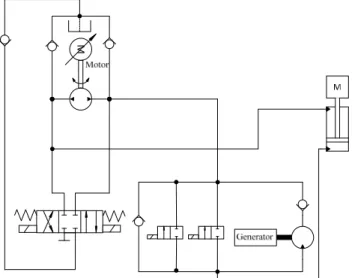
Yu Ying-xiao proposed an electric hybrid boom system for excavator

47)

. Hydraulic motor and generator also used for energy saving. The configuration is shown in Fig. 6. Due to the hydraulic motor and generator are used in the system, it will generate big resistant when boom move down. The author considers this point and add two on/off valves to the energy regeneration part. If the potential energy of boom is not enough to run the generator, the on/off valve will be opened. Part of the flow or all the flow will go to the tank. So, the main pump doesn’t need to output more energy to move the boom down. In the simulation results, the system can regenerate energy without much energy loss of main pump.

M

Fig. 6 One example of a hybrid hydraulic excavator

3.2 Hybrid hydraulic excavator

Wei shen has studied on a CPR system

48)

. It has a high-pressure rail and low-pressure rail. The accumulator is connected to the high-pressure rail. The configuration is shown in Fig. 7. An adjustable single point under constant pressure strategy was proposed.

This control strategy makes the engine operate under a certain given rotating speed and torque as far as possible by controlling the throttle of engine and displacement of main pump. The selection of single point is based on the average power of the working process. When the pressure of high-pressure rail is low, the system will follow the control strategy. If the pressure exceeds the threshold value, the engine will work into idle state. Due to the structure and control strategy, a smaller rated power engine can be used in the system. In the simulation results, the engine can work in a high efficiency range and fuel consumption can be reduced up to 13%.

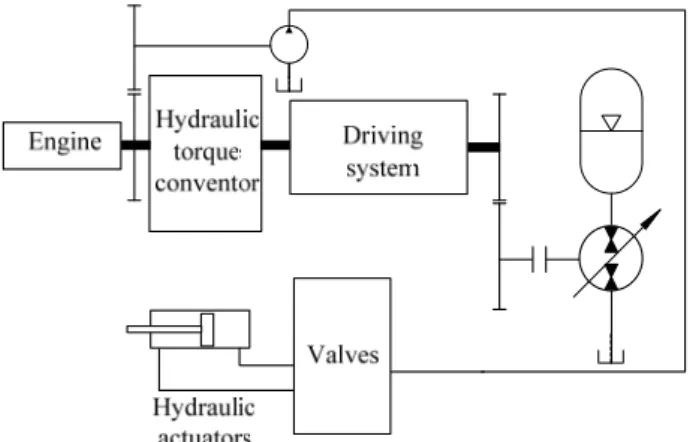
Sun Hui present an energy saving scheme with parallel hydraulic hybrid system

49)

. The configuration is shown in Fig.8. An accumulator and pomp/motor are used to regenerate and store energy. During deceleration, the hydraulic pump/motor decelerates the loader while operating as a pump to capture the energy normally lost to friction brakes in a conventional loader. While running, shoveling and digging, the hydraulic pump/

motor works in motor mode to provide auxiliary traction power for the loader which ensures the engine working in better fuel economy region and reducing the overflow losses of hydraulic system.

Fig. 7 Configuration of CPR system

(5)

In experiment and simulation, the braking energy recovery rate is between 41.97% to 75.70%. The reuse ratio of regenerated energy is 54.01%.

Fig. 8 Hydraulic hybrid system research by Sun Hui.

The STEAM system is proposed by the Institute for Fluid Power and Controls Aachen, Roland Leifeld, Milos Vukovic, Hubertus Murrenhoff RWTH Aachen University

50)

. The configuration is shown in Fig. 9. This system has three pressure rail. Two set of accumulators are install in the high-pressure rail and middle pressure rail. The main pump only charge the high-pressure rail to keep the engine working in a high efficiency area.

The high-pressure rail can charge the middle-pressure rail using hydraulic component. The hydraulic cylinder and motor can connect to the three pressure rails to realize different function. In the experiment result, the engine can work in high efficiency range and 18.3% of fuel consumption can be saved.

Yu Ying-xiao et al proposed a system using hydraulic transformer and accumulator for boom system

51)

. The configuration is shown in Fig.10. When the boom moves down, the hydraulic transformer will run to store energy to the accumulator. The hydraulic transformer can keep the pressure of head chamber constant without influencing the pressure of the accumulator. The hydraulic transformer can eliminate the throttling loss.

The author not only considers the energy regeneration, but also the input energy of the main pump. In the simulation result, the system can regenerate 52.8%

energy. And input energy will not increase, which compare with the conventional system.

Fig. 9 Configuration of STEAM system

M

Fig. 10 The hydraulic hybrid system of using hydraulic transformer

4. Productions of hybrid hydraulic excavator

In 2008, Komatsu launched the world’s first hybrid

excavator. Compared to the standard PC200-8, the

average reduction of fuel consumption is 25% and the

maximum reduction is 42%

52-55)

. The system

configuration is shown in Fig.11. It is a parallel hybrid

hydraulic system. The electric motor is used to the

swing system. The efficiency of the electric motor

during acceleration is higher compared with the

hydraulic motor, and using electric motor can get

smooth turning performance. Then energy can be

regenerated when the upper structure slows down with

turning. The super capacitor is used as ESU to satisfy

the frequent engine speed variations in a short time. As

a result, the engine can work in lower speed,

comparing with the standard PC200-8. The fuel

consumption can be reduced. The Kobe Steel Ltd

(6)

developed the hybrid hydraulic excavator to save energy and proposed an 8-ton hybrid hydraulic excavator in 2013

56)

. The configuration of the developed hybrid excavator is shown in Fig. 12.

Fig. 11 The hybrid hydraulic excavator of Komatsu

The system employs a small engine of 27 kW. The battery is chosen as the ESU. The permanent magnet motor has been adopted for the swing function. The motor enables the regeneration of energy during the deceleration of swing motion. The system is a parallel electric hybrid excavator. Based on the different conditions, the engine can drive the pump or charge the battery. The battery is used to assist the engine to drive pump or drive the swing motor. In the experimental results, the fuel efficiency was improved by 40%. The system could reduce the engine power and achieve a significant noise reduction.

Fig. 12 The hybrid hydraulic excavator of Kobe Steel

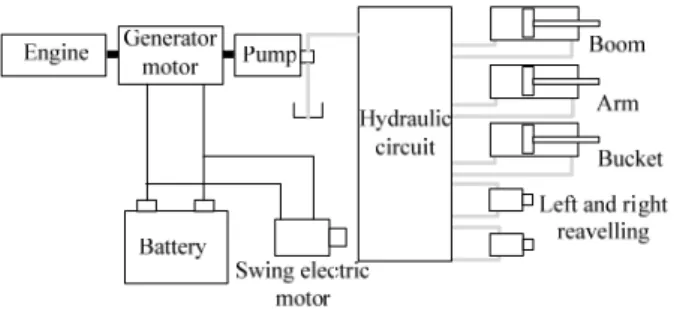
The Hitachi developed a 20-ton hybrid excavator in

2008

57-62)

. The ZX200 hybrid excavator is shown in

Fig.13. ZX200 uses a parallel hybrid system, and electric motor is used to drive the swing. The hydraulic motor and generator are used to regenerate potential energy of boom and arm. When the swing system stopping and boom or arm moving down, the system can regenerate the energy and save it in super capacitor.

The regenerated energy can be reused to assist the

engine. Compare with conventional excavator, 20%-25%

of fuel consumption can be saved.

Fig. 13 ZX200 hybrid excavator of Hitachi 5. Challenges

5.1 Reliability

The construction machine always work in severe environment. The reliability of component is very important. The hybrid excavator uses more components than the conventional hydraulic excavator, such as electric motor, generator, battery, sensors. These components should have the same service life as the conventional system. Due to the severe environment, the sensors which are arranged on the boom, arm or bucket are easy to be broken. The arrangement and protection of the sensors should be considered. So, the reliability of the hybrid construction machine, especially the excavator and loader takes big challenges to the designer.

5.2 Cost

Due to the increase of the components and complicated structure, the manufacturing cost of hybrid excavator is much higher than that of the conventional excavator. If the manufacturing cost increases so much, the energy saving of the system is meaningless. The cost needs to be not so much expensive than the standard excavator while ensuring the performance. The tradeoff the performance and cost is a big challenge.

5.3 Control strategy

The control strategy of hybrid hydraulic excavator is

very important. It determines the performance of the

system. For the electric hybrid excavator, the control of

(7)

electric motor and engine combination, SOC of battery and super capacitor, and generator should be considered.

For the hydraulic hybrid excavator, the pressure of accumulator, flow rate from each energy source should be considered. Some of systems use pump/motor, hydraulic transformer and energy regeneration system and so the total control strategy will become more complicated. The control strategy also include the monitoring and fault tolerance supervisory control for the safety of the system. So, making a good control strategy is a big challenge together.

6. Conclusions

This paper reorganizes the hybrid construction machine, particularly excavator systems in recent years.

Electric hybrid and hydraulic hybrid excavators and loaders are reviewed and the characteristics of each configuration are analyzed. And then the productions and research of hybrid hydraulic technology in construction machinery company has been investigated.

Finally, the challenges of using the hybrid technology to the construction machine was commented. .

Acknowledgement

This work was supported by the Korea Institute of Energy Technology Evaluation and Planning(KETEP) grant funded by the Korea Government Ministry of Trade, Industry and Energy(G032070311) and by the KIAT(Korea Institute for Advancement of Technology) grant funded by the Korea Government, Ministry of Trade Industry and Energy(No. N0001292, HRD Program for construction equipment)

References

1) Z. Quan, L. Quan and J. Zhang, “Review of energy efficient direct pump controlled cylinder electro-hydraulic technology”, Automation in Construction, Vol.35, pp.336-346, 2014.

2) S. R. Lee and Y. S. Hong, “Synchronous Control of an Asymmetrical Dual Redundant EHA”, Journal of Drive and Control, Vol.13, No.2, pp.1-9, 2016.

3) S. R. Lee and Y. S. Hong, “Control-performance Improvement of Dual EHAs”, Journal of Drive and Control, Vol.13, No.3, pp.32-38, 2016.

4) J. S. Joh, “A Review on New Non-hybrid Technologies to Improve Energy Efficiency of Construction Machineries”, Journal of Drive and Control, Vol.13, No.3, pp.53-66, 2016.

5) J. Y. Huh, “Energy Saving in Boom Motion of Excavators using IMV”, Journal of Drive and Control, Vol.14, No.3, pp.1-7, 2017.

6) H. G. Park, S. A. Nahian and K. K. Anh, “A Study on Energy Saving of IMV Circuit Using Pressure Feedback”, Journal of Drive and Control, Vol.13, No.4, pp.31-44, 2016.

7) D. Das, P. Chowdhury, B. N. M. Truong and K. K.

Ahn, “A Novel Energy Recuperation System for Hybrid Excavator using Hybrid Actuator”, 15th International Conference on Control, Automation and Systems, pp. 1930-1935, 2015.

8) T. A. Minav, L. I. E. Laurila and J. J. Pyrhonen,

“Analysis of electro-hydraulic lifting system's energy efficiency with direct electric drive pump control”, Automation in Construction, Vol.30, pp.144-150, 2013.

9) H. Sun, L. F. Yang, J. Q. Jing, and Y. L. Luo,

“Control strategy of hydraulic/electric synergy system in heavy hybrid vehicles”, Energy Conversion and Management, Vol.52, No.1, pp.668-674, 2011.

10) K. K. Ahn, T. H. Ho and Q. T. Dinh, “A study on energy saving potential of hydraulic control system using switching type closed loop constant pressure system”, Proceedings of the JFPS International Symposium on Fluid Power, pp.317-322, 2008.

11) K. K. Ahn and Q. T. Dihn, “Development of energy saving hybrid excavator using hybrid actuator”, Proceedings of the Seventh International Conference on Fluid Power Transmission and Control (ICFP 2009), pp. 205-209, 2009.

12) T. H. Ho and K. K. Ahn, “Saving energy control of cylinder drive using hydraulic transformer combined with an assisted hydraulic circuit”, ICCAS-SICE, pp. 2115-2120, 2009.

13) K. K. Ahn and Y. Ji, “Development of Hybrid

(8)

Excavator for Regeneration of Boom Potential Energy”, Journal of Drive and Control, Vol.7, pp.25-32, 2010.

14) T. Lin, W. Huang, H. Ren, S. Fu and Q. Liu,

“New compound energy regeneration system and control strategy for hybrid hydraulic excavator”, Automation in Construction, Vol. 68, pp.11-20, 2016.

15) B. B. Sarlioglu, C. T. Morris and D. Han and S.

Li, “Driving Toward Accessibility: A Review of Technological Improvements for Electric Machines, Power Electronics, and Batteries for Electric and Hybrid Vehicles”, IEEE Industry Applications Magazine, Vol.23, No.1, pp.14-25, 2017.

16) Y. Gou, “Research on Electric Vehicle Regenerative Braking System and Energy Recovery”, International Journal of Hybrid Information Technology, Vol.9, No.1, pp.81-90, 2016.

17) T. Lin, Q. Wang and B. Hu and Wen Gong,

“Research on the energy regeneration systems for hybrid hydraulic excavators”, Automation in Construction, Vol. 19, No. 8, pp1016-1026, 2010.

18) X. Zeng, N. Yanga, Y. Peng, Y. Zhang and J.

Wang, “Research on energy saving control strategy of parallel hybrid loader”, Automation in Construction, Vol. 38, pp.100-108, 2014.

19) D. T. Jeong, C. Kim, J. H. Kim, J. H. Suh and M.

L. Jin., “Mission Scenario-based Design of Hydraulic Manipulators for Armored Robot Systems”, Journal of Drive and Control, Vol.14, No.4, pp.51-60, 2017.

20) H. I. Yoon, K. K. Ahn and T.Q. Dinh, “A study on an energy saving electro-hydraulic excavator”, ICROS-SICE International Joint Conference, 2009.

21) G. H. Jun and K. K. Ahn, “Extended-State- Observer-Based Nonlinear Servo Control of An Electro-Hydrostatic Actuator”, Journal of Drive and Control, Vol.14, No.4, pp.61-70, 2017.

22) M. H. Bae, T. Y. Bae and S. K. Choi, “The Critical Speed Analysis of Gear Train for Hydro-Mechanical Continuously Variable Transmission”, Journal of Drive and Control, Vol.14, No.4, pp.71-78, 2017.

23) T. Lin, Q. Wang, B. Hu and W. Gong, “Development

of hybrid powered hydraulic construction machinery”, Automation in Construction, Vol.19, No.1, pp.11-19, 2010.

24) J. I. Yoon, D. Q. Truong and K. K. Ahn,

“Development of an energy saving electric excavator”, the 8th JFPS International Symposium on Fluid Power, pp.426-432, 2011.

25) T. Wang and Q. Wang, “An Energy-Saving Pressure-Compensated Hydraulic System with Electrical Approach”, IEEE/ASME Transactions on mechatronics, Vol.19, No.2, pp.270-578, 2014.

26) J. I. Yoon, D. Q. Truong and K. K. Ahn, “A generation step for an electric excavator with a control strategy and verifications of energy consumption”, International Journal of Precision Engineering and Manufacturing, Vol.14, No.5, pp.755-766, 2013.

27) I. Cires and V. M. Nani, “Stability control for a huge excavator for surface excavation”, Applied Mathematical Modelling, Vol.40, No.1, pp.388-397, 2016.

28) T. A. Minav, L. I. E. Larurial and J. J. Pyrhonen,

“Analysis of electro-hydraulic lifting system's energy efficiency with direct electric drive pump control”, Automation in Construction, Vol.30, pp.144-150, 2013.

29) P. Casoli, A. Gambarotta, N. Pompini and L. Ricco,

“Hybridization methodology based on DP algorithm for hydraulic mobile machinery- Application to middle size excavator”, Automation in Construction, Vol.61, pp.42-57, 2016.

30) M. Chen and D. Zhao, “The gravitational potential energy regeneration system with closed- circuit of boom of hydraulic excavator”, Mechanical System and Signal Processing, Vol.82, pp.178-192, 2016.

31) J. Jiang and C. Liu. “Modeling and simulation for Pressure Character of the Plate-Inclined Axial Piston Type Hydraulic Transformer”, 2010 IEEE International conference on Information and Automation June 20-23, pp.245-249, 2010.

32) T. H. Ho and K. K. Ahn, “Saving Energy Control

of Cylinder Drive Using Hydraulic Transformer

Combined with An Assisted Hydraulic Circuit”,

ICROS-SICE International Joint Conference 2009,

(9)

pp.2115-2120. 2009.

33) B. N. M. Truong, D. Q. Truong, S. Y. Lee and K.

K. Ahn, “Study on Energy Regeneration System for Hybrid Hydraulic Excavator”, 2015 International Conference on Fluid Power and Mechatronics, pp.1349-1354,2015. 2015.

34) 1126 Z. Faye, “Assembly Simulation Research for Hydraulic Transformer with Virtual Manufacturing Technology”, Technology and Innovation Conference, 2009.

35) H. T. Hung and K. K. Ahn, “A Study on the Position Control of Hydraulic Cylinder Driven by Hydraulic Transformer Using Disturbance Observer”, International Conference on Control, Automation and System, pp.2634-2639, 2008.

36) K. S. Oh, K. S. Yi, J. Seo, Y. Kim and G. Lee,

“Online Estimation of Rotational Inertia of an Excavator Based on Recursive Least Squares with Multiple Forgetting”, Journal of Drive and Control, Vol.14, No.3, pp.40-49, 2017.

37) J. H. Kim and Y. S. Hong, “Comparison of Force Control Characteristics between Double-Rod and Single-Rod Type Electro-Hydrostatic Actuators (I):

Tracking Performance”, Journal of Drive and Control, Vol.14, No.4, pp.9-16, 2017.

38) J. H. Kim and Y. S. Hong, “Comparison of Force Control Characteristics between Double-Rod and Single-Rod Type Electro-Hydrostatic Actuators (II):

Back-Drivability”, Journal of Drive and Control, Vol.14, No.4, pp.17-22, 2017.

39) T. W. Ha et al., “Position control of an Electro- Hydrostatic Rotary Actuator using adaptive PID control”, Journal of Drive and Control, Vol.14, No.4, pp.37-44, 2017.

40) G. H. Jun and K. K. Ahn, “Extended-State- Observer-Based Nonlinear Servo Control of An Electro-Hydrostatic Actuator”, Journal of Drive and Control, Vol.14, No.4, pp.61-70, 2017.

41) M. H. Bae, T. Y. Bae and S. K. Choi, “The Critical Speed Analysis of Gear Train for Hydro- Mechanical Continuously Variable Transmission”, Journal of Drive and Control, Vol.14, No.4, pp.71-78, 2017.

42) D.Y. Wang, C. Guan, S.X. Pan, M. J. Zhang, and

X. Lin, “Performance analysis of hydraulic excavator powertrain hybridization”, Automation in Construction, Vol.18, No.3, pp.249-257, 2009.

43) R. M. Schupbach et al, “Design methodology of a combined battery ― ultracapacitor energy storage unit for vehicle power management”, Power Electronics Specialist Conference, Vol.1, pp.88-93, 2003.

44) Q. Xiao, Q. F. Wang, and Y. T. Zhang, “Control strategies of power system in hybrid hydraulic excavator,” Automation in Construction, Vol.17, No.4, pp. 361-367, 2008.

45) T. Wang and Q. Wang, “Efficiency analysis and evaluation of energy-saving pressure-compensated circuit for hybrid hydraulic excavator,” Automation in Construction, Vol.47, pp.62-68, 2010.

46) T. Wang, Q. F. Wang, and T. L. Lin. “Improvement of boom control performance for hybrid hydraulic excavator with potential energy recovery,”

Automation in Construction, Vol.30, pp.161-169, 2013.

47) Y. X. Yu et al., “A study on the energy regeneration system of boom for hybrid hydraulic excavator,” 15th International Conference on Control, Automation and System, pp.1910-1914, 2015.

48) W. Shen, J. Jiang, X. Su and H. R. Karimi.

“Control strategy analysis of the hydraulic hybrid excavator,” Journal of the Franklin Institute, pp.541-561, 2015.

49) S. Hui and J. Junqing. “Research on the system configuration and energy control strategy for parallel hydraulic hybrid loader,” Automation in Construction, Vol.19, No.2, pp.213-220, 2010.

50) RWTH Aachen University, “STEAM-the best of both welds,” The Seventh Workshop on Digital Power, Linz, Austria, 2015.

51) Y. X. Yu et al., “Study on Energy Regeneration for Boom System of Hybrid Hydraulic Excavator,” the 19

th

International Conference on Mechatronics Technology, 2015.

52) H. Inoue. “Introduction of PC200-8 Hybrid

Hydraulic Excavators,” Komatsu technical report,

Vol.54, No.161, pp.1-6, 2008.

(10)

53) Komatsu Corporate Profile 2008, “PC200-8 hybrid hydraulic excavator contributes to reducing CO

2

Emissions,” vol.3, pp.4-5, 2008.

54) M. Naruse, M. Tamaru and K. Kimoto, “Hybrid construction equipment,” US Patent No.6708787, 2004-03-23.

55) Komatsu Ltd., “Komatsu launches world's first hybrid excavator”, Down to Earth, Vol.7, No. 48, pp.23, 2008.

56) M. Kagoshima, M. Komiyama, T. Nanjo and A.

Tsutsui, “Development of new hybrid excavator”, Kobelco Technology Review, Vol.27, pp.39-42, 2007.

57) M. Ochiai, “Development for environment friendly construction machinery”, Construction, Vol.9, pp.24-28, 2003.

58) W. Becca, “Earthmoving, International Construction”, Vol.47, No.10, pp.25-34, 2008.

59) S. Riyuu, et al., Hybrid construction machine JP Patent No.2003328397, 2003-11-19.

60) Hitachi construction machinery, Co.Ltd, “Dvelopment of battery driven construction machinery for CO2 reduction,” Technical report for development of technical measure for global warming control, 2005.

61) M. Ochiai and S. Ryu, “Hybrid in Construction Mchinery”, The 7th JFPS International Symposium on Fluid Power, ISBN:4-931070-07-X pp.41-44, 2008.

62) S. Ohira et al, “Use of Emission Rights for

Construction Machinery to Help Prevent Global

Warming,” Hitachi Review, Vol.62, No.2, 2013.

수치

Fig. 3 The  parallel  hybrid  hydraulic  excavator  research  by  Qing  Xiao.
Fig.  6  One  example  of  a  hybrid  hydraulic  excavator
Fig.  9  Configuration  of  STEAM  system
Fig.  13  ZX200  hybrid  excavator  of  Hitachi 5. Challenges

참조

관련 문서