Corresponding Author: Chun-Man Park
Department of Public Health, Keimyung University Sindang-dong, Daegu-city 704-701, Korea Tel: +82-53-580-5451, E-mail: [email protected]
Article submitted 01 December 2009, Revised 10 December 2009, Approved 12 December 2009
Examination of Generating Mechanism Concerning Father's Participation in Child-rearing
Ji-Sun Park, Rie Kondo*, Jung-Suk Kim**, Tsukasa Sasai***, Shigesato Takahashi****, Chun-Man Park*****†, Kazuo Nakajima*
Graduate school of Health and Welfare, Okayama Prefectural University
* Faculty of Health and Welfare Science, Okayama Prefectural University
** Gyeongnam Provincial Government Countermeasures for Low Birthrate & Aging Society Division
*** National Institute of Population and Social Security Research Department of Population Dynamics Research
**** National Institute of Population and Social Security Research Deputy Director-General
***** Department of Public Health, Keimyung University
Ⅰ. Introduction
In a survey conducted in 2004 by the Japanese Cabinet Office entitled “Survey of Attitudes Toward Gender-Equal Society”, 48.9% of respondents were
“against” the notion that “the husband should go out to work and the wife should look after the home”
while 45.2% were “for” it. This was the first time since the survey was started in 1979 that the number of those against exceeded the number for. It can therefore be inferred that there are signs of change in the traditional role-allocation structure whereby men are assigned to the public life domain, that is, men are responsible for production activity, and women are assigned to the private life domain, that is, women are responsible for reproduction activity.
However, in “Basic Survey on Social Life”(2006), published by the Ministry of Internal Affairs and Communications, it is reported that the amount of time husbands spend on activities such as housework, child rearing, and care is significantly
less than the amount of time wives spend on such activities, regardless of whether or not the wife is employed. In light of the fact that in Japan there are now more working married women than there are full-time housewives, if housework and child rearing are the joint responsibility of men and women, then a change not only in the attitude of Japanese men toward the traditional role allocation, but also in the extent of actual participation in housework and child rearing is desirable.
In the past, the “household demands” hypothesis, the “relative resources” hypothesis, the “alternative resources” hypothesis, the “time availability”
hypothesis, and the “ideology” hypothesis have been put forward as hypotheses pertaining to the factors that govern the participation of fathers in housework and child rearing(Shelton and John, 1996). In empirical studies(Matsuda, 2006; Aoki and Iwatate, 2005; Ishii, 1992; Kato et al., 1998; Nishioka, 1998;
Matsuda and Suzuki, 2002; Sakai, 2007; Mizuochi, 2006a, 2006b; Kohara, 2000; Shibata and Corine,
1996; Ueda, 2005; Hallberg and Klevmarken, 2003;
Tsuya, 2000; Theodore, 1996; Kamo, 1994; Solberg and Wong, 1992; Connelly, 1992; Kamo, 1988;
hiller, 1984; Gronau, 1977; Oaxaca, 1973) pertaining to these hypotheses, in focusing on causal relationships, the number of children, the age of the youngest child, and the father's return-home time are used as independent variables and the frequency of participation by the father in housework and child rearing(Matsuda, 2006; Aoki and Iwatate, 2005;
Ishii, 1992; Kato et al., 1998; Nishioka, 1998), the participation time(Matsuda and Suzuki, 2002; Sakai, 2007), and the relative share of responsibility (Mizuochi, 2006a, 2006b; Kohara, 2000; Shibata and Corine, 1996; Ueda, 2005; Hallberg and Klevmarken, 2003; Tsuya, 2000; Theodore, 1996;
Kamo, 1994; Solberg and Wong, 1992; Connelly, 1992; Kamo, 1988; Hiller, 1984; Gronau, 1977;
Oaxaca, 1973) are used as dependent variables. In statistical analysis, this relationship is expressed as a linear model based on either multiple regression analysis or logistic regression analysis in which these independent variables are arranged synchronously (i.e., in parallel) with respect to the dependent variables. Such statistical analysis techniques are better suited to the development of prediction functions than they are to the analysis of the validity of causal relationships. Usually, if there is no need for child rearing (cause), then child-rearing activity does not take place (effect). It is conjectured, however, that while emphasizing the causal relationships that have been used in studies until now, incorporating different variables as, for example, indirect-effect variables and mediating variables, and constructing the generating mechanism of child-rearing participation by the father as a causal-relationship model will produce a more appropriate and realistic model. In this sense, there
have been hardly any studies that propose a complex causal-relationship model pertaining to child-rearing participation by the father, with the exception of studies by Kamo(1988) and Hiller(1984). However, while their studies investigate the relationships between variables, they do not examine the validity of the causal-relationship model itself. Studies focusing on flexible generating mechanisms and processes pertaining to child-rearing participation by the father promise to yield significant information not only in an academic sense, but also for the promotion of work-life balance among future generations of young parents.
It is clarified that child-rearing participation by father is affect to child development(Gable et al., 1992; Ishii-Kuntz, 2004), growth of the father (Sasaki, 1996; Morisita and Iwatate, 2009), the mother's health(Shimizu et al., 2008; Nagahisa et al., 2004) and marital relationship(Suemori and Ishihara, 1998; Lee, 2008). Therefore it can be expected that effective information for not only father but also the child's development and the maintenance and improvement of mother's health is gotten as for the result of this study.
In relation to child-rearing participation by fathers from double-income households, this study postulates a generation model of child-rearing participation by the father that is based on the notion that “child-rearing needs nourish the father's parental-role awareness and this, in turn, affects the frequency of child-rearing participation” and constructs an original causal model based on the notion that the father's return-home time and working hours are potential disincentives for child-rearing participation. The purpose of this study was to make it clear about the fitness to the data of the causality model above-mentioned.
Ⅱ. Methods
1. Subjects
Subjects of this survey consisted of the fathers of 2,006 households that use 21 day-care centers and 4 kindergartens whose cooperation was received via the city government departments that have jurisdiction over day-care centers and kindergartens in cities A and B in prefecture I and in city C in prefecture II (city A: 499 households; city B: 1,113 households; city C: 988 households). Forms specifying details related to the protection of privacy were distributed to potential participants, who were asked to participate in the survey only after giving their assent. This study was approved by an ethics committee established by Okayama Prefectural University.
2. Investigation method
The surveyed items consisted of the father's age, the father's educational history, the number of children, the age of the youngest child (or, in the case of an only child, the age of that child), the father's parental-role awareness (positive or negative), the father's daily working hours, the father's return-home time, and child-rearing participation by the father.
The “parent positivity scale” developed by Aoki(2005) was used to measure the father's parental-role awareness. The responses were quantified as follows: “0 points: I disagree”, “1 point: I mostly disagree”, “2 points: I mostly agree”,
“3 points: I agree”.
The frequency of child-rearing participation by
the father was measured using five items from the
“2nd National Survey on Family in Japan”, conducted by the National Institute of Population and Social Security Research(2000), and the
“2004/2005 International Comparative Study on Home Education”, conducted by the National Women's Education Center, that were judged to be applicable to fathers raising infants or children in the lower grades of elementary school (i.e., eating meals together, helping change clothes or preparing a change of clothes, playing together, putting to bed or sleeping together, and helping to bathe or bathing together). The responses on child-rearing participation were quantified as follows: “0 points:
never”, “1 point: once or twice a month”, “2 points:
once or twice a week”, “3points: three or four times a week”, “4 points: everyday/always”.
3. Statistical analysis
The authors postulated a basic generation model of child-rearing participation based on the following notion: “child-rearing needs father's parental-role awareness (positive and negative) child-rearing participation”. On the basis of this model, they constructed a causal-relationship model (Fig. 1) incorporating the father's return-home time and working hours as potential disincentives for child-rearing participation. Here, data on the father's return-home time was restricted to fathers that return home at 17:00 or later. Return-home times later than 24:00 were recorded as 24:00.
The fitness to the data of the causality model was investigated with structural equation modeling, and was evaluated with the Comparative Fit Index (CFI) and Root Mean Square Error Approximation (RMSEA). The significance of the path coefficients in this analysis was evaluated with test statistics, and
Figure1. A generating process model for the father's participation in child-rearing coefficients exhibiting an absolute value of 1.96 or
more (a significance level of 5%) were judged to be statistically significant. “SPSS12.0J for Windows”
and “Amos16.0” were used as statistics software.
Ⅲ. Results
1. Distributions of Attributes of Surveyed Population
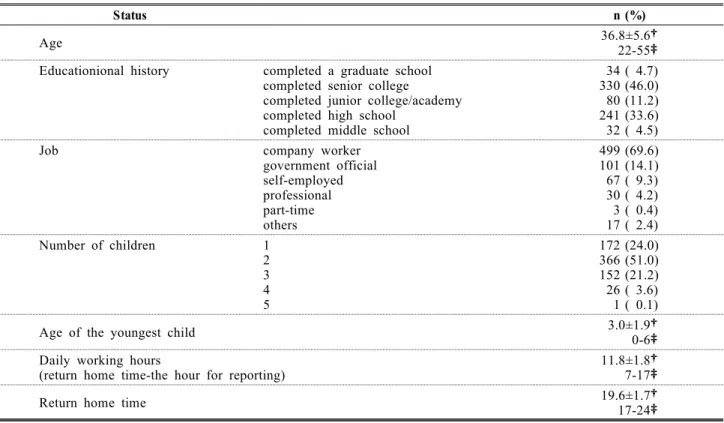
The distributions of the basic attributes of the surveyed population are shown in Table 1. The average age of the fathers was 36.8 (standard deviation: 5.6), and the age range was 22 to 55.
There were 366 households (51.0%) with two children, the most common number, and this was followed by 172 households (24.0%) with one child, 152 households (21.2%) with three children, and 27 households (3.7%) with four or more children. The average age of the youngest child was 3.0 (standard deviation: 1.9), and the age range was 0 to 6.
The response distributions and average scores with respect to the measurement scales used for the fathers' “child-rearing participation”, “parent positivity”, and “parent negativity” are shown in Tables 2 to 5. Regarding child-rearing participation, the most common response for “eating meals together” was “everyday/always” at 36.5%. For
“helping change clothes or preparing a change of clothes”, it was “once or twice a week” at 28.6%;
for “playing together”, it was “once or twice a week” at 46.3%; for “putting to bed or sleeping together”, it was “once or twice a week” at 23.7%;
and for “helping to bathe or bathing together”, it was “once or twice a week” at 69.6%.
Of the responses obtained from 1,267 people (collection rate: 48.7%), statistical analysis was applied to the data for the 717 people for whom there were no missing values among the variables required for examination of the causal-relationship model.
Status n (%)
Age 36.8±5.6†
22-55‡
Educationional history completed a graduate school completed senior college
completed junior college/academy completed high school
completed middle school
34 330 80 24132
( 4.7) (46.0) (11.2) (33.6) ( 4.5)
Job company worker
government official self-employed professional part-time others
499 101 6730 3 17
(69.6) (14.1) ( 9.3) ( 4.2) ( 0.4) ( 2.4)
Number of children 1
2 3 4 5
172 366 152 26 1
(24.0) (51.0) (21.2) ( 3.6) ( 0.1)
Age of the youngest child 3.0±1.9†
0-6‡
Daily working hours
(return home time-the hour for reporting) 11.8±1.8†
7-17‡
Return home time 19.6±1.7†
17-24‡
†Mean±Standard deviation
‡Range
Table 1. Respondent characteristics, sample for analysis
Item
n ( % )
never once or
twice a month once or
twice a week three or four
times a week everyday /always
1. Eating meals together 5
(0.8) 21
(2.9) 212
(29.6) 216
(30.1) 262
(36.5) 2. Helping change clothes or preparing a
change of clothes 129
(18.0) 113
(15.8) 205
(28.6) 166
(23.2) 104
(14.5)
3. Playing together 6
(0.8) 72
(10.0) 332
(46.3) 176
(24.5) 131
(18.3) 4. Putting the bed or sleeping together 154
(21.5) 131
(18.3) 170
(23.7) 109
(15.2) 153
(21.3) 5. Helping to bath or bathing together 31
(4.3) 80
(11.2) 284
(39.6) 164
(22.9) 158
(22.0) Table 2. Distribution of responses of the father's participation in child-rearing
Item
n ( % )
different Does not think especially like
that
Thinks a little
like that Thinks like that
1. It is good to be a father 3
(0.4) 67
(9.3) 265
(37.0) 382
(53.3) 2. I grew humanly with becoming the father 1
(0.1) 88
(12.3) 299
(41.7) 329
(45.9) 3. When I behave as a father, I think most by mine 89
(12.4) 432
(60.1) 171
(23.8) 26
(3.6) 4. I feel reason of life in being a father 26
(2.2) 117
(16.3) 338
(47.1) 246
(34.3) 5. With becoming the father, I was stabilized the mind. 31
(4.3) 240
(33.5) 332
(46.3) 114
(15.9)
6. I feel reality in being a father 10
(1.4) 124
(17.3) 378
(52.7) 205
(28.6) Table 3. Distribution of responses of parent positivity
Item
n ( % )
different Does not think especially like
that
Thinks a little
like that Thinks like that 1. My own conduct are rather restricted because it is the
father 49
(6.8) 307
(42.8) 284
(39.6) 77
(10.7) 2. My own interest facing to only the child, range of
vision becomes narrow 164
(22.9) 458
(63.9) 90
(12.6) 5
(0.7) 3. While having participated to child-rearing, I think that
take from society and in order to keep being left 326
(45.5) 347
(48.4) 40
(5.6) 4
(0.6) 4. It is felt that I'm a burden to raise the child 244
(34.0) 384
(53.6) 85
(11.9) 4
(0.6) 5. I think myself to unfit for a father 145
(20.2) 408
(56.9) 157
(21.9) 7
(1.0)
6. I wish we had not had children 630
(87.9) 73
(10.2) 12
(1.7) 2
(0.3) Table 4. Distribution of responses of parent negativity
2. Fitness to the Data of the Factor Structure Model with Respect to the Measurement Scales
Before investigation of the fitness to the data of the causality model for child-rearing and housework participation by fathers, regarding the measurement scales used for the fathers' “child-rearing participation”, “parent positivity”, and “parent
negativity”, the construct validity viewed in terms of the factor structure model was investigated using confirmatory factor analysis based on structural equation modeling.
As a result, the fit indices for data on child-rearing participation by fathers were found to be GFI=0.965, CFI=0.982, and RMSEA=0.089, and the fit indices for data on fathers' parent positivity/
negativity were found to be CFI=0.890, GFI=0.944,
and RMSEA=0.077. Overall, these are statistically acceptable levels. However, of the items pertaining to parent negativity, “Xc6. I wish we had not had children” gave rise to bias in the passage rate of the response categories and so it was omitted.
As a result of using Cronbach's α to evaluate the reliability of the measurement scales for the items used in confirmatory factor analysis, values of 0.76, 0.79, and 0.58 were obtained for “child-rearing participation (5items)”, “parent positivity (6items)”, and “parent negativity (5items)”.
The average score for “child-rearing participation (5items)” was 11.9 (standard deviation: 4.1), and the range was 1 to 20. The average score for “parent positivity (6items)” was 8.9 (standard deviation:
5.5), and the range was 0 to 24. The average score for “parent negativity (5items)” was 9.2 (standard deviation: 2.7), and the range was 0 to 16.
3. Fitness to the Data of Generating Process Model for Child-Rearing Participation by Fathers
A generating process model for the child-rearing participation of fathers from double-income households was postulated, and the data compatibility of a causal-relationship model incorporating the father's return-home time and working hours as potential disincentives for child-rearing participation into the generating process model was investigated.
As a result, the fit indices were found to be CFI=0.912, GFI=0.948, and RMSEA=0.082.
Regarding the path coefficients, the path coefficient of the pathway from the age of the youngest child to the father's parent positivity (0.08) and the path coefficient of the pathway from the father's parent positivity to child-rearing participation (0.19) were both at statistically significant levels. Also, the
father's return-home time and the working hours, which were considered as disincentives exhibited a direct effect on child-rearing participation without being influenced by the father's parent positivity or parent negativity. The path coefficient of the pathway from return-home time to child-rearing participation was -0.43, and the path coefficient of the pathway from working hours to child-rearing participation was -0.13. The value of the path coefficient expressing the relationship between the return-home time and working hours was 0.80.
Ⅳ. Discussion
The authors postulated a generation model pertaining to the child-rearing participation of fathers from double-income households. On the basis of this model, they constructed a causal- relationship model incorporating the father's return- home time and working hours aspotential disincentives for child-rearing participation, and analyzed the data compatibility of this model and the relationship between the variables. In statistical analysis, structural equation modeling was used.
This statistical technique offers much greater flexibility in model formation than conventional analysis techniques, and can be used to apply actual data to a model constructed on a theoretical hypothesis and evaluate the validity of that model using multiple fit indices. Structural equation modeling enables the separation of measurement errors. This means that the degree of relationship between variables can be derived more appropriately.
It can therefore be concluded that the use of structural equation modeling in this study was appropriate. On the basis of the suggestion that the lower limit for the number of samples required in structural equation
modeling is between 150 and 200, it can be said that the required number of samples for statistical analysis was obtained in this study.
Regarding the results of this study, firstly, it was established that the basic generation model of
“child-rearing needs father's parental-role awareness child-rearing participation” was compatible with the data. However, the age of the youngest child was the only variable pertaining to child-rearing needs that was relevant and parent positivity was the only variable pertaining to the father's parental role that was relevant. The fact that the above model was statistically supported suggests a possible interpretation whereby the independent variables considered in the various hypotheses previously proposed in relation to child-rearing participation exist within a chain of cause and effect. To date, there has been no report of findings that indicate the possibility of a causal relationship between variables that, in the past, have been considered independent variables in relation to child-rearing participation by fathers. It can be concluded that the findings of this study will constitute basic data for the purpose of constructing appropriate generating mechanisms pertaining to child-rearing participation by fathers. In the stress studies(Lazarus and Folkman, 1984, 1987) of Lazarus et al., in trying to distinguish between the ambiguous elements covered by the term “stress”, they used the term “(latent) stressor” in relation to internal and external environmental stimulation. Of the variables pertaining to child-rearing needs that were considered in this study, the age of the youngest child can, applying the results of the above stress studies, be characterized as a (latent) stressor in the sense that child rearing involves difficulties.
Also, the father's parental-role awareness, which was considered in this study, can be characterized as one aspect of stress recognition. This stress
recognition is related to the idea that because there are individual differences in stress reaction with respect to the same stressor, there must be some variable that influences the relationship between stressor and stress response. It can be inferred that the results of this study support the hypothesis that child-rearing needs, such as those pertaining to the age of the youngest child, give rise to parent positivity on the part of the father (positive stress evaluation), and that this is accompanied by the manifestation of child-rearing participation.
Furthermore, this child-rearing participation can, applying the results of existing stress studies, be characterized not as a stress response, but rather as a form of coping geared toward alleviating and combating the stress response, in other words, problem-focused coping (changing the situation, clarifying the problem, finding an alternative solution, and implementing the best method), and it can be inferred that the father's sense of well-being increases through this activity. In this study, the authors focused on the generating process of child-rearing participation by the father and investigated the fit of the model. It is desirable that, in the future, more hypotheses will be derived from appropriate theories and, for example, that stress recognition theory incorporating consideration of stress responses in relation to problems associated with child-rearing participation by fathers are applied to the development of new models or that new theories incorporating consideration of work-life balance are developed and subjected to empirical investigation.
Secondly, it was established that the father's return-home time and daily working hours, variables proposed in earlier studies, directly affect the frequency of child-rearing participation by the father without being influenced by the other variables used
in this study. According to the results of studies conducted in the field of social science, the above variables belong to the time availability hypothesis.
Previous studies pertaining to child-rearing participation by fathers have reported that the shorter the father's working hours, the greater the frequency of child-rearing participation by the father(Kato et al., 1998), and that the later the father's return-home time, the lower the frequency of child-rearing participation by the father(Kato et al., 1998; Matsuda and Suzuki, 2002). This study supports these findings. On this occasion, the path coefficient of the return-home time with respect to child-rearing participation by the father took its highest value. It should be noted that this study originated from the hypothesis that the variables pertaining to the time availability hypothesis are controlled by the father's parental-role awareness.
However, the results of statistical analysis suggest that the father's return-home time and daily working hours should be characterized as variables that are not easily controlled by the father's parental-role awareness. In other words, the return-home time can be characterized as an environmental variable that functions with respect to child-rearing participation by the father before it actually takes place. In general, working hours and return-home time are determined by contracts formed between workers and employers. In principle, however, there are eight working hours in a day. Then again, many corporations have recently adopted systems that allow self-regulation of working hours. Such systems include the limited-period reduced-hours system, flex-time, staggered working hours, tele-commuting, work-location restrictions (i.e., transfer restrictions), the “No Overtime Day”
system, late-night overtime exemptions, child-care leave, family-care leave, the maternity/paternity
reduced-hours system, paternity leave, short-period leave, multipurpose leave, full implementation of the five-day week, and systems allowing the accumulation of annual paid leave. It can be inferred from the fact that the return-home time cannot seem to be made earlier that, as indicated by earlier studies(Aoki and Iwatate, 2005), the workplace climate influences fathers' return-home times. This is illustrated by comments such as “an awareness of other people makes me feel reluctant to use paid leave”, “the pervading atmosphere makes it difficult to return home early for personal reasons”, and “I am restricted by work-related personal relationships, even outside working hours”. It cannot be denied that, among the systems that allow self-regulation of working hours, the “No Overtime Day” system, late-night overtime exemptions, and full implementation of the five-day week are particularly important for promoting child-rearing participation by fathers. The key issue is how to change the workplace climate so that these systems can be used easily. It is desirable that corporations and managers actively promote an improvement of the working environment geared to ensuring the work-life balance of young parents.
In this study, a generation model for child-rearing participation by fathers was subjected to statistical investigation. As a result, it was suggested that an academic approach such as one of the following is required: further developing the generation model for child-rearing participation by fathers proposed by the authors and reconstructing it as a more realistic model; using other theories to derive other hypotheses for examination; or creating new theories and incorporating the generation model for child-rearing participation by fathers as one example. Regarding practical issues, it is reported in
“Basic Survey on Social Life”(2006), published by
the Ministry of Internal Affairs and Communications, that the amount of time husbands spend on activities such as housework, child rearing, and care is significantly less than the time wives spend on such activities, regardless of whether or not the wife is employed. More specifically, regarding the way that couples spend time each day, classified according to whether or not the wife is employed, the total average amount of time that the husband in a double-income household spends on housework, child-rearing, and care is 30minutes, and the wife in such a household spends 415on such activities, whereas the husband in a household where only the husband is employed spends 39minutes on such activities, and the wife in such a household spends 621on such activities. The time spent by the husband varies little according to whether or not he is in a double-income household whereas the wife in a double-income household is responsible for housework, child-rearing, and care while maintaining employment and so she has little free time. In order to remedy this situation swiftly and to realize a gender-equal society that emphasizes work-life balance, corporations should evaluate the usage, particularly by young parents, of the “No Overtime Day” system, late-night overtime exemptions, and full implementation of the five-day week, and should quickly construct systems ensuring that the use of such systems does not lead to reductions in wages.
If such a system and a social system are constructed, it can be expected for father's participation in child-rearing to increase and to lead to the child's development and the maintenance and improvement of mother's health.
Ⅴ. Conclusion
In this study, father's participation in child-rearing which was the relation to not only the father's growth but also the child's development and mother's health was taken up, and the mechanism concerning the generation was examined. As a result, [father's parental-role awareness is influenced by the child-rearing needs, and the parental-role awareness influences the frequency of child-rearing participation] was supported with empirical hypotheses. Moreover it was established that the father's return-home time and daily working hours, variables proposed in earlier studies, directly affect the frequency of child-rearing participation by the father without being influenced by the other variables used in this study. From the above, a system and a social system that promoted father's participation in child-rearing were discussed.
(This study was based on “Comprehensive Study of Effect on Marriage and Childbirth of Low-Birthrate Countermeasures Implemented as Part of Family and Labor Policies”(2008), which was funded by a Ministry of Health, Labor and Welfare grant for scientific research and produced under the supervision of Shigesato Takahashi.)
References
Aoki Satoko and Iwatate Kyoko. 2005. Determinants of paternal involvement in childcare;the analysis of differences between mother's and father's belief. Bulletin of Tokyo Gakugei University.
Series 1 56:79-85.(In Japanese)
Connelly, R. 1992. The Effect of Child Care Costs on Married Women's Labor Force Participation.
Review of Economics and Statistics 74(1):
83-90.
Gable, S., Belsky, J. and Crnic, K. 1992. Marriage, Parenting, and Child Development: Progress and Prospects. Journal of Family Psychology 5(3-4):
276-294.
Gronau, R. 1977. Leisure, Home Production, and Work-the Theory of the Allocation of Time Revisited. Journal of Political Economy 85(6):
1099-1123.
Hallberg, D. and Klevmarken, A. 2003. Time for children: A study of parent's time allocation.
Journal of Population Economics 16(3):205-226.
Hiller, Dana V. 1984. Power Dependence and Division of Family Work. Sex Roles 10:1003-1019.
Masako, Ishii-Kuntz. 1992. Are Japanese Families
‘Fatherless’?. Sociology and Sociological Research 76(3):105-110.
______. 2004. Father's Involvement and School-Aged Children's Sociability: A comparison between Japan and the United States. Japanese Journal of Family Sociology 16(1):83-93.(In Japanese) Kamo, Yoshinori. 1988. Determinants of Household
Division of Labor: Resources, Power, and Ideology. Journal of Family Issues 9(2):177-200.
______. 1994. Division of Household Work in the United States and Japan. Journal of Family Issues 15(3):348-378.
Kato Kuniko, Ishii Kuntz Masako, Katsuko Makino, Michiko Tsuchiya. 1998. Factors determine father's participation in child-rearing. The journal of Family Education Research Center 20:38-47. (In Japanese)
Kohara Miki. 2000. Long commuting time and market labor・housework. The Monthly journal of the Japan Institute of Labour 476:35-45.(In Japanese)
Lazarus, R.S. & Folkman, S. 1984. Stress, appraisal, and coping. New York: Springer Publishing Campany.
______. 1987. Transactional theory and research on emotions and coping. European Journal of Personality 1:141-169.
Lee Ki-pyong. 2008. The effect of husband's
participation in household work on wife's marital satisfaction: introducing the concept of the expectation sufficiency. Japanese journal of family sociology 20(1):70-80.(In Japanese) Matsuda Shigeki, Suzuki Yukio. 2002. Relation of
Labor Time and Domestic Labor Time of the couple. Japanese Journal of Family Sociology 13(2):73-84.(In Japanese)
Matsuda Shigeki. 2006. Level and change of determinants of father's participation in housework and child-rearing. Japanese journal of research on household economics 71:45-54.
(In Japanese)
Ministry of International Affairs and Communications.
2006. Basic Survey on Social Life.(In Japanese) Mizuochi Masaaki. 2006a. Father's participation in
child-rearing and allocation of housework.
Japanese journal of research on household economics 71:55-63.(In Japanese)
______. 2006b. Allocation behavior of housework and Father's participation in child-rearing. The Quarterly of social security research 42(3):
149-164.(In Japanese)
Morishita Yoko and Iwatate Kyoko. 2009. How does the birth of the first child make the father change? Bulletin of Tokyo Gakugei University 60: 9-18.(In Japanese)
Nagahisa Hisako, Kashiwagi Keiko, Kang Ran-Hye.
2004. Cross-cultural study between Japan- Korea regarding Value of children and responsibility of having child in fathers. Journal of Bunkyo Gakuin University 6(1): 43-59.(In Japanese)
National Institute of Population and Social Security Research. 2000. The 2nd national survey on family in Japan.(In Japanese)
National Women's education center of Japan. 2005.
International Comparative Study on Child Raising and Family Life 2004, 2005.(In Japanese)
Nishioka, H. 1998. Men's Domestic Role and the Gender System: Determinants of Husband's Household Labor in Japan. Journal of Population Problems 54(3):56-71.
Oaxaca, Ronald. 1973. Male-Female Wage
Differentials in Urban Labor Markets.
International Economic Review 14:693-709.
Sakai Kazufumi. 2007. A Comparative Analysis of the Shortness of Weekday Contact between Father and Child in Japan and Korea : How This Influences the Father-Child Relationship and the Factors That Contribute to the Short Contact Time. Journal of the National Women's Education Center of Japan 11:11-22.(In Japanese)
Sasai Yasuyuki. 1996. Paternal development and family systems-A viewpoint of life-span perspective-. The Annual Report of Educational Psychology in Japan 35:137-146.(In Japanese) Shelton, Beth A. and John, Daphne. 1996. The
Division of Household Labor. Annual Review of Sociology 22:299-322.
Shibata Aiko and Boyles Corine. 1996. Allocation of living hours. The Journal of Japan Economic Research 32:133-148.(In Japanese)
Shimizu Naoko, Sumioka Rieko, Kishida Mayuki and Manabe Emiko. 2008. Child-rearing father's Stressors, Stress-Responses and Stress-Copings during Childcare Period. Kyoto Prefectural
University of Medicine 17:79-86.(In Japanese) Solberg, E.J. and Wong, D.C. 1992. Family Time
Use: Leisure, Home Production, Market Work, and Work Related Travel. Journal of Human Resources 27(3):487-510.
Suemori Kei and Ishihara Kunio. 1998. The husband's housework accomplishment and wife's marital relations satisfaction. Journal of population problems 54(3): 39-55.(In Japanese)
Theodore, N. Greenstein. 1996. Husbands' participation in domestic labor: Interactive effects of wives' and husbands' gender ideologies. Journal of Marriage and Family 58:585-595.
Tsuya, Noriko O. 2000. Female Empowerment, Marriage Postponent, and Gender Relations in Japan: An Intergenerational Perspective.
Pp.318-348 in Women's Empowerment and Demographic Processes by Harriet B. Pressere and Gita Sen (eds.)
Ueda, A. 2005. Intrafamily time allocation of housework: evidence from Japan. Journal of the Japanese and International Economies 19(1):
1-23.(In Japanese).
ABSTRACT
Objectives: This purpose of this study was to make clear the fitness to data of the causality model related to father's child-rearing participation in a double-income household.
Methods: Subjects of this survey consisted of the fathers of 2,006 households that use 21 day-care centers and 4 kindergartens whose cooperation was received via the city government departments that have jurisdiction over day-care centers and kindergartens in cities A and B in prefecture I and in city C in prefecture II (city A: 499 households; city B: 1,113 households; city C: 988 households). The surveyed items consisted of the father's age, the father's educational history, the number of children, the age of the youngest child, the father's parental-role awareness, the father's daily working hours, the father's return-home time, and child-rearing participation by the father.
Results: The fit indices were found to be CFI = 0.912, GFI = 0.948, and RMSEA = 0.082. Regarding the path coefficients, the path coefficient of the pathway from the age of the youngest child to the father's parent positivity (0.08) and the path coefficient of the pathway from the father's parent positivity to child-rearing participation (0.19) were both at statistically significant levels. Also, the father's return-home time and the working hours, which were considered as disincentives exhibited a direct effect on child-rearing participation without being influenced by the father's parent positivity or parent negativity. The path coefficient of the pathway from return-home time to child-rearing participation was -0.43, and the path coefficient of the pathway from working hours to child-rearing participation was -0.13. The value of the path coefficient expressing the relationship between the return-home time and working hours was 0.80.
Conclusion: Authors infered that it'll be the basic material to build a generation mechanism about vanity and father's child-rearing participation appropriately as a result of this research.
Key Words: Father, Child-rearing, SEM
<국문초록>
맞벌이 가정 부친의 육아참가 발생과정
목적: 이 연구는 맞벌이 가정의 부친의 육아참가 발생과정을 인과관계모델로 구축하여 이 모델에 대한 데이터로 의 적합성에 대해 검토하는 것을 목적으로 하였다.
방법: 조사대상은 I 현 A,B시, II현 C시의 어린이집 21곳과 유치원 4곳을 이용하는 2,006세대(A시:499세대, B시:1113세대, C시:98세대)의 부친으로 하였다. 조사내용은 부친의 연령, 학력, 자녀수, 막내자녀나이, 부모역할관, 1일 노동시간, 귀가시간, 육아참가로 구성하였다.
결과: 부친의 육아참가 발생과정 모델의 데이터로의 적합성에 대해 검토한 결과, 적합도 지표는 CFI=0.912, RMSEA=0.082였다. 경로계수를 살펴보면, 막내자녀나이에서 긍정적 부모역할관으로 향하는 경로계수는 0.08,
긍정적 부모역할관에서 육아참가로 향하는 경로계수는 0.19로 통계학적으로 유의하였다. 또한 저해요인으로서
상정한 귀가시간과 1일 노동시간은 부친의 긍정적/부정적 부모역할관으로부터 영향을 받지 않고, 육아참가에
직접효과를 나타내었다. 이때, 귀가시간에서 육아참가로 향하는 경로계수는 -0.43, 노동시간에서 육아참가로 향하는 경로계수는 -0.13, 귀가시간과 노동시간 간의 상관계수는 0.80이었다.
결론: 이상의 결과를 통해 본 연구에서 제기한 모델의 타당성을 증명하였고, 부친의 육아참가 발생 매커니즘에 관한 기초자료로 활용될 수 있음을 시사한다.
주제어: 부친, 육아, SEM