서 론
최근 들어 우울증의 핵심적인 특징으로 인지 기능 저하의 중요성이 강조되고 있으며1) 이에 대한 많은 연구들이 이루 어지고 있다. 우울증 환자 중 2/3에서 인지 기능 저하가 관
찰되며2-4) 급성 삽화가 종료된 후에도 1/3에서 1/2의 환자들 에게 영향을 주는 것으로 알려져 있다.2,5) 일부 연구에 따르 면 우울 증상이 관해 되어도 94%에서 인지 기능 저하가 지 속된다고 하며5) 인지 기능 영역 중 언어기억과 언어유창성, 정신운동속도는 급성 삽화가 종료되면 회복 되었으나 실행
Received: April 12, 2021 / Revised: May 14, 2021 / Accepted: June 7, 2021
Corresponding author: Vin Ryu, Mental Health Research Institute, National Center for Mental Health, 127 Yongmasan-ro, Gwangjin-gu, Seoul 04933, Korea
Tel:02) 2204-0109·Fax:02) 2204-0381·E-mail:[email protected]
정상인을 통해 알아본 우울 증상과 불안 증상이 특정 인지 기능에 미치는 영향
국립정신건강센터 정신건강의학과,1 정신건강연구소2
김규호1·남윤영1·한지연2·유리나2·유 빈2
Effects of Depression and Anxiety Symptoms on Specific Cognitive Function by Evaluating Healthy Subjects
Kyuho Kim, M.D.,1 Yoon-Young Nam, M.D., Ph.D.,1 Jiyeon Han, M.S.,2 Rina Yu, M.A.,2 Vin Ryu, M.D., Ph.D.2
1Departments of Psychiatry, 2Mental Health Research Institute, National Center for Mental Health, Seoul, Korea
ABSTRACT
Objectives:Based on the fact that cognitive functions decline known as comorbid symptoms of depression can precede depression, this study seeks to observe the effects of depressive symptoms and anxiety symp- toms on cognitive function in healthy subjects.
Methods:To recruit 50 general populations to evaluate cognitive and clinical symptoms and to find out the effects of clinical symptoms on cognitive functions, Pearson correlation and multivariate regression were con- ducted. Correlation analysis of subdomain cognitive function was conducted for reliability analysis.
Results:Trail making test-B that evaluates the execution function correlates with depressive symptoms (r=0.300, p=0.03) and age (r=0.323, p=0.02). Depressive symptoms (β=0.304, p=0.03) and age (β=0.335, p=0.01) were significantly related to Trail making test -B (Adjusted R2=0.148). Subjective cognitive tests corre- lates with anxiety symptoms (r=0.434, p=0.002). In the correlation between cognitive functional items, Subjec- tive cognitive tests was found to be correlated with other test except Spotter.
Conclusions:In this study, depressive symptoms contribute independently to executive functions in addition to demographic characteristics such as age and duration of education. Given that cognitive decline is a common long-term clinical outcome in depression, we expect active early intervention and evaluation of cognitive func- tion to be helpful.
KEY WORDS:Depressive symptom ㆍAnxious symptoms ㆍDepression ㆍCognitive function.
https://doi.org/10.22722/KJPM.2021.29.1.42 ISSN 1225-6471
기능과 주의력은 치료후에도 지속되는 것으로 나타났다.6) 인지 기능 저하는 우울증 치료에 부정적인 영향을 보이고 항 우울제에 대한 반응이 낮으며7,8) 이로 인해 우울 삽화 이후에 도 정신사회적 기능에 지속적인 손상을 초래할 수 있다.9)
주요우울장애에서 흔하게 인지기능 저하가 관찰되나 경도 우울장애 혹은 그 이전의 우울 증상에서도 관찰되는데10-12) 특히, 정신사회적 기능의 손상은 우울증 진단 이전의 우울 증상을 가진 집단에서도 우울증 환자들과 비슷한 정도의 손 상을 초래한다.13,14) 정상 인지 기능을 지닌 노년층 환자를 대 상으로 한 연구에서 우울 증상은 인지 기능을 예측하는 것 으로 보고되었고 우울 증상이 심할수록 인지 기능 저하의 위험성이 커지며15) 이는 다른 종편 연구에서의 결과와 일치
한다.16-18) 즉, 임상 증상이 있는 정상인을 대상으로 인지 기
능에 대한 평가와 적절한 조기 개입이 예후에 중요한 역할 을 하게 될 수 있다.
한편 불안증에서도 우울증과 마찬가지로 인지 기능 저하 가 동반되는 경우가 많아 이 둘의 관계에 대한 관심이 높아 지고 있지만 아직 명확한 결론은 없다. 강박장애나 범불안장 애, 외상후스트레스장애는 주의력, 실행기능, 기억력 저하와 연관성이 있고 불안증은 인지 기능 저하의 예측 인자가 되 는 연구도 있지만19-21) 반대로 임계값 미만의 불안증과 인지 기능은 양의 선형관계를 보이는 연구도 있었다.22-24) 즉, 많은 연구에서 불안 증상이 너무 낮거나 높을 때, 역전된 U모양 으로 인지 기능저하를 보인다.25,26) 또한 우울증에서도 불안 증상이 40~50%로 흔하게 동반되며 불안 증상이 심할수록 인지 기능 저하가 악화되는 것으로 알려져 있어27) 이에 대 한 적절한 평가가 필요할 것으로 보인다.
흔히 인지 기능 저하가 동반되는 치매나 조현병과 달리 우울증에서는 주의력, 작업기억, 실행기능, 처리속도를 포 함한 객관적 인지 기능과28) 주관적 인지 기능의 저하가 관찰 된다.29) 따라서 우울증에서의 인지 기능을 평가하는 도구에 대한 관심이 많아지고 있는데 대부분의 평가도구는 시간이 오래 걸리거나 자가보고식의 주관적 평가 또는 인지 기능의 한 영역만을 평가하는 경우가 많다.30) 최근에 이러한 기존 평가도구의 단점을 보완 할 수 있는 Thinc-itⓇ이 개발되어 사용되고 있다. 위 도구는 2016년 우울증 환자에 대한 인지 기능 평가를 목적으로 만든 디지털 선별 도구로서 검사 시 간이 짧고 우울증 환자에게서 저하되는 특정 객관적 인지 영역과 주관적 인지영역에 대한 평가를 할 수 있다는 장점 이 있다.31) 이전 연구를 통해 위 도구에서 우울증 환자들의 인지 기능 저하를 관찰할 수 있었으며 평가도구에 대한 유 효성과 민감성이 보고되었고,32) 우울증을 진단받지 않은 인
구를 대상으로 한 연구에서도 시간적 유효성, 수렴적 유효성, 피험자군내에서의 신뢰성이 확인되었다.33)
이에 본 연구는 임상적 수준 미만의 우울증상과 불안증상 을 가진 정상인에게서도 특정 인지 기능의 변화가 있을 수 있음을 예측하여 적용이 쉽고 주관적 인지기능과 다양한 객 관적 인지기능을 평가할 수 있는 도구를 사용하여 특정 인 지 기능 영역과 변수 간의 상관분석을 통해 관련성을 평가 하고 그 영향을 다변량 회귀분석을 통해 검증하고자 한다.
방 법
1. 연구 대상
연구 피험자는 웹 광고를 통해 모집 되었으며, 19세 이상 50세 이하의 성인 50명이 참여하였다. 연구설계는 국립정신 건강센터(the National Center of Mental Health) 윤리위원 회의 승인을 받았다(IRB No. 116271-2019-26). 연구에 참 여하는 대상자의 기준으로 간이 정신 상태 평가를 위한 면 담(The Mini International Neuropsychiatric Interview for Diagnostic and Statistical Manual of Mental Disorders, MINI)34)을 통해 정신과적 과거력이 없으며 일차 친족 중에 정신과적 질환이 없는 사람을 대상으로 하였다. 이외 배제 기준으로 주요 신체 질환, 인지 기능에 영향을 줄 수 있는 약물 복용(예, 스테로이드제, 베타차단제 등)이 있거나 8시 간 내 알코올 사용이 확인된 경우와 사전 정신과적 면담을 통해 부적절한 참가자라고 판단되는 경우로 하였다. 모든 참여자들은 국립정신건강센터 정신건강연구소에서 평가에 대한 충분한 설명을 듣고 사전 서면 동의하였다.
2. 측정 도구 1) Thinc-itⓇ
인지 기능 평가로 노트북컴퓨터 버전의 Thinc-itⓇ를 사용 하였다.32) 본 도구는 적용이 용이하고 민감도와 타당도가 높 으며 주관적 인지 영역과 객관적 인지 영역을 모두 평가할 수 있는 장점이 있다. 우울증 환자의 인지 기능 저하에 민감 하게 반응하도록 설계되었고 우울증 심각도에 따라 인지 기 능이 다르게 나타나는 특성을 보인다.35) 객관적 인지기능을 평가하는 영역으로서 주의력검사(Spotter)는 주의력과 실행 기능, 기호대체검사(Symbol check)는 작동기억, 실행기능, 주의/집중력을 암호 해독 검사(Code breaker)는 실행기능 과 처리속도, 주의/집중력, 선로잇기검사B형(Trail making test-B)으로 실행기능을 평가할 수 있다.31) 주관적 영역의 인 지 기능은 Perceived Deficits Questionnaire for Depres-
sion five-item version (PDQ-5)로 측정하였다. 본 연구에서 는 피험자가 검사에 익숙해질 수 있도록 연습 시간을 주었고 프로그램에서 제공되는 안내에 따라 피험자가 스스로 학습 하도록 하였으며, 연구자는 필요한 경우에 도움을 주었다.
2) 한국어판 Quick Inventory of Depressive Symptomatology-Self Report (QIDS-SR)
한국어판 자기보고형 간이우울증상 척도(Korean Self Rat- ing version of Quick Inventory of Depressive Symptom- atology-Self Report, QIDS-SR)는 2003년 Rush등36)이 발 표한 논문에 수록된 것을 번역한 것으로 DSM-IV의 9가지 우울증상영역에 초점을 맞추어 채점하는 16개의 문항으로 이루어져 있고 총점의 범위는 27점이다. QIDS-SR 척도는 주요 증상을 짧은 시간에 평가할 수 있고, 점수 산정이 용이 하며 이전 국내 연구에서 만족스러운 신뢰도와 타당도를 보인 바 있다.37)
3) 한국어판 Beck Anxiety Inventory (BAI)
Beck 불안 척도(Korean version of Beck Anxiety Inven- tory, BAI)는 일차 의료기관에서 주로 사용하는 불안의 인지 적, 정서적, 신체적 영역을 포함하는 21문항으로 구성된 자 기 보고식 검사로 총점의 범위는 63점이고 성인의 경우 22 점이상부터 관찰과 개입을 요하는 것을 알려져 있다.38,39)
3. 분석방법
자료 분석은 상용 통계 분석 패키지인 MedcalcⓇ를 이용 하였다. 나이, 교육기간, 우울점수, 불안점수가 인지 기능에 미치는 영향을 파악하기 위해 피어슨 상관분석과 다변량 회귀분석을 시행하였다. 상관분석은 나이, 교육기간, 우울 점수, 불안점수와 인지 기능 평가 검사 간에 시행되었고, 인 지 기능평가의 소검사간 분석에 사용하였다. 다변량 회귀분 석을 위해서는 종속변수인 각각의 인지 기능 측정값과 독 립변수인 우울점수, 불안점수와 혼란변수인 나이, 교육기간 을 포함하여 입력법으로 선형회귀분석을 시행하였다. 통계 적 유의수준의 판단기준은 α=0.05로 하였다.
결 과
1. 참여자의 인구학적 특성
29명의 여성과 21명의 남성 피험자가 본 연구에 참여하 였으며, 피험자 평균 연령은 43.5±6.1세, 교육연수 15.3±
2.2년이었다. 우울 점수는 2.90±4.26 불안 점수는 2.28±
3.13이었다. 남녀간 나이(t=1.03, p=0.31), 교육 연수(t=
-1.03, p=0.31), 우울 점수(t=-0.39, p=0.70), 불안 점수(t=
-0.35, p=0.73)는 통계적 유의성이 관찰되지 않아 성별에 따 른 나이, 교육연수, 우울 점수, 불안 점수의 차이는 보이지 않았다.
2. 인지 기능 평가 소항목과 우울증상, 불안증상, 나이, 교 육기간에 대한 상관분석
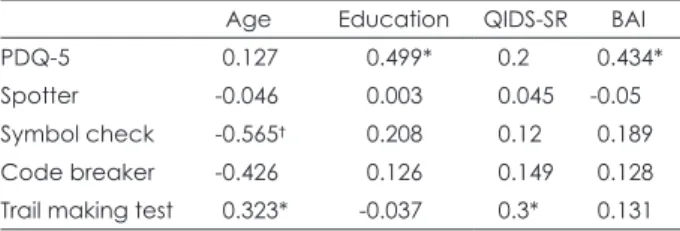
평가 도구를 사용하여 측정한 인지 기능과 임상 변수로서 우울점수와 불안점수 그리고 혼란 변수로서 나이, 교육기간 에 대해 피어슨 상관분석을 시행하였다(Table 1). 주관적 인 지 기능검사(PDQ-5)는 점수가 낮을 수록 주관적 인지 기능 의 저하를 시사하는 것으로 교육기간(r=0.499, p=0.002)과 불안점수(r=0.434, p=0.002)와 양의 상관 관계를 보였지만, 나이, 우울점수와는 유의하지 않았다. 객관적 인지 기능 항 목 중 주의력검사는 정확한 응답을 위한 평균 지연 시간을 측정하였고 나이, 교육기간, 우울점수, 불안점수와 상관성 이 유의하지 않았다. 기호대체검사는 일정 시간내에 정확한 응답 수를 측정하였으며 나이(r=-0.565, p<0.001)와 유의 한 음의 상관 관계가 있었다. 암호해독검사도 일정 시간내 에 정확한 응답 수를 측정하였고 나이(r=-0.426, p=0.002)와 음의 상관성이 있었다. 선로 잇기 검사는 완성까지 걸리는 시간을 측정하였고 평균나이(r=0.323, p=0.02), QIDS-SR (r= 0.300, p=0.03)와 유의한 양의 상관성이 있지만 불안 증 상과 교육기간과는 상관성이 유의하지 않았다.
3. 인지 기능 평가 소항목과 우울증상, 불안증상, 나이, 교 육기간에 대한 회귀분석
평가 도구를 사용하여 측정한 인지 기능과 임상 변수로 서 우울점수와 불안점수 그리고 혼란 변수로서 나이, 교육 기간에 대해 입력법을 이용하여 다변량 회귀분석을 시행하 였다(Table 2). 주관적 인지 항목인 PDQ-5 (F (4,45)=5.96, p=0.001)는 독립 변수가 28.8%의 영향력이 있었으며 이 중 교육기간(β=0.362, p=0.004)이 유의하였다. 기호 대체 검사
Table 1. Correlation between cognitive function test and other clinical variables
Age Education QIDS-SR BAI
PDQ-5 0.127 0.499* 0.2 0.434*
Spotter -0.046 0.003 0.045 -0.05
Symbol check -0.565† 0.208 0.12 0.189
Code breaker -0.426 0.126 0.149 0.128
Trail making test 0.323* -0.037 0.3* 0.131
* : p<0.05, †: p<0.001. PDQ-5 : Perceived Deficits Question- naire for Depression five-item version, QIDS-SR : Korean Self rat- ing Version of Quick Inventory of Depressive Symptomatology, BAI : Korean version of Beck Anxiety Inventory
(F (4,45)=6.42, p<0.001)는 독립 변수가 31%의 영향력이 있었으며 이 중 나이(β=0.554, p<0.001)만 유의하였다. 암 호 해독 검사(F (4,45)=2.86, p=0.03)는 독립 변수가 13.2%
영향력이 있었으며 이 중 나이(β=0.451, p=0.003)가 유의하 였다. 선로 잇기 검사(F (4,45)=3.00, p=0.02)는 독립 변수가 14.8% 영향력이 있었고 이 중 우울점수(β=0.304, p=0.03)와 나이(β=0.335, p=0.01)가 유의하였다. 주의력 검사는 유의 한 항목이 관찰되지 않았다.
4. 인지 기능 평가 소항목간 상관성 분석
본 연구에서 사용되는 인지기능 평가도구의 검사들은 우 울증에서 흔히 저하되는 영역을 평가하는 것으로 검사간의 상관성을 알아보기 위해 소항목간 상관분석을 시행하였다.
(Table 3). 주관적 인지 기능 항목인 PDQ-5는 객관적인 인 지항목 중 주의력 검사(r=-0.377, p=0.006), 기호 대체 검사 (r=0.451, p=0.001), 선로 잇기 검사(r=-0.350, p=0.01)와 유 의한 상관성이 있었다. 객관적 항목 중 주의력 검사는 암호 해독 검사(r=-0.332, p=0.02), 선로 잇기 검사(r=0.294 p=
0.04)와 상관 관계를 보였고 기호 대체 검사와는 유의한 상관 관계가 없었다. 기호 대체 검사는 암호 해독 검사(r=0.451, p=0.001), 선로 잇기 검사(r=-0.308, p=0.03)와 유의한 상관 관 계가 관찰되었고 암호 해독 검사는 선로 잇기 검사(r=-0.350, p=0.01)와 유의한 상관 관계를 보였다.
고 찰
간이 우울 검사로 평가한 우울 증상은 실행기능을 평가
하는 것으로 알려진 선로잇기검사에 영향을 미쳤다. 실행기 능은 계획, 의사 결정, 작업기억, 억제, 유연성, 피드백에 대 한 반응을 통칭하며40) 전전두엽의 기능과 연관이 있고 실행 기능의 저하는 자기억제, 자기점검, 직업과 학업, 사회적 기 능에 영향을 준다.41) 정상인들을 대상으로 우울 증상과 인지 기능에 대한 연구에서 노년층은 우울 증상이 높을수록 실행 기능, 주의력, 작업기억의 저하가 있었고,11) 비환자군에서는 실행기능과 주의력, 작업기억이 저하되는 것으로 관찰되었 다.31) 첫 번째 우울 삽화에서도 인지 기능 저하가 흔히 관찰되 는데 첫 번째 우울 삽화 환자들을 대상으로 한 연구에서 실행 기능, 주의력, 작업기억의 저하가 보고되었다.42) 기분장애의 유전적 위험 요소가 있는 쌍둥이를 대상으로 한 연구에서는 실행기능과 주의력의 저하가 기분장애 발병의 예측 인자로 알려졌다.43) 이전 연구들에서 저하되는 인지 기능 영역은 주 로 실행기능, 주의력, 작업기억, 처리속도이며35,44-46) 특히 실 행기능의 저하는 공통적으로 관찰되었고 이는 정상인을 대상 으로 우울 증상과의 연관성이 나타난 본 연구 결과를 뒷받침 해준다. 그러나 인지기능의 저하는 인구학적 특성과 임상증 상에 따라 다르게 발생할 수 있어 인지기능의 다양한 영역을 평가하여 종합적으로 판단하는 것이 필요할 것으로 보인다.
불안 증상은 주관적 인지 기능 항목인 PDQ-5와 양의 연 관성이 관찰 되었는데 타 연구에서는 불안 증상이 높을수록 주의력과 작업기억이 높아지는 것으로 관찰되었다.47) 이는 불안 증상으로 인한 일정 수준의 각성은 인지 기능에 도움이 되지만 불안 증상이 심해지면 주의력을 감소시켜 인지 기능 이 저하되는 역전된 U모양을 보이는 것으로25) 본 연구에서 불안증상이 객관적 인지기능 영역에 영향을 미치지는 않았 지만 일정 수준의 불안증상은 피험자로 하여금 주관적인 인 지 기능을 높게 보고 하는 것으로 보인다.
인지 기능 소항목간 상관분석 자료 중 주관적 인지 기능 항목인 PDQ-5와 객관적인 항목의 상관성을 비교하였을 때 주의력 검사, 기호 대체 검사, 선로 잇기 검사가 주관적 인지 기능과 유의한 상관성이 있었다. 주관적 인지 기능과 객관적
Table 3. Correlation between each cognitive function test PDQ-5 Spotter Symbol check Code breaker Spotter -0.377†
Symbol check 0.451† -0.01
Code breaker 0.155 -0.332* 0.451*
Trail making test -0.35 0.294* -0.308* -0.35*
* : p<0.05, †: p<0.01. PDQ-5 : Perceived Deficits Question- naire for Depression five-item version
Table 2. Variables influencing on the cognitive function test
PDQ-5 Spotter Symbol check Code breaker Trail making test
adjR2 0.288 -0.072 0.306 0.132 0.148
Age 0.158 0.035 0.555‡ 0.415‡ 0.335*
Education 0.362† 0.026 0.076 0.035 0.047
QIDS-SR 0.086 0.101 0.040 0.058 0.304*
BAI 0.241 0.105 0.135 0.044 0.081
Regression analysis with ANOVA and standard coefficients (β) for dependent variables. * : p<0.05, †: p<0.01, ‡: p<0.001. PDQ-5 : Perceived Deficits Questionnaire for Depression five-item version, QIDS-SR : Korean Self rating Version of Quick Inventory of Depres- sive Symptomatology, BAI : Korean version of Beck Anxiety Inventory
인지 기능의 연관성에 대한 논란은 있지만 우울증에서 주로 주관적 인지 기능이 더 저하되는 것으로 알려져 있고 이는 우울증의 특성상 비관주의와 자기 비하로 인한 것일 수 있 으며 일상생활에서 인지 기능 저하로 느끼는 불편함이 검사 상으로 드러나지 않아 생길 수 있다.48,49) 그러나 인지 기능의 두가지 영역 모두 우울증에서 환자의 치료와 예후에 중요한 영향을 끼칠 수 있는 것으로 알려져 있다. 본 연구에서는 암 호 해독 검사를 제외한 나머지 객관적 항목이 주관적인 인 지 기능을 평가한 PDQ-5와 상관성이 있었는데 질환군을 대상으로 하지 않은 모집단에서는 주관적 인지 기능과 객 관적 인지 기능의 차이가 비교적 적은 것으로 보인다.
나이는 객관적 인지 기능 항목 중 기호 대체 검사, 암호 해독 검사, 선로 잇기 검사와 유의한 상관 관계가 있었는데 기호 대체 검사는 작업기억, 선로 잇기 검사는 실행기능, 암 호 해독 검사는 실행기능 및 주의력과 연관성이 있다고 알 려져 있다. 노화에 따른 전반적인 인지 기능 저하가 일반적 임을 고려할 때 피험자의 나이에 따른 고려가 필요할 수도 있으며 특히 우울 증상과 불안 증상으로 인한 인지 기능 저 하를 평가할 때 고령일 경우 노화에 대한 인지 기능 평가도 구를 선별검사로서 시행하는 것이 필요할 수도 있겠다.
본 연구의 제한점은 다음과 같다. 첫째로 정상인에서 우 울 증상과 불안 증상에 따른 인지 기능을 1회의 평가를 통 해 확인하였다. 인구학적 특성 및 임상 증상에 따른 인지 기 능 수준이 개인에 따라 다를 수 있다는 점을 고려할 때 추적 관찰을 통해 개인간 인지 기능의 변화를 확인하고 임상 증 상 경과에 따른 영향을 파악하는 후속연구가 필요하겠다. 두 번째로 한 기관에서 모집된 비교적 적은 수의 참여 인원과 자발적인 모집으로 인한 선택편향의 가능성이 있을 수 있겠 다. 이러한 제한점에도 불구하고 본 연구는 우울증에서 핵심 증상으로 거론되는 인지 기능 저하가 우울증보다 선행할 수 있다는 점에 착안하여 기존 연구에서 거의 이루어지지 않 았던 정상인을 대상으로 임상증상과 인지 기능을 평가하였 고 우울 증상이 실행기능 영역의 인지 기능 저하에 기여하 는 것을 확인할 수 있었다. 우울 증상은 나이와 교육기간 같 은 인구학적 특성과 독립적으로 인지 기능에 기여하며 이는 우울증 환자의 흔한 장기적 임상 경과인 인지 기능 저하를 설명하는 관찰이다. 보다 적극적인 인지 기능에 대한 평가 와 개입이 우울증의 임상 경과 개선에 도움이 될 것으로 기 대한다.
Acknowledgments
이 논문은 2019년 국립정신건강센터 내부연구과제(과제번호 R2019-5)의 지원을 받아 수행한 연구임.
Conflicts of Interest
The authors have no financial conflicts of interest.
REFERENCES
(1) Rock P, Roiser J, Riedel W, Blackwell A. Cognitive impair- ment in depression: a systematic review and meta-analysis.
Psychological Medicine 2014;44:2029.
(2) Abas MA, Sahakian BJ, Levy R. Neuropsychological defi- cits and CT scan changes in elderly depressives. Psychological Medicine 1990;20:507-520.
(3) Butters MA, Whyte EM, Nebes RD, Begley AE, Dew MA, Mulsant BH, Zmuda MD, Bhalla R, Meltzer CC, Pollock BG. The nature and determinants of neuropsychological func- tioning in late-lifedepression. Archives of General Psychiatry 2004;61:587-595.
(4) Afridi MI, Hina M, Qureshi IS, Hussain M. Cognitive dis- turbance comparison among drug-naive depressed cases and healthy controls. J Coll Physicians Surg Pak 2011;21:351-355.
(5) Bhalla RK, Butters MA, Mulsant BH, Begley AE, Zmuda MD, Schoderbek B, Pollock BG, Reynolds III CF, Becker JT. Persistence of neuropsychologic deficits in the remitted state of late-life depression. The American Journal of Geriatric Psy- chiatry 2006;14:419-427.
(6) Douglas KM, Porter RJ. Longitudinal assessment of neuro- psychological function in major depression. Australian & New Zealand Journal of Psychiatry 2009;43:1105-1117.
(7) Potter GG, Kittinger JD, Wagner HR, Steffens DC, Krish- nan KRR. Prefrontal neuropsychological predictors of treat- ment remission in late-life depression. Neuropsychopharmacol- ogy 2004;29:2266-2271.
(8) Story TJ, Potter GG, Attix DK, Welsh-Bohmer KA, Steffens DC. Neurocognitive correlates of response to treatment in late- life depression. The American Journal of Geriatric Psychiatry 2008;16:752-759.
(9) Weissman MM, Bland RC, Canino GJ, Faravelli C, Green- wald S, Hwu H-G, Joyce PR, Karam EG, Lee CK, Lellouch J.
Cross-national epidemiology of major depression and bipolar disorder. JAMA 1996;276:293-299.
(10) Dotson VM, Resnick SM, Zonderman AB. Differential asso- ciation of concurrent, baseline, and average depressive symp- toms with cognitive decline in older adults. The American Jour- nal of Geriatric Psychiatry 2008;16:318-330.
(11) Dotson VM, Szymkowicz SM, Kirton JW, McLaren ME, Green ML, Rohani JY. Unique and interactive effect of anxiety and depressive symptoms on cognitive and brain function in young and older adults. Journal of Depression & Anxiety;2014.
(12) Elderkin-Thompson V, Kumar A, Bilker WB, Dunkin JJ, Mintz J, Moberg PJ, Mesholam RI, Gur RE. Neuropsycho- logical deficits among patients with late-onset minor and major depression. Archives of Clinical Neuropsychology 2003;18:
529-549.
(13) Judd LL, Paulus MP, Wells K, Rapaport M. Socioeconomic
burden of subsyndromal depressive symptoms and major de- pression in a sample of the general population;1996.
(14) Jaeger J, Berns S, Uzelac S, Davis-Conway S. Neurocognitive deficits and disability in major depressive disorder. Psychiatry Research 2006;145:39-48.
(15) Paterniti S, Verdier-Taillefer M-H, Dufouil C, Alpérovitch A.
Depressive symptoms and cognitive decline in elderly people:
longitudinal study. The British Journal of Psychiatry 2002;181:
406-410.
(16) Bassuk SS, Berkman LF, Wypij D. Depressive symptomatolo- gy and incident cognitive decline in an elderly community sam- ple. Archives of General Psychiatry 1998;55:1073-1081.
(17) Chen P, Ganguli M, Mulsant BH, DeKosky ST. The tempo- ral relationship between depressive symptoms and dementia: a community-based prospective study. Archives of General Psy- chiatry 1999;56:261-266.
(18) Geerlings MI, Bouter L, Schoevers R, Beekman A, Jonker C, Deeg D, Van Tilburg W, Adèr H, Schmand B. Depression and risk of cognitive decline and Alzheimer’s disease: Results of two prospective community-based studies in The Nether- lands. The British Journal of Psychiatry 2000;176:568-575.
(19) Ferreri F, Lapp LK, Peretti CS. Current research on cogni- tive aspects of anxiety disorders. Current Opinion in Psychia- try 2011;24:49-54.
(20) Potvin O, Hudon C, Dion M, Grenier S, Préville M. Anxiety disorders, depressive episodes and cognitive impairment no de- mentia in community-dwelling older men and women. Interna- tional Journal of Geriatric Psychiatry 2011;26:1080-1088.
(21) Sinoff G, Werner P. Anxiety disorder and accompanying sub- jective memory loss in the elderly as a predictor of future cogni- tive decline. International Journal of Geriatric Psychiatry 2003;18:
951-959.
(22) Mantella RC, Butters MA, Dew MA, Mulsant BH, Begley AE, Tracey B, Shear MK, Reynolds III CF, Lenze EJ. Cog- nitive impairment in late-life generalized anxiety disorder. The American Journal of Geriatric Psychiatry 2007;15:673-679.
(23) Beaudreau SA, O’Hara R. The association of anxiety and de- pressive symptoms with cognitive performance in community- dwelling older adults. Psychology and Aging 2009;24:507.
(24) Stillman AN, Rowe KC, Arndt S, Moser DJ. Anxious symp- toms and cognitive function in non-demented older adults: An inverse relationship. International Journal of Geriatric Psychi- atry 2012;27:792-798.
(25) Bierman EJ, Comijs HC, Rijmen F, Jonker C, Beekman AT.
Anxiety symptoms and cognitive performance in later life: re- sults from the longitudinal aging study Amsterdam. Aging and Mental Health 2008;12:517-523.
(26) Salthouse TA. How general are the effects of trait anxiety and depressive symptoms on cognitive functioning? Emotion 2012;
12:1075.
(27) Cha DS, Carmona NE, Rodrigues NB, Mansur RB, Lee Y, Subramaniapillai M, Phan L, Cha RH, Pan Z, Lee JH. Cog-
nitive impairment as measured by the THINC-integrated tool (THINC-it): the association with self-reported anxiety in major depressive disorder. Journal of Affective Disorders 2018;238:
228-232.
(28) Lee RS, Hermens DF, Porter MA, Redoblado-Hodge MA.
A meta-analysis of cognitive deficits in first-episode major de- pressive disorder. Journal of Affective Disorders 2012;140:113- 124.
(29) Svendsen AM, Kessing LV, Munkholm K, Vinberg M, Mis- kowiak KW. Is there an association between subjective and objective measures of cognitive function in patients with af- fective disorders? Nordic Journal of Psychiatry 2012;66:248- 253.
(30) Bakkour N, Samp J, Akhras K, El Hammi E, Soussi I, Zah- ra F, Duru G, Kooli A, Toumi M. Systematic review of appro- priate cognitive assessment instruments used in clinical trials of schizophrenia, major depressive disorder and bipolar disor- der. Psychiatry Research 2014;216:291-302.
(31) Strand SEB: How we can THINC-it Better: A new Digital Screen- ing Tool in Depression Assessment. The University of Bergen;
2018.
(32) McIntyre RS, Best MW, Bowie CR, Carmona NE, Cha DS, Lee Y, Subramaniapillai M, Mansur RB, Barry H, Baune BT. The THINC-integrated tool (THINC-it) screening assess- ment for cognitive dysfunction: validation in patients with major depressive disorder. The Journal of Clinical Psychiatry 2017;
78:873-881.
(33) Harrison JE, Barry H, Baune BT, Best MW, Bowie CR, Cha DS, Culpepper L, Fossati P, Greer TL, Harmer C. Sta- bility, reliability, and validity of the THINC-it screening tool for cognitive impairment in depression: a psychometric explora- tion in healthy volunteers. International Journal of Methods in Psychiatric Research 2018;27:e1736.
(34) Sheehan DV, Lecrubier Y, Sheehan KH, Amorim P, Janavs J, Weiller E, Hergueta T, Baker R, Dunbar GC. The Mini- International Neuropsychiatric Interview (MINI): the devel- opment and validation of a structured diagnostic psychiatric interview for DSM-IV and ICD-10. The Journal of Clinical Psy- chiatry;1998.
(35) Andersson S, Lövdahl H, Malt UF. Neuropsychological function in unmedicated recurrent brief depression. Journal of Affective Disorders 2010;125:155-164.
(36) Rush AJ, Trivedi MH, Ibrahim HM, Carmody TJ, Arnow B, Klein DN, Markowitz JC, Ninan PT, Kornstein S, Man- ber R. The 16-Item Quick Inventory of Depressive Symptom- atology (QIDS), clinician rating (QIDS-C), and self-report (QIDS-SR): a psychometric evaluation in patients with chronic major depression. Biological Psychiatry 2003;54:573-583.
(37) Jin-Pyo H, Sung-jin P, Su-Bin P, A-Young L, Dae-Jong J. Re- liability and Validity study of the Korean Self rating Version of Quick Inventory of Depressive Symptomatology (K-QIDS- SR). Mood Emot 2013;11:44-50.
(38) Beck AT, Epstein N, Brown G, Steer RA. An inventory for measuring clinical anxiety: psychometric properties. Journal of Consulting and Clinical Psychology 1988;56:893.
(39) Yook S, Kim Z. A clinical study on the Korean version of Beck Anxiety Inventory: comparative study of patient and non-pa- tient. Korean J Clin Psychol 1997;16:185-197.
(40) Elliott R. Executive functions and their disorders: Imaging in clinical neuroscience. British Medical Bulletin 2003;65:49-59.
(41) Diamond A. Executive functions. Annual Review of Psycholo- gy 2013;64:135-168.
(42) Talarowska M, Zajączkowska M, Gałecki P. Cognitive func- tions in first-episode depression and recurrent depressive disor- der. Psychiatria Danubina 2015;27:0-43.
(43) Vinberg M, Miskowiak KW, Kessing LV. Impairment of ex- ecutive function and attention predicts onset of affective disor- der in healthy high-risk twins. The Journal of Clinical Psychi- atry 2013;74:747-753.
(44) Bortolato B, F Carvalho A, S McIntyre R. Cognitive dysfunc-
tion in major depressive disorder: a state-of-the-art clinical re- view. CNS & Neurological Disorders-Drug Targets (Formerly Current Drug Targets-CNS & Neurological Disorders) 2014;
13:1804-1818.
(45) Hammar Å, Årdal G. Cognitive functioning in major depres- sion-a summary. Frontiers in Human Neuroscience 2009;3:26.
(46) Mondal S, Sharma V, Das S, Goswami U, Gandhi A. Neuro- cognitive functions in patients of major depression. Indian Jour- nal of Physiology and Pharmacology 2007;51:69.
(47) Bierman E, Comijs H, Jonker C, Beekman A. Effects of anx- iety versus depression on cognition in later life. The American Journal of Geriatric Psychiatry 2005;13:686-693.
(48) Purcell R, Maruff P, Kyrios M, Pantelis C. Neuropsychologi- cal function in young patients with unipolar major depression.
Psychological Medicine 1997;27:1277-1285.
(49) Brown R, Scott L, Bench C, Dolan RJ. Cognitive function in depression: its relationship to the presence and severity of in- tellectual decline. Psychological Medicine 1994;24:829-847.
국 문 초 록 연구목적
본 연구는 우울증의 동반증상으로 알려진 인지 기능 저하가 우울증보다 선행될 수 있다는 점에 착안하여 정 상인에게서 우울 증상과 불안 증상이 인지 기능에 미치는 영향을 관찰하고자 한다.
방 법
일반인 50명을 모집하여 인지 기능 및 임상 증상에 대한 평가와 임상 증상이 인지 기능에 미치는 영향을 알 아보기 위해 피어슨 상관분석과 다변량 회귀분석을 시행하였다. 우울증에서 흔히 저하되는 인지 영역을 평가 하는 검사 소항목간의 상관성을 알아보기 위해 위해 소항목간 상관분석을 시행하였다.
결 과
선로잇기검사(B형)는 우울 증상(r=0.300, p=0.03)과 나이(r=0.323, p=0.02)와 상관 관계를 보였고 이에 영향 을 미치는 독립변수는 우울 증상(β=0.304, p=0.03)과 나이(β=0.335, p=0.01)이며 선로잇기검사(B형)에 대해 14.8%의 설명력을 보여주었다. 주관적 인지 기능 검사는 불안 증상(r=0.434, p=0.002)과 상관 관계가 있었다. 인 지 기능 소항목간 상관분석에서 주관적 인지 기능검사는 주의력검사를 제외한 나머지 항목과 상관 관계가 있었다.
결 론
본 연구에서 우울 증상은 나이, 교육기간 같은 인구학적 특성 외에 독립적으로 실행기능에 기여하는 것을 알 수 있었다. 우울증에서 인지 기능 저하가 흔한 장기적인 임상 결과임을 감안할 때 인지 기능에 대한 적극적인 조기 개입과 평가가 도움이 될 것으로 기대한다.
중심 단어:우울·불안·우울성 장애·인지 기능.