• 검색 결과가 없습니다.

Systems Engineering Approach to the Heat Transfer Analysis of PLUS 7 Fuel Rod Using ANSYS FEM Code

N/A
N/A
Protected

Academic year: 2021

Share "Systems Engineering Approach to the Heat Transfer Analysis of PLUS 7 Fuel Rod Using ANSYS FEM Code"

Copied!
7
0
0

로드 중.... (전체 텍스트 보기)

전체 글

(1)

www.kosse.or.kr

Systems Engineering Approach to the Heat Transfer Analysis of PLUS 7 Fuel Rod Using ANSYS FEM Code

Sang-Jun Park, Mutegi Peter Mutembei, Ihn Namgung

*

KINGS (KEPCO INTERNATIONAL NUCLEAR GRADUATE SCHOOL)

Abstract : This paper describes the system engineering approach for the heat transfer analysis of plus7 fuel rod for APR1400 using, a commercial software, ANSYS. The fuel rod is composed of fuel pellets, fill gas, end caps, plenum spring and cladding. The heat is transferred from the pellet outward by conduction through the pellet, fill gas and cladding and further by convection from the cladding surface to the coolant in the flow channel. The goal of this paper is to demonstrate the temperature and heat flux change from the fuel centerline to the cladding surface when having maximum fuel centerline temperature at 100% power.

This phenomenon is modelled using the ANSYS FEM code and analyzed for steady state temperature distribution across the fuel pellet and clad and the results were compared to the standard values given in APR1400 SSAR. Specifically the applicability of commercial software in the evaluation of nuclear fuel temperature distribution has been accounted. It is note that special codes have been used for fuel rod mechanical analysis which calculates interrelated effects of temperature, pressure, cladding elastic and plastic behavior, fission gas release, and fuel densification and swelling under the time-varying irradiation conditions.

To satisfactorily meet this objective we apply system engineering methodologies to formulate the process and allow for verification and validation of the results acquired. The close proximity of the results obtained validated the accuracy of the FEM analysis of the 2D axisymmetric model and 3D model. This result demonstrated the validity of commercial software instead of proprietary in-house code that is more costly to develop and maintain.

Key Words : Heat transfer, Temperature distribution in fuel rod, PLUS7, APR1400, FEM analysis

Received: November 10, 2016 / Revised: June 2, 2017 / Accepted: June 22, 2017

* Corresponding Author : Ihn Namgung, [email protected]

This is an Open-Access article distributed under the terms of the Creative Commons Attribution Non-Commercial

License(http://creativecommons.org/licenses/by-nc/3.0) which permits unrestricted non-commercial use, distribution,

and reproduction in any medium, provided the original work is properly cited.

(2)

1. Introduction

The advanced fuel assembly, named PLUS7, is developed by Korea Nuclear Fuel (KNF) in accordance with APR1400 development. The fuel assembly consists of 236 fuel rods and burnable absorber rods, 4 guide thimbles, 1 instrument tube, 12 grids, 1 top nozzle, and 1 bottom nozzle.

The fuel rod consists of fuel pellets, fill gas (Helium gas), cladding (ZIRLO), end caps, plenum spring and spacer discs. The goal of this paper is to evaluate the temperature distribution and heat flux from the fuel centerline when having maximum fuel centerline temperature at 100%

power. The material property of ZIRLO used for fuel clad is proprietary; hence an equivalent material; Zircaloy-4, is used instead of ZIRLO.

A fuel rod consists of UO2 pellets in a Zircaloy-4 cladding tube and a small gap between the surface of the fuel pellets and the inside surface of the cladding. The heat generated by nuclear fission is conducted through the fuel rod and further taken away by the surrounding coolant in the flow channel by convection. We calculated the pellet internal heat generation and applied it in the analysis model to visualize fuel heat flux and temperature distribution.

For the physical design of Plus7 fuel rod, the design process should meet requirements stated in the following documents related to fuel rod design.

• CFR, 10CFR50 Appendix A

• US NRC Regulatory Guide

• ASME Code, Sub-Section III

Fuel pellet design requires not only above design codes, but also needs to show material aspects through test which has been done for long time in commercial nuclear fuel. It was

decided to use current pellet design and geometry. The fuel clad material also varies according to vendor. In this study, as explained above, Zircaloy-4 material was selected for analysis and temperature distribution through pellet, fill gas and clad has been evaluated using commercial FEM software. As a first step for demonstrating the validity of commercial code to th assessment of mechanical behavior, steady state temperature distribution was calculated and compared with the values in APR1400 SSAR. Actual fuel rod in reactor undergoes various radiation environment and transient reactor operations which results in numerous cases of environment condition. This effect is time dependant phenomena, and was ignored for this study to simplify the problem scope and applied BOL(begining of life) condition.

The system design criteria for the fuel pellet, and fuel rod structure was reviewed and assessed.

2. System Engineering Process

The system engineering approach focuses

on the analysis and designing of the system as

a whole rather than focusing on individual

components. At first you need to specify the

design requirements by analysing the problem

question. The approach aims at obtaining a

specified combination of resources with such

concomitant assignment of function, designated

use of material, and pattern of information

flow that the whole system represents a

compatible, optimum, interconnected ensemble

yielding the operating performance desired.

(3)

[Figure 1] Flow chart of the project process

[Figure 2] Project Process V-Model

This project dealt with thermal (heat transfer) analysis in the Plus7 fuel rod and consisted of four sections as follows:

A. Review the fuel rod internal structure B. Reconfirm the dimensions of each

component

C. Review the thermal properties of com- ponent materials

D. Perform analysis using ANSYS 17.0 • Fuel pellet heat transfer - 2D and 3D

2.2 System Engineering Methodology

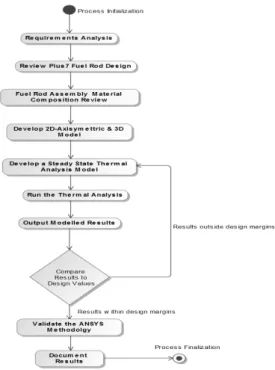
Implementing the system engineering approach assesses the problem in a more efficient manner and eases the execution of the fuel rod heat transfer analysis.

Figure 1 shows a flow chart representing the step-wise flow of activities in the project.

The whole project process execution is represented in the V-model shown in Figure 2.

It is a systematic approach to understand and project requirements of the client and maps these requirements to process definitions. The V-model also performs reviews on multiple levels tracing all requirements through the entire project life cycle so as to ensure clear and unambiguous requirements.

2.3 System Verification

The analysis set-up was verified through reference to fuel design codes and standards as earlier mentioned and following the operational and geometrical guidelines provided for in the SSAR document.

2.4 System Validation

The analysis results were validated through

performance of a comparative study between

the analysis output and the design values

provided for in the SSAR documents. Any

deviations should be within tolerable margins,

otherwise the methodology is not credible.

(4)

<Table 1> General Data

No. Parameter Value

1 Total Core Heat Output, W 3.983x10⁹ 2 Maximum Fuel Centerline Tem-

perature at 100% Power, °C 1,712 3 Maximum fuel Rod LHR, W/cm 420.8 4 Core Heat Generation Rate, W/mm

3

0.79837 5 Fuel rod material(sintered pellet) UO2 6 Pellet diameter (nominal, mm) 8.192

7 Pellet length, mm 9.8

8 Pellet density (nominal, Kg/m

3

) 10,440 9 Pellet density(nominal) (% theoretical) 95.25 10 Stack height density (nominal), Kg/m

3

10,110

11 Clad material Zircalloy-4

12 Clad ID, mm 8.43

13 Clad OD, (nominal), mm 9.50 14 Clad thickness, (nominal), mm 0.89

15 Fill Gas Material Helium

<Table 2> Thermal Properties of Helium

Temperature °C 25.0 100. 200.0 300.0 400.0 Conductivity

(W/mK) 0.150 0.174 0.205 0.237 0.270 Specific Heat

Capacity (J/kgK)

5200 5200 5200 5200 5200

Density(kg/m³) 0.15

<Table 3> Thermal Properties of Uranium Dioxide Temperature℃ 27.0 127.0 227.0 327.0 427.0 527.0 627.0 727.0

Conductivity

(W/mK) 8.10 7.10 6.15 5.33 4.70 4.27 3.88 3.61 Specific

Heat Capacity (J/kgK)

236.4 265.8 282.1 292.4 299.7 305.3 310.0 314.0

Density

(kg/m³) 7,920

<Table 4> Thermal Properties of Zircaloy-4 Temperature℃ 100 200.0 300.0 400.0 500.0 600.0 700.0 800.0

Conductivity

(W/mK) 13.6 14.3 15.2 16.4 18. 20.1 22.5 25.2 Temperature℃ 27.0 127.0 367.0 817.0 820.0 840.0 860.0 880.0

Specific Heat Capacity

(J/kgK)

281 302.0 331.0 375.0 502.0 590.0 615.0 719.0

Density (kg/m³) 6,550

3. Analysis Modelling

3.1 Assumptions for Modeling

Fuel rod geometry and components are shown in Figure 3. Some of the general information related to fuel rod are taken from APR1400 SSAR and shown in Tables 1 through 4.

We assume certain conditions to obtain the results as outlined in our objectives. They include:

A. Axial heat transfer is zero so we could ignore any axial heat transfer.

B. The only active heat transfer process is conduction in the cladding and convection in the fill gas & outer cladding surface/

coolant. The pellet cracks are neglected;

this is beyond the scope of this study.

C. The strain effects, i.e. thinning of clad due to pressure load and creep, on the temperature field of the fuel was not considered.

D. The gap heat transfer coefficient, which

depends on the gap width, the tem-

perature at the fuel outer surface and the

cladding inner surface, the inner gas

(5)

2D Modeling 3D Modeling [Figure 4] Analysis Model

2D Modeling 3D Modeling

[Figure 5] Operating parameters modeling

pressure, and the mean temperature, is modeled by a given function of time. The latter can also include effects arising from radiation.

E. The heat transfer coefficient in the surface- film between cladding and coolant is also approximated by a given function of time.

3.2 Input Parameters Evaluation

3.3 Analysis Model Creation

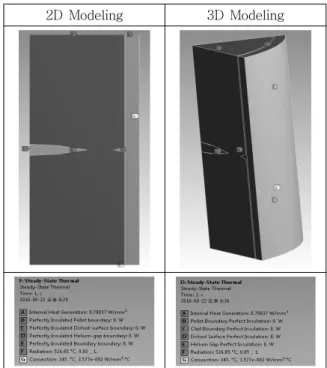
The fuel rod thermal analysis model was created in 2D axisymmetric and 3D model, Figure 4, to compare the results. The models comprise of:

① Two neighboring pellets cut at the plane of symmetry.

② Middle-dished upper pellet section, filled with helium gas

③ Helium gas layer between the pellet and the clad + Pellet chamfered section filled with Helium gas

④ The fuel cladding

Figure 5 shws the boundary conditions that are applied to the model.

4. Analysis & Result

4.1 Calculations - Internal Heat Generation (Pellet Internal)

The internal heat generation is defined as the heat generation rate by a body per unit volume. In our case therefore:

We are provided with the Maximum Linear Heat Rate = 420.8 W/cm = 42.08 W/mm

The pellet’s cross-sectional area

  × 

  × 

 

Maximum Heat Generation rate = Maximum Linear Heat Rate / Pellet’s cross-sectional area

  

  

   

So, we enter this value, 0.79837, into the Internal Heat Generation in ANSYS 17.0

4.2 Steady State Thermal Properties Input

We assign the required boundary conditions

(6)

The result of 2D Modeling

The result of 3D Modeling

[Figure 6] Temperature profile

The result of 2D Modeling

The result of 3D Modeling

[Figure 7] Heat flux profile

(Insulation) as well as defining the Rod Internal Heat transfer phenomena;

• Pellet

• Internal Heat Generation Rate

• Radiation Heat Transfer between the pellet

& the clad through the helium fill gas medium

• Convective Heat Transfer between the clad outer surface and the Coolant channel

4.3 Solving the Model & Viewing the Results Having fully characterized the operating envir- onment we define the desired results output;

Temperature Distribution & Heat Flux Distribution and then run the simulation. The 2D axisymmetry and 3D model results are presented together to make easy comparisons.

Figure 6 shows the results of temperature distribution contour plots, while Figure 7 shows the results of heat flux contour plots.

The results show that there are no significant differences in the result of 2D axisymmetric model and 3D model.

5. Discussion & Conclusion

A. The Analysis Temperature Distribution results generally show close values comparable to the standard values in the SSAR document.

• For the Fuel Centre-line temperature the value deviated by +18.4 0C for 2D case and +20.9 0C for 3D case

• For the Clad outer-surface temperature the value deviated by +37.6 0C for 2D case and +37.56 0C for 3D case

• This deviation is a minor difference since the fuel pellet temperature depend heavily

based on BOL (beginning of life). The SSAR values are also for BOL values.

B. For the maximum heat flux results, the

ANSYS simulated data records +0.7707 W/mm2

(50%) and +0.8194 W/mm2 (58%) deviation

for 2D & 3D cases respectively. This is a

(7)

<Table 5> Analysis results versus standard values No. Item Description Simulated

Value

SSAR Value 2-Dimensional Data

1 Maximum Fuel Centre-line

Temperature, °C 1730.4 1,712

2 Clad Outer-surface Tem-

perature, °C 384.6 347

3 Maximum Fuel Rod Heat

Flux, W/mm

2

2.183 1.4123

3-Dimensional Data 1 Maximum Fuel Centre-line

Temperature, °C 1732.9 1,712

2 Clad Outer-surface Tem-

perature, °C 384.56 347

3 Maximum Fuel Rod Heat

Flux, W/mm

2

2.2317 1.4123

value. From the heat flux profile, we note that this value is only depicted on a very isolated zone (Pellet chamfer section) and thus the geometrical definition at this point may have affected the results. It’s worth to note that from the heat flux profile the actual Maximum Fuel Rod Heat Flux averages at a much lower value, estimated at around 1.63 W/mm2 which depicts a 0.2177 W/mm2 (15%) deviation.

C. In conclusion:

• With additional effort at defining the input values more accurately, better comparable results can actually be achieved.

• These comparable ANSYS results qualify the analysis tool as a viable means to perform thermal analysis.

• The 2D model performs so closely in comparison to the 3D model and this result verifies the unique abilities of the

simplified 2D analysis to represent 3D scenarios in the fuel rod analysis.

Acknowledgement

This work was supported by the 2016 Research fund of the KEPCO International Nuclear Graduate School (KINGS), Republic of Korea. The authors would like to express appreciation toward KINGS.

References

1. Alexander Kossiakoff et.al, Systems Eng- ineering Principles and Practice, 2

nd

ed.

2010.

2. INCOSE Systems Engineering Handbook, V3.2.2, 2011.

3. Sung-Hwan Chung, Kyoung-Myoung Chae, Byung-Il Choi and Heung-Young Lee, 2003, “Calculation of the Effective Thermal Conductivity for PWR Spent Fuel Assembly”, Proceedings of the Korean Nuclear Society Spring Meeting Gyeong ju, Korea, May 2003, pp. 4.

4. Korea Electric Power Corporation and Korea Hydro & Nuclear Power Co., Ltd., 2001, “APR1400 SSAR (Standard Safety Analysis Report”, Republic of Korea, CHAPTER 4 REACTOR.

5. ANSYS V.17 General purpose FEM analysis software. 2016.

6. Ihn Namgung, ANSYS Workbook, KINGS

textbook, 2015.

수치

Figure  1  shows  a  flow  chart  representing  the step-wise flow of activities in the project.
Figure  5  shws  the  boundary  conditions  that  are  applied  to  the  model.
Figure  6  shows  the  results  of  temperature  distribution contour plots, while Figure 7 shows  the  results  of  heat  flux  contour  plots.

참조

관련 문서