http://dx.doi.org/10.4491/KSEE.2016.38.4.193 ISSN 1225-5025, e-ISSN 2383-7810
생태독성실험을 위한 한국 우점종 유리물벼룩(Daphnia galeata)의 특성 및 독성민감도: 큰물벼룩(Daphnia magna)과의 비교연구
Characteristics and Toxicity Sensitivity of Korean Dominant Species Daphnia
galeata for Ecotoxicity Testing: Comparative Study with Daphnia magna
최영설․곽진일․안윤주†
Rongxue Cui․Jin Il Kwak․Youn-Joo An† 건국대학교 환경과학과
Department of Environmental Science, Konkuk University
(Received November 11, 2015; Revised February 25, 2016; Accepted March 14, 2016)
Abstract : Water flea is a widely used test species in the aquatic ecotoxicity test. In Korea, D. magna is currently used as a standard test species, however that do not inhabit in the Korean aquatic ecosystem. In this study, Daphnia galeata, which is a dominant species in the Korean aquatic ecosystem, was collected from domestic lake and investigated to suggest the D. galeata for ecotoxicity assessment in Korea. We investigated the characteristics, life span, and toxicity sensitivity compared with D.
magna. The life span test of D. galeata was performed in this study, and then the results were compared to the sensitivity with D. magna to confirm the applicability for ecotoxicity assessment. The 48h-L(E)C50 values for seven heavy metals (As, Cd, Cr, Cu, Hg, Ni, and Zn) of D. galeata and D. magna were collected and analyzed. As a results, shorter lifetime, less reproduction, smaller body size of D. galeata were observed compared with D. magna. D. galeata was similar or more sensitive than D. magna for seven heavy metals. Therefore, we propose that D. galeata is a suitable test species for ecotoxicity testing in Korea.
Key Words : Daphnia galeata, Daphnia magna, Life Span, Ecotoxicity, Toxicity Sensitivity
요약 : 생태독성 관리제도가 국내에 도입된 이래 Daphnia magna(큰물벼룩)는 시험종으로 널리 사용되고 있다. 다만 D. magna 는 국내 비서식종으로 국내의 담수 환경을 반영한 생태독성 평가에는 제한점이 존재한다. 따라서 국내 서식 물벼룩 중 적합 한 시험종을 선정하여 생태독성 평가에 대한 활용가능성을 평가할 필요가 있다. Daphnia galeata(유리물벼룩)는 국내 한강 수 계 우점종이며 대부분의 수계에 서식하고 있는 물벼룩이다. 본 연구에서는 D. galeata의 국내 고유 시험종으로서의 활용가능 성을 평가하고자 D. galeata의 특성 및 생활사를 확인하여 D. magna와 비교하였다. 또한 D. galeata의 독성민감도를 확인하고 자 D. galeata 및 D. magna에 대한 7종 중금속(As, Cd, Cr, Cu, Hg, Ni, Zn) 급성독성자료 조사, 수집하여 민감도를 비교분석 하였다. D. galeata의 생활사 측정결과 D. galeata의 생존기간은 28 ± 8일로 D. magna의 절반수준으로 나타났으며 생존기간 동안의 어미 개체당 새끼 생산량도 D. magna보다 적었으며, 평균적인 체구도 D. magna보다 D. galeata가 작았다. 독성민감도 는 7종의 중금속에 대해 D. galeata가 D. magna보다 더 민감하거나 유사한 것으로 확인되었다. 장단점을 종합적으로 고려한 결과, D. galeata는 국내 고유 생태독성 시험종으로 적합하며 차후 D. magna를 대체하거나 병행하여 사용할 수 있는 시험종 으로 사료된다.
주제어 : 유리물벼룩, 큰물벼룩, 생활사, 생태독성, 독성민감도
1. 서 론
물벼룩은 담수 생태계에 서식하는 대표적 수서 무척추동 물로 조류(algae)를 섭취하는 1차 소비자임과 동시에 어류 의 피식자로서 먹이사슬에서 매우 중요한 역할을 하므로 화 학물질의 생태독성평가에 빈번하게 사용되는 생물종이다.1,2) 현재 경제협력개발기구(OECD),3,4) 국제표준화기구(ISO)5,6) 등 국제기관에서는 Daphnia magna(큰 물벼룩)를 표준시험 종으로 추천하고 있으며, 실제 연구에서도 D. magna는 가 장 많이 사용되고 있다. 우리나라 환경부의 ‘수질 및 수생 태계 보전에 관한 법률 시행규칙’에 근거하여 수질오염물
질의 배출허용기준7)과 폐수종말처리시설의 방류수 수질기
준8)에서 생태독성을 평가하도록 기준이 마련되어 있는데,
이 때 수질오염공정시험기준에 따라 D. magna를 독성시험 에 사용하도록 제시하고 있다.9,10) 그러나, D. magna는 미 북반구에 주로 서식10)하고 국내 수계에는 서식하지 않는 물벼룩11)으로 국내 담수생태계에 대한 영향을 직접적으로 평가하기에는 한계가 존재한다. 현재 국내 서식종인 Moina macrocopa(모이나물벼록)를 대상으로 한 고유종 시험종 연 구가 진행 되고 있으나,10) 국내에 서식하는 물벼룩 표준시 험종은 지리적 분포, 대표성, 인공배양가능성, 독성민감도 등 문제로 인하여 매우 제한적이므로, 국내 담수생태환경 을 반영할 수 있는 국내 시험종의 도입방안에 대한 연구가 필요하다.
국내수계에 서식하는 것으로 알려진 물벼룩은 총 29속 53 종으로 Daphnia galeata, Daphnia pulex, Bosmina longirostris,
Diaphanosoma brochyurum, Moina macrocopa 등이 있다.12) 본 연구에서는 국내 우점종이며 D. magna와 동일한 Daphnia 속에 속하는 물벼룩인 D. galeata(유리물벼룩)를 대상으로 국 내 고유 시험종으로서의 적용가능성을 평가하였다. D. galeata 는 도감에 의하면 “몸은 대체로 긴 달걀형이고 꼬리길이가 긴 편이며 각자는 긴 것이 많다. 머리부와 갑각사이는 목홈 에 의한 구별이 명확하지 않으며 입이 잘 발달되어 있다.
단안인 것이 보통이며 꼬리발톱 근처에 10~20개의 미세한 털 이 존재하고 몸의 뒤쪽 등에는 1~4개의 돌기가 있으며 수컷 은 긴 제1촉각을 가짐” 으로 보고되어 있다.13,14) D. galeata 는 전형적인 원양 물벼룩15)이며 습한 바람이 부는 자연환 경에서 수면 위 70-80 cm에서 10-50 cm 길이, 3-5 cm 넓이 의 무리를 지어 다니고 한 무리에는 약 1,000-100,000마리 의 개체가 있다.16) Koivisto15)의 연구에서는 D. galeata 성 체의 크기를 1.0-2.5 mm로 보고하였으며, 국내 연구16) 결과 에서는 팔당호에 서식하는 D. galeata의 크기가 0.300-1.525 mm로 측정된 것으로 확인되었다. D. galeata는 전 세계적 으로 신북구와 구북구에 분포되어 있고,18) 국내에서는 한강 수계의 우점 물벼룩이며, 팔당호,17,19,20) 소양호,21) 파로호,20) 청평호,22,23) 의암호,23) 춘천호,22,23) 충주호,19,24,25) 주암호14) 등 대부분 수계에서 서식하고 있는 것으로 확인되었다.
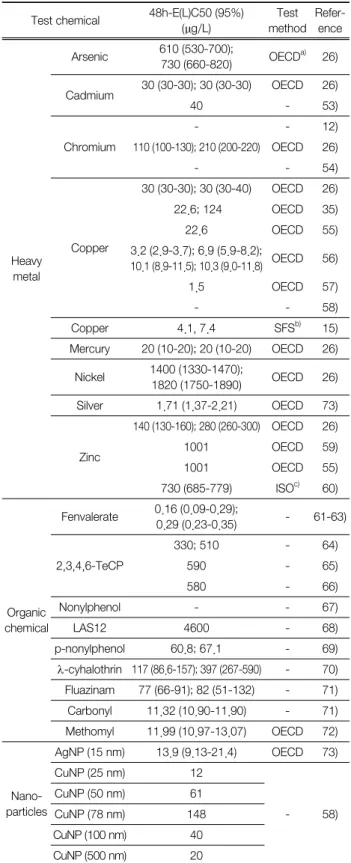
다수의 문헌에서 보고된 바와 같이 D. galeata는 국내 수 계에 우점하여 서식하는 종이지만, 국내에서 D. galeata를 이용한 생태독성 연구는 미비하며12,26) 국외에서도 많지 않 은 것으로 조사되었다. D. galeata를 이용한 독성연구는 총 23건으로, 물질별로는 중금속류가 10건, 유기화합물 관련 독성연구가 12건, 나노물질 독성연구가 1건으로 확인되었 다(Table 1). 따라서 본 연구에서는 D. galeata를 국내 고유 생태독성 시험종으로 제안하고자 D. galeata를 채집 및 배 양을 하였으며, 표준시험종인 D. magna와의 특성, 생활사 및 독성민감도를 비교하였다. 한편, 본 연구결과는 ‘국내 수 생생물 보호를 위한 환경기준 마련 연구’27)에서 국내 수생 생물 보호기준 제안을 위한 기반자료로 활용되었다.
2. 연구방법
2.1. Daphnia galeata 채집 및 배양
D. galeata는 2012년 5월에 두 차례에 걸쳐 건국대학교 교 내에 위치한 호수(일감호)에서 동물플랑크톤 채집망을 이 용하여 채집하였다. 채집 개체는 육안, 현미경관찰, 기존문헌 및 도감 분석을 통해 D. galeata로 추측되는 개체를 분리하 였다. 채집 0일부터 5일째까지는 GF/F filter (Whatman FG/F filter, Whatman)로 여과한 일감호 호숫물에서 D. galeata로 추측되는 개체를 배양하면서 실험실 환경에서의 배양 적합 성을 확인하였다. 채집 후 6일째부터는 일감호 호숫물과 mo- dified moderately hard water (MHW)28)을 4:1, 2:1, 1:1, 그 리고 1:2의 비율로 혼합한 배양액(media)에서 순차적으로 배양하여, 채집한 D. galeata로 추측되는 개체가 실험실 조
Table 1. 48h-E(L)C50 values for Daphnia galeata exposed to chemicals in the previous studies
Test chemical 48h-E(L)C50 (95%) (µg/L)
Test method
Refer- ence
Heavy metal
Arsenic 610 (530-700);
730 (660-820) OECDa) 26)
Cadmium 30 (30-30); 30 (30-30) OECD 26)
40 - 53)
Chromium
- - 12)
110 (100-130); 210 (200-220) OECD 26)
- - 54)
Copper
30 (30-30); 30 (30-40) OECD 26) 22.6; 124 OECD 35)
22.6 OECD 55)
3.2 (2.9-3.7); 6.9 (5.9-8.2);
10.1 (8.9-11.5); 10.3 (9.0-11.8) OECD 56)
1.5 OECD 57)
- - 58)
Copper 4.1, 7.4 SFSb) 15)
Mercury 20 (10-20); 20 (10-20) OECD 26)
Nickel 1400 (1330-1470);
1820 (1750-1890) OECD 26) Silver 1.71 (1.37-2.21) OECD 73)
Zinc
140 (130-160); 280 (260-300) OECD 26)
1001 OECD 59)
1001 OECD 55)
730 (685-779) ISOc) 60)
Organic chemical
Fenvalerate 0.16 (0.09-0.29);
0.29 (0.23-0.35) - 61-63)
2,3,4,6-TeCP
330; 510 - 64)
590 - 65)
580 - 66)
Nonylphenol - - 67)
LAS12 4600 - 68)
p-nonylphenol 60.8; 67.1 - 69)
λ-cyhalothrin 117 (86.6-157); 397 (267-590) - 70) Fluazinam 77 (66-91); 82 (51-132) - 71) Carbonyl 11.32 (10.90-11.90) - 71) Methomyl 11.99 (10.97-13.07) OECD 72)
Nano- particles
AgNP (15 nm) 13.9 (9.13-21.4) OECD 73)
CuNP (25 nm) 12
- 58)
CuNP (50 nm) 61
CuNP (78 nm) 148
CuNP (100 nm) 40
CuNP (500 nm) 20
a)OECD guidelines for testing of chemicals, No. 202. Daphnia sp., acute immobilisation test
b)SFS 5062 (1984). Water quality. Determination of the acute toxicity with water flea, Daphnia magna Straus.
c) ISO 6341:1996. Water quality-Determination of the imhibition of the mobility of Daphnia magna Straus (Cladocera, Crustacea)-Acute toxicity test.
Fig. 1. Images of female and male Daphnia galeata and Daphnia magna. (A) D. galeata female at 24 h; (B) D. galeata male at 24 h; (C) D. galeata female at 21 d, (D) D. magna female at 24 h; (E) D. magna male at 24 h; (F) D. magna female at 21 d.
건과 인공 배양액인 MHW에 순응할 수 있도록 하였다. 이 후 인공배양액인 100% MHW에서의 배양․유지가 성공함 에 따라 물벼룩 분류전문가의 도움으로 동정평가를 진행하 여 D. galeata종임을 검증받았다. 실험실 내에서 배양 시 온 도는 21℃, 명암 광주기는 16:8 시간으로 하였으며, 먹이는 담수녹조류인 Chlamydomonas reinhardtii, Chlorella vulgaris 및 Pseudokirchneriella subcapitata를 공급하여 지속적으로 계대배양하였다.
2.2. 생활사(Life span) 비교
100% MHW와 실험실 조건에서 D. galeata의 순응 완료 후 D. galeata의 생활사를 측정하였으며, 유사 조건에서의 D.
magna 생활사29)와 비교분석하였다. 본 연구에서는 D. galeata 의 생활사를 측정하기 위해 35 mL glass vial (30(D) mm × 75(H) mm)에 20 mL의 MHW를 첨가 후 3배(brood) 이후의 24시간 미만의 어린(neonate) D. galeata 암컷 개체를 1마리 씩 노출하여 총 29반복을 관찰하였다. D. galeata 수컷의 경 우 암컷보다 상대적으로 긴 제1촉각을 갖고 있으므로,14) 현 미경을 이용하여 제1촉각의 길이를 확인하여 암컷을 선별 하였다(Fig. 1). 생활사 관찰 동안 온도 21℃, 명암 광주기 16:8 시간 조건으로 유지하였으며, MHW는 2일에 한 번씩 교체하였다. 먹이는 반복수당 매일 50 µL의 C. reinhardtii 를 공급하였으며 24시간마다 유영장애, 치사 및 새끼 생산 수를 확인하였다. 한편, D. galeata의 형태학적 특성은 기존 문헌 조사를 통해 분석하였다.
2.3. 독성민감도 비교
D. galeata를 국내 고유 생태독성 시험종으로 제안하기 위 해서는 기존에 사용되고 있는 D. magna의 독성민감도와 비교가 필요하다. 본 연구에서는 D. galeata와 D. magna의 독성민감도를 비교하기 위해 수계 주요 오염물질인 중금속 7종(As3+, Cd2+, Cr6+, Cu2+, Hg2+, Ni2+, Zn2+)을 선택하였으
며, 각 물질에 대한 물벼룩의 48h-E(L)C50값을 조사, 비교 하였다. 각 물질별 D. magna에 대한 48h-E(L)C50값은 US EPA ECOTOX Database (http://cfpub.epa.gov/ecotox/)에서 수집하였으며, 수집된 자료 중 중금속 무기염을 이용한 독 성값만 민감도 비교에 활용하였다. 수집된 자료 중 제시된 48h-E(L)C50는 As3+, Cd2+, Cr6+, Cu2+, Hg2+, Ni2+및 Zn2+별 로 각각 16, 217, 57, 404, 30, 21 및 111개로 확인되었다.30) 반면, D. galeata를 이용한 7종 중금속에 대한 48h-E(L)C50 독성자료는 Table 1에 제시된 바와 같이 매우 제한적이다.
3. 결과 및 고찰
3.1. Daphnia galeata와 Daphnia magna의 형태학적 특성 및 생활사 비교
Malone16)의 연구에 의하면, D. galeata의 머리 모양은 두 가지 형태로 구분할 수 있다. 한 종은 머리가 둥글고 다른 한 종은 삼각형 모양이나 두 종 모두 머리 끝부분이 뾰족한 것으로 알려져 있다. 본 연구에서 채집한 어린(neonate) D.
galeata 또한 두 가지 다른 형태의 머리모양을 한 D. galeata 가 모두 관찰되었으나 개체가 성숙됨에 따라 머리가 점차 둥글어져 뾰족한 부분이 사라지는 것으로 확인되었다(Fig.
1). D. galeata는 D. galeata Sars, D. galeata mendotae, D.
galeata galeata31) 등 여러 아종이 있는데, 머리의 모양이 다 른 것이 관찰된 것은 D. galeata의 아종에 따른 특성이거나 계절적, 북방적 변이에 의한 것으로 보고되었다.32) 기존연 구의 조사결과, D. galeata 성체(adult)의 강모 간격 및 필터 메쉬 크기(filter mesh size)는 각각 0.4-1.3 µm과 0.32-1.0 µm이며, D. magna의 강모 간격 및 필터 메쉬 크기는 각각 0.3-0.8 µm, 0.24-0.64 µm로 D. magna의 강모 간격 및 필터 메쉬보다 D. galeata가 큰 것으로 나타났지만, 성체의 크기 는 D. galeata가 1.0-2.5 mm로 D. magna (2.0-3.0 mm)보다
작은 것으로 확인되었다.15,33) 본 연구에서도 실험실에서 배 양중인 D. galeata와 D. magna를 대상으로 부화한지 24시 간 및 21일째 되는 암컷을 현미경으로 관찰한 결과, Fig. 1 에서와 같이 D. magna가 D. galeata보다 큰 체구를 가지고 있음을 확인하였다.
본 연구에서 D. galeata의 생활사를 관찰한 결과, MHW 에서 평균 28 ± 8일 생존하는 것으로 확인되었으며, 첫 배 (brood)시간은 9 ± 2일로 나타났다. 또한 생활사 동안에 어 미 개체당 총 새끼 생산수는 29 ± 23마리, 배(brood)당 4 ± 1 마리씩 2 ± 1일 간격으로 새끼를 생산하였으며(Table 2), 배 반복(number of broods produced)은 최대 16번으로 확인되 었다(Fig. 2). 본 측정결과는, 기존 연구결과34)와도 유사한데, 임34)의 연구에서는 여과한 현장시료를 이용하여 D. galeata 생활사를 확인한 결과 평균 20일, 최대 40일 정도 생존하였 다고 보고하고 있다. 한편, 최와 임11)의 연구에서는 MHW에 서 D. galeata가 7일밖에 생존하지 못하였고, 짧은 생존 기 간 동안 생식도 관찰되지 않았지만, M4 및 비료를 이용한 배양액에서는 각각 21, 34일 동안의 생존과 29, 42마리 새 끼 생산을 보고한 바 있다. MHW에서의 D. magna 생활사 의 경우, 기존 연구결과를 통해 분석하였으며, 평균 생존은 50.1 ± 10.9일, 첫 배 시간은 9.0 ± 0.0일, 어미당 총 새끼 생
Table 2. Life span, first brood, total number of offspring per adult, and the number of offspring per broods of Da- phnia galeata and Daphnia magna.
Daphnia galeataa)
Daphnia magna29) Life span (days) 28±8 50.1±10.9
First brood (days) 9±2 9.0±0.0
Total number of offspring per adult 29±23 357.8±104.7 Number of offspring per brood 4±2 13.3±3.7
a)Data from this study
Fig. 2. Number of offspring per adult at each number of broods produced. The italic number under the each box plot indicates number of survivors of adult Daphnia galeata. Life span test was conducted until the last adult was dead.
산수는 357.8 ± 104.7마리, 배반복은 평균 13.3 ± 3.7회로 확 인되었다(Table 2).29) D. galeata와 D. magna의 생활사를 비 교하면 두 종의 첫배시간은 비슷하지만 D. galeata의 생존 기간은 D. magna의 절반 수준으로 따라서 배반복과 총 새끼 생산수가 훨씬 적은 것으로 확인되었다.
3.2. Daphnia galeata와 Daphnia magna의 독성민감 도 비교
기존 연구결과를 이용하여 7종 중금속(As3+, Cd2+, Cr6+, Cu2+, Hg2+, Ni2+, Zn2+)에 대한 D. galeata와 D. magna의 48h-E(L)C50 비교결과(Fig. 3), 중간값(median)을 기준으로 Cd2+, Cr6+ 및 Ni2+에 대해 D. galeata와 D. magna의 독성민 감도는 유의한 차이는 없는 것으로 나타났다. 그러나 As3+, Cu2+ 및 Zn2+에 대해서는 D. galeata가 D. magna보다 민감 하였으며, Hg2+에 대해서는 D. galeata가 D. magna보다 약 간 둔감한 것으로 확인되었다. 한편 평균값(mean)을 기준으 로 독성민감도를 비교할 경우, Hg2+에 대해 D. magna보다 둔감한 것으로 분석되었으나, 그 외 6종 중금속은 D. magna 보다 민감한 것으로 나타났는데, 이는 생체량 차이로 인해 민감도 차이가 발생한 것으로 사료된다. 이러한 결과는 기존 연구결과와도 부합되는바 Bossuyt 등35)의 연구에서 현장수 (field water)에서 직접 채집한 D. magna와 D. galeata를 이 용하여 현장수와 ISO 배양액에서의 구리 독성평가를 진행하 여 48h-EC50 비교 결과, D. galeata가 D. magna보다 민감한 것을 관찰한바 있다. 다만 물벼룩에 대한 중금속 독성은 시 험수의 기본 물리적 특성인 pH,36~46) 경도,39,40,42,43,45,47,48) 알칼 리도,43,48) DOC,36,38~40,44~46,49) DOM45,47,49~51) 등과 화학적 특성 인 Na+,36,37,41,44,46,48) K+,37,41,44,46) Mg2+,37,41,48,52) Ca2+ 37,38,41,44,46,48,52)
의 영향을 받으며, 본 연구에서 제시된 독성민감도 결과 (Fig. 3) 또한 동일한 조건에서의 독성민감도 비교결과가 아 니라는 한계점이 존재한다. 현재까지 D. galeata 관련 독성 연구는 제한적이며(Table 1), 따라서 본 연구에서 D. magna 와의 독성민감도 비교에 활용된 D. galeata의 독성자료도 부족한 실정으로, 향후 D. galeata를 이용한 독성자료 생산 이 필요하며, 더 많은 독성자료를 활용한 D. magna와의 독 성민감도 비교가 요구된다.
3.3. 국내 생태독성시험 활용성
7종 중금속에 대한 독성민감도 비교분석 결과, D. galeata 는 표준시험종으로 사용되고 있는 D. magna보다 민감하거나 유사한 것으로 확인되었다. 그러나 본 연구에서 D. galeata 를 채집, 배양, 유지하고 독성시험을 진행하는 과정에서, 생 태독성시험에 적용하기에 D. galeata는 개체 특성상 몇 가 지 제약이 존재하는 것으로 확인되었다. 첫째로 D. galeata 의 entrapment 현상이다. D. galeata의 경우 자연환경이 아닌 실험실 조건에서 D. magna와 달리 entrapment 현상이 쉽게 발생하는 것으로 관찰되었다. Entrapment 현상이 발생하면 개체는 실험 용액의 표면장력으로 인하여 수면에 갇히게 되
Fig. 3. 48 h-E(L)C values distribution of (A) As, (B) Cd, (C) Cr, (D) Cu, (E) Hg, (F) Ni, and (G) Zn for Daphnia galeata and Daphnia magna. The Daphnia galeata data were collected from Cui et al.26) and Daphnia magna data were from USEPA ECOTOX.30)
는데 자체의 힘으로는 수면 아래로 벗어나지 못하여 유영 장애가 발생하며 수면에 갇히는 시간이 점차 증가함에 따라 최종 치사에 이르는 것으로 관찰되었다. 따라서 D. galeata 를 생태독성시험에 적용하려면 entrapment 현상을 제어해 야 하는데, 이러한 현상은 1 mg/L의 saponin을 시험용액에
첨가하면 충분히 제어가 되었으며, 적용된 saponin농도에 의 한 영향은 무시할 수 있는 수준으로 확인되었다.26) 두 번째 로 확인된 제약은 D. galeata의 생존기간 및 새끼 생산성이 D. magna보다 상대적으로 짧고 적기 때문에 실험에 필요한 개체 확보가 D. magna보다 어려울 수 있다는 것이다. 그러
나 이 제약은 배양 및 유지 개체수를 늘리는 방법으로 충분 히 해결 가능한 것으로 확인되었다. 따라서 국내수계에 우점 하는 D. galeata는 국내 생태독성 표준시험종으로 충분히 활 용 가능할 것으로 판단된다.
4. 결 론
현재 우리나라는 ‘수질 및 수생태계 보전에 관한 법률 시 행규칙’상 수질오염물질의 배출허용기준7)과 폐수종말처리 시설의 방류수 수질기준8) 평가 시 수질오염공정시험기준에 따라 D. magna를 독성평가에 사용하고 있다.9,10) 그러나 D.
magna는 국내 수계 비서식종으로 시험물질이 국내 수생태 계에 대한 영향을 직접적으로 반영하기에는 한계가 있다.
따라서 본 연구에서는 생활사 관찰 및 독성민감도 비교분 석을 통해 국내 담수생태계의 우점종이며 실험실조건에서 계대배양이 가능한 D. galeata를 국내 고유 생태독성 시험 종 및 향후 국내 수생생물 보호 기준 설립에 활용 가능한 종으로 제안하였다. 한편, D. galeata는 “국내 수생생물 보호 를 위한 환경기준 마련 연구 (I)”27)에서 국내 서식종을 이용 한 독성자료 생산에서 풍년새우(Branchinella kugenumaensis), 미꾸리(Misgurnus anguillicaudatus)와 함께 연구된 바 있다.
우리나라 생태독성 관리제도가 확대되기 위해서는 국내 시 험종 발굴에 대한 연구가 절실하며, 국내수계에 우점하는 생물종을 대상으로 실험실 배양조건 확립 및 국제표준 시험 종과의 비교연구가 앞으로 필요할 것이다.
Acknowledgement
This research was supported by the Basic Science Research Program of the National Research Foundation of Korea (NRF), which is funded by the Ministry of Science, ICT, and Future Planning (2014R1A2A1A11050513) and the Ministry of Educa- tion (2013R1A1A2061386). The authors acknowledge their gratitude to Prof. Seong Myeong Yoon in Chosun University, Korea for his species identification.
References
1. Sarma, S. S. S. and Nandini, S., “Review of recent ecotoxi- cological studies on cladocerans,” J. Environ. Sci. Heal. B, 41(8), 1417~1430(2006).
2. An, Y.-J., Nam, S.-H. and Lee, W.-M., “Fundamentals of eco- toxicity evaluation methods using domestic aquatic organisms in Korea: (II) Water flea,” Korean J. Limnol., 40(3), 357~
369(2007).
3. Organization for Economic Cooperation and Development (OECD), “Guideline for testing of chemicals 202 Daphnia
sp., Acute immobilisation Stest,”(2004).
4. Organization for Economic Cooperation and Development (OECD), “Guideline for testing of chemicals 211 Daphnia magna reproduction test,”(2012).
5. International Organization for Standardization (ISO), “ISO 10706:2000 Water quality-Determination of long term toxicity of substances to Daphnia magna Straus (Cladocera, Crust- acea),”(2000).
6. International Organization for Standardization (ISO), “ISO 6341:2012 Water quality-Determination of the inhibition of the mobility of Daphnia magna Straus (Cladocera, Crust- acea),”(2012).
7. Ministry of Environment, “Enforcement regulations of the water quality and aquatic ecosystem conservation act. annexed Table 13-the standards for permissible discharge of water pollutants,”(2013).
8. Ministry of Environment, “Enforcement regulations of the water quality and aquatic ecosystem conservation act. annexed Table 10-the standards for the quality of discharged water of the wastewater treatment facilities”(2013).
9. Ministry of Environment, “Standard Method of Water pol- lution ES 04751.1 Acute toxicity test method of the Daphnia magna Straus (cladocera, crustacea),”(2015).
10. Ministry of Environment, “Whole effluent toxicity informa- tion system,” https://www.biowet.or.kr/iwt/ko/test/EgovTest rganism.do(2015).
11. Choe, S.-H. and Lim, B.-J., “Reproduction of water flea by the culture conditions,” Korean J. Limnol., 36, 208~214(2003).
12. National Institute of Environmental Research, “Behavior as- sessment of water flea on toxicants,”(2001).
13. Ministry of Environment, National Institute of Environmental Research, Han River Environment Research Center, “Illustra- tion of biota in the Lake Paldang,” p. 158(2007).
14. Ministry of Environment, National Institute of Environmental Research, Yeongsan River Environment Research Center, “It's nature! - Illustration of organisms in Yeongsan and Seomjingan River,” p. 84(2009).
15. Koivisto, S., Ketola, M. and Walls, M., “Comparison of five cladoceran species in short- and long-term copper exposure,”
Hydrobiologia, 248(2), 125~136(1992).
16. Malone, B. J. and McQueen, D. J., “Horizontal patchiness in zooplankton populations in two Ontario kettle lakes,” Hy- drobiologia, 99(2), 101~124(1983).
17. National Institute of Environmental Research, “Mechanism of algal occurrence and succession in Lake Paldang - Elucida- tion on structure and function of phyto- and zooplankton,”
(2003).
18. Kotov, A., “Crustacea-cladocera checklist,” FADA (Freshwater Animal Diversity Assessment)(2013).
19. National Institute of Environmental Research, “Survey on the structure of ecosystem in middle-downstream of South-Han river and Lake Paldang,”(2005).
20. National Institute of Environmental Research, “Survey on the structure of ecosystem in middle-downstream of South-Han river and Lake Paldang,”(2006).
21. National Institute of Environmental Research, “Survey of ecosystem structure in two lakes located in the upper regions of the North Han-River (Lake Soyang and Paro),”(2006).
22. National Institute of Environmental Research, “Survey of ecological structure in three Lakes located in the middle regions of the North Han-River (Lake Chunchon, Uiam and Chungpyong,”(2005).
23. National Institute of Environmental Research, “Survey of ecological structure in three Lakes located in the middle re- gions of the North Han-River (Lake Chunchon, Uiam and Chungpyong,”(2006).
24. National Institute of Environmental Research, “Investigation of ecosystem and structure of Southern Han River's Basin and Lake Chungju,”(2005).
25. National Institute of Environmental Research, “Investigation of ecosystem and structure of Southern Han River's Basin and Lake Chungju,”(2006).
26. Ministry of Environment, “Establishment of environment stan- dards for protection of aquatic ecosystems,”(2015).
27. United State Environmental Protection Agency (USEPA),
“Methods for measuring the acute toxicity of effluents and receiving waters to freshwater and marine organisms,” EPA/
812/R/02/012, Office of Water, Washington DC, USA(2002).
28. Kim, B.-S., Park, Y.-K., Park, K.-H., Shin, J.-S., Kim, J.-H.
and Yoon, S. M., “Comparison of life cycle of several Ko- rean native freshwater cladocerans in laboratory culture con- ditions,” Korean J. Pestic. Sci., 10(3), 196~200(2006).
29. United State Environmental Protection Agency (USEPA),
“ECOTOX database,” http://cfpub.epa.gov/ecotox/quick_query.
htm(2014).
30. Glagolev, S. M., “Species composition of Daphnia in Lake Glubokoe wih notes on the taxonomy and geographical dis- tribution of some species,” Hydrobiologia, 141(1-2), 55~82 (1986).
31. Cho, K. S., “Illustration of the fresh water zooplankton of Korea,” Academy Publishing Company(1993).
32. Geller, W. and Müller, H., “The filtration apparatus of clado- cera: filter mesh-sizes and their implications on food selecti- vity,” Oecologia(berl), 49, 316~321(1981).
33. Lim, B.-J., “Ecological studies on zooplankton community in the lower Han River system,” Doctor's Thesis of Hanyang University(1992).
34. Bossuyt, B. T. A., De Schamphelaere, K. A. C. and Janssen, C. R., “Using the biotic ligand model for predicting the acute sensitivity of cladoceran dominated communities to copper in natural surface waters,” Environ. Sci. Technol., 38(19), 5030~5037(2004).
35. Santore, R. C., Di Tora, D. M., Paquin, P. R., Allen, H. E.
and Meyer, J. S., ”Biotic ligand model of the acute toxicity of metals. 2. Application to acute copper toxicity in fresh- water fish and Daphnia,” Environ. Toxicol. Chem., 20(10), 2397~2402(2001).
36. De Schamphelaere, K. A. C. and Janssen, C. R., “A biotic ligand model predicting acute copper toxicity for Daphnia magna: the effects of calcium, magnesium, sodium, potas-
sium and pH,” Envion. Sci. Technol., 36(1), 48~54(2002).
37. De Schamphelaere, K. A. C., Heijerick, D. G. and Janssen, C. R., “Refinement and field validation of a biotic ligand model predicting acute copper toxicity to Daphnia magna,”
Comp. Biochem. Physiol. C, 133(1), 243~258(2002).
38. De Schamphelaere, K. A. C. and Janssen, C. R., “Develop- ment and field validation of a biotic ligand model predict- ing chronic copper toxicity to Daphnia magna,” Environ.
Toxicol. Chem., 23(6), 1365~1375(2004).
39. De Schamphelaere, K. A. C. and Janssen, C. R., “Effect of dissolved organic carbon concentration and source, pH, and water hardness on chronic toxicity of copper to Daphnia magna,” Environ. Toxicol. Chem., 23(5), 1115~1122(2004).
40. Heijerick, D. G., De Schamphelaere, K. A. C. and Janssen, C. R., “Predicting acute zinc toxicity for Daphnia magna as a function of key water chemistry characteristics: develop- ment and validation of a biotic ligand model,” Environ. Toxi- col. Chem., 21(6), 1309~1315(2002).
41. Heijerick, D. G., Janssen, C. R. and De Coen, W. M., “The combined effects of hardness, pH, and dissolved organic car- bon on the chronic toxicity of Zn to D. magna: develop- ment of a surface response model,” Arch. Environ. Contam.
Toxicol., 44(2), 201~217(2003).
42. Hyne, R. V., Pablo, F., Julli, M. and Markich, S. J., “In- fluence of water chemistry on the acute toxicity of copper and zinc to the cladoceran Ceriodaphnia Cf Dubia,” Environ.
Toxicol. Chem., 24(7), 1667~1675(2005).
43. Clifford, M. and McGeer, J. C., “Development of a biotic ligand model for the acute toxicity of zinc to Daphnia pulex in soft waters,” Aquat. Toxicol., 91(1), 26~32(2009).
44. Ryan, A. C., Tomasso, J. R. and Klaine, S. J., “Influence of pH, hardness, dissolved organic carbon concentration, and di- ssolved organic matter source on the acute toxicity of copper to Daphnia magna in soft waters: implications for the biotic ligand model,” Environ. Toxicol. Chem., 28(8), 1663~1670 (2009).
45. Clifford, M. and McGeer, J. C., “Development of a biotic ligand model to predict the acute toxicity of cadmium to Daphnia pulex,” Aquat. Toxicol., 98(1), 1~7(2010).
46. Pettinen, S., Kostamo, A. and Kukkonen, J. V. K., “Com- bined effects of dissolved organic material and water hard- ness on toxicity of cadmium to Daphnia magna,” Environ.
Toxicol. Chem., 17(2), 2498~2503(1998).
47. Gensemer, R. W., Naddy, R. B., Stubblefield, W. A., Hockett, J. R., Santore, R. and Paquin, P., “Evaluating the role of ion composition on the toxicity of copper to Ceriodaphnia dubia in very hard waters,” Comp. Biochem. Physiol. C, 133(1), 87~97(2002).
48. Karmer, K. J. M., Jak, R. G., Hattum, B. V. and Hooftman, R. N., “Copper toxicity in relation to surface water-dissolved organic matter: biological effects to Daphnia magna,” Environ.
Toxicol. Chem., 23(12), 2971~2980(2004).
49. De Schamphelaere, K. A. C., Vasconcelos, F. M., Tack, F.
M. G., Allen, H. E. and Janssen, C. R., “Effect of dissolved organic matter source on acute copper toxicity to Daphnia
magna,” Environ. Toxicol. Chem., 23(5), 1248~1255(2004).
50. Al-Reasi, H. A, Smith, D. S. and Wood, C. M., “Evaluating the ameliorative effect of natural dissolved organic matter (DOM) quality on copper toxicity to Daphnia magna: impro- ving the BLM,” Ecotoxicol., 21(2), 524~537(2012).
51. Naddy, R. B., Stubblefield, W. A., May, J. R., Tucker, S. A.
and Hockett, J. R., “The effect of calcium and magnesium ratio on the toxicity of copper to five aquatic species in fresh- water,” Environ. Toxicol. Chem., 21(2), 347~352(2002).
52. Marshall, J. S., “Cadmium toxicity to laboratory and field populations of Daphnia galeata mendotae,” Bullet. Environ.
Contam. Toxicol., 21(4-5), 453~457(1979).
53. Winner, R. W., “Toxicity of copper to Daphnids in recons- tituted and natural water,” EPA-600/3-76-051 p. 68, US EPA (1976).
54. Bossuyt, B. T. A., Muyssen, B. T. A. and Janssen, C. R.,
“Relevance of generic and site-specific species sensitivity distributions in the current risk assessment procedures for copper and zinc,” Environ. Toxicol. Chem., 24(2), 470~478 (2005).
55. De Schamphelaere, K. A. C., Bossuyt, B. T. A. and Janssen, C. R., “Variability of the protective effect of sodium on the acute toxicity of copper to freshwater cladocerans,” Environ.
Toxicol. Chem., 26(3), 535~542(2007).
56. Song, L., Vuver, M. G., De Snoo, G. R. and Peunenburg, W. J. G. M., “Assessing toxicity of copper nanoparticles across five cladoceran species,” Environ. Toxicol. Chem., 34 (8), 1863~1869(2015).
57. Piscia, R., Colombini, M., Ponti, B., Bettinetti, R., Monticelli, D., Rossi, V. and Manca, M., “Lifetime response of contem- porary versus resurrected Daphnia galeata Sars (crustacean, cladocera) to Cu(II) chronic exposure,” Bullet. Environ. Con- tam. Toxicol., 94(1), 46~51(2015).
58. Muyssen, B. T. A., Bossuyt, B. T. A. and Janssen, C. R.,
“Inter- and Intra-species variation in acute zinc tolerance of field-collected cladoceran populations,” Chemosphere, 61 (8), 1159~1167(2005).
59. Vesela, S. and Vijverberg, J., “Effect of body size on toxi- city of zinc in neonates of four differently sized Daphnia species,” Aquat. Ecol., 41(1), 67~73(2007).
60. Day, K. and Kaushik, N. K., “An assessment of the chro- nic toxicity of the synthetic pyrethroid, fenvalerate, to Daphnia galeata mendotae, using life tables,” Environ. Pollut., 44 (1), 13~26(1987).
61. Day, K. and Kaushik, N. K., “The adsorption of fenvalerate to laboratory glassware and the alga Chlamydomonas reinh- ardii, and its effect on uptake of the pesticide by Daphnia
galeata mendotae,” Aquat. Toxicol., 10(2), 131~142(1987).
62. Day, K. and Kaushik, N. K., “Short-term exposure of zoo- plankton to the synthetic pyrethroid, fenvalerate, and its effect on rates of filtration and assimilation of the alga,” Arch.
Environ. Contam. Toxicol., 16(4), 423~432(1987).
63. Stephenson, G. L., Kaushik, N. K. and Solomon, K. R.,
“Acute toxicity of pure pentachlorophenol and a technical formulation to three species of Daphnia,” Arch. Environ.
Contam. Toxicol., 20(1), 73~80(1991).
64. Liber, K., Kaushik, N. K., Solomon, K. R. and Carey, J. H.,
“Experimental designs for aquatic mesocosm studies: a com- parison of the ‘ANOVA’ and ‘Regression’ design for assess- ing the impact of tetrachlorophenol,” Environ. Toxicol. Chem., 11, 61~77(1992).
65. Liber, K., Kaushik, N. K. and Solomon, K. R., “Acute and chronic toxicity of 2,3,4,6-tetrachlorophenol and pentachlo- rophenol to Daphnia and Rotifers,” Arch. Environ. Contam.
Toxicol., 26, 212~221(1994).
66. Shurin, J. B. and Dodson, S. I., “Sublethal toxic effects of cyanobacteria and nonylphenol on environmental sex deter- mination and development in Daphnia,” Environ. Toxicol.
Chem., 16(6), 1269~1276(1997).
67. Tanaka, Y. and Nakanishi, J., “Effect of linear alkylbenzene sulfonate on population growth of Daphnia galeata: A life table evaluation,” Environ. Toxicol., 16(4), 344~348(2001).
68. Tanaka, Y. and Nakanishi, J., “Chronic effects of p-nonyl- phenol on survival and reproduction of Daphnia galeata:
Multigenerational life table experiment,” Environ. Toxicol., 17(5), 487~493(2002).
69. Schroer, A. F. W., Belgers, J. D. M., Brock, T. C. M., Matser, A. M., Maund, S. J. and Van den Brink, P. J., “Com- parison of laboratory single species and field population-level effects of the pyrethroid insecticide γ-cyhalothrin on fresh- water invertebrates,” Arch. Environ. Contam. Toxicol., 46 (3), 324~335(2004).
70. Van Wijngaarden, R. P. A., Arts, G. H. P., Belgers, J. D. M., Boonstra, H., Roessink, I., Schroer, A. F. W. and Brock, T.
C. M., “The species sensitivity distribution approach compared to a microcosm study: A case study with the fungicide flu- azinam,” Ecotoxicol. Environ., 73(2), 109~122(2010).
71. Mano, H., Sakamoto, M. and Tanaka, Y., “A comparative study of insecticide toxicity among seven cladoceran species,”
Ecotoxicol., 19(8), 1620~1625(2010).
72. Völker, C., Boedicker, C., Daubenthaler, J., Oetken, M. and Oehlmann, J., “Comparative toxicity assessment of nanosilver on three Daphnia species in acute, chronic and multi-genera- tion experiments,” Plos One, 8(10), 1932~6203(2013).