DOI http://dx.doi.org/10.7235/hort.2013.13021
Enzyme-linked Immunosorbent Assay를 이용한 CMV-P1 저항성 고추 유전자원 평가
신지은1ㆍ서생군1ㆍ김준영1ㆍ우제현1ㆍ김한길1ㆍ박용주2ㆍ홍세진1ㆍ김병섭1*
1강릉원주대학교 식물생명과학과, 2바이오통
CMV-P1 Resistance Evaluation Using Enzyme-linked Immunosorbent Assay of Pepper Genetic Sources (Capsicum spp.)
JiEun Shin1, Sheng Jun Xu1, Jun Young Kim1, JeHyeon Woo1, Han Gil Kim1, Yong Ju Park2, Sae Jin Hong1, and Byung Sup Kim1*
1Department of Plant Science, Gangneung-Wonju National University, Gangneung 210-702, Korea
2Biotong Co., Anseong 456-841, Korea
Abstract. Recently, Cucumber mosaic virus (CMV)-P1 infection in pepper cultivation is very serious problem, which causes low marketability and yield. In this research, 56 domestic pepper cultivars including 20 PR (Phytophthora resistance) cultivars, 31 foreign pepper lines collected from USA and 112 genetic pepper resources form RDA Genebank were used for CMV-P1 resistance evaluation. Resistance evaluation was performed at 24 days and 51 days after artificial inoculation of peppers by enzyme-linked immunosorbent assay (ELISA).
Among the 36 domestic cultivars ‘Muhanjilju’ were resistant to CMV-P1. All 20 PR cultivars and 29 foreign peppers except ‘NuMex Twilight’ and ‘Chainese Giant’ were susceptible. Among 112 pepper lines from RDA Genebank, nine pepper lines were resistant, and 17 pepper lines were moderately resistant, and 86 pepper lines were susceptible. Almost all domestic peppers on the market were highly susceptible to CMV-P1, whereas 17.2% of foreign pepper cultivars and genetic pepper lines from RDA Genebank were resistant or moderately resistant. Resistant pepper lines selected in this study can be used as genetic sources for breeding CMV-P1 resistant pepper.
Additional key words: Cucumber mosaic virus, foreign pepper lines, breeding, RDA Genebank
*Corresponding author: [email protected]
※ Received 30 January 2013; Revised 29 July 2013; Accepted 31 July 2013. 본 연구는 농림수산식품부 농림기술개발사업의 채소병리 검정지원 사업단(과제번호:609002-5호)의 지원에 의해 이루어진 것이다.
ⓒ 2013 Korean Society for Horticultural Science
서 언
열대 아메리카 원산지인 고추는(Capsicum spp.)는 가지 과채소 작물로 마늘과 함께 중요한 조미채소 중 하나로 꼽 히고 있다. 김치와 양념요리에 주원료로 사용되면서 1975년 이래 건고추의 재배면적은 우리나라의 채소류 중 가장 넓은 재배면적을 차지하고 있다. 전국 고추 재배면적은 통계조사 결과 2008년에 48,825ha에서 2012년에는 45,459ha로 3,366ha 가 다소 감소하였지만 농가의 주요 소득원이 되는 작물 중 하 나이며 경제적으로 중요한 작물임은 분명하다(KOSIS, 2012).
고추에 발생하는 바이러스는 전 세계적으로 66종에 달한 다. 이 중에서 전 세계적으로 발생하여 피해를 주는 바이러 스는 29종으로 알려져 있고 나머지 바이러스들은 지역적으 로 발생하여 피해를 주고 있다. 그 중 Cucumber mosaic virus (CMV)는 전 세계적으로 발생하며 9과 100여 종의 식물에 감염을 일으키는데, 고추에서는 1980년대 TMV와 함께 주 요 바이러스로 보고(Kim and Lee, 1991; Kim et al., 1990a, 1990b)된 이후 현재까지 지속적으로 발생하여 피해를 주고 있다. 최근에 CMV는 고추에서 Broad bean wilt virus2 (BBWV2)와 함께 가장 중요한 바이러스이며, 1980년대
ISSN 1226-8763
Kor. J. Hort. Sci. Technol. 31(6):764-771, 2013
Tobamovirus가 90%, CMV가 10% 내외로 발생했던 것과 비교해 고추의 육묘 및 재배방식의 변화로 발생횟수와 피해 가 증가하고 있다(Cho et al., 2006a; Choi et al., 2005).
CMV는 Cucumovirus그룹의 대표적인 바이러스로 85과 365 속 775종의 기주식물로부터 분리된다는 기록으로 보아, 적 어도 1,000종 이상의 식물들을 기주로 가지고 있다고 생각 된다(Palukaitis et al., 1992). 고추에 발생하는 병징으로는 잎 말림, 모자이크, 엽맥에 퇴록 모자이크를 보임과 동시에 잎과 줄기에 괴저병반과 함께 낙엽지거나 괴저와 함께 고사, 새순의 고사 과실기형 등이 있다. CMV는 넓은 기주범위를 가지고 있으며, 진딧물에 의한 비영속전염 바이러스로 전 세계적으로 분포한다(Franckiet al., 1979). 많은 기주범위와 바이러스병 발생빈도가 높은 반면 이에 대한 뚜렷한 방제법 이 확립되지 못한 실정이다. CMV 저항성 고추로 인도에서 발견된 Perennial이 저항성 재료로 보고되었고, 이를 이용한 저항성 육종(Lapidot et al., 1997), QTL mapping(Caranta et al., 1997, 2002; Chaim et al., 2001), 새로운 저항성 유전자 의 검색(Grube et al., 2000; Suzuki et al., 2003) 등의 연구 가 진행되고 있다. 국내에서는 고추에 발생하는 바이러스병 의 분류 동정(Choi et al., 2002; Kang et al., 1973; Kim and Choi, 2001; Kim et al., 1990a, 1990b, 2002; Lee et al., 2002; Im et al., 1991), 방제(Choi et al., 1995; Lim et al., 1997; Sung et al., 2002)에 관한 연구보고는 있으나 고추의 바이러스병 저항성과 관련해서는 Kang and Choi(1976), Yang et al.(2009), Kang et al.(2010)의 연구 외에는 연구자료가 적은 실정이다. 또한 상업용 품종을 민간종묘회사에서 관리 하면서 저항성 재료와 육종에 관한 학술 논문이 매우 적은 것도 아쉬운 점이다. 최근에는 신품종의 보급에 따라 새로 운 바이러스 계통이 출현하고 있는데 그에 대한 조사와 연 구가 미흡한 실정이다. CMV의 경우 재배 및 생장 과정에서 커다란 문제를 야기하고 있는데 이를 효율적으로 방제하기 위한 노력의 일환으로 유전자 변형 작물에 대한 연구가 진 행되고 있다(Cai et al., 2003; Chen et al., 2003; Lee et al., 2009). 또한 최근에는 CMV 유전자 변형에 관한 연구로 유전자변형작물의 삽입유전자의 검출에 관한 연구와 유전 자변형작물의 도입유전자의 안정성 평가에 관한 연구(Han et al., 2011; Kang et al., 2011)가 보고되었고, CMV 유전자 변형고추에 대한 포장적응성과 생육 특성 관한 연구도 보고 되었다(Kim, 2011).
바이러스 감염에 의한 피해를 줄이기 위한 검정법들이 오 래 전부터 시행되어 왔는데 그 진단법으로는 주로 바이러스 항체를 이용한 Latex응집법, enzyme-linked immunosorbent assay(ELISA), dot blot immuno assay(DBIA)와 전자현미경
을 이용한 방법, 바이러스의 특이적인 primer를 이용한 polymerase chain reaction(PCR) 방법들도 이용되고 있다.
일반적으로 특정 바이러스병의 감염여부는 육안검정이 불 가능 하지만 항혈청을 이용한 방법인 ELISA는 특정 바이러 스의 감염여부의 확인 조사가 가능하고, 반응의 민감성이 높으며, 다수의 시료를 한꺼번에 진단이 가능하여 경제적이 며, 흡광도 측정에 의하여 바이러스의 양을 추정할 수 있는 정량적이고 정성적 분석이 가능하다는 잇점이 있다(Agrios, 2005; Im et al., 1991).
CMV는 여러 계통이 있으나 1980년대 후반부터 국내 고추 농가에서 가장 큰 피해를 주는 것이 CMV-P0인 CMV-Fny이 다. 방제에 대해서는 속수무책이었으나 1990년 중반에 저항 성 유전자원을 확보하여 저항성 품종이 개발하게 되었다.
그러나 최근에 신종 계통인 CMV-P1이 출현하여 CMV-P0 에 저항성을 갖는 고추도 감염되기 시작하였다(Sung et al., 2002). CMV-P1에 저항성을 갖는 품종을 개발하기 위해서 는 저항성 유전자원의 확보가 절실한 실정이다(Ryu, 2007;
Sung et al., 2002).
본 연구에서는 CMV-P1 저항성 고추 유전자원을 확보 하기 위하여 국내 육성품종, 도입품종, 국내 보유 유전자원 에 대한 ELISA를 이용한 CMV-P1의 저항성 검정을 실시 하여 CMV-P1저항성 품종 육성의 자료로 활용하고자 실시 하였다.
재료 및 방법
공시재료
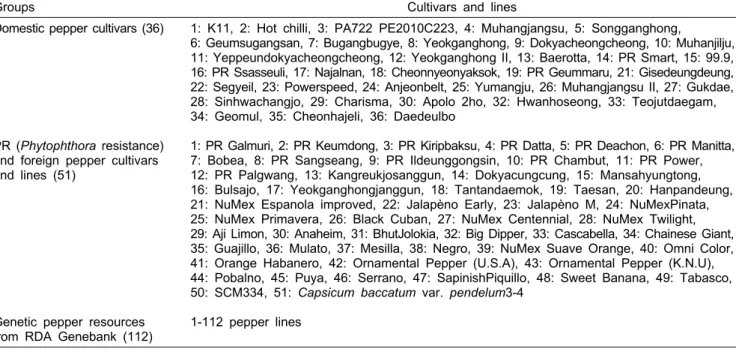
본 실험의 공시재료로 20품종의 역병저항성 PR계통을 포 함한 국내 시판 품종 56품종, 미국 뉴멕시코 주립대학에서 들여온 도입자원 31품종 및 계통, 농촌진흥청 유전자원센터 로부터 분양받은 유전자원 112 계통을 공시하여 CMV-P1 에 대한 저항성 여부를 조사하였다(Table 1). 실험은 강릉 시 지변동에 위치한 유리온실 및 비닐하우스에서 2012년에 수행하였다. 실험에 사용된 고추 종자는 온실 내에서 육묘 용 상토(초록이, 농우바이오사)가 담긴 50공 연결포트에 종 자 5립씩 파종하여 25-28°C에서 발아를 유도하였다. 바이러 스 접종원은 농우바이오에서 CMV-P1 균주를 분양 받아 -70°C 초저온냉동고에 보관하면서 실험에 사용하였다. 접 종원 조제를 위해 0.01M phosphate buffer(pH 7.0)를 사용 하였으며 이 병엽은 10배(W/V)가 되도록 유발을 이용해 마 쇄한 후 2-3겹의 거즈를 이용해 걸러내 그 즙액을 접종용 바이러스로 공시하였다.
Table 1. Cultivars and lines of pepper used in this study.
Groups Cultivars and lines
Domestic pepper cultivars (36)
PR (Phytophthora resistance) and foreign pepper cultivars and lines (51)
Genetic pepper resources from RDA Genebank (112)
1: K11, 2: Hot chilli, 3: PA722 PE2010C223, 4: Muhangjangsu, 5: Songganghong,
6: Geumsugangsan, 7: Bugangbugye, 8: Yeokganghong, 9: Dokyacheongcheong, 10: Muhanjilju, 11: Yeppeundokyacheongcheong, 12: Yeokganghong II, 13: Baerotta, 14: PR Smart, 15: 99.9, 16: PR Ssasseuli, 17: Najalnan, 18: Cheonnyeonyaksok, 19: PR Geummaru, 21: Gisedeungdeung, 22: Segyeil, 23: Powerspeed, 24: Anjeonbelt, 25: Yumangju, 26: Muhangjangsu II, 27: Gukdae, 28: Sinhwachangjo, 29: Charisma, 30: Apolo 2ho, 32: Hwanhoseong, 33: Teojutdaegam, 34: Geomul, 35: Cheonhajeli, 36: Daedeulbo
1: PR Galmuri, 2: PR Keumdong, 3: PR Kiripbaksu, 4: PR Datta, 5: PR Deachon, 6: PR Manitta, 7: Bobea, 8: PR Sangseang, 9: PR Ildeunggongsin, 10: PR Chambut, 11: PR Power, 12: PR Palgwang, 13: Kangreukjosanggun, 14: Dokyacungcung, 15: Mansahyungtong, 16: Bulsajo, 17: Yeokganghongjanggun, 18: Tantandaemok, 19: Taesan, 20: Hanpandeung, 21: NuMex Espanola improved, 22: Jalapèno Early, 23: Jalapèno M, 24: NuMexPinata, 25: NuMex Primavera, 26: Black Cuban, 27: NuMex Centennial, 28: NuMex Twilight, 29: Aji Limon, 30: Anaheim, 31: BhutJolokia, 32: Big Dipper, 33: Cascabella, 34: Chainese Giant, 35: Guajillo, 36: Mulato, 37: Mesilla, 38: Negro, 39: NuMex Suave Orange, 40: Omni Color, 41: Orange Habanero, 42: Ornamental Pepper (U.S.A), 43: Ornamental Pepper (K.N.U), 44: Pobalno, 45: Puya, 46: Serrano, 47: SapinishPiquillo, 48: Sweet Banana, 49: Tabasco, 50: SCM334, 51: Capsicum baccatum var. pendelum3-4
1-112 pepper lines
바이러스 접종
파종한 고추 종자의 본엽이 1-2엽 전개되고 있는 떡잎에 carborundum(600mesh)과 면봉을 이용해 도말 접종하였다.
접종 방법은 carborundum을 고르게 뿌리고 공시한 바이러 스 접종액을 면봉에 묻힌 후 가볍게 문질러 주는 방법으로 접종하였다. 접종 후에는 25°C 이상의 온도가 유지되는 온 실에서 주변으로부터 감염을 차단하기 위해 망실에 두고 병징을 관찰하였다. 접종 24일 후 병조사를 하였고, 접종 5주 후에는 식물체가 자라면서 병징의 발현과 진행정도를 조사하기 위해 시설하우스 내에 정식하여 조사하였다. 고 추 유전자원의 유묘검정도 50공 연결포트에서 파종한 후 같은 방법으로 접종하고 유리온실 내에서 관주 관리만 하 면서 유묘상태로 접종 24일 후 육안검정과 ELISA 검정으 로 조사하였다.
저항성 평가
ELISA 방법은 CMV capture antibody와 1×carbonate coating buffer(Na2CO3 1.59g/NaHCO3 2.93g/NaN3 0.29g/pH 9.6/mass up ddH2O 1000mL)를 1:200의 비율로 희석하여 96 well micro- plate에 각각 100μL씩 분주하여 4°C에서 16시간 반응 시킨 후, 1×PBST(NaCl 8.0g/NA2HPO4 1.15g/KH2PO4 0.2g/KCl 0.2g/Tween-20 0.5g/pH 7.4 mess up ddH20 1000mL)로 300 μL씩 세척한다. 1g의 검정 시료를 1×general extraction buffer (NaSO4 1.3g/PVP 20.0g/NaN3 0.1g/powdered egg albumin 2.0g/Tween-20 20.0g/pH 7.4 mess up 1×PBST 1000mL)와 유발을 이용해 1:10의 비율로 마쇄하여 세척한 microplate
에 100μL씩 분주하여 30°C 습식상에서 2시간 반응시켰다.
반응 후 동일한 방법으로 세척하였고 enzyme conjugate를 1×ECI buffer(BSA 2.0g/PVP 20.0g/NaN3 0.2g/pH 7.4 mess up 1×PBST 1000mL)에 1:200의 비율로 희석하여 100μL씩 분주하여 30°C 습식상에서 2시간 반응시켰다. 반응 후 세척 한 microplate에 발색 tablet을 첨가하여 암조건에서 30분간 반응시켜 결과를 확인하였다. 모든 단계가 끝난 후에는 흡 광도를 측정하기 위해 효소면역측정기(Multiskan EX, Thermo Fisher Scientific, USA) 405nm의 파장에서 그 값을 측정하 였고 negative control과 건전 잎 시료의 흡광수치의 2배 이상 을 양성으로 판독하였다(Mumford et al., 1994). 흡광수치가 0.200 이하이면 저항성(resistant), 0.200-0.500이면 중도저항 성(moderately resistant), 0.500 이상이면 감수성(susceptible) 으로 표시하였다. 또한 1, 2차의 평균값이 0.200 이하지만 반 복구 중 한 주 이상이 0.500 이상이면 양성으로 판단하였다.
결과 및 고찰
시판 품종의 검정
국내 시판 고추 품종의 바이러스병 저항성 정도를 조사하 기 위해 바이러스 접종원을 인위적으로 접종한 결과 접종 1 주일 후 망실에서 관리한 고추 유묘의 상엽(신초) 부위에서 전형적인 CMV 병징이 나타나기 시작하였다. 접종 2주 후 에는 접종 1주차보다 접종엽을 제외한 개체의 전엽에 모자이 크를 비롯한 잎 말림 현상이 관찰되었고 시간이 지나면서 그 구분이 뚜렷해지기 시작하였다. 접종 24일 후에 육안검
Fig. 1. The ELISA results of domestic pepper cultivars/lines after CMV-P1 artificial inoculation. Error bars represent the standard deviation of five replications. Number of cultivar/line according to Table 1. N.C: Negative Control, P.C: Positive Control.
Fig. 2. ELISA of domestic pepper cultivars/lines by CMV natural infection according to field test at 90 days after transplanting.
Number of cultivar/line according to Table 1. NT was not tested, N.C: Negative Control, P.C: Positive Control.
정과 ELISA 결과 국내 시판 품종인 36품종 가운데 ‘무한질주’
품종이 저항성 품종으로 조사되었고, ‘K11’, ‘Hot chilli’, ‘PA722 PE2010C223’, ‘배로따’는 중도저항성, ‘무한장수’ 품종을 포 함한 나머지 32품종은 모두 감수성으로 조사되었다(Fig. 1).
그중 접종 24일 후 유묘상태에서는 ‘무한장수’, ‘예쁜독야청 청’, ‘배로따’, ‘PR금마루’ 품종이 ELISA 진단결과 음성으 로 구분 되었으나 포장으로 이식 후(접종 51일 후)에는 양성 으로 조사되었다(Fig. 1). 반대로 접종 24일 후에는 ‘역강홍’,
‘PR 스마트’, ‘신화창조’, ‘카리스마’, ‘대들보’ 품종이 감수 성으로 구분 되었으나 식물체 생육이 진행됨에 따라 성체저 항성을 띠는 품종도 있었다(Fig. 1). 또한 품종간 유묘식물과 성체식물에서 바이러스 발현정도에 차이가 있는 것으로 보 이며 이는 품종별 검정과 조사시점이 중요할 것으로 판단된 다. CMV-Fny 저항성 고추(Nongwoobio Products information, 2013)인 ‘배로따’, ‘PR 스마트’, ‘99.9’, ‘PR 싹쓸이’, ‘나잘
난’, ‘천년약속’은 실험 결과 CMV-P1에는 감수성인 것으로 확인되었고(Fig. 3C), 저항성을 보인 ‘무한질주’의 경우 역 병, 바이러스병과 청고병에도 내병성을 보이는 품종으로 실 제로 CMV-P1에도 저항성을 보였다(Figs. 1 and 3A). 자연 발병에 의한 포장검정에서는 ‘독야청청’, ‘예쁜독야청청’,
‘역강홍II’, ‘배로따’, ‘PR싹쓸이’, ‘나잘난’, ‘천년약속’, ‘아 폴로2호’, ‘대들보’의 9품종이 저항성을 보였으며 ‘K11’, ‘Hot chilli’, ‘PA722 PE2010C223’, ‘무한장수’, ‘송강홍’, ‘금수강 산’, ‘부강부계’, ‘PR스마트’, ‘99.9’, ‘기세등등’, ‘파워스피 드’, ‘신화창조’, ‘카리스마’의 13품종이 감수성을 보였고 나 머지 품종은 not test로 조사하지 않았다(Fig. 2). ‘무한질주’
품종은 인공접종 실험에서 CMV-P1에 저항성이였으나 자 연발병 포장실험의 결과는 중도저항성이었다. 본 조사에서 사 용된 CMV항체는 polyclone antibody를 이용하였으므로 CMV-Fny 및 CMV-P1의 구분 없이 두 계통에 의한 감염을
A
B
C
Fig. 3. The resistance assay of domestic pepper cultivars/lines at 24 days and 51 days after CMV-P1 artificial inoculation.
A: Muhanjilju (resistant), B: Hot chilli (moderately resistant), C: 99.9 (susceptible).
Fig. 4. The ELISA results of PR (Phytophthora resistance) pepper cultivars and foreign pepper cultivars/lines after CMV-P1 artificial inoculation. Error bars represent the standard deviation of five replications. Number of cultivar/line according to Table 1. N.C, negative control; P.C, positive control.
Table 2. The results of CMV-P1 resistance evaluation using ELISA of pepper genetics sources.
Groups No. of sample Sz MR R
Domestic pepper cultivars 56 51 4 1
Foreign pepper lines 31 29 2 0
Genetic pepper resourcesy 112 86 17 9
Total 199 167 22 10
zS, susceptible; MR, moderately resistant; R, resistant.
yGenetic pepper resources from RDA Genebank.
조사한 것이었다. 본 조사 결과 CMV-Fny에 저항성이 보고 된 몇몇 품종이 ELISA 양성 반응을 보인 것은 CMV-P1에 감염되었기 때문인 것으로 사료된다.
국내 육성품종과 도입자원의 저항성 평가
국내에서 고추 역병 방제를 위해 육성된 역병 저항성 품 종인 PR품종과 병 저항성 육종을 위하여 외국에서 도입한 고추자원의 CMV-P1저항성 검정을 실시하였다. 20개의 역 병 저항성 품종은 조사 결과 CMV-P1에 모두 감수성이었으
며, 31개의 도입자원 중 ‘NuMexTwilight’, ‘Chainese Giant’
는 중도저항성으로 조사되었으며, 대표적인 고추 역병 저항 성 유전자원인 ‘SCM334’ 계통 역시 CMV-P1에 고도의 감 수성을 나타내었다(Table 2 and Fig. 6). 실험 결과 고추 역 병 방제를 위해 육성된 역병 저항성인 PR품종에서는 저항 성이 존재하지 않았으며 도입한 고추자원에서도 중도저항 성을 보이는 품종은 있었으나 저항성을 가진 품종은 존재하 지 않았다.
유전자원의 저항성 평가
최근 국내 고추 시판 품종과 재배종에 대한 바이러스병 저항성이 무너지고 있다(Cho et al., 2006b, 2008). 바이러스 병에 대한 저항성도 재배환경과 온도 등 외부요인에 의해 변화가 생기고 있어 바이러스병에 저항성인 품종 육종 개발 이 시급하다. 국내 시판 품종과 병 저항성 육종용 종자에서 도 CMV-Fny에 강한 품종은 존재하여도 CMV-P1에 저항성 인 품종은 없었다(Table 2, Figs. 1, and 6). 따라서 국내 보 유 유전자원에서 CMV-P1저항성 탐색을 위해 농촌진흥청 유전자원센터에서 분양받은 112계통의 고추 유전자원을 이 용해 CMV-P1에 저항성을 가지는 자원을 조사하였다. 조사
Fig. 5. The ELISA results of genetic pepper resources (150) from RDA Genebank after CMV-P1 artificial inoculation. Error bars represent the standard deviation of five replications. N.C, negative control; P.C, positive control.
A B C D
E F G
Fig. 6. CMV symptoms of PR (Phytophthora resistance) cultivars, foreign pepper cultivars/lines and pepper lines from RDA Genebank at 24 days after CMV-P1 artificial inoculation. A and B, NuMex Twilight, Chainese Giant (moderately resistant); C and D, PR Gumdong, SCM334 (susceptible); E, 103 (resistant); F, 113 (moderately resistant); G, 77 (susceptible).
결과 총 112계통 가운데 6, 20, 26, 29, 30, 31, 36, 37, 94, 100, 110, 112, 113, 115, 147, 149, 150의 17계통이 ELISA 결과 0.500(absorbance at 405nm) 이하로 중도저항성으로 조사되었고 32, 33, 34, 35, 38, 39, 103, 116, 117의 9계통이 0.200 이하로 저항성으로 조사되었고, 나머지 86계통은 모 두 감수성으로 조사되었다(Table 2, Figs. 5, and 6). 또한 Fig. 1과 2에서 보듯이 유묘상태의 결과와 포장에서의 성체 식물에서의 바이러스 병징과 발현정도의 차이를 보인 것을 보아 고추 유전자원에 대한 시기별 추가 조사가 필요할 것 으로 판단된다. 또한 CMV는 자연상태에서 주로 진딧물에 의해 전염되므로 본 조사에 사용된 품종에 대해 명확한 결
과를 얻기 위해서는 진딧물 접종에 의한 실험이 추가로 진 행되어야 할 것으로 생각된다.
국내 고추재배는 제한된 경지면적과 대체 소득 작물의 부 재로 인해 연작이 불가피하고 매년 동일 바이러스병의 출현 과 연속적 감염 그리고 방제 시기의 조절 실패 등으로 발생 피해가 증가하고 있다. 이를 효과적으로 대처하기 위해서 저 항성 품종의 개발이 요구되고 있는데 본 실험에서 CMV-P1 계통에 저항성을 보인 유전자원을 이용해 바이러스 병 저항 성 품종 개발을 위한 육종재료와 유전연구, 분자마커 연구 에 좋은 소재로 활용될 수 있을 것으로 기대된다.
초 록
최근 고추재배에 있어 CMV-P1감염은 상품성 저하와 생 산량 감수를 발생시키는 매우 심각한 문제이다. 본 실험에 서는 역병 저항성 품종인 PR계통을 포함한 국내 시판 56품 종과 미국에서 도입해 온 31품종 도입자원 및 농촌진흥청 유전자원센터(RDA Genebank)로부터 받은 112개의 고추 유 전자원을 CMV-P1 저항성 검정에 사용하였다. 저항성 검정 은 인공 접종 후 24일 후와 51일 후 ELISA를 실시하였다. 36 개 시판품종 중 ‘무한질주’ 품종이 CMV-P1에 저항성이었다.
모든 PR품종과 중도저항성인 ‘NuMex Twilight’와 ‘Chainese Giant’를 제외한 29개 외국 도입고추는 감수성이었다. RDA Genebank의 112계통의 고추 유전자원에서는 저항성 계통 이 9, 중도저항성을 나타내는 계통이 17, 나머지 86계통은 모두 감수성으로 조사되었다. 국내 시판 고추품종은 거의 CMV-P1에 높은 감수성을 보이는 것으로 확인되는 반면, 외국 도입자원과 유전자원의 17.2%가 저항성이거나 중도저 항성으로 확인되었다. 본 연구 결과로 확인된 저항성 고추 는 CMV-P1 저항성 고추육종에 유용한 유전자원으로 이용 될 수 있다.
추가 주요어 : 오이모자이크바이러스, 외국 고추계통, 육종, 농촌진흥청 유전자원센터
인용문헌
Agrios, G.N. 2005. Plant pathology: Serology of plant viruses.
Elsevier Academic Press, New York. p. 744-747.
Cai, W.Q., R.X. Fang, H.S. Shang, X. Wang, F.L. Zhang, Y.R.
Li, J.C. Zhang, X.Y. Cheng, G.L. Wang, and K.Q. Mang. 2003.
Development of CMV-and TMV-resistance transgenic chili pepper: Field performance and biosafety assessment. Mol.
Breed. 11:25-35.
Caranta, C., A. Palloix, V. Lefebvre, and A.M. Daubeze. 1997.
QTLs for a component of partial resistance to Cucumber mosaic virus in pepper: Restriction of virus installation in host-cells. Theor. Appl. Genet. 94:431-438.
Caranta, C., S. Pflieger, V. Lefebvre, A.M. Daubeze, A. Thabuis, and A. Palloix. 2002. QTLs involved in the restriction of Cucumber mosaic virus (CMV) long-distance movement in pepper. Theor. Appl. Genet. 104:586-591.
Chaim, A.B., R.C. Grube, M. Lapidot, and M. Jahn. 2001.
Identification of quantitative trait loci associated with resistance to Cucumber mosaic virus in Capsicum annuum. Theor. Appl.
Genet. 102:1213-1220.
Chen, Z.L., H. Gu, Y. Li, Y. Su, P. Wu, Z. Jiang, X. Ming, J.
Tian, N. Pan, and L.J. Qu. 2003. Safety assessment for genetically modified sweet pepper and tomato. Toxicology 188:297-307.
Cho, J.D., J.S. Kim, J.H. Lee, and B.N. Chung. 2008. Characteristics of a NP strain for Cucumber mosaic virus (CMV-NP) identified newly from sweet pepper showing fruit necrosis. Res. Plant Dis. 14:134-137.
Cho, J.D., S.H. Lee, J.S. Kim, G.S. Choi, H.R. Kim, B.N Chung, and K.H. Ryu. 2006a. Characteristics of Cucumber mosaic virus-VCH causing vein chlorosis on red pepper on Korea.
Res. Plant. Dis. 12:226-230.
Cho, J.D., S.H. Lee, G.S. Choi, T.J. Lim, B.N. Chung, K.H. Ryu, and J.S. Kim. 2006b. Viruses and their mixed infections on red peppers at Jeolla-do province in 2005. J. Plant Pathol.
21:124-125. (Abstr.)
Choi, G.S., J.H. Kim, D.H. Lee, J.S. Kim, and K.H. Ryu. 2005.
Occurrence and distribution of viruses infecting pepper in Korea. Plant Pathol. J. 21:258-261.
Choi, G.S., J.H. Kim, K.H. Ryu, J.K. Choi, S.Y. Chae, H.R. Kim, B.N. Chung, J.S. Kim, and Y.M. Choi. 2002. First report of Tobacco mild green mosaic virus infection pepper in Korea.
Plant Pathol. J. 18:323-327.
Choi, J.K., E.J. Hong, J.Y. Lee, and M.U. Chang. 1995. Responses to infection of Tobacco mosaic viruspepper strain (TMV-P) in transgenic tobacco plants expressing the TMV-P coat protein or its antisense RNA. Kor. J. Plant Pathol. 11:374-379.
Francki, R.I.B., D.W. Mossop, and T. Hatta. 1979. Cucumber mosaic virus. CMI/AAB Descriptions of Plant Viruses No. 213.
Grube, R.C., Y. Zhang, J.F. Murphy, F. Loaiza-Figueroa, V.K.
Lackney, R. Provvidenti, and M.K. Jahn. 2000. New sources of resistance to Cucumber mosaic virus in Capsicum frutescens.
Plant Dis. 84:885-981.
Han, B.K., S.W. Kang, and G.P. Lee. 2011. Case study of methodological procedure for assessment of introduced gene in genetically modified plants: CMV resistant red pepper. Kor.
J. Hort. Sci. Technol. 29(Suppl. II): 196. (Abstr.)
Im, K.H., B.K. Chung, J.Y. Yoon, and S.K. Green. 1991. A Survey on viruses infecting peppers (Capsicum annum) in Korea by microplate method of enzyme-linked immunesorvent assay (ELISA). Kor. J. Plant Pathol. 7:252-256.
Kang, G.Y., J.I. Choi, and Y.J. Na. 1973. Isolation and identification of viruses affecting pepper (Capsicum annuum L) in Korea.
Kor. J. Hort. Sci. Technol. 13:35-43.
Kang, G.Y. and J.I. Choi. 1976. Studies on the resistance of some varietics of pepper to Tobacco mosaic virus. Kor. J. Hort. Sci.
Technol. 17:61-68.
Kang, S.W., B.K. Han, and G.P. Lee. 2011. Case study of methodological procedure for stability assessment of introduced gene in genetically modified plant: CMV resistant red pepper.
Kor. J. Hort. Sci. Technol. 29(Suppl. II): 196. (Abstr.) Kang, W.H., N.H. Hoang, H.B. Yang, J.K. Kwon, S.H. Jo, J.K.
Seo, K.H. Kim, D. Choi, and B.C. Kang. 2010. Molecular mapping and characterization of a single dominant gene controlling CMV resistance in peppers (Capsicum annuum L.) Theor.
Appl. Genet. 120:1587-1596.
Kim, J.S., S.K. Kim, G.S. Choi, and M.W. Lee. 1990a. Virus disease incidence and symptom appearance in red pepper. Kor.
J. Plant Pathol. 6:125-132.
Kim, J.S., S.K. Kim, S.Y. Lee, and M.W. Lee. 1990b. A pepper vein chlorosis virus causing stem necrosis and vein chlorosis
on red pepper in Korea. Kor. J. Plant Pathol. 6:376-381.
Kim, J.S. and K.H. Lee. 1991. Virus disease incidence and symptom expression of peppers cultivated in vinyl house, and serological relationship of CMV isolates from peppers. Res. Pept. RDA (C.P) 33:8-14.
Kim, J.S. and G.S. Choi. 2001. Viruses infecting peppers in the world and their characteristics (introduction). J. Kor. Capsicum Res. Coop. 7:23-48.
Kim, J.H. 2011. Comparison of field adaptability and growth characteristics of CMV-tolerant GM pepper (Capsicum annuum L.). Ph.D. Thesis. Korea Univ., Seoul, Korea.
Kim, J.H., G.S. Choi, and J.K. Choi. 2002. Characterization of Cucumber mosaic virus subgroup II isolated from paprika in Korea. Plant Pathol. J. 18:6-11.
Korean Statistical Information Service (KOSIS). 2012. Pepper of cultivation area. http://www.kosis.kr.
Lapidot, M., R. Ben-Joseph, S. Ben-Harush, M. Pilowsky, S. Cohen, and C. Shifriss. 1997. Tolerance to Cucumber mosaic virus in pepper: Development of advanced breeding lines and evaluation of virus level. Plant Dis. 81:185-188.
Lee, S.H., S.M. Kim, H.S. Choi, J.W. Park, T.S. Jin, and K.W.
Lee. 2002. Pepper mild mottle virus is a major Tobamovirus on pepper in Korea. Plant Pathol. J. 18:381. (Abstr.) Lee, Y.H., M. Jung, S.H. Shin, J.H. Lee, S.H. Choi, N.H. Her,
J.H. Lee, K.H. Ryu, K.Y. Park, and C.H. Harn. 2009. Transgenic peppers that are highly tolerant to a new CMV pathotype.
Plant Cell Rep. 28:223-232.
Lim, P.O., J.S. Ryu, H. Lee, Y.S. Park, J.M. Kwak, J.K. Choi, and H.G. Na. 1997. Resistance to Tobamoviruses in transgenic tobacco plants expressing the coat protein gene of Pepper mild mottle virus (Korean isolate). Mol. Cells. J. 30:313-319.
Mumford, R.A., I. Barker, and K.R. Wood. 1994. The detection of Tomato spotted wilt virus using the polymerase chain reaction.
J. Virol. Methods 46:303-311.
Nongwoobio Products information. 2013. Products information.
http://www. nongwoobio.co.kr.
Palukaitis, P., M.J. Roossinck, R.G. Dietzgen, and R.I.B. Francki.
1992. Cucumber mosaic virus. Adv. Virus Re. 41:281-348.
Ryu, K.H. 2007. Development of transgenic resistant pepper plant to multivirus infection with virus and host derived genetic resources. Seoul Women’s University. Res. paper. p. 9.
Suzuki, K., T. Kuroda, Y. Miura, and J. Murai. 2003. Screening and field trials of virus resistant sources in Capsicum spp.
Plant Dis. 87:779-783.
Sung, J.H., J.H. Park, H.Y. Shin, M.U. Chang, H. Sayama, and H. Atarashi. 2002. Protective effect of two Japanese attenuated Cucumber mosaic virus (CMV) strains, PV1-K and PV2-K against a Korean virulent CMV isolate, CMV-KP in Korea hot pepper cultivars. Plant Pathol. J. 18:373. (Abstr.) Yang, H.B., W.Y. Liu, W.H. Kang, M. Jahn, and B.C. Kang.
2009. Development of SNP markers linked to the L locus in Capsicum spp. by a comparative genetic analysis. Mol. Breed 24:433-446.