2014 KSDF 1229-0033/2014-3/45-52
ⓒ
〈연구논문 학술( )〉
1. 서 론
생체는 단백질 탄소화물 지질 등 비교적 다량으, , 로 함유되어 있는 구성성분과 비타민류 호르몬류 등, 과 같이 극히 미량으로 존재하면서 생물의 여러 가 지 생리현상이나 기능을 제어하는 물질에 이르기까 지 많은 종류의 천연유기화합물을 포함하고 있다1-3).
이들 성분 중에서 식물에 함유되어 있는 미량의, 휘발성 방향성의 유기화합물 중에는 생장과 분화,
†Corresponding author: Young Jin Jung ([email protected]) Tel.: +82-55-350-5387 Fax.: +82-55-350-5389
††Corresponding author: Dae Youn Hwang ([email protected]) Tel.: +82-55-350-5388 Fax.: +82-55-350-5389
에는 관계없으나 특별한 기능을 가진 차 대사산물2 이 존재한다 예를 들면 식물 (secondary metabolite) . , 에서 추출한 미량의 물질 중에는 초식동물에 대한 방어 수분매체의 유인 미생물로부터 감염에 대한, , 방어 다른 식물의 성장을 억제 또는 방해하는 타, 감물질(allelochemical)의 기능 및 식물 상호간 경쟁 등의 생태학적인 기능을 가지고 있는 것도 있다4-9). 하지만 소나무에서는 이러한 천연유기화합물과 기 능성 대사산물에 대한 연구가 극히 드물다.
적송소나무(Pinus densiflora 는 한국 일본 중국) , , 등 극동지방에 자생하는 상록성 침엽교목으로 그 구성성분으로는 수분 당질 섬유소 외에 소량의 단, , 백질 지질 회분 정도가 알려져 있으며 솔잎 솔방, , , , Abstract: Red pine (Pinus densiflora) is widely used traditional medicine, pharmacological and nutritional values from which the phytochemical compounds are derived. The present study was aimed to examine the antibacterial effects in the absence and presence of a immature red pine cone extract against 13 microorganisms. The components in the aqueous extract from immature red pine cone were identified by GC-MS. About 1.4% of total polyphenolic compound was measured in aqueous extract collected from immature red pine cone. Also, the high concentration of -phellenandrene,β α -pinene, limonene, bornyl acetate and aldehyde was detected in total ion chromatograms. Of total 13 microorganisms, 4 microorganisms including Pseudomonas aeruginosa, Vibrio cholera, Listeria monocytogenes, Klebsiella pneumonia were effectively killed by aqueous extract of immature red pine cone. The highest anti-bacterial effect was detected in P.
aeruginosa, followed by V. cholera, L. monocytogenes and K. pneumonia. In case of P. aeruginosa, the largest diameter of inhibition zone was maintained to 1/2 solution treated cells and slightly decreased at 1/4 and 1/8 solution treated cells.
Also, in test used V. cholera and L. monocytogenes, the inhibition zone was strongly formed in only 1 and 1/2 solution treated cells, while K. pneumonia showed the very small diameter of inhibition zone in all concentrations. Therefore, these results suggested that the aqueous extracts of immature red pine cone should be considered as a new and potentially important anti-bacterial substrate to effectively prevent the microbial infection and penetration.
Keywords: polyphenolic compound, anti-bacterial effect, paper disc method, Pseudomonas aeruginosa, Pinus densiflora
미성숙 솔방울 열수추출물의 항균성
정경희 · 황인식 · 김지은 · 이영주 · 곽문화 · 이영희1 · 이재호 · 황대연†† · 정영진†
부산대학교 바이오소재과학과, 1부산대학교 유기소재시스템공학과
Anti-bacterial Effects of Aqueous Extract Purified from the Immature Cone of Red Pine (Pinus densiflora)
Kyung Hui Jeong, In Sik Hwang, Ji Eun Kim, Young Ju Lee, Moon Hwa Kwak, Young Hee Lee1, Jae Ho Lee, Dae Youn Hwang†† and Young Jin Jung†
Department of Biomaterials Science, Pusan National University, Miryang, Korea
1Department of Organic Material Science and Engineering, Pusan National University, Busan, Korea
(Received: January 2, 2014 / Revised: February 11, 2014 / Accepted: February 14, 2014)
울 송진 껍질 등 모든 부위가 약용 및 건강식품으, , 로 이용되어왔다 유효성분의 단리기술의 발전과 더. 불어 소나무를 이용한 농약 의약 향료 항균제 독, , , , 성물질 등의 상업적 가치가 있는 제품으로 개발하 기 위하여 많은 연구가 수행 되고 있다10-14). 대부분 의 식물에서 추출한 각종 정유성분들의 함량은 열 매 잎 가지, , , 줄기 뿌리 등 식물의 부위와 생육환, 경 및 수확시기에 따라 다르지만 동일한 종류의 식 물에서는 정유성분의 종류는 거의 동일하게 추출되 며 나무의 경우 활엽수보다 침엽수에 정유성분이 더, 많이 존재한다 소나무과의 정유성분은 주로. terpenoid 류, phenol , tannin , alkaloid류 류 류와 flavonoid류 등이 존재하므로 살균 소독 항염증 및 진정작용이 보고, , 되어 있다15-18). 현재까지는 소나무의 솔잎만을 시료 로 하여 추출물의 생리활성 항산화 면역활성 병, , , 원성 및 식중독 미생물에 대한 항균성을 활용한 식 품으로서의 효능 피부미백 및 노화방지와 관련된, 기능에 대하여 많은 보고가 있다19-22). 그러나 미성, 숙 솔방울을 이용한 항균효능에 대한 연구는 아직 보고된 바 없다.
따라서 본 연구에서는 식물의 생리활성 물질은, 함량의 차이는 있으나 동일 속의 모든 부위에는 동 일한 기능의 물질이 존재할 것이라는 원리에 따라 미 성숙 솔방울 열수추출물을 이용하여 항균성을 평가하 고자 총 13개 미생물을 대상으로 실험을 실시하였으 며, 그 결과 미성숙 솔방울 열수추출물은 P. aeruginosa, V. cholera, L. monocytogenes, K. pneumonia 등 종의4 균에 대해 우수한 항균효과를 나타냄을 확인하였다.
실 험 2.
시료의 추출 2.1
본 연구에 사용된 미성숙 솔방울은 2011년 7월 말에서 8월 초순경에 부산광역시 금정산에 조림되 어있는 적송소나무로부터 채취한 것을 시료로 사용 하였다. 미성숙 솔방울의 꼭지에 있는 목질부분을 제거한 후 수돗물과 증류수로 세척하여 실내에서 자연 건조하였다.
환류냉각장치(condenser)가 부착된 반응기에 세척․ 건조한 솔방울 1 kg과 증류수 4 kg을 100℃에서 7 시간 동안 추출하고 여과한 후rotary vaccum evaporate 로 농축한 일부의 추출원액을 항균실험용 시료로서 사용하고 잔량은 감압 건조하여 15.86 g의 분말로 제조하였다.
총 폴리페놀(polyphenol)의 함량을 측정하기 위하 여 제조한 분말과 n-헥산을 1.0 : 2.5(w/v)의 비율로 혼합하여 상온에서 시간 교반한 후 분액여두에 옮겨1 조지방 성분을 제거하고 그 여액은 여과장치(Millipore Stericup Sterile Vacuum Filter Unit, pore size 0.45μ 를 이용하여 여과한 후 동결건조기에서 건조하 m)
여 폴리페놀의 함량 분석용 시료로 사용하였다.
폴리페놀의 측정 2.2
페놀성 물질의 함량은 Folin Denis법23)에 따라 측 정하였다 열수추출한 분말을. 1 mg/ml의 농도로 증 류수에 용해시킨 시료용액 0.5 ml에 증류수 1.5 ml 를 추가하여 시료의 부피가 2 ml가 되도록 조정한 후 Folin-ciocalteu`s phenol reagent 0.5 ml를 첨가 후 잘 혼합하여 분간 실온에서 방치한다 여기에5 . Na2CO3
포화수용액 2 ml를 가하여 실온에서 1시간 방치하 여 발색시킨 후 760 nm에서 흡광도를 측정하였다. 이때 총 폴리페놀의 함량은 tannic acid를 이용하여 작성한 표준곡선을 이용하여 도출하였다 즉. , Tannic
표준곡선은 용액에
acid 50% MeOH tannic acid 1 mg/ml로 제조하고 최종농도가, 0, 50, 100, 200 및
용액이 되도록 희석하여 에서 흡
300 g/mlμ 760 nm
광도를 측정하여 표준곡선으로 하였다.
2.3 Gas chromatograph Mass spectrometer 측정
(GC-MS)
미성숙 솔방울 열수추출물의 성분을 확인하기 위 해 GC-MS 분석을 실시하였다. GC-MS(JEOL , JMS-사
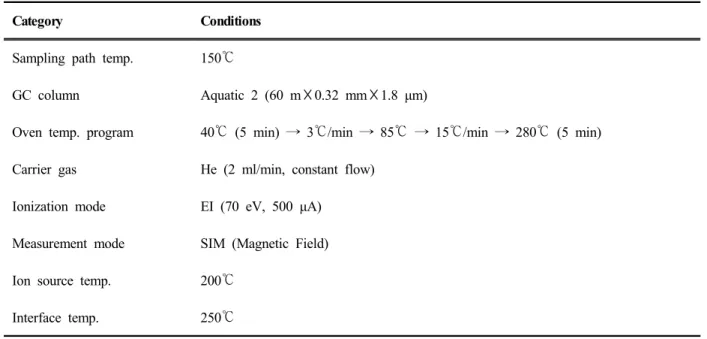
로 에서 제시된 조건으로 분석하
700, Japan) Table 1
였다. Total ion chromatogram에 나타난 추출물의 각 각에 대한 pea 로부터k mass spectrum을 얻어 내장된 search librar 의y data base로부터 확률이 높은 성분을 선정 비교 관찰하였다.
미생물균주 및 배지 2.4
본 실험에서는 그람음성균 종9 (Pseudomonas aerugi- nosa, Klebsiella pneumonia, Vibrio cholera, Salmonella choleraesuis, Proteus vulgaris, Serratia marcescens, Salmonella typhimurium, Haemophilus actinomycete- mcomitans, Eikenella corrodens), 그람양성균 종3 (Ba- cillus subtilis, Listeria monocytogenes, Staphylococcus aureus), 효모 1 (Candida albicans 의 미생물을 사종 ) 용하였다.
Category Conditions Sampling path temp. 150℃
GC column Aquatic 2 (60 m 0.32 mm 1.8 m)☓ ☓ μ
Oven temp. program 40℃ (5 min) ⟶ ℃3 /min ⟶ 85℃ ⟶ 15 /min℃ ⟶ 280℃ (5 min)
Carrier gas He (2 ml/min, constant flow)
Ionization mode EI (70 eV, 500 A)μ
Measurement mode SIM (Magnetic Field)
Ion source temp. 200℃
Interface temp. 250℃
Table 1. GC-MS condition for the identification of major component in aqueous extract of immature red pine cone
이들 중에서 H. actinomycetemcomitans, E. corrodens 는 ATCC로부터 구매하였으며 나머지 미생물들은, 부산대학교 생명환경화학과 응용환경미생물실험실 로부터 제공받아 사용하였다 미생물 배양의 경우. H. actinomycetemcomitans, E. corrodens는 tryptic soy agar(TSA, Difco Laboratory Inc., USA)에 5% sheep
를 첨가하여 제조된 배지를 사용하였
blood 으며 그,
외 미생물들은 모두 brain heart infusion(BHI, Difco 배지를 사용하였다
Laboratory Inc., USA) .
항균활성 측정 2.5
추출물의 항균활성 측정은 paper disc법으로 이전 에 보고된 방법에 따라 실시하였다24). 먼저 BHI나 배지에 각 균주를 균일하게 도말하고 미성숙
TSA ,
솔방울 열수추출물을 각 농도(0.05, 0.5, 5, 50 mg/ml) 별로 20 ㎕를 loading하여 건조된 6 mm paper disc 를 배지 표면에 올려놓은 다음 37℃의 항온기에서 24 간 배양시켰다 배양 후시 . disc 주변에 생성된 inhibition zone의 직경을 측정하였다.
통계처리 2.6
모든 실험은 회 반복하여 실시하였으며3 , SAS(Stati- stical Analysis System)를 사용하여 각 처리 군의 평균과 표준편차를 산출하고 분산분석을 행한 후 로 각 처리구간의 유의 Duncan’s multiple range test
성을 검증하였다.
결과 및 고찰 3.
총 폴리페놀 화합물의 함량 3.1
소나무과의 솔잎 솔방울 나뭇가지에는 테르펜, , (terpene), 페놀화합물(phenolics), 탄닌(tannin) 등의 정 유성분, 엽록소성분 무기 및 유기성분 비타민류 등, , 이 포함되어 있는 것으로 보고되어 있다25,26).
일반적으로 솔방울의 열수추출에 의한 고형체의 분말은 15.86 g으로 1.58%의 수율을 나타내었지만 수 증기 증류에 의한 정유성분의 함량은 솔잎에는
가지에는 정도이며 시료의 채
0.13~1.3%, 0.2~0.9% ,
취시기와 채취부분 및 추출조건에 매우 많은 차이가 있다 대부분. 의 연구에서는 분쇄한 솔잎을 시료로 사 용하여 열수와 알코올로 추출한 경우 고형체의 분 말로 각각 6~9% 정도의 수율을 보고하였다25 27)‐ .
본 실험에서와 같이 미성숙 솔방울을 분쇄하지 않고 그대로 시료로 사용하면 작업은 편리하지만 열매 내부의 단단한 과육부분과 덩어리 상태로 용 액의 침투가 곤란하여 추출의 효과를 매우 감소시 키는 것으로 사료된다 폴리페놀 화합물의 함량. 은 페놀성 물질이 phosphmolybdic acid와 반응하여 청색을 띠는 것을 이용하여 측정한다26). 페놀류는 식물체의 대사 작용에 의해 생성되는 물질로 주로 benzoic acid, cinnamic acid, guinic acid, caffeic acid, 등의 방향족 산의 성분으로 구성되어 ferulic acid
있다26).
본 연구에서 적송소나무 미성숙 솔방울 열수추출 물의 총 폴리페놀 함량을 tannic acid 표준곡선을 이 용하여 측정한 결과 1.4%가 함유되어 있었다 이러. 한 실험결과는 일반적으로 적송소나무의 솔잎을 유 기용매 또는 열수로서 추출하여 얻어지는 총 폴리 페놀의 함량(1.3~1.6%)과 매우 유사하였다24).
미성숙 솔방울 열수추출물의 성분분석 3.2
적송소나무의 미성숙 솔방울 열수추출물의 성분 을 분석하기 위해 추출물에 대한 GC MS‐ 측정을 실 시하였다 그 결과. retention time 2.87분에 있는 번1 피크는 공기, 3.87분과 4.12분에는 알코올과 아세톤
Figure 1. Total ion chromatograms of the aqueous extract purified from the immature red pine cone.
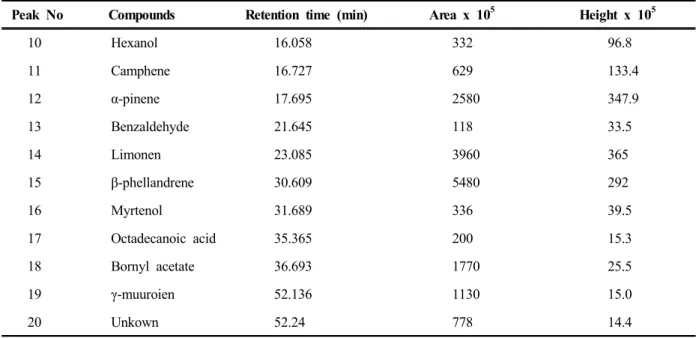
Peak No Compounds Retention time (min) Area x 105 Height x 105
10 Hexanol 16.058 332 96.8
11 Camphene 16.727 629 133.4
12 α-pinene 17.695 2580 347.9
13 Benzaldehyde 21.645 118 33.5
14 Limonen 23.085 3960 365
15 β-phellandrene 30.609 5480 292
16 Myrtenol 31.689 336 39.5
17 Octadecanoic acid 35.365 200 15.3
18 Bornyl acetate 36.693 1770 25.5
19 γ-muuroien 52.136 1130 15.0
20 Unkown 52.24 778 14.4
Table 2. Contents of major components in the immature red pine cone
이며, 9.45분과 10.96분의 피크는 2-ethylacrolein 및 n-pentanal으로 추정된다(Figure 1, Table 2).
또한 이러한 결과로부터, 미성숙 솔방울 열수추출물 의 주성분은 β-phellenandrene, α-pinene, limonene 및 bornyl acetate 등을 포함하는 hydrocarbon류와 aldehyde 류로 구성되어 있음을 확인하였다(Table 2).
등 과 등 의 연구에 의하
Zavarian (1986) Zafra (1976)
면 같은 수종에서도 계절과 연령 및 채취부위에 따 라 정유성분의 현저한 차이를 나타내었다28,29).
Choi 등은 국내에 서식하는 리기다 소나무(Pinus rigida Mill)와 적송소나무의 수증기 증류에 의한 정유 성분의 종류와 함량에 차이를 보고 하였다30).
특히 솔방, 울에 많이 존재하는 β-phellenandrene은 pinocareol과 더불어 구충작용과 관계가 있어서 강한 살충력을 가진다고 알려져 있다31).
미성숙 솔방울 열수추출물의 항미생물 활성 3.3
미성숙 솔방울 열수추출물의 항미생물 효과를 평 가하기 위하여 paper disc법을 이용하여 13종류의 미 생물에 대한 inhibition zone의 지름을 측정하였다 그. 결과 총 13종의 미생물 중에서 종4 (P. aeruginosa, V.
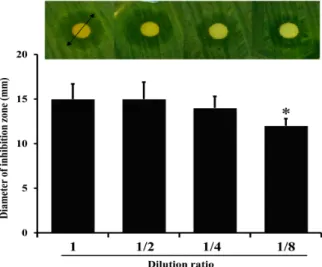
cholera, L. monocytogenes, K. pneumonia 의 미생물) 에서 효과적으로 inhibition zone이 형성됨을 관찰하 였다 특히. , P. aeruginosa에서는 가장 큰 inhibition zo 이ne 생성되었으며, 1/2 희석농도까지는 크기가 감소하지 않았으며, 1/4 희석농도에서부터 점진적 으로 감소하였다 그러나. 1/8 희석농도에서도10 mm이 상의inhibition zone이 형성됨을 관찰되었다(Figure 2).
또한 미성숙 솔방울의 열수추출물은, V. cholera와 L. monocytogenes에서는 유사한 항미생물 효과를 나 타내었다.
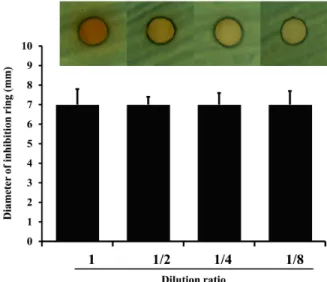
Inhibition zone은 미성숙 솔방울의 추출원액의 처 리로 V. cholera와 L. monocytogenes에서 10 mm이상의 지름으로 형성되었으며, 1/2 희석농도에서도 약간 감소
Figure 2. Antibacterial effects of immature red pine cone extract on the P. aeruginosa. The four kinds of disk con- taining the different concentration of immature red pine cone extract were placed on the bacteria plate spread with P. aeruginosa. These plates were cultured at 37oC in- cubator for 24 hr and the diameter of inhibition zone was measured with ruler. Three samples were assayed in triplicate via disk testing. The values are expressed as the means±SD. *P<0.05 is the significance level compared to the cells treated with vehicle disk.
는 하였으나 지속적으로 관찰되었다. 그러나1/4과1/8 희석농도에서는 형성되는 inhibition zone의 형성을 유 의적으로 관찰할 수 없었다(Figure 3, Figure 4).
마지막으로 미성숙 솔방울 열수추출물은 K. pneu- monia에서 매우 작은 inhibition zone의 형성을 유도 함을 관찰하였으며 농도에 상관없이 일정한 양상을, 나타내었다(Figure 5). 이러한 결과는 미성숙 솔방울 열수추출물이 4가지 미생물에 효과적으로 작용하여 성장을 억제하는 효과가 있음을 제시하고 있다.
한편 소나무의 다른 부위를 이용한 항미생물 활, 성에 대한 연구가 일부 보고되었다 소나무 종자의. 껍질로부터 분리된 암모니아 추출물의 전처리는 E.
coli, K. pneumonia, S. aureus으로부터 감염을 유의 적으로 억제하는 효과를 나타내었으며32), 소나무껍 질로부터 추출된 폴리페놀은 multi-species biofilm에 서 균의 성장과 insoluble glucan의 합성을 효과적으 로 억제하였다33).
비록 추출물의 종류나 시험방법은 다르지만 이, 러한 이전의 연구결과들은 본 연구결과와 매우 유 사하게 소나무 추출물의 항미생물 효능을 보여주고 있다.
Figure 3. Antibacterial effects of immature red pine cone extract on the V. cholera. The four kinds of disk con- taining the different concentration of immature red pine cone extract were placed on the bacteria plate spread with V. cholera. These plates were cultured at 37oC incubator for 24 hr and the diameter of inhibition zone was mea- sured with ruler. Three samples were assayed in triplicate via disk testing. The values are expressed as the means±SD. *P<0.05 is the significance level compared to the cells treated with vehicle disk.
Figure 4. Antibacterial effects of immature red pine cone extract on the L. monocytogenes. The four kinds of disk containing the different concentration of immature red pine cone extract were placed on the bacteria plate spread with L. monocytogenes. These plates were cultured at 37oC incubator for 24 hr and the diameter of inhibition zone was measured with ruler. Three samples were assayed in triplicate via disk testing. The values are expressed as the means±SD. *P<0.05 is the significance level compared to the cells treated with vehicle disk.
결 론 4.
본 연구에서는 적송소나무의 미성숙 솔방울을 새로운 바이오소재로 개발하기 위하여 미성숙 솔 방울 열수추출물을 분리하여 그 성분을 분석하고, 가지 미생물에 대한 항미생물효과를 분석하고 13
자 하였다.
그 결과 미성숙 솔방울 추출물은 다량의 폴리 페놀화합물을 함유하고 있었으며 실험에 사용된,
종의 그람음성균과 종의 그람양성균 종의 효모
9 3 , 1
중에서 P. aeruginosa, B. cholera, L. monocytogenes,
K. pneumonia의 4종의 미생물에 대해 우수한 항
미생물 효능을 나타내었다.
따라서 적송소나무의 미성숙 솔방울 열수추출물 은 항균성 섬유소재의 개발 등 산업적 목적뿐만 아 니라 항균성 질병의 예방 치료 등 의료적 목적으, 로 활용가치가 매우 높을 것으로 사료된다.
감사의 글
이 논문은 부산대학교 자유과제 학술연구비 년(2 ) 에 의하여 연구되었음.
Figure 5. Antibacterial effects of pine cone extract on the K. pneumonia. The four kinds of disk containing the different concentration of immature red pine cone extract were placed on the bacteria plate spread with K.
pneumonia. These plates were cultured at 37oC incubator for 24 hr and the diameter of inhibition zone was measured with ruler. Three samples were assayed in triplicate via disk testing. The values are expressed as the means±SD. *P<0.05 is the significance level compared to the cells treated with vehicle disk.
References
1. N. Ohtake, “Natural Product Chemistry”, Dong Hwa Technology Publishing Co., Seoul, 1976.
2. Weisberger, “Technique of Organic Chemistry, 3rd ed.”, Interscience Publishers, New York, 1951.
3. F. Bakkali, S. Averbeck, D. Averbeck, and M.
Idaomar, Biological Effects of Essential Oils- a Review, Food and Chemical Toxicology, 46, 446 (2008).
4. H. J. Dorman and S. G. Deans, Antimicrobial Agents from Plants: Antibacterial Activity of Plant Volatile Oils, J. of Applied Microbiology, 88, 308 (2000).
5. R. Mumm, T. Tiemann, S. Schulz, and M. Hilker, Analysis of Volatiles from Black Pine (Pinus Nigra):
Sigificance of Wounding and Egg Deposition by a Herbivous Sawfly, Phytochemistry, 65, 3221(2004).
6. H. M. Ashour, Antibacterial, Antifungal, and Anti- cancer Activities of Volatile Oils and Extracts from Stems, Leaves, and Flowers of Eucalyptus
Sideroxylon and Eucalyptus Torquata, Cancer Biology and Theraphy, 7(3), 399(2008).
7. G. Mena-Rejion, E. Caamal-Fuentes, Z. Cantillo -Ciau, R. Cedillo-Rivera, J. Flores-Guido, and R.
Moo-Puc, In Vitro Cytotoxic Activity of Nine Plants Used in Mayan Tradional Medicine, J. of Ethnopharmacology, 121, 462(2009).
8. F. Menichini, F. Conforti, C. Formisano, F. Piozzi, and F. Senatore, Phytochemical Composition, Anti -inflammatory and Antitumor Activities of Four Teucrium Essential Oils, Food Chemistry, 115, 679(2009).
9. T. Mosmann, Rapid Colorimetric Assay for Cellular Growth and Survial: Application to Prolieferation and Cytotoxicity Assays, J. of Immunological Met- hods, 65, 55(1983).
10. C. F. Carson and T. V. Riley, Antimicrobial Activity of the Major Components of The Essential Oil of Melaleuca alternifolia, J. of Applied Microbiology, 78, 264(1995).
11. K. A. Hammer, C. F. Carson, and T. V. Riley, Antimicrobial Activity of Essential Oil and Other Plants Extracts, J. of Applied Microbiology, 86, 985(1999).
12. E. J. Hong, K. J. Na, I. G. Choi, K. C. Choi, and E. B. Jeung, Antibacterial and Antifungal Effects of Essential Oils from Coniferous Trees, Biological and Pharmaceutical Bulletin, 27(6), 863(2004).
13. J. S. Lee and E. J. Go, A Study on Natural Dye Having the Effects on the Atopic Dermatitis(Part
) -
Ι Bamboo Extract-, Textile Coloration and Fini- shing(J. of Korea Soc. Dyers and Finishers), 24(1), 189(2012).
14. J. S. Lee and G. E. Jeong, A Study on Natural Dye Having the Effects on the Atopic Dermatitis (Part Ⅱ) -Pine Needles Extract-, Textile Coloration and Finishing(J. of Korea Soc. Dyers and Finishers), 24(1), 196(2012).
15. D. Kalemba and A. Kunicha, Antimicrobial and Antifungal Properties of Essential Oils, Current Medicinal Chemistry, 10, 813(2003).
16. R. J. W. Lambert, P. N. Skandamis, P. J. Coote, and G. J. E. Nychas, A Study of The Minimum
Inhibitory Concentration and Mode of Action of Organo Essential Oil, Thymol and Carvacrol, J. of Applied Microbilogy, 91, 453(2001).
17. C. M. Mann and J. I. Markham, A New Method for Determining the Minimum Inhibitory Concen- tration of Essential Oils, J. of Applied Microbilogy, 84, 538(1998).
18. P. K. Koukos, K. I. Papadopoulous, D. T. Patiaka, and A. D. Papagiannopoulos, Chemical Composition of Essential Oils from Needles and Twigs of Balkan Pine(Pinus peuce Grisebach) Grown in Nor- thern Greece, J. of Agricultural and Food Chemistry, 48, 1266(2000).
19. M. Y. Choi, E. Y. Choi, E. Lee, T. J. Rhim, B.
C. Cha, and H. J. Park, Antimicrobial Activites of Pine Needle(Pinus densiflora Sieb et Zucc) Extract, Korean J. of Microbiology and Biotechno- logy, 25, 293(1997).
20. C. H. Park, Antibacterial Activity of Ethanol Extract of Pine Needle against Pathogenic Bacteria, Korean J. of Food Preservation, 5, 380(1998).
21. K. C. Sung and K. J. Kim, Tyrosinase Activited Inhibition Effect and Analysis of Pine-Needle Extract, J. of the Korean Oil Chemists, 22, 71(2005).
22. J. H. Yoo, J. Y. Cha, Y. K. Jeong, K. T. Chung, and Y. S. Cho, Antioxidative Effect of Pine (Pinus denstifora) Needle Extracts, J. of Life Science, 14, 863(2004).
23. T. Swain, E. Hillis, and M. Oritega, Phenollic Constituents of Ptunus domestica I, Quantitative Analysis of Phenolic Constituents, J. of the Science of Food and Agriculture, 10, 83(1959).
24. G. N. Rolinson and E. J. Russell, New Method for Antibiotic Susceptibility Testing, Antimicrob Agents Chemother, 2(2), 51(1972).
25. H. J. Lee, B. C. Chen, H. T. Choi, S. H. Kim, Y.
A. Ham, D. S. Lee, and S. S. Ham, Quality Characteristics of the Vaporized Liquid of Water -boiled Pine Needle, Korean J. of Food Preser- vation, 12, 107(2005).
26. S. K. Kang, S. H. Kang, O. J. Choi, Y. W. Kim, and Y. D. Kim, Volatile Flavor Compounds of Pinus densiflorasied and Zucc According to Extracting
Solvents and Steam Distillation Method, J. of the Korean Society of Dietary Culture, 11, 403(1996).
27. Y. H. Kang, Y. K. Park, S. R. Oh, and K. D.
Moon, Studies on the Physiological Functionality of Pine Needle and Mugwort Extracts, Korean J.
of Food Science and Technology, 27, 978(1995).
28. E. Zavarian, Monoterpenoid Differentiation in Relation to the Morphology of Pinus Discolor and Pinus Johannis, Phytochemistry, 10, 3107(1986).
29. M. Zafra, Seasonal Variations in the Composition of Pinus Halepensis and Pinus Sylvestris Twigs and Needle Essential Oil, The J. of Agricultural Science, 1, 1(1976).
30. K. S. Choi, H. K. Park, J. H. Kim, Y. T. Kim, and I. B. Kwon, Flavor Components of the Needle Oils Pinus rigida Mill and Pinus densiflora Sieb
and Zucc, Korean J. of Food Science and Tech- nology, 20(6), 769(1988).
31. O. Y. Sang, S. J. Yoo, and J. S. Oh, A Study on the Pharmacological and Nutritional Values of Needles of Pinus densiflora Sieb and Zucc, Reasearch Bulletin of the Experiment Forests, 5, 63(1997).
32. H. Sakagami, M. Yoshihara, M. Fujimaki, C. Wada, N. Komatsu, H. Nakashima, T. Murakami, and N. Yamamoto, Effect of Pine Seed Shell Extract on Microbial and Viral Infection, In Vivo, 6(1), 13(1992).
33. A. Furiga, A. Lonvaud-Funel, G. Dorignac, and C.
Badet, In Vitro Anti-Bacterial and Anti-Adherence Effects of Natural Polyphenolic Compounds on Oral Bacteria, J. of Applied Microbiology, 105(5), 1470 (2008).