1. Introduction
The squat exercise is a free weight exercise using
the human joints[1,2] and one of the free weight exercises that are recognized as important from a bio-mechanical point of view. It is an important
A Study of the design method for Interactive squat exercise Instrument
Byeong-Ho Jeong1, Ju-Hoon Park1, Ji-won Kim2*
1Division. of Automotive, Nambu University
2*Dept. of Physical Therapy, Nambu University
인터렉티브 스쿼트운동기구의 설계방법에 관한 연구
정병호1, 박주훈1, 김지원2*
1남부대학교 자동차공학부, 2*남부대학교 물리치료학과
Abstract Squat exercise is one of the free weight exercises that are recognized as important from a bio-mechanical point of view. It is an important exercise to train lower extremity muscles in daily activities or sports activities and to strengthen trunk and lower body strength. It is effective and accurate to use a variety of assistive devices to calibrate athletic posture with squat exercise supported interactive device. The issues of the structural analysis for design a foot plate for squat exercise is to model the behavior by simplifying the dynamic behavior. In this paper, the authors proposed a exercise system design method for the vertical load distribution and bio-mechanical signal process used for the squat exercise mechanism analysis, and based on these results, designed device can make the more safe and reliable free weight exercise. It is applied to system design through design method with kinematic dynamic, VR device and estimation model of exercise.
Key Words : Squat Exercise, Signal processing, Bio-Signal, Bio-machenical design, Performance analysis
요 약 스쿼트운동은 안전하고 효과적인 운동성과를 기대할 수 있는 중요한 프리웨이트운동의 하나로 하체강화운동에
가장 효과적인 운동으로 알려져 있다. 인터렉티브 스쿼트운동 장치를 활용하여 동적인 운동과정을 단순화하여 스쿼트 운동 동작을 모델링하고 이를 기반으로 한 생체신호 및 동작 분석을 수행할 수 있으며 또한 장치를 통해 사용자 자세교정을 통해 올바르고 효과 높은 스쿼트운동 과정을 확립할 수 있다. 제안된 모델링을 기반으로 설계된 풋플레이트에 위치한 로드 셀의 검출된 신호를 활용하여 스쿼트동작을 생체신호검출과 검출된 신호처리과정을 거쳐 스쿼트운동의 오류동작을 검출해 내는 신호출력을 확보할 수 있다. 본 논문에서 제안된 인터랙티브 스쿼트운동장치의 설계방법과 동작의 안전성 분석방법은 생체역학 신호처리 방법에 기인하며 사용자의 스쿼트 운동자세를 해석을 위한 검출된 생체신호 및 동작신호를 통해 올바 르지 못한 스쿼트 동작을 교정함으로서 바른 스쿼트 운동을 유도할 수 있으며 연구 결과를 VR 장치에 적용하거나 운동 평가를 위한 장치로 활용할 수 있다.
주제어 : 스쿼트운동, 신호처리, 생체신호, 생체역학신호처리, 성능분석
*This study was supported by the Research Program funded by the Nambu University in 2017.
This work was supported by the National Research Foundation of Korea(NRF) grant funded by the Korea government(MSIP; Ministry of Science, ICT & Future Planning) (No. 2017R1C1B5018177).
*Corresponding Author : Ji-Won Kim([email protected]) Received December 13, 2017
Accepted February 20, 2018
Revised December 20, 2017 Published February 28, 2018
exercise to train and to strengthen trunk and lower body strength in daily activities [3,4]. Squat movement is a free weight movement using the human joints in the form of a closed chain movement of the lower limbs, and it produces cooperative contractions such as Quadriceps femoris, Psoas Major, Erector Spinae, and Hamstring as well as large hip muscles[5]. Body strength and balance ability training of the large muscles of the gluteus maximus are required through physical training[6,7]. It is most commonly performed exercise among the many of gluteus maximus muscle strength exercises.
The definition of a squat movement is to start with an upright posture and to sit down without lifting the feet on the ground. It is possible through the evaluation of squat movement allows selection of the range of motion of the joint, activation of the muscles, and the overall control of the neuromuscular system. However, since the evaluation mainly depends on the visual evaluation of the inspector, numerical quantitative and objective evaluation is necessary.
In this paper, we designed a instrument to support the correct squat motion by acquiring and analyzing the biomedical signals through the load cell sensor for the prevention of injuries and proper body alignment during squat exercise. In addition to, we propose a method of signal processing of a device that can give feedback to the user of the generated bio-signals, and have conducted studies on maximizing the exercise effect by database and posture monitoring through human interface for the interest of exercise[8,9]. The proposed method and experimental results are presented and proposed squat exercise system is quantify motion data for analyze the error motion and present the motion model so as to induce the correct squat exercise motion.
2. Mechanical analysis method of the Squat exercise
2.1 Correct squat exercise method
The squat exercise is effective in correcting legs and strengthening muscles, but it is a high-intensity exercise which is caused by physical injuries[10].
Therefore, squat exercise should be done in preparation for correct posture. If the legs are misaligned during the squat exercise, the load on the knee joint may increase, causing injury to the knee and the center of the weight leans forward, it will increase the back of the waist, so proper body alignment is an important factor when squatting to prevent body damage. Correct squat exercise postures, such as deformed knee and pelvic movements during the practice of a squat exercise, it can cause back pain and knee pain.
Since the conventional squat exercise devices are composed of weight and body for increasing the load on the body, there is a limit in confirming the alignment of the body and analyzing the motion or giving feedback for the correct movement. However, the proposed interactive trainer has the correct motion. In other words, unlike the existing body-type orthodontic machine which gives passive postural correction, the interactive trainer participates in the exercise itself and acts as an active exercise device.
2.2 Mechanical analysis of squat exercise method
The vector analysis of the motion mechanism of the squat exercise can be used to analyze the alignment of the torso[11]. Squat exercise motion model can be developed by analyzing the direction of the force between the x and y-axis based on modeling.
(a)Standing position (b)Squatting position Fig. 1. Squat excise vector analysis of movement
mechanism
In Fig. 1., the mechanical angle formed by the gravity line and the tibia is the extension line of the femur and the shin bone. represents the angle formed by the extension line of the trunk and the femur, and represents the holding angle for balancing using the torso and the arm. The mechanical model of the human body for the squat movement is interpreted as a plane model of four segments, and the length from the base link is, , , respectively.
The segments are connected by a cylindrical hinge, which shows a structure that can be rotated to the ankle, knee, buttock, and shoulder joints. Therefore, it can be expressed as Equation (1).
(1)
The global reference frame is placed in the ankle joint and is assumed to be fixed during the exercise.
Using the Denavit-Hartenberg(DH) transformation, the orthogonal coordinates of x and y and the rotation direction reference Φ of the end-effector frame are the same as the joint angles and are shown in Equation (2).
cos cos cos
sin sin sin
(2)
The anterior kinematics can be interpreted according to Equation (2). In addition, the knee angle is expressed by equation (3) by the cosine law.
cos
≤ ≤ (3)
If the legs are misaligned during the squat exercise, the load on the knee joint is increased and if the center of weight is inclined forward, a back injury occurs.
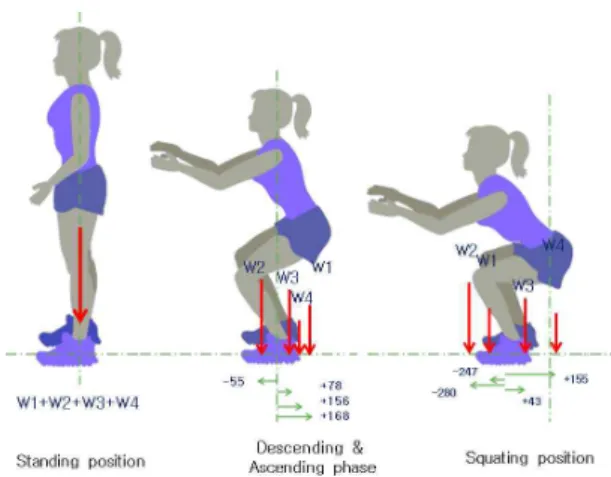
2.3 Classification of the squat exercise position Correct body alignment is an important factor when squat exercise to prevent body damage. In order to calculate the magnitude of the load according to the user's condition, the posture can be divided into three types of Standing Position, Descending & Ascending Phase, and Squatting Position[12,13].
Standing Position is the standing position of the squat exercise before starting to exercise. This posture is the meaning of position initialization that provides important physical information before the squat exercise. [Fig. 2] showed the Classification of the squat exercise position.
Fig. 2. Classification of the squat exercise position
Descending or ascending phase is the magnitude of the load according to the condition and the condition of the intermediate posture of the motion in the descending(Descending phase) or ascending(ascending phase) posture. It is a pause posture from the middle position while starting the squat exercise and reaching from the standing posture to the squatting posture.
This posture states that the muscular strength of the body is maintained in a gentle state of tension with the safety of the body balance is increasing. On the other hand, it is a process in which momentum is increased by imparting considerable tension to muscle strength.
Final squatting position in which the body height is lowered by starting the exercise from the standing posture. This posture is the state in which the strength
of the body is the most tense and the degree of the body anxiety is the highest. The Squatting Position is the rest position with the lowest body height.
3. Design of the Squat exercise equipment
3.1 Design method of the Squat exercise equipment
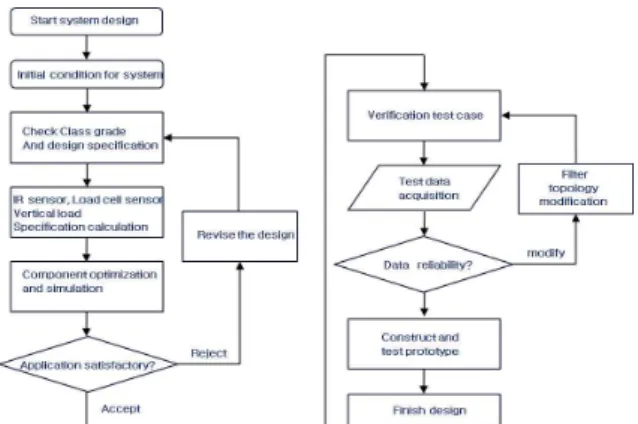
The kinematic analysis of the squat exercise is related to the kinematic interpretation of rotational and gravitational directions throughout the overall operating range[14,15,16]. To effectively understand the biomechanics of free weight exercise for design of exercise assist instrument, you need to know the specific characteristics of the relevant parts. Mentioned about modelling method above which is applied for squat excise instrument system analysis. The processor for system design present the block diagram in Fig. 3.
Fig. 3. Design method of the Squat exercise equipment
A variety of sensors for system design and optimized design techniques are applied in the detected signal processing. Data reliability can be secured through the designed prototype.
3.2 Bio-sensing and FSR filter design using load cell
Load cell is a sensor that measures force or load by converting physical quantities such as force or load into
electrical signals[17]. The designed system uses a load cell and a weight sensor to monitor muscle recovery and weight-bearing activity4.
Fig. 4. System design for stable analysis using 4 load cells
The four signal path components consist of a gain &
signal conditioning cell, an anti-aliasing filter, an ADC(analog-to-digital converter), and a digital signal processing block. The low pass analog filter removes the superposed high-frequency noise before the analog signal reaches the ADC.
There is a linear relationship between the strain value of the strain gage for measuring the mechanical change and the change in the detected electrical resistance.
×
(4)
Where, R is Initial resistance of the strain gauge (Ω), ΔR is Resistance change caused by elongation or contraction (Ω), K is Proportional constant (called the
“gauge factor”), ε is Strain, σ is the stress value, and E is the modulus of elasticity of the measured object respectively. The load value can be obtained by the change of the resistance value as a voltage in the Wheatstone bridge circuit. Using the below formula (5), calculate load cell Load cell capacity calculate specification.
∩≥
× × × ×
(5)
Where, F1=impact coefficient (1.1~1.5), F2=load bias factor(1.1~1.3), F3=load unbalance factor(1, 3point=1, 4point 1.2), W1= actual load, W2=initial weight, N=number of load cells, Ft=Combined effect of zero
setting devices, Fw=Effect of wind force (for hoppers).
Using equation (6), the signal detection using a transducer with a 4-point footplate design
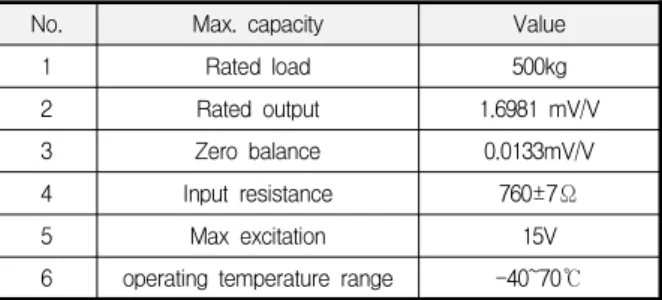
The load cell converts the physical deformation that occurs in the receiving part of the Elastic strain member, which generates a structurally stable deformation with respect to the force or load. [Table 1]
shows the specifications of the piezo-resistive sensor for squat motion detection.
No. Max. capacity Value
1 Rated load 500kg
2 Rated output 1.6981 mV/V
3 Zero balance 0.0133mV/V
4 Input resistance 760±7Ω
5 Max excitation 15V
6 operating temperature range -40~70℃
Table 1. Pressure sensor specification
The applied load cell sensor is applicable to a wide range of applications due to its low profile, integrated load base and high measurement capacity compared to low decks. If a load is applied to the load cell and strain force is generated, it can be expressed as the value of the changeable voltage value by the resistance change amount of the strain gauge with the Wheatstone bridge. Wheatstone Bridge Constructs electrical circuits and converts them into electrical signals for data processing.
Fig. 5. Wheatstone bridge circuit for load cell sensor
The relationship of the Wheatstone bridge circuit can be expressed as equation (6).
(6)
In this study, the filter circuit is designed by applying Active Sallen-Key(VCVS, voltage-controlled voltage-source) filter, and it has the same R or C value as the operational amplifier with unit gain. For a single second stage, the designer has only three performance factors: DC gain, ω0(characteristic frequency of the second pole pair), and Q (indicating the complexity of the pole).
Fig. 6. Sallen-Key second-order low-pass filter
However, Active Sallen-Key filter topology has 5 elements of 2R, 2C, and amplifier gain. Advantages over LC-Larger bandwidth, parts, no magnetic emission, Component values determine filter characteristic, Capacitor codes fixed, resistance
‘dialed-in’ via trim potentio-meters, Two low-pass with a slope of -40dB / decade Filter, and CA has a sharp response near the passband edge.
(7)
For a Butterworth 2nd-order response, DF = 1.414;
therefore, R1/R2 = 0.586. Standard second-order form is equation (8).
∈
(8) Solving for ξ
(9)
Properly design the filter Step1. is choosing resistors and capacitors for OP-AMP filters, ξ=0.5, Q=0.71, natural frequency=1kHz.
×
(10)
Step 2. is Sallen-Key unity gain low-pass filter circuit.
(11)
(12)
Sallen-key topology is a second-order filter topology having non-inverting gain. It is commonly used in voltage-controlled voltage-source(VCVS) implementations.
The gain is configurable with isolated gain resistors making this topology highly usable. Signal process simulation using filter pro.
(a) Filter response for various filter type
(b) Frequency and phase responses Fig. 7. Frequency and phase responses
In the proposed system, the load cell detects the deformation of the elastic body by the load. It uses the principle of a flat plate capacitor and has the most accurate and high resolution characteristic among the displacement conversion type. It is a device that converts force or weight into electric signal.
4. Experiment results
4.1 Squat exercise equipment
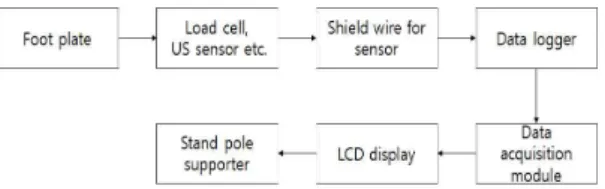
The instrument for the interactive squat exercise consisted of two parts: a foot plate for motion and a data center for data detection. The footplate is designed to have a vertical force of 200kg or more through the load calculation.
Fig. 8. System structure of data center
The data center for data detection has a stand pole capable of withstanding a vertical load of 10kg or more and a stand type pole And manufactured. STS304 series holders and sensor wires of more than 5m were secured from the foot plate. The 10-channel data logger collects the width and filtered sensor output signals and transmits almost the output signals to the data acquisition module through the USB terminal as data.
The data acquisition module implements the data display by transmitting the acquired data to the monitor, so that the exerciser can check the data generated during the exercise through the monitor in real time.
4.2 Squat exercise equipment
Fig. 9. is the output waveform of the signal in Standing position under no load condition. In the no-load state, the output signal appears in a constant
pattern. Since the initial state does not exist and the state is triggered by the fluctuation of the waveform, a state in which the signal waveform is not constantly fluctuated is regarded as the initial state.
Fig. 9. Signal waveform in standing ready
Fig. 10. shows the output waveform in the state of normal squat movement. As shown in the output waveform, it can be seen that the lower sensor responds uniformly and the output waveform due to the deformation of the force appears uniformly.
Fig. 10. Output detection waveform of normal squat movement posture
Fig. 11. shows that the knee is protruded by the squat error operation, and the lower sensor is less deformed due to the deformation of the upper sensor.
Fig. 11. Error motion, motion waveform where the knee protrudes forward
Fig. 12. is a squashed motion waveform in which both knees converge inward due to a squat error operation, so that undesirable pressure is imbalanced because undesired waveforms are detected in contrast to the right motion detection of the lower sensor.
Fig. 12. Error motion, bent motion with knee inward
Fig. 13. is an output waveform of the operation in which the knee is opened outward due to the squat error operation. In contrast to the right motion, a waveform appears in reverse phase. 13 and the opposite motion waveform.
Fig. 13. Error waveform, output waveform of outward knee motion
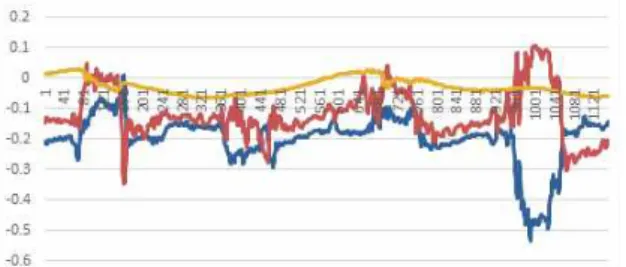
Fig. 14. is an output waveform in which the left trunk deviation occurs due to a squat error operation.
It can be confirmed that the sensor signal is separated and the force is deformed in one direction when compared with the right operation.
Fig. 14. Fault action, output waveform with left trunk deviation
Fig. 15. is an output waveform in which a right trunk deviation occurs due to a squat error operation.
It can be confirmed that a sensor signal is separated and a force is deformed in one direction when compared with a right operation.
Fig. 15. Error waveform, output waveform with rightward trunk deviation
4. Conclusion
In this study, we propose an design method of the free weight exercise instrument that was able to monitoring with numerical analytic for correct free weight exercise with interactive squat exercise equipment. We tested the performance of the prototype by analyzing the obtained bio-signal information in regard to dynamic motion analysis. Using the protype equipment for the squat exercise, we obtained meaningful pattern waveform of normal equat movement posture. We can acquire the correct squat motion numerical data by analyzing the biomedical signals. Through this study, we developed the technical process of the squat exercise device based on the dynamic analysis and it is possible to extend various free weight exercise fields.
REFERENCES
[1] Picard, R. W., Vyzas, E., & Healey, J. (2001). Toward machine emotional intelligence: Analysis of affective physiological state. IEEE transactions on pattern analysis and machine intelligence, 23(10), 1175-1191.
[2] Li, L., Olson, M. W., & Winchester, J. B. (2008). A proposed method for determining peak power in the
jump squat exercise. The Journal of Strength &
Conditioning Research, 22(2), 326-331.
[3] Macek, J & Kleindienst. J. (2011). Exercise support system for elderly: Multi-sensor physiological state detection and usability testing. In IFIP Conference on Human-Computer Interaction. (pp. 81-88). Berlin, Heidelberg : Springer.
[4] Hassan, M. F. A., Zulkifley, M. A., & Hussain, A. (2015).
Squat exercise abnormality detection by analyzing joint angle for knee osteoarthritis rehabilitation. Journal Teknologi, 77(7), 19-24.
[5] Mihai DOINEA. (2010). Mobile Platform for an Exercise Distributed Application.Body Building Science Journal, 2(3), 39-48.
[6] John G. Webster. (2010). Medical Instrumentation application and design. 4th ed, WILEY.
[7] Roger Bartlett, Introduction to Sports Biomechanics, Analysing Human Movement Patterns, 2nd Edition, Routledge Publishing, 2007.
[8] Drillis, R., Contini, R., & Bluestein, M. (1969). Body segment parameters. New York University, School of Engineering and Science.
[9] Jim Karki (2002). Active Low-Pass Filter Design, Texas Instruments, Application Report.
[10] B. G. Jung. J. W. Kim & B. H. Jeong. (2017). A Study of Structural Analysis Simulation for Squat Excise Foot Plate.Journal of The Korea Convergence Society, 9(X).
355-372
[11] Dugan, E. L., Doyle, T. L., Humphries, B., Hasson, C. J.,
& Newton, R. U. (2004). DETERMINING THE OPTIMAL LOAD FOR JUMP SQUATS: AREVIEW OF METHODS AND CALCULATIONS. The Journal of Strength & Conditioning Research, 18(3), 668-674.
[12] Schoenfeld, B. J. (2010). Squatting kinematics and kinetics and their application to exercise performance.
The Journal of Strength & Conditioning Research, 24(12), 3497-3506.
[13] Walsh, J. C., Quinlan, J. F., Stapleton, R., FitzPatrick, D.
P., & McCormack, D. (2007). Three-dimensional motion analysis of the lumbar spine during “free squat” weight lift training. The American journal of sports medicine, 35(6), 927-932.
[14] Nicholas Soleyn. (2013). Starting Strength - Analyzing the Squat. The Aasgaard Company, 1-8.
[15] S. Hee. Cho & S. Y. Lee. (2016). A Effect of the Squat Convergence Exercise Among Knee Joint Angle on Quadricpes Strength in the Patients With Patellofemoral Pain Syndrome. Journal of The Korea Convergence
Society, 17(2).43-52.
[16] S. G. Back. (2016). Effects of Using Convergence Circuit Weight Training on the Blood Lipids and Oxygen-carrying Factors in Middle-aged Women.
Journal of The Korea Convergence Society, 7(6).
267-274.
[18] www.vpgtransducers.com
정 병 호(Byeong-Ho Jeong) [정회원]
▪2006년 8월 : 조선대학교 일반대 학원 전기공학과 (전력전자공학 박사)
▪2006년 9월 ∼ 2009년 2월 : ㈜기 영미다스 선임연구원
▪2009년 3월 ∼ 현재 : 남부대학교 자동차공학부 교수
▪관심분야 : 의공융합, 전력전자 신재생에너지
▪E-Mail : [email protected]
박 주 훈(Ju-Hoon Park) [정회원]
▪1998년 2월 : 동신대학교 물리학과 (이학사)
▪2000년 2월 : 동신대학교 대학원 물리학과(이학석사).
▪2006년 2월 : 전남대학교 대학원 광공학과(공학박사).
▪2005년 3월 ∼ 현재 : 남부대학교 자동차공학부 교수
▪관심분야 : 의료기기, 의공학, 의광학
▪E-Mail :
김 지 원 (Ji-won Kim) [정회원]
▪2014년 2월 : 인제대학교 일반대학 원 물리치료학과(이학박사)
▪2014년 4월 ∼ 현재 : 남부대학교 물리치료학과 교수
▪관심분야 : 운동역학, 의공융합, 운 동치료
▪E-Mail : [email protected]