Oocyte Maturation Process of Zebrafish (Danio rerio), an Emerging Animal Model
Seung Jin Han*
Department of Biological Sciences, Inje University, Gimhae, Gyeongnam 50834, Korea Received October 8, 2015 /Revised October 26, 2015 /Accepted October 26, 2015
The zebrafish is an emerging vertebrate model organism in reproductive biology. The oocyte matura- tion of zebrafish is triggered by maturation inducing hormone (MIH, 17α,20β-Dihydroxy-4-pre- gnen-3-one). In almost all animals, the oocyte maturation is governed by activation of pre-MPF which consists of cyclinB and inactive Cdk1. In the oocyte of Xenopus and mice, the activity of Cdk1 is regu- lated in two ways, one is the interaction with cyclinB and the other is phosphorylation/dephosphor- ylation of T14/Y15 residues on the Cdk1 by Wee1 and Cdc25. Unlike Xenopus and mice that have a sufficient amount of pre-MPF, pre-MPF is absent in GV oocyte of most teleost including zebrafish.
Therefore, the activation of MPF during zebrafish oocyte maturation might totally depend on de novo synthesis of cyclinB proteins. It is reported that the translation of maternal mRNA is regulated by combination of several RNA binding proteins such as CPEB, Dazl, Pum1/Pum2, and insulin-like growth factor2 mRNA-binding protein 3 in the zebrafish oocytes. However, the definitive mechanism of these proteins to regulate the translation of stored maternal mRNAs remains to be elucidated.
Therefore, the investigation of the maturation process of the zebrafish oocyte will provide new in- formation that can help identify the role of translational control in early vertebrate oocyte maturation.
Key words : Maturation promoting factor, meiosis resumption, oocyte, RNA binding proteins, zebrafish
*Corresponding author
*Tel : +82-55-320-3787, Fax : +82-55-336-7706
*E-mail : [email protected]
This is an Open-Access article distributed under the terms of the Creative Commons Attribution Non-Commercial License (http://creativecommons.org/licenses/by-nc/3.0) which permits unrestricted non-commercial use, distribution, and reproduction in any medium, provided the original work is properly cited.
Journal of Life Science 2015 Vol. 25. No. 10. 1184~1195 DOI : http://dx.doi.org/10.5352/JLS.2015.25.10.1184
서 론
새로운 실험 동물 모델로서의 제브라피쉬
제브라피쉬는 잉어과에 속하는 물고기로, 인도가 원산지이 며 수명은 약 2년 정도이다. 다 자란 제브라피쉬의 크기는 3~4cm 정도로 몸에는 가로 줄무늬가 있다. 제브라피쉬는 쥐, 토끼, 원숭이 등 다른 척추동물에 비해 크기가 작아 좁은 공간 에서 적은 비용으로 많은 수의 개체를 유지하기가 쉽다. 생후 3개월이면 번식이 가능한 암컷은 계절에 관계없이 일주일에 한번 정도 약 200~300개의 알을 낳는다. 제브라피쉬는 체외수 정을 하기 때문에 정자와 난자를 따로 채취해 목적에 맞게 교배하여 개체를 발생시킬 수 있다. 수정란의 초기 세포분열 간격은 15분 정도로 대장균의 세포분열보다 빠르다. 발생 6시 간 정도에 낭배형성(gastrulation)이 시작되어 발생 10시간 정 도에 완료되며, 12시간이 지나면 눈의 형태가 형성되기 시작 하여 수정 후 24시간이 지나면 대부분의 주요 장기와 기관이 형성된다[51]. 제브라피쉬 알과 배아는 투명하기 때문에 발생
과정에서 일어나는 표현형들을 쉽게 구분하고 분류할 수 있 다. 예를 들어 심장의 박동, 혈관과 혈액의 순환을 육안으로 관찰할 수 있다는 점에서 혈관 형성 연구에도 많은 도움이 되고 있다. 또한 형광단백질과 같은 생물 표지자를 기관 특이 적으로 발현시키면 특정 생체 기관 내에서 일어나는 변화를 실시간으로 이미지화할 수 있다[64]. 영국의 Sanger center에 의해 25쌍 염색체 대부분의 유전자 염기서열이 밝혀짐으로써 (https://www.sanger.ac.uk/resources/zebrafish/) 유전자 돌연변이에 의한 장기형성 과정의 이상과 질병 형성 과정을 쉽게 규명할 수 있는 장점을 가지고 있다. 인간 게놈의 22%는 척추동물 특이적인 유전자이므로 적어도 5,000개 이상의 인간 유전자 기능이 다른 척추동물 모델을 이용함으로써 분석 가능 하다. 척추동물인 제브라피쉬는 인간이나 생쥐와 유전체 구조 가 유사하며, 유전자 및 단백질 간의 상동성이 매우 높아 특정 유전자의 기능을 연구하기에 적합하다. 또한 폐를 제외하고 간, 췌장, 지라, 흉선 등 인간이 지니고 있는 대부분의 장기를 가지고 있고 신경계 및 각종 기관 형성 과정이 사람과 매우 유사하기 때문에 인간의 유전 질환 및 질병 연구를 위한 질환 동물로써 적합하다. 또한 제브라피쉬 발생배는 0.7mm정도로 작기 때문에 96-well microplate에 3-5마리 정도씩 분주한 후 약물을 이용하여 효율적인 신약 후보 물질 발굴 및 검증에 유용하다. 이러한 스크리닝 방법은 무척추동물인 예쁜 꼬마 선충(C. elegans)이나 초파리(Drosophila melanogaster)에서나 가 능했던 방법인데, 이 방법을 이용하여 발굴된 약물은 생체 내 에서 효과를 나타낼 확률이 높고 약물 독성에 대한 정보도
- Review -
함께 얻을 수 있다. 또한 대량으로 쉽게 채취 가능한 수정란에 DNA 및 RNA를 미세주사하여 유전자를 과발현시키거나, CRISPR나 TALEN 또는 antisense morpholino oligonucleo- tide를 이용하여 유전자를 낙인/낙다운(gene knock-in/
knock-down)함으로써 짧은 시간에 다양한 유전자들의 기능 을 분석할 수 있다. 이러한 많은 장점으로 인해 제브라피쉬는 인간 유전체 비교 연구, 암과 면역질환, 골다공증, 비만 등의 질병 원인 규명 등에 다양하게 이용되고 있다[62, 94, 118].
제브라피쉬를 포함하는 물고기는 생식생물학 연구에서도 새롭게 대두되는 실험 동물이지만 상대적으로 이들의 초기 난자 성숙에 대한 연구는 미비한 편이다. 본 총설에서는 제브 라피쉬 난자 초기 발생 단계에서 일어나는 조절 기작을 기존 에 난자 연구의 주재료로 이용되던 아프리카 발톱개구리 (Xenopus laevis)와 생쥐(Mus musculus) 난자 성숙 과정과 비교 분석함으로써 난자 성숙 연구 재료로서의 제브라피쉬의 가치 를 재조명하고자 한다.
본 론
난자 성숙(oocyte maturation)
지금까지 척추동물 난자 성숙 과정은 주로 발톱개구리와 생쥐 난자를 이용한 분자생물학적, 세포생물학적 연구를 기초 로 이해되었다. 발생 초기에 생성되어 난포(ovarian follicle)에 존재하는 동물 난자는 더 이상 세포 분열을 이행하지 않고 감수분열 전기(prophase)와 중기(metaphase)의 중간 단계인 망사기(dictyate stage)에 세포주기가 정지되어 있다. 배란이 일어나기 바로 직전까지 유지되는 세포주기 정지 기작은 아직 완벽하게 규명되지 않고 있다. 세포주기가 중단된 난자는 형 태학적으로 다른 세포와 확연히 구분되는데, 특이적인 인 (nucleolus)을 가진 거대 핵과 부분적으로 응축이 일어나지 않 은 염색체를 갖는다. 이 상태의 미성숙 난자를 난핵포(Germi- nal Vesicle, GV) 난자라 한다[24]. GV 난자에서 높은 농도로 유지되는 2차신호전달체(second messenger)인 3’,5’-cyclic ad- enosine monophosphate (cAMP)는 난자 세포 감수분열 중지 에 중요한 역할을 한다[11, 14]. 생쥐에서 G 단백질연관수용체 (G protein-coupled receptor, GPCR)의 일종인 GPR3, 그리고 쥐(Rattus norvegicus)의 GPR12가 유전적으로 제거된 난자가 세포주기를 재개하는 것으로 보아 이 수용체들이 하위 단계의 adenylyl cyclase (AC)를 활성화시켜 cAMP를 생성하는 것으 로 보인다[22, 36, 72]. GPR3는 발톱개구리 난자의 세포주기 정지에도 관여한다[21]. 프로게스테론(progesterone)에 의해 유발되는 발톱개구리의 난자 성숙과 난포에서 방출되면 자발 적으로 진행되는 생쥐 난자 성숙 과정에는 자극 G-단백질 (stimulatory G-protein, Gs)이 작용하는 것으로 알려져 있다 [67, 101, 102, 111]. 생쥐 난자에 Gs 단백질에 대한 항체를 미세 주사하면 cAMP의 생산이 중단되는 것으로 보아 GPCR의 하
위 단계에서 Gs가 AC를 활성화시키는 것으로 생각된다[71].
생성된 cAMP에 의해 활성화된 “cAMP 의존성 단백질 인산화 효소 A(cAMP dependent protein kinase A, PKA)”는 난자 내부의 몇몇 기질을 인산화하여 세포주기를 정지시킨다[6, 67]. 이러한 사실은 PKA의 억제제인 PKI, 또는 조절 소단위체 (R subunit)를 난자에 주입하면 난자가 세포주기를 재개하고, 반대로 PKA의 촉매 소단위체(catalytic subunit)를 주사하면 난자의 세포주기가 억제된다는 실험 결과를 통해 증명되었다 [6, 7, 80]. 또한 cAMP를 분해하는 효소인 포스포디에스터라제 (phosphodiesterase, PDE)의 억제제인 isobutylmethylxanthine (IBMX)을 처리하면 난자에서 일어나는 세포주기 재개를 막을 수 있다[15, 18, 99]. 그러나 아직도 어떠한 분자들이 PKA에 의해 조절되어 난자 성숙이 억제되는지는 확실치 않다.
성년이 되면 황체형성호르몬(leutinizing Hormone, LH)이 작용하여 난자 세포 주변의 과립층세포(granulosa cell)에서 난자로 감수분열 재개 신호가 전달된다. 난자 성숙(oocyte ma- turation)이라고도 불리는 감수분열 재개(meiosis resump- tion)는 염색체 응집과 GV 소실로 규정되는데 이를 “난핵포 소실(germinal vesicle breakdown, GVBD)이라 한다[13]. 난자 세포는 MI (metaphase I, 제1감수분열 중기) 시기를 거쳐 제1 극체(polar body)를 방출하고 DNA의 복제 없이 두 번째 세포 분열에 들어간 후 MII (metaphase II, 제2감수분열 중기) 상태 에서 다시 세포주기가 정지한다. 이 상태에서 배란이 일어나 고 정자와의 수정을 기다리게 된다[96, 108].
제브라피쉬 난자 성숙
제브라피쉬 난소의 난원세포(oogonia)는 감수분열을 시작 한 후 제1감수분열 전기(prophase I) 상태에서 배아 발생에 필요한 mRNA가 축적되며 성장한다. 발생중인 난자는 크기와 투명도에 따라 5단계로 나눌 수 있다[65]. 발생 초기의 I 단계 난자는 다시 크기에 따라 IA (7-20 μm)와 IB (20-140 μm)로 분류하는데 두 단계 모두 투명하게 보인다. II 단계는 140-340 μm의 크기를 가지며 표층포(cortical alveoli; 난황포)가 축적 되기 시작한다. III 단계 초기의 난자는 크기가 340-690 μm 정도 되고 간에서 합성된 glycolipoprotein인 vitellogenin이 난자에 축적되는 난황형성 과정(vitellogenesis)이 시작되면서 점점 불투명해진다. 난자 특이적 거대 핵인 GV는 난자의 중심 에 위치해 있다. 690 μm 정도 크기의 미성숙 III 단계 난자는 호르몬 자극에 의해 감수분열을 재개하여 IV, V단계로 들어간 다. 690–730 μm 크기의 IV 단계 난자는 GV가 표피층 근처로 비대칭적으로 이동하게 된다. 성숙한 난자(V 단계)는 크기가 730–750 μm에 달하게 되고 GV가 해체되면서 제2감수분열 중기(MII, metaphaseII) 상태가 된다. 투명한 상태의 V 단계 난자는 산란이 되고 정자와 수정이 되었을 경우 배아로 발생 할 수 있는 상태가 된다. III 단계의 난자가 IV단계를 거쳐 V 단계가 되는 과정이 제브라피쉬의 난자 성숙 과정이다.
제브라피쉬 난자 성숙 과정은 뇌하수체(pituitary gland)에 서 분비되는 생식샘자극호르몬(gonadotropic hormone, GTH)에 의해 촉발된다[81]. 난포자극호르몬(Follicle stim- ulationg hormone, FSH)과 황체형성호르몬(LH)의 두 가지 GTH가 분비되는 포유동물과 마찬가지로 제브라피쉬에서도 GTHI과 GTHII 두 가지 종류의 호르몬이 분비되는데 GTHI는 난포의 성장에 관여하는 반면 GTHII (LH)는 난포를 자극하여 성숙 유도 호르몬(maturation inducing hormone, MIH) 분비 를 촉진시킨다[57]. MIH는 난자의 성숙을 유도하는데 17α,20β- dihydroxy-4-pregnen-3-one (17α,20β DHP)가 제브라피쉬 난 자의 GVBD를 유발하는 가장 효과적인 스테로이드이다. 이 호르몬은 경골어류(teleost)인 송사리과(medaka, Oryzias lat- ipes)[43], 연어과(Oncorhynchus rhodurus)[82, 109], 메기과 (Indian catfish)[30, 98], 방어류(Yellowtail, Seriola quinquer- adiata) [97], 고등어(chub mackerel, Scomber japonicas) [70]
등에서도 난자 성숙을 유도한다고 알려졌다. 이 호르몬은 물 고기 난자 세포막 표면에 존재하는 GPCR인 프로게스틴 수용 체(progestin receptor, mPR)에 작용한다[126, 127]. 그러나 MIH가 분자적 수준에서 어떻게 mPR과 결합하는 지는 아직 알려지지 않았다. 이 GPCR은 백일해 독성-민감성 억제 G-단 백질(pertussis toxin-sensitive inhibitory G-protein, Gi)을 활 성화시킴으로써 세포내부로 신호를 전달하게 된다[119, 120].
Gi는 세포막에 존재하는 AC를 억제하여 cAMP 농도를 낮추고 PKA는 활성을 잃게 된다[127]. AC활성촉진제(adenylate cy- clase activators)나 PDE 억제제(phosphodiesterase inhibitors) 를 처리하면 발톱개구리, 생쥐와 마찬가지로 물고기 난자 성 숙 과정이 억제되는데 이러한 실험 결과는 제브라피쉬, 발톱 개구리, 생쥐 모두에서 cAMP가 난자 성숙 과정을 억제하는 역할을 한다는 것을 입증한다[15, 19, 20, 46, 69, 114].
비록 17α,20β DHP가 제브라피쉬 난자 성숙을 조절하는 주 요 호르몬으로 알려져 있지만 발톱개구리와 제브라피쉬 모두 에서 인슐린(insulin)과 인슐린유사성장인자(insulin-like growth factor, IGF) 또한 난자 성숙을 유도한다[1, 2, 60, 84]. 발톱개구 리의 경우 인슐린 수용체가 하위 단계의 PI3-kinase와 PKB (Protein Kinase B, Akt)를 활성화시킨다. PKB는 PDE3A (Phosphodiesterase 3A)를 인산화하여 활성을 증가시켜 cAMP의 분해를 촉진한다. 최근 제브라피쉬의 난자 세포주기 재개 과정에도 활성화된 PDE3A가 cAMP를 분해하여 PKA의 불활성화에 관여한다는 것이 보고되었다[16]. 비록 생쥐에서 도 난자 성숙과정에 Akt의 활성이 증가하고, Akt를 과발현하 면 PDE3A가 인산화되며 난자 성숙이 촉진된다는 것이 밝혀 졌지만 PI3-kinase의 활성을 증가시키는 외부 신호는 아직 밝 혀지지 않았다[33].
동난포(antral follicle)에 존재하는 성숙한 생쥐 난자는 난포 막세포(theca cell), 벽과립층 세포(mural granulosa cell), 난구 세포(cumulus cell)로 둘러싸여 있고 발톱개구리와 제브라피
쉬의 난자도 난포막세포와 과립층세포로 둘러싸여 있다. 생쥐 와 발톱개구리 난자 성숙 과정의 큰 차이점 중 하나는 이러한 주변 세포들을 제거하면 생쥐 난자는 자발적인 난자 성숙 (spontaneous oocyte maturation)에 들어가는 반면 발톱개구 리는 GV 상태를 유지하고 있다는 것이다. 제브라피쉬의 경우 주변 세포가 제거되면 대부분이 GV 상태를 유지하지만 상대 적으로 많은 난자가 자발적 성숙 단계로 넘어간다. 이러한 사 실은 생쥐 난자의 주변 체세포에서 난자 성숙 억제 신호가 나온다는 것을 의미한다. 최근 연구결과에 의하면 주변 체세 포에서부터 유래한 cGMP가 PDE3A를 억제함으로써 생쥐 난 자의 세포주기 재개를 막는다[106, 107, 110]. 난포의 cGMP의 농도는 mural granulosa cell에서 발현되는 NPPC ligand와 cumulus cell에 존재하는 수용체인 NPR2 (Natriuretic pep- tide receptor2)에 의해 유지되고 생성된 cGMP는 gap junction 을 통하여 난자로 운반된다[68, 122, 123]. 이러한 신호전달과 정이 제브라피쉬 난자 세포주기 조절에도 보존이 되어있는지 는 알려져 있지 않으나 체세포로부터 분리된 많은 제브라피쉬 난자가 자발적 난자성숙에 들어가는 것으로 보아 체세포 유래 신호가 난자 성숙 억제에 관여하는 것으로 생각된다. 최근 연 구결과에 의하면 제브라피쉬 난자 주변의 체세포에서 분비된 estrogen과 그 수용체인 GPER/GPR30의 신호전달 과정을 통 해 난자의 Scr kinase와 metalloprotease가 활성화되고 HBEGF가 생성된다. HBEGF는 난자 표면의 EGFR에 결합하 여 Map2k kinase와 Map3/1 kinase를 활성화함으로써 난자 성숙을 억제한다[90, 91, 93].
최근 생쥐, 돼지, 소, 원숭이 그리고 인간 등 여러 포유동물 에서 LH의 자극에 의해 발현되는amphiregulin (AREG), epi- regulin (EREG), betacellulin (BTC)과 같은 EGF-유사 성장인 자(EGF-like growth factor)가 granulosa cell과 cumulus-oo- cyte complex 사이의 신호전달체계를 통하여 난자 성숙 과정 을 조절한다는 것이 보고되었다[10, 25, 63, 92, 113, 121]. 생쥐 난포에서는 EGF-유사 성장인자가 granulosa cell에서 발현되 고 granulosa cell과 cumulus cell에 존재하는 EGFR에 결합하 여 하위 단계의 신호 전달에 관여한다. 제브라피쉬에서는 EGF 가 granulosa cell과 난자에서 모두 발현되는 반면 EGFR은 granulosa cell에서만 발현되어 EGF 신호가 난자에서 난포 세 포 쪽으로 향하게 된다. EGF는 activin βA와 βB의 발현을 촉 진시키고 follistatin의 발현을 억제한다[113].
단백질 수식(protein modification)에 의한 난자 성숙 조절 단세포 진핵생물인 효모, 그리고 발톱개구리와 생쥐를 비롯 한 모든 동물에서 난자 세포주기 재개는 성숙촉진인자 (maturation or M phase promoting factor, MPF) 복합체에 의해 이루어지는데, 이 복합체는 효소 활성을 갖는 cdc2 인산 화효소(cdc2 kinase)와 조절 단백질인 cyclinB로 이루어져 있 다[48, 77, 83]. 발톱개구리와 생쥐의 성숙되지 않은 난자에는
Fig 1. Signal in the fish oocyte maturation. See text for details.
pre-MPF라 불리는 비활성 MPF가 존재하는데 이 복합체의 cdc2 소단위체는 T161 잔기와 T14/Y15 잔기가 인산화되어 있다. CAK kinase에 의해 매개되는데 T161잔기의 인산화는 Cdc2를 활성화시키는 반면[17, 77] MytI/Wee1 kinase는 T14/Y15 잔기를 인산화하여 MP의 활성을 억제한다[44]. 발톱 개구리 난자에서는 PKA가 T14/Y15잔기를 탈인산화하는 Cdc25C phosphatase를 인산화하여 활성을 낮춤으로써 난자 의 미성숙 상태를 유지한다[23]. 발톱개구리 난자에 프로게스 테론을 처리하면 PKA가 비활성화 되어 Cdc25C가 활성화되 고 T14/Y15 잔기의 인산기를 제거하여 MPF가 활성화된다 [23]. 생쥐의 미성숙 난자에서는 PKA가 Wee1B kinase를 인산 화하여 활성화시키고, Cdc25B phosphatase를 불활성화시킴 으로써 MPF를 비활성 상태로 유지하게 된다[32, 95, 125].
MIH에 의해 자극을 받은 제브라피쉬의 난자도 MPF의 활성화 를 유도한다[54]. 그러나 제브라피쉬의 난자에는 비록 cyclinB mRNA는 존재하지만 단백질이 존재하지 않으므로[55]
pre-MPF라 불리는 비활성 MPF가 존재하지 않는다[40, 56].
이러한 이유로 제브라피쉬의 난자 세포에서는 Wee1과 Cdc25 가 난자의 성숙 과정을 조절하지 않을 것이라는 추정을 가능 하게 한다. 생쥐 Wee1B는 MII 상태의 난자가 수정 후 체세포 분열을 시작할 때 MPF의 활성을 감소하는데도 중요한데[87]
이러한 역할이 제브라피쉬에서도 보존되어 있는지는 확실하
지 않다. 그렇다면 제브라피쉬 난자의 성숙 과정에서 일어나 는 cAMP 감소와 이로 인한 PKA 활성 감소는 어떻게 MPF 활성화를 유도하는가? 이 과정에는 단백질 합성에 의한 cyclinB 농도 증가가 필수 불가결하다고 알려져 있다. 발톱개 구리, 소, 염소, 양 그리고 돼지 등의 난자에 단백질 합성 억제 제인 cycloheximide를 처리하면 GVBD가 일어나지 않는 것으 로 보아 이 동물들의 난자 성숙 과정에서 단백질 합성이 필수 적이다. 그러나 생쥐 난자는 억제제의 유무와 상관없이 GVBD 가 일어난다[26]. 생쥐와 발톱개구리의 pre-MPF의 가장 큰 차 이점은 cyclinB와 Cdc2의 상대적 비율인 듯하다. 생쥐의 난자 에는 614 nM의 cyclinB1이 존재하고 이것은 90 nM 정도 존재 하는 Cdc2의 농도에 비해 7배 정도 높은 반면 발톱개구리의 다 자란 난자에는 50 nM 정도의 Cdc2와 상대적으로 적은 양 인 1 nM 정도의 cyclinB가 존재한다[48]. 즉 상대적으로 발톱 개구리는 더 적은 양의 pre-MPF를 함유하고 있으며 이로 인해 난자 성숙과정에서 cyclinB 합성을 통한 MPF 복합체 생성이 필수적인 듯하다. 제브라피쉬의 III 단계 난자에는 cyclinB 단 백질이 전혀 존재하지 않기 때문에 제브라피쉬 난자 성숙은 완전히 단백질 발현 조절에 의존하는 듯하다. 다음 절에서는 난자 내에서의 단백질 발현 조절 기작을 살펴보도록 하자.
단백질 합성(protein synthesis)에 의한 난자 성숙 조절 염증 반응, 신경 세포의 가소성, 세포분열 및 노화를 비롯한 여러 생물학적 현상에서 전사 후 단백질 번역 조절이 중요한 역할을 한다[42]. 특히 동물 초기 발생 단계는 전적으로 단백질 번역에 의해 조절된다고 알려져 있다[34, 50]. 초파리 등 모델 생물체에서 모체 유래 mRNA (maternal mRNA)의 발현이 낭 배형성(gastrulation) 전단계인 포배중기전환기(midblastula transition, MBT)까지 발생 과정을 조절한다. 포유동물에서도 난자 성숙 단계와 접합자 게놈 활성(zygote genome activa- tion, ZGA)이 일어나는 초기 배아 발생 단계까지는 전사가 전혀 일어나지 않고 모든 과정이 저장되어 있던 maternal mRNA의 단백질 번역 조절에 의해서만 일어난다[12, 59, 61].
그러나 난자에서 배아로 변환되는 과정에서 난자 세포주기 조절과 배아 발생에 필요한 단백질을 코딩하는 mRNA의 단백 질 번역에 관한 자세한 조절 기작은 아직 제대로 규명되지 않았다[12]. 앞 절에서 언급한 바와 같이 GTH와 MIH에 의해 유도되는 제브라피쉬를 포함하는 물고기의 난자 성숙 과정은 단백질 합성에 의존한다. 특히 제브라피쉬 난자의 cAMP 농도 를 인위적으로 높게 유지하면 난자 성숙이 일어나지 않는 것 으로 보아 난자 내의 PKA의 활성이 난자 성숙에 필요한 단백 질 번역과 연결되어 있음을 알 수 있다. 그러나 MPF를 주사하 여 일어나는 난자 성숙에는 단백질 합성이 필요하지 않다. 또 한 시간적으로 GTH나 MIH의 자극에 의한 난자의 성숙보다 MPF의 주사에 의한 난자의 성숙과정이 더 빠르게 일어나는 것으로 보아 MPF 활성화가 단백질의 합성에 뒤따른다는 것을 알 수 있다[55]. 이러한 사실은 합성되는 단백질이 MPF 자체 이거나 MPF의 활성을 조절하는 단백질이라는 것을 추정할 수 있게 한다. 가장 가능성이 높은 단백질은 MPF 복합체를 이루는데 필수적인 cyclinB 단백질이다. 제브라피쉬 뿐 아니라 골드피쉬, 잉어, 메기, 미꾸라지, 칠성장어 등 여러 종류의 물 고기에서 cyclinB cDNA가 분리되었지만 이들 어류의 미성숙 난자에는 cyclinB 단백질이 존재하지 않는다[4, 29, 37, 38, 47].
단백질 합성을 저해한 조건에서도 골드피쉬 난자에 cyclinB 단백질을 주사하면 GVBD가 유발되므로[49] MIH에 의해 유 발되는 어류의 난자성숙에는 cyclinB의 합성이 필수적이다. 이 러한 사실은 지금까지 척추동물 난자 성숙 모델 시스템으로 주로 이용되던 발톱개구리나 생쥐 난자와는 달리 물고기 난자 는 단백질의 변형(인산화, 탈인산화)에 의한 변수를 고려하지 않는 상태에서 단백질 번역 조절 관점에서만 난자 성숙 조절 을 연구할 수 있는 이상적인 실험 모델이라는 것을 의미한다.
몇몇 연구가 제브라피쉬 난자에서 cyclinB mRNA의 단백질 번역에 대하여 언급하고 있지만 제브라피쉬 난자에 저장된 maternal mRNA들이 어떻게 정확한 시간에만 번역이 개시되 는 가에 대한 기작은 아직 규명되지 않았다[54-56, 116, 117].
첫 번째 고려해야 할 문제는 미성숙 난자에서 단백질 발현의 억제 기작이다. 제브라피쉬 난자 mRNA는 초파리의 경우와
마찬가지로 공간적인 배치에 의해 조절된다. 제브라피쉬의 미 성숙 난자에서 cyclinB mRNA는 동물극 쪽에 편중되어 있는 데 이러한 cyclinB의 국지성에는 Pumilio 단백질 결합이 중요 하다[56]. 이 국지성은 미세소관(microtubule)과는 무관하지만 액틴(actin) 섬유를 분해하는 시약인 시토칼라신(cytochalasin) 을 처리하면 cyclinB mRNA가 산재하는 양상을 보이는 것으 로 보아 액틴을 포함한 세포골격이 작용하는 것을 알 수 있다 [54, 56]. 난자 성숙 단계서 MIH의 자극에 의해 cyclinB mRNA 가 세포질로 흩어지게 되면 산재된 mRNA에서 단백질 번역이 활성화되는 것으로 생각된다.
난자 성숙 과정에서 단백질 합성은 mRNA 3’말단의 아데닐 산중합(polyadenylation) 정도에 의해 조절된다고 알려져 있 다. 성숙된 난자에서 cyclinB mRNA의 poly (A) tail은 미성숙 난자의 그것에 비하여 약 100 nucleotides 정도 길다[116, 117].
이러한 poly (A) tail의 신장은 난자의 GVBD와 거의 동일한 시기에 일어난다. 그러나 어떻게 MIH가 polyadenylation을 유발하는지에 관한 연구는 미비한 편이다. 발톱개구리 난자에 서는 저장된 maternal mRNA에 결합하는 RNA 결합 단백질 (RNA binding protein, RBP; 예를 들어 CPEB1, CPSF, ePAB 등), 폴리아데닐라제(polyadenylase; Gld2), 디아데닐라제 (deadenylase; PARN), 스캐폴드단백질(scaffold/adaptor;
Symplekin. Maskin) 그리고 5’의 캡 구조에 결합하는 단백질 인 eIF4E가 이루는 고분자 복합체가 poly (A) tail을 짧게 유지 함으로써 단백질의 번역을 저해하는 것으로 알려졌다[8]. 발톱 개구리 난자에서 CPEB1 (cytoplasmic polyadenylation ele- ment binding protein)이 mRNA의 polyadenylation을 억제하 거나 활성화하는 핵심 조절자로 알려져 있다[27, 31, 103]. 단백 질 번역이 촉진될 때 CPEB1은 Eg2 (Aurora A) kinase에 의해 Ser174번 자리가 인산화되며 PARN이 복합체로부터 떨어져 나가서 mRNA의 polyadenylation이 촉진된다. 길어진 poly (A) tail에 ePAB가 결합하여 mRNA가 고리화 구조를 형성하 며 리보솜이 결합하여 단백질 번역이 촉진된다[39, 73, 74]. 그 러나 Aurora kinase가 정말로 난자에서 단백질 번역 조절에 관여하는지는 의견이 분분하다[53]. 몇몇 그룹에서 개구리 난 자 성숙 과정에서 Aurora A kinase의 활성화를 관찰하고자 하였으나 실패하였으며, 난자 추출액에서 항체를 이용하여 Aurora A kinase를 제거시켰을 경우에도 초기의 CPEB1 인산 화를 억제하지 못하였다[39, 53, 85]. 신경세포에서는 CPEB1이 칼슘/칼모듈린-의존 인산화효소 II (calcium/calmodulin-de- pendent kinase II, CAMKII)에 의해[41], 초파리의 난자에서는 CPEB의 homolog인 Orb가 카세인인산화효소 2(Casein kin- ase2)에 의해 인산화된다[115]. 또한 돼지 난자에 Aurora A kinase 억제제를 처리하여도 CPEB의 인산화를 억제하지는 못 하는 것으로 보아 Aurora A kinase가 CPEB1에 의해 매개되는 번역의 촉진을 매개하는 지는 다시 조사되어야 할 것이다.
생쥐 난자 성숙 과정에서 단백질 번역이 활발하게 일어나는
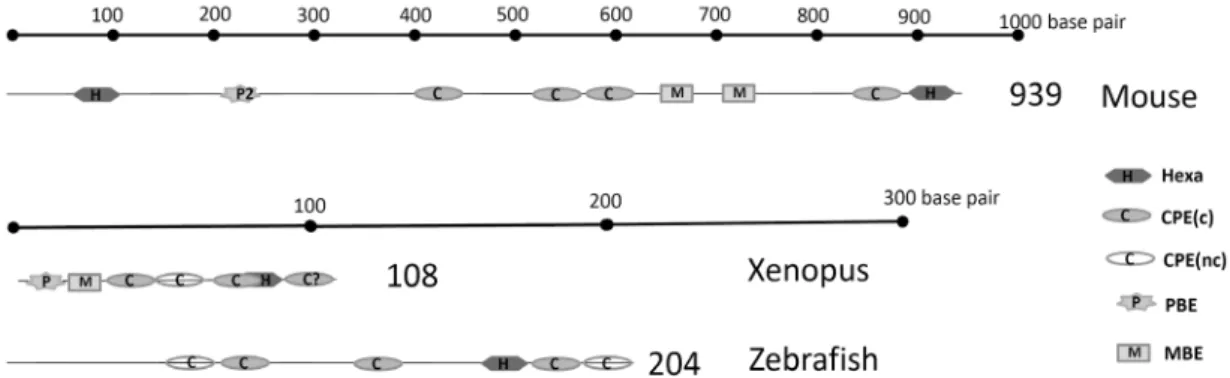
Fig 2. 3’ UTR structure of mouse, Xenopus and zebrafish cyclinB1 mRNA. The schematic diagram shows the putative RNA binding sites in the mouse, Xenopus and zebrafish cyclinB1 mRNA. H : hexanucleotide sequences (AAUAAA or AUUAAA), P: pumillio binding elements (UGUA(N)AUA), CPE (c): consensus cytoplasmic polyadenylation elements (UUUUAU, UUUUAAU), CPE (nc): non-consensus cytoplasmic polyadenylation elements (UUUUACU, UUUUAAAU, UUUUAAGT, UUUUCAU) M:
Musashi binding elements (G/AU1-2AGU). Accession number of each genes is NM_172301 for mouse, NM_001087797 for Xenopus, and AB040435 for zebrafish.
리보솜 집합체인 폴리좀(polysome)에 결합하는 maternal RNA를 genome-wide 접근 방법에 의해 규명한 최근의 데이 터베이스를 분석하면 20% 이상의 mRNA가 CPEB가 결합하 는 서열인 CPE (Cytoplasmic polyadenylation element)를 가 지고 있는 것을 알 수 있다[9]. 이것은 이 단백질이 생쥐 난자에 서도 mRNA 번역에 중요함을 암시한다. 또한 Dazl (Deleted in AZoospermia-like) 단백질도 초기 정자와 난자 성장, 그리 고 난자 세포 주기 동안 중요한 역할을 한다[9, 100]. 생쥐 난자 에서 감수분열이 재개되고 7시간 후 CPEB1 단백질은 분해되 어 더 이상 cyclinB를 비롯한 여러 mRNA에 결합하지 못한다.
난자가 MI에서 MII로 이행되는 이 시기에는 여러 mRNA의 단백질 번역이 증가한다. 이 단계에서는 CPEB1에 의해 발현 이 조절되어 축적된 Dazl이 주요 단백질의 발현을 조절하는 듯하다. in-sillico 데이터를 분석하여 보면 난자내의 1,000개 이상의 maternal mRNA가 Dazl과 결합할 수 있는 보존된 서 열을 가진다. 이 mRNA들의 유전자 온톨로지(Gene Ontology, GO) 데이터 분석 결과를 보면 많은 mRNA가 세포주기 조절 기능을 가지는 것을 알 수 있다. 이것은 CPEB 뿐 아니라 Dazl 도 단백질 발현을 조절함으로써 감수분열에서 주요 역할을 할 가능성을 암시한다. 제브라피쉬의 난자에서 CPEB와 상동 성을 갖는 두 개의 단백질인 Zorba와 ElrA2가 발견되었지만 [3, 86]이 단백질과 결합하는 mRNA의 종류와 단백질 번역 조절 기작에 대한 연구는 아직 미비하다. 제브라피쉬의 Dazl 단백질은 3’ UTR (untranslated region)에 GUUC서열을 갖는 mRNA의 번역을 조절한다[66]. 제브라피쉬의 Dazl은 mRNA 의 poly (A) tail 길이 조절함으로써 miRNA에 의한 germline mRNA의 단백질 번역 억제를 완화시키고[105] 초기 pri- mordial germ cell의 확립에서도 중요한 역할을 한다 [35]. 다 른 RBP인 Puf/푸밀리오(pumilio) 단백질은 Drosophila와 C.
elegans에서 단백질 번역을 억제한다[58]. 그러나 개구리의 난
자에서는 Pum1/Pum2의 인산화가 CPEB를 활성화하여 단백 질 번역 억제가 풀리게 된다[88, 89]. 제브라피쉬에서도 pum- illilo-2의 발현이 확인 되었지만[112] 난자 숙성에서의 역할에 대해서는 밝혀진 바 없다. 다른 RBP인 insulin-like growth fac- tor 2 mRNA-binding protein 3는 제브라피쉬 cyclinB mRNA 의 3’ UTR에 결합하여 단백질 번역을 억제한다[104]. CPEB1 과 Dazl을 포함한 여러 RBP는 음성, 양성되먹임의 상호협동에 의해 단백질의 발현을 조절하는 듯 하지만 이들의 상호관계에 대한 세부적인 기작은 아직 잘 알려지지 않았다. 어떻게 많은 RNA binding protein (RBP)들이 정확한 상호협동에 의해 난 자 성숙 과정에서 단백질의 발현을 조율하는 지는 심도 있게 규명되어야 한다.
난자의 성숙과정 중 단백질 발현을 조절할 수 있는 다른 가능한 기작은 Eukaryotic polypeptide chain elongation fac- tor 1γ (EF-1γ)에 의한 조절이다. EF-1γ는 단백질 합성과정 중 polypeptide의 신장에 관여하는 단백질로서 MPF의 주 기질로 알려져 있다[5]. MPF에 의해 인산화된 EF-1γ는 금붕어와 제브 라피쉬 난자 성숙 과정에서 단백질 합성에 역할을 한다[5, 45, 75, 76, 78, 79]. 만약 생쥐를 비롯한 여러 다른 동물의 난자에서 도 EF-1γ가 MPF의 기질로 작용하여 단백질 번역을 조절한다 면 난자 숙성 과정을 촉진하는 새로운 양성되먹임 작용을 규 명할 수 있다.
결론 및 전망
제브라피쉬를 이용한 척추동물 난자 성숙 연구에서 특히 고려해야 할 사항은 같은 단백질을 코딩하는 mRNA라 할지라 도 물고기와 발톱개구리 그리고 생쥐에서 이들 mRNA의 3’UTR 부분이 서열상으로 차이를 보인다는 것이다. 예를 들어 같은 cyclinB를 코딩하는 mRNA는 서로 다른 RBP 결합 자리
를 가지고 있으며 대표적인 RBP인 CPEB의 결합 자리인 CPE 의 위치와 수도 다르다(Fig. 2). 이로 인하여 polyadenylation 정도나 난자 성숙 특정 단계에서 단백질로의 번역 정도가 차 이가 있을 것으로 생각된다. 제브라피쉬 cyclinB1의 3’UTR은 발톱개구리 cyclin B1 3'UTR보다 난자 성숙과정에서 단백질 번역에 덜 효과적인데 이것은 각 종마다 난자의 성숙에 관여 하는 적정 cyclinB의 양이 다름을 반영하는 것 같다[124]. 이러 한 사실은 각 종의 난자 성숙 과정이 공통점을 가지지만 종별 특이성도 가진다는 것을 의미한다. 그러므로 각각의 종에 따 른 3’ UTR의 차이점과 공통점 그리고 여기에 결합하는 단백질 의 종류 등이 규명되어야 한다. 또한 최근 제브라피쉬 난자에 서 cyclinB mRNA의 단백질로의 번역이 mRNA의 3’ UTR뿐 아니라 단백질을 코딩하는 부위인 open reading frame (ORF) 에 존재하는 서열에 의해서도 조절을 받는다는 것이 제안되었 기 때문에 단지 3’ UTR을 이용한 단백질 발현 조절 조사에는 주의를 기울여야 한다[116]. 이러한 단점에도 불구하고 제브라 피쉬의 난자는 앞에서 언급한 여러 장점 때문에 생식생물학 연구에서 새롭게 대두되는 매력적인 실험 재료이다. 또한 기 존에 발표된 제브라피쉬 난자에서 발현되는 단백질을 분석한 프로테오믹스 데이터[28, 52, 128]와 비교분석을 통하여 상호 보완한다면 난자 성숙 과정을 세포학적, 분자생물학적으로 심 도 있게 규명할 수 있을 것으로 기대된다.
감사의 글
이 논문은 2009년도 정부(교육과학기술부)의 재원으로 한 국연구재단 기초연구사업의 지원을 받아 수행된 연구임(No.
2009-0072501).
References
1. Andersen, C. B., Roth, R. A. and Conti, M. 1998. Protein kinase B/Akt induces resumption of meiosis in Xenopus oocytes. J. Biol. Chem. 273, 18705-18708.
2. Andersen, C. B., Sakaue, H., Nedachi, T., Kovacina, K. S., Clayberger, C., Conti, M. and Roth, R. A. 2003. Protein kin- ase B/Akt is essential for the insulin- but not progester- one-stimulated resumption of meiosis in Xenopus oocytes.
Biochem. J. 369, 227-238.
3. Bally-Cuif, L., Schatz, W. J. and Ho, R. K. 1998. Characteriza- tion of the zebrafish Orb/CPEB-related RNA binding pro- tein and localization of maternal components in the zebra- fish oocyte. Mech. Dev. 77, 31-47.
4. Basu, D., Navneet, A. K., Dasgupta, S. and Bhattacharya, S. 2004. Cdc2-cyclin B-induced G2 to M transition in perch oocyte is dependent on Cdc25. Biol. Reprod. 71, 894-900.
5. Belle, R., Minella, O., Cormier, P., Morales, J., Poulhe, R.
and Mulner-Lorillon, O. 1995. Phosphorylation of elonga- tion factor-1 (EF-1) by cdc2 kinase. Prog. Cell Cycle Res. 1, 265-270.
6. Bornslaeger, E. A., Mattei, P. and Schultz, R. M. 1986.
Involvement of cAMP-dependent protein kinase and pro- tein phosphorylation in regulation of mouse oocyte maturation. Dev. Biol. 114, 453-462.
7. Bornslaeger, E. A., Wilde, M. W. and Schultz, R. M. 1984.
Regulation of mouse oocyte maturation: involvement of cy- clic AMP phosphodiesterase and calmodulin. Dev. Biol. 105, 488-499.
8. Charlesworth, A., Meijer, H. A. and de Moor, C. H. 2013.
Specificity factors in cytoplasmic polyadenylation. Wiley Interdiscip. Rev. RNA 4, 437-461.
9. Chen, J., Melton, C., Suh, N., Oh, J. S., Horner, K., Xie, F., Sette, C., Blelloch, R. and Conti, M. 2011. Genome-wide analysis of translation reveals a critical role for deleted in azoospermia-like (Dazl) at the oocyte-to-zygote transition.
Genes Dev. 25, 755-766.
10. Chen, X., Zhou, B., Yan, J., Xu, B., Tai, P., Li, J., Peng, S., Zhang, M. and Xia, G. 2008. Epidermal growth factor re- ceptor activation by protein kinase C is necessary for FSH- induced meiotic resumption in porcine cumulus-oocyte complexes. J. Endocrinol. 197, 409-419.
11. Cho, W. K., Stern, S. and Biggers, J. D. 1974. Inhibitory effect of dibutyryl cAMP on mouse oocyte maturation in vitro. J.
Exp. Zool. 187, 383-386.
12. Clarke, H. J. 2012. Post-transcriptional control of gene ex- pression during mouse oogenesis. Results Probl. Cell Differ.
55, 1-21.
13. Conti, M. 2010. Signaling networks in somatic cells and oo- cytes activated during ovulation. Ann. Endocrinol. (Paris). 71, 189-190.
14. Conti, M., Andersen, C. B., Richard, F., Mehats, C., Chun, S. Y., Horner, K., Jin, C. and Tsafriri, A. 2002. Role of cyclic nucleotide signaling in oocyte maturation. Mol. Cell.
Endocrinol. 187, 153-159.
15. Conti, M., Andersen, C. B., Richard, F. J., Shitsukawa, K.
and Tsafriri, A. 1998. Role of cyclic nucleotide phosphodies- terases in resumption of meiosis. Mol. Cell. Endocrinol. 145, 9-14.
16. Das, D., Khan, P. P. and Maitra, S. 2013. Participation of PI3-kinase/Akt signalling in insulin stimulation of p34cdc2 activation in zebrafish oocyte: phosphodiesterase 3 as a po- tential downstream target. Mol. Cell. Endocrinol. 374, 46-55.
17. Dekel, N. 1996. Protein phosphorylation/dephosphorylation in the meiotic cell cycle of mammalian oocytes. Rev. Reprod.
1, 82-88.
18. Dekel, N. and Kraicer, P. F. 1978. Induction in vitro of muci- fication of rat cumulus oophorus by gonadotrophins and adenosine 3',5'-monophosphate. Endocrinology 102, 1797- 1802.
19. DeManno, D. A. and Goetz, F. W. 1987. The effects of for- skolin, cAMP, and cyanoketone on steroid-induced meiotic maturation of yellow perch (Perca flavescens) oocytes in vitro. Gen. Comp. Endocrinol. 66, 233-243.
20. DeManno, D. A. and Goetz, F. W. 1987. Steroid-induced fi- nal maturation in brook trout (Salvelinus fontinalis) oocytes in vitro: the effects of forskolin and phosphodiesterase
inhibitors. Biol. Reprod. 36, 1321-1332.
21. Deng, J., Lang, S., Wylie, C. and Hammes, S. R. 2008. The Xenopus laevis isoform of G protein-coupled receptor 3 (GPR3) is a constitutively active cell surface receptor that participates in maintaining meiotic arrest in X. laevis oocytes. Mol. Endocrinol. 22, 1853-1865.
22. DiLuigi, A., Weitzman, V. N., Pace, M. C., Siano, L. J., Maier, D. and Mehlmann, L. M. 2008. Meiotic arrest in human oo- cytes is maintained by a Gs signaling pathway. Biol. Reprod.
78, 667-672.
23. Duckworth, B. C., Weaver, J. S. and Ruderman, J. V. 2002.
G2 arrest in Xenopus oocytes depends on phosphorylation of cdc25 by protein kinase A. Proc. Natl. Acad. Sci. USA 99, 16794-16799.
24. Eppig, J. J., O'Brien, M. and Wigglesworth, K. 1996.
Mammalian oocyte growth and development in vitro. Mol.
Reprod. Dev. 44, 260-273.
25. Fru, K. N., Cherian-Shaw, M., Puttabyatappa, M., Vande- Voort, C. A. and Chaffin, C. L. 2007. Regulation of granulosa cell proliferation and EGF-like ligands during the peri- ovulatory interval in monkeys. Hum. Reprod. 22, 1247-1252.
26. Fulka, J., Jr., Motlik, J., Fulka, J. and Jilek, F. 1986. Effect of cycloheximide on nuclear maturation of pig and mouse oocytes. J. Reprod. Fertil. 77, 281-285.
27. Gebauer, F. and Richter, J. D. 1996. Mouse cytoplasmic poly- adenylylation element binding protein: an evolutionarily conserved protein that interacts with the cytoplasmic poly- adenylylation elements of c-mos mRNA. Proc. Natl. Acad.
Sci. USA 93, 14602-14607.
28. Groh, K. J., Nesatyy, V. J., Segner, H., Eggen, R. I. and Suter, M. J. 2011. Global proteomics analysis of testis and ovary in adult zebrafish (Danio rerio). Fish Physiol. Biochem. 37, 619-647.
29. Gutierrez, J. N., Duncan, N. J., Estanol, P. V., Garcia-Aguilar, N. and Garcia-Gasca, A. 2003. Partial cloning and expression of the cyclin B gene in the ovary of the bullseye puffer (Sphoeroides annulatus). J. Exp. Zool. A Comp. Exp. Biol. 295, 211-216.
30. Haider, S. and Rao, N. V. 1992. Oocyte maturation inClarias batrachus. III. Purification and characterization of matura- tion-inducing steroid. Fish Physiol. Biochem. 9, 505-512.
31. Hake, L. E. and Richter, J. D. 1994. CPEB is a specificity factor that mediates cytoplasmic polyadenylation during Xenopus oocyte maturation. Cell 79, 617-627.
32. Han, S. J., Chen, R., Paronetto, M. P. and Conti, M. 2005.
Wee1B is an oocyte-specific kinase involved in the control of meiotic arrest in the mouse. Curr. Biol. 15, 1670-1676.
33. Han, S. J., Vaccari, S., Nedachi, T., Andersen, C. B., Kovacina, K. S., Roth, R. A. and Conti, M. 2006. Protein kinase B/Akt phosphorylation of PDE3A and its role in mammalian oocyte maturation. EMBO J. 25, 5716-5725.
34. Hao, S. and Baltimore, D. 2009. The stability of mRNA influ- ences the temporal order of the induction of genes encoding inflammatory molecules. Nat. Immunol. 10, 281-288.
35. Hashimoto, Y., Maegawa, S., Nagai, T., Yamaha, E., Suzuki, H., Yasuda, K. and Inoue, K. 2004. Localized maternal fac-
tors are required for zebrafish germ cell formation. Dev. Biol.
268, 152-161.
36. Hinckley, M., Vaccari, S., Horner, K., Chen, R. and Conti, M. 2005. The G-protein-coupled receptors GPR3 and GPR12 are involved in cAMP signaling and maintenance of meiotic arrest in rodent oocytes. Dev. Biol. 287, 249-261.
37. Hirai, T., Yamashita, M., Yoshikuni, M., Lou, Y. H. and Nagahama, Y. 1992. Cyclin B in fish oocytes: its cDNA and amino acid sequences, appearance during maturation, and induction of p34cdc2 activation. Mol. Reprod. Dev. 33, 131-140.
38. Hirai, T., Yamashita, M., Yoshikuni, M., Tokumoto, T., Kajiura, H., Sakai, N. and Nagahama, Y. 1992. Isolation and characterization of goldfish cdk2, a cognate variant of the cell cycle regulator cdc2. Dev. Biol. 152, 113-120.
39. Hodgman, R., Tay, J., Mendez, R. and Richter, J. D. 2001.
CPEB phosphorylation and cytoplasmic polyadenylation are catalyzed by the kinase IAK1/Eg2 in maturing mouse oocytes. Development 128, 2815-2822.
40. Holt, J. E., Lane, S. I. and Jones, K. T. 2013. Time-lapse epi- fluorescence imaging of expressed cRNA to cyclin B1 for studying meiosis I in mouse oocytes. Methods Mol. Biol. 957, 91-106.
41. Huang, Y. S., Jung, M. Y., Sarkissian, M. and Richter, J. D.
2002. N-methyl-D-aspartate receptor signaling results in Aurora kinase-catalyzed CPEB phosphorylation and alpha CaMKII mRNA polyadenylation at synapses. EMBO J. 21, 2139-2148.
42. Ivshina, M., Lasko, P. and Richter, J. D. 2014. Cytoplasmic polyadenylation element binding proteins in development, health, and disease. Annu. Rev. Cell Dev. Biol. 30, 393-415.
43. Iwamatsu, T. 1978. Studies on oocyte maturation of the medaka, Oryzias latipes. V. On the structure of steroids that induce maturation in vitro. J. Exp. Zool. 204, 401-408.
44. Jackman, M. R. and Pines, J. N. 1997. Cyclins and the G2/M transition. Cancer Surv. 29, 47-73.
45. Janssen, G. M., Morales, J., Schipper, A., Labbe, J. C., Mulner-Lorillon, O., Belle, R. and Moller, W. 1991. A major substrate of maturation promoting factor identified as elon- gation factor 1 beta gamma delta in Xenopus laevis. J. Biol.
Chem. 266, 14885-14888.
46. Jensen, J. T., Schwinof, K. M., Zelinski-Wooten, M. B., Conti, M., DePaolo, L. V. and Stouffer, R. L. 2002. Phosphodiester- ase 3 inhibitors selectively block the spontaneous re- sumption of meiosis by macaque oocytes in vitro. Hum.
Reprod. 17, 2079-2084.
47. Kajiura-Kobayashi, H., Kobayashi, T. and Nagahama, Y.
2004. The cloning of cyclin B3 and its gene expression dur- ing hormonally induced spermatogenesis in the teleost, Anguilla japonica. Biochem. Biophys. Res. Commun. 323, 288- 292.
48. Kanatsu-Shinohara, M., Schultz, R. M. and Kopf, G. S. 2000.
Acquisition of meiotic competence in mouse oocytes: abso- lute amounts of p34(cdc2), cyclin B1, cdc25C, and wee1 in meiotically incompetent and competent oocytes. Biol.
Reprod. 63, 1610-1616.
49. Katsu, Y., Yamashita, M., Kajiura, H. and Nagahama, Y.
1993. Behavior of the components of maturation-promoting factor, cdc2 kinase and cyclin B, during oocyte maturation of goldfish. Dev. Biol. 160, 99-107.
50. Kimble, J. 2011. Molecular regulation of the mitosis/meiosis decision in multicellular organisms. Cold Spring Harb.
Perspect. Biol. 3, a002683.
51. Kimmel, C. B., Ballard, W. W., Kimmel, S. R., Ullmann, B.
and Schilling, T. F. 1995. Stages of embryonic development of the zebrafish. Dev. Dyn. 203, 253-310.
52. Knoll-Gellida, A., Andre, M., Gattegno, T., Forgue, J., Admon, A. and Babin, P. J. 2006. Molecular phenotype of zebrafish ovarian follicle by serial analysis of gene ex- pression and proteomic profiling, and comparison with the transcriptomes of other animals. BMC Genomics 7, 46.
53. Komrskova, P., Susor, A., Malik, R., Prochazkova, B., Liskova, L., Supolikova, J., Hladky, S. and Kubelka, M. 2014.
Aurora kinase A is not involved in CPEB1 phosphorylation and cyclin B1 mRNA polyadenylation during meiotic matu- ration of porcine oocytes. PLoS One 9, e101222.
54. Kondo, T., Kotani, T. and Yamashita, M. 2001. Dispersion of cyclin B mRNA aggregation is coupled with translational activation of the mRNA during zebrafish oocyte maturation.
Dev. Biol. 229, 421-431.
55. Kondo, T., Yanagawa, T., Yoshida, N. and Yamashita, M.
1997. Introduction of cyclin B induces activation of the ma- turation-promoting factor and breakdown of germinal vesi- cle in growing zebrafish oocytes unresponsive to the matu- ration-inducing hormone. Dev. Biol. 190, 142-152.
56. Kotani, T., Yasuda, K., Ota, R. and Yamashita, M. 2013.
Cyclin B1 mRNA translation is temporally controlled through formation and disassembly of RNA granules. J. Cell Biol. 202, 1041-1055.
57. Laan, M., Richmond, H., He, C. and Campbell, R. K. 2002.
Zebrafish as a model for vertebrate reproduction: character- ization of the first functional zebrafish (Danio rerio) gonado- tropin receptor. Gen. Comp. Endocrinol. 125, 349-364.
58. Lai, F. and King, M. L. 2013. Repressive translational control in germ cells. Mol. Reprod. Dev. 80, 665-676.
59. Lee, M. T., Bonneau, A. R. and Giraldez, A. J. 2014. Zygotic genome activation during the maternal-to-zygotic transition.
Annu. Rev. Cell Dev. Biol. 30, 581-613.
60. Li, J., Liu, Z., Wang, D. and Cheng, C. H. 2011. Insulin-like growth factor 3 is involved in oocyte maturation in zebrafish. Biol. Reprod. 84, 476-486.
61. Li, L., Zheng, P. and Dean, J. 2010. Maternal control of early mouse development. Development 137, 859-870.
62. Lieschke, G. J. and Currie, P. D. 2007. Animal models of human disease: zebrafish swim into view. Nat Rev Genet.
8, 353-367.
63. Lindbloom, S. M., Farmerie, T. A., Clay, C. M., Seidel, G.
E., Jr. and Carnevale, E. M. 2008. Potential involvement of EGF-like growth factors and phosphodiesterases in ini- tiation of equine oocyte maturation. Anim. Reprod. Sci. 103, 187-192.
64. Long, Q., Meng, A., Wang, H., Jessen, J. R., Farrell, M. J.
and Lin, S. 1997. GATA-1 expression pattern can be re- capitulated in living transgenic zebrafish using GFP reporter gene. Development 124, 4105-4111.
65. Lubzens, E., Young, G., Bobe, J. and Cerda, J. 2010. Oogenesis sin teleosts: how eggs are formed. Gen. Comp. Endocrinol.
165, 367-389.
66. Maegawa, S., Yamashita, M., Yasuda, K. and Inoue, K. 2002.
Zebrafish DAZ-like protein controls translation via the se- quence 'GUUC'. Genes Cells 7, 971-984.
67. Maller, J. L. and Krebs, E. G. 1977. Progesterone-stimulated meiotic cell division in Xenopus oocytes. Induction by regu- latory subunit and inhibition by catalytic subunit of ad- enosine 3':5'-monophosphate-dependent protein kinase. J.
Biol. Chem. 252, 1712-1718.
68. Mao, G. K., Li, J. X., Bian, F. H., Han, Y. Y., Guo, M., Xu, B. S., Zhang, M. J. and Xia, G. L. 2013. Gap junction -mediated cAMP movement between oocytes and somatic cells. Front. Biosci. (Elite Ed.). 5, 755-767.
69. Masciarelli, S., Horner, K., Liu, C., Park, S. H., Hinckley, M., Hockman, S., Nedachi, T., Jin, C., Conti, M. and Manganiello, V. 2004. Cyclic nucleotide phosphodiesterase 3A-deficient mice as a model of female infertility. J. Clin.
Invest. 114, 196-205.
70. Matsuyama, M., Shiraishi, T., Sundaray, J. K., Rahman, A., Ohta, K. and Yamaguchi, A. 2005. Steroidogenesis in ovar- ian follicles of chub mackerel, Scomber japonicus. Zoolog.
Sci. 22, 101-110.
71. Mehlmann, L. M., Jones, T. L. and Jaffe, L. A. 2002. Meiotic arrest in the mouse follicle maintained by a Gs protein in the oocyte. Science 297, 1343-1345.
72. Mehlmann, L. M., Saeki, Y., Tanaka, S., Brennan, T. J., Evsikov, A. V., Pendola, F. L., Knowles, B. B., Eppig, J. J.
and Jaffe, L. A. 2004. The Gs-linked receptor GPR3 main- tains meiotic arrest in mammalian oocytes. Science 306, 1947-1950.
73. Mendez, R., Hake, L. E., Andresson, T., Littlepage, L. E., Ruderman, J. V. and Richter, J. D. 2000. Phosphorylation of CPE binding factor by Eg2 regulates translation of c-mos mRNA. Nature 404, 302-307.
74. Mendez, R., Murthy, K. G., Ryan, K., Manley, J. L. and Richter, J. D. 2000. Phosphorylation of CPEB by Eg2 medi- ates the recruitment of CPSF into an active cytoplasmic pol- yadenylation complex. Mol. Cell 6, 1253-1259.
75. Minella, O., Cormier, P., Morales, J., Poulhe, R., Belle, R.
and Mulner-Lorillon, O. 1994. cdc2 kinase sets a memory phosphorylation signal on elongation factor EF-1 delta dur- ing meiotic cell division, which perdures in early development. Cell. Mol. Biol. (Noisy-le-grand). 40, 521-525.
76. Monnier, A., Belle, R., Morales, J., Cormier, P., Boulben, S.
and Mulner-Lorillon, O. 2001. Evidence for regulation of protein synthesis at the elongation step by CDK1/cyclin B phosphorylation. Nucleic Acids Res. 29, 1453-1457.
77. Morgan, D. O. 1995. Principles of CDK regulation. Nature 374, 131-134.
78. Mulner-Lorillon, O., Cormier, P., Cavadore, J. C., Morales, J., Poulhe, R. and Belle, R. 1992. Phosphorylation of Xenopus
elongation factor-1 gamma by cdc2 protein kinase: identi- fication of the phosphorylation site. Exp. Cell Res. 202, 549- 551.
79. Mulner-Lorillon, O., Minella, O., Cormier, P., Capony, J. P., Cavadore, J. C., Morales, J., Poulhe, R. and Belle, R. 1994.
Elongation factor EF-1 delta, a new target for matura- tion-promoting factor in Xenopus oocytes. J. Biol. Chem. 269, 20201-20207.
80. Mulner, O., Belle, R. and Ozon, R. 1983. cAMP-dependent protein kinase regulates in ovo cAMP level of the Xenopus oocyte: evidence for an intracellular feedback mechanism.
Mol. Cell. Endocrinol. 31, 151-160.
81. Nagahama, Y. 1994. Endocrine regulation of gametogenesis in fish. Int. J. Dev. Biol. 38, 217-229.
82. Nagahama, Y. and Adachi, S. 1985. Identification of matura- tion-inducing steroid in a teleost, the amago salmon (Oncorhynchus rhodurus). Dev. Biol. 109, 428-435.
83. Nebreda, A. R. and Ferby, I. 2000. Regulation of the meiotic cell cycle in oocytes. Curr. Opin. Cell Biol. 12, 666-675.
84. Nelson, S. N. and Van Der Kraak, G. 2010. The role of the insulin-like growth factor (IGF) system in zebrafish (Danio rerio) ovarian development. Gen. Comp. Endocrinol. 168, 103- 110.
85. Nishimura, Y., Kano, K. and Naito, K. 2010. Porcine CPEB1 is involved in Cyclin B translation and meiotic resumption in porcine oocytes. Anim. Sci. J. 81, 444-452.
86. O'Connell, M. L., Cavallo, W. C., Jr. and Firnberg, M. 2014.
The expression of CPEB proteins is sequentially regulated during zebrafish oogenesis and embryogenesis. Mol. Reprod.
Dev. 81, 376-387.
87. Oh, J. S., Susor, A. and Conti, M. 2011. Protein tyrosine kin- ase Wee1B is essential for metaphase II exit in mouse oocytes. Science 332, 462-465.
88. Ota, R., Kotani, T. and Yamashita, M. 2011. Biochemical characterization of Pumilio1 and Pumilio2 in Xenopus oocytes. J. Biol. Chem. 286, 2853-2863.
89. Ota, R., Kotani, T. and Yamashita, M. 2011. Possible involve- ment of Nemo-like kinase 1 in Xenopus oocyte maturation as a kinase responsible for Pumilio1, Pumilio2, and CPEB phosphorylation. Biochemistry 50, 5648-5659.
90. Pang, Y. and Thomas, P. 2009. Involvement of estradiol- 17beta and its membrane receptor, G protein coupled re- ceptor 30 (GPR30) in regulation of oocyte maturation in ze- brafish, Danio rario. Gen. Comp. Endocrinol. 161, 58-61.
91. Pang, Y. and Thomas, P. 2010. Role of G protein-coupled estrogen receptor 1, GPER, in inhibition of oocyte matura- tion by endogenous estrogens in zebrafish. Dev. Biol. 342, 194-206.
92. Park, J. Y., Su, Y. Q., Ariga, M., Law, E., Jin, S. L. and Conti, M. 2004. EGF-like growth factors as mediators of LH action in the ovulatory follicle. Science 303, 682-684.
93. Peyton, C. and Thomas, P. 2011. Involvement of epidermal growth factor receptor signaling in estrogen inhibition of oocyte maturation mediated through the G protein-coupled estrogen receptor (Gper) in zebrafish (Danio rerio). Biol.
Reprod. 85, 42-50.
94. Phillips, J. B. and Westerfield, M. 2014. Zebrafish models in translational research: tipping the scales toward ad- vancements in human health. Dis. Model. Mech. 7, 739-743.
95. Pirino, G., Wescott, M. P. and Donovan, P. J. 2009. Protein kinase A regulates resumption of meiosis by phosphor- ylation of Cdc25B in mammalian oocytes. Cell Cycle 8, 665- 670.
96. Plachot, M. and Mandelbaum, J. 1990. Oocyte maturation, fertilization and embryonic growth in vitro. Br. Med. Bull.
46, 675-694.
97. Rahman, M., Ohta, K., Yoshikuni, M., Nagahama, Y., Chuda, H. and Matsuyama, M. 2002. Characterization of ovarian membrane receptor for 17,20beta-dihydroxy-4-pregnen-3- one, a maturation-inducing hormone in yellowtail, Seriola quinqueradiata. Gen. Comp. Endocrinol. 127, 71-79.
98. Rao, N. V. and Haider, S. 1992. Oocyte maturation in Clarias batrachus: in vitro effect of various gonadotropins and homologous pituitary homogenate. Indian J. Exp. Biol.
30, 235-237.
99. Richard, F. J., Tsafriri, A. and Conti, M. 2001. Role of phos- phodiesterase type 3A in rat oocyte maturation. Biol.
Reprod. 65, 1444-1451.
100. Ruggiu, M., Speed, R., Taggart, M., McKay, S. J., Kilanow- ski, F., Saunders, P., Dorin, J. and Cooke, H. J. 1997. The mouse Dazla gene encodes a cytoplasmic protein essential for gametogenesis. Nature 389, 73-77.
101. Salustri, A., Petrungaro, S., Conti, M. and Siracusa, G. 1988.
Adenosine potentiates forskolin-induced delay of meiotic resumption by mouse denuded oocytes: evidence for an oocyte surface site of adenosine action. Gamete Res. 21, 157-168.
102. Salustri, A., Petrungaro, S., De Felici, M., Conti, M. and Siracusa, G. 1985. Effect of follicle-stimulating hormone on cyclic adenosine monophosphate level and on meiotic ma- turation in mouse cumulus cell-enclosed oocytes cultured in vitro. Biol. Reprod. 33, 797-802.
103. Stebbins-Boaz, B., Hake, L. E. and Richter, J. D. 1996. CPEB controls the cytoplasmic polyadenylation of cyclin, Cdk2 and c-mos mRNAs and is necessary for oocyte maturation in Xenopus. EMBO J. 15, 2582-2592.
104. Takahashi, K., Kotani, T., Katsu, Y. and Yamashita, M.
2014. Possible involvement of insulin-like growth factor 2 mRNA-binding protein 3 in zebrafish oocyte maturation as a novel cyclin B1 mRNA-binding protein that represses the translation in immature oocytes. Biochem. Biophys. Res.
Commun. 448, 22-27.
105. Takeda, Y., Mishima, Y., Fujiwara, T., Sakamoto, H. and Inoue, K. 2009. DAZL relieves miRNA-mediated re- pression of germline mRNAs by controlling poly(A) tail length in zebrafish. PLoS One 4, e7513.
106. Tornell, J., Billig, H. and Hillensjo, T. 1990. Resumption of rat oocyte meiosis is paralleled by a decrease in guano- sine 3',5'-cyclic monophosphate (cGMP) and is inhibited by microinjection of cGMP. Acta Physiol. Scand. 139, 511- 517.
107. Tornell, J., Carlsson, B. and Billig, H. 1990. Atrial natriuretic
peptide inhibits spontaneous rat oocyte maturation.
Endocrinology 126, 1504-1508.
108. Tsafriri, A. 1979. Mammalian oocyte maturation: model systems and their physiological relevance. Adv. Exp. Med.
Biol. 112, 269-281.
109. Ueda, H., Kambegawa, A. and Nagahama, Y. 1985. In- volvement of gonadotrophin and steroid hormones in sper- miation in the amago salmon, Oncorhynchus rhodurus, and goldfish, Carassius auratus. Gen. Comp. Endocrinol. 59, 24-30.
110. Vaccari, S., Weeks, J. L., 2nd, Hsieh, M., Menniti, F. S. and Conti, M. 2009. Cyclic GMP signaling is involved in the luteinizing hormone-dependent meiotic maturation of mouse oocytes. Biol. Reprod. 81, 595-604.
111. Vivarelli, E., Conti, M., De Felici, M. and Siracusa, G. 1983.
Meiotic resumption and intracellular cAMP levels in mouse oocytes treated with compounds which act on cAMP metabolism. Cell Differ. 12, 271-276.
112. Wang, H. N., Xu, Y., Tao, L. J., Zhou, J., Qiu, M. X., Teng, Y. H. and Deng, F. J. 2012. Identification and character- ization of the pumilio-2 expressed in zebrafish embryos and adult tissues. Mol. Biol. Rep. 39, 2811-2819.
113. Wang, Y. and Ge, W. 2004. Cloning of epidermal growth factor (EGF) and EGF receptor from the zebrafish ovary:
evidence for EGF as a potential paracrine factor from the oocyte to regulate activin/follistatin system in the follicle cells. Biol. Reprod. 71, 749-760.
114. Wiersma, A., Hirsch, B., Tsafriri, A., Hanssen, R. G., Van de Kant, M., Kloosterboer, H. J., Conti, M. and Hsueh, A.
J. 1998. Phosphodiesterase 3 inhibitors suppress oocyte ma- turation and consequent pregnancy without affecting ov- ulation and cyclicity in rodents. J. Clin. Invest. 102, 532-537.
115. Wong, L. C., Costa, A., McLeod, I., Sarkeshik, A., Yates, J., 3rd, Kyin, S., Perlman, D. and Schedl, P. 2011. The func- tioning of the Drosophila CPEB protein Orb is regulated by phosphorylation and requires casein kinase 2 activity.
PLoS One 6, e24355.
116. Yasuda, K., Kotani, T., Ota, R. and Yamashita, M. 2010.
Transgenic zebrafish reveals novel mechanisms of transla- tional control of cyclin B1 mRNA in oocytes. Dev. Biol. 348, 76-86.
117. Yasuda, K., Kotani, T. and Yamashita, M. 2013. A cis-acting element in the coding region of cyclin B1 mRNA couples subcellular localization to translational timing. Dev. Biol.
382, 517-529.
118. Yen, J., White, R. M. and Stemple, D. L. 2014. Zebrafish models of cancer: progress and future challenges. Curr.
Opin. Genet. Dev. 24, 38-45.
119. Yoshikuni, M., Matsushita, H., Shibata, N. and Nagahama, Y. 1994. Purification and characterization of 17 alpha,20 be- ta-dihydroxy-4-pregnen-3-one binding protein from plas- ma of rainbow trout, Oncorhynchus mykiss. Gen. Comp.
Endocrinol. 96, 189-196.
120. Yoshikuni, M. and Nagahama, Y. 1994. Involvement of an inhibitory G-protein in the signal transduction pathway of maturation-inducing hormone (17 alpha,20 beta-dihy- droxy-4-pregnen-3-one) action in rainbow trout (Onco- rhynchus mykiss) oocytes. Dev. Biol. 166, 615-622.
121. Zamah, A. M., Hsieh, M., Chen, J., Vigne, J. L., Rosen, M.
P., Cedars, M. I. and Conti, M. 2010. Human oocyte matu- ration is dependent on LH-stimulated accumulation of the epidermal growth factor-like growth factor, amphiregulin.
Hum. Reprod. 25, 2569-2578.
122. Zhang, M., Su, Y. Q., Sugiura, K., Xia, G. and Eppig, J.
J. 2010. Granulosa cell ligand NPPC and its receptor NPR2 maintain meiotic arrest in mouse oocytes. Science 330, 366-369.
123. Zhang, M., Tao, Y., Xia, G., Xie, H., Hong, H., Wang, F.
and Lei, L. 2005. Atrial natriuretic peptide negatively regu- lates follicle-stimulating hormone-induced porcine oocyte maturation and cumulus expansion via cGMP-dependent protein kinase pathway. Theriogenology 64, 902-916.
124. Zhang, Y. and Sheets, M. D. 2009. Analyses of zebrafish and Xenopus oocyte maturation reveal conserved and di- verged features of translational regulation of maternal cy- clin B1 mRNA. BMC Dev. Biol. 9, 7.
125. Zhang, Y., Zhang, Z., Xu, X. Y., Li, X. S., Yu, M., Yu, A.
M., Zong, Z. H. and Yu, B. Z. 2008. Protein kinase A modu- lates Cdc25B activity during meiotic resumption of mouse oocytes. Dev. Dyn. 237, 3777-3786.
126. Zhu, Y., Bond, J. and Thomas, P. 2003. Identification, classi- fication, and partial characterization of genes in humans and other vertebrates homologous to a fish membrane pro- gestin receptor. Proc. Natl. Acad. Sci. USA 100, 2237-2242.
127. Zhu, Y., Rice, C. D., Pang, Y., Pace, M. and Thomas, P.
2003. Cloning, expression, and characterization of a mem- brane progestin receptor and evidence it is an intermediary in meiotic maturation of fish oocytes. Proc. Natl. Acad. Sci.
USA 100, 2231-2236.
128. Ziv, T., Gattegno, T., Chapovetsky, V., Wolf, H., Barnea, E., Lubzens, E. and Admon, A. 2008. Comparative proteo- mics of the developing fish (zebrafish and gilthead seab- ream) oocytes. Comparative biochemistry and physiology.
Comp. Biochem. Physiol. Part D Genomics Proteomics 3, 12-35.
초록:새로운 실험 동물 모델인 제브라피쉬(Danio rerio)의 난자 성숙 기작
한승진*
(인제대학교 생명과학부)
새로운 실험 동물로 대두되고 있는 제브라피쉬는 척추동물 생식생물학 연구에서도 중요한 역할을 한다. 제브라 피쉬의 난자 성숙은 maturation inducing hormone (MIH, 17α,20β-Dihydroxy-4-pregnen-3-one)에 의해 촉발된다.
대부분의 동물의 난자성숙에는 cdc2 kinase와 cyclinB 단백질 복합체인 MPF의 활성화가 필요하다. 발톱개구리와 생쥐에서는 MPF 활성이 두 가지 기작에 의해 조절되는데, 하나는 cyclinB 결합이고 또 다른 하나는 Wee1과 Cdc25에 의한 T14/Y15 잔기의 억제성인산화와 탈인산화이다. 발톱개구리나 생쥐와 달리 제브라피쉬를 포함한 대부분의 진골어류(teleost)는 GV 난자에 pre-MPF complex가 존재하지 않으므로 MPF 활성화는 전적으로 cyclinB 단백질의 de novo synthesis에 의존한다. 다른 종과 마찬가지로 제브라피쉬의 모계유래 mRNA도 CPEB, Dazl, Pum1/Pum2, insulin-like growth factor2 mRNA-binding protein 3 등 다양한 RNA binding protein (RBP) 의 결합에 의해 번역이 조절된다. 그러나 제브라피쉬 난자에서 단백질 번역 조절에 관여하는 자세한 작용 기작은 확실하게 규명되지 않았다. 그러므로 제브라피쉬 난자의 성숙과정을 연구하는 것은 척추동물 난자 초기 성숙과정 에서 단백질 번역 조절의 역할을 규명할 수 있는 새로운 정보를 제공할 것이다.