1
A Conformational Comparison of 1,2-Bis(phenylthio)- o -carborane, C
14H
20B
10S
2, by X-Ray Diffraction Method
and Molecular Orbital Calculation
Kyu Ho Song, Jaejung Ko, Sang Ook Kang, Won-Sik Han, Soonnam Kwon and Il-Hwan Suh
Department of Material Chemistry, Korea University
,208 Seochang, Jochiwon Chungnam 339-700, Korea
E-mail: [email protected]
Abstract
The reaction of dilithio-
o-carborane with dipenyl disulfide produces a phenyl thiolated
o-carbo- rane and it has been confirmed that there is conformational similarity between the structure of the compound elucidated by X-ray crystallography and that calculated by ab initio and density func- tional theory.
抄 錄
Dilithio-
o-carborane
과dipenyl disulfide
를反應하여a phenyl thiolated
o-carborane compound
가얻어 졌으며
X-ray crystallography
로 밝혀진이compound
의 構造와ab initio
및density functional theory
로計算한이compound
의構造間에conformational similarity
가있음을確認하였다
.
1. Introduction
o
-Carboranes are “superaromatic” systems,
1)which can undergo electrophilic and nucleophilic substitu- tion. The
o-carborane has icosahedral geometry to be idealized mm2 (C
2v) symmetry.
2)To develop the chemistry of dilithio-
o-carborane (Li
2C
2B
10H
10), we have examined its reactions with diphenyl disulfide which is capable of binding substrates such as pal- ladium (II) complex.
3)The structure of the title compound (I) was already elucidated by Vinas,
et al.
4)by means of X- ray crystallography in 2002. We now report its slightly better structural result than the previous one from the viewpoint of the number of intensity data and the reliability index and besides the calculated result carried out using the ab initio Hartree-Fock level of theory with self-consistent reaction field method in the gas phase.
2. Experimental Section 2-1. Synthesis
All experiments were performed under a nitrogen atmosphere by standard Schlenk techniques. A stirred THF solution (10 mL) of
o-carborane (0.15 g, 1.04 mmol) was lithiated using 1.6 M
n-BuLi (1.43 mL, 2.29 mmol) at
−78
oC. The reaction mixture was stirred continuously. After 2 hours at
−78
oC, diphe- nyldisulfide (0.25 g, 1.14 mmol) was dropwised. The mixture was slowly warmed to room temperature and stirred for additional 4 hours. The solution was extracted with ether, washed with saturated aqueous NaCl, and dried over anhydrous MgSO
4. All volatiles were evaporated in vacuo.
The pure product was obtained by chromatogra-
phy on silica gel using benzene/hexane (1:10) as an
eluent, and recrystallized from benzene/hexane solu-
tion as colorless crystals in 94% yield. mp: 186
oC.
1
H NMR (CDCl
3):
δ7.48 (d, 4H, J = 8.0 Hz), 7.24 (m, 6H). IR (KBr pellet: cm
−1): 2552 (
ν(B-H)).
2-2. Collection and reduction of X-ray dif- fraction data
The X-ray diffraction data were collected on a Bruker SMART diffractometer
5)with 1 K CCD area detector using graphite-monochromated MoK
αradi- ation (0.71073 Å) at room temperature. The pro- cesses for the collection and reduction of X-ray data were same as those by Kim and others
5-7)and only difference was that 1850 frames by the command MULTIRUN were collected because the title com- pound belonged to the monoclinic system. All crys- tal data and structure refinement for (I) are given in Table 1.
2-3. Structure solution and refinement The structure was solved by direct methods and subsequent Fourier synthesis with the space group
C
2/
c(15); it was refined by full-matrix least-squares
on
F2using reflections with I > 2
σ(I).
8)Scattering factors for neutral atoms and dispersion corrections were taken from the internal library of SHELXL97.
8)Table 1. Crystal data and structure refinement for (I)
Identification code (I)
Empirical formula C
14H
20B
10S
2Formula weight 360.52
Temperature 233(2) K
Wavelength 0.71073 Å
Crystal system, space group monoclinic, C2/
cUnit cell dimensions a = 19.956(4) Å alpha = 90
ob = 8.7533(18) Å beta = 111.17(3)
oc = 11.598(2) Å gamma = 90
oVolume 1889.2(7) Å
3Z, Calculated density 4, 1.268 Mg/m
3Absorption coefficient 0.276 mm
−1F(000) 744
Crystal size 0.34
×0.25
×0.23 mm
Theta range for data collection 2.19 to 28.37
oLimiting indices
−26<=h<=26,
−11<=k<=11,
−15<=l<=15 Reflections collected/unique 9512/2357 [R(int) = 0.0177]
Completeness to theta = 28.37 99.3%
Max. and min. transmission 0.9392 and 0.9118
Refinement method Full-matrix least-squares on
F2Data/restraints/parameters 2357/0/124
Goodness-of-fit on
F21.080
Final R indices [I>2sigma(I)] R1 = 0.0313, wR2 = 0.0886
R indices (all data) R1 = 0.0347, wR2 = 0.0925
Extinction coefficient 0.0014(7)
Largest diff. peak and hole 0.293 and
−0.214 e.Å
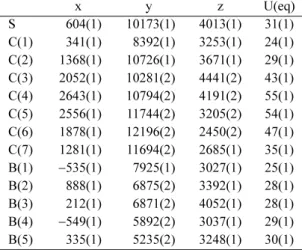
−3Table 2. Atomic coordinates (
×10
4) and equivalent isotropic displacement parameters (Å
2×10
3) for (I).
U(eq) is defined as one third of the trace of the orthogonalized U
ijtensor
x y z U(eq)
S 604(1) 10173(1) 4013(1) 31(1)
C(1) 341(1) 8392(1) 3253(1) 24(1)
C(2) 1368(1) 10726(1) 3671(1) 29(1)
C(3) 2052(1) 10281(2) 4441(2) 43(1)
C(4) 2643(1) 10794(2) 4191(2) 55(1)
C(5) 2556(1) 11744(2) 3205(2) 54(1)
C(6) 1878(1) 12196(2) 2450(2) 47(1)
C(7) 1281(1) 11694(2) 2685(1) 35(1)
B(1)
−535(1) 7925(1) 3027(1) 25(1)
B(2) 888(1) 6875(2) 3392(1) 28(1)
B(3) 212(1) 6871(2) 4052(1) 28(1)
B(4)
−549(1) 5892(2) 3037(1) 29(1)
B(5) 335(1) 5235(2) 3248(1) 30(1)
Table 3. Bond lengths [Å] and angles [deg] for (I)
S-C(1) 1.7749(11) C(1)#1-B(1)-B(4) 104.63(8)
S-C(2) 1.7754(12) C(1)-B(1)-B(4) 104.69(8)
C(1)-B(2) 1.6897(17) C(1)#1-B(1)-B(3) 107.66(8)
C(1)-B(3) 1.6937(17) C(1)-B(1)-B(3) 57.65(7)
C(1)-B(1)#1 1.7135(16) B(4)-B(1)-B(3) 59.44(7)
C(1)-B(1) 1.7203(16) C(1)#1-B(1)-B(2)#1 57.58(7)
C(1)-C(1)#1 1.784(2) C(1)-B(1)-B(2)#1 107.62(9)
C(2)-C(7) 1.3828(18) B(4)-B(1)-B(2)#1 59.41(7)
C(2)-C(3) 1.3894(18) B(3)-B(1)-B(2)#1 107.60(9)
C(3)-C(4) 1.387(2) C(1)-B(2)-B(4)#1 106.08(9)
C(4)-C(5) 1.374(3) C(1)-B(2)-B(3) 58.46(7)
C(5)-C(6) 1.378(2) B(4)#1-B(2)-B(3) 107.97(9)
C(6)-C(7) 1.3848(19) C(1)-B(2)-B(5) 105.49(9)
B(1)-B(4) 1.7802(19) B(4)#1-B(2)-B(5) 60.36(8)
B(1)-B(3) 1.7905(19) B(3)-B(2)-B(5) 59.82(7)
B(1)-B(2)#1 1.7921(18) C(1)-B(2)-B(1)#1 58.87(7)
B(2)-B(4)#1 1.7703(19) B(4)#1-B(2)-B(1)#1 59.96(7)
B(2)-B(3) 1.7755(19) B(3)-B(2)-B(1)#1 106.77(9)
B(2)-B(5) 1.7815(19) B(5)-B(2)-B(1)#1 107.59(9)
B(3)-B(4) 1.7703(19) C(1)-B(3)-B(4) 106.26(9)
B(3)-B(5) 1.7736(19) C(1)-B(3)-B(5) 105.66(9)
B(4)-B(5)#1 1.7857(19) B(4)-B(3)-B(5) 60.51(8)
B(4)-B(5) 1.7857(19) C(1)-B(3)-B(2) 58.24(7)
B(5)-B(5)#1 1.767(3) B(4)-B(3)-B(2) 108.48(9)
C(1)-S-C(2) 104.65(5) B(5)-B(3)-B(2) 60.26(7)
B(2)-C(1)-B(3) 63.30(8) C(1)-B(3)-B(1) 59.10(7)
B(2)-C(1)-B(1)#1 63.54(7) B(4)-B(3)-B(1) 59.99(7)
B(3)-C(1)-B(1)#1 114.38(9) B(5)-B(3)-B(1) 107.91(9)
B(2)-C(1)-B(1) 114.46(9) B(2)-B(3)-B(1) 107.05(8)
B(3)-C(1)-B(1) 63.26(7) B(2)#1-B(4)-B(3) 109.47(9)
B(1)#1-C(1)-B(1) 110.28(8) B(2)#1-B(4)-B(1) 60.63(7)
B(2)-C(1)-S 125.27(8) B(3)-B(4)-B(1) 60.57(7)
B(3)-C(1)-S 119.68(7) B(2)#1-B(4)-B(5)#1 60.13(8)
B(1)#1-C(1)-S 121.38(7) B(3)-B(4)-B(5)#1 107.77(9)
B(1)-C(1)-S 112.77(7) B(1)-B(4)-B(5)#1 107.93(9)
B(2)-C(1)-C(1)#1 109.35(7) B(2)#1-B(4)-B(5) 108.08(9)
B(3)-C(1)-C(1)#1 108.82(7) B(3)-B(4)-B(5) 59.83(8)
B(1)#1-C(1)-C(1)#1 58.87(7) B(1)-B(4)-B(5) 107.83(9)
B(1)-C(1)-C(1)#1 58.50(7) B(5)#1-B(4)-B(5) 59.32(9)
S-C(1)-C(1)#1 118.07(4) B(5)#1-B(5)-B(3) 108.45(8)
C(7)-C(2)-C(3) 120.28(12) B(5)#1-B(5)-B(2) 108.41(8)
C(7)-C(2)-S 119.34(9) B(3)-B(5)-B(2) 59.92(7)
C(3)-C(2)-S 120.21(11) B(5)#1-B(5)-B(4)#1 60.34(9)
C(4)-C(3)-C(2) 119.14(14) B(3)-B(5)-B(4)#1 107.38(9)
C(5)-C(4)-C(3) 120.51(14) B(2)-B(5)-B(4)#1 59.51(7)
C(4)-C(5)-C(6) 120.23(14) B(5)#1-B(5)-B(4) 60.34(9)
C(5)-C(6)-C(7) 120.04(15) B(3)-B(5)-B(4) 59.65(8)
C(2)-C(7)-C(6) 119.78(13) B(2)-B(5)-B(4) 107.53(9)
C(1)#1-B(1)-C(1) 62.62(8) B(4)#1-B(5)-B(4) 107.65(9)
Symmetry transformations used to generate equivalent atoms: #1
−x, y,
−z + 1/2.
Anisotropic displacement parameters were assigned to all non-hydrogen atoms. The positional parame- ters of all H-atoms were constrained to ride on their attached atoms with isotropic displacement parame- ters fixed at 1.2 times the equivalent isotropic dis- placement parameter of their parent atoms. The highest peak and deepest holes in the final differ- ence density map are 0.293 e/Å
3at 0.76 Å from C5 and
−0.214 e/Å
3at 1.21 Å from C1, respectively.
The crystallographic data, final conventional agreement indexes and other structure refinement parameters are listed in Table 1. Final atomic coor- dinates and the equivalent isotropic thermal param- eters are given in Table 2. Table 3 shows selected bond lengths and angles. All average value given in this paper are calculated by the program AVERESD.
9)3. Discussion
In the title compound (I), a half molecule belongs to an asymmetric unit and a molecule is completed by another half molecule obtained by twofold sym- metry along b-axis at x = 0 and z = 1/4 [symmetry code (i)
−x, y,
−z + 1/2] (see Fig. 1).
The aromatic
Csp2-
Csp2distances in the phenyl ring, which is planar within 0.007(1) Å, vary from 1.374(3) to 1.3894(18) Å with a mean value of 1.3827(9) Å and the average C-C-C angle is 120.00(6)
o. These values are very similar to those
of 25,27:26,28-bis(3,9-dioxa-6-aza-undecane-1,11- dioxy)calix[4]arene tetrahydrate.
11)The dihedral angle between the phenyl ring in an asymmetric unit and another one by the symmetry element [code (i)] is 74.70(5)
o.
The average S-C distance is 1.7752(8) Å, which is slightly shorter than 1.818(8) Å found in the molecular structure of 1,2-Ph
2-1,2-C
2B
10H
10(3)
4)but similar to 1.772(4) Å in the molecular structure of 1,2-(SPh)
2-1,2-C
2B
10H
10(5).
4)The angle of C1-S-C2 104.65(5)
o, which is very close to the tetrahedral angle, denotes that there is two lone pairs at the sul- fur atom. S ... S [code (i)] distance is 3.467(1) Å.
In icosahedral B
12H
12−2, the three center bond the- ory in boron hydride provides a useful description for understanding the structure and the electronic distributions. Carbon has one more electron than boron, so the C-H moiety is isoelectronic with the B-H
−moiety. Replacing the two B-H
−moieties, icosahe- dral carborane can be represented as C
2B
10H
12.
2)In the carborane moiety of (I), B-B distances range from 1.7703(19) Å of B3-B4 to 1.7921(18) Å of B1-B2 [code (i)] with the average B-B distance 1.78000(52) Å. B-B-B angles are divided into two kinds: acute angles with a mean 60.00(1) Å and obtuse angles with a mean 107.98(2) Å as shown in Table 3.
As shown in Fig. 1, the carborane forms an icosa- hedron consisting of twenty nearly regular triangles with a side 1.78000(52) Å on the average (see Table 3). All these conformational values are sim- ilar to those found in 1,2-(SPh)
2-1,2-C
2B
10H
10(5).
4)It is, however, noteworthy that the C1-C1 [code (i)] distance 1.784(2) Å is considerably longer than 1.629 Å in 1,2-C
2B
10H
10(1),
4)1.64 Å in
o
-B
10Br
2H
8C
2H
2,
12)1.67(4) Å in B
10Br
2H
8C
2H
2,
12)1.733(4) Å in 1,2-Ph
2-1,2-C
2B
10H
10(3),
4)but shorter than 1.798(3) Å in 1,2-(SPh)
2-1,2-C
2B
10H
10(5)
4)and 1.858(5) Å in 1,2-
µ-SCH
2(CH
2OCH
2)CH
2S-1,2- C
2B
10H
10(7),
4)and the C1-C1 [code (i)] distance is slightly longer than B5-B5 [code (i)] = 1.767(3) Å, which is the shortest one among B-B bond lengths (see Table 3), even though the covalent radius 0.77 Å for carbon is shorter than 0.83 Å for boron. This phenomenon appears to be attributable to the steric repulsion between the freely moveable two phenyl Fig. 1. An ORTEP diagram
10)(20% probability
ellipsoids) of (I). H atoms are drawn as small circles
of arbitrary radii. Only half molecule (an asym-
metric unit) is labelled and another half molecule is
obtained by symmetry element
−x, y,
−z + 1/2.
sulfides related by symmetry code (i), and so it could be said that the C-C distance in the carborane cluster may vary depending on substituent.
The closest intermolecular distance 3.0613 Å between S and H1 [code (i)] suggests that the molecular packing is governed only by Van der Waals forces.
4. Molecular Orbital Calculation
The molecular orbital calculation was performed using Gaussian 98 W revision A. 7.
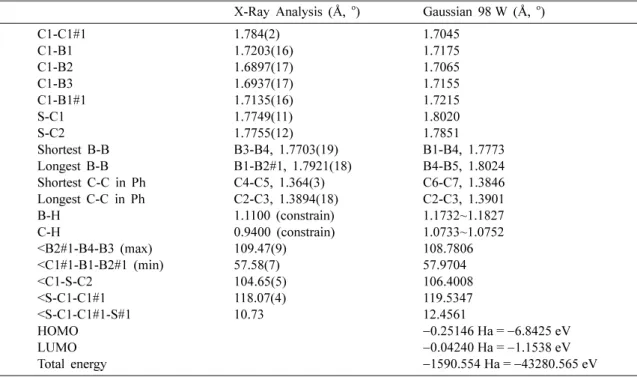
14)The geome- tries obtained from X-ray analysis were optimized by Hartree Fork theory (HF), # RHF/3-21G(d) and the optimized geometry was used in the input file Table 4. Selected bond lengths, bond angles, HOMO, LUMO and total energy obtained from X-ray analysis and Gaussian 98 W are tabulated and no information on the energy is available from X-ray analysis. Only the minimum and maximum values for the acute and obtuse angles in the
o-carborane are listed.
X-Ray Analysis (Å,
o) Gaussian 98 W (Å,
o)
C1-C1#1 1.784(2) 1.7045
C1-B1 1.7203(16) 1.7175
C1-B2 1.6897(17) 1.7065
C1-B3 1.6937(17) 1.7155
C1-B1#1 1.7135(16) 1.7215
S-C1 1.7749(11) 1.8020
S-C2 1.7755(12) 1.7851
Shortest B-B B3-B4, 1.7703(19) B1-B4, 1.7773
Longest B-B B1-B2#1, 1.7921(18) B4-B5, 1.8024
Shortest C-C in Ph C4-C5, 1.364(3) C6-C7, 1.3846
Longest C-C in Ph C2-C3, 1.3894(18) C2-C3, 1.3901
B-H 1.1100 (constrain) 1.1732~1.1827
C-H 0.9400 (constrain) 1.0733~1.0752
<B2#1-B4-B3 (max) 109.47(9) 108.7806
<C1#1-B1-B2#1 (min) 57.58(7) 57.9704
<C1-S-C2 104.65(5) 106.4008
<S-C1-C1#1 118.07(4) 119.5347
<S-C1-C1#1-S#1 10.73 12.4561
HOMO
−0.25146 Ha =
−6.8425 eV
LUMO
−0.04240 Ha =
−1.1538 eV
Total energy
−1590.554 Ha =
−43280.565 eV
where the total energy is HF = E(E-E) + E(N-N) + E(E-N) + KE.
1 Hartree = 27.211 eV. Symmetry code #1:
−x, y,
−z + 1/2.
Fig. 2. Orbital shape for (I). (a) LUMO:
−1.1538 eV, (b) HOMO:
−6.8425 eV.
for the calculation of HOMO, LUMO and total energy. The calculation was carried out using # RB3LYP/6-31G(d).
The selected bond lengths and bond angles obtained from both X-ray analysis are compared with those from Gaussian 98W, and the HOMO, LUMO and total energies are also listed in Table 4.
As can be seen in Table 4, the atomic bond lengths from the Gaussian 98W data are slightly longer on the whole than those including the calculated C-H = 0.94 Å and B-H = 1.11 Å in the carborane cluster from the X-ray analysis, but the valence angles are very similar to each other. Fig. 2 shows the LUMO and HOMO are mainly situated in the vicinity of sulphur atoms and their energy gap 5.6887 eV indi- cates the compound (I) is close to an insulator rather than a conductor. The UV absorption edge for (I) has not been measured.
References
1) Hoffman, R. and Lipscomb, W. N., J. Chem.
Phys .,
36, 3489 (1962).
2) Muetterities, E. L., Boron Hydride Chemistry, Chapter 9, Icosahedralcarborane, pp. 302-347, Academic Press, New York (1975).
3) Takeda, N., Shimizu, D., Sasamori, T. and Tokitoh, N., Acta Cryst .,
E61, m1408-m1410 (2005).
4) Jordi Llop, Clara Vinas, Josep M. Oliva, Francesc Teixidor, Miquel Angel Flores, Raikko Kivekas and Reijo Sillanpaa, Journal of Organometallic Chemistry ,
657, 232 (2002).
5) Bruker, SMART (Version 5.0) and SAINT-Plus (Version 6.0). Bruker AXS Inc., Madison, Wisconsin, USA (1999).
6) Kim, Y.-S., Ko, J., Kang, S. O., Han, W.-S., Jeong,
J. H. and Suh, I.-H., Korean J. Crystallography ,
16
![Table 3. Bond lengths [Å] and angles [deg] for (I) S-C(1) 1.7749(11) C(1)#1-B(1)-B(4) 104.63(8) S-C(2) 1.7754(12) C(1)-B(1)-B(4) 104.69(8) C(1)-B(2) 1.6897(17) C(1)#1-B(1)-B(3) 107.66(8) C(1)-B(3) 1.6937(17) C(1)-B(1)-B(3) 57.65(7) C(1)-B(1)#1 1.7135(16) B](https://thumb-ap.123doks.com/thumbv2/123dokinfo/5537403.465358/3.892.133.772.213.1083/table-bond-lengths-å-and-angles-deg-for.webp)