- 227 -
Analysis of Food Components of Carthamus Tinctorius L. Seed and its Antimicrobial Activity
Seok-Yeong Yu1, Young-Jun Lee1, Suk-Nam Kang2, Seong-Kap Lee3, Jung-Young Jang4, Hyo-Ku Lee4, Jeong-Ho Lim5, and Ok-Hwan Lee1†
1
Department of Food Science and Biotechnology, Kangwon National University, Chuncheon 200-701, Korea,
2
Department of Animal Resources Technology, Gyeongnam National University of Science and Technology, Jinju 660-758, Korea
3Department of Food and Biotechnology, Hoseo University, Asan 336-795, Korea
4
Department of Food Science, Kongju National University, Yesan 340-800, Korea
5Korea Food Research Institute, Seongnam 463-746, Korea
홍화씨의 식품학적 성분 분석 및 항균활성
유석영1․이영준1․강석남2․이성갑3․장중영4․이효구4․임정호5․이옥환1†
1강원대학교 식품생명공학과, 2경남과학기술대학교 동물소재공학과, 3호서대학교 식품생명공학과,
4공주대학교 식품공학과, 5한국식품연구원
Abstract
This study was conducted to investigate the physicochemical characteristic of Carthamus tinctorius L. seed and to assess its total phenol content, total flavonoids content and antimicrobial activity. The moisture, crude protein, crude fat, crude ash and carbohydrates of the Carthamus tinctorius L. seed were 5.58, 37.16, 13.69, 3.52, and 40.05%, respectively. Total amino acid in Carthamus tinctorius L. seed was 391.99 mg%. The major free sugar of Carthamus tinctorius L. seed were fructose(3.29%) and sucrose(1.74%). Linoleic acid(79.46%) was a major fatty acids in the crude fat of Carthamus tinctorius L. seed. The K and Ca contents were the highest in Carthamus tinctorius L. seed. Total phenol and total flavonoids contents of the ethanolic extract were 55.52 ± 0.99 mg GAE/g and 78.69 ± 0.91 mg QE/g, respectively. The extract from Carthamus tinctorius L. seed showed growth inhibitory effect on Staphylococcus aureus, Salmonella typhimurium, Escheria coli, Candida albicans, Bacillus cereus, Listeria monocytogenes, Vibrio parahaemolyticus, and Clustridium perfringens. These results indicate that the Carthamus tinctorius L. seed extract can inhibit food pathogen associated with total phenol and total flavonoids contents.
Key words:Antimicrobial activity, food component, total phenolic content, total flavonoid content
서 론
1)
홍화(safflower, Carthamus tinctoriusL.)는 도라지목의 국 화과에 속하는 1년생 초본이고 원산지는 에티오피아 또는 아프가니스탄이며, 티벳, 중국에서 재배되기도 한다(1). 홍 화는 황색색소인 safflor와 적색색소인 carthamin을 함유하 고 있어 천연 염료로서 예로부터 사용되어져 왔고, 아울러 어혈 및 통경 치료나 한약처방제로 널리 이용하고 있다.
한편 홍화씨는 홍화의 종자(safflower seed)이며, 홍화씨유
†Corresponding author. E-mail:[email protected] Phone:82-33-250-6454, Fax:82-31-241-0508
는 많은 리놀레산과 식물성스테롤 성분, 단백질 및 식이성 섬유소의 급원으로 중요성을 지닌다(2).
최근의 연구에서는 늑골골절 회복 및 골절 치유 효과(3), 항산화 활성(4), LDL 산화 억제(5), 지질대사 개선(6)등의 생리활성이 보고되어 왔다. 홍화씨의 생리활성 성분으로는 8-hydroxyarctigenin 4’-O-β-D-glucoside, N-feruloylserotonin 5-O-β-D-glucoside, N-feruloylserotonin, matairesinol, N- (p-coumaroyl)serotonin-5-O-β-D-glucoside, N-(p-coumaroyl) serotonin, 8-hydroxyarctigenin, acacetin 7-O-β-glucuronide, acacetin(2)이 있으며, 그 중N-feruloylserotonin이 가장 많으 며N-feruloylserotonin의 생리활성에는 항산화 활성 및 멜라 닌 생성 억제(7)로 보고된 바 있다. 또한 휘발성분의 경우
hexanal, (E)-2-heptenal, (E,Z)-2,4-decadienal 및 (E,E)-2,4- decadienal 등의 알데히드류와 torreyol, β-eudesmol 등의 terpene alcohol류 등이 동정되었다(8). 하지만, 홍화씨의 식 품학적 성분분석 및 항균활성에 관한 연구는 초기 단계에 불과하다.
식품의약안전청의 식중독 통계 시스템을 보면 2002년부 터 현재까지 꾸준한 증가 추세를 나타내며, 식중독 발병 주요 원인균으로는 살모넬라, 황색포도상구균 및 바실러스 등이 대두되고 있다(9). 현재 항균활성을 가진 천연물질로 는 유기산, 효소, 식물의 정유성분 및 페놀성 물질 등이 알려져 있으며, 특히 식물에 널리 분포하고 있는 페놀성 물질은 항산화 효과 및 단백질과 결합하는 성질을 가지므로 미생물의 성장을 저해하므로 항균활성을 지닌다(10). 그로 인해 미생물로부터 식품의 안전성을 유지하기 위해 유해 하지 않은 천연 항균 물질의 개발의 관심이 높아지고 있다(11).
따라서, 본 연구에서는 홍화씨의 식품학적 기초자료를 제공하고자 일반성분, 아미노산 조성, 지방산 조성, 유리당 조성, 무기질 조성 등을 분석하였다. 또한, 식중독 발병 원인균에 대한 홍화씨 에탄올 추출물의 항균활성을 조사 하였다.
재료 및 방법
실험 재료 및 시약
본 연구에 사용된 홍화씨는 국내산으로 2011년도에 수확 한 것을 영농법인 제천한방마을(Jechon, Korea)에서 구입하 여 사용하였다. 구입한 홍화씨는 이물질을 제거하고 분쇄 기(IKA M20, IKA, Staufen, Germany)로 20~30 mesh로 조 분쇄하였고 일반성분, 아미노산, 유리당, 지방산, 무기질, 비타민 등의 식품학적 성분분석 및 항균활성 측정에 사용하 였다.
홍화씨의 이화학적 성분 분석 일반성분 분석
AOAC법(12)에 따라 수분은 105℃ 상압건조법, 조지방 은 soxhlet 추출법, 조단백은 semi micro kjeldahl법, 조회분 은 550℃ 회화법으로 정량하였다. 탄수화물은 100에서 조 지방, 조단백, 조회분을 뺀 값으로 하였다.
아미노산 분석
홍화씨의 아미노산 함량 분석은 AccQ․Tag 방법(13)을 이용하여 분석하였다(1993). 분말시료 약 0.2 g을 정확히 취하여 50 mL 튜브에 넣고 6 N HCl 15 mL를 가한 다음 N2로 치환하여 신속하게 밀봉하였다. 이를 110℃ 오븐에서 24시간 가수분해 시킨 뒤 방냉하여 50 mL 정용플라스크에
옮기고 탈이온수로 정용한 후 0.2 μm membrane 필터로 여과하였다. AccQ․Fluor Reagent kit를 사용하여 유도체화 시켜 홍화씨의 구성 아미노산을 분석하였다. 즉, 여과된 유리 아미노산 시료 10 μL를 시험관(Φ 6×50 mm) 밑바닥에 취하고 여기에 AccQ․Fluor Reagent kit의 1용액 70 μL를 넣어 혼합하였다. 여기에 미리 55℃에서 반응시킨 2A 용액 20 μL를 넣어 재혼합하였고, 이를 실온에서 1분간 방치한 후 55℃에서 10분간 유도체화시킨 다음 HPLC로 유리 아미 노산을 측정하였다. 분석에 사용한 아미노산 표준물질은 amino acid standard H (Pierce, USA)이고, 칼럼은 AccQ Tag column (3.9x150 mm, Waters, USA), 검출기는 fluorescence (Ex=250 nm, Em=395 nm, Jasco, Japan)이고 분석온도는 37℃이었다.
유리당 분석
홍화씨 분말시료 5 g에 80% ethanol 145 mL을 넣고 90℃
항온수조에서 2시간 동안 환류 추출한 후 10,000g에서 10분 동안 원심분리하여 얻은 상등액을 적당히 농축시켜, 0.25 μm membrane 필터로 여과한 후 HPLC로 분석하였다(14).
유리당 표준시료는 fructose, sucrose, glucose 및 maltose (Sigma Co, St Louis, USA)를 사용하였고, 칼럼은 carbohydrate analysis column (300x3.9 mm, Waters, USA), 검출기는 RI, 시료주입은 10 μL이었다.
지방산 분석
홍화씨의 지방산 분석은 gas chromatography를 이용하여 측정하였다. 우선, 홍화씨의 지방질은 soxhlet 추출법(12)으 로 추출하고 AOAC법(15)에 따라 50 mL의 둥근플라스크에 지방질 200 mg을 취하여 0.5 N NaOH/MeOH를 넣고 환류냉 각기를 부착한 다음 지방구가 없어질 때까지 가열된 모래상 자에서 5~10분간 가수분해 시켰다. 10% BF3/MeOH 5 mL 을 환류냉각기 위로 천천히 넣어 2분간 모래상자에 방치하 여 반응시켰다. 다시 5 mL 헥산을 환류냉각기 위로 넣어 1분간 반응시키고 냉각관에서 분리하여 반응플라스크에 포화식염수 15 mL을 넣고 마개를 막은 상태에서 5초간 가볍게 흔들어 준 후 포화 식염수를 추가로 넣어 헥산층이 플라스크 목까지 올라오도록 하였다. 헥산층을 뽑아 무수 황산나트륨이 들어있는 파스퇴르 피펫을 통과시켜 탈수시 키고 탈수된 시험액을 가스크로마토그래피에 주입하여 분 석하였다. 사용한 칼럼은 HP-INNOWax (30 mx0.25 mm x 0.25 μm film thickness, USA), 검출기는 불꽃이온화 검출 기, 주입기 온도는 220℃, 검출기 온도는 275℃, 오븐의 온도는 50℃/3 min-10℃/min-250℃/5 min, 운반기체는 헬륨 이었다.
무기질 분석
홍화씨의 무기질 분석은 유도결합 프라즈마 원자방출
분광법을 이용하여 측정하였다. 홍화씨에 함유된 무기질의 전처리 방법은 건식법(16)으로 하였다. 즉, 홍화씨 분말시 료 약 2 g을 도가니에 넣고 전열기에서 예비 가열시킨 후 550℃ 전기 회화로에서 6시간 회화한 다음 방냉 하였다.
여기에 탈이온수 10방울을 가하고 묽은 질산(1:1 HNO3) 4 mL를 넣은 다음 다시 전열기(120℃)에서 수분을 제거시 키고 550℃ 전기 회화로에서 1시간 회화․방냉하였다. 여기 에 묽은염산(1:1 HCl) 10 mL를 첨가한 다음 이를 50 mL 정용플라스크로 옮겨 탈이온수로 정용, 여과하여 유도결합 프라즈마 원자방출 분광법(ICP-AES, Inductively Coupled Plasma Atomic Emisson Spectrophotometer, Jobin Yvon JY138 Ultrace, France)으로 분석하였다. 각 원소의 표준용 액은 0, 1, 10 ppm의 3수준의 농도로 조제하여 표준검량곡 선을 작성하였으며 이때, ICP-AES의 작동조건은 power:
1.0 kW for aqueous, nebulizer pressure: 3.5 bar for meingard type c, aerosol flow rate: 0.3 L/min, shealth gas flow: 0.3 L/min, cooling gas: 12 L/min 이었다. 각 무기질의 검출 파장 은 Ca: 393.366, Mg: 279.553, Mn: 257.610, Se: 196.060, Na: 588.995, K: 766.491, Fe: 238.204, P: 213.618, Cu:
324.754 및 Zn: 213.856 nm이었다.
추출물의 제조 및 유용성분의 분석 추출물의 제조
분쇄된 홍화씨에 약 10배의 80% 에탄올을 첨가하고 80∼
100℃ 수욕 상에서 3시간동안 환류냉각하면서 3회 반복 추출하였다. 조추출물은 4℃에서 방냉한 후, Whatman No.
3 여과지로 여과하고 10,000g로 원심분리하여 50℃에서 감 압농축 한 후 동결건조 하여 홍화씨 80% 에탄올 추출물을 제조하였다. 추출물의 수율은 원료 대비 고형분의 양으로 계산하였다.
총 플라보노이드 함량 분석
홍화씨 추출물에 함유된 활성성분을 평가하기 위하여 홍화씨 추출물의 총 flavonoid 함량을 측정하였다(17). 홍화 씨 추출물을 각각 일정량 취한 후 50% methanol용액 5 mL 로 정용한 시료 용액 1 mL과 diethylene glycol 10 mL를 혼합하고 여기에 1 N NaOH용액 1 mL 가하여 잘 혼합한 후 37℃에서 1시간 반응시킨 후 420 nm에서 흡광도를 측정 하였다. 이때 표준검량곡선은 quercetin (Sigma Co, St Louis, USA)을 이용하였고 농도별로 표준곡선(y=3.3533x+0.0377) 을 작성하여 홍화씨 총 플라보노이드 함량을 측정하였다.
총 페놀 함량 분석
총 페놀 함량은 Folin-Dennis법에 의하여 분석하였다 (18). 즉, Folin-Dennis시약은 sodium tungstate 10 g, phosphomolybdic 2 g, phosphoric acid 5 mL를 100 mL 용량 플라스크에 넣고 증류수로 정용한 후 삼각플라스크에 옮겨
2시간 동안 환류조작하여 사용하였다. 실험방법으로는 캡 튜브에 증류수 7 mL씩 넣고 DMSO (dimethylsulfoxide)에 녹인 시료를 1 mL씩 넣은 후 Folin-Dennis 시약을 0.5 mL를 첨가한 다음, 정확히 3분 후에 sodium carbonate anhydrous 포화용액 1 mL, 증류수 0.5 mL를 넣은 후 725 nm에서 흡광 도를 측정하였다. 표준용액으로는 gallic acid (Sigma co., St. Louis, USA)를 사용하였다. 이때 표준곡선(y=8.8187x +0.0324)을 농도 별로 작성하여 총 페놀 함량을 측정하였다.
항균활성
항균활성능은 8 mm disk 확산법(19)을 이용한 분석하였 다. 10% DMSO을 이용하여 홍화씨 추출물을 20 mg/mL stock으로 만들어 실험에 이용하였다. 이때 사용된 균주 중 Staphylococcus aureus (ATCC112692), Salmonella typhimurium (ATCC14028), Escheria coli (ATCC11775), Candida albicans (00432 ATCC 1023 IFO 1594), Bacillus
cereus (ATCC1178IFO)은 한국식품연구원에서 분양받아
사용하였으며, Listeria monocytogenes (ATCC 19114), Vibrio parahaemolyticus (ATCC 17802D-5), Clustridium perfringens (ATCC13124)는 한국균주은행에서 분양받아 사용하였다. 분양받은 균주는 Nutrient broth에서 2회 계대 배양하여 실험에 이용하였다. 계대배양된 균주는 Nutrient agar에 도말 처리한 이후 각 시료를 0, 10, 50, 100, 200 μL씩 loading 한 8 mm disk를 처리하였다(각각 0, 0.2, 1.0, 2.0, 4.0 mg/disk, dry base). 처리한 disk는 37℃에서 48시간 배양시켰다. 배양이후 각 미생물에 대한 활성화된 clear zone의 크기를 계수하여 표시하였다. 이러한 항균 활성은 3회 실험하였다.
결과 및 고찰
일반성분 분석
홍화씨의 일반성분을 분석하기 위하여 수분, 조단백질, 조지방, 조회분 및 탄수화물의 함량을 조사하였다(Table 1). 홍화씨의 수분함량은 5.58±0.09%이었고 조단백질 함량 은 37.16±0.85%, 조지방 함량은 13.69±8.98%, 조회분 함량
Table 1. Proximate composition ofCarthamus tinctoriusL. seed (%) Moisture Crude Ash Crude
protien1) Crude fat Carbohydrate2) Carthamus
tinctorius
L. seed 5.58±0.093) 3.52±0.04 37.16±0.85 13.69±8.98 40.05
1)Nx6.25
2)100–sum of moisture, ash, crude protein and crude lipid contents
3)Values are mean±standard deviation of triple determinations
은 3.52±0.04%, 탄수화물 함량은 40.05%이었다. 홍화씨 및 발아홍화씨의 화학성분을 분석한 Kim 등(2)에 의하면 홍화 씨 및 발아홍화씨의 조지방 함량을 건물량으로 계산하였을 때, 약 19.7 및 15.7%로 본 연구의 분석결과와 비슷한 경향 을 보였다. 하지만, 가용성무질소물의 함량은 건물량을 기 준으로 홍화씨에서 58.9%, 발아홍화씨에서 64.0%로 나타 나 본 연구의 결과(40.05%)와 다소 차이를 보이는 것으로 나타났다.
아미노산 분석
홍화씨의 아미노산 함량 및 조성을 분석한 결과는 Table 2와 같다. 홍화씨에는 총 391.99 mg%의 아미노산이 함유되 어 있었으며 valine, threonine, leucine, isoleucine, lysine, methionine, phenylalanine 등의 필수아미노산은 122.97 mg% 함유되어 있는 것으로 나타났다. 이들 필수아미노산 은 홍화씨 전체 아미노산의 함량의 약 31.3%를 차지하는 것으로 나타났다. 한편, 아미노산 중에서 alanine (75.43
Table 2. Amino acid composition ofCarthamus tinctoriusL. seed (mg%, dry basis) Amino acid Carthamus tinctoriusL.
seed Proportion (%)
Asparic acid 33.24 8.48
Glycine 8.97 2.29
Alanine 75.43 19.24
Valine 26.86 6.85
Leucine 10.67 2.72
Isoleucine 11.99 3.06
Serine 29.65 7.56
Threonine 25.45 6.49
Tyrosine 6.55 1.67
Proline 22.99 5.86
Arginine 37.93 9.68
Histidine 24.23 6.18
Glutamic acid 27.58 7.04
Cysteine 2.45 0.63
Phenylalanine 11.32 2.89
Tryptophane 19.19 4.90
Lysine 7.5 1.91
Methionine 9.99 2.55
Total A.A1) 391.99 100
EAA2) 122.97 -
EAA/Protein 0.84 -
EAA/Total A.A 0.31 -
1)Amino acid
2)Essential amino acid
mg%), arginine (37.93 mg%) 및 aspartic acid (33.24 mg%)이 많이 함유되어 있는 반면, cystine (2.45 mg%), tyrosine (6.55 mg%) 및 lysine (7.5 mg%) 등은 적은 수치를 나타내었다.
홍화씨 및 발아홍화씨의 유리아미노산을 Kim 등(2)에 의하 면 홍화씨 및 발아홍화씨의 총 유리아미노산의 함량은 193.5 및 418.7 mg%로 본 연구의 결과와 유사한 경향을 나타내었다.
유리당 분석
홍화씨에 함유된 fructose, glucose, sucrose, lactose 및 maltose 등의 유리당 함량을 분석한 결과는 Table 3과 같다.
홍화씨에는 fructose가 3.29% 함유되어 있었고 sucrose는 1.74%도 함유되어 있었다. 반면, maltose는 검출되지 않았 다. 홍화의 부위별 유리당 함량을 분석한 Kim 등(20)의 결과 에 의하면, 홍화의 주요 유리당은 sucrose 및 fructose로 본 연구의 결과와 비슷한 경향을 나타내었다. 하지만 홍화씨 에 함유된 sucrose의 절대적인 함량은 약 157.3 mg%로 본 연구의 결과와는 다소 차이를 나타내었다.
Table 3. Free sugar content of Carthamus tinctoriusL. seed (%, dry basis) Carthamus tinctoriusL. seed Proportion(%)
Fructose 3.29 52.56
Glucose 0.71 11.34
Sucrose 1.74 27.80
Lactose 0.52 8.31
Maltose 0.00 0
Total 6.26 100
지방산 분석
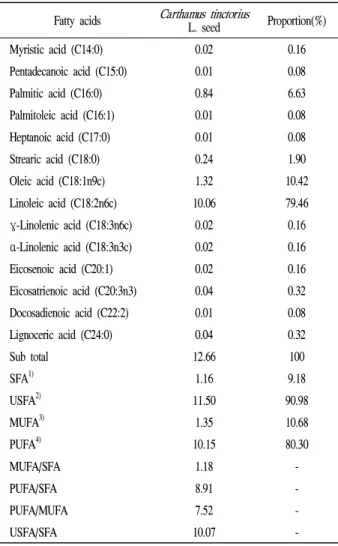
홍화씨의 식품학적 성분 중 조지방의 지방산 조성을 분 석하였다(Table 4). 홍화씨의 조지방 중에 가장 많이 함유되 어 있는 지방산은 linoleic acid (C18:2)로 약 79.46%의 비율 을 차지하였다. Oleic acid (C18:1)도 약 10.42%를 차지하여 불포화지방산의 함유량이 매우 높게 나타났다. 이와 같이 홍화씨의 자방산 조성은 이미 보고된 결과(2)와 유사하게 linoleic acid와 oleic acid 등의 불포화지방산이 거의 80%
이상을 차지하는 반면, 포화지방산은 약 10% 정도로 매우 낮았다. Kim 등(2)의 보고에서 발아홍화씨에는 미량의 linolenic acid (C18:3)를 함유하고 있었고, 발아에 의한 홍화 씨의 지방산 조성의 변화는 거의 없다고 보고하였다.
무기질 분석
홍화씨의 무기질 함량을 분석한 결과는 Table 5와 같다.
홍화씨에는 K 및 Ca의 함량이 1,528 및 1,005 mg%으로 가장 많이 함유되어 있었다. 총 무기질 함량(3,478 mg%)을 기준으로 하여 K 및 Ca는 약 43.94 및 28.90%의 비율을
Table 4. Fatty acid composition in crude fat of Carthamus tinctoriusL. seed
(%, crude fat dry basis) Fatty acids Carthamus tinctorius
L. seed Proportion(%)
Myristic acid (C14:0) 0.02 0.16
Pentadecanoic acid (C15:0) 0.01 0.08
Palmitic acid (C16:0) 0.84 6.63
Palmitoleic acid (C16:1) 0.01 0.08
Heptanoic acid (C17:0) 0.01 0.08
Strearic acid (C18:0) 0.24 1.90
Oleic acid (C18:1n9c) 1.32 10.42
Linoleic acid (C18:2n6c) 10.06 79.46
γ-Linolenic acid (C18:3n6c) 0.02 0.16 α-Linolenic acid (C18:3n3c) 0.02 0.16
Eicosenoic acid (C20:1) 0.02 0.16
Eicosatrienoic acid (C20:3n3) 0.04 0.32
Docosadienoic acid (C22:2) 0.01 0.08
Lignoceric acid (C24:0) 0.04 0.32
Sub total 12.66 100
SFA1) 1.16 9.18
USFA2) 11.50 90.98
MUFA3) 1.35 10.68
PUFA4) 10.15 80.30
MUFA/SFA 1.18 -
PUFA/SFA 8.91 -
PUFA/MUFA 7.52 -
USFA/SFA 10.07 -
1)Saturated fatty acid
2)Unsaturated fatty acid
3)Monounsaturated fatty acid
4)Polyunsaturated fatty acid
Table 5. Mineral contents ofCarthamus tinctorius L. seed (mg%, dry basis) Carthamus tinctoriusL. seed Proportion (%)
Na 134.90 3.88
K 1,528.31 43.94
Ca 1,005.31 28.90
Fe 157.44 4.53
Mn 6.28 0.18
P 33.27 0.96
Zn 4.45 0.13
Cu 0.54 0.02
Mg 607.62 17.47
Total 3,478.12 100
나타내었다. Mg은 607 mg%, Fe는 157 mg%, Na는 134 mg%을 함유하는 것으로 나타났다. 홍화의 부위별 화학성 분 및 DPPH라디칼 소거활성은 연구한 Kim 등(20)의 보고 에 의하면, 홍화의 주된 무기질은 K, Ca, Mg, Na, P 등이었으 며, 홍화씨에는 약 2,613 mg%의 K과 1,160 mg%의 Ca이 함유되어 있는 것으로 나타났다. 본 연구의 결과와는 절대 적인 수치는 다르지만, 홍화씨의 주요 무기질 성분 및 조성 등은 같은 경향을 보였다. 이상의 결과로 볼 때, 홍화씨는 K 및 Ca의 주요 공급원으로 골다공증과 같은 질병에 매우 중요한 이용가치를 가지고 있다고 사료되었다.
총 페놀 및 총 플라보노이드 함량 측정
홍화씨를 80% 에탄올로 환류 냉각하여 추출한 후, 여과 및 감압농축 하고 동결건조 한 추출물의 추출수율은 약 37.0% 이었다. Table 6에서 보는바와 같이, 홍화씨 추출물 의 총 페놀 및 총 플라보노이드 함량은 각각 55.52±0.99 mg GAE/g 및 78.69±0.91 mg QE/g으로 나타났다. Kim 등 (20)에 의하면 홍화의 부위별 총페놀 함량은 꽂잎에서 5.8%, 어린싹에서 4.7%, 잎에서 4.4%, 꽃봉오리 부위에서 약 3.5%의 페놀성 화합물을 함유하고 있었다. 또한, Kim 등(4)은 홍화씨 메탄올 추출물에서 약 12.34%의 총페놀 함량을 나타내 본 연구의 결과와는 다소 다른 경향을 보였 다. 이는 시료간의 특성과 추출용매에 따른 결과의 차이로 생각되어진다.
Table 6. Total phenol and total flavonoids contents of ethanolic extract obtained from Carthamus tinctorius L. seed
Carthamus tinctoriusL. seed ethanolic extract
Total phenolic compound
(mg GAE/g) 55.52±0.99
Total flavonoids content
(mg QE/g) 78.69±0.91
Total phenol content is milligrams of total phenol contents per gram of extract based on gallic acid as standard. Total flavonoids content is micrograms of total flavonoid content per gram of extract based on catechin as standard. The values are means
± S.D. from three replications.
항균활성
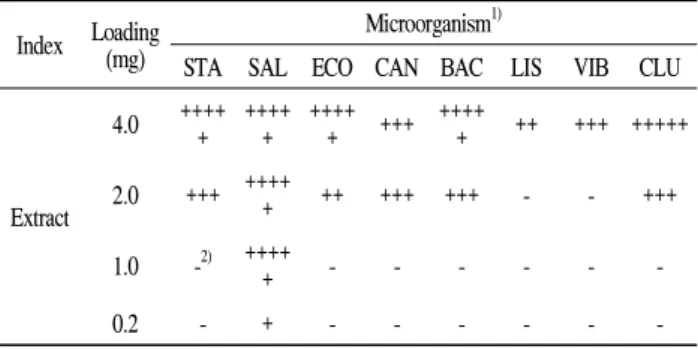
홍화씨 추출물에 대한 항균효과를 비교한 결과는 Table 7과 같다. 항균활성의 평가를 위하여Staphylococcus aureus (ATCC112692), Salmonella typhimurium (ATCC14028), Escheria coli(ATCC11775),Candida albicans(00432 ATCC 1023 IFO 1594), Bacillus cereus (ATCC1178IFO),Listeria monocytogenes (ATCC 19114), Vibrio parahaemolyticus (ATCC 17802D-5), 및Clustridium perfringens (ATCC13124) 의 pathogen을 사용하였다.
홍화씨 추출물의 경우, 4.0 mg의 농도에서Staphylococcus aureus, Salmonella typhimurium, Escheria coli, Candida
albicans, Bacillus cereus, Listeria monocytogenes, Vibrio parahaemolyticus 및Clustridium perfringens모두에서 강한 항균효과를 보였다. 홍화씨 추출물의 농도와 항균효과간의 관계를 살펴보면 홍화씨 추출물의 농도가 증가함에 따라 Staphylococcus aureus, Salmonella typhimurium, Escheria coli, Candida albicans, Bacillus cereus, Listeria monocytogenes, Vibrio parahaemolyticus및Clustridium perfringens에 대한 항균효과도 증가하는 경향을 보였다.
이상의 결과로 볼 때Staphylococcus aureus, Salmonella typhimurium, Escheria coli, Candida albicans, Bacillus cereus, Listeria monocytogenes, Vibrio parahaemolyticus 및 Clustridium perfringens에 대한 홍화씨 추출물의 항균효과 는 추출물의 농도가 증가함에 따라 보다 강한 항균효과를 보여 홍화씨 추출물에 함유된 페놀성 물질들에 기인한 것으 로 사료된다. 향후, 항균활성에 대한 작용기전 연구 및 식중 독 균에 오염되기 쉬운 식품류에 응용연구가 요구된다.
Table 7. Antimicrobial activity of extract fromCarthamus tinctorius L. seed against pathogenic bacteria
Index Loading(mg) Microorganism1)
STA SAL ECO CAN BAC LIS VIB CLU
Extract
4.0 ++++
+ ++++
+ ++++
+ +++ +++++ ++ +++ +++++
2.0 +++ +++++ ++ +++ +++ - - +++
1.0 -2) ++++
+ - - - - - -
0.2 - + - - - - - -
n=31)STA = Staphylococcus aureus (ATCC112692), SAL = Salmonella typhimurium (ATCC14028), ECO =Escheria coli(ATCC11775), CAN =Candida albicans(00432 ATCC 1023 IFO 1594), BAC =Bacillus cereus(ATCC1178IFO), LIS =Listeria monocytogenes(ATCC 19114), VIB =Vibrio parahaemolyticus(ATCC 17802D-5), and CLU = Clustridium perfringens (ATCC13124).
2)- = No antimicrobial activity; + = slight anitimicrobial activity inhibition zone (I.Z) of sample 8.1-9.0 mm; ++ = Moderate antimicrobial activity, I.Z of sample 9.1-10.0 mm; +++ = Clear antimicrobial activity, I.Z of sample 10.1-12.0 mm; ++++ = strong antimicrobial activity, I.Z of sample 12.1-13.4 mm; +++++ = very strong antimicrobial activity, I.Z. of sample >13.5 mm.
요 약
본 연구는 홍화씨의 식품학적 성분 및 항균활성을 분석 하였다. 홍화씨의 수분함량은 5.58±0.09%, 조단백질 37.16
±0.85%, 조회분 3.52±0.04%, 조지방 13.69±8.98%, 탄수화 물 40.05%이었다. 홍화씨의 총 아미노산은 391.99 mg%이 고, 이중 필수아미노산의 함량은 122.97 mg%이었다. 홍화 씨의 아미노산 중 alanine (75.43 mg%), arginine (37.93 mg%) 및 aspartic acid (33.24mg%)을 많이 함유하고 있었다.
홍화씨의 주요 유리당은 fructose가 3.29%이었고, linoleic acid (C18:2)는 약 79.46%의 비율을 차지하여 홍화씨의 조
지방 중 가장 많은 것으로 나타났다. 또한, Oleic acid (C18:1) 도 약 10.42%를 함유하여 불포화지방산의 함유량도 매우 높게 나타났다. 홍화씨의 무기질 함량 측정 결과, K 및 Ca의 함량이 1,528 및 1,005 mg%으로 가장 많이 함유되어 있었 다. 총 페놀 및 총 플라보노이드 함량은 55.52±0.99 mg GAE/g, 78.69±0.91 mg QE/g으로 나타났다. 홍화씨의 항균 활성은 농도가 증가함에 따라 Staphylococcus aureus, Salmonella typhimurium, Escheria coli, Candida albicans, Bacillus cereus, Listeria monocytogenes, Vibrio parahaemolyticus 및Clustridium perfringens균에 대한 항균 효과가 높아지는 것으로 나타났다.
참고문헌
1. Song HR, Ra DK, Kim JS, Jung TS, Kim YH, Kang HJ, Kang CB, Yeon SC, Kim EH, Lee HJ, Shin GW, Park MR, Kim GS (2002) Effects of safflower seed on new bone formation. J Vet Clin, 19, 66-72
2. Kim EO, Lee KT, Choi SW (2008) Chemical comparison of geriminated- and ungerminated-safflower (Carhtamus tinctorius) seeds. J Korean Soc Food Sci Nutr, 37, 1162-1167
3. Seo HJ, Kim JH, Yun KD, Jcon S.M, Ku SK, Lee, JH, Moon KD, Choi MS (2000) The effects of safflower seed powder and its fraction on bone tissue in rib-fractured rats during the recovery. J Korean Nutr, 32, 411-420 4. Kim HJ, Jun BS, Kim SK, Cha JY, Cho YS (2000) Polyphenolic compound content and antioxidative activities by extracts from seed, sprout and flower of safflower (Carthamus tinctoriousL.). J Korean Soc Food Sci Nutr, 29, 1127-1132
5. Cho SH, Park YY, Yoon JY, Choi SW, Ha TY (2006) The effect of polyphenols from safflower seed on HMG-CoA reductase (HMGR) activity, LDL oxidation and Apo A1 secretion. Korean J Food Sci Technol, 38, 279-283
6. Kim JH, Jeon SM, Park YA, Choi MS, Moon KD (1999) Effects of safflower seed(Carthamus tinctorious L.) powder on lipid metabolism in high fat and high cholesterol-fed rats. J Korean Soc Food Sci Nutr, 28, 625-631
7. Roh JS (2005) Isolation, identification and charaterization of antioxidants and antimelanogenesis compounds from safflower(Carthamus tinctoriusL.) seeds. Ph D. Thesis, Yonsei University, Korea
8. Choi SH, Im SI, Jang EY, Cho YS (2004) Volatile
components of flower and seed of safflower. Korean J Food Sci Technol, 36, 196-201
9. Yoon SY, Lee SY, Kim KBWR, Song EJ, Lee SJ, Lee CJ, Park NB, Jung JY, Kwak JH, Nam KW, Ahn DH (2010) Antimicrobial activity of theSargassum fulvellum ethanol extract and the effect of temperature and pH on their activity. Korean J Food Sci Technol, 42, 155-159 10. Kim JY, Lee JA, Kim KN, Song GP, Park SY (2007) Antioxidative and antimicrobial activities ofEuphorbia helioscopia extracts. J Korean Soc Food Sci Nutr, 36, 1106-1112
11. Jeon YH, Xiaoqing Sun, Kim MR (2012) Antimicrobial activity of the ethanol extract from Rubus coreanum against microorganisms related with foodborne illness.
Korean J Food Cookery Sci, 28, 9-15
12. AOAC (1990) Official Methods of Analysis. 15th ed.
Association of Official Analytical Chemists, Washington, DC, USA
13. Waters AccQ-Tag Amino acid Analysis System (1993) Operator's Manual
14. Korea Food and Drug Administration. Test method in general 1 (2003) Food Code(separate volume)
15. Official Methods of Analysis of AOAC International 16th ed. (1995) The Scientific Association Dedicated to Analytical Excellence. Washington DC, USA, p 11-15 16. Official Methods of Analysis of AOAC International 16th ed. (1995) The Scientific Association Dedicated to Analytical Excellence. Washington DC, USA, p 71-73 17. Kang YH, Park YK, Lee GD (1996) The nitrite scavenging and electron donating ability of phenolic compounds. Korean J Food Sci Technol, 28, 232-239 18. Teresa-Satue M, Huang SW, Frankel EN (1995) Effect of natural antioxidants in virgin olive oil on oxidative stability of refined, bleached and deodorized oilve oil.
J Am Oil Chem Soc, 72, 1131-1137
19. Kim MS, Lee DC, Hong JE, Chang KS, Cho HY, Kwon YK, Kim HY (2000) Antimicrobial effects of ethanol extracts from Korean and Indonesian plants. Korean J Food Sci Technol, 32, 949-958
20. Kim JH, Kim JK, Kang WW, Ha YS, Choi SW, Moon KD (2003) Chemical compositions and DPPH radical scavenging activity in different sections of safflower. J Korean Soc Food Sci Nutr, 32, 733-738
(접수 2012년 11월 28일 수정 2013년 3월 26일 채택 2013년 4월 4일)