• 검색 결과가 없습니다.

A study on factors affecting consumers' information retrieval activities: Focusing on outbound tourism consumers in Japan and South Korea

N/A
N/A
Protected

Academic year: 2021

Share "A study on factors affecting consumers' information retrieval activities: Focusing on outbound tourism consumers in Japan and South Korea"

Copied!
10
0
0

로드 중.... (전체 텍스트 보기)

전체 글

(1)

1. Introduction

Modern consumers retrieve a lot of information during the purchase process. This information retrieval

activity has a direct influence on purchasing decisions.

In addition, retrieved information affects not only purchase activity but also evaluation of product satisfaction and intention of repurchase. This process is

A study on factors affecting consumers' information retrieval activities:

Focusing on outbound tourism consumers in Japan and South Korea

Jongmin Bae

Gradaute School, College of Commerce, Nihon University

소비자의 정보 검색 활동에 영향을 미치는 요인에 관한 연구 한국과 일본의 아웃바운드 관광 상품 소비자를

중심으로

배종민

일본대학교 상학연구과

Abstract Information is very important for modern consumers, and the factors that have a great influence on product purchasing. Accordingly, elucidating factors affecting the retrieval process of information is an important. This study identifies factors that affect tourism information retrieval activities. First, it was carried out the meta analysis of tourism information, repurchase intention, attitude toward technology, and information utilization. Through the meta analysis, hypothesis model about each factor of information retrieval and repurchase of tourism products was suggested. The hypothesis model was verified by a survey of Korean and Japanese tourists. As a result, it is confirmed the relationship between the above factors. The results of this study are expected to contribute to the development of a tourists’ information usage model in the future.

Key Words : Tourism marketing, Korea, Japan, The use of information, The factors of search activity

요 약 현대 소비자들에게 제품의 정보는 매우 중요하며, 소비자의 제품 구매 활동에 영향을 미치는 요소 중에 하나이다.

따라서 정보의 검색 과정에 영향을 미치는 요인을 규명하는 것은 마케팅에 있어서 중요한 연구 과제라고 할 수 있다. 이 연구에서는 관광객이 여행중 단계에 있을 때, 정보 검색 활동에 영향을 미치는 요인을 확인하였다. 먼저 관광정보, 재구매의 도, 기술에 대한 태도, 정보 활용에 대한 이론적인 내용을 확인하였다. 이후 정보 검색의 각 요인들과 관광 상품의 재구매 사이의 가설 모델을 제안하였으며, 이 모델은 한국과 일본의 관광객을 대상으로 한 설문조사를 통해 검증을 실시하였다.

설문조사 결과의 분석을 통해, 선행연구를 통해 확인한 요인들의 관계성을 확인하였다. 연구 결과 관광 상품이 관광 상품의 소비자에게 영향을 요인들을 확인하였으며, 요인들 간의 관계 또한 확인하였다. 본 연구의 결과는 향후 관광객 정보 이용 모델 개발의 기초 연구가 될 것으로 기대한다.

주제어 : 관광 마케팅, 한국, 일본, 정보이용, 검색활동요인

*Corresponding Author : Jongmin Bae([email protected]) Received February 28, 2018

Accepted April 20, 2018

Revised March 27, 2018 Published April 28, 2018
(2)

the same for purchasing tourism products. Information about tourism products has a great influence on purchase of tourism products, satisfaction, and repurchasing intention.

One of the main purposes of retrieving information about tourism products is to avoid anticipated post-purchase risks. There is the high volume of information retrieving activity in modern consumers’

purchasing. That means that there are many risks to the purchasing behavior of consumers. Tourism products have the following three characteristics. First, the verification of the retrieved tourism information takes place after the purchase has occurred. Second, it is not a product with a high frequency of contact.

Third, the price is high comparatively. According to these features, consumers are more sensitive to risk than with other products. Therefore, it can be considered that tourism information and information retrieving activities in tourism products are very important.

Due to this importance, tourists engage in more information retrieving activities than they do in purchase of other products, and there are many ways to retrieve information. This tendency is more prominent in overseas tourism products. The scale and proportion of overseas tourism is getting bigger due to the fact that it offers a completely different experience compared to domestic tourism products. However, due to differences in language, law, and culture, there are many restrictions on information retrieving activities in overseas tourism products. In addition, the accuracy and sanctity of the retrieved information is more vulnerable for overseas compared to domestic tourism products. Therefore, the risk that consumers have to bear is bigger.

Of course, these risks are being mitigated to some extent by information provision efforts at sightseeing spots and the development of ICT infrastructure for foreign tourists. According to these features of overseas tourism products and environmental changes, the information retrieving activity of tourists occurs in

all stages of tourism – before, during, and after the trip.

Especially, the information retrieval activity during the trip plays a role in reducing the vulnerability of the information acquired before the trip, and it affects the satisfaction of the tourism product as well as repurchase intention. These changes have induced a need to extend the research scope regarding tourism information retrieval. In particular, expanding the scope of research to the during stage of the trip is important for marketing research. This is because this is the stage where tourism activities data can be collected and verified simultaneously.

To extend the scope of research to the during stage of the trip, it is necessary to consider the factors that may influence the information retrieval activity in that stage. Information retrieval at the during stage of the trip is contextually different from information retrieval at other stages. In this study, I derive factors affecting tourists' information retrieving and verification activities in the during stage of the trip.

2. Meta-analysis

2.1 Tourism Information and Use Intention

“Tourism information” refers to all information that

tourists needed for tourist activities. In addition, data

types and sources change according to the needs of

tourists. Generally, tourism information can be divided

into six categories as follows. The first category is

general information about tourist areas. This refers to

climate information, societal information, economic

information, and cultural assets of the area. The second

category is accommodation information. This means

the information on the type, location, rating, number of

rooms, availability, price, and dining and other facilities

of accommodation. The third category is the

transportation information. This means information

about the type of transportation, cost, available times,

and duration. This can be subdivided into two parts.

(3)

That is, travel to the target area and travel within the target area. The fourth category is the information about restaurants. This means information on famous and/or unique restaurants, and about the style, menu, services, and how to access. The fifth category is information on enjoyable facilities or events. This means information about location, type, cost, and event information. The final category is information about safety and security. Activities of tourism in unfamiliar places are a great pleasure. However, it is very important to ensure a sense of psychological relief so as to enjoy them completely. The information in this category refers to information that confirms the safety of tourism. For example, tourist insurance information, medical facilities information, emergency contact information, location and contact details of embassies, and geographical positioning information.

Nowadays, more common tourists use the tourism online information through the internet. The research of Jacobsen & Munar(2012)[1] clearly stands forth that this trend is getting stronger. According to the research of Li, Li & Hudson (2013)[2], online tourism information is considered very important irrespective of age or gender. In addition, It also shows that the accessibility of online tourism information is very important.

There are differences between online information and offline information. Online information has the following six features. ① It is easy to update to the latest information (Freshness). ② Transfer of information is simple (Accessibility). ③ It allows two-way communication of information (Interactivity).

④ It is possible to provide various types of information by using multimedia (Abundance). ⑤ Access to relevant information is simple (Ease of use). ⑥ The information structure is massive and deep (Immensity)[3].

As mentioned above, the conceptual scope of information started from simple pieces of information but has expanded widely. Nowadays, information is understood in terms of structure and the function of

data. This trend can be found in the concepts of big-data and deep-learning.

The Samsung Economic Research Institute of Korea has defined big-data as "The collection of data that is difficult to handle [including data from] the organization and technology personnel to management and analysis."[4] According to this definition, besides the information itself, human resources and organization are essential for handling information.

Deep-learning is defined as a set of machine-learning algorithms to attempt a high level of abstraction using a combination of different non-linear transformation techniques[5]. Based on these theories, the meaning of information can include pieces of information, technical personnel, and the management of information. This can be applied equally well to tourism information.

Through these features and classifications of tourism information, it can be considered that there are three kinds of intention to use tourism information.

The first is information to support tourism activity itself. This is aimed to satisfy the basic needs of tourism products. The second is information for additional fun. This is aimed at meeting additional needs during trips, and providing tourists with unexpected pleasures. The third is information on safety. This is aimed at obtaining maximum satisfaction by solving the safety problems that may occur in the during stage of the trip. In light of these types, intention of use of tourism information can be a factor affecting the retrieval of information.

2.2 Tourism information retrieval

Tourism information retrieval according to the features of the activity can be classified in various ways, as follows:

First, information retrieval can be divided into

searching and surfing. Searching refers to finding

specific features and purchasing with the purpose of

information retrieval. Surfing is an ongoing search

process seeking simple or general information.

(4)

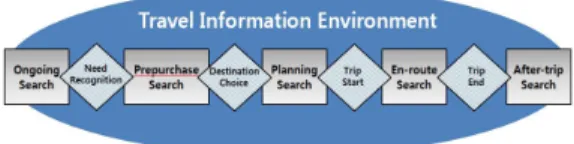
Pan (2003)[6] divided tourism information retrieval into five steps based on the flow of tourism activities.

The five steps of this model are Ongoing Search, Prepurchase Search, Planning Search, En-route Search, and After-trip Search, as presented in Fig. 1.

Fig. 1. A Process Model of Travel Information Search

The conventional concept of the tourist information search refers only to the step of Planning Search.

However, Pan divided this into two steps: Ongoing Search and Prepurchase Search. He thought of each step as having different features of information search.

He also asserted that there is an information search in the After-trip step. He argued that the information search in the En-route Search step and After-trip Search step are particularly important factors determining intention to revisit.

Another classification criterion of the information search activity is the range of search activities. By this criterion, search activities can be divided into internal search and external search. Internal search is a process of retrieving the necessary information from one’s own past experience or knowledge. External search is a process of retrieving the necessary information from outside one’s own experience and knowledge. Sources of information in the external search process include books, radio, TV, Internet, and external human resources.

In addition, the characteristics of information retrieving activities and information processing should be confirmed. This classification is classified according to the purpose of information retrieving behavior, and is similar to internal search and external search.

According to this criterion, information retrieval activities can be classified into information seeking and information processing. According to Lee(2017)[7],

information seeking means identifying the types of information and selecting sources of information consumers want. The information processing is the behavior of processing the information to be used for its purpose in a proper form. And these two behaviors occur at the same time. This concept is closely related to the formation of information credibility and the intention to use of information services. Considering this theory with the study of Pan(2003), the information seeking behavior and the information processing behavior can be considered to occur simultaneously at each stage of the travel.

Finally, there is a criterion of classification about knowledge regarding time flow, which can be divided into knowledge gained before and after the search.

Earlier knowledge often has features that affect the later knowledge. Based on these theories, it is determined that previously gained knowledge may be affected by the information search activity in the En-route Search step.

Therefore, earlier knowledge can be considered as a factor affecting information retrieval activity in the during stage of the trip.

2.3 Infrastructure, Information, and Attitude Recently, information technology has been changing rapidly. Especially, with the spread of cloud computing services, reliance on IT services has increased in many industries, including the tourism industry. In the cloud computing service, a large amount of information is accumulated and the retrieval of information becomes more simple. According to these environmental changes, many technologies have appeared such as Big-Data and Deep Learning. The tourism industry was also affected by these environmental changes, and huge amount of tourism information is being accumulated.

Furthermore there have been many changes, such as the emergence of more convenient services[8].

These changes are lowering the barriers between

countries. In particular, they have lowered the barriers

of communication method and language problem. These

(5)

two barriers are the greatest to international tourism.

However, accessing tourism information from overseas is becoming very convenient, due to changes such as supporting multi-language tourism websites, diversification of internet platforms, support of mobile device, and unified standards for communications technology. Furthermore, this environment is making possible to collect marketing information such as location information, health information, and billing information. Therefore, these changes in technology can promote search activity in the En-route step.

Considering this point, the change of infrastructure due to the development of technology, especially the diversification of search methods, can be considered as a factor affecting information retrieval activity in the during stage of the trip.

Another factor that can affect tourism information searching is tourism constraints. The study of tourism constraints covers the restrictions from the selection of tourist sites to tourism activities.

Samdahal & Jekubovich (1997)[9] classified tourism constraints into personal constraints, structural constraints, and interpersonal constraints. Personal constraints and interpersonal constraints are constraints that can occur in relationships with people, and structural constraints are factors such as time, money, and health.

Hinch & Jackson (2000)[10] identified seasonal factors of tourism as tourism constraints.

Pennington-Gray & Kerstetter (2002)[11] studied tourist constraints on tourists of natural tourism products. They classified constraints as inherent constraints (safety, technology, tourism information, etc.), interpersonal constraints (family, friends, trip partners, etc.), and structural constraints (money, time, weather, conditions, road conditions, equipment, etc.).

Similarly, Nyaupane, Morais, & Graefe (2004)[12]

classified tourism constraints into structural constraints such as money, time, weather, and places, intrinsic factors included in tourism products, and interpersonal constraints on relationships with people.

Andronikidis, Vassiliadis, Priporas, & Kamenidou

(2006)[13] conducted an empirical survey of the factors related to intrinsic constraints, interpersonal constraints, and structural constraints on tourists in Greek ski resorts.

Based on the above research on tourism constraint factors, tourism constraints can be classified into three categories. First is factors that come from the characteristics of tourism products. These factors include safety, technology, travel information, pricing, and so on. The second category is interpersonal factors.

These include family, trip partners, tourist guides, and so on. The third category is structural constraints.

These include time, place, equipment, and so on.

Especially, among the three categories of tourism constraints, structural constraints most directly influence the intention of using information retrieval infrastructure. According to these theories, time, place, and search method can be considered as factors affecting intention of information retrieval.

There is a discussion on the asymmetry[14] of information in demand and supply of tour information.

The information asymmetry means an inequality of information structure. This phenomenon is the gaps of information that occurs between the information providers and consumers. They do not have the same quality and quantity of information. This is especially problematic when the information provider pursuits economic benefits using the information advantage.

This problem has a negative impact on the credibility of the information source. However, in outbound tourism, the problem of information asymmetry has already existed apparently due to problems such as differences in language and culture. Therefore, it is assumed that there is no trust problem in information source due to information asymmetry in this study.

2.4 Technology Acceptance Model

There are many theoretical studies on the use of

technology and attitude. As a model to explain the

behavior of information technology use, Davis

(1989)[15] proposed the Technology Acceptance Model

(6)

(TAM). This theory is a model that extends the Theory of Reasoned Action (TRA) proposed by the Fishbein & Ajen (1975)[16]. According to the TRA, there are personal factors and social factors. Personal factors are attitudes toward behavior, and social factors are subjective social norms. These two factors affect the intention of activities and the actual action. Davis asserted that perceived usefulness and perceived ease of use are major factors in information technology. He explained the process of influence. The attitude caused by these factors affects the intention of action, and the intention of action affects the actual behavior.

In addition, according to the research of Bandura (1982)[17], the user of information technology has higher confidence when the ease of use is high level.

This confidence makes the attitude toward information technology positive.

Lederer et al. (1998)[18] found that the TAM can be applied to homepage information search. In their study, the perceived ease of use had a positive impact on attitude, on use of the homepage, and behavior in the information search.

We can explain the relationships concerning information search activities by using this model. When searching for information, if usefulness and ease of use are experienced, the information search behavior changes the attitudes of tourists. This changed attitude affects the actual tour activities by altering intention of action.

Fig. 2. Technology Acceptance Model.[19]

3. Research Model

The factors affecting the information retrieval

activities in the during stage of the trip can be defined as follows.

First, we can consider the intention of tourists to use tourist information. This is a factor that can be considered from the classification of information, and can be classified into three categories: usefulness, fun, risk avoidance.

The second is the environmental factor of information retrieval. These factors include time and place, including the physical environment of the tourist.

The information retrieval methods available is also considered as a factor.

The third factor, earlier knowledge about the tourism sites, can be considered as a factor influencing retrieval activity. Earlier knowledge means information that is already available internally or externally to tourists, and can be verified without any additional retrieve activity.

It is considered that the factors mentioned above are influential on the search activity through influencing the attitude toward retrieval.

Given the above, the following hypotheses are set here, as indicated by the research model:

Hypothesis 1: The time of the tourist and search attitude are positively correlated.

Hypothesis 2: The place of the tourist and search attitude are positively correlated.

Hypothesis 3: The method of the tourist and search attitude are positively correlated.

Hypothesis 4: Usefulness and search attitude are positively correlated.

Hypothesis 5: Fun and search attitude are positively correlated.

Hypothesis 6: Risk-avoidance and search attitude are positively correlated.

Hypothesis 7: Existing knowledge of the tourist and search attitude are positively correlated.

Hypothesis 8: Search attitude and search activities

are positively correlated.

(7)

4. Survey and Results

The survey was conducted in international airport terminals in Japan and South Korea. The survey period was from the 9th of August to 18th of September. It was conducted on 68 tourists (46 Japanese and 22 Korean). The questionnaire of this survey was designed to address the above hypotheses using Likert-scale items. The correlation analysis was used to examine how each factor is related to each of the others. The analysis software is SPSS 18. Table 1 shows the result for correlation between time, place, method and search attitude.

Time Place Method Search Attitude

Time

Pearson correlation Sig. (2-tailed) N

1

68 -.058

.638 68

-.157 .201 68

-.025 .838 68

Place

Pearson correlation Sig. (2-tailed) N

-.058 .638 68

1

68 -.068

.583 68

-.046 .709 68

Method

Pearson correlation Sig. (2-tailed) N

-.157 .201 68

-.068 .583 68

1

68 .819**

.000 68 Search

Attitude

Pearson correlation Sig. (2-tailed) N

-.025 .838 68

-.046 .709 68

.819**

.000 68

1 68

**. Correlation is significant at the 0.01(2-tailed) level.

Table 1. Correlation

(Time, Place, Method, Search Attitude)

Time Search Attitude

Time 1

Search Attitude -.025 1

Table 2. Hypothesis 1

Table 2 shows the correlation analysis results relating to hypothesis 1. The coefficient of the result is -.025. This means there is no connection between the time factor and search attitude.

Place Search Attitude

Place 1

Search Attitude -.046 1

Table 3. Hypothesis 2

Table 3 shows the correlation analysis results relating to hypothesis 2. The coefficient of the result is -.046. This means there is no connection between the place factor and search attitude.

Method Search Attitude

Method 1

Search Attitude .819 1

Table 4. Hypothesis 3

Table 4 shows the correlation analysis results relating to hypothesis 3. The coefficient of the result is .819. This means there is a very strong connection between the method factor and search attitude.

Table 5 shows the result for correlation between usefulness, fun, avoid risk and search attitude.

Usefulness Fun Avoid Risk

Search Attitude

Usefulness Pearson correlation Sig. (2-tailed) N

1

68 .618**

.000 68

.567**

.000 68

.731**

.000 68

Fun

Pearson correlation Sig. (2-tailed) N

.618**

.000 68

1 68

.582**

.000 68

.748**

.000 68

Avoid Risk Pearson correlation Sig. (2-tailed) N

.567**

.000 68

.582**

.000 68

1

68 .740**

.000 68

Search Attitude

Pearson correlation Sig. (2-tailed) N

.731**

.000 68

.748**

.000 68

.740**

.000 68

1

68

**. Correlation is significant at the 0.01(2-tailed) level.

Table 5. Correlation(Usefulness, Fun, Avoid Risk)

Usefulness Search Attitude

Usefulness 1

Search Attitude .731 1

Table 6. Hypothesis 4

Table 6 shows the correlation analysis results

relating to hypothesis 4. The coefficient of the result is

.731. This means there is a strong connection between

the usefulness factor and search attitude.

(8)

Fun Search Attitude

Fun 1

Search Attitude .748 1

Table 7. Hypothesis 5

Table 7 shows the correlation analysis results relating to hypothesis 5. The coefficient of the result is .748. This means there is a strong connection between the fun factor and search attitude.

Avoid Risk Search Attitude

Avoid Risk 1

Search Attitude .740 1

Table 8. Hypothesis 6

Table 8 shows the correlation analysis results relating to hypothesis 6. The coefficient of the result is .740. This means there is a strong connection between the avoid risk factor and search attitude.

Earlier Knowledge

Search Attitude

Earlier Knowledge

Pearson correlation Sig. (2-tailed) N

1 68

.613

**

.000 68

Search Attitude Pearson correlation Sig. (2-tailed) N

.613

**

.000 68

1

68

**. Correlation is significant at the 0.01(2-tailed) level.

Table 9. Hypothesis 7

Table 9 shows the correlation analysis results relating to hypothesis 7. The coefficient of the result is .613. This means there is a connection between the earlier knowledge factor and search attitude.

Search Attitude Search Activity

Search Attitude Pearson correlation Sig. (2-tailed) N

1 68

.470

**

.000 68

Search Activity Pearson correlation Sig. (2-tailed) N

.470

**

.000 68

1

68

**. Correlation is significant at the 0.01(2-tailed) level.

Table 10. Hypothesis 8

Table 10 shows the correlation analysis results relating to hypothesis 8. The coefficient of the result is .470. This means there is a connection between the search attitude to the search activity.

As the results of analysis indicate, the time factor and the place factor (hypothesis 1 and 2) were found to be non-significant. The other hypotheses are all proven.

The results indicate the following conclusions. First, retrieval method of information affects attitude and search activity. Second, purpose of search and earlier knowledge affect attitude toward search. Third, the attitude to the search affects search behavior. The relationship between each factor is shown in Fig. 3.

Fig. 3. Relationship of Factors

As shown in Fig. 3, time factor and place factor are not related to the search attitude. In addition, the method factor was the most influential factor. The three intentions of using information are at almost similar levels. Earlier knowledge has a significant impact, but it is less influential than other factors. The validated model is shown in Fig. 4.

Fig. 4. Verification Model

(9)

5. Discussion

Direct implications of this research are as follows:

First, we identified a method for increasing search behavior. The actual search behavior of tourists is influenced by search method, intention to use tourism information (usefulness, fun, avoid risk), and earlier knowledge. Thus, the provision of means for searching and the structuring of information suited to the purpose of use can change the attitude toward retrieving tourism information, and it is possible to increase the tourism information retrieval behavior in this way.

Second, the direction of information system construction is confirmed. According to results of this research, the intention of using information has a strong influence on information retrieving. Therefore, it is necessary for operators who provide information to tourists to structure information in accordance with this intention.

Conclusions of this research are as follows:

First, it can be considered that the information retrieving activity in the en-route step takes place in line with the available information retrieving method and purpose. As the level of technical environment between countries becomes similar, the methods of retrieving tourism information in the en-route step will gradually become more diverse. In addition, retrieved information according to this purpose can satisfy the needs of tourists; thus, it will be possible to increase the satisfaction of tourists through information retrieving activities in the en-route step.

Next, it will be possible to stimulate the economy of the tourist area by promoting additional purchasing activities during tourism activities. The retrieving of tourism information by tourists can affect all purchasing activities that occur in the en-route step.

Using the results of this study, it can be deduced that purchasing behavior can be increased if tourists can get information easily. Thus, sellers of tourism products and people in charge of the tourist area should carry out further investigation on the methods of providing

tourism information, the needs of tourists, and the purpose of information retrieval in the en-route step.

Through this research, it is possible to establish a model for information use in the en-route step. Based on this result, it is possible to integrate this model with other tourism activities. Accordingly, it will be possible to construct a model that can specify the relationship between the provision of tourist information and the satisfaction with tourism products. Therefore, it is considered that this study helped elucidate the relationship between the provision of tourism information and satisfaction factors. In order to find an active marketing method for tourists who are planning to travel overseas in the future, it is necessary to establish a model for information retrieval and satisfaction in the en-route step of trips. This study can provide the rationale for modeling by identifying the factors affecting tourist information retrieval.

The limitations of this study are as follows. First, only limited variables were identified. The research model in this study is not a whole model for the process of tourism information affecting the satisfaction of tourists. It is investigated only a part of the whole model in this study. Thus, in order to obtain more effective rationale, it is necessary to investigate about the whole research model. The second is that only a limited number of surveys have been conducted.

A larger number of surveys should be done to make more accurate analysis of the relationships between variables. Third, the comparison between Korean and Japanese tourists is necessary. The survey for this study was conducted for Korean and Japanese tourists.

However, the model of research was not to compare Korean and Japanese tourists. Thus, it is necessary to establish a model to compare the tendency of tourists in Korea and Japan in future research.

Therefore, additional research is necessary to confirm the more specific relationship between tourist information and satisfaction of tourists. Kang(2017)[20]

stated that, the qualitative measurement was needed in

addition to quantitative measurement to measure

(10)

satisfaction more accurately. Thus, further studies on the model including qualitative measurement will be needed. At that time, this study can provide the rationale for modeling by identifying the factors influencing tourism information retrieval.

REFERENCES

[1] Jacobsen, K. S. & Munar, A. M. (2012). Tourist information search and destination choice in a digital age. Tourism Management Perspectives, 1, 39-47.

[2] Li, X., Li, X.. & Hudson, S.(2013). The application of generational theory to tourism consumer behavior: An American perspective. Tourism Management, 37, 159-164.

[3] Cho, H. Y. (2006). Studies in Online Travel Information Credibility and Relation Continuance Trust. Doctoral dissertation. The Graduate School of Kyonggi University, Kyonggi-do.

[4] Ham, Y. G. & Chae, S. B. (2012). Big-data, Change the Management. Seoul : The Samsung Economic Research Institute of Korea.

[5] Bengio, Y., Courville, A. & Vincent, P. (2013).

Representation learning: A review and new perspectives.

IEEE Trans Pattern Anal Mach Intell, 35(8), 1798-1828. doi: 10.1109 / TPAMI.2013.50.

[6] Pan, B. (2003). Travel Information Search on the Internet: An Exploratory Study. Doctoral dissertation.

Urbana, Illinois.

[7] Lee, J. H. (2017). A Study on How Reference Groups, Convenience and Pursuit of Information Affect Subscription-Based Webtoon Service Usage through Reliability and Curiosity. Journal of Convergence for Information Technology, 7(2), 101–109.

[8] Lee, S. H. & Lee, D. W. (2014). A Case Study in Japanese and Prospect of Cloud Computing Service in Convergence Age. Journal of the Korea Convergence Society, 6(1), 17–22.

[9] Samdahl, D. M. & Jekubovich, N. J. (1997). A critique of leisure constraints: Comparative analyses and understandings. 

Journal of Leisure Research, 29(4), 430–452.

[10] Hinch, T. D. & Jackson, E. L. (2000). Leisure constraints research: Its value as a framework for understanding tourism seasonality. Current Issues in Tourism, 3(2), 87 –106.

[11] Pennington-Gray, L. A. & Kerstetter, D. L. (2002).

Testing a constraints model within the context of nature-based tourism. Journal of Travel Research, 40(4), 416–423.

[12] Nyaupane, G. P., Morais, D. B. & Graefe, A. R. (2004).

Nature tourism constraints: A cross-activity comparison.

Annals of Tourism Research, 31(3), 540–555.

[13] Andronikidis, A., Vassiliadis, C. A., Priporas, C. V. &

Kamenidou, I. C. (2007). Examining leisure constraints for ski centre visitors: implications for services marketing. Journal of Hospitality & Leisure Marketing, 15(4), 69–86.

[14] Joung, J. W. & Lee, S. H. (2017). The effect of information asymmetry between accounting information provider and users on information user decision. Journal of Convergence for Information Technology, 7(2), 125–

130.

[15] Davis, F. D. (1989). Perceived usefulness, perceived ease of use, and user acceptance of information technology.

MIS Quarterly, 13(3), 319–340.

[16] Fishbein, M. & Ajzen, I. (1975). Belief, Attitude, Intention, and Behavior: An Introduction to Theory and Research. Reading, MA: Addison-Wesley.

[17] Bandura, A. (1982). Self-efficacy mechanism in human agency. American Psychologist, 37(2), 122–147.

[18] Lederer, A. L., Maupin, D. J., Sena, M. P. & Zhuang, Y.

(2000). The technology acceptance model and the World Wide Web. Decision Support Systems, 29, 269–282.

[19] Davis, F. D. (1989). Perceived usefulness, perceived ease of use, and user acceptance of information technology.

MIS Quarterly, 13(3), 321–323.

[20] Kang, M. S. (2017). A study on the Development of Topic Map for Analysis of Customer Satisfaction in Tourism Industry. Journal of the Korea Convergence Society, 8(10), 249–255.

배 종 민(Bae, Jong Min ) [정회원]

▪2002년 2월 : 한국외국어대학교 컴 퓨터공학과 (공학사)

▪2013년 3월 : 일본대학교 상학과 (상학석사)

▪2013년 4월 ∼ 현재 : 일본대학교 상학과 (상학박사과정)

▪관심분야 : 관광마케팅, 빅데이터, 정보활용, 소비자행동

▪E-Mail : [email protected]

수치

Fig.  1.  A  Process  Model  of  Travel  Information  Search
Fig.  2.  Technology  Acceptance  Model.[19]

참조

관련 문서

In order to analysis the perception this article examines ‘Kan statement’ and ‘Korea-Japan Agreement for Books’ through ‘Treaty on Basic Relations

Although image retrieval method using outline and vertex of figure is used to express spatial information, search speed is relatively slow and it is

As a result, in order to form a cooperation system for the regulation of shipment and production by structuring a network centering on Zakmokban

This study was carried out to analyze factors influencing Korean consumers' attitude and buying behavior on the green products.. The research model was

This study aims to explore the concepts of wayfinding and choice architecture in the information book and to find a connection for the proper provision

In this Thesis, an empirical study on the Influence of Consumer's Preferences and Satisfaction on Purchase Intention of Korean Automobile in Vietnamese Consumers

At last, the paper comparative study on South Korea and China consumer's overseas travel pattern and travel behavior and predict the South Korea's and

Fifth, It is necessary to establish an information network related to Taekwondo tourism information. Until now, the reason why Taekwondo does not receive