DOI: http://dx.doi.org/10.7316/KHNES.2013.24.6.550 eISSN 2288-7407
Ni Nanoparticles-hollow Carbon Spheres Hybrids for Their Enhanced Room Temperature Hydrogen Storage Performance
JIN-HO KIM, KYU-SUNG HAN
Icheon branch, Korea Institute of Ceramic Engineering and Technology Icheon-si, Gyeonggi-do, 467-843, Republic of Korea
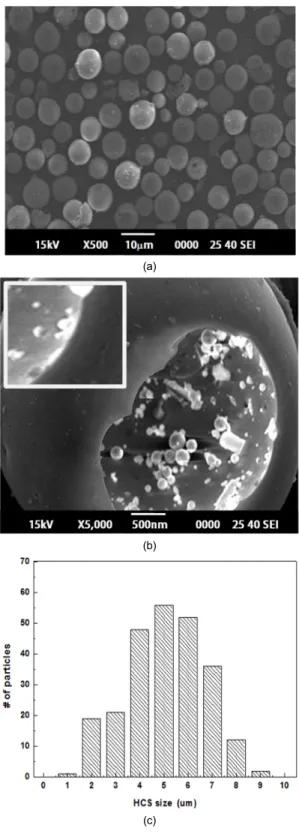
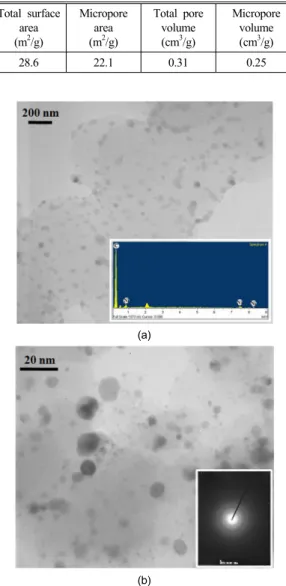
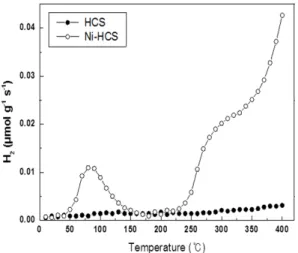
Abstract >> A glucose hydrothermal method is described for preparing hollow carbon spheres (HCS), which have a regular morphology and a high Brunauer-Emmett-Teller surface area of 28.6 m2/g. Scanning electron microscopy shows that they have thin shells and diameter between 2 and 8 μm. The HCSs were modified for the enhanced room temperature hydrogen storage by employing Ni nanoparticles on their surface. The Ni-decorated HCSs were characterized by X-ray diffraction, transmission electron microscopy coupled with an energy dispersive spectroscope, and an inductively coupled plasma spectrometer, indicating that fine and well-distributed Ni nanoparticles can be accomplished on the HCSs. The hydrogen uptake capacity in HCSs with and without Ni loading was evaluated using a high-pressure microbalance at room temperature under a hydrogen pressure upto 9 MPa. As much as 1.23wt.% of hydrogen can be stored when uniformly distributed Ni nanoparticles are formed on the HCSs, while the hydrogen uptake capacity of as-received HCSs was 0.41 wt.%. For Ni nanoparticle-loaded HCSs, hydrogen molecules could be easily dissociated into atomic hydrogen and then chemically adsorbed by the sorbents, leading to an enhanced capacity for storing hydrogen.
Key words : Hollow carbon spheres, Hydrogen storage, Glucose, Ni impregnation, Hydrothermal synthesis, Spillover effect
†